Small Cap Value Report (13 Aug 2015) - QRT, SDM, CNIC

Good morning!
Quarto Inc (LON:QRT)
Share price: 210p (down 10.6% today)
No. shares: 19.7m
Market cap: £41.4m
I last reported on this "leading global illustrated book publisher and distribution group" on 9 Feb 2015 on renewal of the company's bank facilities.
Prior to that, I reported on 2 Feb 2015 covering the 2014 trading update. Those two articles are still relevant, so I won't repeat all the same detail below.
Interim results to 30 Jun 2015 - Quarto has made nearly all its profit in H2 in recent years, so the interims are not a good guide to full year performance. Accordingly today's fall in adjusted operating profit from $0.6m to $0.2m is not of enormous concern, although it would have been better to see profits improving.
Last year it made $0.6m adjusted operating profit in H1, and $14.8m in H2, so it's a very heavily H2-weighted seasonal trading pattern, which I presume is due to its illustrated books being popular items for gifts at Christmas.
Therefore it's a waste of time further analysing H1 trading, and more important to focus on the outlook comments for H2, which say;
We fully anticipate Quarto will have a strong second half of the year with good order book visibility. Quarto will develop further as a business in 2015 and continue to expand our reach in channel, territory and format. We are well-positioned, as we have shown in recent years, to grow organically, capitalising on our strengths, making long-lasting, information-rich books and selling them in as many languages and channels as possible. We also intend to develop the business by making suitable acquisitions, as we have done, that are complementary to our existing businesses and provide financial and operational synergies, taking advantage of opportunities that support the long-term growth of our business around the world.
That sounds pretty emphatic to me, and the positive comments are backed up with "good order book visibility", meaning that it's more than just hoping H2 will be strong.
Valuation - the valuation graphics look very appealing, as do the quality scores too, so this initially looks a very good value share. Bear in mind that the graphics are based on last night's closing price, so with the shares down 10.6% today, the PER will now be nearer 6 than 7, and the dividend yield will have risen to about 3.4%.
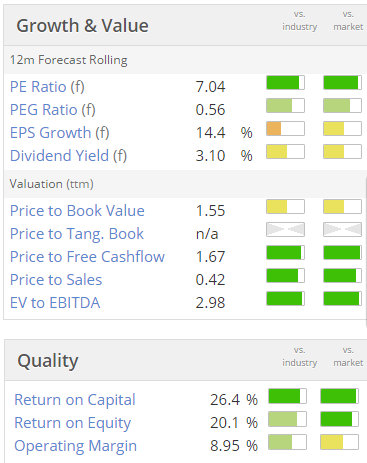
Dividends - the interim divi this time has again been held at 3.35p (as in other recent years), with comments that the final divi will be more heavily weighted than usual compared with H1, to reflect the seasonality of trading.
Balance sheet - as I've commented before, this is where it all goes wrong. The main issue is that Quarto has way too much debt on its balance sheet, so let's focus on that.
Bank debt - net debt at 30 Jun 2015 is reported at $81.0m (only $0.5m lower than a year earlier). Note that the 31 Dec year end seems to be a seasonal low for net debt, at $66.0m on 31 Dec 2014, which shows how relying on year end Enterprise Value can be dangerous - as you might well be calculating the valuation of the business on an artificially low net debt figure, thus over-valuing the business.
So at £1 = $1.56, the net debt converts to £51.9m, which is more than the market cap of £41.4m. This drastically affects how we should value the company. If you were to reduce net debt to a modest amount of, say 1 year's profits, then that would mean you would need to do an equity fundraising at the current share price which resulted in the number of shares in issue being doubled.
That would almost halve EPS (I say almost, because interest costs would greatly reduce if debt were mostly repaid, thus partially offsetting the increased number of shares in issue, in its effect on EPS). Therefore overall, if enough equity were raised to fix the balance sheet, then the PER would rise from around 6-7, to about 11-12, which looks about the right price for this type of business.
So my point is that the high level of debt makes this share look apparently cheap, but when you theoretically strengthen the balance sheet to a point where it would be a safe investment, then the PER is no longer cheap.
I suspect that an equity fundraising here is likely to happen at some point, and is long overdue in my opinion.
EBITDA & bank covenants - the company very helpfully publishes its bank covenants (I wish all companies would do this), and the current scores, in note 8 to today's accounts. This shows (see below) that the company is operating within its bank covenants, and has some headroom (although not enough to be really comfortable), and bear in mind this is when interest rates are at historic lows.
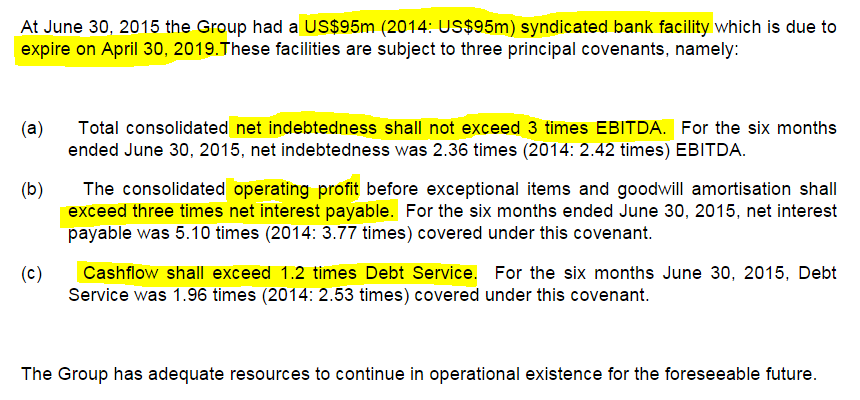
It's good that the banks renewed the facility, so there's no panic on that front, as the facilities run to Apr 2019.
However, what really concerns me is that the banks rely on an EBITDA covenant, listed as (a) above. The problem with this, is that Quarto's EBITDA number is a red herring. They have a large amount of costs going onto the balance sheet into "intangible costs - pre-publication costs", which is the biggest asset item on the debit side of the balance sheet, at $57.5m.
This seems to be fed into the P&L quite quickly, over about two years, so there was a massive $30.9m amortisation charge for these costs in calendar 2014 for example. The impact of this is that pre-publication costs are being deferred for about two years, using this capitalisation and amortisation method. That might be a reasonable accounting treatment, but you cannot ignore an amortisation charge that is spreading real business operating costs over just two years - this is why EBITDA is utterly meaningless at this company. Yet the worry is, EBITDA is the kingpin supporting the bank debt. The bank are working on that basis that this is a hugely cash generative business, making gigantic EBITDA. But actually, it's not.
The risk is therefore that the bank at some point recognises that relying on EBITDA is not sensible, and potentially moves the goalposts, requiring a lot of the debt to be repaid. That would then need a dilutive equity fundraising. I'm not saying that is going to happen, but it is a big risk here for investors.
What the company should be doing, in my view, is paying down bank debt as a top priority, and that would mean cancelling divis for the foreseeable future. That's what I'd do anyway. Highly indebted companies with stretched balance sheets, really should not be paying any divis at all, it's much too risky. Banks may be relaxed at the moment, but you cannot rely on that always being the case.
My opinion - it's far too risky for me to consider investing anything here. Net tangible assets are negative, and there's way too much bank debt, which relies on an EBITDA covenant which looks inappropriate to me.
On the other hand, at the moment the market is paying little attention to weak balance sheets, and seems to be assuming that interest rates will remain low forever. That's fine in the good times, but if & when something goes wrong, then a weak balance sheet is a curse, and can quickly destroy investor returns.
I'm surprised that the StockRanks gives a very high score of 97 to Quarto, but the system seems to more-or-less ignore balance sheet weakness, high debt (and pension deficits - as we've seen with Wincanton (LON:WIN) ), which I think could emerge as a flaw in the system when credit conditions tighten & interest rates rise. For the time being though, it's working brilliantly!
Although I think we might need two StockRank systems - the current one to use in benign economic & stock market conditions, and a much tougher one (emphasising balance sheet strength) to protect the downside in more bearish conditions.
Or people can just do what I do - using StockRanks to give me a shortlist, and then manually weed out the dodgy overseas AIM companies, and the companies with unacceptably weak balance sheets. All food for thought & discussion!
Stadium (LON:SDM)
Update re Open Offer - I was really pleased to see that Stadium included an Open Offer element within its recent fundraising - i.e. they gave existing shareholders (including private investors) the opportunity to buy some discounted shares at the same price & time as the Institutional Placing. Bravo!
In my view, companies should always include an Open Offer with Placings, as it can often be done relatively cheaply. and companies have a moral duty to allow existing shareholders to participate too, rather than being diluted through (often repeated) Placings.
After all, the principle of pre-emption rights for existing shareholders is a core principle in UK company law, and Placings by-pass that crucial point. This does not reflect well on a company and its advisers, if existing holders see their interests harmed by repeated discounted Placings, which is common with smaller, loss-making companies especially.
Stadium saw strong demand from its existing shareholders, with 1.577m shares being applied for, out of just under 944k available. So a successful fundraising. I think the Open Offer element should have been larger.
The danger with including a very small Open Offer alongside a Placing, is that it looks little more than a fig-leaf, or token gesture. In an ideal world, I'd like to see Open Offers be the same size as the Placing, where a discounted price is being offered.
CentralNic (LON:CNIC)
Share price movement - I don't know what to make of this statement, would any readers care to comment? Sounds potentially interesting.
The Board of CentralNic plc, (AIM:CNIC), the internet platform business which derives revenues from the global sale of domain names, believes that the recent movement in the Company's share price is related to media comment surrounding the recent announcement by Google to adopt the suffix .xyz for use by its new identity "Alphabet", the principal website of which will be abc.xyz. CentralNic is the exclusive global wholesaler for .xyz, receiving a share of revenues for all .xyz domains registered.
The Board wishes to make it clear that although the recent announcement by Google was very positive, the growing interest in .xyz was expected as awareness and usage of .xyz and CentralNic's other new Top-Level Domains continues to expand.The Company continues to trade in line with market expectations for the current year to 31st December 2015.
The shares are up 26% to 61p at the time of writing.
I don't know enough about the company to decide whether it's worth looking at or not. Have any readers looked at this one?
That's all for today!
Regards, Paul.
(of the companies mentioned today, Paul has no long or short positions.
A fund management company with which Paul is associated may hold positions in companies mentioned.
NB. These reports are Paul's personal opinions only)
Disclaimer
This is not financial advice. Our content is intended to be used and must be used for information and education purposes only. Please read our disclaimer and terms and conditions to understand our obligations.

16 comments
Another thought! Maybe we can ask Ed to create a Paul Scott "Bargepole" short screen, picking up some of the balance sheet weaknesses that can be quantified and put into a screen. And even if he does I'll still be reading your column because there are is always more information in the fine print that can easily get missed in the headline numbers.
I'm not so sure we need to worry about a return to interest rate normality. We've been waiting for a return to normal interest rates for a few years now and almost nothing has happened. Can the central banks really return interest rates to normal without causing another crash? It's a bit like any bubble. Once the bubble has formed, pricking it will bring a big explosion. It always feels safer to avoid the bang by keeping on pumping in more air.
As always thanks
Julian
An interesting question is why Quarto has debt given that it's basic operating model should generate positive cash - that is the beauty of the co-edition model, you are only making books that will definitely sell and make a profit. Over many, many years Quarto has acquired a string of imprints financed almost entirely by debt, the shares are quite tightly held with a non- trivial % owned by the companies founders - that may explain the dividend policy and the oversize gearing. The core legacy problem appears to be that most acquisitions have not generated value or noticeably improved cashflow. Turnover has risen slowly and over 10 years has roughly doubled, but earnings have been much more uneven. This company also has a long track record of "exceptional adjustments" meaning reported figures can be quite opaque. In fairness the current management team seem to be making a decent fist of improving operating metrics but in balance sheet terms the old adage about " I would not start from here if I were you" definitely applies.
Thanks Paul
I hope this post makes some sense. I've been sitting at Gatwick airport for this last - ell it feels like the last few years. Flight is delayed due to thunderstorms this morning.
On balance sheet risk:
* the danger signs on Quarto are obvious in the stock report - Altman Z-score at close to distress level and net gearing at 141%
* it does seem strange that these obvious risks are not reflected in the stock ranks. I'd be happier with a stock rank system that reflected these risks. Maybe we can suggest this in the feedback and requests slot
* and sometimes it seems to work the other way round. I've seen stock reports with Altman Z-scores at distress levels even though the company had no debt and buckets full of cash.
Well no system is perfect. And this one is pretty good. So it makes sense that we need to do some work too.
Thanks again for illuminating analysis.
Hi JulianH,
I agree that the Altman Z-score isn't much use. I've found its scores are rather erratic, and so I prefer to check the amount of, and terms of the debt position myself. Plus checking the balance sheet myself, in the context of a business's cash generation & outlook, is a critical part of my own due diligence.
That said, as no doubt Ed would say, the Altman Z-score is mathematically proven, to screen out nearly all companies which go bust in the next 12 months.
Another key point, is that near-zero interest rates are creating an artificial environment, where banks are happy to allow zombie companies to continue trading, as by charging them say 5% interest pa. but having a near-zero cost of funds, the banks are effectively seeing 4%+ of bad debts being recovered each year. So they're happy to run with that situation forever, and get back money that they otherwise would have lost. That's one of the main reasons for continued near-0% interest rates - it allows the banks to rebuild their balance sheets by diverting the interest receipts that savers would have got, onto banks balance sheets instead!
Therefore I feel that any system which does well in this environment will need a radical re-jig once interest rates normalise, as it could well be allowing far too much risk through inadvertently, in a benign environment. There's a good case for making hay whilst the sun shines, but I'm just flagging up balance sheet risk that will, at some point, resurface with a vengeance!
Regards, Paul.
Hi Paul,
there is plenty of analysis done for CentralNic CentralNic (LON:CNIC) over at the TMF by GHF as pesquera noted above:
http://boards.fool.co.uk/share-idea-8211-cnic-centralnic-13251940.aspx?sort=postdate
and also By Martin
http://www.privatepunter.co.uk/News/more-on-cnic-13-august-2015
One definitely worthy of research - In the high risk high reward category though
Edit: and if you Search Twitter for CentralNic - its had plenty of coverage today to
Hi Paul
great analysis as always. Re. your question about CentralNIC, my opinion is that the Google announcement is a distraction and doesn't affect (either positively or negatively) the potential revenues and profits that CentralNIC might generate.
Domain registration companies look, from the outside, like they print their own money. Customers have to pay for .co.uk, .com, and other extensions in order to maintain their internet presence. In theory, every time a new extension (like .xyz) is created to provide additional capacity, customers would then have to pay additional fees to preserve and protect their internet identity.
However, it doesn't actually work like that, as distribution and registration is a business with pretty low barriers to entry, and the wider governance (largely open source/liberatarian) over the internet domain hierarchy means that even if new internet "real estate" is created, the price of the estate will tend to go down in proportion.
This kind of business is actually more like a regulated utility like National Grid than a digital/web business, in my opinion, and should be valued on a similar basis.
I'm ambivalent about whether its a good investment right now. The forecasts all look rosy, and the balance sheet isn't too bad (given that it has raised a lot of capital in the last couple of years). However, its a bit on the small side for me and I'm not convinced management are running it for the benefit of shareholders...
There's an excellent write-up on CNIC in your very own pub!
http://boards.fool.co.uk/share-idea-8211-cnic-centralnic-13251940.aspx?sort=postdate
Wow, fantastic analysis today Paul on Quarto Inc (LON:QRT). Thanks for sharing your insights as always.
What I think is interesting to point out is that Quarto Inc (LON:QRT) is a favourite of Lord John Lee (I have heard him speak about the company more than once in the last year or so). He's normally one for pretty strong balance sheets, so QRT is an unusual pick for him given its undeniably weak balance sheet.
Francis
Thanks Francis!
I spoke to Lord Lee about Quarto Inc (LON:QRT) a while ago, and his view is that the company has considerable intangible, but real value in the book catalogue. So he sees them as annuities which churn out profit for long periods. Therefore he seemed to consider the bank debt as acceptable, which surprised me too.
Regards, Paul.
To be fair,if you were to make an open offer large enough to completely satisfy demand from existing shareholders,wouldn't that reduce demand in the aftermarket ? If it did - even temporarily - that might cause the share price to weaken - upsetting shareholders who had just bought in the open offer even more !
Hi Paul
Thanks for a very interesting take on Quarto , it makes me wonder how many other companies have undisclosed debt covenants that are based on a flawed understanding of the key drivers of the business concerned.
The only reason I ask is that I ran a business for a while where our lead bankers spent ages trying to get their heads around how to apply inappropriate covenants that they were used to using in other superficially similar circumstances. In so doing they ended up taking a much larger risk than I would have done in their shoes and doing so obliviously!
Every time we had a facility review the same credit analyst would attend and miss the wood for the trees in exactly the same way as in prior reviews , Quarto looks very similar and we are only discussing it as you've picked up on it and they've followed best practice by disclosing in detail their covenants.
Cheers
Hi rhomboid1,
Brilliantly put! I totally agree. EBITDA-based covenants are currently fashionable with banks, but as you say, they can be completely inappropriate for some businesses, whilst being a good proxy for cashflow at other businesses. Yet some banks seem oblivious to this, and as you correctly state, are taking on much more risk than they realise. That's certainly my view of the banking position at Quarto Inc (LON:QRT) , and is a large risk which is currently dormant, but who knows what might happen in future?
I don't see the point in taking that risk, when the business isn't even particularly appealing.
Regards, Paul.
' surprised that the StockRanks gives a very high score of 97 to Quarto, but the system seems to more-or-less ignore balance sheet weakness, high debt (and pension deficits
OKAY SO WE NEED TO REVISIT THE WAY THE QUALITY RANKING IS MADE AND MAKE SURE THAT ANY REVISION FEEDS PROPERLY INTO THE OVERALL STOCKRANK..
Hi Paul
Re. Quarto Inc (LON:QRT). I really like the way you look at high net debt and consider the impact on the financials if the debt were to be reduced to acceptable levels.
Your para. however lacks details. When you say "1 year's profits", is this OP?, PTP? or NP?
If it is Net Profit then your assumption of 1x Net Profit looks on the conservative side. My own rule of thumb is a max of 3.5x OP (borrowed from the Naked Trader). So a target 2x OP would be reasonable to me.
Regards, Ram
Hi Ramridge,
Re Quarto Inc (LON:QRT) , I was only trying to give a rough idea of how a more stable balance sheet might look, and demonstrate the point that the PER would then be much higher. It doesn't need to be worked out precisely to get the point across.
I would much rather invest in Bloomsbury Publishing (LON:BMY) for example, which actually has net cash, but is on a PER of 11.8. That seems to me a much better risk:reward play than the superficially cheap, but heavily indebted Quarto Inc (LON:QRT) .
Although I take your point that you would be happy with net debt of say 2x operating profit, which is fine - whatever suits you - there's no one correct answer!
Regards, Paul.
Bloomsbury has excellent figures,but I'd guess that the Harry Potter money would start to tail off.