Small Cap Value Report (14 Apr 2015) - PRV, AN., FLO, MANX

Good morning! Today's report is a bit earlier than usual, as I have to be in Reading by noon, for an investor lunch. It's certainly going to be a busy fortnight - on Saturday there is the UK Investor Show, and I'm delighted to have been asked to appear on a small caps/value investing panel with Nigel Wray and Paul Jourdan of Amati. So it's quite something for a humble blogger to be sitting alongside such high profile investors!
Then next week, on Thu & Fri, it's the latest Mello event - where I've been asked to do a talk on Balance Sheets, and I'll also be doing a session explaining in more detail the dangers of spread betting - and what specifically went (disastrously) wrong for me in 2008, which I've mentioned here (and elsewhere) many times before. I think it's important to be open about, and learn from, one's mistakes, as well as the successes, as hopefully other people are then forewarned about what can go wrong once gearing is involved.
My feeling is that with this bull market now looking long in the tooth, and with plenty of over-valuation around, there's an increasing likelihood of another big shock to the system at some point - so hopefully my warnings might help one or two people avoid over-extending themselves in the good times?
Porvair (LON:PRV)
Share price: 303p
No. shares: 44.8m
Market Cap: £135.7m
Trading update - this specialist filters company is just over a third of the way through its current financial year, ending 30 Nov 2015.
I feel the company has managed investor expectations well, in that it has been open about last year's results including some large one-off contracts, which won't recur. Therefore investors were prepared for softer figures this year, and hence have not gone into a panic about that.
Today's statement says;
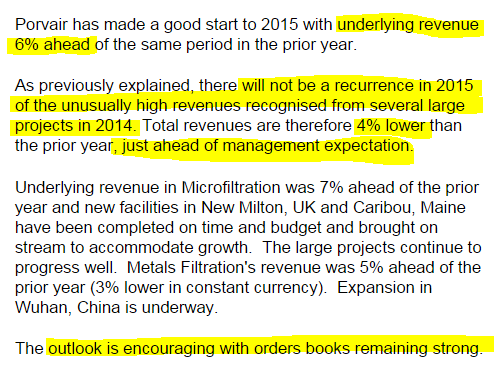
I think it's stretching credibility somewhat to strip out the big contacts from last year, and then say that "underlying revenue" is 6% ahead, whilst then saying in the next paragraph that it's actually 4% lower.
There's no mention of whether profitability is in line with expectations or not, but I suppose that since revenues are "just ahead of management expectation" then it's reasonable to assume that profits should be in line with expectations.
The outlook sounds solid too, so there's nothing to panic about here.
My opinion - this share has looked fully valued for some time, and that remains the case - note that it looks fairly pricey on all valuation metrics;
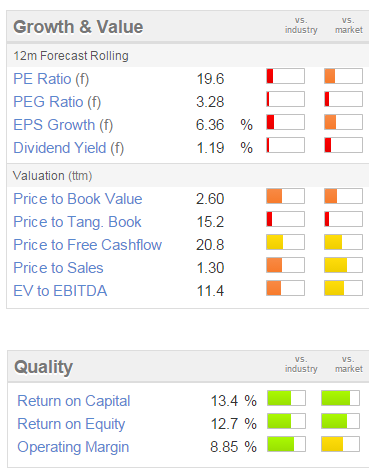
Earnings growth since 2009 was very good, but appears to be tailing off now. Therefore I question whether a PER of nearly 20 is still appropriate? Personally, I'd be looking for much stronger growth if I was paying that kind of price. There again, maybe bulls think it can exceed broker forecasts? Personally I'd only be interested at a PER of say 12-14, so more like 200p per share, than 303p per share.
Alternative Networks (LON:AN.)
Share price: 462p
No. shares: 48.4m
Market Cap: £223.6m
Trading update - for the half year ended 31 Mar 2015. There is a lot of detail given, but the key bit says;

My opinion - the company seems decently profitable, but I've had a quick look at their last Balance Sheet, and it fails my simple tests - with a weak current ratio, and negative net tangible assets.
Given that the company is decently cash generative, then the weak balance sheet probably isn't the end of the world really, but it puts me off. The divis aren't bad though, with a forecast yield of 3.77%.
Flowtech Fluidpower (LON:FLO)
Share price: 123p (down 3.2% today)
No. shares: 42.8m
Market Cap: £52.6m
Final results - for calendar 2014 - these being maiden results for this group in its current form, which listed on AIM in May 2014. It is a distributor of technical fluid power products - e.g. pneumatics, hydraulics, hoses, etc.
The figures look good, with turnover up 17.7% to £37.8m, and underlying operating profit up 15.4% to £6,146k. That's a very high operating profit margin of 16.3%, and my initial reaction is that such a high margin is unlikely to be sustainable for a distributor. Normally distributors only make a very low margin, in low to middle single digits, in my experience.
Pro forma EPS came in at 11.65p, so the PER looks about right, at 10.6. Distributors generally don't command high ratings, as they are only shifting other peoples' products, with little to no IP of their own.
Balance sheet - looks sound to me. The current ratio is very solid at 2.09, and long term liabilities are reasonable at £6.6m, which is only slightly more than one year's underlying profit.
Dividends - the company paid an interim divi of 1.67p, and has declared 3.33p final divi, so 5.0p for the full year. That's a healthy yield of 4.1%.
Outlook - this is where it starts to go wrong a bit, with exposure to both the oil & gas sector, and exporters to the Eurozone, both currently having problems;
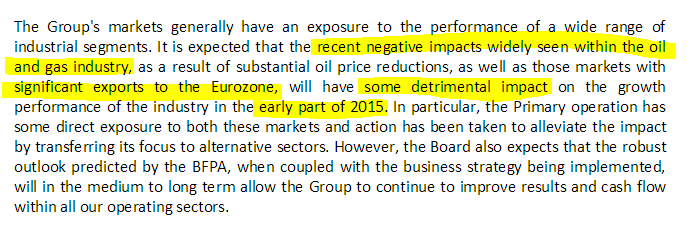
My opinion - overall, I think it's probably best for me to steer clear of this one. The comapny does have scope to do more acquisitions, so they may be able to offset the problem sectors buy bolting on acquisitions.
You also always have to consider why the previous owner wants to sell, with any recent IPO. Have they foreseen softer market conditions? Do they doubt the growth potential perhaps? Above all, have they taken advantage of a favourable exit price in a buoyant IPO market?
Manx Telecom (LON:MANX)
Share price: 185p
No. shares: 113.0m
Market Cap: £209.1m
Full year results - for calendar 2014. This company operates telecoms services on the Isle of Man, so presumably has a monopoly or near monopoly, which for starters makes me very wary of investing - there's too high a risk of a regulator dropping a bombshell by allowing in competition, or capping prices. I don't generally invest in any regulated industries.
Dividends - the only reason to buy these shares is for the divis. The total divis relating to 2014 are 9.9p, which gives a decent yield of 5.4%.
Balance sheet - this is weak. The company has net tangible assets of only £3.5m. Also it is carrying a lot of debt - which was £53.7m at the year end. The company says this is about 2 times EBITDA, but there is an ongoing capex requirement, which EBITDA ignores.
Growth - where's the growth going to come from? Surely this is a mature business? Although I note from the revenue table that one section (highlighted) is showing strong growth;
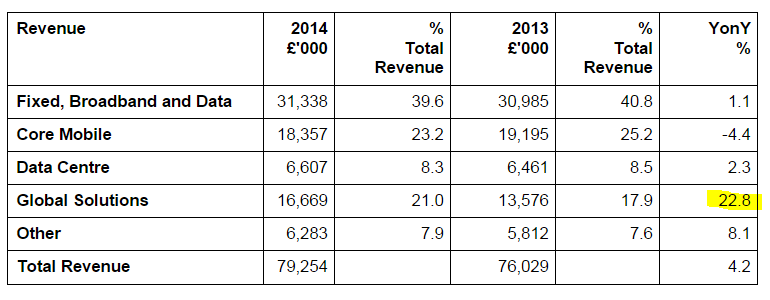
My opinion - I don't like it, for the reasons given above - lack of growth, too much debt, weak balance sheet, and operating a local monopoly.
It would also be worth checking the pension fund position. It is shown as an asset of £2.2m on the balance sheet, but the cashflow statement shows a £2.1m cash outflow.
In my view it can be a mistake to chase very high dividend yields. I'd rather have a somewhat lower divi, but from a company which is financially strong, and has good growth prospects. That can end up giving you a better long term return, than chasing a very high divi yield from a mature, or even declining company.
Right, gotta dash, see you tomorrow as usual!
Regards, Paul.
(of the companies mentioned today, Paul has no long or short positions. A fund management company with which Paul is associated may hold positions in companies mentioned)
Disclaimer
This is not financial advice. Our content is intended to be used and must be used for information and education purposes only. Please read our disclaimer and terms and conditions to understand our obligations.

12 comments
From today's Q1/15 update from Hunting:
"During Q1 2015 market conditions across the oil and gas sector continued to be volatile, with global rig counts continuing to decrease, particularly in North America where data indicates a 46% decline since the start of the year. WTI oil prices averaged $49 per barrel during the first quarter of 2015, and capital expenditures across the industry have continued to reduce or be placed on review. This market environment has resulted in operating profits across Hunting's business being approximately 60% lower during Q1 2015 compared to Q1 2014."
If extrapolated over FY15, a 60% fall in operating profits would probably mean no nett profit at all in 2015.
http://www.investegate.co.uk/hunting-plc--htg-/rns/agm-and-q1-2015-trading-statement/201504150700112042K/
Top job Jane. Hunting (LON:HTG) and Amec Foster Wheeler (LON:AMFW) are big enough to weather the storms and may even be seen as takeover targets for their assets. However they are far too expensive now. I would like to see the former at sub 400 again, possibly 335 or so, and the latter at around 620. Those number mean the forcasts and figures add up to long term value. We must be patient (and probably disappointed).
This was from Hunting's last annual results:
"Over the last few years, a quiet revolution in North America has taken place which has reshaped the supply of hydrocarbons. Hydraulic fracturing (fracking) initially transformed the US natural gas market from a concerning deficit to an exportable abundance. Further advances in fracking and horizontal drilling have now made a positive impact on US oil production and coupled with global supplies, have created a temporary imbalance to the world's supply/demand curve.
Accordingly, oil prices have declined dramatically, and the global oil and gas industry is quickly resetting its expenditure and profitability expectations. Rig counts continue to decline each week with varying estimates of future levels. Operators initially set modest targets of contraction, but have escalated those reductions depending on their geographic focus, debt position and cost structure.
This rapid decline in industry expenditure and activity will inevitably feed through to our revenue and profitability levels for 2015. Depending on the geographic location and product description, profit levels will vary. North America onshore activity will be the most affected and will be the target region for most of Hunting's initial cost actions including, headcount reduction, hiring and salary freezes and capital investment constraints. Since year end, approximately 500 employees or 13% of the Group's global workforce have been affected. The offshore Gulf of Mexico, primarily deep water drilling and production, will have modest changes in rig count and expenditure.
Internationally, we expect the Middle East and Asia Pacific to remain at activity levels seen in 2014 however, tubular margins will decline. Canada and the North Sea has and will continue to experience contraction in rig counts and activity at varying levels dependent upon the individual operator's cost points.
Despite the subdued consensus for the short term oil market, Hunting remains confident in the long term fundamentals for oil and gas demand. Our capital investment programme for additional and more efficient capacity will be completed throughout 2015 with a strong belief in preparedness for the eventual recovery. Our balance sheet remains solid with modest levels of net debt. Our unique products, global footprint, flexible manufacturing capacity and experienced personnel will enable us to manage the downturn yet capture opportunities which often appear in cyclical environments.
We do not know the length or depth of the industry contraction. We will however endeavour to provide updates more often than required regarding the activity and developments we see in the markets and clients we serve. Your Company has an excellent team of experienced managers to respond quickly during this period and react to the changing developments of individual clients, commodity prices, geopolitical influences and financial requirements. They remain committed to improving further the Company's Health, Safety and Environment record. They will introduce new products that will aid in reducing customer costs for oil and gas extraction. And finally, they will be mindful of shareholder value and the need to operate as if Hunting were their personal company. "
That is a very cautious outlook statement with next to nothing in the way of profit guidance for the current year.
Hunting is also a manufacturer of equipment for the N. America fracking market and so might well be exposed to a serious downturn there, beyond the effect on oil services as such.
Imo, it was worth buying at around 430p. Now, it wouldn't be on my buy list at 570p, except as a potential takeover candidate.
All IMHO, DYOR.
Just a reminder that the Mello Workshop event where Paul is appearing in three workshops and also on the MasterClass panel with Ed Croft is next week on Thursday and Friday and the full programme including the company presentations has just been released under the Mello workshops tab here....
http://melloevents.com/mello-workshop/
We are rapidly selling out to our full capacity for the Thursday in particular so do please book as quickly as you can and tickets can be booked online at the website. The hotel is completely sold out on the Thursday evening when we have a wonderful dinner planned with Gervais Williams speaking to the 150 dinner guests and also Clarke Carlisle the ex PFA chairman.
We have a great two day event lined up so do come and join us but please book quickly and start selecting which of the fifty workshops you want to attend. http://melloevents.com/mello-workshop/
David
Ah, beginner, but when tings are looking "dodgy" is it not the time to start to dig around for value?
True, some stocks (arguably NBI) still look a bit pricey but there are pockets of value starting to appear - looking at a longer term value basis. PFC looks vulnerable with the debt it carries but AMFW on the other hand looks a lot more interesting at current levels, especially with the benefits to come from improving Foster Wheeler and intergration savings. There will also, IMO, be a rise in strategic M&A as long term bigger players take advantage of depressed prices and sentiment to acquire companies, especially if they can fund it from cash or ultra low rate debt.
With the PE of cash so high at present, using it to acquire other companies is going to be EPS enhancing, even before cost savings etc. Which is why, of course, we are now seeing a rising tide of deals, not just in the O&G space.
You are quite right DJ. I actually like Hunting (LON:HTG) , as there is comparatively little debt, and some good longer term contracts in place. I simply lack the brave gene!
Oops that will teach me to skim read your reports! My full attention from now on.
Paul, tha comments from Flowtech (FLO) you highlight are in line with comments today from Northbridge (NBI):
"Capital investment in the oil and gas industry as a whole has seen a noticeable reduction in almost all areas of operation and recent M & A activity amongst the majors will lead to further consolidation in a sector which includes many of our key customers. Underlying demand for our goods and service will take some time to stabilise and, as current contracts unwind, replacement contracts are likely to be harder to secure."
Imo, food for thought for oil services stocks.
Agree with your points Jane, and don't think we've reached the bottom with oil services stocks. Am surprised Northbridge Industrial Services (LON:NBI) is still on a relatively high PER, given the wobbly outlook statement. Projected EPS for 2015 is 35.6p, and given they missed EPS for 2014 I can't see how this is realistic. I think a lot of oil services stocks could still fall further.
Oil services stocks in general, especialy Petrofac (LON:PFC) and Hunting (LON:HTG) , have become a trader's dream, but with all the uncertainty in the field I cannot see them as a viable long-term investments currently. As Jane has said elsewhere, there are also implications for Pressure Technologies (LON:PRES) . Competition for contracts will become cutthroat. Tenders will be pitched too low, and profits will be slashed for a considerable number of years. Mergers and takeovers may occur, but some companies will also take minor works in-house. This is a very uncertain time.
To be fair to Porvair they have been pretty consistent in explaining the 'one-off' nature of a number of large contracts, & their exceptional impact on profits last year.
Hi Darktrade,
Absolutely, which is exactly what I said in the second paragraph of the section on Porvair (LON:PRV) !
The company has indeed managed investor expectations well by flagging up the issue of non-repeating large contracts well in advance.
Regards, Paul.