Small Cap Value Report (14 Mar 2017) - GYM, BLTG, BUR, FCCN

GYM (LON:GYM)
Share price: 183.9p (+2%)
No. shares: 128m
Market cap: £236m
(Edit: Please note that after initially publishing this note, I bought some shares in GYM. I now have a long position in this company).
Nice progress at The Gym, with the growth strategy being executed as planned.
To quickly summarise what it's doing: The Gym is pioneering the low-cost gym model with 24 hour opening times, a skeleton staff structure, no long-term customer contracts, and much cheaper prices than the conventional gym chains.
Today's statement mentions that one third of joiners are new to gym membership, which bodes well for discount chains growing the market and not just taking share from the competition (although they also mention that the largest number of new joiners come from traditional higher cost gyms).
The adjusted profit before tax for the year was £8.7 million and customer numbers grew by 19% to 448,000, as had already been revealed in the trading statement I covered here in January.
According to the CEO, "the way our new sites mature over time remains predictable", and this can be seen seen in the EBITDA per mature site, which is almost flat year-on-year despite the growth of the estate.
They also claim to have a "known and predictable cost base", in contrast to other leisure businesses and indeed the EBITDA margin on mature sites is fairly stable year-on-year (up to 47.5% from 46.3%).
Outlook
The new financial year has started well and in line with the Board's expectations. January and February are the two most significant trading months of the year for any gym business. Membership numbers at the end of February had increased to 495,000, a record level, with a 10.5% increase since December 2016. This level of member growth will help to underpin our performance for the rest of the year.
In 2017 we anticipate opening towards the top end of the guidance range of 15 to 20 sites. As in 2016, these site openings will be weighted to the second half of the year, with six sites expected to be open in the first half of the year.
Financial Results
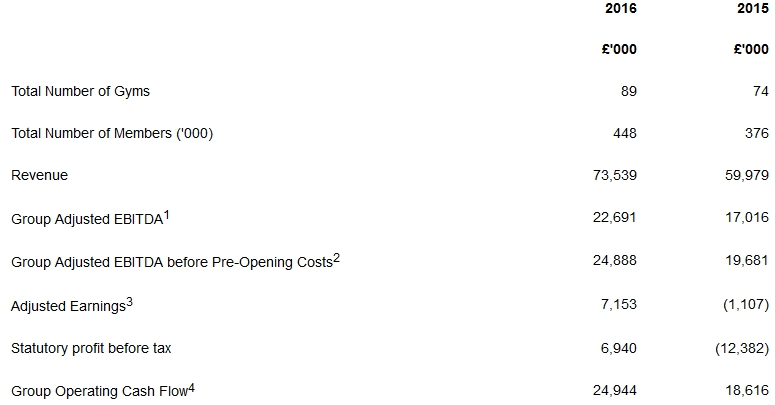
I'm sure some folks will be looking at this on a PE ratio basis, but for something which is rolling out across the country, it really needs to be looked at from a growth runway point of view - how big might it be in 5 years? For how many years could it open 15-20 new gyms annually? The mature valuation is what counts.
Dividend: Not very important at this stage but .75p is declared so that 1p will have been paid for the full year. A progressive dividend policy is intended.
Cash flow: A really interesting cash flow breakdown is included. The company has broken down its maintenance and expansionary capex, to illustrate the cost of its growth strategy and the cash generation of existing sites:
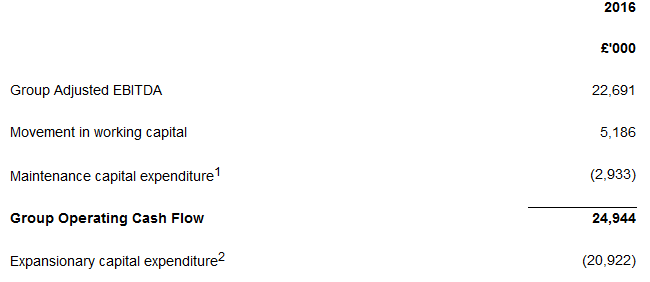
The consolidated cash flow statement shows £26 million in net cash flow from operating activities, not far off the £25 million Group operating cash flow shown above. So it looks like there are serious arguments to be made that the company is already in a very healthy cash generative state.
My opinion: To put it simply, I think that this is one of the more interesting growth stocks in the UK at the moment.
Blancco Technology (LON:BLTG)
Share price: 241p (-22%)
No. shares: 58.2m
Market cap: £140m
This is not a company I've studied recently, as I thought the remuneration policies and corporate governance situation at Regernesis (as it was formerly known) were questionable, and that management were at least as interested in promoting the share price as they were in developing it into a sustainable business.
Through various corporate maneuvers, most of its value is now driven by the data erasure activities of Blancco - which it purchased in 2014 for £60 million.
Regenersis was primarily a mobile phone repair outfit. At the time, Regenersis said that Blancco would provide "a new way to leverage the Regenersis global sales team and its relationships with major global mobile operators and OEMs", and "a one stop solution to Regenersis' existing repair clients."
By early 2016, that strategy had gone up in smoke as the repair business was completely sold. The company had decided to become a pure play software business, and that was that.
But the shareholder base and management team are evolving, and readers have requested that I take a look at this today, so I'm happy to make a few comments on the latest news.
Adjusted Profit
I see that the company is still making a great number of adjustments to its statutory numbers. Unfortunately, this is what happens when investment bankers run businesses. There are seven adjustments, plus their tax effect, which turn a statutory loss of £2.1 million into an adjusted profit of £2.2 million. Previously, Regernesis called this the "Headline Operating Profit".
Adjustments for this year include £1 million in share based payments, which are said to have rewarded participants "for growth in the value of the company", i.e. the share price went up.
My opinion
I'm afraid I still can't take this company seriously.
Of course, it's possible that I'm missing something, and there is a real investment opportunity here. Revenues have grown to £14 million for the six month period, and I see revenues forecast by brokers of £32 million for this full financial year.
Putting it in the best possible light, you could argue that there was nearly £7 million in adjusted operating cash flow (before working capital and before exceptionals), and that this cash flow is set to grow with increased sales in the years ahead.
Maybe if the market cap was closer to what was paid for Blancco in 2014, and especially if management could stop playing with the numbers, it's something I could start to look at with an open mind.
Addendum: There is a useful discussion around the sudden departure of Blancco's CFO on another Stockopedia thread at this link.
Burford Capital (LON:BUR)
Share price: 752.5p (+3%)
No. shares: 208m
Market cap: £1,567m
This is a bit bigger than our mandate at SCVR, but I'll take a look at it by popular demand.
Burford claims to be "the world's largest publicly traded provider of litigation finance".
The financial highlights are excellent:
- 75% increase in net profit after tax to $115.1 million (2015: $65.7 million) and 61% increase in operating profit to $124.4 million (2015: $77.2 million), contributing to a 21.1% ROE
- Income increased by 59% to a record $163.4 million (2015: $103.0 million), driven by 60% increase in income from litigation-related investments to $140.2 million (2015: $87.9 million)
- Strong organic cash generation, with record investment recoveries of $216 million (2015: $146 million)
There are five sources of income, with litigation accounting for the lion's share.
Litigation income rose by 60% (as mentioned in the highlights above), and the $52 million income increase was accompanied by just a $10 million increase in related expenses. Hence, the very large increase in profitability.
The RNS link does not include as much information as you might expect - go directly to the Burford website for the full report and investor presentation slides.
It was an incredibly successful year, which has been recognised in an increased market capitalisation:
It has been a momentous year for Burford. Since the beginning of 2016, our share price has more than tripled and we have created well over a billion dollars in shareholder value. We acquired the other leading player in our space and solidified our position as the industry leader in a growing and evolving industry. We successfully floated a second bond issue, raising $144 million of fresh capital, and benefitted to the tune of tens of millions of dollars from the devaluation of Sterling – a benefit that accrues to our shareholders given our US Dollar denominated assets and dividend payments. And the business itself had by far its best year ever, setting records for income and profits, for cash receipts
The company claims to have assembled "what is clearly the leading and most experienced team in the litigation finance industry".
Somewhat surprisingly, it appears that insiders own very few shares, with no insider owning more than 200,000 shares (or 0.1%). Instead, it is being backed primarily by certain well-known institutional investors.
Edit: John Eustace has noted in the comments that management do own shares - 24 managers own 14.4% of shares, per the annual report. It is the named directors who do not own very many shares,that is all. Thanks for helping me on this point.
My opinion
I can't do this company justice based on the limited amount of time I've been able to dedicate to it today, but I'm intrigued that it appears to have come up with a highly profitable combination of financial and legal insights.
Were there regulatory and legal changes which created Burford's opportunity (it was only founded in 2009), or did it innovate to take on old challenges? I'd like to understand the business model better.
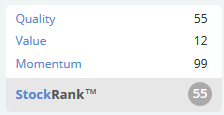
Momentum is incredibly strong:
French Connection (LON:FCCN)
Share price: 34.75p (-0.4%)
No. shares: 96.3m
Market cap: £33m
This is an old story and has been crying out for some kind of a conclusion, at least according to most observers except for the Chairman & CEO (one person).
Anyway, the underlying operating loss has reduced to £3.7 million from £4.7 million, and the cash position was almost stable at £13.5 million (compared to £14 million a year ago). So once again, the company seems to be struggling along without profitability but also without facing an imminent collapse.
The outlook statement does not suggest that the Chairman is going to abandon his efforts to turn the company around any time soon:
Overall whilst the performance for the year as a whole has been disappointing, the noticeable improvement we have seen during the second half and into the new financial year leads me to believe that we are moving in the right direction. The reaction to this year's collections has been very strong so far with sales both in our own stores and wholesale customers' up on last year. It is early in the year and we have a considerable amount of work to do to take the Group back to profitability, however I believe that the actions we have taken and continue to take, will go a long way to achieving that goal this year.
The "noticeable improvement" referred to above is a 4.4% increase in like-for-like retail sales. Overall retail sales were down 5% due to store closures.
Store closures are arguably the most important factor here: it needs to return to a size where retailing isn't ruining the financial performance every year.
So I'd zero in on this paragraph:
In the last four years we have closed 37 full price French Connection stores representing over 40% of the store base. This programme will continue during the current year with two stores already closed and another six expected later in the year. Whilst there are still some stores within the portfolio that we wish to exit given their performance, the rate of closure will reduce going forward and we expect to have around 30 full price French Connection stores remaining by January 2019. The average lease length of the remaining UK/Europe stores is 3.2 years (2016: 4.0 years).
I'm afraid I will have to agree with many other investors who have analysed this company: the rate of store closures is not sufficiently urgent.
The retail division lost nearly £10 million this year, a big improvement on 2016 (loss of £15.6 million) but still enough to ruin the overall results once again.
And the company opened a new store along with two concessions this year, while closing nine other stores. If I owned shares in FCCN (and I did previously, although do not own them currently), I would not want to see any store openings at all, while the retail division is in its current state.
Cash: the minimum cash position during the year was £2 million, helped by a working capital inflow. But assuming continued losses and considering the risk of a working capital outflow in 2017-2018, it's easy to imagine that the company will need to start using a bank facility very soon.
Segment Results
I wonder how many of the common/group overheads could in reality be attributed to the retail division:

After including store disposal and closure costs, the final loss for the year was £5.3 million, worse than the £3.5 million seen in the year ending January 2016.
My opinion
I don't know if the company will end up going to the wall, but I could see it eventually being bought out when it is financially distressed and there are no other options.
Whatever happens, I wouldn't trust that external shareholders will be treated well (based on what I understand from the Chairman's past dealings with them). So I won't be buying shares in this company again.
Disclaimer
This is not financial advice. Our content is intended to be used and must be used for information and education purposes only. Please read our disclaimer and terms and conditions to understand our obligations.

164 comments
From Legal Week today:
"Shepherd & Wedderburn has become the first UK law firm to secure a portfolio financing arrangement with litigation funder Burford Capital.
The Scottish law firm is set to receive an eight-figure sum from Burford Capital, which it can use to offer alternative fee arrangements to clients as well as to grow its reach in commercial litigation and arbitration.
The deal marks the first time a top 100 UK law firm has signed a portfolio financing arrangement of this kind, though US firms have taken up similar deals including some practising in the UK."
http://www.legalweek.com/sites/legalweek/2017/07/31/shepherd-and-wedderburn-seals-multi-million-financing-from-burford-capital-in-uk-first/?slreturn=20170631081505
I joined the Burford Capital (LON:BUR) earnings call earlier. It was all very positive in my opinion. The slides are on their website:
http://www.burfordcapital.com/wp-content/uploads/2017/07/Investor-Presentation-2017-Interim-Results-FINAL.pdf
"A replay facility will be available until Thursday 10 August 2017 by dialing +44 (0) 20 8196 1998 / +1 866 583 1035 with the passcode ‘5490256#’."
Thanks John, they do present in plain English which is great.
I also listened in and I completely agree John. I thought the best comment was from the CIO when he said cash receipts from past investments were being recycled back into new investments to fuel future growth.
One of the bear points I have on Burford Capital (LON:BUR) has been the negative operating cashflow, in that there is an ongoing need to finance the time lags between up front funding of a new investment and the time it takes for cash to be realised after the case has worked its way through the judicial process.
This is what their aggregated cashflow looks like since they started trading in 2009:
So they've seen a cash outflow in excess of $650m which has been financed by the original IPO proceeds of $290m and the retail bonds of $556m, leaving $194m cash remaining.
While they can continue to generate returns on capital of 60% on completed investments, I'm perfectly happy for this state of affairs to continue, but this is a new growth industry and Burford are likely to be seeing plenty of investment opportunities for years to come which means it could be a long time before they are consistently showing positive operating cashflow.
So I think it's great they are talking about recycling cash from completed cases into new investments as that should tilt the balance of financing the growth away from retail bonds and off-balance sheet funding.
Also the change to a mixed operating model where, in addition to deploying capital from their own balance sheet, they earn fees for managing funds of other people's money will enable their continued growth.
The share price seems to have run out of steam since lunchtime...
One thing I wonder is how lumpy their earnings potentially could be considering the nature of the business...?
I found this comment in the interim report interesting as it appears to fly in the face of other comments they have made previously about moving towards portfolio investments and away from single case/binary investments:
Given the rates of return on offer, it is possible that litigation funders are leaving themselves open to claims of usury and champerty, as the Ireland ruling a few months back demonstrated.
However it is interesting that regulatory risk barely gets a mention in any of Burford's annual reports since the company incorporated, not even in the risks section. The only exception is the 2015 report so it's worth quoting that at some length to get an understanding of their take on the issue:
It is possible that Burford are being blasé about the risk, but they are a bunch of lawyers (is 'bunch' the correct collective term for lawyers?) and as such would tend to be risk averse. If it was genuinely a material risk to their business I would expect them to have included all sorts of disclaimers in their communications.
Very happy with my Burford Capital (LON:BUR) investment but you've always got to look for the negatives ...
... and you've got to reckon that if a company gets involved in funding litigation against sovereign governments then at some point those governments will look to introduce regulation. In addition cases as Peter Thiel's secret funding of the litigation against Gawker don't tend to help. Burford themselves have pointed out that this doesn't really have anything to do with their business, but history suggests that governments don't always apply business logic to regulation, particularly where it's costing them money.
The issue with this, of course, is if it does happen we won't see it coming. Just sayin' ....
timarr
I can't see any first world democratic country making litigation finance illegal as it is a public good, it benefits society in that it allows people / companies recourse to the law that may otherwise be denied it on cost grounds - Burford do due diligence & therefore it is not in their interest to finance groundless cases.
I think this is a bit of a red herring worry - I believe the real concern would be a big player moving into the market once Burfords profits catch their eye.
On what grounds would you believe they would make litigation finance illegal ?
In what way is society hurt by it ?
I think ignoring the risk is in the realm of wishful thinking - just because we don't think it should happen or that it's reasonable doesn't mean that it won't. And, a side-issue though it might be, the Gawker case suggests that there are cases in which it can be used to shut down freedom of speech: is that a public good? As this article suggests, big businesses hate it already - they'll be plenty of lobbying going on behind the scenes:
https://www.nytimes.com/roomfordebate/2016/05/27/the-ethics-of-investing-in-anothers-lawsuit/this-is-casino-litigation-where-we-all-lose
Burford Capital (LON:BUR) is now my largest holding, but I'm not going to ignore the potential risks of the investment, regardless of the ongoing opportunity.
timarr
Hi Tim
The article is completely without basis, Burford or any other litigation finance company act as a filter & would only ever finance a case that they believe had legal merit & a chance of succeeding. Do you agree with the journalists point of view or knowing the facts believe that the argument has any merit, if not it is just someones groundless opinion.
Knowing the facts can you personally make the case for making litigation finance illegal, we have to have some trust that our politicians / law makers have a reasonable amount of intelligence or we would not make any investment for fear that the industry could be made illegal in the future.
Hi Steve
At no point have I suggested that there's any possibility that litigation finance will be made illegal, so I don't know why you keep on repeating that point. Regulation would reduce Burford's profits but is hardly likely to send them out of business. I see next to no possibility of a total loss of capital here.
I also agree that the article isn't very good, the interesting point is that the author is actually not a journalist ... as students of discourse analysis would no doubt agree it's often not what people say that's important, but why they say it.
However I don't understand why I have to make any case at all - whether I believe litigation finance is acceptable or not is completely irrelevant. In my experience when I allow personal feelings to override logical analysis I make poor investment decisions. And my opinion on that matter will make no difference whatsoever to subsequent events - so why would I even bother considering it?
As it happens I think there's a very good chance Burford will carry on making very good returns, and a much smaller chance that some form of regulation will be introduced to limit those returns - but the point is, that if it happens it will be a cliff-edge event and is therefore inherently unpredictable. And when that's happened in the past, as with on-line gambling in the US or more recently with spread-betting in the UK and Germany, the result has been a sudden and precipitous drop in the share price.
timarr
Sorry Tim I didn't mean for my reply to come across as it obviously did to you & I hate the rudeness shown on many bulletin boards.
What I do not understand is what your concerns are - why would authorities want to regulate something that is of public benefit - why do you think the authorities would want to regulate the litigation finance industry & if they did in what way would they regulate it - from my understanding Burford customers are business's that see the financial benefit of funding their legal cases, they are in no way coerced into it & they are not selling their services to vulnerable people.
It is not gambling or spread betting.
I was actually wondering if I have missed something & that actually there is a bad element to what Burford are doing that needs regulating ?
Hi Steve
I really didn't take it personally, this is an imperfect means of communication.
I can think of four reasons why the industry might end up being regulated: (1) There are some high-profile cases which go against entrenched interests - imagine what might happen if President Trump was sued using one of these? (2) There are some high profile cases where litigation funding is used to promote cases which aren't in the public interest - so using them to restrict freedom of speech, for instance. (3) The use of litigation finance becomes widespread in the legal industry - in time I think that's a distinct possibility, and a mass market will always require some form of regulation to avoid abuse. (4) Powerful lobby groups persuade government that there is good cause to regulate - that's what the article I linked to in the previous post was alluding to.
Now, as bestace's previous post suggests, regulation may well be in Burford's best interests, as it would tend to promote a flight to quality. But in the short term it would still impact the share price.
As for litigation finance being in the public interest - well, maybe. But arguably so was no-win, no-fee litigation and that's led to a race to the bottom of the human condition. There are always unknown unknowns and unexpected consequences, the legal profession is a human invention made up of human designed rules - there's nothing set in stone about it.
But again, to be clear, I like Burford Capital (LON:BUR). I just regard it as my job to weigh up all of the possibilities.
timarr
Hi Tim
Thanks for the clarification, hopefully nothing too much to worry about (other than vested interests / corrupt politicians).
I have to say I couldn't agree more regarding no win no fee, another industry that I think is ripe for regulation is the car hire rip offs which I have been a recent victim & the insurance industry, I was in an accident with an old gentleman in an old car (not a classic a Passat) on by bicycle, there was limited damage to the car & none to the driver & yet the insurance bill came to £7k+ how on earth can they justify that - no wonder Hiscox is on my watch list ; )
I think a distinction can be drawn between "no win/no fee", car hire fees, PPI, leasehold charges etc. which are all consumer/retail cases, and on the other hand business to business cases which Burford focus on.
Clearly where retail consumers are involved there is likely to be a higher risk of regulation but where that happens it doesn't necessarily mean Burford will be directly affected.
Couldn't agree more, I think the chance of regulation having a negative impact on Burfords business to be a negligible risk - I guess with Burford it seems such a great company we are all looking for what could be the possible down side - nice problem to have.
I believe as factor investing becomes more popular finding the likes of Burford that doesn't fit into easy analysis will be the key to good returns.
Quality will out eventually - hopefully.
And Stockopedia ranks Burford Capital (LON:BUR) as a "Momentum Trap" with a value rank of 14. Hmm..
Great quote from N1+Singer this morning, saying if the return from the Peterson case is the norm "then there is probably no target price high enough to capture this!".
Great share & one of the only companies whose annual report is an entertaing read.
Re. Burford Capital (LON:BUR) Looking at the full 1H report, eps for 1H is 63.89 cents (+150%); Broker Forecast for full year is 88 cents.
They really don't need to do much in 2H to exceed consensus broker forecast.
Ram, and the H1 results include nothing more for the recent Teinver/Aerolíneas award.
I'd expect high FY earnings upgrades once analysts have company guidance.
Hi Jane
I don't think Burford give much guidance hence the consistently inaccurate broker forecasts.
I'm not sure H2 will show the growth of H1 & hopefully the market is educated enough on the nature of their earnings to take the growth for the year as a whole.
I find it interesting to compare Burford with Fervertree & Boohoo, all three of which I hold & all of a similar market cap & 100%+ eps growth, however the difference being Burfords PE is a fraction of the other 2.
... and with a forecast PE of only 15, any % broker upgrade should flow straight through to (at least) a similar increase in SP
Hi Ram
They have got to rerate at some stage as well, a PE of 15 is ridiculous.
A growth rate like that in a new industry, with a moat & a low PE is the kind of opportunity that doesn't come along that often, hence it foolishly / bravely makes up over 50% of my portfolio.
Steve - I really believe that the investment community doesn't fully understand Burford's business & operating models.
It is unique and difficult to fully understand, and therein lies the problem to them.
Bloody hell, I thought I was being brave with a 10% allocation!
Hi Bestace
I go for the "can't sleep is too concentrated" school of fund allocation & managed to sleep like a baby last night - I'm reading Jesse Livermores biography at the moment & that makes me feel like a conservative grandma ; )
Steve,
Spoiler alert - the Jesse Livermore story is a fantastic read but it doesn't have a happy ending.
"The game of speculation is the most uniformly fascinating game in the world. But it is not a game for the stupid, the mentally lazy, the person of inferior emotional balance, or the get-rich-quick adventurer. They will die poor." Jesse Livermore
Hi John
Yes I know a little about his life, wouldn't it make the most fantastic film, I think it would need to be a trilogy a little like the Godfather, with him going bust at the end of each of the first 2 films & then the ultimate goodbye at the end. I also think his son shot his wife & then his sons mother (his ex wife) shot his son. I love the image of him being locked in a bank volt surrounded by his cash to review the years trading mistakes & going to work in Wall St on his 300ft yacht - would make the Wolf of Wall St seem tame.
Wow! Calling him larger than life would be an understatement.
Hi Ram
I know your a Minervini man & he said that Livermore was one of his major influences, for a brief background to his life & his way of trading you can read "Hot to Trade in Stocks", its only a couple of quid for the Kindle.
Thanks, Steve. It's on my to-do list now.
Re. Burford Capital (LON:BUR) Just Wow! They have smashed the ball into the next county! A big thankyou to Jane.
Crikey. I was optimistic and this exceeds my expectations.
First half profit greater than the whole of 2016, which was itself a record year!
And they continue to innovate and grow at a rapid pace.
As Jane says, tremendous results.
Hi John
I bet your glad your alarm went off !!!!
Hi Steve,
Yes, very happy indeed!!
I see they have opened above £11.00.
And no let up ahead in the growth of the business that I can see - if anything they are accelerating.
John
Tremendous half-year results from Burford Capital (LON:BUR) :
"Burford Capital Limited ("Burford" or the "Company"), a leading global finance firm focused on law, announces its financial results for the half year ended 30 June 2017.
Highlights
?
Best ever results in Burford's history: 1H 2017 profit exceeds record profit for full year 2016
?
Income increased by 130% to $175.5 million (H1 2016: $76.2 million), driven by a 148% increase in investment income to $161.6 million (H1 2016: $65.3 million)
?
151% increase in operating profit to half-year record of $155.0 million (H1 2016: $61.7 million), and 170% increase in profit after tax to $142.7 million (H1 2016: $52.8 million)
?
Interim dividend of 3.05¢ (H1 2016: 2.67¢) declared, at the rate of one third of total 2016 dividend - an increase of 14% over last year's interim dividend. Interim dividend payable on 15 November 2017 with record date of 20 October 2017
?
Strong demand for Burford's capital, with record new commitments to investments of $488 million (comprising $226 million from our balance sheet and $262 million from our investment funds), $289 million of which already deployed
?
Record investment performance underpinned by 11 investments, including largest cash generation from a single investment in our history, the sale of 25% of our ongoing Petersen investment
?
Cash generation of $173.7 million from investments on balance sheet, exceeding every previous half-year period
?
Oversubscribed retail bond offering, raising £175 million at a 5% coupon, to further support client demand and future growth
?
Gerchen Keller acquisition and integration successful and well-received, first fund starting to generate performance fees. Burford's new investment management business closed largest investment fund ever raised in sector, at $500 million, to invest in complex strategies"
http://www.londonstockexchange...
https://www.rns-pdf.londonstoc...
Jane
There were big trades on Hargreaves yesterday
RECENT TRADES TRADES BY VOLUME
Time / date
Buy / sell
Volume Price Value
13:55 - 26/07 Buy 116300 1,040.00p £1,209,520.00
13:55 - 26/07 Buy 116300 1,040.00p £1,209,520.00
13:56 - 26/07 Buy 94806 1,040.00p £985,982.40
09:21 - 26/07 Buy 75000 1,010.00p £757,500.00
15:39 - 26/07 Buy 50000 1,030.00p £515,000.00
REgards
Howard
There's an interesting commentary here on the ICSID arbitration award in favour of Teivner/Marsans/Burford. It is from a very well regarded business news site in Argentina.
http://m.iprofesional.com/notas/253253-El-fondo-que-financio-el-juicio-contra-el-Estado-por-Aerolineas-logro-un-premio-de-us140-millones
In the section "cautela y negociación", there is this text:
"En ese sentido, un mensaje del presidente Mauricio Macri por las redes sociales estuvo lejos de rechazar el fallo: le adjudicó responsabilidad por la deuda a pagar al gobierno de Cristina Kirchner, precandidata a senadora por Unidad Ciudadana en las próximas elecciones.
“Por la inmensa torpeza y arrogancia que el gobierno anterior tuvo con Aerolíneas el país fue condenado a pagar u$s320 millones más intereses”, escribió Macri en Twitter.
“Nos llega esta condena en el mejor momento de la historia de Aerolíneas y los vuelos comerciales, con récord total de pasajeros transportados”, agregó para luego afirmar que “nada detendrá a la revolución de los vuelos que está en marcha uniendo al país, llevando cada vez a más argentinos con mejores tarifas”.
Así, se desprende que para el jefe de estado, el fallo es justo. Sin embargo, no se podía esperar otra reacción del Presidente en plena campaña electoral y a 20 días de las PASO en la que el oficialismo tendrá un difícil reto con la expresidenta en la provincia de Buenos Aires.
Fuera del ámbito doméstico, se espera que el Estado negocie los términos del fallo en contra."
What they are saying here is that President Macri, in a message on social media, far from rejecting the judgement, instead put the responsibility for it on the past government of former President Cristina Kirchner, who is expected to stand as a candidate for the Senate for Buenos Aires Province in elections to be held three weeks from now and who is expected to put up a tough fight against Macri's party. Macri tweeted that "it was because of the immense sloth and arrogance of the previous government in managing Aerolíneas that the country now stands condemned to pay $320m plus interest" and he goes on to highlight that Aerolíneas, under his government, has recovered and is now performing very well indeed. The article states that one can deduce that for President Macri the verdict is fair, although the article also cautions that this is a time of electoral campaigning and that this response from Macri was thus to be expected.
The article also picks up on Burford's reference to there being often negotiations to arrive at an agreed settlement and seems to be linking this in with President Macri's response to Burford's statement and implying that a negotiated settlement could well find favour in Buenos Aires.
My own view is that while the Macri government is obviously very keen to put to rest Argentina's dismal past record of fighting continually against the international financial community, local politics are inherently unstable and political necessity could blow this off track. Only last month, Argentina was able to raise in New York $2.75bn in 100-year bonds (yes, really!) and for Argentina to go back to its old ways of fighting every last decision they don't agree with would likely put the shutters up once more against international bond issues. In the grand scheme of things, the Marsans/Burford judgement is very small beer for Argentina and it would be in their interest to settle the matter quickly and get it over and done with.
The much bigger "Petersen" claim (also a Burford case) in respect of the expropriation of the YPF energy group is coming fast down the tracks and that is likely to give President Macri even greater opportunities to open up numerous cans of worms about the alleged corruption on a gigantic scale of past Kirchner governments. It may well suit Macri now to settle this relatively small Aerolíneas case, keeping Argentina on track to access international money markets while also using the judgement as a political weapon locally, as a precursor to the Petersen/YPF judgement also perhaps going against Argentina which would be the real political bazooka.
All IMHO, DYOR.
Burford Capital (LON:BUR) excellent comments thank you Jane. I very much enjoy reading your in depth analysis of situations such as these & appreciate you sharing your knowledge, thank yoi
A few thoughts on this:
and in Article 53 (1) of the ICSID Convention:
Bestace, thank you for your post.
I appreciate the points that you make. However, there is an unavoidable political context to this and that cannot be ignored, should the claimants wish to avoid further delays, however much one would like to think otherwise.
The whole matter actually stems from Argentine internal politics, essentially Néstor and Cristina Kirchner, as successive real "populist" Presidents of Argentina in the previous decade, throwing to the masses the supposed corpses of foreign owners of emblematic local businesses taken back "for the people" without compensation. That is common to both the Repsol ("Petersen") case and this Aerolíneas case. This economic nationalism has been a constant in Argentine politics for most of the last sixty or seventy years, ever since the days of Perón. I doubt that any politician there would even risk being painted as the agent of foreign economic interests.
Macri is, imo, attempting to break this cycle and is trying to bring Argentina back into the international fold. After having been shut out of international bond markets for a decade or more, he has succeeded in selling 100-year bonds to raise $2.75bn, this for a country that has defaulted eight times in the last 200 years!
So it is the political context that will inevitably come into play and the article is making that very point, that Macri is using this judgement to attempt to k.o. Kirchner. He can also now point out to the electorate tangible benefits achieved from ceasing to be the international economic pariah that Argentina was under the Kirchners. So the conjunction of the austral political firmament may be right for Macri to face down the inevitable accusations that will come his way of "selling out" to the international money markets.
However, politicians are what they are and are in office for short periods of time and, as perhaps in every country, there would still be ways of delaying and delaying enforcement of the award, perhaps for years more, should political expediency dictate. It would be foolish to disregard this fact.
Therefore, imo, it would be in the interests of the claimants (with Burford having its say) to be prepared to negotiate a settlement, and to wrap the matter up pragmatically while the time is right, however much one would wish otherwise. As for the amount being "materially lower", tbh I doubt it would need to be "materially lower" since the award is already only for about 20% of the amount of the original claim which was, I believe, for $1.6bn. Macri could actually sell this fact as another success of his making.
Jane.
(Another link on this award from a US site.
Note this para, relevant to understanding the local political context referred to above:
"Both the investor-state case and Burford’s role in seeking to profit from it turned out to be hugely controversial in Argentina. The Argentinian government at one point sought criminal charges against Burford and accused some of the lawyers involved -- including Luzi, an Argentinian national -- of treason, though nothing ever came from those threats."
http://www.americanlawyer.com/... )
I'm aware of the political backdrop, but my point is slightly different: in my view Burford are being more cautious than the facts of the situation warrants.
It is Burford that are raising the prospect of the award being annulled or overturned but I've explained why I think that is unlikely. Maybe as lawyers they are using 'arse-covering' language because that's what they are used to doing, but if they genuinely think this is a risk and are assigning a material non-zero probability of this being an outcome in their 'expected value' calculations, then I think their 'fair value' NAV for this investment could be understated.
Likewise it is Burford that are using language about the scope for negotiations etc. to "reduce materially" the award. You seem to agree with me that a material reduction is unlikely but again, if Burford believe there is a considerable chance of this happening, their NAV calculations will reflect that.
There may well be a negotiation in the interests of a quick settlement, but I think the outcome of the arbitration and the limited options available for Argentina to appeal through legal channels means the claimants are in a stronger position in any negotiation process than they otherwise would be.
It's also interesting to see this extract from Burford's funding agreement in the arbitration ruling:
That point 4 is particularly interesting - Burford get a minimum 50% IRR regardless of any other percentage splits set out in the agreement. A $13m outlay in year 1 followed by a $140m inflow in year 7 equates to an IRR of just under 50% (so Excel tells me), so maybe that's where Burford's stated $140m figure comes from?
But this clause implies that any downwards negotiation on the amount would be irrelevant to Burford because they would still be entitled to their 50% IRR i.e. $140m. In fact it might even be in Burford's interests to prolong settlement if the 50% rate applies for as long as the case remains unsettled, e.g. if settlement takes place in year 8 rather than in year 7, the cash inflow required to maintain a 50% IRR increases to $220m. So maybe I've just contradicted my earlier point and there is an incentive on the claimants to come to a quick settlement with Argentina(!), but that won't impact on Burford's 50% IRR.
Hi John
I agree, I would be very surprised if it wasn't above forecasts.
N+1 Singer have already said after todays news they expect to substantially increase full year expectations after H1 results are released on Thursday.
But I guess we must all be positively bias towards the stocks we own or we would not own them ; )
I have a feeling that Burfords caveat this morning about broker forecasts is a forewarning that the news on Thursday will not be what the forecasts predict.
I love the conservative nature of their RNS's & I believe that the forewarning is for a major beat, or maybe its just wishful thinking on my part as they are my largest holding.
Fingers crossed for Thursday.
Steve,
They roll out that caveat with every announcement these days. I take it at face value. We can't know what the results will be until they are announced.
That being said I'm also optimistic.
1. The first full contribution from Gerchen Keller. There was only one week of their numbers included last time.
2. The uplift from recognition of the Petersen valuation based on the secondary market transactions.
3. The rapidly increasing amount of capital they have deployed.
I'll be setting my alarm for 07.00 on Thursday.
I have found some info on an Argentine site which refers to the way that Burford is remunerated. It is in Spanish (I am a translator) and I won't translate the article but you can use Google Translate, should you wish to do so.
This para states that Burford would be entitled to an amount of "about" four times their investment (hence, say, four times Burford's costs of $13m, ie. $52m), then 40% of the first $100m (I assume they are interpreting this as meaning the first $100m after the $52m), then 30% of the balance.
On an award of $324m, this would work out at, firstly, $52m (ie. 4 x $13m) plus, secondly, $40m plus, thirdly, 30% of ($324 - 52 - 100), that is $51.6m, adding them up we get to $52m plus $40m plus $51.6m, a total of $143.6m, which is about the figure Burford are quoting.
"El negocio de Burford ha sido brutal, con una plusvalía del orden del 1000%, ya que solamente ha gastado 13 millones. El acuerdo al que llegaron los dueños de Marsans con estos buitres, al que luego se adhirió la administración concursal de Air Comet, establecía que cobrarían una cantidad fija del orden de 4 veces el dinero que hubieran gastado hasta el fallo del CIADI, más unos porcentajes escalonados, según la indemnización conseguida, un 40% de los primeros 100 millones, y el 30% para el resto hasta 500 millones."
http://www.lacelosia.com/el-fondo-burford-que-compra-y-financia-pleitos-se-lleva-el-43-de-los-324-millones-de-dolares-de-indemnizacion-de-argentina-marsans/
Imo, if this is the model of reward that Burford are using in their contracts, it's very clever, their costs get fully covered first (and with a 300% profit!) and then there's a tremendous incentive to push hard for a great chunk out of award beyond this.
(PS: I have no idea where the site got this info. A leak from inside one of the Argentine parties, perhaps?).
Hi Jane
Many thanks for the research about Burford Capital (LON:BUR) you are sharing, they are very insightful and much appreciated.
Regards
Howard
If I understand correctly, there's also compound interest since 2008 to be applied to the above figures.
Edit: It seems the rates of interest to be applied have to be specified by the arbitrator in his ruling, so we would need to see that to be able to estimate the effect.
Two decisions in cases backed by Burford.
One win, in that involving Aerolíneas Argentinas,
one loss, in the Mastercard case.
http://www.4-traders.com/BURFORD-CAPITAL-LIMITED-5668352/news/Burford-Capital-Reports-Favourable-Investment-Result-24803434/
http://www.legalbusiness.co.uk/index.php/lb-blog-view/10492-court-rejects-landmark-application-for-14bn-class-action-against-mastercard-in-freshfields-win
Original report from Burford press release re Teinver S.A.: http://www.burfordcapital.com/newsroom/burford-capital-reports-favourable-investment-result/
An extract of which is:
"It is important to emphasize that this arbitral decision does not necessarily mean that this amount will actually be paid in full, or at all. There remain various avenues for challenge to the decision and the matter is not yet free of litigation risk; indeed, the entire decision could later be overturned by an adjudicatory body with higher authority and result in a loss for Burford. Moreover, it is commonplace for there to be negotiations, settlement discussions and discounting that could reduce materially the figures provided above, and Burford generally does not have any control over the outcome of those discussions as it is a third party to the actual litigation."
I have a Burford Capital (LON:BUR) query I'm hoping one of you kind folk can help me with.
I've taken a look at some reports from 2016 to try and understand some of the figures.
What I'm trying to understand is what the difference is between:
1) Investment Commitments stated as $378m in the FY2016 results (http://otp.investis.com/clients/uk/burford_capital/rns/regulatory-story.aspx?cid=1377&newsid=852966)
2) Investment Commitments stated as $326.8m on their website/the 2016 Annual Report.
(http://www.burfordcapital.com/investors/investor-information/concluded-investment-performance/)
Why is there a difference in these figures? Surely they should match?
Any insight would be appreciated.
Abtan
Im looking at H&L
Wheres the 1.6 million pound sell at 12.09?? Or all the others?
RECENT TRADES BY VOLUME
Select time periodTodayLast 5 trading days
The London Stock Exchange does not disclose whether a trade is a buy or a sell so this data is estimated based on the trade price received and the LSE-quoted mid-price at the point the trade is placed. It should only be considered an indication and not a recommendation.
Trades priced above the mid-price at the time the trade is placed are labelled as a buy; those priced below the mid-price are sells; and those priced close to the mid-price or declared late are labelled ‘N/A’.
Time / date Buy / sell Volume Price Value
16:35 - 16/06 Sell 343859 849.00p £2,919,362.91
12:09 - 16/06 Sell 200000 847.50p £1,695,000.00
11:39 - 16/06 n/a 50000 846.50p £423,250.00
16:25 - 16/06 Sell 25000 853.00p £213,250.00
09:53 - 16/06 Sell 18360 846.21p £155,364.16
15:18 - 16/06 n/a 13386 849.75p £113,747.54
12:46 - 16/06 Buy 10729 858.68p £92,127.78
14:47 - 16/06 n/a 10000 856.50p £85,650.00
09:47 - 16/06 n/a 10000 845.00p £84,500.00
12:45 - 16/06 Buy 10000 858.71p £85,871.00
11:00 - 16/06 Sell 6783 847.18p £57,464.22
15:16 - 16/06 n/a 6635 849.75p £56,380.91
15:13 - 16/06 n/a 6401 850.75p £54,456.51
11:38 - 16/06 Sell 5900 847.37p £49,994.83
11:38 - 16/06 Sell 5900 847.37p £49,994.83
12:47 - 16/06 n/a 5888 861.50p £50,725.12
12:47 - 16/06 n/a 5886 861.50p £50,707.89
12:47 - 16/06 n/a 5837 861.50p £50,285.76
12:41 - 16/06 Buy 5000 855.00p £42,750.00
15:19 - 16/06 Sell 5000 850.62p £42,531.00 ×
Apologies - I missed the 200,000 trade in a manual trawl through the 30 or so pages of individual trades. The 50,000 trade was referred to in my comment and as you indicate may have been a buy or a sell. The next three largest trades were covered in my "100k or more" comment. The largest 343k trade as described above is a closing Uncrossing Trade.
All told, Burford Capital (LON:BUR) closed up today. There may well be an ongoing correction going on from the recent highs, but I'm not sure today's trading pattern in isolation is indicative of that.
Gus.
Some huge Sells today... roughly 6 millions pounds today the biggest tranche was a 2.9 million pound sale after the clock at 16.35pm.... Its going to continue down then track sideways and go up (eventually) - Williams R% is flat scraping the floor and cant go any lower.... Buying in the dips is the only way to make serious cash.. My point and figure chart which is rarely wrong has a reversal to a low of 661..(That will change when it start going up again) I value this at 1500 using Benjamin rule..(that will take a long time).... I will hammer back in when my chart reverses... The more is goes up (it will go up a lot) the more volatile it will be... I cannot remember it ever dropping more than 5% in one go on a 10 year chart.... we are down 12% in a week now.... Monday will open lower I think , with the sheep following the herd.. I will just keep and eye on the volume..
Hi Red.
Not sure the 344k/£2.9m trade you refer to is a single "sale". According to the London Stock Exchange board, the 16.35 trade is marked as a UT (Uncrossing Trade).
http://www.londonstockexchange.com/exchange/prices-and-markets/stocks/exchange-insight/trade-data.html?fourWayKey=GG00B4L84979GGGBXAMSM
This is not a "sell" per se but (as I understand it) rather part of the SETs market clearing mechanism that in effect matches any open bids and offers at the end of the trading session. Depending on the number of brokers/outstanding limit orders etc., the number can be quite large for a liquid share (as Burford Capital (LON:BUR) is at the moment). (I've copied below an explanation of the UT process taken from another post). If anyone else has a view on how "real" the underlying UT trade is, perhaps they could comment.
Apart from a 25k/£213k trade at 4.25pm @ 853p (which doesn't look like an obvious sell or purchase given the price levels at or around this time) most of today's later trades look to be relatively small (£10k or less) with retail punters pick pocketing each other to either top up on the recent fall or get out now that recent momentum is tailing off. There were a few bigger trades of £100k+ earlier in the day the largest of which was for a nominal value of about £423k made early this morning.
I see you've made a similar post on the BUR thread over on the London South East board - were you referring to the three big (£350k) sales reported here which were dated 15/6 (i.e. yesterday)? All told, Burford Capital (LON:BUR) is up about 1% today in line with the rest of AIM which suggests buying and selling pressure was roughly in balance.
Gus.
__________________
A "UT" uncrossing trade can generally be ignored. For those of you who want to know how it is calculated:
The Uncrossing Algorithm performs a series of passes within an individual market, matching the best bids and best offers present in the price time sequence. When all crossed volume has been matched, an Uncrossing Trade Price can be determined for the market. This price is found by applying one of the following calculations. The calculation used is determined by the presence of residual limit volume within that market following uncrossing.
The four possible cases are:
• There is no remaining bid or offer limit volume in the market Uncrossing Trade price = the average of the bid and offer price from the last match.
• There is remaining limit offer volume but no limit bid volume in the market
Uncrossing Trade Price = offer price from last match.
• There is remaining limit bid volume but no limit offer volume in the market
Uncrossing Trade Price = bid price from last match.
• There is remaining limit offer and limit bid volume.
To determine the Uncrossing Trade Price in this case:
• Determine what the Best Offer Price is. Determine what the Bid Price is from the last match. Take the lowest of these. This is known as the ‘High Price’.
• Determine what the Best Bid Price is. Determine what the Offer Price is from the last match. Take the highest of these. This is known as the ‘Low Price’.
The Uncrossing Trade Price is the average of the ‘High Price’ and ‘Low Price’. If this value is halfway between two tick values the price allocated to all uncrossed business will be rounded towards zero (rounded down if the value is positive, rounded up if the value is negative).
If no matches occur within a market there will be no Uncrossed Trade Price for that market.
Jane an excellent well written explanation
Thankyou
Re. selling positions in Burford Capital (LON:BUR) my concern is that I have little idea:
a) when profits will come to fruition (years?), and
b) where profits are actually coming from
It reminds me a little of XLMedia (LON:XLM) which has good financials, but doesn't divulge which websites it owns, making it difficult to validate the viability of its income streams.
I must admit to having held BUR in the past, but sold out most of my holding after a nice gain due to the the niggling concerns mentioned above. I've kept a small position, but will sell out if the share price dips materially.
Abstan,
See the last annual report.
At the end of 2016, Burford had outstanding litigation investments on our balance sheet of $549 million (2015: $320 million). In addition, we have a further $290 million in undrawn commitments made to existing investments. Thus, our portfolio stands at $839 million in investments and commitments, which have been made across 64 different litigation investments. This is a significant expansion of Burford’s portfolio in a single year. That translates into an average commitment of $13 million to an investment, although once again there is material deviation from the mean.
Align that with the other information in the Annual Report perhaps of particular note is page 11
'Unfortunately' the Peterson case has taken the attention of short term investors when, in fact, resolution of the case may well be in the medium term; although it should be noted BUR have made considerable profit on it already.
Afternoon
I'm aware that there are significant numbers floating around, though I couldn't see much to increase my confidence on where their profits are coming from, and most importantly, when (if?) they'll come in.
I've been burnt in the past from simply trusting management. This could very well be a cash cow, but for now there are too many unknowns for me to keep a material holding.
Interesting how BUR qualifies for the short selling screen "James Montier 'Unholy Trinity' Screen"-
. Out of 90 Qualifying (virtually all are dogs) only 3-4 have some history of upward climbing and consistent performing....
http://www.stockopedia.com/screens/james-montier-unholy-trinity-screen-12/?display=charts®ion=gb#display
James Montier 'Unholy Trinity' Screen
The last part of the document submitted on Tues sums it up for Argentina,they cannot use the fact they are a state to escape being prosecuted in the US... This is one of the one of the biggest cases they have at worth at least 3 billion dollars... They are still squabbling about where it can be heard... Will take years to complete and get the money
"Because Argentina acted commercially in raising capital and forming a commercial contract, “the subsequent breach of contract cannot be cloaked in immunity.” Weltover, 941 F.2d at 151. Respectfully submitted, /s/ Michael"
June 13, 2017 Via ECF Catherine O’Hagan Wolfe United States Court of Appeals for the Second Circuit Thurgood Marshall United States Courthouse 40 Foley Square New York, NY 10007 Re: Petersen Energía Inversora, S.A.U. v. Argentine Republic, Nos. 16-3303-cv(L) & 16-3304(con) Dear Ms. O’Hagan Wolfe: We write in response to YPF S.A.’s June 12 letter citing Bolivarian Republic of Venezuela v. Helmerich & Payne International Drilling Co., 137 S. Ct. 1312 (2017). Helmerich has little bearing here. Plaintiffs in this case did not advance a “nonfrivolous argument” standard for assessing the applicability of the commercial-activities exception. Nor did the district court adopt that standard. Rather, it acknowledged that the FSIA requires it to resolve factual disputes to the extent necessary to determine jurisdiction. See SPA-11-12. Helmerich involved the FSIA’s expropriation exception, which requires a “valid claim that ‘property’ has been ‘taken in violation of international law.’” 137 S. Ct. at 1318 (emphasis added). The Supreme Court noted, in the context of that exception, that “merits and jurisdiction” may become “intertwined” because the plaintiff must demonstrate an international-law violation as part of its jurisdictional showing. Id. at 1319. But the commercial-activities exception does not require a similar merits showing. Whether an action is “based upon” commercial activity is assessed by reference to the nature of plaintiffs’ claims — i.e., the “gravamen of the complaint.” OBB Personenverkehr AG v. Sachs, 136 S. Ct. 390, 395 (2015). Nothing in Helmerich casts doubt on the district court’s straightforward FSIA analysis. The gravamen of plaintiffs’ claim is that defendants breached contractual obligations they entered into while raising billions of dollars in capital in the United States, facts no party disputes. As this Court stated in Weltover, and the Supreme Court unanimously affirmed, Catherine O’Hagan Wolfe June 13, 2017 Page 2 “[o]nce a sovereign enters the marketplace as a commercial actor, it ‘should be subject to all the rules of the marketplace.’” Weltover, Inc. v. Republic of Argentina, 941 F.2d 145, 151 (2d Cir. 1991), aff’d, 504 U.S. 607, 614, 617 (1992). In pointing to supposed “conflict[s]” that would explain why defendants breached their commercial obligations, Letter at 2, YPF proposes an inquiry the FSIA expressly forbids. See 28 U.S.C. § 1603(d) (commercial activity assessed on the basis of its “nature,” not its “purpose”). Because Argentina acted commercially in raising capital and forming a commercial contract, “the subsequent breach of contract cannot be cloaked in immunity.” Weltover, 941 F.2d at 151. Respectfully submitted, /s/ Michael
Yes, YPF raised capital in the US, their shares were quoted in the US,
they had shareholders from many countries besides the US and Argentina itself.
The Argentine Government then gets into one of its frequent political holes
and decides to nationalise YPF, sorry, to expropriate YPF. Without compensation!
They are then sued in the US by Repsol, 51% owner of YPF, get nowhere in the US courts
and then decide to settle with Repsol only for $3bn, thinking they need not
bother with paying anything at all to the other 49% of shareholders.
Their reasoning, presumably, being that they were still getting YPF at half-price!
I'm no lawyer (thank God!) but common sense seems to tell me that the Argentines
haven't a leg to stand on. Just imagine if the numerous mining and resources stocks
quoted in London were similarly nationalised, without compensation, by their
respective operational host countries. If Argentine internal politics dictate nationalisation,
then that's their prerogative but not without compensation!
I am aware of the stories and rumours and intrigue around the links the directors of
Petersen had with the Kirchners, around the so-called "Santa Cruz money" sent to
Switzerland to help Petersen buy their stake in YPF. I am aware that one of the Kirchners'
key financial advisors mysteriously dropped dead in the street in Buenos Aires just a few
days ago after, allegedly, threatening to open numerous cans of worms. However,
all that is internal to Argentina (a country I know well and where I have friends), it is
nothing to do with the case being heard in New York, despite the usual media stirring in BA.
I'd be very surprised if the NY court allows the case to be transferred to Argentine jurisdiction,
even more so given the blatant intimidation there has already been of lawyers in Argentina
who have been or who are involved on the Petersen/Burford side which would, imo, make
a fair verdict there almost impossible to achieve.
Nice ,thats for that
Yesterday info
Plaintiff - Appellee - Petersen Energia Inversora, S.A.U. Plaintiff - Appellee Petersen Energia S.A.U. Defendant - Appellant Argentine Republic Defendant - Appellant - YPF S.A. There are shed load of documents for this case, the last document filed is: BL-80 June 15, 2017 Request CASE, before RKW, GC, DC, C.JJ., HEARD.[2058974] [16-3303, 16-3304]
Same Plaintiffs & Defendants Last updated Jun. 13, 2017 at 05:53 PM Last document filed: BL-54 June 12, 2017 Request ATTORNEY, Shaud Gerard Tavakoli for Argentine Republic, in case 16-3304 , , ADDED.[2055856] [16-3303, 16-3304] Still ongoing
Docket for Case #: 16-3303
The last document filed is not currently available electronically, it needs courier retrieval...
---- http://linkedin.com/in/shaud-tavakoli-7a4ba31
For Argentina An associate , Really?
Either this guy hasnt updated his profile on linkedin,Or hes good. You would think a partner (higher than a associate) would be representing Argentina. Even though hes more than qualified...Surely they would only want the top --- -------------------------------------------------------------
"An associate may be a junior or senior attorney, but normally does not hold an ownership interest in the firm even if associated with the firm for many years. First-year associates are entry-level junior attorneys and are generally recent law school graduates in their first year of law practice"
Hi Guys - Just wanted to say thanks in sharing your info on this as following it with no legal background is quite tricky!
I would not get too hung up on one case, although big it is irrelevant to Burfords long term future, which is the largest player in a very lucrative NEW market.
I would love to speak to the sellers at the moment & ask them WHY ?
Steve,
My thoughts exactly. I was sitting still and completely bemused at the current movements in the share price. I've concluded this all offers an opportunity from a long term perspective and added a bit to my already overweight holding.
This is the order that the Argentines are appealing against:
http://www.leagle.com/decision/In%20FDCO%2020161027963/Petersen%20Energia%20Inversora,%20S.A.U.%20v.%20Argentine%20Republic
As was to be expected there was no decision made today in respect of the Argentinian appeal in the Petersen case, and it could be some weeks or months until there is. Personally I thought the previous judgement was clear and is likely to be upheld, but I am not a lawyer.
https://www.clarin.com/ieco/economia/argentina-pidio-ee-uu-juicio-ypf-traslade-pais_0_ByxxeHxXb.html
Docket number
16-3303-cv
Docket number
16-3304-cv
Ok got it from an argentine news channel
10am courtroom 1703 nyc
Peterson energia inversora ,et al
V argentine republic ypf s a
Time alloted 12 mins.... To convince 3 judges ..
Problem is Argentina may have a case...
But as you say, Repsol sued Argentina and won in the US so not sure what happens...makes a mockery of the sovereign act
"The Foreign Sovereign Immunities Act (FSIA) of 1976 is a United States law, codified at Title 28, §§ 1330, 1332, 1391(f), 1441(d), and 1602–1611 of the United States Code, that establishes the limitations as to whether a foreign sovereign nation (or its political subdivisions, agencies, or instrumentalities) may be sued in U.S. courts—federal or state. (In international law, government protection against lawsuits in foreign courts is known as state immunity; government immunity in domestic courts is known as sovereign immunity.) It also establishes specific procedures for service of process, attachment of property and execution of judgment in proceedings against a foreign state. The FSIA provides the exclusive basis and means to bring a lawsuit against a foreign sovereign in the United States. It was signed into law by President Gerald Ford on October 21, 1976.[6]"
This was the response I got via got email from Burford a few days ago
"Dear Sir,
I can confirm that there is a hearing on 15 June. But for clarity, this upcoming hearing is an oral argument on the defendant's appeal of the district court's denial of their motions to dismiss based on the argument that they are immune from jurisdiction in U.S. courts under the Foreign Sovereign Immunities Act"
This is probably why its diving... Especially with BURFORDS negative RNS a few days before the hearing today.. Why would you sell a few days before a major appeal hearing of where the case will be heard...... Clever or daft I don't know?... If the hearing today cant be overruled then it will be heard in Argentina not the US. If its overturned then it will be heard in the US.. Still a very long way to go ... years..
" Despite Burford's enthusiasm for the Petersen claims, there is significant risk in all litigation and Burford regards these sales as prudent risk and balance sheet management transactions"....
Today 15thy June 2017 is the Appeal hearing at the NYC court of appeal to see if BUR can sue in the US or have to go to Argentina for the Peterson case. The hearing is just about if they can overrule the previous decision that barred them from Suing the Argentine government in the US. There will be no result to the actual case its just the jurisdiction where the legal practice can happen ..Obviously you want it overruled from the previous announcement where they CANNOT sue Argentina in the US... Expect an RNS any time... Probably tomorrow morning..
Isn't it actually the other way round, that the NY court decision last year was to admit Burford's right to sue in the US (which is what Repsol actually did for their claim) and that it is Argentina that is seeking today to overturn that decision?
This from Burford's 2016 Annual Report, page 16:
"The Petersen claim is being heard in US federal court
in New York and during the course of 2016 the court
issued an important preliminary decision in Petersen’s
favour, permitting the case to be heard in the US.
That decision is now being appealed by Argentina
and YPF. Without turning this discussion into a legal
brief, it is important to understand that US law
prescribes the circumstances under which its courts
are able to involve themselves in disputes against
foreign sovereigns, and so the preliminary issues
largely concern whether the claim will be heard in
the US as opposed to in an international arbitration
proceeding and are not merits adjudications."
http://www.burfordcapital.com/wp-content/uploads/2017/03/BUR-26890-Annual-Report-2016-web.pdf
http://www.hardmanandco.com/docs/default-source/company-docs/burford-capital-documents/14.06.17-positive-judgement-from-the-secondary-market.pdf
"Little more than an exercise in educated guesswork"
Their "educated guesswork" proved conservative for the last results & this increase in estimates for 2017 are huge.
This was enough for me to top up again.
Yet the shares are down 5% today, does not make much sense to me, I will be topping soon if they go any lower.
To me, the fact they have left themselves the leeway of selling a further 10% of the Petersen case at an implied value for the full case of upwards of $600m is rather more than a nod and a wink. Looking at their total full-year revenues, it's also obvious that not very much at all of the value of their residual share implied by these realised sales has been taken to profit so far. The PER figures in the Hardman report are also worth a good look; into single figures for the current year and not much above single figures for 2018 once that possible further 10% tranche of the Petersen case is included.
Is the market seriously behind the curve on this one?
Or is it that they just do not understand the business model?
"Is the market seriously behind the curve on this one?
Or is it that they just do not understand the business model?"
...............................................................................................
Whilst I think this is an excellent long term hold I think it's understandable why it might not appeal to some - it's now got a market cap of £2bn, revenue recognition is incomprehensible, your assets walk out the door every night and you got to ask yourself - is their take in some cases equitable? It doesn't always look as if it is, and that will attract competition or regulation at some point.
All that said, it's the market leader in a growing market. And this is a market where where being the No. 1 counts for a lot .
Burford paid hardmanandco to perform this report
"http://www.hardmanandco.com/legals/research-disclosures"
"The following companies have commissioned Hardman & Co to write research for a fee in the last 24 months as part of a research, investor engagement or investor forum contract:
Burford does also get effected by the £ versus $ and the £ is stronger since the Fed raised rates, could be a reason.. Lets wait and see..
"BURFORD CAPITAL"
More tranches of the Petersen claim sold, representing a greater percentage of the case at an even higher implied full value:
http://www.londonstockexchange.com/exchange/news/market-news/market-news-detail/BUR/13257908.html
"Burford Capital Limited ("Burford" or the "Company"), a leading global finance firm focused on law, announces that it has sold further participation interests to institutional investors in its possible future proceeds from its investment related to the Petersen claims.
Yesterday's sales represent a further 15% of Burford's economic entitlement from the Petersen claims for a sale price of $66 million, implying a total value for Burford's economic entitlement of $440 million.
The sales are in addition to prior sales in March 2017 and December 2016 in which Burford sold 10% of its economic entitlement in the Petersen claims for a sale price of $40 million, implying a total value at that time for Burford's economic entitlement of $400 million. Thus, Burford has now sold a total of 25% of its economic entitlement in the Petersen claims for a total of $106 million and continues to hold 75% of its original economic entitlement.
Despite Burford's enthusiasm for the Petersen claims, there is significant risk in all litigation and Burford regards these sales as prudent risk and balance sheet management transactions. Burford has agreed that it will not engage in further sales of its interest in the Petersen claims at an implied value of less than $600 million and that Burford will not reduce its holding below 65% until after 31 December 2018 and will permanently hold at least 50.1% of the economic entitlement in the Petersen claims.*
With their costs already fully recovered, this $66m is, I believe, pure profit, as would be further sales or eventual recoveries from this case.
In a note just issued, Liberum point out that the ROIC for this case so far is of 489% and that a successful conclusion of the case could bring Burford a pay-out as high as $1.125bn.
IMHO, DYOR.
So I emailed burford..on a sunday and they came back to me on sunday..Impressive
"Dear Sir,
I can confirm that there is a hearing on 15 June. But for clarity, this upcoming hearing is an oral argument on the defendant's appeal of the district court's denial of their motions to dismiss based on the argument that they are immune from jurisdiction in U.S. courts under the Foreign Sovereign Immunities Act.
Best,"
Basically nothing is going to resolved very soon.....Im still betting on years....its just a hearing to discuss if they can be sued in the US as they were rejected to do so before
And yet two separate investors, who will presumably have done their own proper due diligence, already rate the value of this case highly enough as to have bought in to the case, taking only 10% of it at a value already exceeding its full cost to Burford Capital (LON:BUR) .
As I said, Burford Capital (LON:BUR) is now on a free ride on this Petersen case and any award now is all upside, whenever it is resolved. Let's see what happens, shall we?
This was from 6 months ago but does show that although if you win,money is held in tax exile and hidden away hence burfords estimate of 60% rebate or less and that could take years to get..
"Shares in Burford, which have achieved a five-fold increase in the past two years, jumped another 7.4% today after the AIM-listed investment company confirmed it could recover close to 60% of any pay-out by Argentina relating to the controversial nationalisation of energy company YPF in 2012."
Look at chevron v ecuador backed by litigation funders.. Thats in its 18th year!!!
Chevon lost,then ecuador lost in higher courts,back and forward and its still going on
https://business-humanrights.org/en/texacochevron-lawsuits-re-ecuador
Unfortunately having worked in the legal sector nothing "is very soon. Very soon , means years.." and yes you can win but it can take years to collect the money if you get the full amount
Good luck trying to get any money out of argentina. Burford are invested in hundreds of cases and above is just some of them
Yes lots of articles out there...
Bank litigation soars by 37%
Litigation funders queue up to hit banks https://www.thetimes.co.uk/edition/business/litigation-funders-queue-up-to-hit-banks-qgdr9xzlw?CMP=TNLEmail_118918_1770775
So far they have been lucky , obvoiusly you only need a few large cases to lose but theres no way you know the cases they are invested in.
If the law changed where cases had to disclose if they are being funded by 3rd party litigation then there could be trouble(which there was some talk about)
In ireland its banned
This is a good website to keep up to date with any news
http://www.litigationfutures.com/news/champerty-holds-firm-ireland-supreme-court-rejects-third-party-funding
We do know some of the cases Burford Capital (LON:BUR) are invested in:
The Petersen/YPF/Repsol case before the NY Appeals Court. This is the case where Burford have sold 10% of their rights and have already thus recovered all their costs and are now on a free ride. Any award will be 100% upside from here.
The Aerolíneas Argentinas case before ICSID, the World Bank tribunal.
A package of BT legal cases in which they have invested £30m.
The first two ought to be coming close to decisions, the first one very soon.
The first one becomes murkier by the day on the Argentine side, the latest twist being the seemingly mysterious sudden death in Buenos Aires of one of the Kirchners' key finance people who was, reportedly, threatening to open numerous cans of worms. Here are a few links on this, all in Spanish, from Argentine sources:
http://www.infobae.com/economia/finanzas-y-negocios/2017/06/08/ypf-rechazo-nuevas-demandas-por-la-expropiacion-de-axel-kicillof-en-2012/
http://www.infobae.com/politica/2017/06/06/el-gobierno-sabia-que-aldo-ducler-queria-entregar-informacion-sobre-ypf/
http://www.mdzol.com/nota/737411-ducler-los-kirchner-eskenazi-e-ypf-alberto-fernandez-miente/
http://www.mdzol.com/opinion/737410-la-muerte-de-ducler-y-lo-que-se-oculta-en-ypf/
http://www.mdzol.com/nota/737120-fondos-k-gutierrez-habia-hecho-la-misma-denuncia-que-ducler/
http://www.infobae.com/politica/2017/06/02/exclusivo-el-documento-sobre-los-kirchner-que-ducler-le-presento-al-gobierno-48-horas-antes-de-morir/
I have a lot of money in BUR
"This week, three members of the Burford Capital patent team were named to the 2017 Intellectual Asset Management (IAM) Strategy 300"
http://www.burfordcapital.com/blog/2017-iam-strategy-300/
Hi Redrichmond
Thanks for post. I also hold Burford Capital (LON:BUR)
You might not have seen this
https://www.bloomberg.com/news/articles/2017-05-30/the-business-of-litigation-finance-is-booming
Regards
Howard
Another advantage is all the money is off the balance sheet.. So not registeted like a loan and it also gets round banking regulations in the US (the main benefit in the US)
When I worked at a world top 5 law firm in the city they were bang into pushing this 3rd party funding..Its the future
http://www.ciarb.org/docs/default-source/ciarbdocuments/events/2016/december/das-convention-presentations/craig-arnott.pdf?sfvrsn=2
Or this one on how it works on the balance sheet side
http://www.burfordcapital.com/blog/litigation-costs-what-finance-execs-should-know/
Both are heavy reading..sorry
Sorry, regulation is the only thing stopping BUR and the above (I posted in wrong order) would slow it
There is an ex UK minister calling for regulation. 3rd party litigation is still banned in Republic of Ireland so market here is small.
To the ones who dont know. The business model simply is they lend you the money to sue someone and they take cut..Its cheaper than borrowing money from banks and can be accounted for differently.
Also suing state goverments can be virtually impossible..They take it on and chase the payout so to lesson the risk
Having worked in legal ,3rd party litigation is the latest thing and will grow masively
Very interesting - thanks Redrichmond. I think US regulation was never going to be at a federal level (even before the current president), it was always going to be up to the individual states to regulate the issue - nice to hear someone of the same view!
Agreed that it is a massive growth area. I'm most interested in when the market is better developed in SE Asia; that, I think, will be a huge opportunity and one I suspect BUR would be well placed for.
Cfpb is the USA version of the FCA
------
Dear J
Thank you so much for your message. Apologies for my delay in responding as I was moving cross-country during all of last week. Thank you for forwarding me this article, as I was unaware of its existence or the fact that I was quoted in it. My statements regarding the CFPB are just my educated guesses based on my research. I have not yet seen any specific instance of the CFPB taking further action against third-party funders. I also doubt that the current administration will direct the CFPB focus on regulating third-party funding. I have no sources on this, just a hunch. My instinct is that the industry will continue on its current course with little or no federal government interference. At the state level, however, there are wide ranging responses from statutes to court cases to bar ethics opinions. The states all take different views regarding third-party funding. Thus, I predict that the states will shape the future of the third-party funding industry in the United States rather than the federal government.
I hope that this is helpful. Have a pleasant week!
Kindest Regards,
...
-----------
This link may be interesting to anyone else who may also be trying to follow in some detail, even in the minutaie, the different cases that Burford Capital (LON:BUR) are involved in.
http://kluwerarbitrationblog.com/2016/04/20/the-bad-faith-conduct-of-arbitration-by-states/
This one is not the Petersen/YPF case before a New York judge, the case recently mentioned in one of Burford's RNS's but is a second case, also against Argentina and is in respect of the nationalisation of Aerolíneas Argentinas. The claim is for US$1.4bn and the proceedings have been going on for five years now before ICSID, the International Centre for the Settlement of Investment Disputes, a court under the aegis of the World Bank.
This case is now at last on to its final stages, all the submissions have been heard and judgement ought to be issued quite soon (well, perhaps, courts being what they are!) and I wonder how the imminence of this judgement has been accounted for by Burford Capital (LON:BUR).
The writer of the articled linked to refers in this way to various activities reportedly carried out by the Argentine Government:
"Indeed, the complaints by the Claimants highlight some of the tools of the toolbox which are available to States in order to intimidate and pressurize not only Claimants, but also their lawyers and even their third party founder"
I have read several articles that appeared in the Argentine media and viewed a press conference by Argentine officials and have read through the ruling of the three-judge tribunal on this aspect of the case. The press articles (in Spanish so I won't post them) are, to me as a layperson, horrifying. The claimants, including Burford, seem to be understandably concerned and alarmed (as I would be, in their position).
Should the case be decided in favour of the claimants, then there would be a big profit for Burford Capital (LON:BUR), in principle, although enforcement of the judgement would perhaps be another matter?
The Burford lawyers will well and truly have earned their money on this one!
I think quality has fallen because debt has risen and the Piotroski F-Score is down, also I think the Altman score is down. I don't have any historical figures to compare with pre and post results. Value has risen due to EPS up 75% but share price is only up 10%. I think if you took the acquisition out of the figures then the SR would be much higher.
http://www.investegate.co.uk/berenberg/rns/proposed-placing-of-existing-ordinary-shares/201703161645297405Z/ More GYM (LON:GYM) stock available now...
Graham -
Re. GYM (LON:GYM) I have looked in detail at this company's FY2016 accounts and find it in a virtuous circle of growth with no debt and entirely financed by its existing estate. Here are the mechanics for FY2016.
- at the start of the year there were 74 gyms and the company added 15 new gyms. These generated £73.5m in revenues
- that gives EBITDA £22.7m ( @31% margin)
- OCF conversion is a remarkable 109.9%. So OCF = £24.9m (which is net of maintenance capex)
- expansionary capex = £20.9m
- @ 1.4m per new gym, that gives 20.9/ 1.4 = 15 new gyms
- and the cycle is complete !
In this process, the company took on no debt and better still its net cash position at the end of year was £2m higher.
On a mature basis, each site generates £476K in EBITDA. So each gym's payback period is roughly 3 - 4 years.
Looking at the coming financial year, a little bit of modelling shows that the company can open 18 new gyms based on year 2016 assumptions, and all organically without raising a sou.
Clearly this is not a perpetual money making machine as it must at some point reach saturation point, attract more competition, be subject to any change in popularity/ customer satisfaction.
However as a medium term investment, this looks very attractive and I bought a decent size this morning.
Regards, Ram
ps. all data used above is the company's own and taken from their published accounts or presentations.
Nice one ram. My position is small for now but I may add to it as the thesis develops. Those numbers sound correct to me.
Ramridge
"On a mature basis, each site generates £476K in EBITDA. So each gym's payback period is roughly 3 - 4 years."
I wouldn't recommend using EBITDA as a guide to profitability in a capital intensive industry.
Looking at the last two years accounts, it becomes clear that GYM (LON:GYM) is writing off it's Fixed Assets over a period of around eight years i.e. a depreciation rate of around 12% p.a.
Applying this rate to the initial cost of £1.4m gives an annual depreciation charge per site of £168K.
Deducting this and 30% tax from the stated £476K EBITDA gives net profit of £215K ie a payback of 7 years. Which is a credible return on capital, though far from incredible.
PS The chart of GYM (LON:GYM) looks like a dog's dinner, with the price below both the 50d & 200d. Did you make an exception to your usual patient approach of waiting for fundamentals & technicals to both align?
Hi Howard -
Yes I agree with your correction. The return on capital taking into account depreciation and tax comes down to some 15%, which is OK and not exceptional.
And you are right too in my investment approach. Had I slept over it, I wouldn't have bought these shares now but waited for the right technical signals. At the moment it breaks a few Minervini criteria, such as declining EMA200, EMA100 and EMA50, And share price well below all three. A moment of ill-discipline, I am afraid!
Regards, Ram
Burford Capital (LON:BUR) I notice Stockopedia has updated it's figures following the results but rather surprisingly the SR has fallen 13 points to only 42, the problem seems to the Quality which has fallen by 23 points. Is this because of the recent acquisition that is making the figures look worse?
I suspect this might be a Stockopedia error. The ROCE figure shown on the right hand side of the Burford Capital (LON:BUR) Stockopedia page is showing as 8.84% but the ROCE figure further down the page under the 'financial summary' section is showing the (correct in my view) 13.5% figure. I think these ROCE figures should be the same and on any given Stockopedia company page they do tend to be.
The 13.5% ROCE figure for 2016 is derived by taking the operating profit figure from the income statement (£124.106m), deducting the GK acquisition costs (£5.945m) and then dividing by total assets less current liabilities (£873.244m). I have no idea how the 8.84% figure is derived.
Having said that, your point about the GK acquisition depressing the Quality score is correct, because the ROCE for 2016 has been depressed by the acquisition. As noted upthread, the 2016 figures include only minimal income from GK due the timing of the acquisition (and even this is offset by the related amortisation charges), but the full acquisition cost of £173.5m is reflected on the year end balance sheet.
By backing out the transactions relating to the GK acquisition I reckon the 'underlying' capital base reduces to £793.5m, resulting in an 'underlying' ROCE of 15.6%.
Hi Bestace,
Thanks for your detailed response on Burford Capital (LON:BUR). Yes it does look like the Stockopedia ROCE is incorrect, I checked February SR and they are the same at 13.6, I have reported it so hopefully it will be updated.
Yes GK acquisition only had 2 weeks I believe of earnings, I hear they just won a case that's worth $24m, so yes this has no doubt distorted the figures.
The ROE don't seem to correct either.
Update from Stockopedia support re Burford Capital (LON:BUR), they agree that the figures do seem incorrect and will be contacting Thomson Reuters. Not sure it will affect the SR much as they use the Long Term ROCE figures.
Just to let you know that Burford Capital (LON:BUR) ROCE and ROE figures have been amended now, well done for spotting that. The Stockrank has gone up to 53.
Ah, thanks for flagging this. So for the overall stockrank, we're almost back to where we were pre-results.
I'm still a bit confused why the Quality score has dropped from 55 to 39. The quality metrics (with a small 'q') are one of the reasons I'm invested here so intuitively I would have expected the Quality score to be much higher.
Also why the Value score has increased from 12 to 21 when the share price is much higher than it was pre-results...
These two articles from law news sites add quite a bit of colour to £BUR's market scope, business model, prospects and ambitions:
http://www.law.com/sites/almstaff/2017/03/14/with-profits-up-75-percent-burfords-results-reveal-evolving-litigation-funding-industry/
https://www.cdr-news.com/categories/litigation/featured/7137-burford-results-reflect-shifting-market-attitude
Burford has grown to be my largest holding at almost 10% and I believe continues to look like a very exciting investment.
I have to say I find its accounts are somewhat unusual and complex to follow as a whole compared to other businesses I invest in. This is somewhat off-putting but the basic business model is clear and I find its reports very clear and well written. Interestingly compared to other businesses they seem to talk more directly and in more detail about things I am interested in like the size of the addressable market and the threat of competition.
At a high level it seems pretty clear that while it is not immune from competition, it is the largest player with some competitive advantages in a newish market with a lot of growth potential. The business model appears very profitable - its track record of profitability on its investments so far is very good and I think proves the business model. There appears to be lots of opportunity for it to reinvest its cash profits and substantial scope for further compound growth. It looks like a high quality growth business with a lot of momentum - just the sort of thing I like to invest in.
Thanks for the Burford comments. I know the company reasonably well but it is always interesting to see what someone coming at it fresh makes of it. I agree brokers will find it hard to do any sensible forecasts or valuation - I think this is a limitation of traditional excel spreadsheet models and not because the brokers are stupid.
Excel is good for forecasting businesses that grow earnings at a steady x% a year, that then generates a precise target price.
But I wouldn't know how to use excel to generate a target price for the sort of probalistic intangible legal assets / asymetric payoffs which is what Burford is all about.
I like the written style of Chief Exec's statements, it is my favourite Annual Report to read. That gives me confidence in their balance sheet.
Bruce,
That does raise questions about forecasting in general and our unrealistic desire for predictability. I started thinking about this after attending an Avation investor presentation last year. They are an aircraft leasing business, so there is plenty there that attracts investors who are good at modelling things in spreadsheets. But they also trade aircraft and aircraft options and produce unpredictable profits from those activities. It seemed to me that a few of the folk with the Excel models would almost rather not have those profits because they couldn't model them, and the shares were undervalued as a consequence.
That made me smell opportunity and those shares are now up 50% - I wonder if there are other opportunities out there in the same vein?
Paul/Graham
Any chance you could look at Somero Enterprises Inc (LON:SOM) and Manx Telecom (LON:MANX) today?
One last comment on Burford Capital (LON:BUR) prompted by listening to the earnings call recording. The results today are basically "legacy Burford". They only include two weeks of the Gerchen Keller acquisition, so that's a further upside to come.
I have just done a search on Gerchen Keller and see that there is an article in Forbes last week reporting that Gerchen (now Burford owned) have just had a quick $24M net win in a legal case against a bankrupt US Magnesium company owner. Wow - It's no wonder Burford wants to distance itself from brokers forecasts!
https://www.forbes.com/sites/danielfisher/2017/03/08/billionaire-rennerts-loss-is-a-quick-double-for-litigation-finance-firm-burford/#67350c601970
Graham thanks very much for another excellent blog. As a holder of French Connection (LON:FCCN) I would appreciate it if you could back up what you mean about the Chairman not treating other shareholders properly in the past and what could potentially happen - i.e. how could he mistreat other shareholders in the future? This would help form a balanced view of this potential risk factor. Thanks again.
Hi dgold, he refused to take any questions from a friend of mine who attended the AGM. And flatly refused to meet larger shareholders who requested a meeting with him.
It wouldn't surprise me if something strange were to happen to minority shareholders in future. Perhaps he would end up trying to take the company private for himself. That just might be paranoia on my part. I simply wouldn't want to put my funds in his care, given his clear disdain for investors.
Graham, thanks for that. I think I have also seen comments elsewhere about Marks being difficult. Though I do recall Paul saying that he trusts the outlook comments etc as in his experience the chairman "tells it as it is". At the risk of this becoming a psychological analysis, it's possible he's difficult but not dishonest, which would mean the "difficult" side of him is much less of a worry.. Though maybe this is wishful thinking on my part as I am a holder. It would also be interesting to know what Paul thinks about this and if he still holds.
If The Gym group were the only entrant in this low cost sector, purchasing stock would be almost a no brainer.
However, there are several of these low cost gym groups around so figuring out how many years we have until market saturation is the tricky part.
I spotted 3 very similar low cost gym chains within about 2 minutes drive in my local town. The Gym seemed to be the quietest.
Scott.
No Paul Sott for a week!
Whatsup?
apad
The Burford share has been my most successful investment in recent years and I came across the company at a Share Soc event in Peterborough a few years agowhere both Ed and Paul Scott were also speakers . Burford CEO Chris Bogart gave a samll presentation to about 15 of us and at that time not many people knew about litigation financing - he was very straight forward and quite impressive and on my return home I bought some of the shares and I have not regretted that decision .At the time Chris Bogart went out of his way to develope a small shareholder base and I think Paul has interviewed him a couple of times since .The market thye operate in is still in its infancy with very few players the size of Burford - I cannot see the share going anywhere else but north and long may it continue .
Graham,
I'm of the opinion that French Connection should leave some retail stores open for click and collect, also to preserve some branding on the High Street. (15 stores or less) With that strategy, I can see the shares going higher because management focuses on their two profitable divisions. Also, it stops the rot in reporting another year of losses (together is five years and counting).
More urgency from Mr Stephen Marks. By the way, the guy lost 92% of his net worth in 12-years, remarkable.
Also, is there a chance of Mike Ashley coming in to bid for French Connection at 55p/share? He is worth £2.4bn or 80 times more than FCCN.
I wanted to add a belated add re the comment on 25% weighting in one share from yesterday.
Firstly it goes without saying that even if one disagrees strongly with either author
- there is a respective way to express one's view point. Thus no surprise for the negative votes.
Theoretically the point is correct - 25% in one share is 'risky', but investing is an art form about risk and reward.
To me criticising the positon is ignoring 2 glaringly obvious points:
1 - is some-one wants to have a concentrated portfolio that is their prerogative,
especially since the individual is very aware of the usual % guidances etc...
I thought a more appropriate comment would be thanking graham for disclosure because I, the reader, can then be more aware of (subconscious) any holder bias and digest the analysis as I see fit.
2 - given that Graham has reviewed (at least) hundreds of investments for their current risk / reward, the fact that he choose to allocate 25% of his funds to one particular share states to me, logically, that he sees that particular share as offering particularly good risk/reward (per his criteria).
I am mindful of Paul's regular comment that he changes his view as the information changes and it is a common investor mistake to be anchored to a previous opinion. i.e. even if our personal strategy is 20 share at 5%, or 50 shares at 2%, we should always be open to the possibility of flexing that opinion if the investment opportunity arises.
Lastly I felt it important to say in advance that if the future price of HAT does fall it does not mean that Graham made an error in his allocation, or diminishes his credibility. Similarly if it rises it doesn't make him a genius.
I am grateful for investors that believe everything they do is right and criticise others because it makes a market.
Investing is about a portfolio of ideas over time and I would also add 'relative to one's chosen strategy'.
To me reading any analysis blindly, not appreciating it's context and not converting it to one's own strategy
- that is indeed "bonkers".
Herbie etc,
I think Burford Capital (LON:BUR) is and has been a classic case of Post Earnings Announcement Drift (PEAD), which is the tendency for this stock’s cumulative return to drift in the direction of its repeated positive Earning Surprises for months following the earnings announcement.
Jane pointed out that BUR have in a 2nd announcement yesterday and have dissociated themselves from ALLbrokers forecasts. In addition Burford have locked in a 2017 win position in the substantive Petersen litigation case - A very clever move. To illustrate just how confused the brokers are; n+1 (their house broker) suggest a +43% share price target, whilst Liberum suggest a more modest target price up +11%.
For me Burford is up +233% today and even after 50% top slicing it is still is my 2nd biggest holding. I think it’s a case of brokers and the market not knowing how to value the litigation funding Goliath that Burford is becoming. If I didn’t hold as much as do I would buy more and take advantage of its PEAD. I will hold now unless the news stream becomes negative. Please though DYOR Ian
Hi iwright7, thanks for all the information, I'm also a holder up a bit more than you but I did top slice a while ago, it is one of my larger ISA holdings but think I will top up tomorrow.
I'm finding many brokers forecasts on growth shares to be far out, Fevertree Drinks (LON:FEVR) would be anothe example if you back 1 year. Probably same with £G4M, Purplebricks (LON:PURP) and Boohoo.Com (LON:BOO) but I have not checked those yet. This can be a issue if you use brokers forecasts in your screening on here.
Herbie,
I have learnt that one if the skills of interpreting the Stocko report and screens is to decide if the brokers forecasts are likely to be accurate. Brokers tend to be conservative with high growth companies, not wishing to over expose themselves to being wrong by over egging EPS until the company announces that it is doing well. Classic cases are obvious growth companies such as those you list with say a 30% current year EPS forecast and with a 10% following year EPS prediction. This underestimate adversely effects the following year's Stocko PER, PEG etc calculations.
A recent example of this I believe is Treatt (LON:TET). I have been involved in sales thought out my career and understand what effect substantially increased sales with operational gearing has to the bottom line. A lot of brokers analysts don't seem to comprehend this aspect and therefore under predict the next year's likely EPS. Of course a possible opportunity for those that do. Ian
The Burford Capital (LON:BUR) results were clearly excellent. On a profit after tax basis they've exceeded broker expectations not just for 2016 but also for 2017 (although note the caveat below on brokers' forecasts)!
I listened in on the conference call earlier and came away with the impression that the management team are very bullish about future growth prospects in a market which they helped to found and which they are leaders of.
Potential risks/negatives, as I see it:Hi Graham,
I'm back on my PC so to answer a couple more of your Burford questions:
The original motivation for the early investors was the search for an investment that is not correlated to the wider market. There's if anything a positive correlation between things hitting the fan and lawsuits being issued. This was coming after the events of 2008.
There has been a switch in public and legal policy in the US, UK, and potentially in future in SIngapore and Hong Kong, towards allowing and even encouraging third party funding of legal cases that was previously thought to be disallowed as champerty, maintenance, or barretry. (http://www.burfordcapital.com/blog/litigation-finance-not-champerty-maintenance-barratry/)
Because of the increasing cost of litigation and the reduced legal aid available, many plaintiffs rely on third party funding to achieve justice.
As Chris Bogart says in the latest report, it's not an area to dabble in. It needs expertise, determination, nerve, and the backing of significant amounts of capital to be credible. Burford have these, and hence in my view have a moat.
Burford have attracted comment due to their investment in the Petersen case against the Argentine government. This could conceivably, eventually, if absolutely everything were to go their way, earn them a sum equal to their current market cap. It's a $3bn claim and they could get more than half. Herein lies the rub with valuing their business. Legal outcomes are inherently unpredictable and they may well not earn a penny from that case. But the outcome is not symmetrical - they have invested $20m and the recent transactions with third parties would put a value of $400m on that investment, which did not hit their latest results. I suspect that was deliberate because they have been conservative in valuing their investments and have not yet as far as I know had to write down the book value of any of them.
Another difficulty is that legal proceedings and Burford's involvement in them are usually confidential. So for the most part we don't know which cases they have an interest in, let alone the likely outcome.
For these reasons, they refuse to issue earnings forecasts and specifically eschew comment on analysts estimates. They refuse to pretend they can predict the future. We have to judge the investment case on the past results.
Their response to this volatility has been to seek to develop more predictable earnings streams. They are now mainly funding portfolios of cases rather than individual lawsuits. As an example, BT is a client for this service. They also bought the Gerchen Keller business. They operate in the same business and were the number two after Burford, but act as a fund manager, investing third party funds and earning a more predictable stream of fees. Burford have funded their business from their own balance sheet, using the proceeds of previous wins alongside their retail bonds.
They also have an arm that works on judgement enforcement. It's one thing to win the case, it's sometimes another thing to track the winnings down.
I'm long - it's 25% of my portfolio. DYOR etc.
John, very helpful post as usual, Burford Capital (LON:BUR) is also a large % holding of mine. Just to take issue though with one comment of yours that they "have not yet as far as I know had to write down the book value of any of them". I think that's an extraordinary and incredibly unlikely suggestion - I am sure they have written down and even written off a good number of them - just that the gains have far exceeded the losses.If your supposition were true, I am sure they would also have said so.
@dgold,
They have said so in the past:
" We are also mindful that
we have by now a significant track record – not
only of making money across our investment
portfolio, but of never having increased the fair
value of an investment only to have to reduce it
later following a realised loss (although that will
doubtless happen at some point)"
Page 6
http://www.burfordcapital.com/wp-content/uploads/2016/08/Burford-Capital-2016-Interim-Report.pdf
Edit: Against that, the latest report says " In total, 2016 saw, as usual, a number of fair value adjustments in the portfolio, both positive and negative, and total unrealised gain increased modestly as a percentage of the total portfolio asset value, from 26% in 2015 to 31% in 2016."
Which would be more in line with your point.
John, well done for finding those quotes. I think the answer to the seeming contradiction is probably that while they may have written down the fair value of investments from the original invested amount, they have not (at least as of the interim report) increased a fair value from its original investment amount only to subsequently reduce it, as per the first quote "never having increased the fair value of an investment only to have to reduce it later". Presumably this reflects the fact that they are very cautious about upgrading the fair values from the original cost in the first place. But however you look it at it, it is very impressive.
I think they are making a different point there; there are certainly cases where the judgement went against them and they had to write off their investment, it's just that they never wrote up the value of those investments before having to subsequently write them back down.
Look at page 13 of the 2015 annual report ('concluded investment performance') and they list 12 investments (out of around 40) which resulted in a loss, of which 6 were 100% losses and a further 3 were 95%+ losses.
Edit: here's that table in a visual format; the smattering of cases written down to zero is visible on the horizontal axis, but it's clear that the vast majority of their cases end up in profit, and by a considerable amount compared to their investment:
I would see it as a sign of good risk management that the losses tend to occur in those cases in which smaller amounts were invested.
Unfortunately they have re-presented the equivalent information in the 2016 report so the results are now consolidated by year, meaning it is no longer possible to see the outcome of individual investments.
bestace,
Having just listened to the recording of the earlier Burford Capital (LON:BUR) results call, I heard that the individual investment performance no longer fits on one sheet of paper, but is still available on their website here.
http://www.burfordcapital.com/investors/investor-information/concluded-investment-performance/
I think you and dgold have it right. They conservatively aim to hold the investment value at their cost until it is completely clear that it will produce a greater return.
I hold Petards (LON:PEG) and agree that the results look good. They say the order book includes £12m for delivery in 2017 which underpins this year's figures. I shall be interested to see what Stocko's computers make of the figures overnight.
Has any reader been in a GYM gym? What was the experience like?
I just moved to Reading West next door to the Gym. I was quite skeptical but I'm actually really impressed. The staff seem motivated and run really great classes (they push you hard but in a non aggressive manor), overall its well maintained, clean and the free weights area looks pretty good. Lots of functional training stuff on offer which is a massive plus in my book. Plenty of machines, in fact there's more than at other gyms for over twice the price, and it never really feels overcrowded even though its busy.
I haven't been in the changing rooms so cant comment on cleanliness there, but overall its in very good shape and about to be refurbished (in my opinion it's not needed as it looks fine).
If the management can keep staff morale where it is and attract new staff of the same quality to the new openings, then I don't see why this shouldn't do very well in the future as I'd recommend the gym to anyone.
I have been a member of the one in Vauxhall, London since it opened about eight years ago. It is kept scrupulously clean and fully maintained.
I was a regular user of one in Stockwell, London. It was a big gym and it was great. They had a vast range of equipment, it was always clean, friendly place to workout, cheaper than the £54 a month gym nearby. The downside was it was often super busy during peak hours - you'd often have to queue to use equipment!
Location is quite a key factor I think - i couldn't be bothered to travel more than about 5 mins to the gym otherwise it would be another excuse not to go. But I agree about the comments re market saturation. I would probably be more interested if they had some international growth plans.
Also keep in mind that in a lot of new housing and flat developments in cities it is common to have a gym as part of the service charge (sometimes this actually is a The Gym) which would be further competition. I live in a flat with a gym included on site so why am I going to now pay for a Gym?
That said The Gym's PE ratio isn't too racy compared to some growth shares so might be worth a look??
Burford Capital (LON:BUR) figures are well ahead of brokers forecasts, I'm surprised that the share price has not gone up more. I don't agree the share price is toppy, if you check the PE on the latest results it's only about 15 and the PEG on the actual figures would about 0.7, I can see the price getting more toppy.
The second RNS today from Burford Capital (LON:BUR) is also worth a close read:
http://www.stockopedia.com/share-prices/burford-capital-LON:BUR/news/rns/170314bur3417z.htm/?title=further-petersen-secondary-market-transaction
It shows the potential for effectively laying off litigation risk to other investors and thus securing what then becomes effectively a guaranteed win position in financial terms.
I am kicking myself for not having bought Burford Capital (LON:BUR) shares previously. I do however hold a few thousand of the 6.5% bonds they issued which are due for repayment in 2022. You can trade them easily at Hargreaves Lansdown, and no doubt most other brokers. The bond price has risen slightly (and therefore the bond yield has fallen) but it is still a fraction under 6%. Given their increasing financial strength, and the fact that the equity price is perhaps a bit toppy, this might be a good way to buy into the company.
Graham,
Burford s report states
"24 of our management team collectively own Burford shares, totaling 14.4% of shares outstanding"
Page 5
http://www.burfordcapital.com/wp-content/uploads/2017/03/BUR-26890-Annual-Report-2016-web.pdf
Many thanks John, I missed that. Report is updated.
Cheers
Graham
Just as a clarification to your correction on Burford Capital (LON:BUR) management shareholdings: in December last year, a new LTIP was implemented (details here) in which all employees of the company (all 80 of them) are participants. The award is subject to the usual basket of performance indicators, including EPS targets of 14% per annum over 3 years.
The CEO and CIO between them own 12.5% of the shares (significant shareholders are listed here). I find it somewhat surprising that neither CEO nor CIO are directors.
Graham. An excellent piece as always. On GYM (LON:GYM), the £25 million pre - expansionary operating cash flow analysis is interesting. 2 points/ questions on how closely this really equates to the long-term steady state cash flow from the existing gyms.
1). In a steady state the change in working capital would presumably be zero. Currently as membership is increasing, working capital will be contributing to cash flow (£5 million in 2016).
2). I am tring to reconcile the stated cash outflow on maintenance capex of £2.9 million, with the accounting PPE depreciation number of £12.7 million. Either the acccountants are being very harsh, or the current cash maintenance capex number is set to increase significantly as the gyms age.
Hi WS, on the second point, it's a great point and yes I'd expect that the cash maintenance capex number would increase over time - most sites are still very new at the moment, so maintenance should be low since the fixtures and fittings etc should be in close to perfect condition.
"how big might it be in 5 years? For how many years could it open 15-20 new gyms annually? The mature valuation is what counts"
Do you have any thoughts on this Graham?
I second Burford Capital (LON:BUR) please.
Seconded with Paraic - Blancco Technology (LON:BLTG) thoughts would be useful
Any chance of looking over Burford Capital (LON:BUR) numbers please?
I see FCCN issued results today. Paul has argued strongly for this share focussing on the closing down of expensive leases most initiated in the pre 2007 period and the implicit value held in their license and wholesale businesses. The closing down element is progressing well. The internet business is also growing. The numbers look reasonably good at several levels. Importantly the cash pile is £13.5m which is gradually being whittled away. Anybody spotting anything to be worried about. I hold and plan to continue holding.
I also read with interest Paul's previous enthusiasm for FCCN, but noticed recently he'd sold his long position in his fantasy portfolio on 19th Jan.
FYI there's a good thread on Blancco Technology (LON:BLTG) 's results today here: http://www.stockopedia.com/content/blancco-quotdoes-my-but-look-big-in-thisquot-175374/ Any other thoughts from Graham would be appreciated as always!
Thanks for that Paraic, I've added that link to the article.
Cheers
Graham
Also wondered if ITQ could be revisited - Paul made a favourable review on 1 December following the last trading statement. Full year results appear to be in-line with expectations and the company talks a lot about re-positioning itself, valuation appears attractive to me even after the increase today. Disclosure - I hold shares in ITQ purchased prior to today's announcement,
Not sure if you want to revisit Petards (LON:PEG) again Graham? Full year results today were ahead of expectations for revenue and PBT. Shares currently up 3.6%. Perhaps the mooted reaction is because people were hoping for a maiden dividend which wasn't forthcoming, although the company has decent FCF. Maybe they have an acquisition planned, hence no dividend? Market cap continues to hover around that £10m mark which seems to be a glass ceiling at the moment. Two brokers have upgraded 2017/18 forecasts today and both have a target price of 35p.
Disclosure - I top sliced just under 20% of my holding during the morning which I had planned to do regardless of today's results as PEG was too highly weighted in my PF for a microcap.
crazycoops - Re. Petards (LON:PEG) . Yes, the numbers look very good. Please also note that the diluted eps = 1.86p which beats broker consensus forecast of 1.73p
By my reckoning, PE = 15 with an eps growth rate of 27%. No debt.
I took an early long position @28.7
On Petards (LON:PEG), there is always the significant dilution because of the convertible to take into account. By my calculation, the implied current market cap (post conversion) is closer to £15 million, and then an implied enterprise value of £13 million. On this basis, the shares are not quite as cheap. As long as Petards does not pay a dividend, there would appear no incentive for holders of the convert (as the convert pays a 7% coupon.) Do your own research to check if my numbers are correct.
Wimbledonsprinter - Thanks for this clarification which does take some of shine away from today's results.
EV/ EBITDA on these term becomes 13/1.6 = 8.1 . Still a good multiple in my view.
PEG- Some clarification from the announcement today-
Diluted earnings per share assumes conversion of all potentially dilutive ordinary shares, which arise from both convertible loan notes and share options, and is calculated by dividing the adjusted profit for the year attributable to the shareholders by the assumed weighted average number of shares in issue. The adjusted profit for the year comprises the profit for the year attributable to the shareholders after adding back the interest on convertible loan notes of £150,000 for 2016.
The convertibles mature by the end of 2018.
Diluted eps, by the company's definition = 1.86 gives a PE of c. 15
There is some good growth here. I own some.
This is a very different company from the Petards that existed before 2014, with new management. From what I could glean by internet research, the way the brothers (CEO and Chairman) took control of the company would make a good Hollywood blockbuster.
Hi laurie - re. Petards (LON:PEG) Many thanks for this clarification. I should really have checked if the 1.86p diluted earnings figure I quoted in my previous post takes into account the potential convertibles dilution, and you have checked that it does.
All metrics and ratios look remarkably good. Let's just hope management continues to steer this ship with a steady hand.
Cheers. Ram