Small Cap Value Report (17 Nov 2015) - CDOG, IDOX, INTQ, LVD, MOS, BLNX

Good evening!
I previously put up a holding page, as I overslept (my stockbroker took me out for beers last night, and that never ends well), and then had to dash off for an investor lunch in Reading, which was very interesting.
So, my apologies for today's report being late.
If you haven't already seen it, this is a very interesting article by Ed about StockRanks, in light of a few recent profit warnings, and investor psychology.
If you have any questions for Lord Lee - you can ask them here as Ben will be travelling to the House of Lords to interview Lord Lee.
Cdialogues (LON:CDOG)
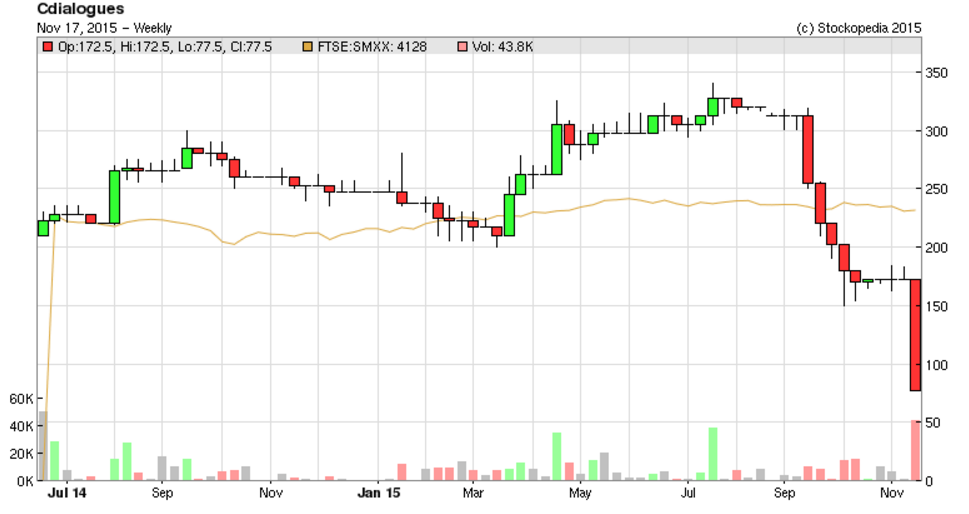
Share price: 77.5p (down 55% today)
No, shares: 6.2m
Market cap: £4.8m
Profit warning - the company (which appears to be a Greek mobile network marketing company) blames poor performance, and delays in new business, for a profit warning which says;
...the Board now believes that revenue for the year ending 31 December 2015 will be below current market expectations, with EBITDA for 2015 being materially below current market expectations.
As part of its normal budgeting process, the Board is reviewing its internal forecasts for the year ending 31 December 2016. Whilst this budgeting process has not yet been finalised, it is likely that these forecasts will be lower than current market expectations.
This is not particularly surprising given that there were clear warning signs that things were not going well, with a previous update on 18 Sep 2015, which I reported on here, expressing my doubts about this company. Amazingly the shares have dropped 73% since then - just 2 months ago, which reinforces the general point that it's often best to sell immediately on the first sign of trouble.
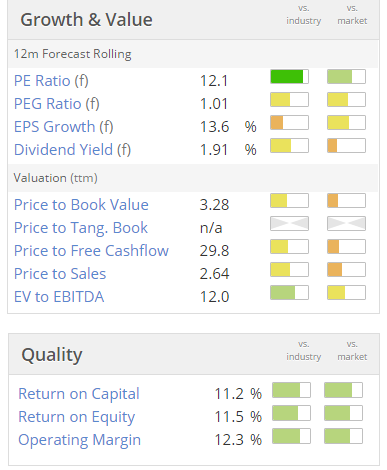
The company claims to have net cash, which now represents a significant proportion of its own market cap, so if you think that some shareholder value might arise from this cash, then it might be worth considering for people prepared to take large risks!
For me, it's Greek, and on AIM, so that makes it an automatic bargepole. Why waste any time on looking at things like this, when they nearly all go wrong sooner or later? Although note that, unusually, this one does pay divis.
The Group maintains a strong balance sheet with net cash as of 31 October 2015 above €3.6 million (31.12.2014: € 2.42 million) while it paid dividends of € 280k to its shareholders within the current financial year. Over 90% of Group cash is maintained in banks in the United Kingdom. The Group does not generate any revenues in the Greek market.
This quality offering was launched on AIM in Jun 2014 by Strand Hanson, and Mirabaud Securities, at 212p per share. Since 88.3% of the company is owned by its Directors, you do wonder why they listed it at all? The 11.7% not owned by Directors is now only worth £562k, so it can't make any financial sense to remain listed. Therefore I see the risk of a de-listing as being quite high? Hence the shares are uninvestable in my view, for multiple reasons.
Idox (LON:IDOX)
Share price: 46p (up 1p today)
No. shares: 355.7m
Market cap: £163.6m
Trading update - there's an upbeat-sounding report today from this software group, which is mainly focussed on the public sector. The key paragraph says;
The Company is pleased to report its Adjusted* results for the year are expected to be in line with market expectations, and that it is maintaining its forward guidance.
Note that the group has been making acquisitions, which will obviously drive earnings growth, which needs to be considered when valuing the shares - one really shouldn't put a stock on a growth multiple, if it's just buying in that growth using debt.
Talking of which, debt (which has been problematic in the past here) is creeping up again - net debt is reported at £23.1m as at 31 Oct 2015.
I last reviewed Idox here on 8 Jun 2015, when it published interims, and quite liked it - although the balance sheet is weak, the business is decently cash generative, hence has demonstrated an ability to pay down debt, and make acquisitions without issuing new shares to any great extent, which is clearly a positive thing.
Valuation - this looks a sensible valuation, probably about right in my view, although if the company keeps putting out positive newsflow, then the market might run the share price up a bit higher, who knows?
InternetQ (LON:INTQ)
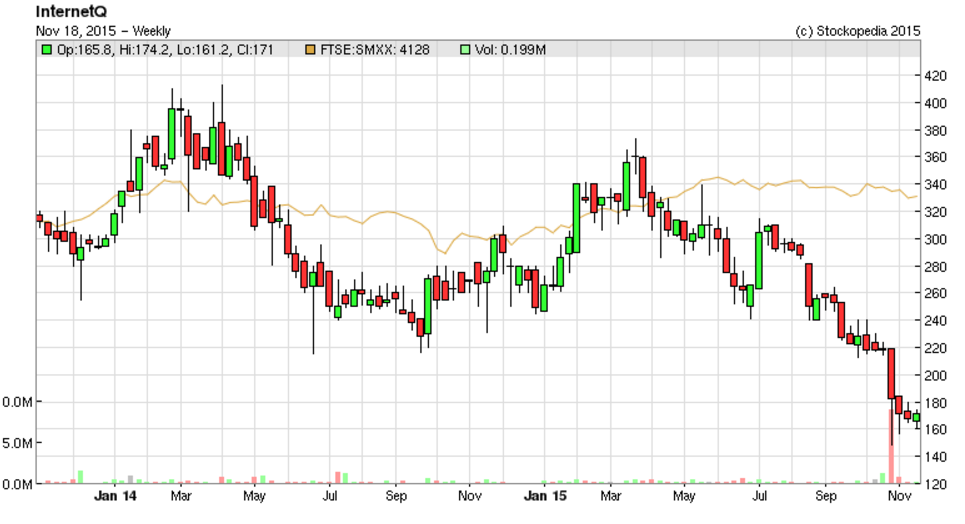
Share price: 171p (up 5% today)
No. shares: 40.3m
Market cap: £68.9m
Trading update, Q1-Q3 2015 - as always, the update from this company looks very positive. Turnover is said to be up 20% to E105.6m for 9 months of this year to date.
EBITDA is up 30% to E17.5m, although note that adjusted profit is only up 4% to E7.9m - presumably because the previously very heavy capitalisation of costs into intangible assets is now catching up with them, as the amortisation charge balloons.
My opinion - when I last reviewed this AIM listed Greek software company, I felt that its figures looked almost a carbon copy of Globo's. Although I should emphasise that was before the full extent of Globo's fraudulent activities came to light.
The similarities are marked though - in particular, excessive capitalisation of costs into intangibles, high debtors, holding a cash balance whilst simultaneously increasing bank debt, profits that don't turn into cash (because they are essentially fictitious - profit is created by capitalising costs), acquisitions of smaller companies, etc.
Plus of course the biggest red flag simply being that it's a Greek company on AIM. That alone makes it uninvestable, even without all the accounting nasties.
The one thing that has stopped me shorting this share (even though I think shorts will probably do well on this one, in the long run), is that Tosca invested E17m to buy a stake in InternetQ's music streaming business, called Akazoo. It's fair to say that Tosca has a very mixed track record, including some real howlers, like Cupid, Healthcare Locums, and others. So I certainly don't place any reliance on their judgement generally. However, they must have done some due diligence, to put E17m into Akazoo. That's enough of a factor to make me want to steer clear from risking a short on InternetQ.
The outcome with Globo, and the striking similarities between Globo and InternetQ's accounts, as probably enough to mean there's likely to be a dark cloud over this share for a long time to come. For that reason, it's not something that appeals in any way to me.
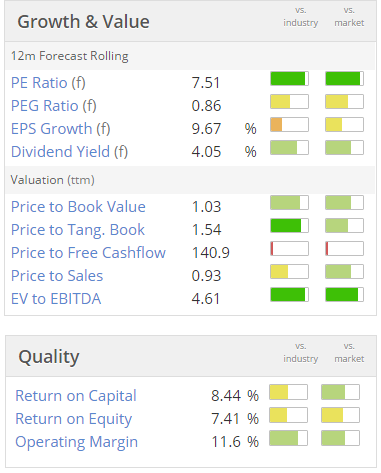
If it starts to generate real cashflow, and starts paying divis, then I would happily look at it again, but for now this remains on the Bargepole List. Another similarity with Globo is that the forward PER is extremely low, just 4.9. That in itself is another red flag - it tells us that the market doesn't believe the figures.
Lavendon (LON:LVD)
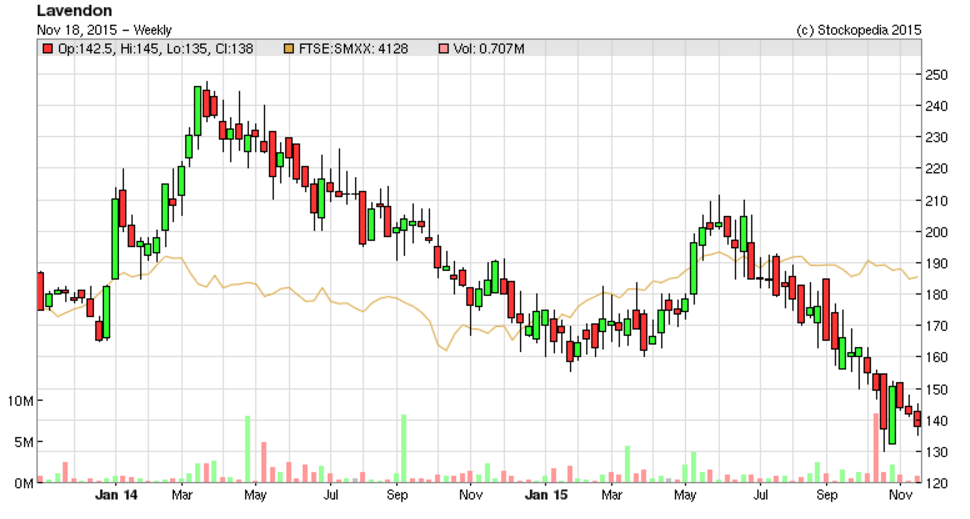
Share price: 140p (up 3.7% today)
No. shares: 169.7m
Market cap: £237.6m
(at the time of writing, I hold a long position in this share)
Trading update - since the share price has been so weak lately, and both Speedy Hire (LON:SDY) and HSS Hire (LON:HSS) issued profit warnings a little while ago, I was bracing myself for bad news from this equipment hire group.
Therefore, the upbeat trading update today made a pleasant surprise, and it's all the more surprising that the shares have only modestly bounced.
The key bit says;
"The Group's trading performance in the first nine months of the year has improved across our markets, driving growth in revenues, profitability and margins. The Board remains confident of delivering on its profit expectations for 2015, and with the delivery of the accelerated fleet investment now almost complete, we are well positioned to respond to market opportunities as we move into 2016."
Valuation - given how modest the valuation is, this looks like a potentially good buying opportunity to me:
My opinion - I really like this one. The shares look strikingly cheap. Furthermore, it has a sound balance sheet, pays a generous dividend, is on a very low PER, and we now also know that it's trading fairly well. What's not to like?!
Maybe I've missed something important, but I really can't see why the market has sold this one off so much lately, there doesn't appear to be any fundamental reason for the recent falls. Therefore, I shall probably be increasing my position size here in the next few days.
Mobile Streams (LON:MOS)
Share price: 15.5p (up 1.6% today)
No. shares: 37.1m
Market cap: £5.8m
(at the time of writing, I hold a long position in this share)
AGM statement - this is a very speculative one, so probably shouldn't be in a value report. However, the company has net cash, and reports today that it had £1.75m in net cash a week ago. NTAV is £3.7m, so I suppose that on a balance sheet basis, there is some support to the price in value terms.
However, what interests me is that the company is expanding into new territories, and reports today that its operations in India have started. The company does ad-funded mobile phone games. It operates mainly in Latin America, and also USA, and Nigeria.
Normally of course this would be a bargepole stock, as it's overseas & AIM. However, I think purely as a speculation, there might be the chance of a multibagger here. It has the look & feel of something speculative that possibly might, at some point, catch the market's imagination, and soar. Certainly the shares have, to a certain extent, already done that recently. Whilst very volatile, the higher price appears to be holding, and volume has been high recently.
Imagine if the company's newsflow from India is positive? That could perhaps trigger a re-rating from a miserly £5.6m market cap to something a good bit higher, maybe?
I must stress again, this is a real punt. But I like the fact that it has cash in the bank, and in the past these shares have multibagged twice before - on the back of strong growth, and decent profits. It all went wrong when the Argentinian currency had all those problems, and the cash pile ended up marooned overseas.
However, to my mind this proves that the company has a proper business, which has been decently profitable before, and therefore who knows, might be again?
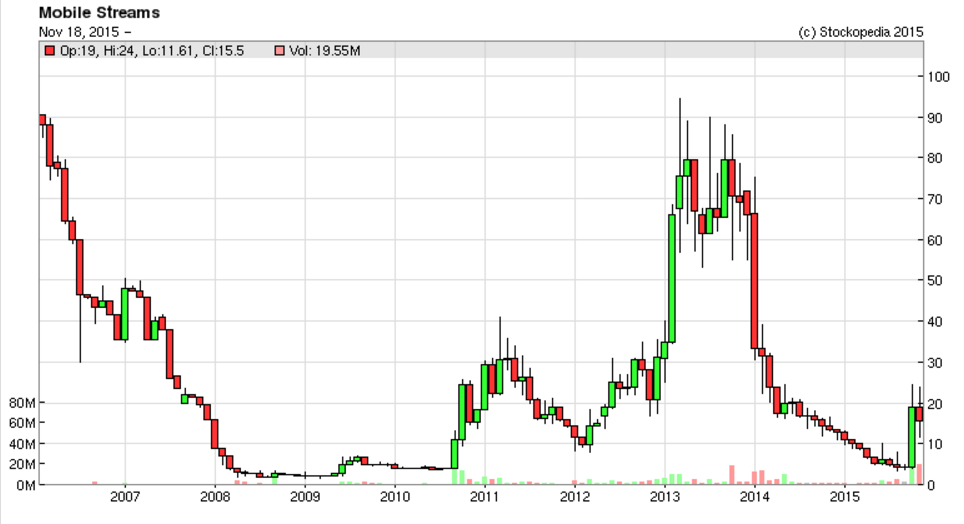
The long term chart shows that this share languished at 2-4p in 2009-10 but then multibagged to a peak of 33.8p in Mar 2011. It then dropped to a low of 9.8p in Feb 2012, before roaring off again to a new peak of 84p in Mar 2013. The most recent low, in Sep 2015 was about 4p. So at 15.5p it's already nearly 4-bagged in the last 2 months, and the mkt cap is still peanuts. Therefore, I am hoping that there's a chance of another multi-bag move from this share maybe? It's a real punt, but everyone likes a little bit of fizz in their portfolio! Wouldn't it all be boring is we didn't allocate a small chunk of the portfolio to have a bit of fun, which occasionally pays off?!
Note also that the number of shares in issue has only risen slightly during the moves noted above - from 36.3m shares in 2010, to 39.4m now. Therefore, theoretically, there's nothing to stop previous highs being revisited, if the fundamentals and outlook excite the market again.
So, not the sort of thing I normally comment on here, and it may well fail to multi-bag, but I think it looks potentially interesting, as a fun punt.
Blinkx (LON:BLNX)
Share price: 25.25p (down 1.9% today)
No. shares: 403.3m
Market cap: £101.8m
Interim results to 30 Sep 2015 - as expected, these figures are dreadful. The original business model broke, so they are now trying out other related things, to see if they can make the business viable again.
This is the trouble we are seeing over & over again with technology-related marketing companies. They hit a rich vein of profits, float the company at a high valuation, then quite soon afterwards, the wheels come off, and investors end up losing most of their money. We've seen this happen more recently with digital media companies, where ad-blocking software increasingly used by the public has just destroyed a whole sector almost overnight.
In H1 this year, Blinkx had a operating cashflow of minus $10.1m. Plus they spent $2.4m on development spending, so the way I look at it, they're running at an annualised cash loss of about $25m p.a.
The cash pile seems to be dwindling accordingly. So it's now reported at $74.9m, although there is another $7.5m which has appeared in "marketable securities" within fixed assets. I'm not sure what that is. If it was a cash equivalent, then it would be in current assets, not fixed assets.
If you can make sense of this outlook statement, then good for you!
The vision for the Company remains to connect consumers with brands through premium content across devices. With the key portfolio components in place, blinkx expects the second half of the financial year to show continued growth of Core mobile, video and Programmatic products, while actively managing down and potentially divesting Non-Core product lines. Integration, continued cost actions, the launch of new products and a return to profitability remain priorities, with key infrastructure milestones scheduled for completion through the first half of calendar 2016 that will simplify execution of multi-channel advertising campaigns for both advertisers and publishers.
The Company's mission is to democratize access to quality digital content in a way that is respectful of consumer choice, impactful for the advertiser and sustainable for the content owner. Solving this fundamental equation is critical in order for the industry to thrive. These basic tenets will guide blinkx's decision-making in the near- and long-term, and represent a path to sustainable growth for both the Company and industry.
My opinion - I would only take an interest in this share, if it was priced significantly below the company's own net cash, because the existing business appears to be a liability (as it's loss-making), rather than anything of value.
So to my mind it would only begin to look interesting at perhaps 10-12p per share, and then only as a complete punt.
As things stand, they don't have a viable business, but do at least have the luxury of a cash pile, which buys them time to sort things out. So it's not really an investment, it's just a complete punt at the moment, and not one that interests me.
Disclaimer
This is not financial advice. Our content is intended to be used and must be used for information and education purposes only. Please read our disclaimer and terms and conditions to understand our obligations.

24 comments
Morning Paul.
Not sure if you are still holding Mobile Streams (LON:MOS) as your "seasonal fizz stock", but if so I wondered if you had any views on the removal of currency controls in Argentina, one of their principal historic markets, and the impact this might have. On the one hand it might allow them to repatriate earnings more easily. On the other, a 30%+ devaluation in the Peso will presumably hit the value of revenues assuming the FX isn't hedged, and many of their costs are £ or US$ based. I recall you saw this very much as a punt on possible growth in other markets such as India so it may be that the Argentine situation is of secondary import.
Thanks,
Gus.
Hi gus,
I sold half my Mobile Streams (LON:MOS) on one of the big spikes up, so more than doubled my money, and am running the balance for free. So to be brutally honest, I'm not really monitoring events, but have just tucked away my remaining "free" shares for the long haul, on the basis that the company has been highly successful in the past, doesn't need cash, and is now trying out similar activities in other countries.
So who knows, it might work? A total punt, not my normal thing at all, but everyone needs to have a little fun!
Regards, Paul.
Thanks Paul.
Mobile Streams (LON:MOS) is a strange company. Not sure if I was writing a business plan I would choose Argentina, India and Nigeria as my target markets but then at least they have about a quarter of the world's population in their sights, have a reasonable balance sheet and have been profitable in the past.
A bit of a yo-yo to be honest - hopefully some more "up-yo" although I suspect the Argentine situation will adversely effect their share price in the near term. Some comfort in the fact that the founder/CEO still holds c.30% of the company stock.
Thanks again.
Gus.
Hi Gus,
Fair comments, but bear in mind that the mkt cap (£3.4m) & EV (£1.3m) of Mobile Streams (LON:MOS) are already so low, that the merest sniff of upside, and the shares can easily multi-bag - as we saw very recently. OK, the big rise didn't hold fully, by any means, but it's still over double what it was a few weeks ago.
The stampeding herd of bulletin board gamblers tend to surge in & out of this stock occasionally - so right now there will be a lot of people watching this stock, and it could easily double (or more) on a strong RNS. The company has been commercially successful before.
Overall, I think it's a very interesting little speculation, to add some potential fizz to an otherwise quite boring portfolio!
Regards, Paul.
Hi Paul
Novice investor here
After reading about internetq I was surprised to read about the accounts with this one being dodgy. On the face of it I wouldn't buy it's stock because1. It's not an industry I know well 2 doesn't give me confidence coming from Greece.
However first look at the numbers look quite good, but I don't understand why there is "payments for intangible assets"? As I thought this was like brand names and intellectual property etc. Which I thought just adds value over time ?
Appologies for sounding simple, I'm a bit lost with this one.
Thanks
Sean
Hi smatthews1,
What Globo (LON:GBO) did to create fake profits, was to capitalise a huge amount of costs onto the Bal Sheet. So instead of the debit entries going through the P&L as costs, they instead go onto the Bal Sheet into intangible assets, thus inflating reported profits.
InternetQ (LON:INTQ) is doing exactly the same thing. The easiest place to find this, is on the cashflow statement, within the investing activities section, where you will see an item called "Payments for intangible assets", which is costs that they are capitalising. Although in this case, it's not much higher than the depreciation/amortisation charge, so you could argue that it's not flattering profits that much.
INTQ's Bal Sht looks weird, in that it displays a lot of the same traits that Globo's did - extremely high intangibles and receivables, running cash balances simultaneously with a similar amount of debt, etc.
I was right in thinking that INTQ might bounce after the bear raid, which it has, but it's certainly not a stock I would want to hold for any length of time, indeed I've sold out now.
I'm not saying that INTQ is definitely a fraud, but I think it displays a remarkable similarity in its accounts to Globo, and that should be enough of a warning to keep any sensible person away from it!
Regards, Paul.
value101,
FCF is after capex, and Lavendon (LON:LVD) are building up their rental fleet - clearly a policy decision, so it doesn't really make any sense to use free cashflow as a performance measure, and be concerned about it, when they are deliberately expanding as their chosen strategy.
The best explanation I've heard today for the share price weakness at LVD came in an email from a friend earlier today. He believes that the market is worried about declining revs/profits from the M.East, which is apparently decently profitable for Lavendon, in light of the low oil price, and likelihood of countries like S.Arabia scaling back their infrastructure spending.
That, to my mind, is a far more credible explanation for the soft share price. All the stuff about ROCE is background noise, because it's already known about. We need to look for something that's changing, and I think worries over M.East exposure is the most sensible explanation for the soft share price.
Regards, Paul.
Sorry, if that chart's impossible to see, I've uploaded it here:
http://imgur.com/8EZlAhu
Although LVD appears to be reasonable value at present, I'm a little more cautious than most. I would certainly attribute a lower than average PE multiple to a business like this based on quality factors.
Firstly, it is correct to be concerned about ROCE, not least because the company itself is. The second paragraph of the 2014 Chairman's Statement says:
"The growth in our revenue has delivered improved profitability which, alongside self-funded
investment, has driven the Group’s return on capital employed (ROCE) ahead of our weighted average cost of capital (WACC) for the first time since the economic downturn in 2008 – an important strategic milestone for the Group."
Where cyclical businesses such as LVD are concerned, it is more instructive from a valuation perspective to examine ROCE across the cycle. Taking a single year ROCE is meaningless, and will likely lead to an overvaluation of the business if you happen to take that measurement at a favourable time in the cycle. Clearly, the minimum acceptable ROCE is cost of capital and based upon the Chairman's comments above, this has been an issue for the group in the past.
To help see this over a 10 year period, there is a very interesting chart in LVD's 2014 results presentation:

As you can see, ROCE (red line) has been below the company's WACC (green line) for most of the 10 year period. As a result, it may be arguable that the company's assets shouldn't be valued any higher than book.A more optimistic view of LVD may be that the uptrend in ROCE isn't wholly cyclical, but at least partially due to business improvements and efficiencies. I'll leave that view to the optimists however!
The common problem with these sorts of cyclical, low ROCE businesses is that when ROCE is at the top of the cycle the company takes on more debt for expansion (and low ROCE companies of course require more capital per unit of growth) and when the cycle eventually turns they are left over-leveraged. Indeed, that happened with LVD in 2009 when it carried out a placing and open offer in order to repair its balance sheet (albeit one of many back then!). As we can see from the LVD interims, the company is now expanding its fleet in these more profitable times with the resultant leap in net debt, now standing at approximately 4.6 times underlying 2014 earnings. (I don't like EBITDA - that's for bankers!).
So those with a long term view may well be more cautious on LVD's valuation for the above reasons. In the short term, traders will, as usual, focus on PE and growth with the usual result of bidding the share price above intrinsic value in the good times. So perhaps there's a short term profitable trade to be had here, but beware: you'd better be vigilant for any signs of a turn in the tide!
Best,
MI
Hi Paul.
I'm back; can you help the 'learning'. Just looked at the valuation models on stockopedia for Lavendon. DCF puts it at 26.78p; Ben Graham rule of thumb at 45.23; Earnings power at 16.6p and Tngible Book value at 87.92p. Relative to sector is at 224.16p which is obviously good. Some say DCF is a very valid measure- what are your thoughts and what can I learn from this. Totally confused - Charles
It seems a boring business that at least I can understand and I like boring businesses. Also it is based in the UK and not in a country with "stan" its name, or Russia or India or anywhere where the market authorities are easily corrupted (this rules out at least 70% of investments.).
its a buy!
Thanks for the update on Lavendon, I am a holder and it was my first purchase for my son's ISA, so I was getting a bit worried. I am now re assured. Also thanks to all on the discussion and data, as a 'student' of investing all in depth discussion helps my learning.
Paul, it's good to go out on the lash occasionally. Although I look forward to your post daily its no problem to wait; good on you.
KR Charles
ROCE is relevant as a limit factor - i.e. in those businesses which are capitally constrained. Many profitable businesses have other more dominant constraints, and end up returning surplus cash as dividends, or spending on non-core ventures. So beware of using it outside of the situations in which it's critical. Think for example of a financially attractive business like Bioventix (LON:BVXP). They could retain more of their dividends or raise more capital, but it would be irrelevant - it wouldn't improve your returns per share. I believe the key is understanding the constraints to growth and the risks.
Good post Kelvin. I think we're in the minority looking at the ROCE of a business as a main filter. Many seem to be enticed by the 'SP was up there, now it's down here' style of investing. Nothing wrong with that of courses you are good at timing purchases and jumping off before the fan is visited by the smelly stuff. Over time, companies do better if they have a higher return from the capital they employ.
NI
As regards ROCE, I've had a discussion about this with a colleague this morning. Personally I place less reliance on ROCE than many people do. It's never going to be that high at an equipment hire company anyway, as outsized returns will simply stimulate competitors to join that space and erode prices.
A far more useful measure, in my view, is operating profit. On this basis, Lavendon (LON:LVD) does fine, with an operating margin of 11.6%.
Moreover, my manual calculation of ROCE (excluding intangible assets, which I always write off) comes out at a reasonable 15.1% (based on last year's figures, with Fix Ass (less intangibles) + current assets, less current liabilities of £259.9m, and pre-exceptional EBIT of £39.3m.
To my mind, that's a perfectly acceptable ROCE, especially given that debt funding is so cheap at the moment, and likely to remain so for some time.
Moreover, there's an attractive divi yield of 3.6%, which is covered by earnings 3.4 times. The last divi rose 30%, so a very pleasing trajectory there.
We have a bang up-to-date positive trading statement, and a strong balance sheet, to reassure.
So, either the price now is wrong (too low), or the price over the last few years has been wrong (too high). I think it's the former - this is a stand out valuation anomaly in the sector, in my view.
It's nothing to do with anchoring to a previous share price, and saying, ooh it must be cheap. It looks extremely good value on solid metrics like PER, divi yield, operating margin is good, balance sheet is good, ROCE is not that bad when you take out intangibles, etc.
It's not a share I would want to hold forever, but to my mind risk:reward is clearly attractive at c.140p per share. In my view, there's a probably 20-40% fairly easy gain on this, if we're patient, just for it to re-rate back to a more appropriate valuation, of a PER of say 10-12.
I see very little downside from this price, and quite good upside. But as always, I'm grateful for opposing views - always important to consider all angles on it.
Regards, Paul.
Paul,
I hold LVD and I'm thinking of buying a few more although that will take me to a larger holding than I'd normally be comfortable with for such a cyclical small cap business. I believe there are two institutions (Old Mutual and Kames Capital) who have been offloading shares for most of this year and suppressing the price. Given yesterday's trading update, there's clearly no fundamental reason for their selling and I always find buying under such circumstances is profitable if you're prepared to sit out and wait for the selling to be cleared, the fundamentals of the business will out.
All the best, Si
Hi Paul,
Maybe I missed something, but it looks like Lavendon's FCF is steadily decreasing towards 0. That would be a big no-no to me, unless there are large capex justified by reasonable opportunities to increase sales or reduce costs...
Cheers
There is an excellent article on the calculation of FCF and its significance where companies are investing to grow (which LVD is doing) here: http://www.sharescope.co.uk/philoakley_article54.jsp
Note the point that where there is investment CAPEX (as distinct from maintenance CAPEX) it's the ROCE on that CAPEX that counts (as discussed in post #14 above)
Cheers,
Mark
A big problem with ROCE is that the number for capital is pretty noisy and open to interpretation, so the raw numbers are not that useful and adjusting them is tricky.
Hi Paul
thanks for another great report. Re. Lavendon I don't think its as much of a bargain as it appears, having had a look at the historical performance of the business.
Last 6 years owner returns are as follows:
- Increase in book value/share: 23.5 (the accounts look pretty clean, as you've said, so I'll assume that the book value is "real" value for now)
- dividends per share: 20.15p
Total return = 43.65p/107.1=40.8% over 6 years = 6.8%, which by curious coincidence matches their operating margin exactly.
Is this an attractive investment if one considers paying out a notional £1 now for a prospective 6.8% earnings yield in future? Given an equivalent owner earnings yield (dividend plus increase in book value) is available from a low cost stock market index, it doesn't look like great compensation for the risk involved in a smaller company.
So... I think that its cheap for a reason - and the reason is that the business inherently earns a pretty low return on capital, and always will.
Of course, the market is a fickly thing, and the share price may go up and down like the proverbial, but I think not for me.
Fair comments on MOS. Management certainly showed their abilities in Argentina until its currency got into trouble. They have a good chance of doing well elsewhere and the relatively small number of shares is issue means any serious buying will have a very noticeable effect.
Hi Paul
Sorry to hear your not doing the report on Boohoo. I was looking forward to it. That said I do understand. I use to comment on FT articles quite a lot and have had three letters published in the past 10 years (I've only written four) but the response to a benign comment I made on an article on IHT in the FT was so unpleasant that I have not commented since and never will again.
That said if you ever do a paid for blog like JIC or UK Value Investor I will be subscriber numero uno.
Hope the hangover is subsiding now.
Michael
Where is the article on Boohoo promised over the weekend? More stockbroker events? Best regards
Yours humanly
Hey Paul you sound like a normal person not like the usual financial people I meet ! Hope your head isn't hurting too much?