Small Cap Value Report (17 Oct 2014) - NPT, SPSY, HYNS

Good morning! Back to work today after a day off yesterday.
It looks as if the sell-off in the USA has abated, at least for the time being. So maybe we might see some share price recoveries over here? Or maybe investors with cash will sit on their hands for the time being? It will be fascinating to see what happens. Personally I'm starting to see bargains appear, as good news is ignored, and the things I'm focussing on are companies with good dividends and strong Balance Sheets - although that's what I always focus on anyway because the downside is very limited with that type of stock (providing the dividends are sustainable).
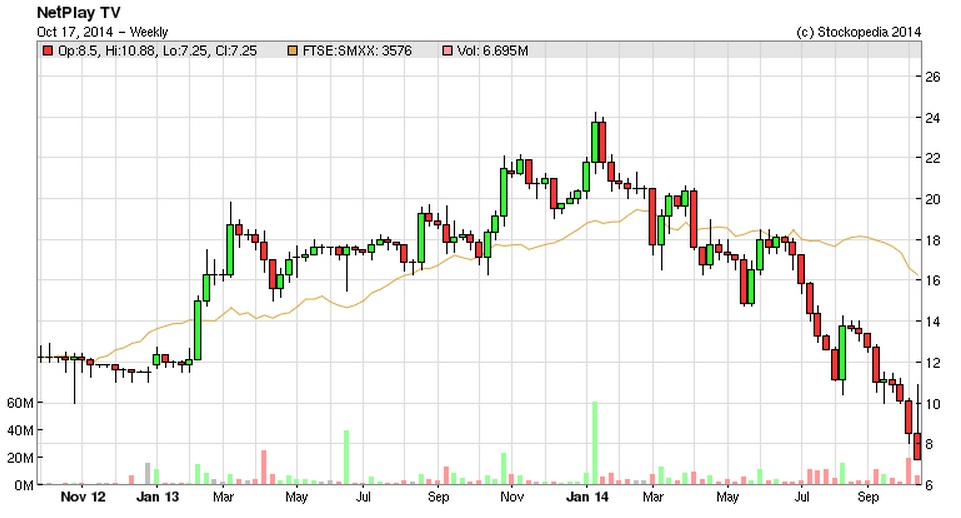
NetPlay TV (LON:NPT)
Share price: 7.5p
No. shares: 296.6m
Market Cap: £22.2m
Trading update - this starts off sounding positive, with these positive opening statistics;
21% increase in new depositing players to 18,853 (Q3 2013: 15,566)
22% increase in active depositing players to 35,225 (Q3 2013: 28,890)
High level of marketing spend results in expected full year results to be below market expectations
Cash balances £13.4m at 30 September 2014 equating to 4.5 pence per share.
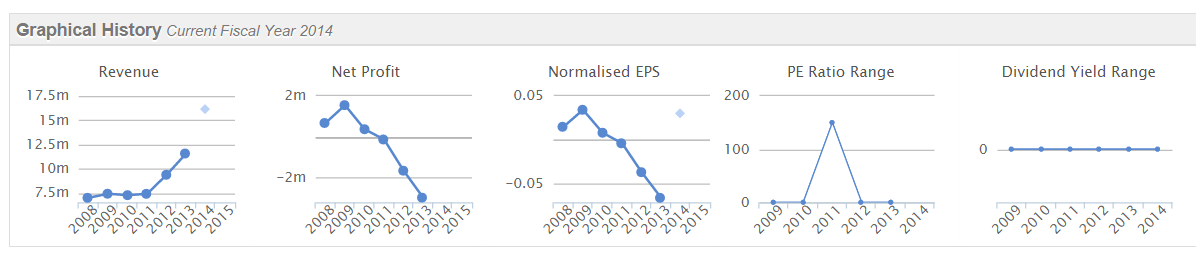
But hang on a minute! I did a double-take when reading point 3 - surely high marketing spend should deliver positive results, not negative results? After all, they are reporting a 22% increase in customer numbers. We have a problem here.
More is revealed here;
Despite the Group's level of marketing spend, it has not achieved the targeted levels of new customers and net revenue expected from this spend. This situation combined with the current trading environment, and the initiation of POC means that the Board expects current market expectations to be materially lower than forecast.
Oh dear. This suggests that something is structurally wrong with their market - maybe some customers have just run out of money to gamble with? After all, we are in an era of declining living standards for many people as their real disposable incomes are eroded.
Also there is material uncertainty over the introduction of new gaming taxes shortly. I've never believed this company's reassurances on that point, talk of mitigating the impact, etc. In my view it's safer to wait and see how things actually pan out, when there is any doubt over changes in regulations. Also, to my mind by far the biggest "tell" was large Director selling a while ago - if they're getting their own money out, whey should I put mine in?!
On a more positive note, action is being taken to improve marketing, and the company is cash generative and has a very strong Balance Sheet;
Management has conducted a thorough review of its marketing activity and has developed a new strategy designed to deliver improved returns through more cost effective and better targeted marketing spend.
The Company remains highly cash flow generative and is supported by a strong balance sheet with cash or cash equivalents totalling £13.4m at 30 September 2014.
My opinion - So there will come a point where this share is cheap, I'm just not sure we are there yet. Cash is worth 4.5p per share, so that should underpin things, if the company remains profitable once the tax changes have been implemented.
Note that the relatively small (£10k & £20k) Director buys in recent months now look to have been done more for PR reasons, to arrest the share price decline, than on fundamentals.
Jimmy Choo
The luxury shoes brand has been a much anticipated IPO, and I did wonder if it would be pulled, given market conditions, but it seems to be going ahead. No prospectus has been published yet, but today the company announces the pricing of the IPO and some other details. It will be at 140p, which values the company at £545.6m. It's amazing to think that the company only started in 1996.
Unusually, the major shareholder JAB Luxury GmbH will still own about 70.2% of the company post IPO, which seems very high - I wonder if they tried to sell more, but couldn't find enough buyers? There is a one year lock-in, so I would expect a subsequent Placing of more of those shares at some point.
I'll have a run through the figures when the Prospectus is published, but am not expecting to find value here! Most IPOs have been priced too aggressively this year. I was interested to hear the views of a Fund Manager who commented that the pricing of IPOs "doesn't leave anything on the table for the buyer", a good way of describing it. Perhaps a better way of doing things might be for companies to List, and then release tranches of shares to buyers at prices that have been determined by the market?
It amazes me that there still appears to be demand for IPO stocks, as the recent history very much shows that buying these things at launch means you nearly always get a bum deal. After all, why would the existing owner be selling unless he was selling at a favourable price for him?!
Aviation shares
I normally have an aversion to aviation shares (airlines, or support companies), as things so often seem to go wrong. However, this could be an interesting area to look at. Valuations have been hit hard by the Ebola outbreak. However, it seems that the virus is not transmitted through the air, but from contact with bodily fluids if not wearing rubber gloves. Therefore it should be containable, and I saw on the news last night that good quarantining procedures had already worked in Nigeria, where they apparently prevented an outbreak.
Therefore, assuming the virus doesn't mutate into a more readily transmitted form, the impact on air travel should be very little. Combined with sharply falling oil prices, which obviously helps boost the profit of airlines, then this could present a value buying opportunity? Something to consider anyway.
On a human level one obviously hopes that the outbreak is stopped soon, but as investors we have to consider the commercial impact of this type of thing too.
Widening spreads
It's 09:40 now, and I am seeing a widespread recovery in the 90 or so small caps that I monitor in real time.
One thing I've noticed today is that the Market Makers are widening the spreads on most of the smallest companies I look at. So that it's totally uneconomic to try to time the market, trading in & out of these shares. Also I tried to buy one share this morning, with a £13m market cap, and was quoted the full Offer price, and so have incurred an instant loss of over 5% when valuing the position at the Bid price.
It's a high yielding share, but just paying the Bid/Offer spread will consume my first year's dividend!
So if you're trying to time the market, then it really only makes sense to trade the more liquid shares, where the spread is narrow. It's pointless trying to be clever and trade in & out of micro caps, as you can't get the liquidity to buy or sell in any size, and the spreads are too wide to make it economic to do so.
Also, I think it's always best to buy on a red day, and sell on a blue day, but that means you might miss a big move upwards when other buyers force the price up rapidly. If you didn't move first thing this morning, then you've already missed a decent bounce in many stocks.
Hedge Fund selling
Somebody just made a very good point on Twitter, that some of the panic selling this week in the USA has been driven by Hedge Funds that were hit hard by the Shire takeover deal falling through. Apparently that put deal arbitrage Hedge Funds onto massive margin calls, which had to be met by liquidating their positions in other stocks, and thus triggering further margin calls, and snowballing into a selling frenzy of leveraged market participants.
The market then has to overshoot on the downside before value investors see enough value to come into the market buying. That all rings true to me.
So overall I think this was a necessary correction, with a capitulation phase 1-2 days ago, as leveraged forced sellers were chewed up & spat out by the market. So I'll stick my neck out here, and say that my instinct is that we're probably over the worst now, and I suspect that (providing there is no more serious bad news) that the market might well stabilise or recover from current levels. Hence I'm a buyer now.
Spectra Systems (LON:SPSY)
Share price: 19.25p
No. shares: 45.3m
Market Cap: £8.7m
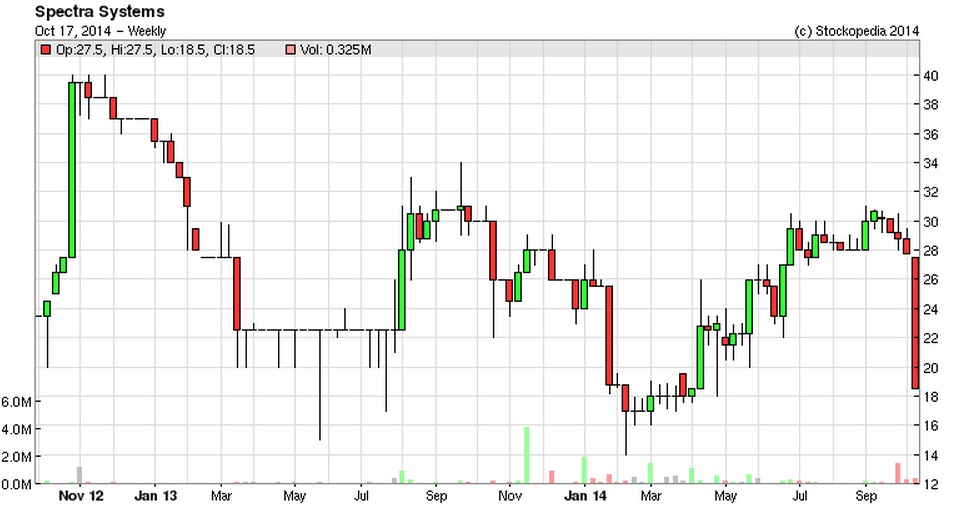
These shares have been heavily whacked this morning, so clearly the market doesn't like their update. I've looked at this company before, but not in any great depth. It's a rather odd little company, based in America, which makes equipment to handle, and chemically clean bank notes, so they can be re-used.
Its historical performance really shows the opposite of what you want;
However, the bull case rests on the company's own cash pile being close to its market cap. Although it's not clear to me that the operating business is worth anything.
Having said that, the last set of interim results look quite good, with a big increase in turnover, and a move into profit. Although the company does not seem able to produce sustainable profit, probably due to the lumpy nature of contracts.
Update - the company says today that a trial with a Mexican bank has fallen through;
Based on this test, the Banco de Mexico stated that: "specifically for the Mexican banknote mix and design, the cleaning process does not meet the central bank's needs at this time and we will consider a second trial of the cleansing technology for the new series of Mexican banknotes, to be issued in 2019".
Although it's not all bad news;
Over the past month, a second Asian central bank has initiated a test program and another third major Asian central bank has requested a detailed estimate of the ongoing operating costs based around the capacity of the commercial AerisTM system being built by Cool Clean Technologies.
The Board continues to be optimistic about the commercialization of the AerisTM banknote cleaning technology and its potential impact on the group's performance over the next few years.
Therefore, if you share the Board's optimism, this might be a good buying opportunity?
My opinion - I'm neutral on this share, because I don't really understand what competitive advantages (if any) the company has, hence have no idea what the future might hold for it. Also I have an aversion to small companies from overseas which list on the UK stock market. Although American companies are usually reasonably alright.
It's worth bearing in mind that companies which never pay dividends arguably exist purely for the benefit of their Directors and employees, who are the only financial beneficiaries from the company's existence.
Although it does seem a rather savage drop in price this morning - down 30% on the day. If you like the company, then it might be a chance to buy in at a bargain price perhaps?
Haynes Publishing (LON:HYNS)
DIY car manuals publisher Haynes has today published its Q1 trading statement covering Jun-Aug 2014 inclusive. It looks pretty awful to me;
As a result of these tighter inventory controls, overall Group revenue ended the first quarter 18% down against the prior period
The company blames currency translation, and de-stocking by customers, but 18% down seems to me far more serious than that. Hence I wouldn't be at all surprised for them to issue a profit warning in a few months' time. There is no mention of profitability in today's statement, which seems odd.
That's me done for today & the week. Apologies again for there being no report yesterday.
Regards, Paul.
(of the companies mentioned today, Paul has no long or short positions.
A fund management company with which Paul is associated may hold positions in companies mentioned)
Disclaimer
This is not financial advice. Our content is intended to be used and must be used for information and education purposes only. Please read our disclaimer and terms and conditions to understand our obligations.

24 comments
I like the idea of some direct matching system. There is clearly an unsatisfactory lack of competition if the market makers can put a 5% spread on a small cap and the investor has no choice but to go elsewhere.
Direct matching could completely eliminate the bid-offer spread, which seems like a good idea.
Of course there needs to be some solution to correct for mismatch in order quantities. If I want 2000 shares and the vendor has 2100 for sale & this is not visible, there needs to be a mechanism to allow both parties the option of adjusting their quantity.
I think it's the Singapore (or was it HK?) market has has defined order multpiles for each stock. You look up the stock and then for example the orders have to be placed in multiples of 500. This is inconvenient, but is preferable to losing 5% on bid offer spread.
The interesting question is how to effectively campaign for such reforms?
Attention of Paul Scott
Paul I think if you check IG Index account allows you to trade as a market participant so you can put your own order into the order book and effectively buy at the bid price the Naked Ttrader uses this technique.
P.S When are you going to write a trading book you have a great story to tell and I reckon it would sell a lot of copies.
Regards
Andy
Surely Haynes Publishing (LON:HYNS) will tend to 0p? It is in a dying industry books (like, CD's DVD's etc) servicing people who can't and don't do any more service cars because they have become to complex?
I would at least like the ability to place an open limit order - there to be shot at .So if I was bidding,,say,10p for a share,it should not later trade below 10p before my order had been filled.Not even as a cross-trade.
I like Paul's idea of the SETSsq system effectively replacing SEAQ for small caps. As people have already said, this change would require almost no effort and could be implemented more or less instantly. It would more than satisfy Paul's slowness criteron (although I think auctions should be a bit more frequent).
It would, of course, eat into the MM's feast (the huge spreads they monopolise) but doesn't the LSE give a darn about the competitiveness of their systems? No?
Thanks Paul - will look at this further.
At the moment I am a bit busy writing a research report on new entrants into the banking. But the huge bid offer spreads that small cap market makers quote are an obvious target, similarly like that massive spreads banks charged retail customers for forex.
When I worked at seymour pierce, the market makers, who were all fat and stupid, used to say "I made a million pounds for the firm last year. You other guys are just a cost." Funnily enough when the firm went into administration, none of them were taken on by Cantors who bought parts of the business from the administrator.
Paul, just reading about NPT on the net. I see they had £14.3m 5 weeks ago but today report £13.4m, should that be a concern? The purchase this morning by Lapping isn't exactly endorsing.
Thanks Paul. Just picked up a bunch of Spectra. Looks brilliant value when I look deeper
I think Avation (LON:AVAP) was mentioned in Sahres Magazine yesterday.
Hi Paul,
I have started reading your small cap reports about a month ago and find them excellent - thanks for sharing your thoughts and ideas.
Particularly enjoy your comments on the wider market and investing in general.
Kind regards
Gerry
Hi Paul,
I agree with your comments on absurdly wide bid offer spreads. Removing stamp duty from AIM is a joke, when you have spreads 10 to 20x wider than 0.5% stamp duty.
I would like to do something about this, but can't think how it can be solved? How can we MM them to quote narrower spreads in say £10K size? There must be a technological solution similar to transferwise or some of these marketbased lenders that match borrowers and savers?
Bruce
Hi brucepackard,
I've given a lot of thought to a solution to the lack of liquidity & wide spreads in micro/small caps.
In my view the best solution would be to have an electronic order book, with direct access automatically given to all investors, where orders go into a dark pool, and if buyers & sellers match, then the trade would just be executed at the mid-price.
So cutting out brokers altogether, other than to provide the IT, and to do the administration.
The reason why I favour a dark pool is because if orders are visible, then people constantly play games and try to out-wit each other, including spurious price movements, fake orders, iceberg orders, etc. Nobody wants to show their hand (either buyers or sellers). So a dark arrangement, whereby anyone who wants to buy or sell simply puts in a firm order, at a fixed price, or a price range, gets automatically filled if someone else also has an opposite order at the same price. Match at the mid-price for every trade, job done.
So you wouldn't need market makers at all.
It will probably never happen, because there are too many vested interests involved.
Regards, Paul.
P.S. The SETSqx system is a good idea (auctions 4 times a day, when people can by-pass the MMs), but hardly anyone uses it, because people don't have direct market access, and discount brokers are not interested in providing access to that kind of thing, they just want lots of electronic orders, filled instantly.
Dark pools are at best a mixed blessing, in general and for this problem:
First, if all the liquidity goes there you won't know the spread, as the public quote will be a dead stub quote on a huge spread (or no price at all in a pure dark pool scenario). So you'll just see a sea of stocks with huge spreads, some of whom may or may not trade on the dark pool. Is that progress? Some people will still be turned off by not seeing the real spread and having to play dark pool games to access the liquidity. To some extent the existing RSP system *is* collectively a dark pool as resting limit orders from clients are not shown, just pinged into the pool every so often according to broker algorithms.
Secondly, that nobody wants to show their hand is trivially false in that at the very least I want to show my hand. As a long term investor if I decide some price is good to buy/sell at, I want to advertise that and see if people come and take my price. In so far as my fundamental research is right more often than not (let's assume that for the sake of argument), I know my price is good and I want to attract people to trade with me (at the wrong price for them!). Compared to public markets, dark pools disenfranchise people like me who are deprived from a platform to advertise they are open for trading at a given price and quantity.
Thirdly, while order book games can be played, a twist on the rules won't remove the problem, you can still play games from the tape and or from various techniques for prodding a dark pool (e.g. send lots of small orders, of trivial size compared to your real order, at various prices to reveal the limits in the book) and or other techniques to be imagined. So dark pools are to an extent the worst of both worlds: most of the game playing of open markets, but with lost transparency.
Open electronic markets for small caps work well enough almost everywhere they've been tried (US, Xetra, euronext, etc) so the LSE should simply join the modern world, there's no need to invent something new and quirky and probably counterproductive here. The solution is known, it just needs to be implemented.
And if you really don't want to show your hand, dark pools can be on the side (as they are on these other markets) but the main reference market should be open -- you can't have good price formation without price information!
Hi cig,
Interesting points, thanks.
The dark pool idea for small caps would have to work in addition to a visible market for small trades, to provide a price reference.
Another idea is that an electronic order book (i.e. visible) could be used for small caps, but slowed down - i.e. the smaller the market cap, then the longer the order has to be left on the order book. This would make people think before placing an order, and stop people playing silly beggars with the price.
So I would like orders for illiquid stocks to be placed for, say a compulsory 5 minutes minimum - i.e. impossible to cancel the order once it is placed. Maybe give people a 10-second window to cancel the order if they accidentally place a fat fingered trade, but only allow them to cancel say 1 or 2 orders per day, to prevent this being abused.
If price sensitive news is announced, then all orders on the order book should be automatically suspended, so that people have time to digest the news.
LSE should try out a few of these ideas, and see what works best.
Until investors get direct market access though, I don't think a lot will change. More disintermediation is needed!
Regards, Paul.
I totally agree on direct market access, just debating the how here! And we'll get there faster if the LSE starts with applying the rest-of-the-world state of the art, before considering experiments.
On dark pools on the side, the total market is finite by definition, most of the activity that goes dark is likely to come from the public realm, hence big spread/people going away vicious cycle. So it's better if dark is marginal (ideally only getting the people who otherwise wouldn't trade at all).
For abusive order cancellations, personally I don't think that's a huge problem (if they came in the first place they'll probably come back and the game playing is largely zero sum) but if you must do something about it, just use a market solution: price the cancellation and let the invisible hand do its work. There's a sweet spot where the price of the cancel is low enough that when you have to cancel for a good reason (news, fat finger, etc) you won't mind, but that prevents intensive gameplaying cancelling (on US markets I pay 1 cent/cancel). On some exchange you get a few free cancels for every executed trade on the same day/instrument, which is good as well.
Another possible substitute for dark pools is simply the close auction: you put a limit-on-close order that doesn't execute in the session itself, only during the close auction, if the transaction maximising price is within your limit, it's one reasonably transparent way to cluster liquidity at a slower pace.
I don't think exchanges should act on news. That's what the market is there for in the first place, it's among other things a platform to debate company(-relevant) news as expressed in the price! And it's virtually impossible for an exchange to react sensibly: the exchange won't cope with anything but RNS (e.g. tweets from famed bloggers...) If some people react faster than you, so be it. The Olympic games would be boring if the chronometer was automatically suspended until the last guy has finished the run... Personally, I think the slow can beat the fast by being wiser.
There shouldn't be. It's frankly the agency issue again. Private investors stick all their money in funds these days and the funds have to buy something to fulfil their fully invested mandate. They'll take a chunk of anything that looks like it might be floated into an index as they are all benchmarked and have tracking error if they don't.
Nobody would buy half these floats if it was their own money. It's not their own money so they don't really care.
Basically the smart money (company owners, private equity) treats the fund management industry like the dumb money it is. The stock market is just an exit route. Frankly the whole thing is a racket and makes me sick... smart money routinely gaming Joe Blogg's pension.
If that is the problem there's an easy fix: start a specialised derivative house that for every IPO you consider dodgy you offer a deliverable future-like product for a slight discount to IPO price. You then make your money from the difference between the inevitably depressed stock price on delivery date (when you buy on the secondary market to deliver to the client) and IPO less discount. It shouldn't take a big discount to attract custom from the fund managers (who are not so dumb as not to take an obvious discount). After a while of you doing this the IPO prices will converge close to fair prices.
(I've looked at this recently, if in a cursory manner, but have not seen any obvious anomaly, the distribution of post-IPO price moves on a weeks to months horizon seemed to be pretty close to random to me.)
As for the stock market being an exit route, what's wrong with that as such? The only purpose of the stock market is to be a platform for companies to find funds for their ventures. For some ventures where public markets are not optimal, other operators provide funding and then if the venture becomes of a nature that is more friendly to the public market format, they can exit -- their job is just a form of bridge credit between funding styles and they get paid for that service, as we get paid for lending our money to listed ventures.
Appreciate the wider commentary Paul, esp on spreads and hedge funds! Very interesting esp the latter.
Second Oldnotbold's comments.
Companies such as Norcros, Vislink, and Co seem to have suffered unduly...tempted to nibble some more of those two,as well as SFE funnily enough enough.
Re AVAP, its PER had dropped to below 6.5, very low for the kind of compazny it is.
Paul, good morning.
AVAP was slaughtered over the last few days but is up 7% this morning, it's the airlines sector but indirectly, leasing of planes.
Hi Paul, I was wondering if you could review your favourite stocks after this recent market laceration. I see lots of value emerging. For instance, I just looked up Safestyle (recent IPO, don't own it), and see it has collapsed to a single digit PE, net cash on BS, strong ROCE and ROE, good '88' stock rank, positive interims, positive outlook statement, highly cyclical into UK housebuilding via uPVC windows (but given all political parties' commitments to building more houses, not a bad thing in an election period, perhaps). There must be many like this, that have sold off for no particularly good reason. I'd love to see your list of the unfairly punished.
Hi oldnotbold,
I don't think I'll publish a list, as I tried that on Twitter yesterday, and was immediately criticised for promoting my own shares. So I blocked that particular person, problem solved! But I suppose he did have a point, albeit expressed with all the lack of charm that you expect from anonymous internet posters.
So the way I look at it is this. If I liked a share on good fundamentals a month ago, and it's now 10%+ cheaper, and there has been no change in the fundamentals, then I'm looking at buying more.
Although I do think it's important to have a bang up-to-date trading statement, saying that the company is trading in line with expectations. Then you know for sure that the drop in share price has been sentiment driven, and hence is spurious.
I've looked at SafeStyle, but it didn't grab me. It's the sort of very cyclical business that should be on a low PER, because it will be making super-normal profits right now due to interest rates being low (thus making financing cheaper for customers), and with housebuilding being buoyant.
So I would say that a PER in mid to high single digits is the correct price.
It's easy to set up double-glazing companies - a distant relative did it years ago. He made good profit in the boom years, then went bust in the next Recession.
Regards, Paul.
Welcome back Paul. I hope you are right (and it had crossed my mind as well because oil price) as I am in Air Partner (LON:AIP) and Dart (LON:DTG). Both have gone form very good profit (particularily £AIP) to horrid loss (particularily £AIP).