Small Cap Value Report (19 Aug) - KENZ, C21, OPM, QPP

Good morning! I'm kicking myself for having sold out of Kentz (LON:KENZ 472p) too early, as it has announced this morning a "highly conditional and unsolicited proposal" was received from Amec regarding a takeover at 565-580p.
Readers here will be well aware of what good value Kentz shares are, as it was flagged in my morning reports three times, on 3 May and 17 May at sub-400p, and again on 26 Jun. Readers who agreed with me, and bought the shares at that time, are already almost 20% up, and I suspect are likely to get another decent boost today on the rejection of the 565-580p takeover approach as it "undervalued the company" and has hence been rejected by the Board. So that both underpins the value at 472p per share, and could drive a higher takeover bid now the company is in play perhaps?
(Edit: I see Kentz shares are up 22% today, to 580p, which is great news for holders. Unfortunately, I forgot to include this one in Paul's Value Picks, which is a pity, as it was clearly a suitable candidate based on my Blog entries referred to above, but never mind - entries won't be altered or added retrospectively, as that would be wrong).
We're looking at a reasonable open, with the FTSE 100 futures indicating a rise of 19 points to 6,508.
I see the CEO of 21st Century Technology (LON:C21 6p) has fallen on his sword, which is probably a good thing given the profits warning and collapse in share price in the last fortnight. I picked up a few of these at just over 5.5p last week, as it seemed to have stopped falling, and if they drop again today then I might pick up some more. The Chairman says this morning that they are looking for a new CEO, and that:
We continue to pursue a number of exciting business leads and look forward to providing further updates in due course."
It strikes me that C21 is too small to be separately Listed, and has too lumpy sales, so this might be the ideal time for a larger competitor to put in a takeover approach for it.
Shares in 1pm (LON:OPM 42p) are now trading at a more sensible share price, following their share consolidation. The market price has gone from 0.3p per share to 42p per share, so I'll quickly check that it's correct.
The capital reorganisation is 146.67 old shares for 1 new share. So at 42p market price today, you just divide the "new money" price by 146.67 to get the "old money" share price, which in this case is 0.286p (old money). In this type of situation, I normally stick a post-it note on the edge of my screen, to remind me what the conversion factor is, during the period of a few days when your mind needs to adjust to the new share price.
Next I've been looking at (drum roll please!) interim results from Quindell Portfolio (LON:QPP 13p). As always, the headline figures look great - revenue increased 78% to £163.3m for the six months to 30 Jun 2013, although adjusted EPS only rose a comparatively small 17% to 1.1p, which I think is due to large number of shares having been issued, diluting the growing profits.
EBITDA increased by 44% to £47.7m, and profit before tax increased by 49% to £43.4m, so on the face of it very impressive numbers for the first half of the year.
The narrative says that:
"Average group trade debtor days at June 2013 reduced to circa 4.8 months (December 2012: 6.5 months)"
Cash collection was one of my main concerns with Quindell, as I have painful personal experience of losing my shirt a few years ago (about £250k loss) on Accident Exchange, which is in the same sector, and has made me very wary of the cash collection issue with this type of company. Accident Exchange reported fantastic growth, huge profits, but it all built up in debtors, which got longer & longer, and eventually had to be written off. So the profits were essentially fictitious in the long run. The shares collapsed, and they de-Listed.
In Quindell's case, it all looks fine, as the above quote shows, trade debtor days have reduced to a reasonable 4.8 months. Or is it really fine? On checking the Balance Sheet, trade and other receivables are actually shown at £243.9m, which is considerably more than revenue for the six months of £163.3m. So how can debtor days be less than six months?
The answer can be found in note 8 to today's accounts, see below:
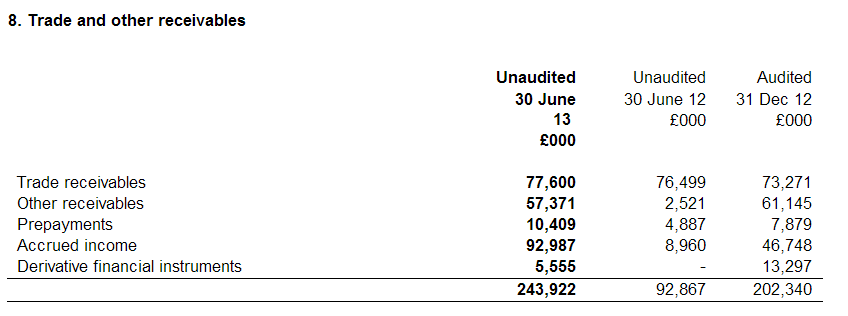
So trade debtors seems to be only a small part of total debtors. Accrued income is just debtors that have not yet been invoiced, and I have no idea what is in that £57.4m "other receivables" line. Prepayments and the derivative I can accept, so strip those out and you are still left with £228m in debtors, which is considerably more than six months turnover.
I don't know whether Quindell's services are VATable, but even if you add 20% VAT onto their entire H1 turnover, you still get to £196m, which is less than the £243.9m debtors figure. So my conclusion is that actually the jury is still out on whether Quindell can collect in its debtors, and that 4.8 months figure looks suspect to me - I'd like to know the workings of that number, as I don't think it includes everything it perhaps should? Anyway, the bottom line is that debtors are still growing and are still huge, so I'm not convinced.
The cash position accordingly is not great. In fact, they still have net debt, of £14.1m, as once again all the growth has ended up in debtors. That should turn around at some point, when turnover growth slows, or goes backwards, but it's not generating cash at the moment.
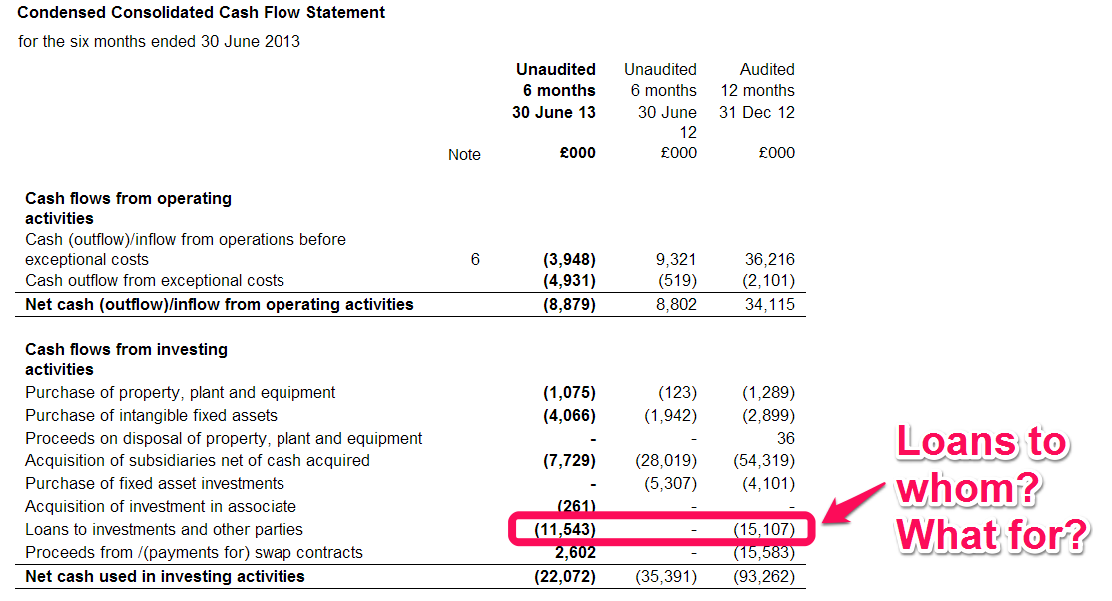
Couple of other funnies jump out at me. On the cashflow statement there is another strange item, being £11.5m paid out, which is described as "loans to investments & other parties". What's that about then? I queried a similar item last year, of a £15.1m cash outflow, but nobody seems to know what that is either. These are quite material amounts, so who is Quindell loaning money to, and why? I'm not suggesting anything untoward, just querying it. See the extract from their cashflow statement below:
The company has issued a lot of shares in the past for acquisitions, and this looks set to continue, with long term liabilities including £24m in deferred consideration that has to be settled in shares. So expect ongoing selling from the various lock-ins expiring, which is certainly one of the drags on the share price.
My main concern though, is how sustainable Quindell's profits are? A contact in the insurance industry has told me that Quindell's profits are real, but that they are not sustainable. The company tries to pass itself off as being a technology business, whereas in reality it's an ambulance chasing business that is generating much of its profit from things like whiplash claims, which as we all know is a long-standing area of widespread falsification of claims by members of the public, who seem to regard it as fair game to claim for whiplash when they are in reality uninjured. At some point the insurers will stop this practice, and I'm surprised they have allowed it to go on this long.
So I just don't believe that Quindell has a sustainable business model at this level of profitability, but instead are almost certainly cashing in on recent regulatory changes, which have given them a purple patch whilst competitors scramble to catch up.
So I don't think it would be wise to base a valuation for the shares on a multiple of bumper profits which probably won't be sustained for that long.
This is probably why Quindell shares remain on such a low multiple of forecast earnings (PER of 5 for 2013, and 4 for 2014, based on Cenkos forecasts), as investors are collectively clearly not convinced the profits are sustainable.
Cenkos are convinced though, and I see their note this morning says they see the shares rising to 18p in the short term, and "potentially much higher (40p+)" in the longer term, so who knows? For me however, there are too many question marks over the business model, so it doesn't interest me as a potential investment. To clarify, I have never held a long or short position in Quindell, as I think it's just fundamentally too difficult to value accurately.
OK, that's it for today. See you from 8 a.m. tomorrow, and just a reminder that my 11 a.m. email goes out every day, to ensure you don't miss a morning report - sign up box is below, it just needs your email address, nothing else.
Regards, Paul.
(of the companies mentioned today, Paul has a long position in C21, and no short positions)
Disclaimer
This is not financial advice. Our content is intended to be used and must be used for information and education purposes only. Please read our disclaimer and terms and conditions to understand our obligations.

29 comments
How do Reuters know this - have they asked them? I would suggest that its not possible to assign motives to a shareholder on the basis that they have a large shareholding. Even if a strategic investor did have long term intentions it could change. Its all very vague.
The acid test from a small investors point of view is whether the directors of the company own or control more than 50% of the shares.
I wondered the same. In the MDM case, the bottom 2 (or 3) are not even "large" by any stretch of the imagination...
Hi Cig
You quite right - some of these shareholders are small. Its all very subjective and not very precise in my view.
The main problem I have is that Free Float is presented as some sort of absolute figure by the industry and when we dig a bit deeper it turns out to be something vague, cobbled together with diiferent interpretations and opinions. It shouldnt be like this.
You may recall an exchange on this board regarding Quindell shareholders and how the major shareholders apparently differed depending on which data was used. Factor this extra variable into ithe equation and a Free Float figure as it stands could be virtually useless.
MDM's website says 'Shares not in public hands 97.94%'. Six institutions hold 87%, the two largest called Pipestone Capital. So 767,000 are in public hands. There were about 27,000 traded today in 13 trades. It looks like anywhere between zero and 30,000 a day, but the odd day with a million+, so I wonder what that 767k means, or public hands?
"Six institutions hold 87%"
Shares held by institutions are "free float". The institutions are at liberty to sell/buy whenever they want unless some other arrangement has been entered into. Only shares held by management/founders/in trust/ or in lock up are not free float as far as I know.
In practice a large strategic holding is not that easy to sell and it's far fetched to consider it at parity with tiny stakes that are really readily tradable. Ultimately the precise definition of free float is what the index vendor or market regulator decides it to be.
I haven't found AIM rules directly, but if they're anything like the FTSE AIM indices rules shown here in section 3.5:
http://www.ftse.co.uk/Indices/FTSE_AIM_Index_Series/Downloads/FTSE_AIM_Index_Series_Rules.pdf
it's broader than your definition.
Shares not in public hands now 98.5% on the website... so most of the turnover could be one insider/large investor hoovering the remaining public shareholders (before a sale?) This is possibly consistent with the cap (flat line) at 180p from December to May which looks like a single buyer.
We've been discussing the MDM free float number with Reuters who have in turn been discussing it with the company. We/Reuters define Free Float as being Total Shares - Treasury Stock - Shares held by Strategic holders/entities.
Strategic entities means that the shares are held by Government Agencies, Corporations, Holding Companies and/or individuals. This is where the shares are held with the intention of gaining market share and/or having control over the company, the idea being that, generally, strategic investors do not primarily intend to earn short term gains from the shares through an increase in share price unlike, say, investment management companies.
Issued shares for the company MDM is 37,459,107 and treasury shares is 200,000. Further to the latest company update as of August 21st 2013, the shares held by Strategic investors in MDM as defined by Reuters above are as follows:
As a result, the total shares strategically held are 25,122,810 and the free float is 37,259,107 - 25,122,810 = 12,136,297, or 100 - 67.43 = 32.57%.
Obviously this number depends on the methodology employed, and this is just one possible methodology but hopefully it helps to clarify the approach used.
See:
As ever, please feel to raise a ticket via the Green Help & Feedback on the right with any follow-up data queries.
Agreed about the screens and Kentz. I bought in back in late February and I'm sat on a tasty 53% gain. I've found so many high quality companies that I wouldn't have sifted out without the screening mechanisms.
You can see more of my selections here http://www.stockopedia.com/fantasy-funds/philhs-fund-4060/
I hold all of the shares in my fund, plus some others.
Thanks again stocko
Yes Stockopedia is wrong. The free float is around 97.5% although there is an additional 7% associated to nominees accounts which 'could' be deemed as additional to the free float.
It depends upon your strategy. In this case it is a solid company paying a growing and substantial 6.3% dividend backed up by a number of influential strategic shareholders who won't appreciate this being cut. They will also ensure they are strong and carry more wait in demanding a premium subject to any acquisition approach.
Without the dividend such a small float would be disadvantageous agreed however, and not my usual strategy. The 5 major shareholders takes the risk off a little too.
MDM are committed to paying out at least 50% of earnings in dividends. The projected yield is based around the fall in EPS. It's not a matter of shareholders objecting to a cut in dividend. The policy is, for a change, very clear.
v interesting piece on QPP. it's not a straight fwd situation.
you draw an analogy to Accident Exchange. in Quindell's defence, Accident Exchange was increasing the size of average insurance claim, so essentially working against the insurers (which is what ultimately brought them down). whereas, if you believe mgmt, Quindell is trying to reduce the average claim size and taking a more collaborative approach with insurers.
i think the 4.8mth debtor days number comes from trade receivables (77.6m) + other receiveables (57.3m) and dividing by the 6mth revenue (167.3) and multiplying by 6mths. So 134.9/167.3 x 6mth = 4.84mth.
one way or another, in a couple of years' time i'm sure QPP will make an excellent case study.
Hi, we've double checking that as it seems to contradict the information given here on the company website - http://www.mdm-engineering.com/im/shareholder.asp - I'll post any resolution here once available.
According to Stockopedia the free float for MDM is 99.7%
The strange case of Quindell rumbles on.
So £93 million pounds worth of business has apparently been concluded but not invoiced? The turnover for 6 months to end of June is only £163 million. Crikey.
No wonder insurers are quick to sign up with Quindell. Its a massive boost to their cashflow having such a generous supplier.
Hopefully when the insurers eventually receive their invoices they dont decide to query them - or worse still refuse to pay.
REF QPP, Loans to other parties,
I seem to remember reading that these loans typically occur when a party is working with QPP to see if they are a good fit with QPP, if QPP subsequently acquire the company, presumably they get taken into account in the purchase arrangements.
I was surprised to see QPP fall after the results, but then again i didnt read them anywhere as close as paul did.
Im in decent profit, and tbh am tempted to sell most of it, as much like yourself i just wish theyd be 100% transparent when they annouce things. though they are getting slightly better at it.
also ive no doubt theyll get to 40p/share if they do a consolidation as is burried away in the bits about listing on ftse 250. i just hope thats not what is meant by the share increacing ;).
Ref Kentz - i sold 2/3 of my holding today - sell on the rumour as they say.
ref QPP
good analysis on the debtors situation Paul.
Strange that the recent Canaccord note had estimated accrued income at 30/6/2013 as being £53 mill - this broker note was done over 3 weeks after the end of the period - £40 extra mill is quite a difference - although half of this difference probably is due to the lower than they expected trade debtors balance.
In some respects though ignoring the hype about reduced debtor days - the overall result is probably a very slight reduction in "effective debtor days" - debtors and accrued income being taken into account - the total figure is up but at a lower rate than the turnover increase - so its not all bad for holders and the semblance of stability is better than what i would have predicted a while back.
Canaccord note is available here
http://dcms.canaccordgenuity.com/ResearchNotes/887d841c06d248c68d1b3d96d6074dd9.pdf
On Kentz, chalk up another result for Stockopedia's own screen of screens. It has been near the top of that screen for a good few months now.
I unfortunately sold up on Kenz too a week ago. Obviously gutted but still made a tidy profit after a long long wait for the market to realise it's value.
I've got into MDM Engineering (LON:MDM) now. A smaller company that will soon be gobbled up for sure.
Is the small free float (3%!) not a problem for MDM Engineering (LON:MDM) ?
Cig, I have a similar concern regarding MDM Engineering (LON:MDM) - would be interested in Paul's (and others) opinion. It is the only thing holding me back from increasing my holding.
Yes good news on Kentz (LON:KENZ). Even if Amec (LON:AMEC) or M&W don't come in with a higher offer it's good for Kentz (LON:KENZ) to have made a public statement that 580p undervalues the company - they will be keen to show that market that they made a good long-term decision rejecting this sort of offer. That said I think an offer of 650p+ would be hard to reject given that Kentz (LON:KENZ) has never really received a premium rating for it's shares despite it's revenue & earnings growth record.
Capital Drilling (LON:CAPD) reported half year results today (I know they probably come under the resources sector but they are a support company so I consider them more like Kentz (LON:KENZ) - to be analysed as a trading company rather than based on NAV or NPV.) As expected revenue declined primarily due to the drop in rig utilisation from 74-65% rather than a significant drop in revenue per rig. Capital Drilling (LON:CAPD) seem to be doing everything right in response to market conditions - cutting capex, reducing costs and paying down debt. This means that they still generated $11.3m OCF. Which means you have a company with an EV of $56m generating annualised OCF of $22m in a year when market conditions are very tough. Seems good value to me.
I presume this RBC note is this morning....copied from Advfn courtesy of GPD2
RBC Capital Markets
Kentz - confirms it has received possible offer from AMEC
Sentiment Indicator : positive
Kentz (LSE: KENZ, 476p at COB Friday; Outperform, 550p PT) - possible offer from AMEC.
l AMEC and M&W Group have announced possible bids for Kentz. AMEC has indicated its possible offer could be made at 565-580p. M&W's approach was at a lower price and the company is now considering its options. Kentz's management has rejected both approaches.
l At 565-580p, Kentz would be trading on a 2014E cash adjusted P/E of 9.8-10.2x, versus AMEC on 11.0x. A cash adjusted P/E of 11.0x implies a valuation for Kentz or 620p.
l AMEC has a track record of making bolt on acquisitions to boost its organic growth, which in 2013E is low. The fit with Kentz is good both in terms of operations(with both oil & gas and mining expertise) and geographical footprint.
l Kentz has its own M&A ambitions and in our initiation, we concluded that a deal to acquire engineers could boost EPS by 40%+. Combined with a re-rating to a sector average P/E, such accretion could take Kentz's valuation to 625p.
AMEC and M&W Group have until 16 September to announce firm intentions to make an offer.
Well I bought a few after your most recent recomendation, so thanks for that. I had been meaning to ask what you thought of the company at this higher price. Will be interesting to see if there is an improved bid.
Thanks again pp,
K
Hi Kenobi,
Good to hear you've done well on Kentz.
Although just to clarify, I never, ever, give share recommendations. This site is all about DYOR, so I just write about what look to me interesting situations, giving my personal opinion, for readers to then do their own research on should they wish.
It's also intended to be interactive, so that we can hopefully make better decisions by pooling our thoughts here in the comments section.
Regards, Paul.
Yes sorry Paul, I meant to say after you flagged kenz.
Glad to see this value report is going well, very much enjoying reading your insights,
Kind regards
K
Just as a guideline, • At 565-580p, Kentz would be trading on a 2014E cash adjusted P/E of 9.8-10.2x, versus AMEC on 11.0x. A cash adjusted P/E of 11.0x implies a valuation for Kentz or 620p.
Personally (and KENZ is a big holding for us), I would see a valuation of 625-650p as a more likely success level, more if there is a competitive bidding situation.
The fit with AMEC is superb in terms of business activity and geography.
D
Don't worry PP, you're not the only one.
Some of us didn't even buy in, despite the clear undervaluation!! My targeted entry point was never quite achieved. Have been a big fan of Kenz for ages, superbly run,and very undervalued as you say.
But good luck to all those who did.
Weekend BB gossip was mooting a possible 700p/bid, unsubstantiated, which was circa £800m or so. Amec's seems rather tepid,and M&W was seemingly lower than 565p/sh