Small Cap Value Report (22 Jul 2016) - LAKE, INL, SPRP

Good morning!
I had a rip-roaring lunch yesterday with the CEO of Research Tree. It's a website that enables private investors to access broker notes - a hot topic which we've been debating here recently. Private investors rightly complain about being blocked from receiving broker notes, under some absurd regulation, which harms our interests instead of protecting them.
Well, here's a service that helps bridge that gap. I'm impressed with the website, and have taken a free trial. There are some good providers of research on the site, including N+1 Singers, and Finncap, and many others. They're hoping to add some more big name brokers shortly. It's handy to have research all in one place, so you just put in the company name, and up comes a list of what research is available. Well worth a look, I think.
Also, we have a special discount code, which gives 20% off annual, or 10% off monthly pricing. The code is "stockopedia". For the avoidance of doubt, I am not getting any commission for mentioning this! I'm just happy to flag up anything that looks useful for investors, and I think Research Tree is a good initiative, to help level the playing field for private investors, so I hope it is a success.
Lakehouse (LON:LAKE)
Share price: 29.25p (up 24% today)
No. shares: 157.5m
Market cap: £46.1m
(I hold a long position in this share)
Board changes - the share price has reacted very positively to news that Bob Holt is joining the Board, as Executive Chairman. Googling his name, I see he seems to have been the founder of Mears (LON:MER) - which is big in providing outsourced services for social housing - so highly relevant experience for Lakehouse.
Ric Piper is stepping down from Chairman to NED.
I think there's a decent underlying business here. Although there's a nagging doubt that it might have one more profit warning in it, possibly?
PMI data
There's been a sharp deterioration in PMI data today, which is forward-looking, hardly a surprise given the impact of Brexit, and the uncertainty that has created. So the only question remains how long & how deep this downturn will turn out to be.
Interestingly, the mid caps index has barely moved today, so it seems that the market is already pricing in a downturn.
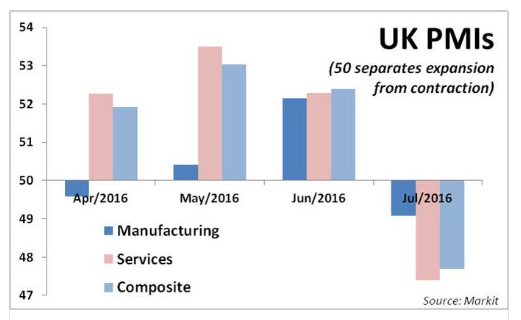
So I think we need to be very careful which stocks we hold, and think ahead about which ones are most likely to be affected by a downturn. Probably lots of profit warnings to come this autumn, unfortunately. Although arguably the market is already pricing-in a downturn, and at some point will start to price-in a recovery. We just don't know when.
The key point I think is to pick shares with a good spread of international business, as they're the ones weathering the storm the best, e.g. Empresaria (LON:EMR) yesterday.
Inland Homes (LON:INL)
Share price: 65.75p (down 1% today)
No. shares: 201.8m
Market cap: £132.7m
Trading statement - this smaller housebuilder & brownfield developer sounds upbeat about things;
"We are confident that our underlying business is extremely robust and the demand for our high quality, lower cost homes remains strong. The appetite for our consented land is similarly unabated, while the size and quality of the land bank we are amassing has exceeded our targets.
While we have been somewhat impacted in the short term by one of our contractors going into administration, against the current supportive market environment, we look to the future with considerable optimism."
Profit is going to be marginally below market expectations (mentioned as being £15.9m), due to a contractor going bust. It's really helpful when companies quote the market consensus figure that they are relating to, as sometimes figures can vary from one financial website to another, creating confusion.
Brexit - this is pretty emphatic, and sounds positive to me;
...the business has continued to see a steady level of enquiries from potential purchasers. These fundamentals were unaffected by the uncertainty ahead of the UK Referendum on membership of the EU and purchaser appetite since the result has remained stable.
Sprue Aegis (LON:SPRP)
Share price: 183p (up 2.2% today)
No. shares: 45.9m
Market cap: £84.0m
Trading update - the share price for this smoke alarms company more than halved in Apr 2016, on a nasty profit warning. However, that would have been a good time to buy, as the shares have risen by c.50% since then - a terrific return for those brave enough to buy at the time, and indeed for existing holders who sat tight.
Today's update shows some improvement on the worst case scenario, but it's still pretty bad;
The Board expects sales for H1 2016 to be approximately £25.9 million (H1 2015: £56.5 million) and to report an operating loss* of £0.9 million (H1 2015: £9.0m operating profit*). Due to stronger than expected trading in June 2016, the operating loss* for H1 2016 is significantly lower than the Board's expectations as previously announced in the Company's final results on 26 April 2016.
The cash pile has almost halved;
Net cash at 30 June 2016 of £14.7 million (2015: £28.9 million) was adversely impacted mainly by the H1 2016 operating loss* and the £7.0m payment for buffer stock acquired in Q4 2015. Sprue remains debt free (30 June 2015: nil debt).
Outlook - it's so helpful when companies publish profit guidance - everyone should do it, even if it means giving investors a range of possible outcomes.
Subject to there being no further net adverse foreign exchange rate movements, the Board expects Sprue's sales and operating profit for the year ending 31 December 2016 to be approximately £58.0 million and £1.9 million respectively.
My opinion - I fail to see why this company is valued at £84m. That seems an awful lot for a company that's only going to make £1.9m this year. Profits are forecast to more than triple next year, giving forecast EPS of 11.2p, but even then the PER is hardly a bargain at about 16.
So it's not for me, at this valuation.
Sorry, I've run out of time, as have a meeting to go to now.
Have a smashing weekend.
Regards, Paul.
(usual disclaimers apply)
Disclaimer
This is not financial advice. Our content is intended to be used and must be used for information and education purposes only. Please read our disclaimer and terms and conditions to understand our obligations.

51 comments
Very solid results today by Inland! NAV at 91p, dividends up 29% and landbank up by a third.
Not sure why Inlands been attracting weakness in shareprice given this progress.
Hopefully sense wil return.
Regards,
Source.
I tried Sharescope for a few months, but didn't get on with it - probably because I have got too used to using the Stockopedia StockReports, and so get everything I need from this site, supplemented with bits & pieces from elsewhere (e.g. >3% ownership data from Morningstar's free service).
I find anything that is a just a sea of numbers on the screen quite offputting. So I like the colour-coded graphics on the StockReports. Suppose it's all about whatever you get used to.
In my view, people who develop financial sites forget that the typical user is not an expert in databases, and finds anything that resembles a database, setting up filters, etc, really very fiddly & off-putting to do. I find that even with the stock screening tool here - it's quite tricky to use I find, trying to select which fields to filter on, from a gigantic long list, and it not always doing what you thought it would do, then having to work out why, etc. Hopefully a new, and easier to use interface could be dreamed up? Maybe a wheel of options by type, in a circle, with drop down items from that, sorted in order of most frequently used?
P.
not sure I would compare ShareScope and Stocko but that is based on my personal use and experience. I use both and have been a Pro user of ShareScope for over 5 years and a Stocko user for 3. ShareScope is much more fiddly but much more powerful as a trading tool. In my view (and based on my use), Stocko is more fundamentally driven and is better for investing.
Broadly I use ShareScope for trading and Stocko for Investing. That said even for Trading, my trading universe uses Stocko to select good candidates while ShareScope gives me the insights on the physics of price - combining good fundamentals with good technicals gives high probability set-ups. I use charting with volume-price interactions in the main to fine tune my timing and have built a few modified indicators that are predicated on volatility and break-outs.
It's a bit of work but any trading or investing system needs rules imo . I now handle crank these , it allows me to review prospects, rank them and commit capital to candidates based on probability of success within defined timescales
Research Tree - The concept is interesting but I would probably use it as a reference tool. I.e. if there is a company you like have a look at the research on it. A huge amount of "research" is not particularly useful. I had a brief look at Research Tree's reports that are available and it is swamped by daily notes, company updates etc etc... so creates a huge amount of noise. While a site like Stockopedia certainly isn't perfect is is without the noise and is more fact driven. A look of research also fails to see the wood for the trees and is from analysts focused on a particular sector. It is also often quite alarmist in nature. I.e. downgrade Unilever as the quarterly sales growth at 3% was lower than our forecast 4.5%.
If this research from Research Tree was so excellent then why don't fund managers, who have access to it, all outperform?
A couple of months ago Lakehouse was discussed on Paul's daily report, and I thought I would apply a contractors eye to their results, to see if I could understand what had gone wrong, even though they are nothing like the sort of contractors I've worked with.
By the time I'd had a good look at them, everyone had gone from the thread, and as I've often provided the final post on scvr without any reply, decided not to bother.
But I do remember the overall impression I came away with after trying hard to understand their likely "claims" situation. It looked to me like the company had gone from an understandable and controllable sort of contractor into a really uncontrollable "dogs breakfast" of numerous newly obtained subsidiaries, which I would defy anyone I knew in the past to control, without a huge increase in staff loyal to the CEO. Several of the many new subsidiaries had, afaics, unique cashflow and reporting properties which would allow either a dishonest subsidiary manager bent on getting a bonus, or a main board MD bent on showing the world good news for a while, to play havoc with the true numbers.
Didn't buy any!
Regards.
muck
Thanks for this. Posts get read long after they are posted, as PIs use them to do research, through Stocko's "discuss" link on the stock reports. I hope your 9 "likes" (and counting ...) encourage you to keep posting, even if it is the final post on a thread at the time.
Hi Paul
A bit late to the debate, but wanted to say thank you for bringing Research Tree to our attention. I was one of the posters the other day about my frustration with Morningstar for just dumping their forecasts, so very much appreciate you taking the time to give us clues as to what's out there for the full, well-rounded investing service by mentioning other companies that may be of interest to PI's.
It's always useful to know what's out there and I will definitely look at trying RT out when I have got all the sand out of my hair after a good old fashioned UK holiday with no exchange rate stresses. Jolly obliging of the weather to play it's part in showing we can go it alone without brexit!
Santa
Hi Paul, thanks from me too, both for trying to put these stupid rules right and also for finding options for PIs. Research Tree is certainly worth a look and like Santa I'll give them a go once the summer hols are out of the way. Glad it was a fun lunch! I must be one of the only people in world who is generally impressed by estimates put out by brokers... not all of them obviously - but when one looks at big companies covered by half a dozen brokers, the concensus estimates are usually damn near right give or take a few percent. And often estimates for smaller companies aren't far off too. Clearly the buy/sell recommendations and the price targets are utter garbage but the rest is well worth having. Although I do remember reading a research note on our old friend Globo shortly before they went bang that was pure fiction!
The other problem with research tree is that you have to be a sophisticated investor to join it, which somewhat fails to level the playing field.
You need to pass 2 out of 3 tests:
Large portfolio
Frequent trading
You have had a city type job
So if you like to keep costs down by not trading, and buy companies for the long term rather than icons on a screen, you're stuffed unless you work in the city.
Hi doug2500
We're as frustrated as you are about this but we have to comply with the EU regulations. The point I find most bizarre is the 10 trades per quarter. I'm not sure why trading frequently should mean you are sophisticated enough, and on that metric Warren Buffett probably wouldn't meet the criteria.
We are looking at the possibility of a cheaper offering with slimmer access that is available for all but we're not quite there yet in terms of the compliance and dev work.
Cheers
R
At least you had the initiative to try and do something on this research issue. The regulations are a joke but unfortunately you can only work within the existing framework.
Couple of points:
- Most equity research is not worth reading, certainly not worth paying for
- Most is pure maintenance
- Many analysts (and brokers/banks) are simply cheerleaders for corporate clients; biased as hell
- Investors are not going to get rich by following broker recommendations without undertaking further independent analysis; and thinking objectively about any broker research they read
- At times you get more from reading a research piece that arrives at a different conclusion compared to the others; an outright sell is much rarer these days
Having said all that I have found it useful at times when a piece of equity research has a decent overview of a company (as a starting point), its competitors and the industry etc. Also when there is very limited coverage it can be insightful to see how the forecasts / expectations have been derived; you can then judge whether this is conservative/aggressive/about right etc.
I applaud your efforts on this and appreciate it "ain't easy". My concern is that the subscription price you have to offer to make it work for your business is perhaps tough to justify by the quality of the actual equity research itself (based on the list of brokers included to date) i.e. the actual equity research itself is not that insightful or valuable.
10 trades per quarter ?
The law makers are obviously so unsophisticated that they do not know the difference between an active trader and a sophisticated investor.
Then how does this work ? I typically make over 10 trades in the first quarter of the financial year, as it includes some new year tidying, followed by some realisation of capital gains at the end of the tax year.
So am I sophisticated in the first quarter and ignorant for the remainder of it ?
MPs, MEPs and European Commissioners should interfere less in our affairs.
Considering state borrowing is out of control in many countries, particularly our own, they should fix that before having the damn cheek to control what we do.
I can not believe that frequent trading is a sign of a sophisticated investor. (Buffett talks about having a punch card with 20 spaces fir ones whole investing life for heavens sake). It is frightening that the people who make up these rules are the same ones who police the financial services industry. They really are clueless. No wonder the financial crisis of 2007/2008 happened.
That's a shocking deterioration in the PMI data sequence that your bar charts show, Paul !
I say shocking given the close historic correlation of UK PMI data with UK GDP, as can be seen from the chart below. If anything, the PMI's understated the scale of the downturn in 2008 :
The implication for UK GDP is clear. Moreover this could be a prolonged recession in the absence of inward investment as a consequence of the Brexit negotiations.
Possibly too early for investors to get invested in UK domestic cyclical stocks today unless the stock in question trades below NCAV or has some strategic value.
Hi Paul,
Whats your thoughts on newly listed (LON:ACRL) full year results?
Cheers, Mark
Mark - Re. Accrol Group (LON:ACRL) I held this stock from IPO and sold it this morning with a small gain.
Generally speaking, the results are good. I made an adjusted eps to be 9.0p against a forecast of 6.6p bringing down PE to 12.5 . However what put me off is the huge debt.
Net debt is £61m which gives a EBITDA multiple of over 4, and a OP multiple of over 5.
In a bull market, I would just about live with this, but in the current uncertain climate, a highly indebted company is vulnerable. I can see Accrol's sales suffer on a downturn, despite the management's assertion that they are somewhat immune.
Of course. all IMO.
Hi Ram,
I'm sure I read in the admission document that they intended to pay down £40m of the debt from the gross £43m placing proceeds. But there was no mention of this in the YE results. Probably due to the timing of the IPO etc.
There was some mention of having paid down the Bank Debt and Lease debt with a new £18m or so RCF.
The bit that did interest me, was that the majority of the debt which is owed to the founding family and Northedge Capital with an annual interest payment of 10%. Not a bad return if you can get it ;)
I'm hoping it is this £40m that is going to be paid down. Reducing net debt to approx £20m.
Cheers, Mark
Regarding Accrol Group (LON:ACRL):
There is a presentation on the results available on the company web page which indicates that post-IPO debt was reduced by £37.5m.
Quoting from some of the bullet points on p10 of the presentation:
"First three elements of debt (which I presume are bank loan, finance leases, shareholder loan) all repaid on listing, replaced with £18.0m RCF with day 1 draw down of £13.0m"
Disclosure: I have some doubts about vulnerability to sterling weakness once the current hedging arrangements expire but (in a very modest way) decided to buy some shares in a company growing above 15% p.a. in a sector less likely than many to be impacted by a possible recession, and with an intended dividend of 6p per share in the coming year.
Hi Shawsdale, thanks for pointing that out. I was reading through the YE results RNS, which annoyingly doesn't include the latest information. I.e. events since year end. However, these do seem to be covered albeit in less detail on the results presentation you have highlighted. So many thanks for that.
Cheers, Mark
Hi Mark -
Yes, I have gone through the admission document and the recent results and I think you are right.
Admission doc:
"The Placing will result in the issue of 43,328,144 Placing Shares, raising approximately £43.3 million, all of which will be used to settle existing debt within the Group and to pay the Company’s costs in connection with the Proposals of approximately £1.9 million."
From the company's recent accounts and presentation, they have confirmed that they have paid off the 'first 3 elements' = £55.6m and replaced with a new RCF with £13m drawndown, which makes a net debt reduction of £42.6m , pretty much aligned to the admission document commitment.
That makes net debt as at July = £60.6m - £42.6m = £18m.
A lot healthier which makes me think of re-buying at current sp level.
Regards, Ram
I'm not a Lakehouse (LON:LAKE) shareholder but the appointment of Mr. Holt and the agreements surrounding it look unusual.
He is currently a non-exec chairman of 5 other companies. Ordinarily, that would mean a day or more per month per company. His "salary" after the first month is split between 3 days per week as a full-time employee of the company and two days per week where he is engaged as a consultant through his own consulting company. Is this driven by tax? Why the differential rates of compensation? He gets the equivalent of £75k/0.6 = £125k annual equivalent full time for three days per week as an employee but £166k annual equivalent (except they only plan to pay him for 47 weeks) and the company has to pay VAT on his consulting fee. Is the intent to keep him as exec chairman or is this just an interim step to another new CEO picked by a board chaired by Mr. Holt?
I also don't understand the "performance" targets. Mr. Holt is entitled to 4.6m shares at no cost to him if the share price (adjusted to include dividends) reaches 98.4p or more when the company publishes it's results for year ending Sep 18. So, on current forecasts, if Mr. Holt restores the company to something approaching a market multiple, he gets 4.6m shares and if the company still trades at a significant discount to the market he gets 2.3m shares.
It looks to me like the company is borrowing Mr. Holt's credibility to re-establish their own. Not necessarily a bad outcome for shareholders but he's getting quite a lot if he delivers the company's current expected performance.
Not necessarily looking to one PMI number as a harbinger of doom though 10% is a big move. Clearly more data is needed as PMI is only really of use in the context of a trend. If this number is reproducible then there is a likely change in trend.
That said, looking at sector rotations since Brexit does support that the market is factoring in some kind of recession: since 23 June (the day before the big one.) until yesterday's close .. a few sectors to consider
REIS/REITs - 10%
Gen retailers - 10%
Construction -6%
Utilities +11%
Tobacco +11%
Pharm +16%
These are bit simplistic given the role of GBPs devaluation in boosting many of the bigger international players. Equally both Mining and O&G are up over 11% so not consistent with a cyclical downturn but then Brexit is likely to do unlikely things. This was not an exogenous event
It has been a great trading environment but if fund flows are anything to go by, investors are moving to cash at least in the short term (link below)
Anecdotally from talking to friends and colleagues, there is a shift in sentiment and a corresponding shift in predilection to spend.
Next week's economic data on GDP and CBI distributive trade will be interesting
http://www.investmentweek.co.uk/investment-week/news/2465721/investors-flocked-to-cash-in-june-but-fundsmith-bucks-risk-averse-trend
Hi
Re Broker notes I was looking at Brokerforecasts.com has anyone tried them?
I lost interest after 10 minutes searching I still couldn't find a list of whose forecasts they include.
John
I would just like to endorse the benefits of Research Tree and that I encouraged them to present to ShareSoc members at one of our seminars about five months ago and our members who joined have been happy with them. RT are a recent start up and need to reach out to private investors and gain traction or they will not be around at all in a years time and we will be back to having barely any access at all to broker and analyst reports.
ShareSoc only started five years ago and now has over 4000 private investor members but other European countries have many multiples of that as paid members so maybe the internet and ease of gaining so much information for free has turned many into freebie chasers. Good quality information needs to be paid for and the best investors will have a wide range of tools that they make use of.
Please do not knock someone who is trying to offer something useful at a reasonable price for investors....if he has to pay out for expensive advertising then i sense membership rates would need to be very high and nobody would pay for the service....catch 22 as they say !
David
David
I would agree and I think RT will be a great resource but the amount one can afford to devote to paid services is determined by the size of ones portfolio. There isn't point in making 10% a year for a third of it say to eaten away in subs to Stockopedia, IC, Shares, MOI, Sharescope etc.
In the end one has to pick and choose. Personally I think that if broker reports are available free to a certain class of investor they should be available free to all.
Personally I have no problem in them posting links in BB's etc or news articles. After all I learnt about Stockopedia through an article by Paul Stevenson (Adventurous Investor) in the FT which was unpaid advertising! https://next.ft.com/content/6362157c-8eb9-11e1-aa12-00144feab49a
My problem is that there are too many services offering bits of what I want. I'm currently subscribed to ShareScope and Stockopedia. I manage to outperform the market over most time periods so it's a hobby that I enjoy that pays me but if I start to add too much cost in subscriptions I might as well give my money to Terry Smith to manage for me and go sit on the beach.
Yes I agree one does have to be careful on how much cost you load up. I trade very little (though looking back more than I should so must still try and be more focused and trade less) plus Stockopedia (UK only adding US is something I would like to do but it is a lot so I have held back), plus a couple of other services which comes to about 0.5% of portfolio.
Sharescope Plus is the other service I have been toying with but I am not sure how much it would add to the investing process. Any comments welcome.
As an aside on Terry Smith I bought £1,700 for my sons JISA in April 2015 and it is up 35.49%! I should have invested my whole portfolio with him and gone to the beach! At the moment what keeps me from doing it is I enjoy the investing process and still feel that I can achieve a sufficient return to make it worth while but at the moment not 35%/16 monghs; that said if Mr Smith keeps returning 35% every 16 months I think will give up!!!)
Hi Purpleski,
I'm a Sharescope Plus user for a couple of years now plus Stockopedia UK+US+EU since the start of this year. I would find it very hard to give up Sharescope because I have developed a non standard chart setup that works for me in terms of timing buys and sales. I've generally found selling to be the more difficult decisions to make - I usually have a list of things I would like to buy.
If you are a buy and hold investor then the charting side is probably not so relevant for you.
The share screening functions and filters in Sharescope are excellent but a bit old fashioned in their interface. There's a lot of functionality in it for those who like to get stuck in. It has the feel of a legacy product being a programme that is installed and run on your PC and these days they seem to be pushing their web based Share Pad product more than Sharescope. I haven't tried that yet. Phil Oakley's regular articles for them are excellent and he bases his write ups on using Share Pad.
Re Fundsmith, I have a similar tale in that I told my sister that was the best place to put her savings last year. Perhaps we should start following our own advice!
I hold Inland Homes (LON:INL) and after the recent battering post-brexit, noted the share price has rebounded to regain a lot of what was lost. It is still a solid, modest and seemingly well run business. I also note that Simon Thompson at IC flagged up that it was (then) relatively discounted. The price now seems a steal, and having worked in the industry know that self building their schemes is not necessarily a hardship but does of course increase [fixed price contract] risk vs greater profit return.
I will continue to hold as I see nothing here that concerns me, and genuinely believe in the management team who have a long, successful track record in this field.
I also hold Lakehouse (LON:LAKE) but sold 70% of my holding this morning on today's welcome 22% uplift. The nagging doubts over their ability to recover, and the soap opera management saga have got too much, and I was happy to cut my current losses today for the sake of piece of mind. I feel happier backing something else for a return in the short/medium term.
I hold Inland Homes (LON:INL) and was pleased to see the rapid share price recovery after the initial fall today. However, reading the RNS carefully, I think there is a bear case here.
Inland have 315 homes under construction across 8 sites. They're starting to "self-deliver" but have been using main contractors. So the contractor that has gone into administration is probably a main contractor, and they hint at this when they say "Inland ... has taken full control of the relevant sites".
It sounds like they've lost the main contractor on half their active sites. They've only started moving towards self-delivery since February this year, so there is a risk they haven't ramped up their own delivery capability enough to avoid delays spreading across those sites. If we assume they account for half the 315 homes under construction (i.e. 157 homes), there is a lot of exposure to the length of time required to get those sites progressing at full speed, and I don't know how long that might take. I'd guess an average of 4 weeks to find subcontractors to take over. On the other hand, all the people formerly employed by the failed main contractor might be persuaded to carry on with Inland in charge, so it could be almost as if nothing happened. Opinions from others very welcome!
Also, comparing completions: 147 this year vs 248. They say the 248 was boosted by a bulk sale of 59 units, so there were 189 underlying completions. This year they have fallen short by 23 expected to sell this year delayed by failure of contractor, so they were expecting 170: a 10% fall on last year. Is that a problem? It's difficult to compare like with like at Inland, because they undertake such a mix of activities.
The RNS also supports the bull case: the average selling price has risen again, and is now well up on last year, presumably as the move to brownfield regeneration comes through in revenue. Forward order book has also risen.
Paul, you might be interested in this comparison of Boohoo.Com (LON:BOO) with ASOS just published on "seeking alpha":
http://seekingalpha.com/article/3990437-boohoo-next-asos?ifp=0
Re. PMI Data
There is an interesting article in today's Times which suggests that there isn't sufficient official data yet to show the impact of brexit.
Basically we need keep the powder dry and wait for the 2nd half of August before sufficient data is made available and analysed to draw any meaningful conclusion.
(Note. Shock, horror. The Times misspelling 'economy')
Even then until an exit from the EU and single market access is agreed it will not mean much.
you would have to think that a profit warning is already factored in the price given broker estimate is 7.9 eps and from memory they already achieved around 2.5 eps 1st half yr? i averaged down to bring total holding av price at 34p......so this share will be a lesson to me wither that was a wise move or i should have sold out a long time ago on earlier profit warnings...!
Paul, I think that the Markit data ought to be treated with great caution, at any time.
They result from the aggregating of three possible responses to questions, as follows:
"PMI data are presented in the form of a diffusion index, which is calculated as follows:[2]
{\displaystyle PMI=(P_{1}*1)+(P_{2}*0.5)+(P_{3}*0)} {\displaystyle PMI=(P_{1}*1)+(P_{2}*0.5)+(P_{3}*0)}
where:
P1 = Percentage number of answers that reported an improvement.
P2 = Percentage number of answers that reported no change.
P3 = Percentage number of answers that reported a deterioration.
Thus, if 100% of the panel reported an improvement, the index would be 100.0. If 100% reported a deterioration, the index would be zero. If 100% of the panel saw no change, the index would be 50.0 (P2 * 0.5).
Therefore, an index reading of 50.0 means that the variable is unchanged, a number over 50.0 indicates an improvement, while anything below 50.0 suggests a decline. An index of 50.0 would arise if either all respondents reported no change or the number of respondents reporting an improvement was matched by the number of respondents reporting a deterioration. The further away from 50.0 the index is, the stronger the change over the month, e.g. a reading of 55.0 points to a more frequently reported increase in a variable than a reading of 52.5.[2] The degree of confidence experienced by respondents reporting an improvement and the degree of concern experienced by respondents reporting a deterioration are not factored into the index."
https://en.wikipedia.org/wiki/Purchasing_Managers%27_Index
Note the absence of weighting and the absence of consideration of degrees of confidence or of concern.
I'd expect there to be elements of uncertainty and of subjectivity in the raw data supplied to Markit by respondents.
In fact, an interesting publication from the Office of National Statistics highlights this very issue:
"Figure 5 shows the trends for the adjusted Index of Services (IoS) from the ONS and the Markit/
CIPS services PMI. As can be seen, while the Markit/CIPS trend tracks the ONS trend on average, it
has a tendency to exaggerate poor economic performance, and mildly overstate good performance.
This was a behaviour seen in the manufacturing output index by Markit/CIPS as well, but to a more
muted extent.
This relationship is seen most clearly during three periods; the economic slowdown in the late 90’s
due to the Asian financial crisis, the slump in late 2001 due to the dot-com bubble, and the recent
recession. In all these cases, the Markit/CIPS measure has shown a drastic drop in performance
and strong recovery, while the adjusted IoS trend provides a more nuanced view of the same story. It
is likely the reason driving this difference is the different ways in which the surveys record economic
activity, as it was in manufacturing."
http://webarchive.nationalarchives.gov.uk/20160105160709/http://www.ons.gov.uk/ons/dcp171766_283172.pdf
Note particularly Figure 5 on page 11, as well as Figure 2 on Page 8.
Obviously these Markit figures are giving comfort to the "I told you so" Remoaners (excuse me!) but history tells us to be very cautious in believing they reflect reality. Comment directly from company CEOs and Chairmen seems to be saying generally quite the opposite.
(Markit as an opinion poll whereas the ONS figures are the actual result might be an analogy?).
I noticed the Telegraph front page headline today says "Staycation boost to UK economy". So it's not a bad thing at all that we can't afford to go on holiday abroad now. No, it's a good thing for the economy.
All negative effects of the vote will be explained away or spun as being positive.
Remarkable first half trading update from LSL Property Services (LON:LSL), who run estate agents across the country and surveying services, etc. Firstly they announce first half figures are ahead:
LSL expects to report strong interim results on 2nd August in-line with the Board's expectations and ahead of the same period last year, delivering growth across all major revenue lines and demonstrating profit growth in both the Estate Agency and Surveying Divisions.
Then they note that the second quarter slowed as the referendum approached:
Quarter two, as expected, saw a slowing of LSL's trading performance in the run up to the EU referendum.
And then they drop a full year profit warning (noting that their reporting year ends in December):
Consequently, whilst still expecting growth in profitability in the second half of 2016 as compared to the first half of 2016, LSL now expects that full year Group Operating profit(1) will be significantly lower than previously anticipated.
Which sounds like business has fallen off a cliff since the referendum but they’re hopeful it will pick up as the rest of the year goes on.
http://www.investegate.co.uk/lsl-property-servplc-...
I’ve been racking my increasingly fragile memory, but in thirty years I don’t think I’ve ever seen an update like it.
timarr
Hi Paul
Regarding Research Tree, I first came in contact with them because they employed/employ somebody to swamp various dicussion boards with supposed comments which refer to their product. That seems both obtrusive and immoral to me. If they want advertising they should pay for it like everyone else. However good the service is I would not subscribe.
Hi Beginner
As one of the co-founders of Research Tree I'm sorry to hear that. We use many marketing channels including paid ads to raise awareness of our product but in a world where huge beasts like IG flood the advertising channels it is both difficult and very expensive to get any traction. We're a small start-up with limited resources and therefore need to look at other ways to get in front of customers.
The one thing we do have is quality content written by city analysts so that's what we use to provide snippets and views on specific companies that are relevant to the reader. We've found that we get a lot of likes for the content we do share in posts and it is always put up within an hour or so of reports being published so should be both timely and relevant.
Apologies again if you feel that way but our intention is to help private investors as we strongly believe everyone should have the same level of access to quality information.
Hi RMundy,
Just a quick question vis "broker reports" do you receive any from the main City participants?
I see from your website that you soruce from:
Hardman&Co
Panmure
Beaufort
Edison
Equity Development
N+1 singers
FinnCap
Liberum
Zeus Capital
Are these the main regular contributors? Do you get anything from the likes of Goldman,MS,JPM or BOA Merrills
Thanks in advance.
Hi Fangorn, sorry I replied earlier but somehow managed to lose the message before submitting.
We've sat down with many of the big banks (e.g. Barclays, Credit Suisse, Citi, Soc Gen) and some have indicated that they might contribute some of their offering in time. However if they do I think it is realistic to assume it will only be a small subset. Their chief concern is cannibalisation of their primary revenues from the fund managers. Our push back is that the majority of the fees paid by the fund managers is for the meetings, calls, models etc rather than just the document.
We currently have 25 providers roughly a third of which are free to view (e.g. Edison, Hardman, Equity Development) and the remainder are available through subscription. The largest at the moment include Liberum, N+1 Singer, Panmure etc, and we are hopeful we will add a few more at that mid-to-large end of the Broker scale over the coming months. That will really boost our FTSE 350 coverage.
Hope that helps but please do let me know if you have any other questions.
Cheers
Rob
Grateful for your response RMundy.
I do wish you well in this regard and will certainly take a closer look at the website.
So much to do and so little time at the moment. The trials of summer...
Thanks for your reply RM. Very decent of you. I genuinely wish you every success with your venture. However you do yourselves no favours by adopting a dozen aliases and posting material even after apparently being banned. Not all publicity is good publicity! I would hazard a guess that getting Paul to mention you here will garner you much more support than all those postings. It may be worth getting the likes of Robbie Burns and Tom Winnifrith to give you a mention as well. Good luck again.
Thanks Beginner, point taken. Have a great wknd.
Hi Paul,
I seem to recall that you used to hold a long position in Lakehouse (LON:LAKE). Have you sold out now? I have a holding in Lakehouse (LON:LAKE) and was pleased that it looks like Bob Holt is joining Lakehouse as he played a prominent role in growing Mears. His remuneration also looks to be well aligned with shareholders and the Special Incentive Award Plan (SIAP) has clear targets in terms of the share price.
Like you I fear there may be another PW given the recent interims they issued, but clearly the market likes the new appointment.
Best wishes,
Imran.
Hi Imran,
Thanks for the prompt, I forgot to include the disclosure that I hold LAKE shares - have added it now.
Regards, Paul.
Paul wrote a positive report on his meeting with Ric Piper (then the new Chairman of Lakehouse (LON:LAKE) ), in his SCVR of 23 May, concluding "Anyway, bottom line for me, is that having met management I'm very happy to hold for the next year. I'm not "all in" yet though - am keeping my position size to medium."
I would welcome some insight into the reasons for Paul's change of mind, because deciding when to sell is probably the most difficult decision investors face and it's even harder to reverse a decision taken recently, so I'm keen to learn how others take that decision.
Hi FREng,
Sorry for any confusion! Am mentioned above, I haven't sold Lakehouse (LON:LAKE), just forgot to include the disclosure originally, which I've now inserted into the main report.
Wishing I'd averaged down now, as "buy more LAKE" is on my calendar to do this week, but I hesitated, so missed what would have been a nice instant profit.
Mind you I reckon the new Chairman is likely to kitchen-sink the figures, so probably one more profit warning to come. The market may not be too bothered about that though, now that there is credible leadership in place.
Regards, Paul.
Thanks for the clarification. Maybe you'll get a second chance to average down on that final profit warning!
I wonder if part of Friday's sharp rise in Lakehouse (LON:LAKE) following the appointment of Bob Holt might be down to speculation that he offers a bridge to a possible future acquisition of Lakehouse (LON:LAKE) by Mears (LON:MER) ?
At roughly 10x Lake's market cap it would be a bite sized acquisition for Mears and given Lake's recent troubles could be available at a knock down price. Mears (LON:MER) itself has been treading water recently so some sensible corporate action might give it a lift. There is a clear crossover between the two businesses and the tapping of Mears' client base with the provision of Lakehouse (LON:LAKE) 's services could be a win win for both companies. Add in possible synergies from shared overhead savings and increased purchasing power and a longer term tie up might make sense. Might be worth taking a trawl through the share register to see if there are any significant common shareholdings (other than Holt himself when his options vest!) that might form the basis for the acquisition.
Gus.
Results from United Carpets Group look good but talk about short and sweet!