Small Cap Value Report (25 Jan 2016) - TRAK, POS, HAL, RBN

Good morning!
Trakm8 Holdings (LON:TRAK)
(at the time of writing, I hold a long position in this share)
Final call for questions (using this form only please) for my latest CEO interview, which I will be recording this afternoon, with the Executive Chairman of TrakM8. A very topical one this, as there was a (frankly rather half-baked, and backward-looking) bear raid on the share last week.
I believe that decent companies should have a right to reply to criticism, as demonstrated with my Brady (LON:BRY) interview, who wanted to respond to my sharply worded comments about them.
TRAK were asked if they would like to answer investor questions, through an interview with me, and they agreed. So I'm really looking forward to conducting what should be a fascinating interview later today.
(Incidentally, I refer sometimes to a company in the plural, because whilst strictly speaking it may be a separate legal entity, hence singular, in the real world a company is actually a group of people, speaking and acting as a group. Therefore the more natural reference, for me is to use the plural when referring to a company. Pedants, may I suggest taking some calming medication, or yoga, as I'm not going to change my writing style on this point!).
Remember that the format for my interviews is always the same - questions come overwhelmingly from investors, and I am happy to ask any question, regardless of how difficult - sourcing the questions from investors is great actually, as it means I can ask things that would otherwise be too impertinent! So it's a terrific format, that works well for everyone. I'll be focusing a lot more of my time on this in the future.
Just because I like the company, and hold shares in it, doesn't mean I'll hold back on asking them the tough questions that need to be asked. I'm a great believer in considering both the bull and the bear case for every share. Only then can you come to an intelligent overall view, which is more likely to be correct.
The way I see thing, the bears have come up with one or two relatively minor points, and blown them way out of proportion in a hysterical manner, clearly designed to induce investor panic. That worked for a couple of hours last week, but has already fizzled out. These questions are worth asking, but they demonstrate a complete lack of understanding about the bigger picture - the company's activities, and its rapidly growing recurring revenue base. I've not seen anything that even dents the bull case for the shares, which is based on out-performance against broker forecasts (twice upgraded in 2015).
Overall my current view is that the bears are wrong, but let's see how the company responds to investor questions today. I reserve the right to change my mind, if the answers given today are unsatisfactory.
Not a great start to the week - a profit warning:
Plexus Holdings (LON:POS)
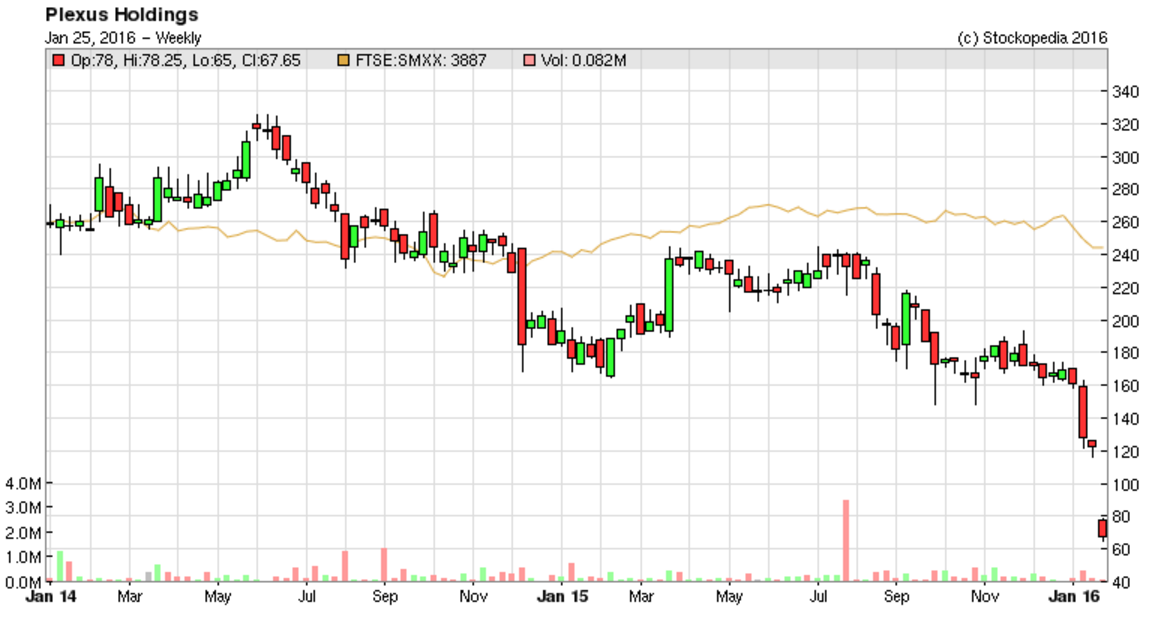
Share price: 69p (down 43.8%)
No. shares: 89.4m
Market cap: £61.7m
(at the time of writing, I hold a long position in this share)
Profit warning - broker forecasts for this year (ending 30 Jun 2016) has already been slashed from 9.1p EPS in Aug 2015, to only 1.3p in Nov 2015, to reflect the downturn in the oil & gas sector - Plexus supplies a high performance, patented wellhead sealing system.
I had hoped this would be sufficient to allow for the downturn in the sector, but unfortunately that has proven incorrect. As today's update spells out (in the usual long-winded way), trading has deteriorated far more than anticipated, with the key sentence saying;
...the Company's financial results for the year to 30 June 2016, which are subject to external audit, will be very significantly below market expectations.
Oh dear. It's not a surprise that things are bad, but the extent of the downturn has caught the market on the hop, hence the shares being down nearly 44% today. The trouble is, there is not sufficient liquidity in the share to achieve price discovery, so anything could happen.
I would imagine that most shareholders will not be able to sell, even if they want to, and that's the big problem with small caps - this illiquidity can create an overhang in the shares that can last for a very long time, since people who want to sell, cannot sell.
Personally, my view is that the damage is probably done now, and as with a lot of oil related shares, it's a question of looking through the current low price of oil, and a return to profits once oil has returned to a level where exploration activity resumes. Plexus has been strongly profitable in the past, and clearly has excellent, patented technology. However, with the oil price this low, all bets are off for the time being.
Quantifying things, there's little doubt now that Plexus will be loss-making in the short-term. Revenue, guidance is given today;
The Board therefore anticipates that revenues for H1 FY16 will be below £7 million, and revenues for H2 FY16 are expected to be approximately 20 per cent below those for H1 FY16.
So I make that roughly £12m revenue for the current year perhaps? That looks a disaster - current market forecast is for £23.9m revenue. With operational gearing, it seems to me that the company is heading for a substantial loss on the P&L this year.
Balance sheet - the first thing to check, when a company reports a severe downturn in profits, is whether it has the financial strength to survive. In this case, I think Plexus looks reasonably OK for the moment. It outlines the cash conservation steps being taken;
As a result of the disappointing financial performance, Plexus is currently taking significant cash conservation steps in terms of reduced capex, opex and personnel expenditure, which the Board believes will stabilise the Company during this difficult oil market cycle.
The problem with cost-cutting is that it often comes with an up-front costs (redundancy payments, contract termination charges, etc). It also reduces a company's ability to benefit from improving market conditions when they arise.
The company does have some bank debt, gross debt of £6.3m at 30 Jun 2015, and with £3.3m of cash at the same date, net debt was £3.0m - not a big worry, providing the bank manager is in a co-operative mood.
The current ratio is 4.77 - very strong, being a surplus of £13.6m of current assets over current liabilities. As turnover has fallen considerably, a large part of debtors should turn into cash, so the company has a liquidity cushion there. Trading losses will however erode its balance sheet, over time.
Outlook - the company at least sees things starting to stabilise;
...it is anticipated that sales will stabilise going into the 2017 financial year prior to what the Directors and other commentators expect to be a strong recovery in relation to exploration drilling activity when the oil price recovers to sustainable levels.
My opinion - this is a very bad profit warning, with substantial losses now looking on the cards for 2015/16 FY. I'm really annoyed with myself over this one. It was obvious that the company was going to be struggling. Indeed, I was only wondering last week whether to play it safe and sell some (or all). Inertia meant nothing happened, and now there's a nasty loss staring at me on the screen.
I'm not going to average down here, as it's usually a mistake to start buying on the initial bounce after a profit warning, as the buyers causing the initial bounce are usually in denial, guilty of "anchoring" to the old share price, and often haven't done their sums properly in terms of being aware of the severity of the profit downturn. We've all done it! So I suspect another lurch down in share price could be on the cards here, who knows?
If any Institutions start selling in the market, then who knows where the price might end up? I'll give it a week or two, to see where the price settles, look at revised broker forecasts, and consider my options then.
There's no doubt that Plexus has terrific technology, with great profit potential in a buoyant oil market. So, in time, I see excellent potential here. In the shorter term though, things look absolutely awful, so it's a question of weighing up those two factors.
UPDATE: As expected, the latest broker forecasts are really grim. Cenkos has more than halved its current year forecast turnover from £26.1m to £12.1m (similar to the figure I estimated above). They have reduced PBT from £2.4m in the current year, to a loss of £6.7m - absolutely dire, as I flagged above.
I'd be amazed if the current price of 72p holds. I think this could be heading down to 50p, or even below. But it depends on whether there are buyers, happy to hoover up shares for the long haul, or if they decide to wait for the price to go lower first. It also depends on whether existing holders are prepared to tough it out for the long-term, or give up and move on. The only way Institutions could buy in size, is mopping up shares in a falling market. It's a brave buy at this point.
So, a good company long term, but a disaster in the short term.
Halosource Inc (LON:HAL)
Share price: 3.88p (down 32.6% today)
No. shares: 220.3m
Market cap: £8.5m
Profit warning - oh dear, this is a car crash. I put this share on my Bargepole List as recently as 20-Nov-2015, after a poor trading update. In my SCVR of 20 Nov 2015 I flagged that the company was running out of cash, due to poor trading, and heavy cash burn. Things have unravelled fast since then, with the shares down 84% in just the last 2 months.
Today's update is even worse, with 2015 turnover down 22.4% vs 2014. The company needed to grow rapidly, to curtail losses, so this is a disaster.
Net cash is down to only $4.6m, down $9.2m in a year, so at the current burn rate it looks as if there's only enough fuel in the tank to last another 5 months from now. So the company only has 2 options - either slash costs, and/or do another fundraising.
Outlook - makes it clear that a fundraising is on the cards;
We have implemented a number of structural changes during 2015 which we expect to continue to improve gross margins in both the Recreational and Environmental Water businesses while we continue to explore strategic opportunities to strengthen our balance sheet and improve cash reserves."
My opinion - based on past performance, I would be amazed if anyone is sufficiently bonkers to put more money into this company. At the very least, existing equity is likely to be virtually wiped out.
Robinson (LON:RBN)
Share price: 184p (down 6.8% today)
No. shares: 16.4m
Market cap: £30.2m
Trading update - for calendar 2015. A very clear, concise update, covering the main points that investors need.
Revenues are anticipated to be £29.1m for the year, which represents a 3.7% increase on last year. Two factors have significantly affected the reported revenues: firstly lower resin prices, which are passed on to our customers, have resulted in lower product prices and secondly, the stronger sterling value in relation to the Polish zloty has reduced the reported value of Polish sales (currently 38% of Group sales). The two together amount to a revenue reduction of £2.4m whereas underlying Group volumes actually increased by 12% compared to the prior year.
Broker consensus is for revenues of £31.9, so this is a £2.8m shortfall at the top line, for the reasons given above.
The directors anticipate trading profits for 2015 will be in line with market expectations, including a stronger financial performance at Madrox and as a consequence the earn-out payable to the vendors in 2016 will be increased.
A good result on profits, in line with expectations, which is pleasing considering revenues fell short. Profit is more important than revenues of course, so a thumbs up here.
Why are the shares down today then? It's probably down to the "challenging year ahead" phrase used in the outlook comments;
The general economic conditions suggest a challenging year ahead with particular pressure on the major brands and the UK grocery sector. Nevertheless, with new business being added in the first quarter, the directors expect to deliver revenue and earnings growth.
My opinion - quite a nice company, but operating in a cut-throat sector. So limited upside probably, as there seems little chance of the fwd PER growing much from the current level of about 13 times 2015 EPS.
There is potential upside from freehold property on the balance sheet, being worth potentially more than book value, so that could be a nice kicker at some point.
Overall, this share looks priced about right to me at the current level.
Disclaimer
This is not financial advice. Our content is intended to be used and must be used for information and education purposes only. Please read our disclaimer and terms and conditions to understand our obligations.

45 comments
Plexus Holdings (LON:POS) continuing downwards? today @ 45.75 bid.... makes me regret buying at 54!! :) oh well long term view and all that :)
Following on from my post in message no. 11 of this thread, here's a very interesting report and video from Bloomberg showing that many shale operators in the US can actually produce oil at $30 a barrel or less, even as low as $22.52.:
http://www.bloomberg.com/news/articles/2016-02-03/texas-toughness-in-oil-patch-shows-why-u-s-still-strong-at-30
This report also shows that the numbers of oil rigs have continued to increase in such operations.
This suggests that looking only at the overall rig count is misleading , as is also thinking of "the US shale producers" as one homogeneous mass, as this article seems to do:
http://www.oilvoice.com/n/How-Saudi-Arabias-grip-on-oil-prices-could-bring-Russia-to-its-knees/2bae675edba4.aspx
It also, perhaps, indicates that Hunting (LON:HTG), mentioned in the post referred to, may be more resilient than thought to low oil prices and perhaps also more liable to benefit from an oil rebound. One other factor in that may well be that there are reportedly already 4,000 wells drilled but not yet producing, ready to be brought into operation at very short notice, for which equipment from Hunting (LON:HTG) may be needed.
All IMHO, DYOR.
(I am a holder of Hunting (LON:HTG), very pleased with today's rise).
I came across this article about a fast-charging system for electric vehicles:
http://www.insidermedia.com/insider/northeast/funding-fuels-filling-station-scheme?utm_source=northeast_newsletter&utm_campaign=northeast_news_tracker&utm_medium=deals_article
"A new type of electric filling station will soon appear on the roadsides in Newcastle and Sunderland after funding was secured for the project.
The North East Combined Authority (NECA) has been awarded £1.5m to help take forward plans for new electric filling stations on the Science Central development on Tyneside and on the A19 on Wearside.
Each filling station will feature six to eight rapid chargers which top up electric vehicles in 15-20 minutes, as oppose to the eight hours it takes for a standard charger."
Your vehicle charged while you have a coffee? Or do your shopping?
When supermarkets start installing these kinds of fast chargers, the charging problem solved?
Together with the numerous research programmes on better batteries,
the move to electric cars may well be faster than anticipated.
Surely the only way that electric vehicles will achieve mass market sales, is for the cars to be able to run at higher speeds that they do now for longer periods, without the battery needing to be recharged, and there being a massive rollout of charging points around the country that can charge the battery to half to full capacity rapidly. Are we not a long way away from that?
No.
The stone age did not end due to a shortage of stones.
Where did that intelligent grid that talks to the car magically arrive from?
Same kind of route as the smart meter programme.
Isn't it Richard, that aside from the former not losing money, it's because the need to go from 80 to 100 is a 25% rise, but the missed opportunity to see an SP rise from 100 to 120 is only a 20% rise.
NI
The biggest threat by far in the long term to the oil market is the development and commercialisation of efficient electric vehicles, something almost certain to happen within perhaps five to ten years. Almost 70% of petroleum in the US is used for transportation and almost 60% of that is for light vehicles, cars and so on.
http://www.c2es.org/energy/source/oil
The Saudis and the other countries dependent on oil may have seen their best days already.
It may be now only a medium-term market, not a long-term one, and they may all just want to get the stuff out of the ground and sell it before the market stops growing and then starts reducing.
Jane,
One factor to consider when looking at electric vehicles is the infrastructure to charge them. In terms of overall generating capacity we are already running with hardly any spare capacity in the UK without adding electric vehicles to the mix. The other factor is the distribution network. The supply to domestic streets is nowhere close to what will be needed if more than a few people want to charge their car at once - the grid just isn't designed or built for that scenario.
This in my view is why Elon Musk / Tesla are pushing home batteries and micro grids. The home batteries charged by solar or wind with local diesel generator backup for peak demands and local distribution to ease the pressure on the main grid. All do-able but a considerable extra infrastructure beyond the vehicle development itself.
For those in cities without off street parking to charge an electric vehicle, the future looks to be Uber type driverless electric vehicles summoned on demand, presumably driving themselves back to a depot to swap out battery packs as needed.
Hi John,
You may be right about driverless cars, although having one's own car is perhaps a matter of personality or home extension as much as of simply being a question of practicality for city driving. I actually was not thinking specifically of Tesla and the like but rather of the big manufacturers who are now investing seriously in electric cars, all over the world. One example is Nissan's announced investment in Sunderland to develop the next generation of batteries:
https://www.northeastautomotivealliance.com/news/f33f2def-15c0-e511-80e1-000d3ab00f2b/
Note the mention of the Nissan Leaf, already with an autonomy of 250km between recharges.
Whichever way the electric vehicle market goes, the impact on oil demand will be very serious, given that about 70% of petroleum is used for transportation and 60% of that part is for light vehicles, meaning that over 40% (0,7 x 0.6) of petroleum use is at risk of replacement by electric vehicle use. Obviously, not all vehicles will be electric and the changeover will be spread over years but the impact on the demand for oil will be very substantial.
Best wishes,
Jane.
Jane
Electric vehicles do indeed offer the prospect of disruptive technology in transportation. However, electricity is not a primary source of energy in the same was that hydrocarbons, hydro, solar, wind, nuclear and wave power are - it still needs to be generated. So while we might not put fuel directly in our vehicle tanks, we would still need to pipe an equivalent amount of oil to power stations to be burned there, subject to the differences in overall efficiencies, before plugging in electric vehicles.
Of course, investment in electrical power generation is another whole issue that makes the Heathrow runway debate look simple!
Colin
Hi Colin,
That's actually a common mis-perception. In fact, only 5% of the world's electricity is produced from oil. Gas as a source accounts for 22%. So almost three-quarters of electricity is not produced from either oil or gas. Here's a link with those figures:
http://www.tsp-data-portal.org/Breakdown-of-Electricity-Generation-by-Energy-Source#tspQvChart
So the point that I and others made about the very real, serious and near threat to oil and gas producers from the advent of electric vehicles (as well as from increased investment in renewables) is valid.
PS: Yes, there would of course be the need for additional electricity generating capacity but I doubt that that would be via oil or gas stations, given the greater competitiveness of renewables now and that, politically and for reasons of climate change, fossil fuels are not the flavour of the day now.
Hello Jane
Thanks for the link, very interesting to see the data so clearly presented.
It also helps put in perspective the additional generating capacity required to power electric vehicles. Using the back of another fag packet, I estimate that the current 1bn vehicles in the world using cig's 8kWh/day figure gives an annual generation requirement of c2900 TWh (ignoring transmission losses etc). Current global usage is 485,000TWh. So electric light vehicles would add less than 2% to the demand for electricity - less than I would have guessed.
Rgds
Colin
Yes but the problem is 39% is coal and that is being phased out in the west due to pollution. Gas is good but is it viable without oil? Problem with electric cars is the price, the range, it maybe ok for city cars. There is already a shortage of electric in UK, there are concerns it will not be enough to meet demand. If my car used 8kw a day, that would more than treble my electric consumption from 3kw to 11kw. The growth in cars is in Asia, countries like China and India. I can't see it happening for at least 10 years maybe 20 to 30.
You may need some more generation capacity, but the grid is well below capacity at night, so assuming mostly overnight charging there's no big problem that can't be solved with a bit of software (the car communicates with the grid to smooth the load through the night).
Back of the envelope calculation: at 8000 miles per annum for an average car, 0.4 KWh/mile (Tesla), that's 8 kwh daily, overnight say 10 hours makes about 3 amps at 240V, which is not particularly taxing (less than a kettle).
To add grist to the mill on the subject of oil price repercussions came across this presentation from Dankse Bank which I thought was an interesting analysis.
http://danskeanalyse.danskebank.dk/abo/OilPriceRepercussionsil110116/$file/OilPriceRepercussionsil110116.pdf
Also Economist magazine has a section on impact of low oil prices in this weeks edition. Not as technical but discusses why low oil prices are not necessarily good for economic growth. As a holder of £BP, £RDS.B, John Wood (LON:WG.) and Premier Oil 2020 5% Bonds (oh dear!!) a bit more certainty (and a rise in the oil price) would be nice!
I love a bit of geo-politics!!
A weak oil price puts the Middle East and Russia under huge pressure and over time will weaken them significantly whilst at the same time boosting many other parts of the economies of the oil consuming nations. The USA has access to a lot of oil that can be used to keep prices low and keep the pressure on those countries and regions that have proven so troublesome over the last few decades.
I can see the US Gov't being more than happy to subsidise the shale oil industry if it gives it that global leverage. Sure some will go bust but they will be picked up by other US companies and kept viable for the wider USA use.
Over the years OPEC has held the world to ransom. The USA has control now and they're going to use it like they always do. They just need to be careful to avoid Russia fragmenting (nukes all over the place) and the Middle East going nuts (general disarray is fine from a US perspective as they're not having to deal with migrants from that area etc.). And they've not even got stuck into Alaska yet which they will once it's worth it to them.
I agree with all this, but we're in a ilogical market, logically opec would cut production across the board 10% and the price of oil would double or more over night, they'd be making much more money and pumping less oil.
However there's economic war going on, whether it's the saudis attacking shale, or the saudis defunding the russian war, or attacking the Iranians, or perhaps some of all of the above.
The point is, people aren't acting rationally here. we have less spare capacity than is normal, so it's as if the saudis in particular are opening the taps to force the price down. They do have a history of doing this to purge the market of expensive oil. I was speaking to a chap who works in the north sea, he was saying that new developments weren't taking place, by the time some of these become economical, the infrastructure will need replacing, (thus making it uneconomical again), so some fields might never be developed because of this.
I have oil investments, I'm wary of investing more in small cos, but the biggies may well pick up bargains and be in a much stronger position when it does recover, shell / bp for example are good value at these levels if you believe the price will be back, and if they manage to hold the divis, you get well paid in the mean time.
The other side of the future of the oil price, as the upper limit on it is pushed steadily downwards by advances in fracking, is the price of solar energy, storage and related technologies, which (if the past is any guide) are falling onto the oil price from a great height. At some point they may crash onto it and flatten it permanently.
The other side of the future of the oil price, as the upper limit on it is pushed steadily downwards by advances in fracking, is the price of solar energy, storage and related technologies, which (if the past is any guide) are falling onto the oil price from a great height. At some point they may crash onto it and flatten it permanently.
I'm not sure I follow this argument... I saw a talking head being interviewed about this in Davos last week and he said that while oil is $40 or below, all alternative sources of energy are totally uneconomic. People will always revert to the lowest cost source of energy regardless of climate change agreements and environmental benefits of the alternatives. I thought he made a good and valid point.
As for the price of oil, I have no particular opinion on whether $30 is any more the "true" value of a barrel than $150 was at the peak. It is naive to think that fracking, or supply and demand are anything to do with the day to day price whilst there are oil derivatives available to hedge funds and investment banks.
All the best, Si
I mean the cost of alternatives is falling, and the rate of the fall is likely to be quick. If each individual tech is improving 5% a year, or decreasing in cost 5%, and several combine in one end product, the net improvement in that end product is the compound effect of the individual improvements.
Say solar cell efficiency this year is 5% up, and manufacturing cost 5% down, then your pound this year buys 110.5% the watts it bought last year. We are notorioiusly bad at dealing cognitively with compounding, [edit: & spelling] which is why I was scoffing at digital cameras just a year before it was blindingly obvious that they were vastly superior. It wasn't just the camera itself, but cheaper computers, Photoshop, storage, sharing, etc.
Difficult times for purchase decisions. I come from the Pharmaceutical Industry and we used to talk about early adopters and conservative followers. With shares I tend to be a conservative follower. I will put a share on my watchlist but I won't buy until there is a sustained rise. It is surprising how often a share on my watch list drops quite a long way before it rises again. Some of course don't seem to rise again. Better to miss a few percent in the rise than to buy a loser. Who ever said this game is easy? :-) All the best everybody, I love reading Pauls blog and the comments. Charles
There s a received wisdom about the secret being "not to lose" money but assuming an investor to be risk neutral I have never understood why missing a few percent on a rise differs from taking a few percent extra fall?
The point for me is about momentum. I prefer to let others find the bottom and establish the up trend. I'll join the party once the music is playing and the drinks are flowing - and I'll try to leave before everyone is drunk.
some good data in the below which supports the ultimate reversion to mean for oil. The challenge of course is trying to time that one. The complications are less global demand as they are accumulated oversupply and current stored reserves. Once the reserve glut decreases sufficiently then replacement costs will start to normalise especially as they will come from a very different upstream landscape
http://knoema.com/vyronoe/cost-of-oil-production-b...
The CME future options price suggest that expectations are for oil to remain sub $40 until early 2017. But then a lot can happen in many of the geo-politically unstable territories to change that.
http://www.cmegroup.com/trading/energy/crude-oil/light-sweet-crude.html
To my mind the supermajors can pick up some great bargains here too when many of the smaller players can no longer service debt. Makes sense for the bigger plays to cut CAPEX on the expectation they can buy other capital projects on knock-down prices . Meantime watch Carlyle Blackwater and the like starting to circle waiting for the carcasses.
Vulture capital swoops will signal the bottom
US shale is in decline, and doomed IMHO, because they have taken on huge amounts of debt which they cannot service with oil at $30, or $40, or $50 .....
you can take all the oil in the ground you like, all the technology improvements you like, but if you can't pay your debt , you are quite simply scuppered.
demand has also fallen, look at the numbers out of russia today, Russian GDP shrinks 3.7%! ouch.....
personally, and it is only my opinion, we will see oil below $30 this week, and stay there for some time...
as regards oil equities and service companies, then just look at the price of oil against the US oil ETF, and you will see it hasn't been this expensive since way back in 1999......yes, oil equities were cheaper when oil was $147/barrel!
just my 2p.
regards
Although the existing shale drillers may go out of business this doesn't necessarily kill the sector in the medium term or even the short term. Chapter 11 bankruptcy which enables companies to continue to operate whilst negotiating with creditors or if liquidated then the assets will be bought by companies unencumbered by debt.
Thanks, Clive, that's very kind of you but I'm no expert, simply an investor who researches opportunities.
Apparently, technology in shale wells has improved tremendously over the last 18 months (needs be!) and productivity has increased by leaps and bounds so they are getting far more out of each well than they did previously. Of course, they do need to keep drilling new wells but even there, once the support infrastructure is in place, it's quick, easy and cheap to do so. For me, that is actually one of the major factors putting and keeping the US shale producers in the driving seat!
All IMHO, DYOR.
Jane.
Hi Jane,
Thanks for your insight into the oil market. What do you think of the view I've read a number of times that shale oil tends to run out quickly, requiring additional investment to constantly find new prospects? Does that affect your view that shale producers are now in the driving seat?
Why go anywhere near the oil sector at the moment - it's a once in an investing lifetime train crash. Surely it's better to look for the potential winners from cheap oil - airlines, cruise lines, consumer discretionary, for example?
All about expectations.
"A good hockey player plays where the puck is. A great hockey player plays where the puck is going to be."Wayne Gretzky
Sell oil stocks & buy airlines if you think we are in a new era of $10-30 oil.
Do the reverse if you disagree!
JohnEustance,
I think the attraction for fishing around in the oil sector, is that the current crude price is unsustainably low - because something like 80% of the world's production is uneconomic at this price, according to a commentator I was listening to last week (correct this point if it's wrong).
So it's inevitable that the PoO will rise somewhat, perhaps to $50-60 - it has to, as production will dry up eventually - once hedges expire, producers will go bust, making a rise in price a certainty. The only uncertainty is when this happens, not if.
Therefore, if you avoid companies which are likely to go bust, there could be rich pickings from bombed out, cash rich, low cost oil producers.
A totally bombed out sector is often where you find the best investments of the future, from the wreckage of the past, because people throw out the baby with the bathwater. As always, good research & selecting the right companies, is the key.
Regards, Paul.
Paul,
Yes, the price of oil could well recover to US$50-60 a barrel. That could happen rather more quickly should there be some kind of major geopolitical shock in the Middle East or if, for example, Venezuela defaults. However, we might not necessarily simply go back to the kind of market we had 18 months ago. The US shale producers have made incredible improvements in cutting costs and in technology and productivity and those improvements will stick. Previously, people seem to have been talking of a break-even point of upwards of US$80 for the shale producers; that break-even point is reportedly now below US$60! (Edit: and the marginal cost of oil from existing sunk wells obviously much less). I also saw some figures comparing new deep-sea wells with shale wells; a new deep-sea well costs about US$10bn and takes five years to come into production, whereas a new shale well costs US$10m or less ( https://www.quora.com/How-much-does-it-cost-to-dri... ) and additional wells can be drilled to come on stream and tied into existing infrastructure within as little as 20 days! So, it's the US shale producers who are the swing producers now and who will cap price rises and that's where the opportunities may be in a market recovery, imo.
Hunting (LON:HTG) is perhaps one example, heavily focused on the US shale well market, as illustrated in this really nice presentation:
http://www.huntingplc.com/~/media/Files/H/Hunting-PLC/pdf/reports-and-presentations/2015/Hunting-Full-Year-Results-4-March-2015-FINAL.pdf
Although there will likely be mergers and takeovers, that's perhaps not so easy to home in on. Really, I'm thinking that there is a fundamental change in the market and that stock-picking needs to take account of that.
Best wishes,
Jane.
I think we all agree it's a matter of time before the oil price rises. I'm erring perhaps on the bearish side of that in terms of timing and extent. I'm also sceptical about the opportunities for small cap investors. The private equity likes of Carlyle in the US have huge amounts of money ready to hoover up the pickings from the shale industry in the US. When I go back in it will be with a major like Shell or BP or a long oil ETF.
Time will tell of course and we all reserve the right to completely change our minds when we wake up in the morning. A relatively minor geopolitical shock could certainly change things - given all that's already going on in the world the low oil price is really remarkable.
Yes I read the same article with all these facts in it as you.
Here is a link for people:- http://www.telegraph.co.uk/finance/newsbysector/energy/oilandgas/12118594/Saudis-will-not-destroy-the-US-shale-industry.html
Regards,
Source.
Jane - Arthue Berman discusses idea that US is now swing producer here
http://www.artberman.com/investors-beware-u-s-tight-oil-is-not-the-swing-producer-of-the-world/
Shaun
(long oil equities and averaging in heavily over next 4 months)
Hi Paul, I will be very interested in hearing your podcast on your interview with Trakm8, in which i had an overweight position till this morning and sold 2/3rds. One burning question I have ; going forward how will the coy finance further aquisitions. Appreciate the cash flow will turn positive in the long term but if a suitable aquisition candidate were to come along, will they borrow or dilute the shareholder value again? Suggest to the coy they put out quarterly management reports if they want to keep the momentum going and the shareholders fully informed.
I have been watching Plexus but the current oil markets and turbulence has held me back, Boy oh boy am i glad I held off. after the dust has settled i think they could be an interesting situation?
I note Plexus has a rather unfortunate ticker as well. Difficult to see how/why management assumed they were going to escape the carnage in the oil sector. Poor performance by the broker as well. As a non holder was tempted to have a look but the falling knife strategy has not been much of a success of late.
Sorry to hear you've suffered a bit today in this one Paul and others
it just stinks when a go-go rated growth stock goes completely ex-growth. These type of shares seem to fall a very long way when it dawns on people that it is not what they thought they had bought into and the company is exposed as just another highly priced oil services company operating in a horrendous market.
It's a shame, but think there is more pain still likely here also as it was on such a high rating for so long.
I think it's likely Plexus's markets are going to be completely shot till 2018 and don't think it's balance sheet is that ideal either....
Regards,
Source.
Morning Paul, Re Plexus Holdings (LON:POS) this is quite a turnaround since October, 2015 where revenue was up and dividend was doubled? There is article in IC on 29/10/15 which I have not got full access to now.
Re Plexus Holdings (LON:POS) looks like the tangible asset value is 27p.. though clearly this will be eroded if the company moves into losses.
What is the quality of the underlying franchise? Can it generate a healthy long-term ROIC & allocate significant capital? If so then it should be trading well above tangible book (although it clearly still is, even after today's fall).
The Investors Chronicle originally tipped the company in July 2015 (just 6 months ago!) when the share price was 225p.
In October (share price 161p) they wrote "The fall-off in oil and gas capital budgets is hardly helpful, but - crucially - the group isn't just another link in the supply chain; its commercial proposition is based on technical innovation. The X-HP/HT drilling market is expanding rapidly, so the roll-out of the Python Subsea Wellhead could prove highly lucrative. Cenkos estimates that Plexus could add upwards of 500p a share to its value if it secured just a 5 per cent market share. Buy."
Does seem to have a lot further to go. And have they ever paid a decent dividend at any point of a cycle?
Also notice Entu coming out this week and just changed their financial director. Again. Second time in a year. Last time was shortly before the interim results, iirc. Said that these results will be in line with expectations, but what exactly are they? Price has been pretty static for a while now though.
Hi Paul - At what time is your interview with Trakm8 Holdings (LON:TRAK) ?