Small Cap Value Report (25 Jul) - IPEL, VNET, HIBU, SSY, HRN, GBO

Good morning! The first company I've been looking at this morning is Impellam (LON:IPEL 397p pre-opening price), a staffing group operating mainly in the UK and USA. It has announced interim results for the 26 weeks ended 28 Jun 2013 this morning. The shares, at 397p, appear to be very cheap against forecast EPS of 66p for this year (that's a forecast PER of just 6). However, it looks as if they are going to miss forecasts, as the interim numbers only came in at 20.1p, slightly down on last year's H1 (2012: 20.9p).
The strange thing is that last year they also disclosed H1 adjusted basic EPS of 27.6p, whereas I cannot see any mention of adjusted EPS this time. Broker forecasts are usually caclculated on adjusted EPS, so this makes it difficult to assess performance here against full year forecasts.
I don't think we can assume that adjusted EPS will be similar to last year, because there was a £3m restructuring charge last year, and there isn't this year. So it looks to me as if the company is trying to gloss over the fact that adjusted EPS has actually fallen quite sharply against last year.
That's not good. I don't like companies who include adjusted EPS when it flatters their performance, but then stop disclosing it when it becomes inconvenient in highlighting poor performance, which appears to be the case here.
The outlook is mixed, with it being positive in the core UK & USA markets, but weakness in their other two divisions (Medacs Healthcare and Carlisle Support Services) is expected to continue holding back EPS. Therefore it looks as if this is effectively a profits warning, and they don't look likely to hit full year EPS forecasts.
They've moved from a net cash to a net debt position of £24.3m at 30 Jun 2013, partly due to working capital changes, and the payment of a 35p special dividend in Apr 2013.
Overall, I'm not at all impressed with the presentation of the figures, which combined with the poor performance from two of their divisions, means I'm taking this one off my watch list for the time being.
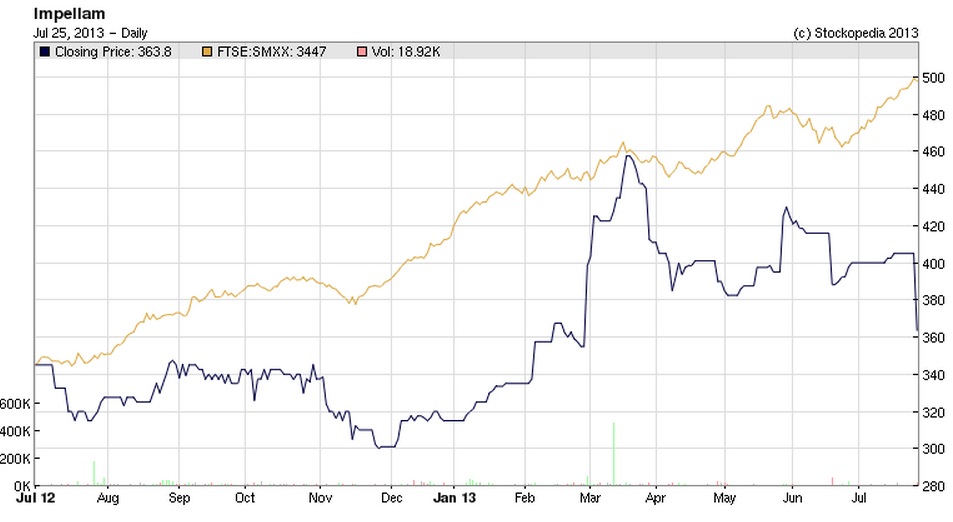
Note that the shares have fallen almost 10% this morning. Here is the 12 month chart, compared with the Small Caps Index (note how amazingly strong that has been - this really is a roaring bull market for small caps, for the moment anyway):
Following an interesting presentation and Q&A with the Chairman of Vianet (LON:VNET 71.5p) on Monday of this week, the company published it's response to the Government's consultation on a proposed new Statutory Code to regulate the tied pub sector. Vianet's response document is on it's website here.
It's important to remember that beer flow monitoring is not the key issue here. The Government's consultation document is mainly about trying to make the brewery Tie arrangements fairer for the tenants. Most reasonable people would agree that the large PubCos do seem to screw tenants into the ground, to a point where many cannot earn a reasonable living. This is because they are not only charged a heavy premium for the drinks, but are also charged high rents. Arguably this is ripping the heart out of rural communities, as village pubs close down.
On the other hand, one could argue that tenants enter into these leases of their own free will, on an arms length basis, and that the breweries are entitled to seek the most effective tenants for their Pubs, in order to maximise the return from their assets. So it's a tricky one, where I can see both sides.
Beer flow monitoring is only mentioned as an aside in the document, which also states that the Government is not trying to alter the fundamental model of the brewery tie, but is just trying to take a bit of pressure off the tenants, at the expense of the Pubcos. So my opinion is that flow monitoring equipment is extremely unlikely to be banned, even if some sort of Statutory Code does go ahead. That in itself is unlikely, as the Pubcos are already lobbying to suggest that this might force the closure of many Pubs, hence causing bad unintended consequences. I suspect therefore that the Statutory Code might end up in the too difficult to do in practice tray, and that the Tories will probably pull Vince Cable back into line on this, because the last thing they want is Pubcos closing uneconomic pubs.
Getting rid of beer flow monitoring equipment is an open invitation for pub tenants to buy illicit beer supplies on the black market for cash, thereby avoiding VAT, Corporation Tax on the profit, etc, to the Treasury's cost. I cannot see how the Treasury would allow this to happen, even if a few Lib Dem MPs perceive this as a vote winner.
Looking at the chart, and the fundamentals, I could foresee Vianet recovering perhaps 40-50% from it's current 71.5p if the regulatory threat falls away, although the timescales on that are 3-6 months, and it could drag on longer, who knows?
As you can see from the 12 month chart below, to get back in line with the small caps index, Vianet would need to double from here. So an interesting contrarian situation perhaps?

I haven't read the Vianet defence document yet, having scheduled that as a job for this weekend, so am interested in any feedback from readers here who have read it. Comments in the comments below please!
It's game over for shareholders in Hibu (LON:HIBU 0p), with the shares having been suspended and a letter from the Chairman stating that the shares are indeed now worthless. Frankly anyone who held the shares should not be investing at all. The shares should have been suspended at least six months ago, as it was blindingly obvious they had no value, because the debt pile was so huge and unrepayable.
I issued a blunt warning here to readers on 13 Feb 2013 as follows, so hopefully none of you got caught on this one:
You know that a management have no idea what to do, when they abandon an existing brand name and replace it with something new & completely meaningless. Such was the case with Yellow Pages, or Hibu (LON:HIBU) as it is now called.
It's been obvious for years that the equity was worth nothing, due to extreme levels of debt, and an underlying business in terminal decline due to the internet. However, they stated as much in an IMS yesterday, which talked about restructuring the debt. Buried within this announcement was a statement that little or no value will be attributed to the existing shares, i.e. they are worthless.
Despite this, some lunatics are still trading the shares, but I do want to emphasise to readers that HIBU shares are almost certainly worthless gambling chips, and the market cap of £8m is a nonsense. I just wanted to flag this up to readers, so you don't get sucked in.
I am perplexed as to how it was allowed for Hibu shares to continue being traded for six months after the company had publicly stated that they were effectively worthless?
SCISYS (LON:SSY 70p pre-opening price) have announced what looks like a contract extension, supplying electronics upgrades for the British Army's "Warrior" armoured vehicles. It's a £5.8m contract in total, although some has already been recognised in turnover, so it's not stated what amount is additional turnover or profit.
It's interesting that, whilst there is downward pressure on defence budgets generally, there will always be niches where spending is increasing. I've come close to buying shares in Scisys a couple of times, but have never quite pushed the button.
(Edit: a contact has just informed me that the Warrior contract is already included within forecasts for Scisys, so this looks to be more of a PR-driven announcement, rather than having any material impact on the figures!)
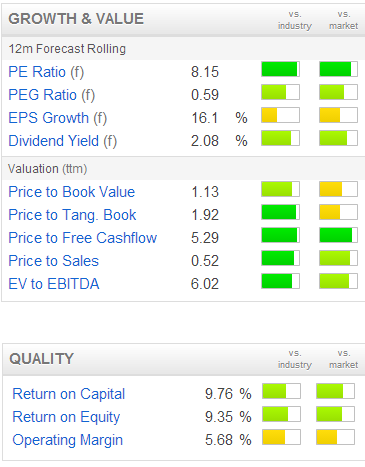
As you can see from the Stockopedia stats for Scisys above right, there's a lot of green, indicating attractive ratios for growth and value.
My chosen value pick in this sector is Cohort (LON:CHRT 157p), which in my opinion has slightly better value characteristics than Scisys, but as always DYOR.
Hornby (LON:HRN 82p) has issued an IMS today. I've revisited the numbers, and they are cautiously saying that (subject to a number of caveats) trading should be in line with expectations. That would deliver EPS of 3.5p for this year, according to broker consensus, so at 82p the shares would be on a PER of a hefty 23 times this year's forecast earnings.
So clearly the share price is not only anticipating an in line result this year, but improved performance in future, as they recover from serious supply difficulties in the past. I can see the place for a niche company like this, but remain uncomfortable with the price. If you have to pay up-front for a trading recovery, how does that make sense on a risk/reward basis? It's not for me at this price.
Globo (LON:GBO 42p) has issued a positive-sounding H1 trading update. "Strong growth momentum" of 51% year-on-year has been achieved in revenues, to E32m for continuing operations. They state that EBITDA and PBT will be "slightly ahead of market expectations".
Let's be clear, the EBITDA figures are totally meaningless, because Globo capitalise so many costs into intangibles. So to value the business on EBITDA is complete fantasy, as it is for most software companies. You're ignoring a large part of their overheads!
The Balance Sheet at Globo just doesn't look right to me at all. Far too much in debtors, and it therefore looks like potentially, an accident waiting to happen in my opinion. Very aggressive accounting techniques tend to come unstuck at some point, with big write-offs. Although those are presented as exceptional, and so it continues.
This type of business has products with very short lifespans too, so it's not something I would feel comfortable with at all, but good luck to people who ride the wave!
I set out in more detail what alarm bells ring for me with Globo's accounts here on 8 April. Maybe I'm being too harsh on them, but having made a lot of mistakes in the past by ignoring accounting signals that worry me, I just don't take any risks any more.
That's covered everything of interest to me this morning, so see you here again from 8 a.m. tomorrow.
Regards, Paul.
(of the companies mentioned today, Paul has long positions in VNET and CHRT, and no short positions)
Disclaimer
This is not financial advice. Our content is intended to be used and must be used for information and education purposes only. Please read our disclaimer and terms and conditions to understand our obligations.

12 comments
Re: Vianet
I have some found some good research from valuehunteruk on the tied pub indusrty. Whilst written over a year ago much is still relevant.
I would agree that the tied business model is under presure and that there will eventually be fewer tied pubs and more managed pubs
http://www.stockopedia.com/content/the-leased-pub-sector-what-does-the-future-hold-58053/
Fitch doesn't think a new code would kill pubcos, but in the end social changes might...
(I hope I've edited this down enough...)
http://www.fitchratings.com/gws/en/fitchwire/fitchwirearticle/UK-Pub-Proposal?pr_id=789475#
I seriously doubt that the forthcoming legislation will ban flow monitoring though it is a bit worrying to see Vianet use Human Rights as one defence for their technology. The bigger issue is the future of the tied tenant industry in general.
There are approximately 50,000 pubs in the UK with about 24,000 on tied agreements. Apparently landlords in 46% of these tied agreements ( approx 11,000 by my reckoning) make less than £15k per annum. The largest pubcos which run these tied agreements appear to be Enterprise and Punch? A quick look at the Stockopedia sheets for these two companies will tell you all you need to know about the health of the pubcos. Warning - if you are a nervous investor easily worried by looking at companies with high levels of debt, don’t bother.
In my view it seems that many landlords (or their pubcos) have not been able to make a reasonable return for some considerable time. This leads me to believe that the industry cannot sustain 24,000 tied pubs in the long term. It’s therefore difficult for me to see how a small company like Vianet can buck the trend and make above average returns from supplying such a declining market.
There will always be tied tenancies - but I suspect their number will contract considerably. When interest rates do rise the tied tenancy business could well be one sector that suffers. In my view Vianet are quite correct to spend some time exploring new markets.
Paul
Have read most of company's submission now and responses to Fair Pint objections to Bruline (Vianet) technology make interesting reading - another example of a so-called consumer pressure group having disproportionate impact (?) based on incorrect or at least selective data presentation (FP are effectively representing disgruntled tenants who feel pubcos are seeking to maximise profits at expense of tenant's living standards. There has clearly been a significant amount of management time and directed at challenging these claims over the last 4 years. Interesting comment re Vince Cable - not the first time our Business Secretary has shown his attitude towards 'big business' and the objective of profit generation in a capitalist system.
Not asking for transcripts of conversations! but are you able to provide any more details of your Q&A meeting
with Dickson?
Also, appreciate you did not comment last week on Synetics interims but have you had a chance to review since? Interested to know if your view might have changed since your last post earlier in the year as revenue, profits pre-tax , EPS and dividend all up. Caveat of future order timing comment form Chairman seems to have caused some negative feeling but this caution seems prudent in present climate and he has claimed since, no different to recent times where large contract purchases (often public funded) can be delayed.
Peter
Paul
It's becoming clear that the threat to VNET in the discussion document is a red herring brought about by a misconceived and poorly drafted Government document. The effect of this has been to draw attention away from the real issue - the introduction of a measure of equality between the tied and untied pubs and the reduction of the power of the very large pub landlords. How this takes effect and the extent to which it takes effect, if at all, will be material to VNET. I suspect that what Vince Cable has in mind is not workable and if and when a Pub Code is produced it could have expensive and long lasting effects - VC should be careful what he wishes for!. Delpher
Paul
Agree with all your comments and previous posts re VNET - have scanned some of their submission and their points that illicit purchases of beer avoiding tax liabilities must be something Government takes seriously - look at similar situation currently re smuggled cigarettes and loss of VAT plus duty. Surely there will always need to be some reliable means to measure flow volumes for tenant's own management control as well as pubcos benefit. Only justification to ban would presumably be doubt as to accuracy of measurement and this by independent assessment seems to have been discounted. Banning figures from flow meters as the method to establish volumes dispensed for compliance and replacing with random check visits by inspectors cannot be a credible alternative and would do little to improve relationships between tenants and pubcos. If individual premises are not economically viable then it should be a decision for the pubcos to make to offer either more favourable terms or to find a more effective tenant. The Government might well be concerned about pub closures but legislating to give tenants more favour or flexibility in their contracts with suppliers seems to me to be another example of politics attempting to interfere with normal commercial forces - there might well be concern of impact of such closures on local communities but this could equally be applied to the demise of some many other economically unviable retail operations whether it is the corner shop, the Post Office or whatever. I can see some recovery in share price for VNET in due course although accept timing could be protracted but in meantime, as you say there is a sustainable high yield and with company board now focused rightly on other flow measurement dispensing applications and a wider geographical spread (notably US) there could be significant capital growth in the medium term.
Peter
Great summary re Vianet (LON:VNET) Peter, I agree with all of that.
From my perspective, I'm completely open about the fact that my original bullishness on the shares at 103p when I bought, turned out to be wrong at least in the short term, from factors which were not foreseen or even foreseeable at the time - the regulatory threat was described by Dickson as "coming completely from left-field", even a bizarre intervention by Vince Cable. You can see that from the chart - it didn't move at all for weeks after the publication of the Govt paper in April, it was only when Vianet mentioned it in their results in June that investors took fright.
Also, they warned on profits before that, which was a surprise given that they have announced positive trading in Oct 2012. As Dickson now accepts, they could have managed investor expectations better in the last year, but have basically been overwhelmed with so many issues to deal with. I'm very encouraged that he's now engaged with the PI community, and personally I like the guy - I think he's genuine, obviously hard-working, and completely committed to this group - just look at his personal shareholding, and the amount of shares he's bought in the last couple of years.
So it's just a matter of logically re-assessing the situation, weighing up the new information we have (about the regulatory threat, and the lack of growth from vending), and deciding where to go from here.
I don't think there is massive upside in the short term, but am happy that we should be usefully higher, hopefully, in 6-12 months. Plus locking in that 8% yield could end up looking like a smart move in the rear view mirror next year?
Cheers, Paul.
Re Impellam (LON:IPEL) . I decided to sell this morning after seeing a lurch down that alerted me to some bad news! Revenue was broadely flat but operating margin is declining, suggesting increased competitive pressure, inability to price, declining revenue and/or rising costs.
This Challenges remain and will need to be addressed in the second half of the year. Our expectation is that we will see a continuance of the strong performance in the core UK and US businesses in the second half of the year but that the corrective changes we will implement in Medacs and Carlisle will continue, for the short term, to hold back growth in EPS. appears to be saying that plans to address this will be kicked off in H2:
My translation of this: Carlisle Support Services has experienced a challenging and disappointing first half due to a combination of internal and external factors and we are responding accordingly, in particular looking at ways to leverage Group capability and resource to improve market position, process and profitability is "the market is tough out there but we'll try to find cost cutting pressures in the rest of the divisions that up to now haven't been sharing best internal practice. We were surpised too!". Further reading indicates that shop fit outs are being deferred 'cos of a recession and preference for clients to invest in the internet as a channel. One of those might reverse but the other likely aint finished yet.
UK and North America seem to be doing OK using EBIT (earnings before anything that can stuff cash flow) and are poised for growth. If only all that poising didn't cost more than expected. But now they are ready!
Medacs (medical) and Carlisle (cleaning and security) both saw similar revenue decreases (8.7% and 9.4%), but very different gross profit decreases (9% and 57.4%).
Carlisle, also the smallest revenue divison, seems to be the dog in the goup.
Net debt increased with the largest outpayment going to dividends however a big increase in short term borrowings (+£21m - revolving credit) contributed more to this.
In summary, remedial action is likely to need H2 to identify/implement and the recession end ing would be really useful too.
I hate selling, it is only a precursor to working out what to buy next.
I'm getting more comfortable with Vianet (LON:VNET) after thinking about things, and have just topped up my position, buying a few more at 72.2p. Maybe not much immediate upside, but with 8% dividend yield, and investor sentiment stabilising/improving re the regulatory threat, perhaps we've seen a bottom? DYOR as usual.
Cheers, Paul.
A very important point with the beer flow monitoring equipment: it is about detecting changes in trends in beer volumes over time relative to prior periods which then warrant investigation. Under the voluntary code of practice the pubco cannot simply send in a bill based on the flow monitoring equipment showing a potential breach of the tie; it must be investigated and reviewed. The legal points are relevant.
I agree, more or less, with Mr C above. Monitoring equipment will remain in use, perhaps under the pretext of stock or quality control, but actually be used as it is now. In a related vein, thank you to all for the reports of meetings. I noted you both thought that there was overstretch in the system. I cannot comment on that, but ultimately think this is both a good and necessary thing for Vianet (LON:VNET). The current business model is very dependent upon the UK monitoring side. This is slowly but inevitably declining because pub estates are getting smaller across the board. Fuel and vending telemetry, as well as the US market, are the way forward. The management seem to have recognised this, and have taken pre-emptive steps. Good on them!
(Re comments on SCISYS (LON:SSY) and Cohort, much militray training is shifting from physical activty to simulation, and also the UK MoD increasingly sees its role in multi-national forces as supplying logistical support rather than teeth arms. This is good for such suppliers of electrical doodahs, despite the cuts (which will impact on the makers of socks and rifles!!)
My thoughts on reading Vianet's defence of beer monitoring:
To be precise, the Gov't proposes that "information obtained from flow monitoring equipment may not be used for the purpose of determining whether a tenant is complying with purchasing obligations and that it may not be used or considered as evidence when enforcing purchasing obligations."
1. If this was enacted I think PubCos would still use beer monitoring to spot who might be cheating, but they'd have to use old-fashioned inspections as evidence. This would be less effective and cost a lot more. Some technology can be used in the barrels to distinguish contracted deliveries from grey market ones.
2. The Human Rights points are fanciful, to borrow a word Vianet use in their doc.
3. The flow devices are accurate enough. Tenants should monitor accuracy themselves I think, plotting a daily chart.
4. Cleaning fluid volume is estimated by Brulines who claim they overestimate. It will remain contentious unless iDraught is installed.
5. Vianet (and PubCos) have overstated the impact of the proposal. IMO. It would increase PubCo costs, to be passed onto tenants in all probability.