Small Cap Value Report (26 May 2017) - VLE, PLA, SDI

Volvere (LON:VLE)
- Share price: 705p (+5%)
- No. of shares: 4.1 million
- Market Cap: £29 million
(Please note that I currently hold a long position in Volvere)
I don't get to use the above disclaimer very much, because my personal portfolio is recklessly undiversified. I only own nine stocks, and the top 5 currently account for 75% of everything (or 79% if you exclude cash). Volvere is a top 5 holding for me.
I bought into it when I discovered it a year ago, and you can find my article on it at this link (external website).
It's an investment company, which typically seeks out unlisted companies which are in need of change - often a change in their financial structure (removal of bank debt) or occasionally a change in strategy/management. It's a supportive shareholder, not a raider or an asset stripper.
It only holds a few investments at a time, and currently has 3 in its portfolio.
Two brothers are the key executives. They own 25% and 13% of shares, respectively.
Today's Results
These results are for the year ending December 2016 - admittedly, slow reporting.
But they're rather good:
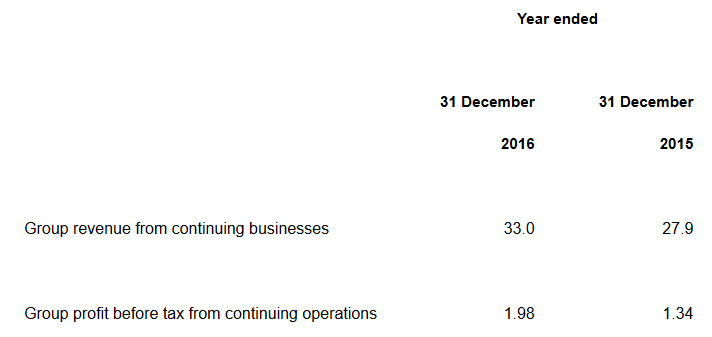
As a consequence of the above, NAV increases to 617p from 569p. That's an increase of 8%, below Volvere's prior long-term average of 15%.
NAV moves in mysterious ways, however. Because Volvere's holdings are unlisted, they are held on the balance sheet at the price originally paid for them, and they only increase NAV by their net profit contribution to the group every year. But if they are sold after profitability has improved, then you can get a sudden jump in NAV (as the underlying gain in value is realised).
Last year, NAV increased by 32%, as an investment was disposed of after its profitability had improved.
This year, there has been no disposal, but PBT has significantly improved, as you can see in the table above.
Shire Foods, previously the largest contributor to profits, lost a large customer and saw margins increase as a consequence of the Sterling devaluation, and PBT reduced from £1.6 million to £1.15 million (before the charges Volvere makes for managing it and lending to it).
The big winner, however, was the new holding Impetus Automotive, a consultant to car manufacturers. It saw PBT (again, before Volvere's charges) increase from £0.6 million over the prior 9-month period, to £1.5 million this full year.
Volvere originally only paid £1.25 million for it, when it needed to remove a bank creditor and find more working capital.
I would expect that Volvere's share of Impetus will reduce to 79%, as was planned if internal management options were to vest. The share has already been reduced to 83%.
The final holding, a CCTV software business, remains profitable but still very small for now.
Summary
If you exclude the central costs incurred by Volvere in managing these businesses, pre-tax profitability has improved to £2.8 million.
Or on a statutory basis, PBT is £2 million and after paying taxes, there is £1.3 million in net income for equity holders, plus £0.3 million for minority interests (the internal managers at their subsidiaries).
Outlook
Conditions at Shire remain tough:
Whilst we remain positive overall about Shire's contribution to the Group, there are some headwinds facing the business, not least increasing labour rates and a reluctance by customers to pass on price rises to consumers. However, raw material prices now seem to have largely stabilised and we have agreed with customers new pricing and product specifications, which are expected to relieve downward margin pressure from the second quarter of 2017.
But things at Impetus are looking better:
The automotive industry is evolving, driven by increasing innovation and technology in both vehicles and their supply and support channels. This provides a dynamic and challenging back-drop for Impetus and we believe the business is well-positioned in such an environment.
As part of a plan to widen Impetus's service offering the company has, with effect from April 2017, assumed responsibility for the management and delivery of a large automotive manufacturer's learning and development activities in the UK. As a result, Impetus now employs almost 400 people (an increase of approximately 150 compared to March 2017) and we expect Impetus' financial contribution to increase further this year as a result.
My opinion
The kicker to all of this is that Volvere is sitting on a cash position of £20 million (up from £16 million a year ago).
Another way of analysing the balance sheet strength is as follows:
- Freehold property +£2.4 million
- Loans and receivables +£7 million
- Cash +£20 million
- Payables -£2.6 million
- Borrowings -£3.7 million
Total Value: £23 million (or £20.7 million excluding freehold property)
It has never paid a dividend, preferring to buy back its own shares from time to time.
I'm happy to continue holding it at a £29 million market cap, looking for progress at Impetus to offset tough conditions at Shire, and for the long-term rate of NAV growth to hopefully continue. I did consider buying a few more this morning, but it's already 12% of my portfolio and that's probably enough.
Plastics Capital (LON:PLA)
- Share price: 121.5 (-1%)
- No. of shares: 35.8 million (before Placing)
- Market Cap: 43 million
Placing to raise £3.74 million
At the risk of trying too hard to make us at the SCVR look smarter than we really are, this niche manufacturer is a share about which Paul and I have each written sceptically.
The balance sheet looked bloated to me when I covered it back in December, and I suggested that the targeted EBITDA growth plan would lead to yet more balance sheet expansion, and poor returns on assets.
Paul has also argued that the accounting adjustments are too large, the net debt is too high, free cash flow negative, and that dividends made further acquisitions unaffordable, without dilution.
Today, it announces that the share count is being increased by 9% by a Placing at 117p. Last night's close was 122.5p.
The net proceeds of the Placing, which are expected to amount to approximately £3.54 million, are to be applied, in part, towards the proposed increase of the Company's stake in the CCM Group, its US based minority investment focused on the production of creasing matrix. In addition, part of the net Placing proceeds will be invested in other parts of the Group in order to increase capacity to satisfy increasing demand for the Group's products and thereby accelerate organic growth.
That sounds like the company needs some extra cash only for growth purposes, but two paragraphs later we also find that dividends are being suspended:
The net proceeds of the Placing will be augmented by the decision of the Board to suspend dividend payments for at least the next two scheduled payments. The Directors estimate that this will result in a cash saving of approximately £1.7 million. It is intended that the cash saving will be re-invested in the business, alongside certain of the net proceeds of the Placing.
The share price has barely moved since I first covered it, so it's hardly been a disaster for shareholders. But raising more cash from shareholders and suspending dividends is 100% consistent with the thesis that this is a poor-quality investment.
Scientific Digital Imaging (LON:SDI)
- Share price: 25.5p (-11%)
- No. of shares: 88.8 million
- Market Cap: £23 million
By request, I'm taking a look at this multi-pronged designer and manufacturers of high-tech products across a range of industries.
This short post-close trading update for the period ending April 2017 has been badly received:
Reported profits before tax are expected to be in line with management's expectations, with the latest acquisition, Astles Control Systems, as expected making a contribution to the profits of the Group.This share has made huge progress over the past year, more than doubling.
The company has five subsidiaries and appears to be hungry for more:
"We have once again strengthened the Group with the recent acquisition and are pleased with the positive contribution from Astles Control Systems. This is a business model we plan to continue to replicate in order to grow a diversified company with increasing revenue streams."That shouldn't be news, but perhaps investors are a little nervous of another placing.
When SDI acquired Astles in December, it did so with a fairly large placing (nearly 24 million shares issued, versus 64 million outstanding prior to the deal).
The issue price was at a discount of 23.5% versus the prior close.
That hit the share price on the announcement day, but it quickly recovered.
So perhaps investors are thinking that more news of that sort may be coming down the tracks shortly.
Headline interim results for this year were good, revenues up 33% and PBT improving to £0.4 million. The subsidiaries are apparently quite active with lots of new product launches.
It could be worthy of further research, but I note that the share count has already multiplied several times over the past few years (up from 18 million in 2012) and it's more my style to go far shares where the share count is going to move in the opposite direction.
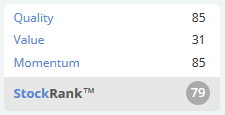
StockRank is not bad, and could improve with the full-year results:
Disclaimer
This is not financial advice. Our content is intended to be used and must be used for information and education purposes only. Please read our disclaimer and terms and conditions to understand our obligations.

32 comments
Fusionex International (LON:FXI) (which I do not hold) announced on Friday (at 5.30 pm) that it intends to de-list from AIM. The joint broker and non-exec chairman have resigned.
FXI is a profitable and growing company with cash. The directors say they are disappointed with AIM and plan to use the costs of their listing inside the business instead.
The SP has collapsed.
Hi Graham
Great post today and Volvere (LON:VLE) looks like an interesting company, which I will research some more. I wished I had come across it a year ago!
I like the management's direct speaking. Have you ever met them?
Like others above I would be interested to hear your reasons behind your running a concentrated portfolio? I run a relatively concentrated portfolio of 16 holdings and the top five reperesenting 60% of the ex-cash portfolio and the top holding 20% on its own. I do believe that if you one goes much beyond 15 stocks you might as well buy an etf.
I may regret my concentration but I was up 35% last year and 48% YTD so I am happy to stick to this strategy which I have decided to follow after reading Buffet, Lynch and a number of others who believe in having a few eggs in a carefully watched basket.
Have a good weekend.
I think Buffett has around 40 shares. He also has larger us companies.
Hi Herbie
Yes but if you look at his portfolio of common stocks:
http://warrenbuffettstockportfolio.com/
You will see that his top six holdings of publicly quoted stocks accounts for 69.67% but I accept that he also owns many companies outright (there is a great list at https://en.m.wikipedia.org/wiki/List_of_assets_owned_by_Berkshire_Hathaway).
But when I mentioned Buffett I was really more pointing towards his sayings/opinions on diversification. For example:
“Diversification is protection against ignorance. It makes little sense if you know what you are doing.”
Also in his earlier years he was known to make big concentrated bets. For example when he bought 5% of Amex after the salad oil scandal this represented 40% of the Buffett Partnership capital at the time.
Finally Benjamin Graham who always preached diversification made money from one investment than all of his other investments combined when he invested 25% of Graham Newmans capital to by 50% of Geico.
I have studied quite deeply the whole concentrated v diversified argument quite deeply to be as sure as I can be that I am going down the right path, as you will hear so often that one has to diversify (30 to 50 stocks - I just could not find 50 stocks that I would want to invest in :-)!)
I am no Warren Buffett and I may still be proved wrong in my strategy but I feel comfortable with it and do sleep soundly at night. :-)
Thanks for that, I did not know about the ones he own's outright, so it appears over 100 companies. OK the top 6 are about 60% of his portfolio, it's still diversification. But I agree it is protection against ignorance, jolly good he did not put all of his money into Tesco. If you have all your money in a few shares it's more risky, especially if they are small companies. Maybe you have been lucky but most people make mistakes or companies go wrong, you only have to look at Crawshaw (LON:CRAW), up x10 in one year and then crashing down, certainly recently it's been easier to pick winners but I think it's been an unusual market. If Corbyn wins the election then I'm sure it will be a completely different kettle of fish.
Hi Herbie
Yes I was in Crawshaw (LON:CRAW) but only modestly but I lost money. But I personally feel I am on safer ground with Boohoo.Com (LON:BOO) Treatt (LON:TET) Bioventix (LON:BVXP) Fevertree Drinks (LON:FEVR) XP Power (LON:XPP) Purplebricks (LON:PURP) Somero Enterprises Inc (LON:SOM) and Air Partner (LON:AIR) though I concede that Purplebricks (LON:PURP) maybe a dangerous pick but even a 50% decline (à la Revolution Bars (LON:RBG) type fall) would not be too painful.
Have good weekend.
Hi Purpleski, I do hold or have held most of those shares plus some others that have done well for me such as Ab Dynamics (LON:ABDP), Burford Capital (LON:BUR), £TRSL, Zytronic (LON:ZYT), £G4M., I have more recently diversified into Europe, some of those have done very well in a short time. I have dabbled in a few such as Crawshaw (LON:CRAW) and Revolution Bars (LON:RBG), lost some money but relatively very small amounts. I'm reducing my small cap exposure, buying some large caps for income. It comes down to what works for you and what you are comfortable with.
Hi purpleski, I'm glad you found Friday's article to be of interest. I've never spoken with Volvere management, but if you haven't spotted this interview yet it might be useful.
It sounds like we are fairly similar in terms of exposure to our top ideas.
Graham
Thanks Graham for the reply and the interview link.
As for the returns I hope that time will prove that this was more because of judgement and luck but we will see.
I feel won of the main contributors to the performance has been, as someone put it, the conviction to hold. There are a number of stocks that I sold, for no good reason than that the price had dropped (which is not a good reason!) in my earlier learning phase of investing which have if I had held seen very nice gains such as £RACE and Fidelity China Special Situations Closed Fund (LON:FCSS) since I sold them. Of course this may an example of hindsight bias, as there may stocks I sold for no good reason which continued to decline.
Graham, thanks for the section on Scientific Digital Imaging (LON:SDI).
No problem Ricky (and John)
Hi Graham I would also be interested in your low diversification strategy is this something you have always adapted or more recently moved towards ? Have you found your performance has increased with low number of stocks held ?
I've recently switched to a max of 12 funds but scale in each investment as the price goes up rather than lumping a twelfth of the total pot in one go when I find something of interest given I;ve only started this last three months running also a momentum screen I'm beginning to think maybe this market is up with events as not much seems to want to go much higher.
Thanks again
Hi clarea, I used to be more diversified, only owning maybe 4 or 5 stocks in total. Now I own 9 and am likely to increase this number, but the top 6 will probably always be a big %.
There is a sense in which this is involuntary: if you invested in 12 different stocks, probably some of them would go up 50-100% after a few years, and some of them would go down, so you'd end up with a huge top 6 % just from their share price movements.
I can't say that my performance has improved since I started doing this, because I've always been concentrated.
Though my returns when managing other people's money, with a higher level of diversification, were actually better than the returns achieved by my personal portfolio. That makes good sense though - when I was running those parallel strategies, the purpose of my personal portfolio was to take on more risk and get a lot of lessons in what worked and what didn't, while giving my clients a safer experience with a more diversified strategy, in accordance with the mandate they had given my company.
I can't speak to your momentum strategy but scaling in is certainly a reasonable thing to do in my book. There's no need to buy or sell anything all at once, barring exceptional circumstances.
Best wishes,
Graham
Focusing on the bigger picture and going on Graham's calculation the market is only valuing 3 profitable businesses at £7.1 m which is an absurd under valuation. Fill your boots while stocks last!
Hi Graham,
I would appreciate any views on Scientific Digital Imaging (LON:SDI). It's a "high flyer" which is down 11.7% on a meeting expectations update which I guess was a bit too weak for the market. I have a small position.
The market survives on differing views and this site is a great opportunity to see others points. On Volvere (VLE) I find that I am way less impressed than Graham (I don't hold). I understand the very attractive potential of Impetus but the group is also shackled to a declining margin, capex-demanding, food business in a far from unique space. I am also more than a little surprised to see 52 days of finished goods inventory. I assume this is Shire Foods, since I cannot see any finished goods arising from Impetus and very little from the small CCTV business.
VLE may be able to turn Shire into a shining star but per Buffett we are reminded that lousy busnesses usually defeat even great management.
It reminds me a bit of Melrose (MRO) where great businesses are bought, expanded and sold profitably while Brush sticks to them soaking up cash and management effort.
Graham, if you don't mind my asking, why do you run a portfolio that you describe as 'recklessly undiversified'? Is it just because you want to take a lot of risk or do you actually think it is not as reckless as you suggest?
I ask because I've been thinking about my own diversification recently and have come to the view that:
A) I don't need that much diversification to effectively manage idiosyncratic risk from individual shares. I think 10-15 shares seems enough for this.
B) I am generally much more concerned about the risk of equities (or classes of equities) crashing in general. I think managing 'market' risk is actually probably easier with a smaller number of shares (so I can more easily ensure they are less cyclical / correlated with the market).
C) Since my strategy is quite reliant on momentum and on occasion selling out of shares quickly, the liquidity of individual shares can sometimes be a more relevant constraint on the size of any individual holding.
A very interesting discussion on diversification and how many stocks are best for a portfolio. I would also be interested in Graham's and or Paul's take on this.
I guess that different personalities and investment styles can make a difference here. I am no believer in diversification (c.f. the Buffett quote in post 13) but I've usually go 40 to 50 stocks in my portfolio. My reasons:
* it takes me a long time to get to know a company and have real confidence in owning the shares. Holding companies lots of companies in a large watchlist just doesn't work. I haven't got the energy to keep monitoring them and learning about them. So I'll buy a small holding of something that looks good (usually after a few hours of research). Then if it keeps performing I can keep topping up
* the real high flyers (BOO, FEVR, ACSO, BVXP, G4M, BUR, KWS...) are getting so expensive. I don't want to sell while they are going up but I do the occasional top slice to protect against a possible crash.
Having small holdings in some other growth companies gives me a good chance to find the next BOO)
* there are so many good companies out there at the moment. Very few of my holdings seem to be duds.
The disadvantage for me of holding so many shares are:
* I don't find enough time to look at all of them in depth (but this would be no different with a small portfolio and a large watchlist
Overall, this approach fits my style and personality. And at the moment it is working.
Edward Croft has written some articles on it but I can't find them on the search, but here is one reply he wrote in August 2015: "I've written a lot on this topic in the past and have my own take. I no longer believe in 5-10 stock portfolios - but if you really are compelled to run such a portfolio your sector approach makes sense... the biggest mistake many focused investors make is putting all their eggs in 5 or 10 stocks only to find they actually took 1 highly correlated sector bet.
I do take issue with the 'focus' investor approach though as it exposes investors to a lot more behavioural bias which most people just can't handle when the going gets tough. There is another way to go about seeking higher returns, though I don't think most investors understand it. The 2 ways to go about maximising returns are:
Concentrated bets in higher volatility shares.
Diversified bets in lower volatility shares plus leverage.
Most private investors either can't access leverage or don't quite understand how to handle it, so rarely go for the latter approach. But there's plenty of research that shows that the latter approach creates much higher risk adjusted returns over the long term, and a far reduced risk of ruin.
And it's not only in theory... I now prefer to take the latter approach in my more speculative account and it works far, far better for me. I have a 50 stock portfolio invested long short across 10 economic sectors in fairly equal weightings - i.e. highly diversified which probably sounds really 'boring' to most investors. I'm in 25 names long and 25 names short... with significant leverage. It's working for me as it's managed to crank up 40% returns year to date with minimal volatility. I'm considering putting a lot more capital into it as a strategy."
Hi Herbie,
I'm certainly with you on the idea of "Diversified bets in lower volatility shares plus leverage." , at least broadly.
I'm intrigued though with the idea that you have 25 longs and 25 shorts.
Is this a deliberate policy and you effectively attempting to be market neutral?
Are you implicitly pair trading?
I ask, because I'm increasingly nervous about the level of the overall market and am considering some form of "hedging". I've always been somewhat nervous about pairs trades as i regard a pair trade as potentially more volatile than a simple long, although perhaps a diversified set of pairs trades negates that volatility.
If that is roughly what you are doing, is there not a systemic methodology risk? E.g if you bias is for your longs to be predominately "value" based and your shorts predominantly "momentum / growth" then the market mood could move all of your pairs in the wrong (or even the right) direction.
If you're prepared to share I'd certainly be interesting in discussing further.
Sorry Gromley, you misunderstood my post, it's not I but Edward Croft who has that portfolio. From memory think he has high Stockopedia ranked longs (mostly UK) and shorts on low ranked (mainly US) shares. That was 18 months ago so could well have changed now.
I don't have any shorts at the moment, sometimes I may do an index short if I think the market is going to crash.
Ah thanks Herbie - yes I'd missed where your quotation marks closed - DOH!
I'll have have a look an see what else EC has written on the subject.
Hi Herbie
This interesting I will take the time to reply later as I am holiday and have to go the beach with my son!
Michael
Hi Herbie
Your style sounds a lot more sophisticated than mine. My reading up on diversified versus concentrated was much inspired by Stockopedia's take on it i.e. They don't agree with a contracted strategy. But there is a lot of evidence out their that once you get beyond 10 stocks (as long as they're not all Angola miners) that the benefits of diversification fades. I think Hagstrom has researched this and back tested it.
In the end perhaps it is what works for the individual investor. I am reading Minervini (TLASMW) and I suspect it is not going to be a strategy for me though I expect to gain knowledge. I wanted/want to be a value investor but have found myself caught up in this raging bull market and can not get off. :-).
It may be a mistake but I DO think my mainstocks are sound and even a severe pull back will still leave me with good returns over the last 3 to 4 years.
Hi Purpleski,
I used to be a value investor but I like some others such as Paul found other styles worked better in the last year or so but that does not mean that momentum will work all the time, believe Minervini is over 80% in cash or EFT shorts at the moment. No one knows the future. Re concentrated, I recall in the Naps that the 2nd choice shares outperformed the first choice ones so sometimes it pays to pick 20 instead of 10. I know some who have run concentrated folios came unstuck last year. It's not just sectors but size also counts, small companies do worse in a recession or crash. Anyway I need some income that is part of my reason for buying some shares.
I agree you have a good choice of stocks, but some are quite vulnerable, I'm considering selling Fevertree Drinks (LON:FEVR) and watching Purplebricks (LON:PURP) closely.
Hi JulianH
Thanks for your post. I find with a watch list at the moment anyway, is that I might add something to a watchlist on Stockopedia but then forget it. I should really add to watchlist and say my RNS alerts on Vox Markets but ...... whereas if I buy a small holding (after a few hours research), I then find myself looking closer at the stock. This is what happened with Revolution Bars (LON:RBG) and having study it, in this case, I sold out for a small loss.
At the moment I don't have any small holdings but even if I had say 30 holdings if I had 75% in five to seven holdings I would consider myself to be running a concentrated portfolio.
As for top slicing I not totally convince on this as a strategy because for me:
- it is another form of market timing which I just don't believe I can do
- I find rarely that I can find an alternative
- for my high conviction stocks I have a very long time horizon 5 plus years (more like 10) so for me a big drawdown is (if the reasons for investing remain unchanged) just a blip on the way to a higher price.
As you imply I think one has to find a style that suits (as long as it has long term prospects of making money) and stick with it.
Hi Trigger,
Thanks for the question.
There are plenty of reasons why I invest this way but one of the simplest ones is that it makes my learning process much faster. My unsuccessful investments have hurt me a lot, and avoiding that pain of large loss has motivated me to avoid making those same mistakes in the future. I've had enough winners so that my capital has been preserved, but I've also learned certain lessons about what to avoid in a much more visceral and accelerated way.
Also, in terms of volatility, I don't think a 5/6/10 stock portfolio is all that bad. So I agree with your point A:
B. I agree with this, since owning fewer stocks means that you live and die by the particular stocks you've chosen, and less by the overall market movements.
C. That's specific to your own strategy, but is an example of how things change when you are concentrated rather than diversified.
In summary, being concentrated is reckless, because it means you can lose big chunks of your capital. It's reckless in the same way that starting a new business or being an entrepreneur is reckless. You can lose. But if you've a mindset for it, then it can't be helped. And a baptism by fire might be the fastest way to learn how to do anything.
I should mention that I've only been highly concentrated when managing my own investments. When managing other people's money, I've been quite a bit more diversified (e.g. 20 good-quality stocks).
Cheers
Graham
I get a similar graph to the one that Graham included. Clearly you could choose the single stock which you feel will be the best performer over the next time period, but you might be wrong and you will experience considerable volatility. By adding an extra stock you can reduce the volatility (if you choose a stock from a different sector or with low covariance to the first stock) but it will presumably have a smaller estimated return than you "best" stock.
So it is a trade-off to slightly dilute your returns for the benefit of lower volatility. As you add more stocks to the portfolio you gradually get a law of diminishing returns where the benefit of a further reduction in volatility does not outweigh the dilution of potential returns.
In the diagram below the "Gain" chart shows the estimated return as more stocks are added to a portfolio and the "Variance" chart shows how the volatility also reduces.
The "Kelly" and "Sharpe" charts are two different ways to combine the data from the Gain and Variance charts to estimate risk-adjusted returns.
For the particular set of assumptions I made when I created these charts the sweet spot was about 10-15 stocks. One key assumption I made was that as I added more stocks I maintained an equal weighting of the stocks in the portfolio.
[Right-click and "view image" for a slightly bigger version of these charts]
I like to think of this process as rather like custom-designing your own special stock which has the risk/reward profile that you want by combining a collection of stocks. After you do that, you probably should not focus too much on the day-to-day performance of each individual stock but just at how the portfolio taken as whole performs. For example the table below shows the sequence of stocks which created the charts above and the cumulative estimated performance for the portfolio as a whole which includes the stocks up to the current row, including a suggested "stop-loss" which also applies to the portfolio as a whole, not as a stop-loss for the individual stocks. As you can see, it also flattens out at about 15 stocks.
Many people will point out that historical data is not an accurate guide to the future, which is true. If I tweak my assumptions I might get a different list of stocks with a different sweet spot. A good case can also be made for having a higher weight on the more favoured stocks. But the underlying principles remain valid.
It's the sort of company where you either trust the people or you don't.
Graham, it's not February! Lol
Haha, thank you Weasel.
Graham
Thanks for looking at Volvere (LON:VLE) (I hold).
I see that the CEO holds enough shares to block a special resolution (a whisker over 25%) and the brothers together hold 38.47% (are they a "concert party"? I have never understood the definition).
The Chairman has 3.18% and "chairs and comprises" both the audit committee and the remuneration committee!
The Corporate Governance Statement in the results is therefore a collectors' item:
"The Board gives careful consideration to the principles of corporate governance as set out in the UK Corporate Governance Code ("the Code") updated by the Financial Reporting Council in September 2014. However, the Company is relatively small and it is the opinion of the Directors that not all the provisions of the Code are relevant or desirable for a company of Volvere's size. On this basis we do not comply with the Code.
The Company has established an Audit Committee and a Remuneration Committee with formal terms of reference which comprise and are chaired by the Chairman."