Small Cap Value Report (27 Nov 2015) - FRP, CAKE, RSTR, CFYN

Good morning!
I'm conscious that my reports this week haven't been up to scratch, so I'll try to do a half decent one today, before I head into Soho for lunch & a brainstorming session with the boss!
Fairpoint (LON:FRP)
Share price: 173.5p (up 3% today)
No. shares: 45.6m
Market cap: £79.1m
Response to Autumn Statement - as we know, earlier this week George Osborne announced the Govt's intention to clamp down on whiplash claims, and the like. This sounds like it could have a major, negative impact on the various ambulance-chasing claims & legals firms which have been profiting from this area.
This reinforces just what a lucky escape Quindell (LON:QPP) shareholders had. Not only was accounting fraud uncovered at the company (no surprise to those of us who had properly scrutinised the company's accounts, and found numerous red flags over the years), but also it now seems that its core business would be under serious threat from these Government proposals.
Indeed, you only have to look at the hapless (or should that be hopeless?) Aussies that bought Quindell's main operations, Slater & Gordon. Look at its share price, since they inexplicably paid £600m for Quindell's main business, despite the seller clearly being in financial distress.
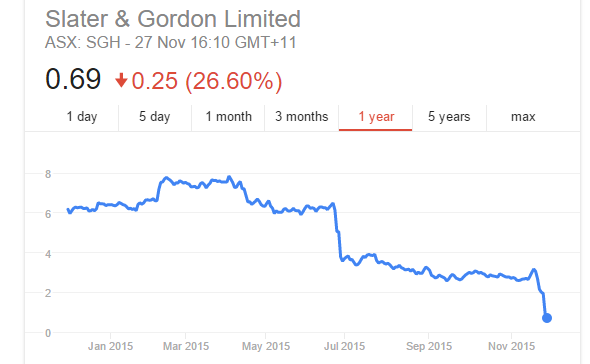
It's down over 90% , and Tom Winnifrith (who did sterling work in exposing the various accounting frauds at Quindell) reckons that it's heading for zero. I don't know about that, but it certainly shows just what a minefield this personal injury legal claims space is, and reinforces my view that the whole sector is probably best avoided at the moment.
Anyway, getting back to Fairpoint (LON:FRP) let's have a look at what their statement says today.
Fairpoint Group plc ("Fairpoint" or "the Group"), one of the UK's leading providers of consumer professional services (including consumer legal services), notes the comments made by the Chancellor in yesterday's Autumn Statement regarding personal injury claims. The Government's outline proposals, which remain subject to consultation, seek to restrict the ability for sufferers of minor whiplash injuries to claim compensation. The expected implementation timetable is April 2017 following a period of consultation in which the exact nature of the proposals will be defined. As such the proposed changes will have no impact on the Board's expectations of Group performance for the year to 31 December 2015 or for the year to 31 December 2016.
It stands to reason that, if proposals are likely to be implemented in Apr 2017, then of course they won't have any impact on results for 2015 or 2016. So I'm not particularly impressed with this paragraph.
Fairpoint goes on to say;
The notion of extending the small claims limit has been a topic of debate for some time and following the acquisition of Colemans LLP and its class leading Legal Processing Centre in August 2015, the Group has an operational capability designed specifically in anticipation of such changes. As such the Group is well positioned to take advantage of these market changes.
The section that I have bolded is rather more interesting. This suggests that not only has Fairpoint anticipated these changes, but it might even benefit from them.
My opinion - this statement is interesting, but it omits the most important information - how much of Fairpoint's business (and in particular its profits) comes from activities which are subject to change?
Unlike Quindell, and others such as Redde (LON:REDD), I don't think Fairpoint has motor injury claims as its main focus, and main money spinner. Its various websites suggest that it owns more broadly based legal practices, covering other areas too, such as family law.
EDIT: Disclosure: I've opened a short position on REDD, due to the factors above, and Aviva announcing that it has crossed from over 14% to over 13% shareholding.
So I was tempted to pick up a few Fairpoint shares this morning, but decided not to in the end. I don't like regulated sectors, especially where regulations are changing. Another factor to consider, is that the zeitgeist is now very much against this type of legal claims company. The Govt has spoken repeatedly about clamping down on the compensation culture, and its stance seems to be hardening.
Therefore, I see this whole area as fraught with risk. Maybe the proposals announced this week might be watered down, as they often are, once industry lobbying has sowed seeds of doubt at Westminster? So it could turn out to be a storm in a teacup.
Overall though, I feel that this now makes companies in this sector (legal services, since that is now Fairpoint's main focus, as the consumer debt side of their business is withering away) very difficult to value. We can't use 2015 or 2016 earnings as the basis to value these shares, because everything could change from 2017 onwards.
More certainty is needed before it can be accurately determined whether these shares are good value or not, in the long run, in my view. Fairpoint is probably the share I would go for, if bottom-fishing in the sector, as management seem excellent, and the valuation before this week's news was already fairly modest. I'm just not yet convinced that this is the right time to go fishing at all.
The other thing to consider, is that all these companies will probably put out reassuring-sounding statements (if they haven't already) but how meaningful are they really? The wording needs very careful scrutiny, as much for what it doesn't say, as what it does. Cleverly constructed words can hide problems sometimes.
Patisserie Holdings (LON:CAKE)
Share price: 325p (down 4.5% today)
No. shares: 100.0m
Market cap: £325.0m
Results for y/e 30 Sep 2015 - this is the chain of upmarket cake & coffee shops, Patisserie Valerie. It's a super format, and is in that lovely space of a self-funding retail roll-out - one of the most lucrative areas for investors, if you spot a good retail format early.
The trouble is, they can also become eye-wateringly expensive during the expansion phase, and of course % growth rates slow down after a while - it's relatively easy to double in size if you only have say 15 shops. But if you have 200, then doubling in size will take longer & be more problematic.
The other thing to consider is that upmarket chains like PV do somewhat limit their market, as there are numerous smaller, less affluent towns, where the format simply wouldn't attract enough better off customers to be viable. Although I note that CAKE also has two other brands, Philpotts, and the rather unattractively named Druckers, plus an artisan bakery subsidiary. So that should allow the group to operate on various levels in the market, which negates my first point really.
P&L - turnover rose 19.9% to £91.9m - so a fairly good growth rate there, but I can't see a split of how much of the growth is organic, and how much is due to new store openings.
The most meaningful profit measure for me is operating profit before exceptionals. This rose 20.2% to £14.6m, so a very good increase in profit there.
EPS calculations are skewed by last year having £858k exceptional costs (the IPO costs, which is perfectly acceptable to treat as exceptional), and I'm pleased to see no exceptionals this year. Also, the tax charge has just over doubled this year, to £3.2m, thus suppressing the EPS comparison of this year vs last year.
These reasons explain why basic EPS has only risen 9.6% to 11.41p. The underlying profit increase is higher than this though, at 20.2% as noted above.
Valuation - diluted EPS this year looks a clean number, ie. no adjustments - in fact, I like these accounts overall - they've not been messed about with, to inflate headline numbers, as so many companies do at the moment.
The PER drops out at a rather scarily high 28.5. Yes it's a lovely business, and has many good characteristics (growth, good cashflow, etc), but can a price this high really be justified? I'm struggling to justify such a high price.
Results seem to have come in bang on forecast, of 11.4p EPS. Broker consensus is for 13.2p in the new year (ending 30 Sep 2016), for a PER of a still very rich 24.6.
This effectively means that you would have to hold this share for another 2-3 years before the valuation came down to something sensible. I can't see how that makes sense. Don't ignore competition either - it's very easy to copy successful formats, and there are other up & coming patisseries chains (such as the wonderfully named, "Paul"), and of course thousands of independent operators.
Balance sheet - successful retailers don't actually need particularly strong balance sheets, because they are (usually) so cash generative. Although in this case, the balance sheet is also excellent - it has moved into a net cash position this year, of £6.1m, which is very impressive considering the capex needed to fund its own expansion.
The current ratio is terrific, at 5.44, with negligible long term creditors (just deferred tax of £1.9m), so this is a very well funded business, with absolutely no issues over both solvency, but also it's a cash cow that can easily fund its own expansion going forwards. Shareholders can therefore look forward to rising earnings, and no dilution from any equity fundraisings, since none should be necessary. Although there is likely to be the usual drip of dilution from share options being exercised.
Operating cashflow - superb, in a word. It generated £15.5m in post-tax operating cashflow, which was almost double what was needed to finance its £8.0m capex in the year. So theoretically, it had the internally-generated financing to expand twice as fast as it actually did.
Dividends - not much at this stage, the yield is just over 1%, but obviously this should rise once the expansion phase is complete, in a few years' time.
Outlook/current trading - sounds good to me;
We delivered our ninth consecutive year of growth in 2015 and this upward trend has continued into 2016 as trading to date remains positive. We have already opened eight new stores in the seven weeks since the financial year end. We have a well advanced pipeline and a healthy balance sheet which puts your company in a strong position to deliver another year of solid growth in 2016.
My opinion - as you can probably tell from the above, the more I dug into the numbers, the more I like this business! The only problem is that the valuation is too high at the moment.
Mind you, I thought that at the time it floated at 170p, and here we are at close to double that price, 18 months later, so perhaps sometimes you just have to pay up for great quality businesses?
Rightster (LON:RSTR)
Share price: 10.6p (up 8.7% today)
No. shares: 369.1m
Market cap: £39.1m
Update - the way I read this, it seems to say that we put ourselves up for sale, but nobody was interested;
Strategic review update and end of Offer Period
On 17 November 2015, Rightster announced a number of changes to the board, supported by the major shareholders, including the appointment of a new Chairman, CEO and COO. In light of their evolving plans for the business, the board has made the decision to conclude the strategic review process and focus on seeking further investment in the Company. Accordingly, the Company is no longer in an offer period under the Takeover Code.
Given that it also says the company needs to raise more money (bolded above), then I'm amazed the share price is up today. Shareholders have a discounted Placing to look forward to, unless they can spin the story so well that people are prepared to pour in more money uncritically.
Risk:reward still looks awful, in my opinion. So it remains a bargepole job unless & until the company can demonstrate that it is commercially viable (i.e. capable of making profit & positive cashflows).
Caffyns (LON:CFYN)
A very quick comment - the interim figures look quite good, but the outlook statement suggests that H2 will be tougher. Note that this group has a high exposure to the Volkswagen group.
Got to dash. Have a great weekend, and see you back here on Monday!
Regards, Paul.
(of the companies mentioned today, I have no long positions, and recently opened a short position on REDD. A fund management company with which I am associated may also hold positions in companies mentioned.
NB. These reports are my personal opinions only, which are subject to change without notice. They are never financial advice or recommendations. The ethos of this site is everyone doing their own research!)
Disclaimer
This is not financial advice. Our content is intended to be used and must be used for information and education purposes only. Please read our disclaimer and terms and conditions to understand our obligations.

29 comments
I waited and waited and added today at just over 132. No likelihood of there being less claims for injury or other sorts of damage while Storm Frank causes more havoc. Funded by selling AML,despite knowing that i would get a trifle more by waiting for the takeover to finalise. I was on a 58% profit and the small "loss" will be compensated for by its change of position, I'm thinking.
OK, perhaps merely a paper cut! I'll accept that but it pleases me to see if I can get them even cheaper!
Given the very limited exposure of a very widely based company to whiplash injury claims, the lack of immediate reality in the government's statement which always sounded like populist kite-flying anyway, this continued fall in SP, with no other factual material looks like the classic self-fulfilling prophecy. I'd just be fascinated to know where the money released from sales of FRP is being better invested, or, is it all going on Christmas?
I'm content, as my own philosophy is to be a long term collector for reliable dividends not as a short term speculator. The UK is becoming more litigious, not less and the government is attempting to reduce legal aid all the time. Society is less cohesive, money and acquiring it is replacing religion and each new administration passes more laws than the one before. I mention the EU and Strasbourg only in passing. Everything I hear from my son and his wife, both solicitors in two distinct sections of the law business, convinces me that this company has a massive future. I have a modest holding in this very well run company and am sitting here waiting to double it when the knife seems to have fallen far enough.
Is it really a falling knife at this stage? It seems to be merely back in the range it's been for the last couple of years. It only was >150p for a few weeks. I would say falling knife territory would be <100p.
I agree its not a falling knife its just had a knock. But it was over 180p for a few weeks and over 160p for a few months. I have not sold mine yet.
I am long on Patisserie Holdings (LON:CAKE) Yes, the valuation is high but the business model and momentum are key to the company.
Those of us who held Pizza Express shares at the turn of the century will remember with anguish that it was taken over at a price that seemed below its intrinsic value. We could not understand it. Pizza Express was controlled by the sucessful Luke Johnson whom analysts and shareholders begged, in vain, not to sell at such a basement price, or at all, as the potential cash flow was attractive.
Luke Johnson is the Chairman of private equity house Risk Capital Partners through which he is Executive Chairman and part-owner of Patisserie Holdings.
Quindell is dead! Long live Watchstone!!!
Paul just wanted to say how much I enjoyed your interview with T Clarke the other day. Very interesting business, run in a sensible conservative way with a leader who has worked his way up through the business from the bottom. From my perspective a sound investment target, although I am not so sold on the timing as others.
Any views on impact on National Accident Helpline?
paul
i think you would be wise to have a more detailed review of the REDD business model it is far from just a legal claims outfit indeed if you had visited their website i think you'd get a much greater appreciation of the range of outsourcing activities they provide to the car insurance industry as a whole. Also of the two law firms they have within their group one one is specifically related to the car insurance sector. I took the opportunity to top up today on the drop to the bottom and I'm not surprised at the move back into the blue at the end of the day.
common sense prevailed!
I wanted clarity from FRP, and got none. Having sold half immediately yesterday, I have sold the rest.
Regarding CAKE, as least the ROCE is good. No matter how many times I listen to David Stredder pushing CRAW (at every opportunity) I still can't force myself to buy a company's shares when the ROCE is under 2% and the PE over 200. How much growth for how many years would it take to justify this rating?
If anyone can explain the attraction I would genuinely welcome it. David/Carmensfella? We've heard how good their processed meat tastes, what is the investment case?
NI
If a company reinvests its profits for growth without fully capitalising the investment due to conservative accounting, you end up with crazy PE as the E is artificially low (indeed E should be about 0 or negative). You have to use other metrics to value it, like expected size and expected margin once it reaches the mature phase. Past ROE is not very relevant either, it's a bit like estimating the future income of a fresh graduate from their income as a teenager.
According to REDD RNS released 1:53pm any changes to regulation would only account for 2.5% of group revenue anyway. I'm holding...
Regarding Fairpoint (LON:FRP) we don't know the precise proportion of revenue which comes from the typical dodgy whiplash claims that Colemans ctts deal in, if any, but it doesn't appear as though its a significant part of revenue.
The last accounts of Colemans ctts stated it focused on 3 core types of work, (1) personal injury, (2) property and private client, and (3) dispute resolution. We don't know what the split is, which is part of the current concern, but within personal injury there are 9 or so sub-types, only two would probably be considered to give rise to the dodgy whiplash type claims - road traffic accidents, and trips and slips.
Whilst some clarification of the proportion of revenue related to this type of claim would have been nice, I don't think it would be a material amount of the total turnover/profit for Colemans ctts, and therefore even less so for Fairpoint (LON:FRP) .
As you have probably guessed, I am a holder.
I also am bullish on Fairpoint. I think their strategy to unify a fragmented legal market will bear synergies and marketing advantages. Their hr long recent video is a must watch.
I also like the fact that their declining markets in IVAs are also a hedge (correct me if wrong) against a housing crash/correction. This declining part of their business would quickly grow again, adding to the growth already happening in the new parts of the business. I like this as its option money on housing slowdown (which in my mind must occur at some point).
Until a couple of years ago I was in the industry and although the arrangements were changing fast I believe that IVA volumes were hit by alternative mechanisms (banks doing direct deals with creditors, debt reduction orders etc) which are cheaper and more flexible and don't require an insolvency practitioner. Margins were hit by the Insolvency Service (https://www.gov.uk/government/organisations/insolvency-service) reducing fee levels for IVAs.
Although it is a beguiling logic I wouldn't bank on IVAs being an effective counter cyclical hedge.
Paul, many thanks for your coverage of CAKE today. I appreciate your comments and balanced view. Yes, at times we do have to pay for a good quality business and just because a share may look or indeed be expensive at face value doesn't mean of course it can't get more expensive, just as a share which looks cheap can't get cheaper (as I have learnt to my cost in a number of investments in the past!).
Additionally I appreciate you being upfront about taking a short position on REDD. As it happens and before I read your report, I sold my holding in REDD this morning. Just couldn't be sure of how much the personal injuries affair will affect it through one of its subsideries(?) Principia Ltd. Hope I have got my facts right.
Regards
CM
Paul is a real french bakery company, been around for years, Cake is a leveraged fake. I liked when it started and given the quality of management it will do well until the next downturn and then disappear.
Paul, If you have a chance I see Sepura (LON:SEPU) half year figures were out the other day which look quite good to me.
In reality, could the small claims court process actually cope with dealing with all of these additional cases?
I suspect not and during the consultation process, once this fact and the increased costs to the authorities are assessed it would not be a shock to see this punted into the long grass like all sorts of other voter friendly initiatives that don't actually provide the government of the day with more income.....
Storm in a tea cup.
Isn't the idea that lawyers can't reclaim legal costs in small claims, and thus can't create all these spurious cases that only exist due to ambulance chaser marketing? Also, even if the number of cases stayed constant, the load on the legal system in aggregate should still be lightened due to simplified procedure.
I suspect the small claims system will cope fine - on a much lower volume of claims. A very large proportion of whiplash claims are spurious / fake.
Out of curiosity, I followed through one of the many "I'm calling about your accident" calls, claiming to be being made on behalf of a firm of solicitors. I was explicitly told to exaggerate & fabricate - "Say it was the whole family in the car because you can claim for each of them". It's an entirely destructive "industry".
To what extent Fairpoint are exposed to this sort of claim, i don't know. But until it's made clear, not one for me.
I think Fairpoint is being massively under-rated by the market. Their proposed business model, of being more transparent about prices for set legal services, has the potential to turn this into a decent growth share. This presentation from last week gives a flavour of the opportunities: https://www.youtube.com/watch?v=SqJjjjFuxvg
The problem with today's RNS is they haven't been transparent about what percentage of their legal business is related to road traffic accidents / whiplash claims. It doesn't sound like a large percentage but maybe it is if they aren't saying. If it's anything less than 10-15% of profit then I think the Chancellor's announcement will be immaterial given broader growth prospects on offer.
I am inclined to think the dip is a good buying opportunity but it would be great if Fairpoint could clarify what percentage of their business is related to whiplash claims.
Just out of interest Redde put out such a statement last week saying 2.5% exposure, so in effect very small.
Fairpoint: "The notion of extending the small claims limit has been a topic of debate for some time...[Fairpoint] has an operational capability designed specifically in anticipation of such changes."
I took this to refer only to the small claims change so It's unclear whether they benefit overall from the Chancellor's changes.
I copy over my comments from the other Fairpoint post.
Its good Fairpoint (LON:FRP) have put out a RNS about the autumn statement but as Brothersinarms says it does not really say anything, only 2015 and 2016 will not be affected as this will come in 2017. Yes if they had said PI claims only account for 5% of their revenue would have been better. They also acquired Colemans in August, now it seems Colemans does specialise in PI. "Fairpoint chiefs reckon they're ready for a strong second half, too, benefitting from the purchase of personal injury expert Colemans last month." So maybe that take over is not well timed?
I do hold shares in Fairpoint (LON:FRP).
I think the sp will recover more, not sure whether to hold or not. Companies should be making money out of legal fees with the hourly rates solicitors charge.
I think Fairpoint is at about the right price now so would rate no more than a hold, perhaps a slightly more positive view than Paul. One strength is the diversity of the legal services they offer so it is no suprise that the the injury claims worries will not affect them unduly. In purchasing legal businesses they are getting some of the most expert lawyers in various fields. I should know because I engaged one to represent us in the field of social care for children with learning difficulties - so they are not all ambulance chasers! One concern I have is that some lawyers tend to be greedy (look at Juridica) but I have seen no signs of this at Fairpoint so I continue to hold.
My concern would be the recent acquisition of Colemans ctts, they do seem to do quite a bit of PI claims, yes ok its not all going to be whiplash, but there does seem to be some exposure.
Paul
I agree that it would have been good if FRP had explained how much of their current turnover would have been affected by the autumn statement.
However, what FRP are doing is quite exciting, they are introducing efficiencies and cost savings into what is an enormously inefficient and wasteful industry (I know cos I work in it!). My sense is that they will be beneficiaries from this legislation as it will put more pressure on small law firms - FRP's business model is to buy and transform such firms. So any loss they may suffer from loss of whiplash / personal injury revenue may well be more than offset by this opportunity.
I remain a buyer and have topped up today.
Thanks as always for a great blog.
Jon
and consumer law right through the process the sales end - normally law firms use highly paid lawyers as their sales force FRP are using sales people instead, defining