Small Cap Value Report (28 Aug 2014) - XAR, MLIN, KMK, OFF

Good morning!
Xaar (LON:XAR)
Share price: 440p
No. shares: 76.4m
Market Cap: £336m
I dropped SCVR coverage of this innovative industrial printhead manufacturer last year, as the shares shot up, taking its market value into mid cap territory. However, after a series of profit warnings (another one today) it's coming back into range, indeed it's a stock that I already hold, having seen value at around 500-550p, based on its strong Balance Sheet with plenty of cash, and a PER that was in the low teens at the time.
The catalyst for my initial buys was the R&D Director spending £200k buying stock - which clearly indicates that he must feel confident about the new products due for launch over the next year, which seem to have potential to be game-changing (allowing inkjet printing directly onto any shape, such as bottles, without the need for a label). I am guessing that more Directors buys could be likely now interim results have been published today.
Averaging down - In my view this morning's initial 25%+ drop in share price was a considerable over-reaction, so in my opinion was a buying opportunity on the opening bell. People say that averaging down is a losing strategy, but personally I've found it can be a highly successful strategy, but only if you are certain that the difficulties triggering the profit warning are of a temporary & recoverable nature, and only if you're prepared to hold for a while, riding out any further price weakness. Averaging down on a stock that is fundamentally going to pot, or is a stale story stock, is of course a disastrous strategy, so great care is needed!
Interim results - As you can see from the headline "adjusted" figures below, taken from today's interims, both turnover & profits are down - the main reason for this is because of increased competition in their main market of printheads for ceramic tile manufacturers. Although this is a known factor, and a broker says this morning that the interim results were in line with expectations. 2013 should really be seen as a spectacular one-off year of growth, which is not sustainable;
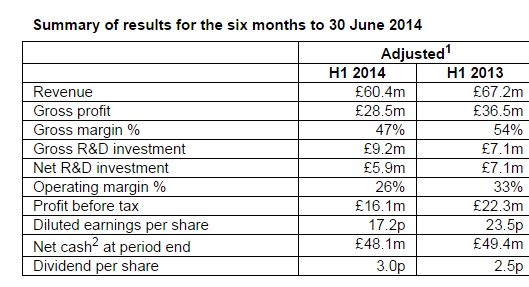
Outlook - the long-term prospects sound good (and bear in mind that only something like 3% of potential industrial printing has made the move from analogue to digital, and that the technology is being adopted in waves by individual sub-sectors);
We continue to lead the market in ceramic tile decoration and remain excited by the future potential offered by tile decoration and a number of other ceramic tile processes. In addition, our partners continue to develop solutions with our technology across multiple applications in both the packaging and industrial markets. As highlighted in June, pre-production activities within the 'Direct-to-Shape' application continue, and our expectations of this opportunity for the longer term have strengthened. Despite being long lived, Grand and Wide Format Graphics remains an opportunity and we are targeting to regain share. Our Thin Film Programme, we believe, will open up multiple further markets to Xaar, significantly broadening the total opportunity over the long term.
This is the stuff that personally I find most interesting about Xaar shares - the company has already shown that it can achieve considerable sales/profit success from one area, printing on tiles, so there is every reason to believe that future success could be achieved in other, potentially much bigger, areas.
On the more immediate outlook, the company issues a mild profit warning for 2014, as follows;
During the third quarter, demand from the ceramic tile decoration sector has softened, which we believe relates to a slowdown in construction activity in China. In light of this, the Board's expectation for 2014 revenue has reduced to £115-125 million, with adjusted operating margin projected to be broadly in line with the 26% achieved in the first half of the year.
FinnCap say this morning that the impact on full year profitability is a reduction of about £4m. So it's unhelpful, but not a disaster. In my view this profit warning warrants a perhaps 10% reduction in share price, but no more than that, given the importance of new products for launch in the next year, in the valuation. If the new products don't sell, then the valuation should of course take another tumble, but if the new products do well, then this could transform back into a growth stock, with a potentially big re-rating. So it's a finely balanced thing in my view.
So, it could have another profit warning in it, who knows? Personally though I'm not interested in short term price movements - it's all about whether Xaar can hit another sweet spot of analogue to digital adoption with its new products in 2015. So personally I see a potential 20% downside risk (from another profit warning), but with 100%+ potential upside, with a 1-2 year view. Let's hope I'm right! As always, this is not a recommendation, it's just my personal opinion only. As we always stress, please Do Your Own Research! (DYOR).
There could be speculative upside from a takeover bid possibly - there don't seem to be any significant founder shareholders, instead 7 Instis are the biggest shareholders, with combined about 62% of the stock. Therefore if a competitor came along and made an offer at a decent premium, they would probably succeed.
Valuation - I'll watch out for detailed revised broker figures, but my back of the envelope sums suggest that about 30p EPS might be the right ballpark for 2014. Therefore at 440p per share at the time of writing, the valuation on a PER basis is 14.7. This could turn out to be very cheap if new products take off. Or it could come under further pressure if existing business (to the tile manufacturers) continues to fall, and new products flop.
Balance Sheet - is bulletproof, with net cash of £48.1m at 30 Jun 2014, although that might reduce somewhat due to capex & the new policy of capitalising some development spend. Net cash is 14.3% of the market cap, so it's providing an increasing support to the valuation with each successive profit warning. Moreover, a healthy bank balance means that R&D spending can be high, and is not disrupted by short term trading, which I like.
Dividends - The interim divi has been hiked by 20% to 3.0p, and policy is a 1:2 policy for interim:final divis, suggesting 9p full year divi. That's a yield of 2.0% - which is OK for a technology company - it's always nice to be paid whilst you wait for a re-rating.
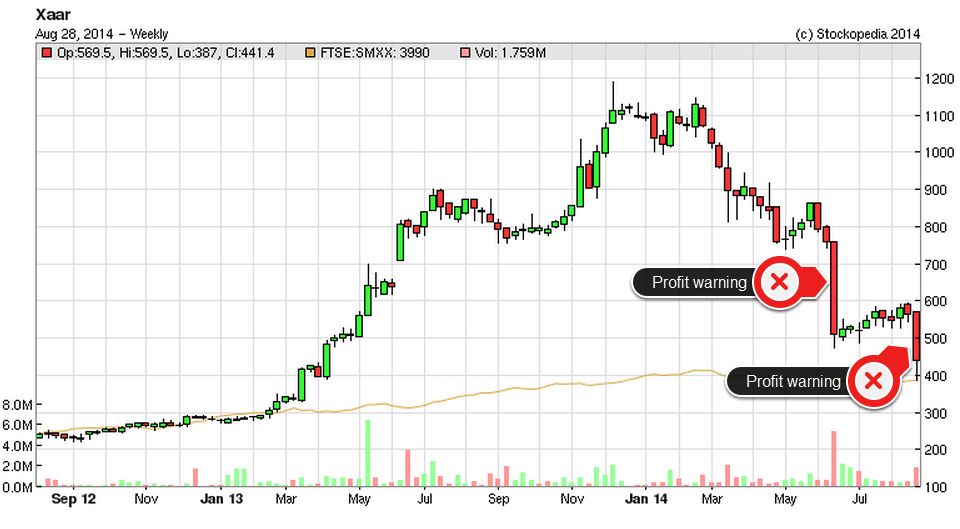
It's certainly been quite a rollercoaster for Xaar shareholders in the last two years, so it will be interesting to see how this one pans out over the next few years.
Molins (LON:MLIN)
Share price: 134p
No. shares: 20.17m
Market Cap: £27.0m
Interim results - for the six months ended 30 Jun 2014 have been published today. The company describes them as;
H1 performance broadly in line with management expectations although market conditions in the Middle East and eastern Europe adversely impacted the Tobacco Machinery division
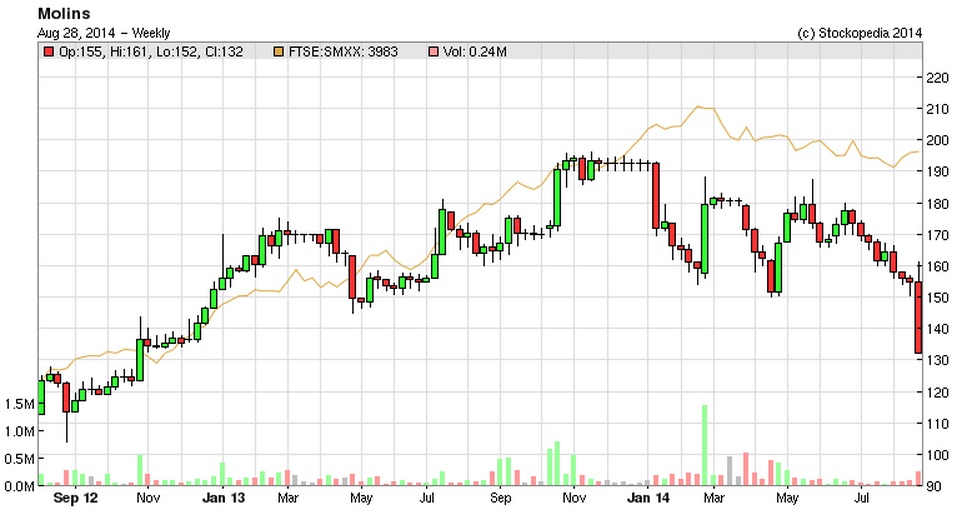
The 18% drop in share price today suggests to me that management had not correctly communicated their expectations to the market. If they had, then the share price wouldn't have moved.
The market cap here is very low now, so I'm wondering whether there is value here?
Profitability - I thought this company was mainly a tobacco machinery company, but looking at the turnover mix from its three divisions, tobacco machinery turnover has fallen dramatically, and it was actually the smallest divison, reporting £ 10m turnover in H1 of 2014 (down 44% on H1 in 2013). That was 25% of total group turnover. This division moved from a profit of £1.3m to a loss of £0.2m (pre-exceptional) in these interim results.
Packaging machinery was the largest division, at 45.8% of turnover, but only delivered a whisker above breakeven, at £0.1m (same as last year).
The only division that really made any money is the scientific services division, although this looks like a bit of crafty wording, as this division makes analytical machines for the tobacco industry! Hmmm. I wonder how much of the packaging division supplies the tobacco industry too?! So-called "Scientific services" had a good half year with profit up from £0.1m to £0.7m.
So overall, H1 saw an "underlying" operating profit of £0.6m (down from £1.5m), which scrubbed off to zero once non-underlying items are taken into account.
Capitalised development spending - If you check the cashflow statement, the company is capitalising quite a bit of development spending - £1.3m in H1, and £2.2m last full year. That exceeds the H1 amortisation charge of £0.6m, so in cash terms it didn't actually make any profit at all in H1.
Seasonality - The company is keen to point out that it tends to have an H2 seasonality to its profits. The trouble is, with H1 near breakeven, the year's profits are now totally dependent on H2, which makes the shares higher risk. I prefer companies that can at least get a decent slug of profits in the bank by the end of H1. It's easier to sleep at night then.
Outlook - the company today says;
As in previous years, the Group's full year trading performance will be significantly weighted towards the second half. The Board is mindful of the strength of sterling and current market conditions for the Tobacco Machinery division. The prospects for the Scientific Services and Packaging Machinery divisions continue to be encouraging.
The Group continues to focus on its growth initiatives, including further development, both organically and acquisitively, within our core sectors.
So that's very mixed, with enough wiggle room included for another profit warning in H2 potentially, so I don't think much reliance can now be placed on estimates for this year's earnings, which of course makes it difficult to value.
Pension deficits - I've reported about this before, so please look back in the archive for more detail. Suffice it to say the company has a gigantic pension fund with total liabilities (on an accounting basis) of about £356m at 30 Jun 2014. Yes, you read that right, three hundred and fifty six million pounds, over 13 times the company's market cap! There are assets covering nearly all of that, on an accounting basis, so the deficit shown on the Balance Sheet is £9.9m. However, on the last actuarial valuation;
The UK scheme was subject to a formal actuarial valuation as at 30 June 2012, which showed a funding deficit as at that date of £53.0m. The agreed level of deficit funding is £1.7m per annum (increasing by 2.1% per annum, except in respect of the payments for the year to 30 June 2016 which will increase by the percentage increase in ordinary dividends in respect of the Company's 2014 financial year if higher than 2.1%). The deficit recovery plan will be formally reassessed following the next scheme specific funding valuation, which will be carried out as at 30 June 2015.
So it's one of these iceberg pension deficits. The crux for me is that cash overpayments of £1.7m are being made, and that seems to me very material to the company's profits & cashflow. It does manage to pay divis, but there's not really much scope to increase the divis, as you can see from the except above that increases in the divi trigger increases in payments into the pension fund.
It also means that nobody in their right mind is likely to attempt a takeover of this company - why would you want to take on the pension liabilities? (and the pension trustees could block a takeover anyway). Thus reducing the potential upside, and eliminating one potential exit route for shareholders.
Balance Sheet - overall it looks reasonable, putting aside the pension deficit for one moment. Although I'm not clear why the company has £9.4m in loans, largely offset by £8.5m of cash. Seems an odd way of doing things.
Dividends - The company has consistently paid slightly increasing dividends over the last six years, so there's no reason to suppose that will stop. Although as mentioned above, the pension scheme heavily restricts the company's ability to increase the divis by much. Although I note that at 134p per share today, the forecast 5.5p total divis for this year give a yield of 4.1%. That's reasonable, but given it's very unlikely to increase by much, dividend seekers would probably be better served going for a more liquid large cap paying 5%.
My opinion - I just don't like it. The pension fund is far too big to make this investable in my view. Even ignoring the pension fund, it doesn't particularly excite me. In my view the rise in share price over the last two years looks pretty spurious - a rising tide lifting all boats & all that. Now reality is coming home to roost in my view.
EDIT: For a more positive take on the results, and interesting background info, there is an excellent update note out today from Paul Hill at Equity Development - who is a brilliant analyst, and also a very successful investor. So whilst he'll naturally paint a positive picture in a commissioned note, it's very much worth reading, and might perhaps offset some of my gloom!
A couple of quickies now before I knock off for lunch;
Kromek (LON:KMK) - This is a loss-making growth company which looks potentially interesting to me, so it's on my watch list. However, I don't like paying up-front for potential, unless there's a very clear & credible path to substantial profits. Looking at the results for the year ended 30 Apr 2014, published today from Kromek, I can't get enough comfort to come anywhere close to the £54m market cap.
It's still much too commercially speculative for me, but looks interesting technology. Having said that, the vast majority of such companies turn out to be terrible investments, so it's very much like looking for a needle in a haystack. Also there is a risk here that if little commercial progress is made in the next year, it could well need to come back to the market for more cash - so potential dilution, especially if the market is not receptive to growth stories when they need the money.
So I'll continue to watch from the sidelines.
Macfarlane (LON:MACF) - I've had a quick skim of the interim figures, but don't like the low operating profit margin, the pension deficit, and too much bank debt. Also H1 operating profit was down on last year.
Office2office (LON:OFF) - looking at today's interims very much reinforces my view that shareholders here got extraordinarily lucky with the recent takeover approach for equity that in my view is worth nothing - I would have bitten off their hand, indeed, sold in the market as soon as the deal was announced, happily giving up a couple of pence in case the deal falls through.
The company's Balance Sheet is in a terrible mess, with negative net tangible assets of £42.4m. Furthermore, whilst they have managed down bank debt to £20.4m, it is clear that this has only been possible by stretching supplier payments, and/or getting up-front payments from customers. Consider this - trade & other creditors (excluding bank debt) is £64.3m, versus £85.4m in six months Cost of Sales (from the P&L a/c). Assuming it's all UK turnover, then trade creditors will include VAT, so strip out 20% VAT in trade creditors, reduces ex-VAT trade creditors to £53.6m. So I make that 114 days credit they're taking from suppliers!
That's probably why they don't really make much profit, as suppliers will be loading up the prices to tolerate such late payment.
Awful figures, so a very lucky escape for anyone daft enough to buy these shares!
On that bombshell, it's time for me to sign & off and grab some lunch.
Back tomorrow!
Regards, Paul.
(of the companies mentioned today, Paul has a long position in XAR, and no short positions)
Disclaimer
This is not financial advice. Our content is intended to be used and must be used for information and education purposes only. Please read our disclaimer and terms and conditions to understand our obligations.

21 comments
Re. XAR. Today's (29/8) piece in the Times by Tempus is interesting and rates this share as high-risk buy. It pretty much echos the general view of this board.
I presume most of us believe we should be free to drink, therefore people should also be free to smoke, as long as no third party has to suffer passive smoking.
Therefore tobacco companies pass my ethical investing test.
None of them go around dishing out free packs in schools. Also it's a lot better having a proper tobacco industry than a criminal supply chain, as with certain other drugs.
my lungs are damaged from smoking, so every time my selfish neighbour stands outside his front door, that STENCH flows into my house. We are on a collision course. I just haven't yet decided how I will deal with this particular person. in my view normally you can negotiate and persuade, far better than dictating.
In fact, being nice and having a good laugh is always better than anything else.
p.
jeff - keep your cigarette smoke WELL away from me, then we can all be happy! ;-)
Just to be clear, I have NEVER smoked tobacco (& only once tried anything else). I don't permit smoking in my own house, our outside it in my garden.
However, any free society should allow people to do whatever they like, as long as it does not harm any third party. Providing tobacco taxation covers the healthcare costs, smoking in suitable locations seems to avoid harm to any other party.
It's true that there is no clearly defined right or wrong when making ethical decisions.
However, I think a common pattern is that individuals think of the ideal situation as a defence. For example, I used to play a lot of online cash poker. On one occasion a player at my table was rinsing a lot of money, hundreds of pounds. I was quite an aggressive player and I took quite a bit off money of this player. The player repeatedly reloaded the cash at the table and kept blowing it. Clearly they were not in the best space. Meanwhile, the sharks where queueing up to get onto the table to exploit this player. When I realised that this player was out of control I suggested that he/she take a break or just stop. My comment was met with consternation at the table. How dare I say that to that the player. One other player asked me to justify my comment that might kill the cash cow and I indicated that this player was out of control. The response was "How do I know that this isn't some well heeled banker who's just come home from a hard days work and is just blowing off some steam with a few hundred quid which to them would be a drop in the ocean"
And there you have it! Focus on the best possible scenario and deny the possibility of the alternative.
I now choose to put myself in the position of the salesperson. For example ...
Would I be comfortable profiting from selling cigarettes to an individual with lung cancer or BOPD or knowingly selling a product that caused these issues?
Would I be comfortable profiting from selling alcohol to individuals with alcohol issues, or alcopops to kids?
Would I be comfortable profiting from playing a croupier in a betting shop raking hundreds of pounds off addicted gamblers on roulette machines?
I've seen the misery of all of these experiences in my counselling room and in my experience I'd suggest each of them have impacts that go beyond the individual as addiction difficulties frequently cause big issues for the nuclear family and I'd suggest wider society. For example, a young father dieing of lung cancer causes misery for his family, denies his kids a father, puts an expense on the NHS and denies the society his earnings.
The top 5 killers in UK are:
The question is "Does the company do enough to mitigate against these issues?"
Perhaps if they spent as much money on support and education as they do on advertising there might not be such an issue.
We all have to make choices we're comfortable with. I tend to use "Can I think about these scenarios and look myself in the mirror?"
Best of luck everyone
Phil
Paul, love your column as always, but as a non-numbers man feel that it might be worth keeping an eye on what is happening in Xaar’s boardroom when assessing the company’s future prospects.
A couple of pointers, Ian Dinwoodie, the CEO who has masterminded Xaar’s stellar performance over the past decade, announced a few months ago that he was quitting in 2015. During his time at the top Xaar’s adjusted eps has risen from 1.6p to 43.2p. Given that he is still only 53 fears that he was exiting at the top of Xaar’s growth curve will not have not been helped by his decision to sell 150,000 shares(nearly three quarters of his holding) at £8.34 a year ago. The transaction was described at the time as “part of a pension fund re-balancing exercise”. To be fair he did buy 20,000 shares at around £5.0 in June but his shareholding is still less than half what it was at the end of 2012.
Perhaps Xaar’s management is such a well-oiled machine that a change of CEO will make no difference to its future prospects. But given the rapid changes in technology and the increasingly competitive marketplace, Dinwoodie’s replacement could be critical to the company’s future success.
Meanwhile, Ramon Borrell, 50, Xaar’s long time R&D director, whose chunky share buys first sparked your interest in the company, has been shunted off the board, and replaced by Edmund Creutzmann, 59.
Borrell has been given the task of developing Xaar’s next generation Thin Film development (P4) technology “to market dominance”. This may be a sensible boardroom change, but Borrell, unlike Dinwoodie, had continued to build up his stake in Xaar, and now owns 221,721 shares – nearly three times as many as Dinwoodie.
I think it might be wise to add a modest “management” warning to the latest profit warning.
Hi Paul
Any comment on PPHE Hotel (LON:PPH) today, Paul? I know the last time you looked at this you were concerned about the amount of debt - any change in your opinion on this? Net debt has reduced slightly in the last six months, gearing on their measure reducing to 59.4% from 61.4%.
Personally I don't see this as a problem as I view PPHE Hotel (LON:PPH) as half REIT, half hotel service company anyway! Much of their debt is secured against freehold property, much of which (by value) is prime London property, the market value of which is surely somewhat higher than book value.
Just wondered if you had changed your view on the company?
Cheers
Thank you Paul. That clarifies it perfectly. Much appreciated.
Hi Paul,
Thank you as always for the morning report. An essential daily read as always for me.
I was wondering if Paul or any other accountant reading this could explain the above to a non-accountant like me. Is it saying that money being owed by the company includes VAT, and that money being owed to the company doesn't include VAT? Or am I getting the wrong end of the stick completely? Probably the latter I suspect.
Many thanks,
Steve
Hi Steve,
To clarify, all figures in the P&L account EXCLUDE VAT.
Whereas Debtors & Creditors on the Balance Sheet INCLUDE VAT.
So to compare them, one has to adjust the VAT out of the trade debtors or trade creditor figures. But that's only if business is UK-only. It gets more complicated if there are sales overseas.
Regards, Paul.
Paul,
Just taken a quick look at XAR. Not sure that today's fall is necessarily overdone. Based on your full year figure of 30p eps, they were forecast to hit 38.5p. So using a per of 14 * the shortfall 8.5p we get about 117p off the price. On top of that it has for this year and next, in effect gone ex growth. Now it may be a blip or it may not, but until we know I'd expect the price to reflect that a bit so 140p fall doesn't seem excessive, just about right, or very mildly overdone..
Anyway just bought a small position in anticipation of a small bounce to keep me interested in what is an interesting stock.
Lee
Hi Lee,
Yes that sort of calculation would make sense if Xaar (LON:XAR) was just a mature business, however it's not! Or rather it's a mature business (the ceramics printheads) combined with an exciting growth business (the new products for new sectors coming in the pipeline).
Therefore for me, I would probably ascribe about half the market cap to the old business, and the other half for the future potential from new products. That's probably why, for me, today's fall seems excessive. Other people might look at it differently though, that's what makes a market!
Regards, Paul.
Very tempted to switch from Molins (LON:MLIN) to Xaar (LON:XAR). They've both come out with reports today which have materially hit their prices, but Xaar seems to offer so much more potential.
Do you still hold Molins Paul? Do you have a view on their half-year figures?
Hi kevanp,
I don't recall ever holding Molins (LON:MLIN), as the pension deficit has always put me off. Possibly I might have briefly held some, it rings a vague bell? Ah yes, I think I bought some after one set of results or trading statement a while ago, but only held for a few days, changed my mind when I researched it in more depth.
Also not convinced about upside from recent levels. Connection with tobacco industry puts me off also - as I'm the world's worst ex-smoker, and utterly despise everything about smoking & anything connected with it!!!
I'll review the numbers & report back here in about an hour.
Regards, Paul.
Great, thanks Paul.
Yeh, it was 26 Feb:
After skim-reading this morning's results for the year ended 31 Dec 2013, I've taken the plunge and bought a few at the open. Just a starter size position, as I generally like to start small, and then build a bigger position if and when my confidence grows after doing more in-depth research. Also that way you don't lose much money if it turns out not to be good, after doing more research. - See more at: http://www.stockopedia.com/content/small-cap-value…
I bought some, perhaps for sentimental reasons — never a good idea — because one summer vacation, while studying for an engineering degree many years ago, I spent several enjoyable weeks working for a precision engineering company in Portsmouth which made little gearboxes for Molin's cigarette making machines!
As for the morality of investing in 'unethical' companies — my reprehensible attitude is "where does one stop".
Best, Kevan
As for the morality of investing in 'unethical' companies — my reprehensible attitude is "where does one stop".
The "where does one stop" issue applies to price as well: the edge between poor and good value is fuzzy and hard to pinpoint exactly, so what about buying anything at any price? If not, whatever technique people use to find where to stop on price can be applied to ethical standards.
More generally, there are many issues in life where "where to stop" is not clear, but most cases are not edge cases. Whatever one's moral standards are, crooked businesses according to those standards are generally easy to recognise.
Personally I find ethics coincides with naked self-interest in investment: I just make a weak holder of crooked businesses, thus making me more prone to loss aversion and churn, hurting the bottom line directly. Moreover crooked businesses tend to be run by crooks (what a surprise!) who tend to abscond with one's funds more often than not.
Cig, I think that 'unethical' and 'crooked' are two entirely different concepts. Crooks are, of course, unethical, but I was using the term unethical in the context of how some view different industries: tobacco, alcohol, gambling, defence, oil, banking, insurance, clothing manufacture, supermarkets — the list, if not exactly endless, is long.
I would guess that most quoted companies in these sectors are squeaky clean legal. There's nothing crooked about them. They just operate in businesses with which some people would prefer not to have any dealings.
Fair point. It does overlap though to some level: one can follow the letter of the law and be dishonest in a common sense way. I do find that most businesses I wouldn't invest in on ethical grounds are dodgy enough that they tend to attract shady characters, but you're right that there are numerous exceptions (dodgy businesses run by decent people and conversely).
I was mainly questioning whether it's too hard to draw a line. People with a very sensitive definition may end up drawing that line so far away they don't invest in stocks at all or only in a small select subset. It's fine for them to do that, and fine for others to disagree with them. It is tricky to define an ethical position and set limits, but in my view still worth doing nonetheless.
Many thanks for your thoughts on Molins (LON:MLIN) Paul. Much as I had anticipated.
I shall now satisfy my confirmation bias (sadly, but surely, the most powerful psychological factor in investment decisions) by reading Paul Hill's note!
Best, Kevan
I also averaged down on Xaar (LON:XAR) this morning. Investing is about the future and not the past and i'm confident that the investment that the board has made in R&D over the past year will start to pay off soon!