Small Cap Value Report (29 Apr 2014) - WLF, UTW, WGB, LID, DSG, WINK, INCA, CTG

Good morning!
Wolfson Microelectronics (LON:WLF)
This semiconductor maker has had a dismal few years, indeed it hasn't made a profit since 2008. I've been vaguely monitoring the shares for signs of a possible turnaround, as there can be exciting upside with this type of company if they develop new products that take off. Also it spends a remarkably high percentage of turnover on R&D, which can also be very positive.
Its Q1 results today look poor to me. However, of more importance is that an agreed cash takeover bid at 235p per share is also announced. So that's an instant 75% profit for shareholders, who have every right to be delighted at that outcome, given the poor performance of the company in recent years.
Utilitywise (LON:UTW)
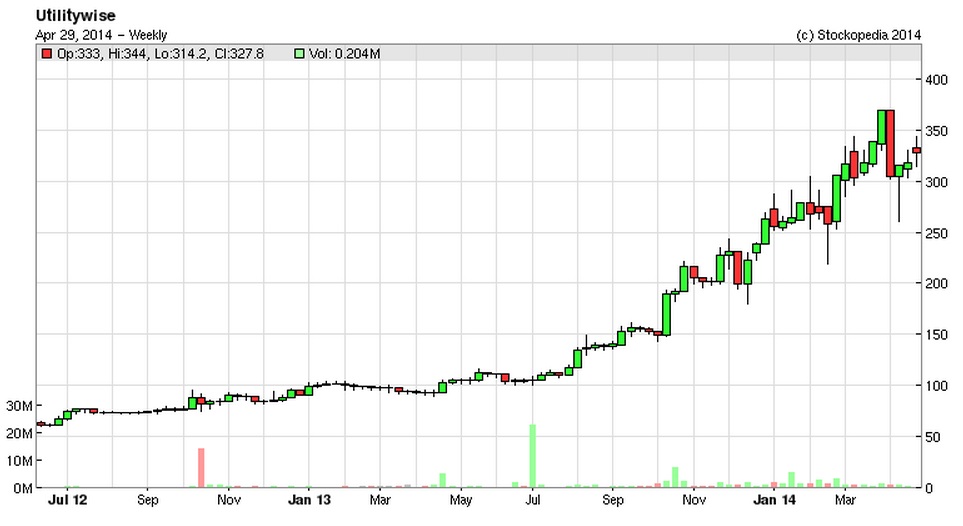
It's moving out of my range now (I normally don't go much above £200m market cap, and this has reached nearly £243m at 335p per share), so this will probably be the last time I report on Utilitywise, the cost consultant for energy costs.
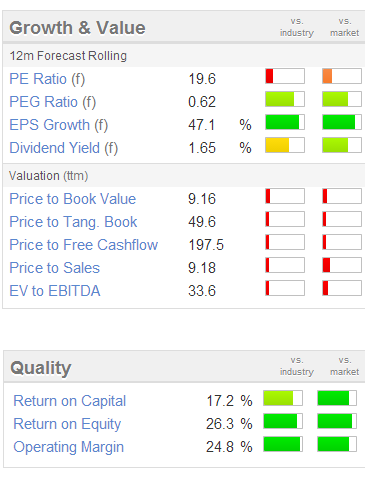
Very impressive interims are announced today, for the six months to 31 Jan 2014. Revenue is up 105% to £21m, and adjusted pre-tax profit is up 133% to £4.9m. Adjusted fully diluted EPS is 5.1p for the six months, so double that to annualise it (simplistically), and just over 10p per share. So a pretty racy PER of almost 33 times!
Although as you can see from the Stockopedia graphics on the right, the forecast PER drops to 19.6 allowing for future earnings growth (based on broker consensus forecasts). These graphics perfectly illustrate the high valuation, but strong earnings growth which has driven investors to give this share a high valuation.
Acquisitions have helped drive those numbers, but without acquisitions, like-for-like revenue still increased 65%, which is very impressive.
I'd be amazed if these profits are sustainable - it looks to me like a company that has found a sweet spot, but competitors will inevitably be drawn in by these bumper profit margins, one imagines. It might also be worth looking into their revenue recognition policy, as I note that there is a very unusual £11m in trade receivables shown in non-current assets, over and above £11.7m in trade receivables shown in current assets. That implies that some revenue (and hence profit) is being recognised more than 12-months in advance of the customers actually paying.
Note that cashflow is also poor, with a £5.4m operating cashflow for the six months to 31 Jan 2014 being more than consumed by a £6.8m increase in trade receivables. Ballooning debtors is without debt the worst possible red flag in any set of accounts, in my opinion. I am always very wary of any company that generates big profits, but has negative cashflow. The reason is that ballooning debtors can hide a multitude of sins, especially at rapid growth companies, and can often be a precursor to problems in the future with cash collection. I'm not suggesting anything is wrong here, just that it might be. So revenue recognition & ballooning debtors is certainly a red flag that needs investigating here.
That combined with the very high PER, means it is not one I would consider investing in. Mention also should be made of the bizarre Director share transactions. They offloaded huge amounts of shares at 75p and 100p (totalling over £27m!), yet more recently Directors have actually bought about nearly £4m of shares at much higher prices (204-260p). I cannot understand why Directors would be so keen to cash out on a huge scale at a quarter of the current price, and then be buyers at a much higher price. Although the main buyer had not previously been a seller.
Walker Greenbank (LON:WGB)
This is a luxury wallpaper company. So as you would expect, they are benefitting from improving economies in the UK and USA. Preliminary results for the year ended 31 Jan 2014 look good. Adjusted profit before tax is up 14.9% to £7.3m, on turnover up 3.6% to £78.4m.
Adjusted EPS is up 20.1% to 11.3p. Basic EPS was 8.63p. The adjusting factors are the LTIP accounting charge (which is presumably the charge for employee/Director share options), and the pension scheme charge. Arguably both of those are legitimate costs, since both are forms of employee remuneration, so I'd be more inclined to value the business on a multiple of say 15 times basic EPS of 8.63p. That arrives at a share price of just under 130p. The shares are actually 189p, which looks about 45% overvalued in my opinion.
Note that it had net funds of £1.5m at the year end. The pension fund deficit increased from £8.2m to £9.2m, so it's noteworthy that these deficits are not melting away yet, although that might happen once interest rates rise. Overall though the Balance Sheet is strong, and if you can live with the pension deficit then the rest of it is fine. Note that capex was heavy last year, with the bulk of £5.9m operating cashflow being spent on capex (£4.7m).
So it's a good company, but the share price is too high, in my opinion. I'd rather buy this type of share after a profit warning, when everyone hates it, rather than when it's priced for perfection.
Lidco (LON:LID)
This company makes medical monitoring equipment, and falls into the cetegory of taking years to reach critical mass, but potentially exciting because the consumables are high margin. They seem to have possibly reached the positive tipping point in the last year. Results for the year ended 31 Jan 2014 are published today, and show a move into madien profit of £0.28m, on turnover up 20% to £8.6m.
The improved performance seems to have been caused by more NHS hospitals adopting their products. Such adoption can be painfully slow, taking years to achieve, but once you're in, you're in, and that can mean lucrative recurring revenues.
The only way to value this comany would be to do some in depth research on likely sales growth. At 23.5p per share, the market cap is currently about £45m, which is clearly already anticipating a considerable further increase in sales & profits. Bear in mind operational gearing though - i.e. that with high gross profit margins, increased sales will drop a large amount through to the bottom line.
Note that the UK surgical disposables sold rose by a very impressive 59% to 23,570 units.
So what growth rate to expect in future is key. The other key research to find out, is what competitor products there are, and what patent protection Lidco has, and whether its products have any technical superiority, and how they compare on price, etc. I see that today's results say that they have strong patent protection, which is good.
The outlook sounds upbeat, concluding;
We believe that LiDCO monitors have the potential to become the 21st century standard for the fluid and hemodynamic monitoring of high-risk patient populations in hospitals and we expect 2014 to be another strong year of growth for the Company.
Overall, it's probably a bit too pricey for me, but it certainly looks one of the more credible growth companies that I've seen for a while. Maybe paying a bit more for the stock now that the business model has been proven, might be a better proposition than buying any number of more speculative, earlier stage AIM stocks? The other thing is that when you buy a small growth company which has just moved into profit, you usually don't have to worry about further dilutive fundraisings.
Dillistone (LON:DSG)
Dillistone is a small software group, specialising in the headhunter niche of the recruitment market. Results for the 12 months to 31 Dec 2013 have been issued today. The reporting cycle seems very slow - having to wait five months after the year end, is at least two months longer than I would like.
The figures look OK. Revenues are up 15% to £8.1m, of which 65% are recurring. Adjusted EPS rose 11% to 8.0p. The shares are currently down 4p to 110p at the time of writing, which puts them on a reasonable PER of 13.8 times 2013 adjuted EPS. The adjustments look sensible, being things like goodwill amortisation & changes in deferred consideration, which are non-trading items, so that's fine.
I like the dividend yield here. A total of 3.85p dividends pertain to 2013, which gives a healthy (and growing) yield of 3.5%. The company has been a consolidator in a fragmented space, and more of that is likely. The company has decided to invest more in product development, so that has resulted in a mild profit warning for the current year, where they say H1 profits are expected to be below the prior year period. It's sensible to manage expectations down now, and with only a 4p share price drop today, the market has taken this is its stride.
Note also that the full year outlook is more positive;
However, taking the year as a whole, the Group expects to make positive progress in 2014, the scale of which will become clearer as the year evolves.
Management here struck me as straightforward and competent, at a meeting last year. Also I found some user groups online, where recruitment consultants were discussing various software, and the Dillistone product had overwhelmingly positive user feedback.
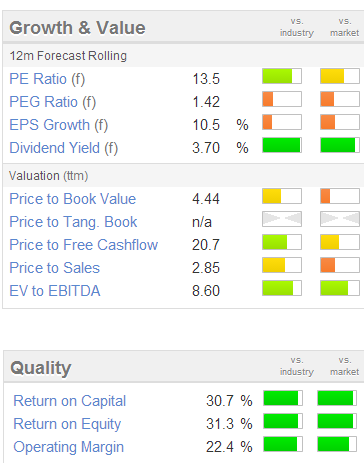
Overall, I like the mix of reasonable valuation, good dividend yield, continued product development, and occasional bolt on acquisitions here.
It's not the most exciting share out there, but I am happy with a small quantity being tucked away in my long term portfolio. DYOR as usual.
There's probably not any immediate upside on the shares, but over a number of years I hope for steady capital appreciation, as well as attractive dividends.
EDIT: Note that Dillistone are organising a results Webinar today at 3pm, for anyone interested in hearing more about the company from the horses' mouths. Details below. I am very keen on Webinars, as they are a highly efficient way of virtually meeting management, without all the hassle & time of travelling into London

M Winkworth (LON:WINK)
This is a small, high end estate agent mainly focussed on London. They are making bumper profits, as you would expect, from a London property market that detached from reality a long time ago, and is now in the realms of fantasy.
Audited figures for 2013 are published today, and show turnover up 15% to £4.94m, and profit before tax of £1.7m. That gives basic EPS of 10.05p (up 69% on 2012). Who knows how long the party will last, but at 158p the shares are on a PER of 15.7 times, which doesn't strike me as a bargain.
It has paid decent divis since 2010, with 5.39p being forecast for this year, giving a forecast yield of 3.4% based on a 158p share price.
Incidentally, if you haven't seen it, there is a hilarious fly on the wall series on BBC2 at the moment about estate agents, called "Under Offer". Highly recommended. The MD of Beauchamp Estates is featured in it, and is, errrr, quite a character!!
incadea (LON:INCA)
This is a software company, serving over 2,400 car dealerships in 87 countries. The headline bullet points look strong, with revenue up 23% to E36m, and a focus on EBITDA. However, they capitalise a lot of development spend, so EBITDA is meaningless.
Looking at the proper figures on the P&L itself, operating profit actually fell, from E4.5m in 2012 to E3.9m in 2013. Exchange differences of E433k are the main factor for the increased finance charge of E705k. The cashflow statement shows that they capitalised E3.1m in development costs. The Balance Sheet looks OK, with year end cash offsetting almost all of the bank debt.
The narrative talks a lot about growth, and it sounds like an ambitious company. I'm not really sure how to value it. Based on these historic figures, it doesn't jump out at me as being good value. The market cap is £65m at 108p per share. Note that revenues in Russia dropped by about two thirds in 2013, which is said to be due to deferral of contract roll-outs with BMW. Maybe revenues are lumpy from licences? I think it would need a lot more research to properly understand this company, and assess its prospects.
Christie (LON:CTG)
This is a services provider to the retail, leisure, and care sectors. They do things like stock-taking, valuation, surveying, etc. This business has always looked pretty marginal to me, eking out a small profit in good years.
The company has put out a positive trading statement today, so maybe it's worth another look?
As a consequence, results for the first half will be positive (2013 £300k loss). Assuming no materially adverse economic changes or political unrest in our core markets, the Board believes that results for the year to 31 December 2014 will be substantially ahead of the current market forecast.
Stockopedia shows 2014 forecast turnover of £57.2m, and a £0.9m underlying profit, or 5.6p normalised EPS. So perhaps they might be heading towards nearer 10p EPS? The shares are up 15% to 113p today, so that suggests a PER of around 11 perhaps, which is probably about right.
Regards, Paul.
(of the companies mentioned today, Paul has a long position in DSG, and no short positions)
Disclaimer
This is not financial advice. Our content is intended to be used and must be used for information and education purposes only. Please read our disclaimer and terms and conditions to understand our obligations.

12 comments
I note Woodford Investment Management has recently bought 6.5M shares in Utilitywise (LON:UTW). Interesting to see how Neil Woodford's new fund(s) perform with the spotlight fixed on him from the start....
Hi - I had a look at the accounting standard, IAS 18 I think. It's been a long time since I've looked at an accounting standard :) so please forgive any slips.
"Revenue is recognised when it is probable that future economic benefits will flow to the entity and these benefits can be measured reliably." http://www.ifrs.org/Documents/IAS18.pdf
And in relation to rendering of services, which the UTW accounts reference in relation to "No further services regarding procurement are performed once the contract has gone live"
"The recognition of revenue by reference to the stage of completion of a transaction is often referred to as the
percentage of completion method. Under this method, revenue is recognised in the accounting periods in
which the services are rendered. " http://www.ifrs.org/Documents/IAS18.pdf
Finally on cash,
"If the inflow of cash or cash equivalents is deferred, the fair value of the consideration receivable is less than the nominal amount of cash and cash equivalents to be received, and discounting is appropriate. This would occur, for instance, if the seller is providing interest-free credit to the buyer or is charging a below-market rate of interest. Interest must be imputed based on market rates. [IAS 18.11]
It does sounds like the accounting standard is quite explicit on revenue recognition rules, and that UTW have indeed followed this standard.
Comments welcome as it would be good to dig deeper if needed.
Worth mentioning Renew Holdings (LON:RNWH) acquisition announcement this morning. A model RNS, setting out all the key financial details for their purchase of Clarke Telecom:
I know Paul isn't keen on the negative working capital here (in common with the entire construction industry), but I am more sanguine, with the bank debt (even after debt taken on to fund this acqusition) remaining low. Another concern about this type of company is project risk: with relative thin (but improving!) margins will profits disappear if a project goes wrong? I asked the directors about this when I first invested, back in 2007. They were able to reassure me that individual projects were generally small & any significant ones were closely monitored by the experienced senior management team. They haven't let me down since that original investment! Moreover, they have successfully transformed the business by successfully executing their strategy of moving away from run-of-the-mill constructution to higher margin "specialist engineering". This acquisition represents another step along that road.
Interims are due on 20th May and I expect them to be strong, as the firm has been heavily involved in repair work from the weather damage this winter, including being the main contractor for the Dawlish rail repair, which they performed superbly on. A positive trading updatereflecting this, was issued last month.
The shares seem very reasonably priced to me,
WHI have raised their FYSep2015 EPS f/c from 19.0p to 21.8p.
Though my holding was already signfiicant, I added some more shares at 225p this morning, which, on a forward multiple of little over 10, seems like rather a good price to me, for a business that is growing strongly. WHI have raised their target price from 275p to 325p following today's news.
Cheers,
Mark
Hi Paul
"so this will probably be the last time I report on Utilitywise"
Maybe you will be (covering them that is) when the market gives them a small sensible rating!
Secondly Christie this is one of John Lee's core holdings and has been a stellar performer for me and today's jump has cheered me up no end after the disappointments of Sweett (LON:CSG) and Seeing Machines (LON:SEE) (on the latter I spoke to CEO today and am reassured and will try and pick up some more shares later today).
I now have to decide whether to follow Warren Buffets view on risk management (put a small number of eggs in one basket and watch it very carefully) or yours and reduce my holding to 15% of 10% from 20%.
By the way does your 15% limit apply to 15% of stocks + cash (that maybe allocated to stocks in the future so not rainy day money) or just value of stock investments.
Thanks as ever for a great blog.
as regards SEE, looks like they may go to 4p fairly quickly, what do you think? looks like support on the chart.
Sorry typo should have been Spaceandpeople (LON:SAL) I sold my small holding in Seeing Machines a while back at a small loss at 6.25p. I did not really understand the company and when paulypilot wrote
New order for "472k in sterling, since AUD$1 = £0.59) for Seeing Machines equipment to be fitted to 66 mining trucks. That works out at about £7,150 per truck" http://www.stockopedia.com/content/small-cap-value-report-11-nov-sal-see-tng-flyb-79024/#sthash.nodCtzcA.dpuf
I just wasn't sure it was for me .
Additional it is non UK/USA and at the moment I am trying to restrict my investingations to companies based in those countries occassionally straying into mainland Europe.
Morning Paul,
I'm always wary of commenting when I'm speaking to an accountancy expert, but maybe I could just throw one bit of extra information out there about Utilitywise (LON:UTW).
My understanding with Utilitywise is they have a whopping book of "secured future revenue" that they can't recognise yet. The ink is on the paper, the contract is fully signed and ready to roll, it's in the bag - it's just that the client is still tied into their old contract and there is a date in the future when £UTW's comes online.
Typically, 70% of the "future secured revenue number" starts to come on stream inside the following half year, but even then, that leaves 30% for a later date.
As of 31st Jan, as far as I understand it - and do put me straight someone - £23.8m was just floating around ready to hit the top line at some point in the future. They can then build on this already "in the bag" revenue with all the other stuff they do and with clients who want to sign up straight away.
I have weak balance sheet knowledge - but maybe that has something to do with the "non current assets" you mention?
Personally, with all this unrecognised revenue, plus the expansion both geographically and in consultant headcount in the UK, I am comfortable with a high PE; as long as one of my favourite things, the PEG ratio, is looking healthy.
I know you were being "back of the envelope" - but with the "future unsecured revenue" figure swelling, I wonder if just doubling the EPS number for the full year would be unwise!
Best Wishes,
Richard
Hi guys - enjoyable discussion on UTW, many thanks.
The growth in non current assets (trade and other receivables) between is indeed comparable to the growth of future secured revenue between 31st Jan 14 and 31st July 13 (50% vs 43%), though less so between 31st Jan 14 and 31st Jan 13 (110% vs 180%). I might speculate this is down to a changing % of future secured revenue to be recognised, but that would be out and out guessing..
The cashflow is materially affected by the decrease in trade receivables at £205k compared to a a £2m increase in the comparative period or £7m in the full year.
The commentary on cashflow does say they have invested £2.3m of cash for operations around headcount growth, infrastructure and other investments which they expect to pay off in the second half - they do specifically mention how the cashflow "trend will improve in the second half as revenues and cashflow from this investment in talent and infrastructure follow and the effects of second half supplier tranche payments take effect."
The cashflow does seem healthy in this light.
Keep up the good work!
cheers
Hi Richard,
Thanks for your comments. If an item appears within Debtors, then that suggests that the revenue & profit has already been recognised in the P&L, since the double entry would be: Credit: turnover (P&L), which drops through to profit, and Debit: Debtors.
Then when the customer pays, the Debtor disappears, and is replaced with cash in the bank.
The other possibility is that they might Debit Debtors, and Credit Deferred Income, both Balance Sheet items, which would have no P&L impact.
I'm not interested in buying any shares in Utilitywise (LON:UTW) at this high valuation, so won't be digging any deeper, but when I spot potential red flags (such as negative cashflow, and unusual Debtors) then I feel obliged to flag them up here, so that readers can then do their own Due Diligence on these potential issues.
Regards, Paul.
"I feel obliged to flag them up here, so that readers can then do their own Due Diligence on these potential issues."
And it's hugely appreciated - loved the risk management stuff on Thurs as well - thanks.
Thanks Paul, you are indeed right on the revenue point. I think this (from 2013 accounts ) explains it well. It seems logical and reasonable to me, but I do not know the broader industry practice and I would definitely defer to your view.
Revenue for the Group is measured at the fair value of the consideration received or receivable. The Group recognises revenue for services provided when the amount of revenue can be reliably measured and it is probable that future economic benefits will flow to the entity.
The Group provides services through negotiating rates with energy suppliers on behalf of business customers and generates revenues by way of commissions from
the energy suppliers. This type of revenue is recognised when the contract between the customer and the energy supplier becomes live. No further services regarding procurement are performed once the contract has gone live. Commissions are calculated based on expected energy use by the business customer at agreed commission rates with the energy suppliers. Where actual energy use by the business differs to that calculated at the date the contract goes live, an adjustment is made to revenue once the actual data is known.
The cash received profile relating to these revenues varies according to the contract terms in place with the energy supplier engaged and can be received before the date the contract goes live or spread over the term of the contract between the energy supplier and the end customer which can be for a period of up to three years. Accrued revenues relate to commissions earned, not yet invoiced or paid and are discounted at an appropriate rate.
Mutt say, that seems like a very aggressive accounting policy to me. Is it really sensible to account for future reveneus that are anticipated but not yet due? I'd much prefer to see these commissions booked when they have been invoiced & beome payable, not before..... but I guess Utilitywise's figures wouldn't look so good if they did that? ;0)
Most companies consider such "revenues" as a forward order book & quote that alongside actual sales, but do not actually include it in their accounts.