Small Cap Value Report (3 Jan 2014) - DEB, NXT, JSG

Good morning! Very little news again today, as expected, so I treated myself to a lie-in, as the noise from the storms kept me awake all night here in windswept Hove. Luckily the roof stayed on, although this type of weather is arguably a good time to get rid of stuff you don't want, by lobbing it over the fence into next door's garden! (only joking, I saw that on Twitter, and it amused me).
Talking of weather, Debenhams (LON:DEB) issued a profit warning on 31 Dec 2013, again blaming the weather - something they did earlier last year too. The trouble is, that excuse has been blown out of the water by their competitors - House of Fraser (whose own staff used to call it "House of Failure" in the 1990s!) seems to have really got their act together and reported a very strong Christmas. As also has John Lewis Partnership (would we expect anything less from them?). So it's very clear now that Debenhams are not executing well, and I would imagine larger investors will be clamouring for either an overhaul of strategy, or a change of CEO. That said, as we discussed in yesterday's comments section, in my view DEB is fixable, and the price now looks attractive to me, hence why I'm long there, and heavily averaged down yesterday.
As I worked for 8 years until 2002 as an FD in ladieswear retailing, this sector particularly interests me, so this is the one time of year when I comment on large cap retailers.
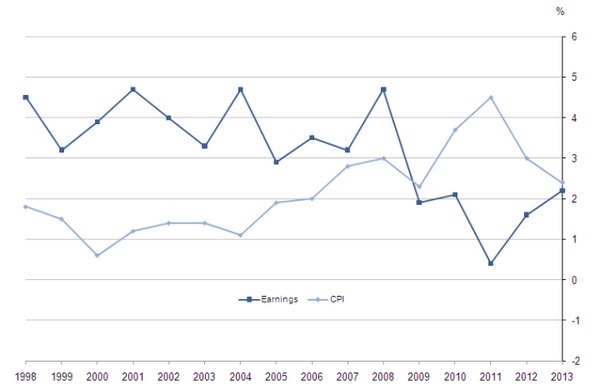
The other thing to consider is that the squeeze on household incomes is now arguably coming to an end.
Twitter is a mine of useful information on economics, and this article from political commentator Guido Fawkes contains an interesting chart showing that annual pay rises on average have now risen to just over 2%, whilst CPI inflation has fallen to just over 2%. Therefore, based on this data, the squeeze on household incomes should now be coming to an end.
As investors it's our job to anticipate trends, hence why I'm prepared to give Debenhams the benefit of the doubt for the time being. It's also been in & out of Private Equity ownership several times before, who know the business well, and I wonder if they might be circling it again? Remember that PE like retailers because of their strong cashflows, so they might try to do what they did before - i.e. strip it of assets, load it up with debt, starve it of capex, then sell it back to the City a couple of years later at a much higher price.
Debenhams is a bit riskier than I would normally look at, due to debt being uncomfortably high, but relative to EBITDA (a key Covenant) it looks manageable, although I think their share buyback programme was a mistake - the money should have been used to repay debt, so it's a good thing that the buyback has recently been ended, in my opinion.
Today's stand out retail performance is from class act, Next (LON:NXT). They've had a remarkably strong Q4, as detailed in today's trading statement, as always a model of clarity. I've always liked the way Next actually give figures for full year guidance, rather than the usual coded wordings used by other companies which are so often prone to misunderstanding.
Next is the sort of business that we should all be scratching our heads over, and wondering why it isn't a core long term holding in our portfolios? They do what they do so well, and it's always been obvious - from the success of the Next Directory, to the huge queues they always attract at Sale time. Sometimes we can all end up not seeing the wood for the trees. Certainly I'm kicking myself over Next, it's a share I should have held, as I knew it was a great business.
The other interesting thing is to look at how Next has used share buybacks to massively increase the share price over the years. As the number of shares in issue is constantly falling, that enhances EPS over and above the growth in the business. Over many years that has been a brilliant strategy. So hats off to them. They are set to deliver EPS growth of 21-24% this year (ending 25 Jan 2014), which is absolutely astonishing for a business this size, in a relatively weak economy.
There are a couple of non-retailer trading updates. Dry cleaner Johnson Service (LON:JSG) has issued an in line with expectations trading update. This has been a good turnaround, with net debt now reduced to below £25m at the end of Dec 2013.
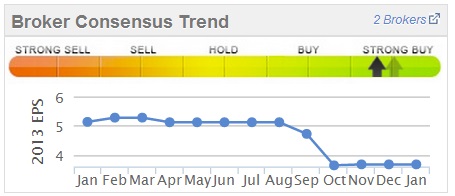 The Stockopedia graphic for broker earnings consensus shows quite a big reduction in estimates for this year, as you can see on the right.
So I would want to know what has driven down those forecasts. The PER of 14.5 based on 2013 estimated earnings doesn't look particuarly cheap to me, so I cannot see anything here to get excited about.
The debt may have reduced a lot, but it's still pretty significant, and remember there is a pension deficit here too, which requires £2m p.a. cash overpayments. Overall then, I cannot see enough upside here to make it worth researching further.
That's it for today & this week. We should be busy again from next week, with lots of trading updates coming through, so I'm looking forward to that.
Regards, Paul.
(of the shares mentioned today, Paul has a long position in DEB)
Disclaimer
This is not financial advice. Our content is intended to be used and must be used for information and education purposes only. Please read our disclaimer and terms and conditions to understand our obligations.

8 comments
Hi Paul
I am speaking now from the perspective of my wife, who has a black belt in shopping (Shoes? Mmmmmm!Handbags? Mmmmmmmm!). She sees Debenhams (LON:DEB) as generally old fashioned and irrelevant, both in their stores and in their offerings. You buy your dad a jumper from there! Also, if you do want anything, wait for it to get to 70% off. Her comparitor is Marks and Spencer (LON:MKS), but there is a disparity in quality, not to the benfit of Debenhams (LON:DEB). Also Debenhams (LON:DEB) has no food section to save the day.
Having said this she bought a pair of boots from Debenhams (LON:DEB) on line last month. I was surprised they came through Amazon. Is there any way of telling what proportion of Debenhams (LON:DEB) on-line sales were made through their own website and how much through other platforms? If the latter predominates that is not good. They will have to pay fees for this, and also the discou nts offered will be huge (boots were down from 90 quid to 20 and therefore a 'bargain' !!!!).
Overall I know you are right and there is a profit to be made here. If nothing else Debenhams (LON:DEB) will get snapped up by private equity types, but in the shorter term this must go further down surely?
Hi Paul
I was just wondering whether you have decided to stop updating your blog for your current holdings and your value picks as the links no longer work (for me at least!)?
many thanks
Ric
Hi Ric,
Yes, I decided to remove the section on my Blog where I listed my personal shareholdings, as it was causing hassle, and there was no benefit from my point of view from sharing that information - I was originally happy to share it for general interest, but when one or two people then spoil that by haranguing me if it's not completely up to date, adopting a sense of entitlement about knowing what private transactions I've done, etc, then forget it.
Since it's not really anyone else's business anyway, I just thought let's get rid of it.
People need to know whether I hold a share or not when I write about it, which is always disclosed at the end of every article. But that's as far as I'm going to go - am not getting into any discussions about when I buy or sell things any more, as people then just start trying to steer me towards becoming a tipping service, which is completely contrary to what is intended, and just leads to hassle as we've seen before.
Less is more sometimes.
Cheers, Paul.
Paul,
I am surprised you are long on Debenhams with the bucket load of debt they are carrying; debt is often serviceable until it has to be rescheduled, possibly at even worse rates if their situation does not improve.
You are obviously understand the retail business very well but all I see in Maidenhead is retailers closing down as they capitulate to the internet sales etc.
This doom in retailing is all great news for the likes of Next as their products are well made and offer great value, however, I trust they will not be increasing debt to buy back shares at the top of the market as many FTSE 100 clowns seem to do, Next could easily increase the dividend or pay a special instead of buybacks.
Regards
Pete Barrett
Pete,
Your last point is reasonable especially as that is exactly what they are doing if you read the announcement - see the relevant section which I reproduce below. It is a bit of a curates egg as far as thinking about buying the shares as they are stopping buy backs because the price is above their hurdle (getting expensive) but your getting special divs from surplus cash flow instead. I guess it depends whether you like prefer your returns more via capital or income.
From the statement:
"Share Buybacks and Special Dividends
At our results announcement in March 2013, we set out the rationale by which we would determine the maximum price at which the Company would buy back shares. In September, based on an Equivalent Rate of Return (ERR) of 8% and achieved annualised profits of £642m our price limit was around £52.00 per share. Since late October our shares have traded above this limit and, as a result, the Company has not bought back shares.
We are now faced with a question as to what to do with the accumulated surplus cash (we already generate more cash than can be invested productively in the on-going development of the business). We have three main options; (a) retain cash for future buybacks, (b) increase the ordinary dividend, or (c) distribute surplus cash by way of a special dividend. Given that interest rates are so low, it makes little sense for the Company to accumulate cash and a substantial increase in the ordinary dividend would hinder the Company's ability to buy back shares if the share price were to rapidly fall at some point in the future.
Consequently, we have decided to pay a special dividend of 50p per share. The cost of £75m approximates to the cash we would have used for buybacks in the period October 2013 to January 2014. This dividend will be paid on 3 February to shareholders on the register at 17 January, so the shares will trade ex-dividend from 15 January.
In the year ahead, we currently expect to generate and return a further £300m of surplus cash. This will be returned either through further quarterly special dividends or buybacks, depending on the share price.
We will continue to revise our buyback share price limit as the Company's profits change. As outlined in today's trading statement, we are now confident of achieving an annual profit of around £692m in the current year (the midpoint of our guidance range). With 155 million shares outstanding, an 8% ERR gives a new share price limit of around £58. If our shares trade consistently above this limit, and as a result we do not buyback shares, we will pay a further 50p special dividend in May and thence quarterly going forward until such time as a lower share price, or higher profits, allows us to return meaningful sums of money through share buybacks. We will give notice of our intention to pay any future special dividends approximately three months in advance of their payment.
In essence we are introducing a rolling quarterly special dividend, which will stay in place as long as our share price remains consistently above our buyback limit. This arrangement will ensure the Company continues to return surplus cash to shareholders, whilst maintaining the flexibility to return to buying back shares if and when our price earnings ratio returns to levels commensurate with an 8% ERR."
Long-time follower, first-time poster, Prompted by concern that you have bet the farm on something which:
- Stands at a competitive disadvantage and requires a turnaround to realise 'value'
- Is so indebted, thus reducing your margin of safety
- Has a current ratio of less than 1
- Has a capex requirement that consistently outstrips depreciation
- Has a management whose declared priority is to maintain dividend / buy back shares rather than pay down debt
It is a sector you know better than I but FCCN, which we are both in in a small way, amply illustrates how badly things can go wrong. I'd want the price much lower before I gambled on their ability to pay down their debt.
Hi Paul. I don't know if you saw my report from the high street in Reading. I posted it late last night in yesterday's blog comments.
Paul, share buy backs are wonderful as long as the share price keeps appreciating; lousy if it keeps going down. So many large caps have used share buy backs as value destructors not creators, and have been appalling judges on the value of their own stock. Also it's a no-brainier to increase EPS - thus often guaranteeing management year end bonuses.
Re: Next - I remember that in my home town, the then Next chairman, David Jones, used to helicopter from his home down to Leicester every day to go to the head office. I think the shares were around 10 pence or thereabouts.... A few years later I worked in their head office merchandising for a while (an awesomely well-run machine, as you say), and the share price was around £15 at that time.
Anyway, pointless to lament, but useful to guide future investing habits!