Small Cap Value Report (3 Jul) - SID, BEG, SDM, OFF, ITM

Good morning. Apologies for the technical gremlins this morning, hence am running a bit late. So here's a quick rattle through the announcements & market events which have caught my eye in the small cap space today.
There has not as yet been an update from Silverdell (LON:SID) on what has happened there, after yesterday morning's suspension of the shares. It's too early to pass judgment on the situation or the Directors, because we do not yet know the full facts. I'm amazed at some of the comments on bulletin boards & elsewhere - how can people be so emphatic when they don't have the full facts?
Although what I do know, from a reliable source close to the company, is that a further announcement will be issued shortly, probably some time today. It appears that there has been some sort of disastrous sequence of events concerning a Winding-Up Petition for a fairly trivial amount of money, which appears to have triggered much bigger problems with the Bank and/or the Court in some way, and has resulted in a subsidiary of Silverdell, Kitson's being put into Administration.
We don't know what will happen next, but it sounds to me as if there's some chance that the situation could be salvageable. We'll have to wait & see what their next announcement says.
Next I've been looking at results from Begbies Traynor (LON:BEG) for the year ended 30 April 2013. They seem to have come in slightly below broker consensus, but not enough to make much difference. Revenue fell from £57.7m last year to £51.1m, so that's an 11.4% drop, and the third consecutive year of declining turnover and profits.
Adjusted EPS came in at 5.3p (vs 6.0p last year), slightly below forecast of 5.45p.
As the business has shrunk, due to continued subdued conditions in the insolvency sector, each year there have been significant exceptional costs, mainly associated with redundancies & office closures. When these costs happen every year, you have to question at what point do they stop being exceptional?
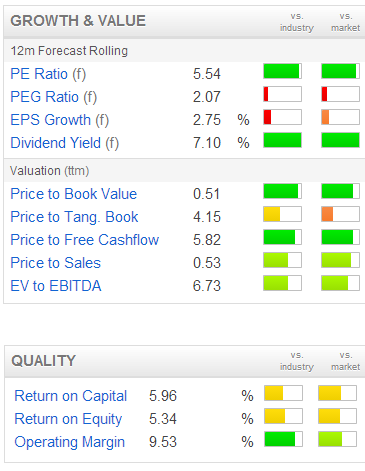
On the positive side, the 1.6p final dividend has been maintained, which gives 2.2p for the full year (same as last year), yielding a thumping 7.2% at the current 30.75p mid price. In my experience, dividend yields over 6% are usually fairly wobbly - i.e. there is an elevated danger that the dividend might be cut, or passed altogether.
I'm very much in two minds about the dividend at Begbies. On the one hand the business generated ample cashflow to finance the divided in 2012/13, but on the other hand it still has high levels of net debt, although net debt has reduced significantly in the last year, and is now £17.2m.
The insolvency practitioner sector is unusual, in that very high levels of debtors are normal, because the costs of each case accumulate, and the fees are then paid in a lump sum from asset realisations near the end of the Administration or Liquidation process which Begbies manage.
So a conventional view of net debt is not so relevant here. Instead it can be seen as revolving credit, which is a normal and unavoidable part of the business model. As long as you account for the interest cost, then arguably you can ignore the revolving debt. This is particularly the case because insolvency practitioners effectively work for the banks, so don't usually have any trouble securing the revolving finance they need.
Begbies facilities look secure, with maturity dates ranging from 2017 to 2021, which these days is actually quite long - most companies struggle to get financing for more than 3 years at a time from the Banks - a factor that has certainly held back economic recovery - how can businesses invest long term if they can only borrow short term?
Cost cutting means that Begbies has managed to increase it's EBITA margin to 16% in the most recent half year, so even on reduced turnover they should continue to churn out decent profits and cashflows, hence the dividend is probably fairly secure.
The group cost base has been reduced from £52m in 2011 to £44m in 2013, and a further £2m reduction is expected this year, so they are certainly operationally geared to deliver bumper profits if & when the insolvency sector becomes busier. We just don't know when that will be.
I reckon Begbies shares are a pretty good each way bet, for a long term portfolio, where you collect in hefty dividends which look reasonably likely to be maintained, and at some point could see good upside on the share price too when insolvencies increase - which they must do at some point, when the Banks balance sheets are strong enough to take the hit from zombie companies currently just meeting interest payments only.
The Eurozone crisis seems to come in wave after interminable wave, and the tide seems to be coming in again. What an utter disaster this misguided single currency project has been, and how much more untold misery will the people of Southern Europe tolerate, in order to continue providing Germany with an artificially cheap currency to maintain its export machine?
There's really only one viable solution in my view, and that is for the Eurozone to split into two, with the Germans & their close neighbours forming a new currency of their own, which will then appreciate against the existing Euro. Only then will the imbalances begin to correct.
The lesson from the 1930s was that you cannot solve a recession by constantly trying to balance the Govt spending deficit. You have to accept a degree of Govt deficits in bad years in order to pull an economy out of recession, otherwise you end up in a deflationary spiral, which is exactly what's happening now in Southern Europe all over again.
I read today that wages have fallen 21% in Greece in the last 3 years, which therefore reduces tax receipts, which means the Govt has to cut again & again, triggering further reductions in demand, and further reductions in tax revenues, and so on in a vicious circle. Who knows where it will end, but countries like Greece, Spain & Portugal surely can't be far away from either popular uprisings, military coups, or embarking on a reckless war to unite the people (Spain invading Gibraltar perhaps?).
Who knows, more sticking plasters from the EU are likely, but at some point the plasters won't work any more. Sorry, I'm rambling a bit, let's get back to companies.
Profits warning of the day comes from Stadium (LON:SDM), a small electronics group, who say that for various reasons results for the full year will be significantly below market expectations. Broker consensus was for 6p this year (ending 31 Dec 2013), so significantly below suggests to me we're probably looking at 3-4p perhaps?
Stadium shares are down 22% to 30.5p at the time of writing, so that puts them on a fairly reasonable rating for the likely level of reduced profits this year. I am intrigued by them also saying that by Q4 and beyond they see profits restored to the level consistent with previous guidance. This suggests to me that this might, and I emphasise might (and always DYOR as usual!) be a buying opportunity? I don't have any spare funds at the moment, but it looks tempting at around the 30p level.
I've almost run out of time, but profits warning of the day should really go to Office2office (LON:OFF), whose shares are currently off 44% to 46.5p. Nasty. They put out a profits warning last night at 5:31 pm. Some people moan about that sort of timing, but personally I don't have a problem with it. The market's shut, so really it's no different to a 7 am announcement, other than that it can affect your sleep badly for one extra night.
I don't normally invest in office supplies companies, as there's no margin in what they do, and customers just shop around for the cheapest online supplier. They are also vulnerable to bad debts from companies going bust, and if you only make a wafer thin margin, one bad debt wipes out the profit from dozens of other accounts.
There's also a profits warning from ITM Power (LON:ITM), which is a blue sky thing, so not of interest to me. But it's a sharp reminder that when there are no profits or revenue to speak of, it's anybody's guess what the company is worth. Also, blue sky projects usually fail, and even when they do work, the process is usually many years longer and much more costly than expected, so shareholders usually get diluted away to nothing by the time they do hit the big-time. However, investors do love a good story, and still lap them up and over-pay for story stocks generally.
Right that's it for today. An old City friend is visiting me in Brighton, for our annual exceedingly boozy lunch. So nobody is likely to get any sense out of me for the rest of today.
See you from 8 a.m. tomorrow morning.
Regards, Paul.
(of the shares mentioned today, Paul has no long or short positions)
Disclaimer
This is not financial advice. Our content is intended to be used and must be used for information and education purposes only. Please read our disclaimer and terms and conditions to understand our obligations.

10 comments
Begbies is a core holding in my SIPP (thanks for the write up Paul). Should fly when interest rates finally go up. Meantime management seem to be running a very tight ship and with shareholders' interests in mind.
Thank you for today Paul, and I hope you have a good lunch. Regarding Silverdell (LON:SID), it is perhaps worth comparing the situation with Vianet (LON:VNET). The former seem to know something bad is in the offing, do nothing, say nothing, and seem to be rather reticent about the whole thing. Result: share price and sentiment crash (probably). The latter have a section in a statement where they choose to highlight something that MAY happen, and seem to be genuinely very circumspect and open about the possibilities. Result: share price and sentiment crash (definitely). I think this just shows companies can be on a hiding to nothing, no matter how they handle matters. The market is unforgiving under all circumstances. I hold both these, and prefer the Vianet (LON:VNET) approach myself. I knew about the case against Kitsons, but bought in anyway. The amounts involved seemed to me to be probably small, as the supplier is not a big concern. Anyway, you live and learn (said the Chariot, Zytronic, Vianet, Silverdell, and Goldplat owning newby!!!!!!!!!!!!!!!!!)
That brings me to Cisk's question about the size of a portfolio. Mine has grown very quickly to be an acknowledgedly ungainly twenty strong. But this is because I buy VERY small amounts, adding later if things pan out well, or letting them sit if things go badly. This means I am rapidly getting stuck with remnants that I do not want to sell because they will show an obscene loss!!! In truth I think less than ten companies, well spread, is plenty.Good luck to one and all!
Vis Begbies,
Perhaps their insolvency biz might be looking up if this article holds any weight...
"Number of businesses with serious cash flow problems hits new high"
Although the number of ‘zombie businesses’ – those that can only pay the interest on their debts – has fallen over the last year from 146,000 to 108,000, the rise in businesses with acute cash flow problems indicates that the outlook for struggling businesses is deteriorating.
http://www.creditman.biz/uk/members/news-view.asp?newsviewID=18277&id=1&mylocation=News&chksrc=NNow4251
Paul, of course you're completely entitled to your own opinion - however my view hasn't changed in 24 hours:
"Whilst we don't yet know what actually happened; a charitable view is that it looks like there was a fundamental misunderstanding of what it takes to run a plc, and what should be disclosed to the market and when; a less charitable view might think that the directors be hung out to dry - fined, barred from directorships, imprisoned etc".
If you're correct and it was an admin mistake - then heads need to roll. Obviously if it's worse, then heads will roll anyway as the company will no longer be.
The BOD spectacularly mishandled the recent Edison note - implying that a rights issue was in the offing, and then they later denied it. This is from a sponsored report! Add this behaviour to the mess yesterday, and it all adds up to a Board who are out of their depth - either inexperienced or not in control of events in their company. It's such a shame as I believe there is a good company underneath, with excellent prospects.
Maybe Babcock International (LON:BAB) will buy them - they will have deep enough pockets to fund the growth.
However this mess leaves a nasty smell all round - and I notice that the spotlight has been turned on the 'Mello' group on the ADVFN BB and their recent meeting with management. It just goes to show how important doing your own research is (something I know you always advocate).
This episode has also made me think of what the ideal number of stocks is to have in your portfolio.
Too small and you never get to know any company well enough - but then a single failure doesn't wipe out a significant part of the portfolio. Too many - well the risk is spread but it's impossible to keep track of so many holdings.
Would welcome any views on what people find is the ideal number of companies to be in a portfolio...
In his great book, "Fooling Some of the People...", David Einhorn quotes Joel Greenblatt in "You Can Be a Stock Market Genius", "...After purchasing six or eight stocks in different industries, the benefit of adding even more stocks to your portfolio in an effort to decrease risk is small." Non market risk can be reduced 81% with 8 stocks, 93% with 16 stocks, 96% with 32 stocks, and 99% with 500 stocks. The point being, the marginal benefit reduces with an increase. I would suggest 8-12, based on my readings. There is clearly a trade off between the amount of research you can perform given the time you have. Research suggests the average is 2 stocks!! Don't be average!
In my active (i.e. punting) portfolio I aim for 8 and usually have about 12 as I tend to fail to sell off losers. SIPP is a bit different as I am trying to preserve value and generate income. Punting porty has significantly outperformed SIPP this year as you might expect.
Paul, Glad to hear your reassuring views on Begbies. Nothing much wrong with the figures given the continued surprisingly weak insolvency market. Dividend held, debt down, and margins and market share also maintained in an extremely tough operating environment.
My one concern is the more than one fifth increase in effective financing cost of BEG’s new banking facilities from 4.6% to around 5.6%. It is said to reflect “current market rates” but seems a rather large increase.
Hard to see the circumstances in which the UK insolvency market could face another substantial contraction from its current depressed levels. Given BEG’s success in cutting its operating costs to match its reduced revenue base, 2012/13 should mark a low point in its profit cycle.
Unless I am missing something BEG’s current valuation ( a historical p/e of under 6 and a yield of 7%) looks badly out of kilter with the rest of the market.
Now that Caledonia IT has dumped its sizeable stake over the last year, it is surprising that there are no well known institutional investors with sizeable stakes on Begbies's share register if the shares are such a bargain. Is this not the sort of share which should appeal to small cap income funds?
The continued absence of blue chip institutional investors, together with the weakness of the Begbies board (just one really independent NED and he used to work for Caledonia) makes me a tad wary about increasing my stake in what looks like a hopelessly undervalued share.
Perhaps Rick Traynor, who owns 29%, and his managers, should think of taking the company private if the market continues to refuse to rate this company more highly?
That said it was a real relief that Begbies held its dividend. It was only last year that Morson, another "undervalued" Manchester company with a big family shareholding, scrapped its dividend because of the weakness of its market.
Within months the Mason family had taken their company private at 50p a share - a more than two thirds discount to Morson's 160p IPO price blaming the markets' failure to rate the company properly.
It really put me off investing in small caps with sizeable family stakes.
Paul
I think you are perhaps being a little too kind to Silverdell. True, the full facts are not known, but especially for anyone holding these shares (I don't own any) what happened yesterday was a total shot out of the blue. Of course, in the absence of facts there will then be speculation and a degree of anger, the usual emotion that rears its ugly head when people see their money being lost.
In this case it would appear the speculation that the problem may be to do with the winding up order of Kitson and what followed may well be the responsible fact as you also suggest above. What is unknown is the series of events that lead to this, who knew what, who did or didn't do what they should have done. The company had maintained it's bullish line through all this and many investors believed everything was hunky dory. The only "known" issue was the rumour of a cash call, denied by the company who made it clear it could fund its growth up to 15%
It was interesting to note that one of the biggest critics of the company yesterday also happened to tip it as a "nifty" buy about a month ago. I believe that the IC also tipped it recently as well, so quite a few people who you would expect to have done their homework seemed to have bought into the undervalued case for the company. However, I doubt whether anybody would have done enough research to imagine that the company could be suspended over a "trivial amount of money" that resulted in a winding up order for part of it.
And there's the problem for investors in this company who may now face losing everything, or, if and when the suspension is lifted a much reduced share price. At the very least it looks like a cock-up of gigantic proportions, but in the absence of a company statement and until the facts of what happened and when are known the investor is in the dark and that will result in speculation based on what is in the public domain. Hopefully the company will come clean on what happened, when and if they survive maybe the market will take pity on them. However, I think many Silverdell investors have resigned themselves to what is going to happen.
An old City friend is visiting me in Brighton, for our annual exceedingly boozy lunch. So nobody is likely to get any sense out of me for the rest of today
Good man. Hope you both have a cracking brunch. Day looks dreary,and with US closed tomorrow, sounds as if your time will be well spent . :)
Hi Paul,
I hold BEG and agree with what you have written. I just have one small moan about them though. The dividend was announced today but doesn't go ex-divi until 9th October and the divi isn't paid until 7th November - four months hence. Only a small thing but four months does seem a bit excessive.
Steve