Small Cap Value Report (30 Apr 2015) - CCT, OPE, UBI, GBO

Good morning!
I'm on Day 4 of my charity challenge, and apart from a headache & irritability (which someone told me is caffeine withdrawal symptoms, as there was no money in the budget for coffee), it's going alright - I think there will be just about enough food to last today & tomorrow. I posted a video blog last night, for anyone who is sufficiently bored to want to watch it! Donations are rolling in, everyone is being amazingly generous, so thank you all very much indeed! We've already raised £850 online, £175 offline, and with Gift Aid that comes to about £1,200 - pretty awesome stuff, in my opinion!
March and April were so busy that I didn't have time to record any audiocasts. However, the one in early Feb with experienced investor/trader Richard Crow, was so popular that I invited him back for a recap. So here is the link for yesterday's discussion between Richard and I. It's nearly an hour long, so lots of material covered, and plenty of interesting stock ideas.
Character (LON:CCT)
Share price: 410p
No. shares: 20.8m
Market Cap: £85.3m
(at the time of writing, I hold a long position in this share)
Interim results - covering the six months to 28 Feb 2015 are out today. I nearly fell off my chair when I read the headline figures, which are fantastic, as shown in the table below. They haven't put in the % gains, but as you can see they are massive - PBT is up 178%!
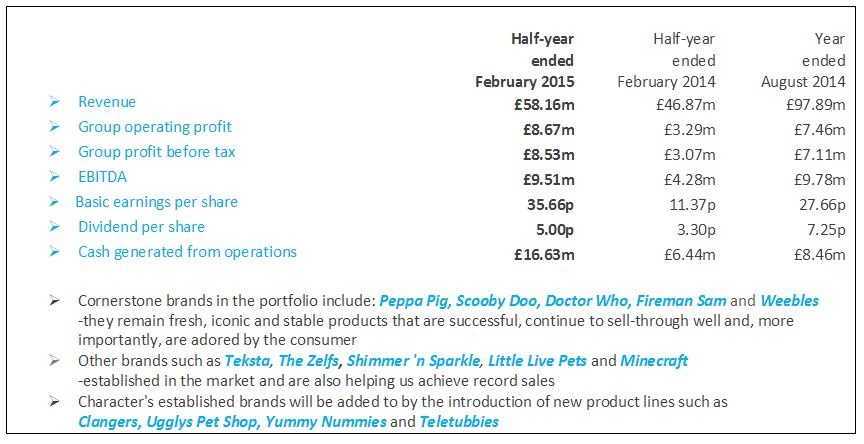
Broker forecast for the current year is 40p EPS, so as you can see, by achieving 35.66p EPS just in H1, they look set to absolutely smash full year forecast.
Clearly, from the flurry of early trades, quite a few people rushed to buy more shares. The trouble is, the headline figures are very misleading, and the company and its advisers deserve a serious ticking off for this. You have to scroll down a considerable way through the narrative to come across this vitally important clarification;
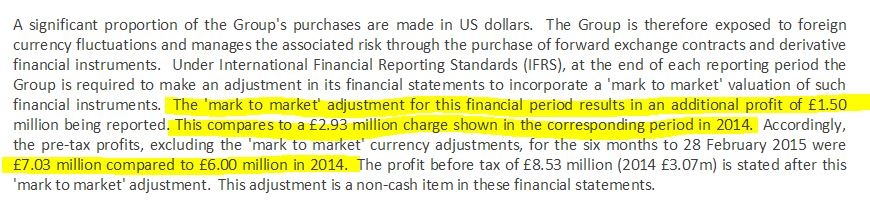
So underlying profit before tax wasn't up 178%, it was actually up 17%!
Isn't it funny how companies are so keen to highlight underlying profits when it goes in their favour, but they bury the bad news deep in the narrative when it goes against them! Anyone who bought first thing, on the headline numbers, and read the narrative later, would rightly feel misled.
Anyway, putting that aside, the figures & outlook are still very good, and I think the shares could potentially have considerable more upside. I was on the case early with this share, and flagged that "it looks like this could be a good time to buy their shares..." on 6 Sep 2014, when the shares were 140p.
Then I was more positive here on 8 Sep 2014, flagging them as "cheap" at 214p.
And again on 3 Dec 2014, as "still good value" at 245p.
And again here on 16 Jan 2015, as "a price of 400-500p looks possible", when the shares were 311p.
So it just goes to show that there have been some good winners flagged up here, as well as things that have disappointed. The trading updates from Character have just been getting better & better.
Outlook - sounds very positive. I am happy to place reliance on management comments about reaction to ranges being good, because when they said this last year, it was indeed a precursor to excellent results;
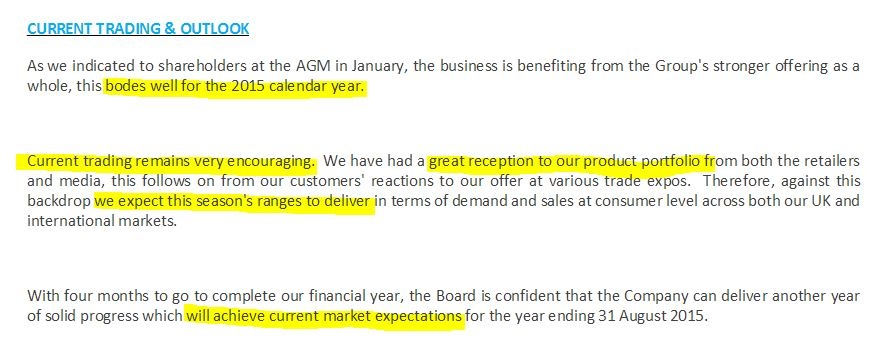
Valuation - It seems a little odd that they are only saying "achieve current market expectations", and not beat them. Given that the H1 EPS figures is close to the full year forecast, I am expecting them to beat expectations by a considerable amount. Remember forecast is 40p, and they are reporting 35.66p just for H1 today, and there doesn't seem any particular seasonality.
Even if we adjust out the mark to market gain of £1.5m, then I make adjusted underlying EPS which the company should have reported, but didn't, of about 29.4p for H1. So even if H2 slips back to say 20p EPS, then nearly 50p EPS should be possible for the full year. At 410p per share currently, that puts them on a PER of only 8.2.
Even if you go with the broker forecast of 40p, which is almost certainly going to be upgraded, then you're still only on a PER of 10.3. So it still looks cheap.
Balance Sheet - looks alright, but not particularly strong. Net tangible assets is £10.9m, and the current ratio is 1.22, so just about OK on my usual rules.
Cashflow - has been remarkably strong, and I'm surprised to see reductions in stock & debtors, given that turnover is up. It looks like there might have been some lucky timing there, so some of the very strong cashflow might reverse in H2. It's all absolutely fine though.
Share buybacks - this is very striking - the company made a terrific call, by buying back 2.3m of its own shares in the six months, at an average price of 260p. This is on top of 1.8m shares bought back at an average of just 182p in the prior year period.
Generally I'm not very keen on share buybacks, because companies seem astonishingly inept at timing them - they usually seem to do them when the share price is too high, and destroy shareholder value. Whereas when the share price is on the floor, and they have surplus cash, they do nothing. That's a general point.
Whereas this company has proven itself to be very shrewd, and has done big share buybacks when the shares were cheap, and trading was strongly improving. Very well done to them! The Executive Chairman has been selling down his stake, perfectly reasonable given that he's 70 year old. Some of those were sold back to the company in buybacks, which is a little odd, but I suppose why not?
My opinion - I'm really hacked off about the results being presented in such a misleading way, but that has only very briefly dented my overall pleasure with this share, indeed I'm happy to hold & buy more at the current level, given how strong the outlook sounds.
The icing on the cake is that Stockopedia likes it too, a StockRank of 98 - I'm always very happy when my own stock ideas also have strong StockRanks.
As regards downside risks, I've covered this in previous reports - toys come in & out of fashion, etc. However, being the 4th largest player in the UK toys market, Character looks to me like a company on a roll.
EDIT: A new broker (Allenby) has initiated coverage with a price target of 575p today, I understand.
Optare (LON:OPE)
De-listing - one of my main motivations for writing these reports is to help readers dodge bullets. Warning readers about shares that look dangerous often leads to receiving abuse from people who are long of the shares, but if it saves other people money, then it's worth it.
Optare is an absolute dog. I've only reported on the company here once, in Aug 2013, where I said;
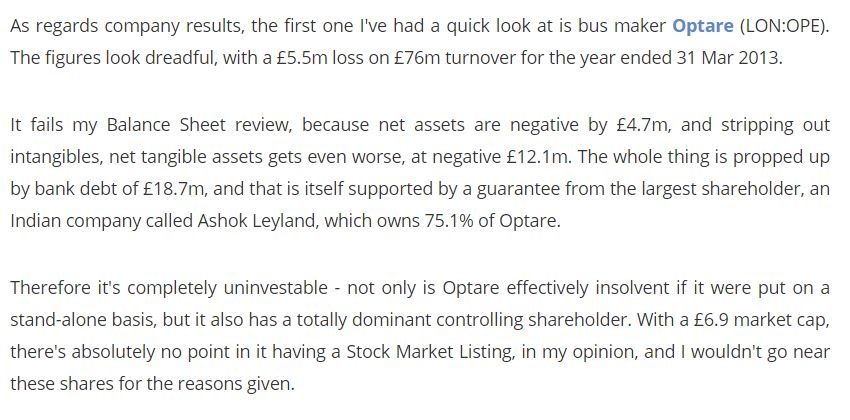
Please excuse me for quoting myself, but it saves typing it all out again!
Anyway, the above has turned out to be correct, and today the company has announced it's de-listing, with the 75.1% shareholder having approved it, so the 75% vote required at the EGM is a done deal.
The shares are down 56% to 0.07p today on this news, and in my view the shares are worth nothing.
My opinion - this case highlights how important it is to avoid, or consider very carefully, any share which has a controlling (over 50%) shareholder. They can do whatever they like, and minority investors are completely at their mercy.
It also highlights that loss-making micro (or nano) caps usually end up the same way - either going into Administration, or being de-listed. When a de-listing is announced, it's usually a loss of at least 50% instantly.
Very occasionally, it can work out, holding shares in a private company, but most of us wouldn't want to. The key advantage of holding listed shares is that you can sell whenever you want, usually.
So hopefully this case is another reminder of the dangers of scraping the bottom of the barrel in terms of market cap, and quality. Plus the danger of a controlling shareholder.
Ubisense (LON:UBI)
Share price: 115p (down 18% today)
No. shares: 25.1m
Market Cap: £28.9m
Profit warning & fundraising - It's definitely blow my own trumpet day today, and why not - after about 4 profit warnings on stocks I like in recent weeks (out of a portfolio of over 50 stocks though), it's probably important to point out some of the things I've actually got right!! This is one of them.
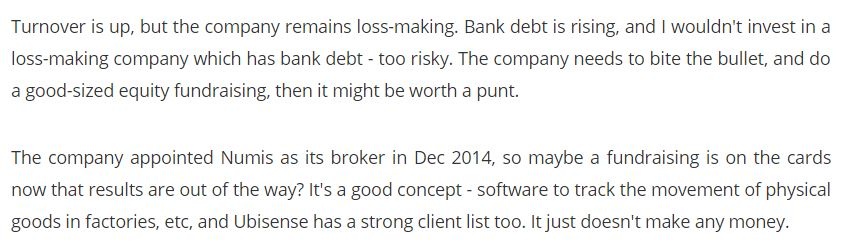
Looking back through the archive, I've repeatedly warned that this company has inadequate financing, indeed was relying on bank debt, which is very dangerous for a loss-making company. Banks are not in the business of providing risk capital to companies (in theory anyway), since their lending margin is not wide enough to suffer lots of bad debts.
My crystal ball was on top form here on 17 Mar 2015, when I commented here (and again, apologies for quoting myself, I'm being lazy);
The profit warning today looks relatively mild - with contract delays meaning that Solutions revenues will be similar to 2014, but Services revenues in line with expectations. They're cutting costs to mitigate the losses. No indication is given of the impact on full year figures, but it doesn't sound disastrous, reading between the lines.
However, the company is skint of course, as I've mentioned before, relying on bank debt. Loss-making growth companies should never, ever have debt. It's a disaster waiting to happen. Anyway, as I predicted, the company needs to raise fresh equity, and comments today;
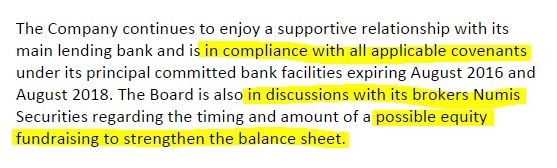
So clearly the need to raise fresh money was indeed the reason Numis were appointed in Dec 2014, as I suspected. It's dangerous telling the market you need to raise more money, as unless someone supports the share price, then people will just sell in the market, and chase the price down, with Placees repeatedly lowering the price they are prepared to inject fresh funds at.
That said, Numis seem to be very accomplished at doing fundraisings, from what I've observed recently, so we'll see.
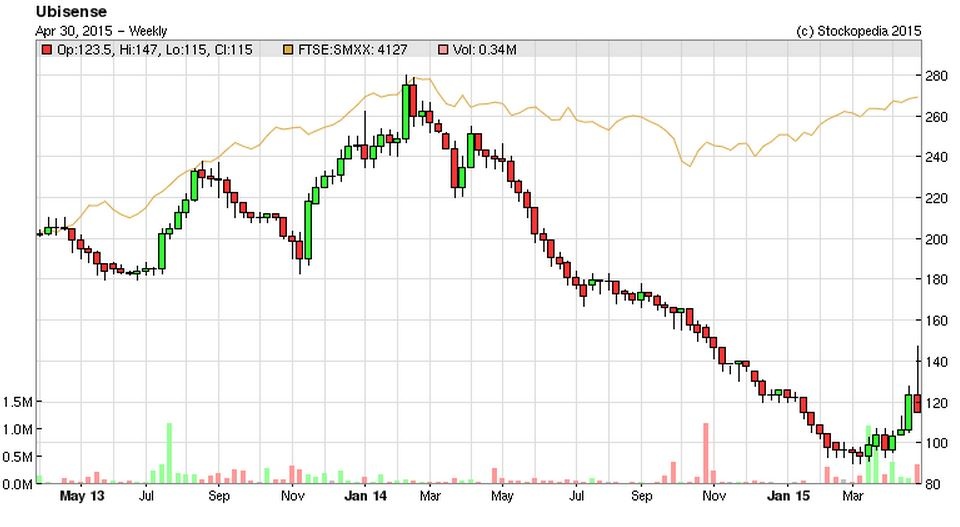
The upward chart movement in recent weeks seems spurious, maybe even a little suspicious. So this is one situation where a bowl forming was not a good signal! (that's a reference to my interview with Richard Crow last night, who likes bowls on charts! Although Richard is dismissive of AIM, so he wouldn't have gone near this stock anyway).
My opinion - it's not a sensible investment as things stand now. However, in a bull market, a stock with a decent jam tomorrow story like this company has, might come back into fashion for a while. So if Numis get a decent sized fundraising away, then it's the sort of thing I might have a little punt on, in my trading account, for a recovery.
Globo (LON:GBO)
Share price: 51p (up 7% today)
No. shares: 373.7m
Market Cap: £190.6m
(for the avoidance of doubt, I have no position in this share at the time of writing)
Preliminary results - for calendar 2014 are out today - rather late, four months after the year end. As usual, the headline numbers look amazing - revenue up 49% to E106.4m, EBITDA up 41% to E50.9m, profit before tax up 30% to E35.7m. EPS up 27% to E0.094, ahead of market expectations. However, free cashflow is stated by the company to be only E7.3m - so only 20% of PBT converts into cash.
Intangible assets - the P&L is safely ignored, as it's effectively fantasy, in my eyes. The E35.7m profit before tax is achieved by diverting an enormous chunk of debit entries (costs) from the P&L, and onto the balance sheet, mainly into intangible assets. These are mainly just payroll costs, so they're worth zilch. They're not an asset at all, but they sit on the balance sheet as if they were.
You can capitalise costs into intangible assets under current accounting treatment, if you call it development spending. As Dr Paul Jourdan of Amati pointed out at the UK Investor Show, sitting next to me on the panel discussion about value investing, many fund managers are dismayed with this new accounting treatment, as they had previously fought hard to stop companies capitalising costs into intangible assets. So in his view (and mine), such capitalised costs should be reversed by investors when looking at the accounts.
In this case, intangible assets (excluding goodwill) rose by E12.9m, so at the very least I would deduct that figure from PBT, to reduce it from E35.7m to E22.8m.
Cashflow statement - I find this far more revealing than the P&L, when looking at the accounts of companies that I suspect are indulging in creative accounting (several changes of auditor at Globo strongly reinforce that suspicion - one of many red flags with this company).
Several things jump out at me. Firstly, why is a company with substantial net cash paying substantial interest payments of E4.1m? Also, why did a company with substantial net cash repay E10m of borrowings, but take out E30.0m of new borrowings in 2014? That simply doesn't make sense to me. If you have a lot of spare cash, then you pay off your borrowings, to save interest. You don't take out new, larger borrowings. Very, very odd. Can anyone shed any light on that?
So the net cash from operating activities is E31.0m. Of that, most of it, E24.4m is spent on capex. Since tangible assets are negligible, what this means is that almost all of that money was spent on intangible assets - i.e. payroll costs! Add in interest received, and you arrive at free cashflow of E7.4m, which is near enough (after rounding) to the company's statement that it made free cashflow of E7.3m.
They also spent E9.1m on acquisitions, which is fair enough, it's fine to exclude that from free cashflow, as it's discretionary.
Therefore, the way I look at things, the free cashflow figure of E7.4m is effectively the real level of profitability the company is achieving, and the much higher P&L numbers are fantasy. You don't have to agree with me, this is just my opinion.
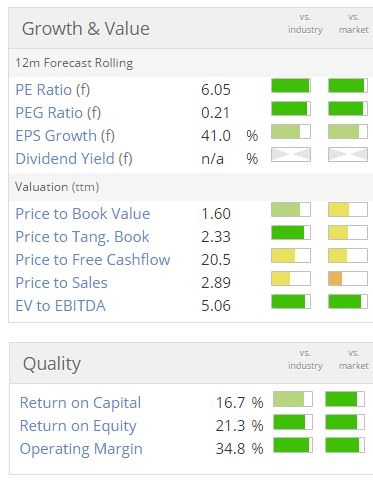 Valuation - so as I've demonstrated above, this means that the company isn't on a PER of 6 at all, as the E part of that calculation is a fantasy number.
As is often the case with companies that indulge in creative accounting, it can fool a computer model! So you can see that the StockRank is high, at 85, and the Growth & Value section is a sea of green.
This is where, in my opinion, you need shrewd human input, to spot the flaws that the computers can't necessarily pick up, because the computer has to assume that the reported accounts are perfect. I don't, and I know what to look for, to identify the imperfect ones!
The non-existent dividend yield is a big tell. Again, a hugely profitable company with pots of cash should be paying decent divis, right? Yes it should, but Globo has never paid a divi. Something just isn't right here, in my view.
Balance Sheet - I've covered intangible assets already, but the other odd items here are "other receivables" within fixed assets - it's very unusual to see any debtor figure up there. I think this might relate to the deferred payments from when the company inexplicably decided to sell 51% of a part of the business to its management, and gave them a cash dowry to enable them to "buy" the business back. There is only one reason to explain why that was done - it was to get the figures off the consolidated balance sheet. It's now an associate, which is a single line entry.
Debtors - this is always a warning sign, if it's more than the usual range of about 60-90 days turnover. In this case trade debtors are E50.8m, which is 48% of turnover for the year. That's way too high, and I don't care what the reasons are, it's just far too high. The ageing of it looks to have deteriorated somewhat too, see note 4 to today's accounts. Although it's easy enough to credit off old, unpaid invoices, and then re-invoice them anew.
A lot of the unpaid debtors are probably Greek Govt, or Greek corporate debts. Which with Grexit impending, what's the likelihood a lot of Globo's debtors will have to be written off? Very high I would say.
Furthermore, there's another E21.1m in other debtors, which relate to deferred income. So the company has booked sales (and hence profit) through the P&L, but not yet billed the customer. So it sits in other current assets until an invoice is raised, and then moves into debtors. So really, total debtors are E71.9m, which is the bulk of 2014's entire turnover!
Cash - the company says it has E82.8m cash, and it did raise a load from a Placing some time ago. So why does it also have E42.4m in bank borrowings? Are they masochists, who enjoy paying the bank interest unnecessarily? On the face of it this seems crazy, but maybe there is an explanation - is the cash marooned in one country, and the debt in another possibly, I don't know?
My opinion - the figures have never looked right with this company, and I strongly believe that sooner or later, there will be big write-offs from this balance sheet. I don't believe the figures, to be blunt. Nor does the market, or the PER wouldn't be 6, would it?!
That said, there does appear to be something here. If you do believe the numbers, and some people might, then there seems good growth in licenses sold, etc.
Anyway, as you might have guessed, it's not for me.
Disclaimer
This is not financial advice. Our content is intended to be used and must be used for information and education purposes only. Please read our disclaimer and terms and conditions to understand our obligations.

58 comments
I see the Globo Annual Report is on their website, p61 looks interesting, I'm not a holder or short but I have to say the accounts look odd to me.
In essence it borrowed an additional c.20m euros during the year and burnt through c.20m euros of cash and cash equivalents by year end.
I think I can see why it needs a bond issue..
PS and it pays very little tax
Paul, well we can agree at least on Silverdell which I never invested in because I did not like it at all when I saw them present. But many were taken in by what seemed a good story.
As regards the change of auditor I said this was "history" because it was discussed at length at last year's AGM, as were also some of the other issues Paul has raised. There is a full report of that meeting by me on the ShareSoc Members Network. In addition I had talked to the CFO about it at a presentation they gave to investors - and where the new auditors also happened to be present so I talked to them also. For those reasons I did not consider the change of auditors to be suspicious. Perhaps this is a case of DYOR - do your own research if there are apparent concerns.
Roger,
Experience has taught me that if you seek assurances from a company, you will always get them. I remember Sean Nutley of Silverdell lying through his teeth to us at a meeting, saying everything was fine, just a few weeks before the group went bust. I could tell from his body language and demeanor that everything was not fine, so I sold my shares immediately.
I'd go further and say that many, maybe even most, Directors of companies on AIM are polished liars. Or at the very least they know how to create a falsely positive impression.
This is a game of cat & mouse between investors, and often quite dodgy companies on AIM.
So, as far as I'm concerned, two unexpected changes of auditor is not something that can be explained away, it's a massive red flag. You take a different view, which is fine.
Regards, Paul.
Paul, no I wasn't born yesterday - actually long before you I think. We could argue a long time about Globo and the Annual Report for 2014 when it is available will certainly be worth reading. And I'll try and ensure I go to the AGM and cover some of the issues you have raised. But issues such as the change of auditors are history.
Roger,
Thanks, I would be interested to hear back from your trip to the AGM, if you manage to ask the company about the specific issues I've flagged.
You may view the two changes of auditor as history, but I certainly don't. It's a very clear warning sign to me, that there were probably issues that the auditors refused to accept.
I look for a pattern of red flags, which usually come together. As demonstrated above, Globo has at least five red flags which concern me greatly. You are happy to disregard them. Fine, that's what makes a market.
Paul.
Re: 'But issues such as the change of auditors are history'
True, these auditor changes are history in that they have happened, but that does not mean that we should ignore them. Auditor changes can be benign but they are often an indication that there is something amiss with the accounting practices.
Paul has a history of identifying 'red flags' and I choose not to ignore his historic ability as I anticipate that he is likely to continue to demonstrate this ability. History is important in some cases.
Hello Mineralwasser
Globo have reasonably high "third party" costs - 18 mill of Direct costs were third party in 2013 compared to only 1.2 mill of staff wages in direct costs.
In summary they presumably simply subcontract out the majority of development and direct cost of sales work out to third party entities. How this works i know not but it may be as simple as most IT bods being engaged on a self employed basis. Or perhaps its cheaper to get a fixed fee via quotes from software development firms for particular assignments.
Whether these are on the books payroll costs or third parties is probably irrelevant as its likely to be the same thing with a different badge on.
The mention of licence costs being capitalised though leads me to believe there may simply be licence fees paid for multi year use of some other bods IP If say they paid Microsoft £5 mil for multi year licence for an import part of the Go Enterprise suite that's a reasonably safe accounting treatment. However they could equally have paid a small Greek subcontractor a large licence fee to use their product rather than a specific development fee, in which case the use of the term licence does not mean the expense may much different from that of development costs.
If one were being devious perhaps one would want to use the term licences to make the expense sound more pukka :)
Note i don't really have any specific knowledge of this industry so my guesswork/presumptions may be completely wrong.
1. Send money to mate as "licence fees"
2. Mate buys new hat
3. Mate buys faux product with money from #1 wearing hat from #2 so that auditor doesn't recognise them
(This comment is a work of fiction. Any resemblance to real business models, living or dead, is purely coincidental.)
Hi Paul Scott,
I have a question regarding the additions to the intangible assets and the statement that they are "(...) mainly just payroll costs (...)". This is something I have always been confused about after reading the Report for 2013 and maybe you can help me with the confusion I have.
Note 16 states that "Additions to internally generated intangible assets totalled €14,577,000 (2012: €11,206,000)", while Note 10 states that "The Group has capitalised wages and social security costs of €1,090,653 in the year ended 31 December 2013". To me it seems like only a small percentage (less than 10%) of the additional intangible assets are actually staff costs.
Can you give any explanation for this?
Hi mineralwasser,
You asked;
Note 16 states that "Additions to internally generated intangible assets totalled €14,577,000 (2012: €11,206,000)", while Note 10 states that "The Group has capitalised wages and social security costs of €1,090,653 in the year ended 31 December 2013". To me it seems like only a small percentage (less than 10%) of the additional intangible assets are actually staff costs.And could I shed any light on this.
Unfortunately not, I don't think the company gives a breakdown of exactly what it capitalises into intangible assets. However, from talking to other software companies, I have found that what they usually capitalise into intangibles (for development spending) is overwhelmingly the cost of getting people to do work - whether its programmers making code, designers, etc, all that kind of thing, and the associated overheads - so it might include some office occupancy costs, etc.
I can only imagine that Globo might use external contractors, which whilst not strictly its own payroll, is just another form of people cost.
I expect most investors could accept a moderate amount of costs being capitalised into development spend on the balance sheet. However, Globo (LON:GBO) takes it to a whole new level - they are capitalising an enormous proportion of their costs.
The IC has a track record of being extremely naive about this type of issue - remember that they remained steadfastly bullish on China frauds like Naibu Global International Co (LON:NBU) and Camkids (LON:CAMK) until the bitter end, seemingly oblivious to the reality that a PER of 1 or 2 is the market telling you something - namely that the figures are highly suspect!
I believe that there's certainly an element of that with Globo too - the forward PER of 6, for a supposedly exciting growth tech company is the market telling you, through a megaphone, that a lot of people think there's something not right here. It's then up to you whether you ignore the warnings, as Roger likes to do, or whether you have a careful think about the very explicit red flags being highlighted by me in the main article.
I don't mind what people do with their own money, but when I see red flags, I report on them.
Regards, Paul.
Hopefully the accrued income bears doesn't head the way it did at Geong where its up to the point where there is an effective debtor days of probably 3 years in the accrued income alone !!!
You are right in that this company has significant accrued income on long term contract work that is not yet billed. That might certainly be a concern if it became excessive or unexplainable.
Shipoffrogs: Not sure how you are measuring it from simply googling the name. It is not a retail product. Need to look at the revenue the company is gaining from it, and industry reviews. Incidentally Investors Chronicle just rated the company a "buy" this morning. P.S. It might help you if you searched "go enterprise byod" or "globo byod", versus their competitors like "Good".
The sunk cost of software development is a good starting point as a measure of the amount of research and development that has been put in, and hence is a useful measure to anyone who is trading the shares in a public market. Yes a trade buyer will do more due diligence on the prospects and likely future revenues that will result but the intrinsic value of the R&D put in will not be totally ignored. In any case you are ignoring the key point I was making that folks knowledgeable in the software sector, or trade buyers therein, will not simply be looking at the accounting data and will likely take very little notice of the balance sheet figures, or even profits. If I was running Globo at this point in time I would be wanting to pay more attention to revenue and its growth than short term profits. And how much they spend on R&D (capitalised or otherwise) is more a function of what they need to spend to develop the products and their strategic product position than anything else.
And really you should not be saying things like "screaming red flags" and "real nasties in the accounts" without some sound evidence. Doing so just annoys people like me. It's just malicious garbage. And your comments on cash are most peculiar - cash is cash and adjusting the cash figure is nonsense.
If you compare Globo with one of your favourites, Synety, which has yet to show they have a business model that can generate any real profits, then I know which one I would prefer to invest in at this point in time.
Roger,
And really you should not be saying things like "screaming red flags" and "real nasties in the accounts" without some sound evidence. Doing so just annoys people like me. It's just malicious garbage. And your comments on cash are most peculiar - cash is cash and adjusting the cash figure is nonsense.
I couldn't care less if you get annoyed by my articles, which are anything but "malicious nonsense" - I think your comments have actually stepped well over that line!
Your problem is that you pick lousy shares, and then get emotionally attached to them, and turn on anyone who flags up all the things that are wrong with them!
You did it with Blinkx (LON:BLNX) and are now doing it again with Globo (LON:GBO).
My article was very, very specific about some of the red flags I see at Globo. You've chosen to ignore those red flags, and shoot the messenger. Whereas practically all other bulls in Globo have accepted that I have raised some very valid points.
Paul.
Paul:
Re Globo. Where are the real nasties? Where are the red flags? If you let the facts speak for themselves that would be sufficient, but you make comments based on ill-informed views. For example, apparently one of your red flags was the change of auditors. But that was explained at the time and perfectly satisfactorily so far as I was concerned. As was the case with Blinkx, there have been lots of ill-informed comments on Globo from people who have not taken the time to study the company and the sector in which it operates in any detail. But mud unfortunately sticks and has done serious damage to these businesses, particularly Blinkx. Who are the bulls in Globo who have accepted your bullshit? It's all very amusing bullshit but it does not reflect the underlying facts. Neither of those businesses are perfect in many regards, but that's true of a lot of software businesses which are often complex and where you need to understand the business model that underlies the accounting data.
Globo has particular problems in that it is a Greek company (and that has a significant impact on the share price alone) and a lot of its revenue historically comes from Greece and other Mediterranean countries where collecting debtors takes time, but that is changing rapidly.
As regards capitalisation of costs they did provide a breakdown in the last accounts. Total was Euro 11.2 m split between software and licenses. As their revenue last year was 71.5m that does not look exceptional to me in any way for such a business.
Oh and incidentally if I had fallen in love with these companies, I would have a lot bigger holding than I do. Again you are making allegations without any evidence! And I can think of a lot of improvements I could make in Blinkx, such as having a CEO who could communicate better what the business does and stand up more strongly to the attacks on it. But no business is perfect and if you gave me a list of your holdings I could no doubt think of several reasons not to invest in any of them.
If you are going to make public prognostications based on weak evidence, you are bound to get some flak. Those who can't stand the heat....
Roger,
You are of course free to take whatever views you like of any company, but hurling abuse at me doesn't exactly strengthen your case, and I'm surprised at you taking that tone.
Just to reiterate my SPECIFIC concerns about the accounts of Globo (and this is not exhaustive);
1) Change of auditors TWICE, and one was a highly unusual, unplanned change after the year-end. If you believe the explanations given by the company, then good luck to you! Many years experience of investing in small caps has taught me to be very careful about unexpected changed in auditors. I trained with PWC, and these things don't happen without good reason, in my experience. So I was right to flag this as a red flag to my readers.
2) Debtors - far too high, as set out in the main article above. Again, in my experience, people who explain away excessive debtors nearly always end up with egg on their face. Excessive debtors is nearly always a sign of problems ahead. So it's a red flag - and just to clarify what red flag means - it's a potential warning sign. Not a definite problem, just a sign that there may be a problem. It's my job to report what I see, so that readers can make up their own minds.
3) The 51% partial disposal of a Greek subsidiary to its own management, which was given away with a cash dowry that is being recycled back to Globo on deferred terms, was a ridiculous transaction in my view. Think it through. How could there possibly be any reason for that transaction, other than to get problems off balance sheet?
4) As mentioned in the main article, why did the company have net cash, yet pay a staggering E4.1m in interest payments on bank debt in 2014? Why did it further increase bank debt, when it has a big cash pile??? I'd love to hear an explanation for this, which nobody has yet come up with. With no explanation from the company, It's a massive red flag.
Re Blinkx (LON:BLNX) - profits have collapsed! But everything is still fine according to you? That pesky Professor Edelman scared away all the customers did he? Come off it Roger! Were you born yesterday?!!
As with any business, if customers are happy with the product or service, then they continue buying it, regardless of what is said at some investor show across the pond, or in a blog.
Paul.
Monty9: that's a very good summary of my view also.
TMFMayn: thanks for the invite but I could write a book on this general subject apart from the knowledge of Globo I have built up. Regret I do not have time to that. But the key issues with Globo are: 1) the involvement in Greece, which is becoming less and less with GO!Enterprise taking off 2) the legacy products that are apparently still growing which surprises some and 3). Can they really conquer the business software world with GO!Enterprise against strong US competition. Revenue growth is what matters, rather than short term profits and cash flow for such companies and in terms of likely valuations (just see how H/P complained about how Autonomy had deceived them about revenues and hence wrote off most of the cost). So it's understanding the business that matters, even more importantly than them having sound financial numbers - indeed the numbers are better than one could reasonably expect from such an early stage business. They do seem to be doing quite well in developing their markets for their products but it is still early to be sure they will be a real world-beater. Viewing the competence of the management is always key in this kind of company, even more so than having a strong balance sheet.
I have also been involved in the software business for 20 years, it may be no co-incidence I am also long GBO. Refreshing to read a view with a different perspective. A number of well respected investors have made investments here. The company is still a somewhat risky investment but the potential upside is large IMHO and has a far higher probability than one would imagine reading the public bulletin boards.
Roger
"But the key issues with Globo are: 1) the involvement in Greece, which is becoming less and less with GO!Enterprise taking off "
Moving away from the financial reporting, googling Go!Enterprise suggests anything but it taking off: it's profile there could barely be more negligible.
Capitalisation of development costs (such as in building property or machinery) is standard accounting practice. I cannot see the difference. The return on such development costs is never certain. This argument is only relevant if you are treating the accounting data as gospel without looking at the business which underlies the figures. That is one of the biggest investment mistakes you can make. With software companies you definitely need to understand the business and as with any company, investing in them by just looking at the bare accounting data without some knowledge of the sector, and how companies operate within it is deeply flawed. But Paul is treating software companies such as Globo as it they were retailers or baked bean resellers. Trade buyers, who ultimately determine the market value of most software businesses, simply do not look at such companies in the same way as Paul.
Hi Roger,
"Trade buyers, who ultimately determine the market value of most software businesses, simply do not look at such companies in the same way as Paul."
I hope you don't mind, but I feel it would be useful for those of us who have never run a software company if you could explain to us how trade buyers value companies in this sector.
It would also be very useful for us if you, as a shareholder in Globo, could show us your valuation sums that prompted you to make your investment.
It's just that there is a lot going on within Globo's accounts and your expertise explaining what figures trade buyers and you yourself look at when deciding to buy would be enlightening.Mayn
Re software capitalisation - Here's another good reason it is prudent (and appropriate): it better reflects the likely market value of the business (and the underlying intrinsic value of the assets), as perceived by trade buyers of such companies. Also if you don't capitalise you have a large potential asset that simply disappears from the accounts and is not therefore visible to investors.
The resale value is not necessarily equal to the cumulative cost of development though... Personally I'm okay with software capitalisation in principle, but it's hard to do right, and prone to the opposite phenomenon of creating phantom assets. Companies whose management have an history of fraud are perhaps more likely to stuff dead bodies in this convenient cupboard.
Roger
I think appropriate and prudent are two different things. So, capitalisation may be appropriate and reflect business reality, but I don't think it's prudent.
The problems in this area are the assumptions made about the future and the subjectivity that is applied, which is why I think it's misleading to support capitalisation of development costs on the basis that it is prudent.
Roger,
I don't think that is true at all (post 29).
A trade buyer for any business, in any sector, will estimate the future value & cashflows from a company's products. The sunk cost on software development that is sitting on the balance sheet is largely irrelevant.
To say that I see software companies like resellers of baked beans is ridiculous. Software companies will command a premium for recurring revenues, for being embedded into other organisations & thus having pricing power, as just two examples of how valuations might be higher than for other businesses. Cross-selling is another key aspect.
I've done very well investing in software companies over the years actually, so it's a sector I generally like, if companies have genuinely good products, and are reasonably priced.
With Globo (LON:GBO) the jury is still out. Their accounts & several change of auditors, have numerous, screaming red flags, some of which I touched on in today's report. So I wish you well with it, but you're overlooking some real nasties in the accounts.
Regards, Paul.
A delayed comment on the Globo post: Paul: I think you suffer from never having run a software company as I have. How would a software company ever raise capital to fund software development if the money thereby raised was immediately written off in the accounts when the benefit in terms of sales and profits were coming through years later? The change to the accounting rules a few years back to require capitalisation where appropriate was in my view a very sound change and was prudent for many reasons. It best reflects the reality of the business situation of the company. I am a small holder of Globo and your comment about deferred income in software companies being "unbilled" revenue is probably also wrong because most software companies charge 20% per annum for support which is billed up front, but provided over the year and hence is in the books as a liability when in reality it will never be crystalised. This is a distortion in the accounts of these companies which you need to take account of when judging their balance sheet strength, current ratios, etc.
"The change to the accounting rules a few years back to require capitalisation where appropriate was in my view a very sound change and was prudent for many reasons."
There is an argument that capitalisation of this expenditure follows business reality, but I'm struggling with the concept that it is "prudent for many reasons". Increasingly prudence seems to be treated as an old fashioned concept in financial reporting.
Roger,
I am sure that running a software business gave you many great insights into the sector. However, your experience does not automatically invalidate everyone else's point of view!
I appreciate the arguments for & against capitalising development spending. It's a simple concept after all. Some people accept capitalised costs, others don't. I'm in the latter camp, and have explained why before - because software companies need to continue developing the product on an ongoing basis - it's part of the normal cost of running the business, as I see things. Stand still, and you die. Creating an artificial profit by capitalising the development costs can lead to a dangerous mismatch between profit and cashflow, and can lead to people over-valuing a business. Hence why I prefer a more prudent view of the accounts. But it's not a right or wrong matter, it's a personal judgment for each reader of the accounts.
Deferred income is another issue we've discussed lots of times before, and there's nothing new to add to that subject. You're right that the liability may never crystallise, but it can move a lot intra-year, and year ends are nearly always chosen to coincide with deferred income being at a peak!
The double entry is DR cash, CR deferred income. Then the CR is gradually released to the P&L as the service is actually delivered. That's it in a nutshell. So personally I like to deduct the deferred income liability from cash, to arrive at a true cash balance which genuinely belongs to the company, if all other factors were to unwind. That's my prudent view of accounts. You put forward an alternative view, which is fine.
I don't think it's helpful or accurate to suggest that I somehow don't understand these accounts issues, when I fairly obviously understand them inside out!
Regards, Paul.
Per Roger
"I am a small holder of Globo and your comment about deferred income in software companies being "unbilled" revenue is probably also wrong because most software companies charge 20% per annum for support which is billed up front, but provided over the year and hence is in the books as a liability when in reality it will never be crystalised."
To be fair to Paul here his point is 100% correct albeit he has used the term "deferred income" rather than "accrued income" - he clearly states though this amounts involved and that the item is a debtor on the balance sheet and not a liability.
Accrued income is definitely (i am sure you would agree) the "Ugly Sister" of the sleeping beauty that is deferred income. Accrued income is always worth mentioning when its material as a potential red flag as there is the double whammy that (a) it needs to be converted to sales and (b) the cash still needs to be collected after its converted to sales - we all know how easy it is too mess around with an accrued income figure if one wants too.
I see way more positives than negatives in Globo but imho there are plenty of red flags in the figures that could be a plausible cause for worry if the integrity of the management turns not to be as good as we hope. Lets be honest here this company looks like its the Costis show most of the time - so i would expect he has a direct hand in dictating the figures we are presented with.So although i see no reason to presume the figures aren't 100% legit i am absolutely fine with someone like Paul highlighting some salient points that would be an issue if "this company turned out to be a bad un" - again to be fair to Paul he pretty much takes this approach to all company balance sheets he looks at so i for one don't particularly see this article as a hatchet job on Globo and thank Paul for his honest analysis and opinions.
Re. AIM Free Float. Although for the main market there is a minimum 25% free float requirement, for AIM companies:
" There are no requirements in the AIM Rules for prospective companies to be of a minimum size, to have an established trading record or to have a prescribed minimum free float. "
It really is a wild west environment with no sheriff in sight.
Carcosa, perhaps it's simply a case of not over-promising, of managing expectations?
While, of course, one can never know with any share whether there are skeletons in the cupboard, the CCT results and balance sheet do look fairly clean. See Paul Scott's comments above, to which I'd add the leverage in the business with a gross profit percentage of almost 38% in H1/15, against 30% for FY14, going along with much higher turnover while overheads seem to be rising at much lower rates. Now admittedly, the mark-to-market adjustments may impact on those GP percentages in soma way, perhaps, I don't know that but it all seems very healthy, imo.
Their product range seems to be right for the market, this being reflected in the 24% increase in turnover in H1/15, while the new product pipeline seems good, at least from people I've spoken to.
But there you are, I couldn't care less whether other people invest in CCT or not, that's simply my analysis as someone who has been in since the 60p share price days. I've always found this an easy business to understand and analyse, not only in terms of the financials but also in terms of the market they're in. There's an enormous amount of information freely available on the toys market and, imo, it's not that difficult to get a handle on what broad market trends are and that's something I look for, it reduces the "surprise" element that's often present in many shares.
All IMHO, DYOR.
PS: Don't mind me asking but is your pseudonym of "Carcosa" related to KL?
janebolacha: Am just flagging up something of a curiosity regarding full year expectations. As for not 'over promising', if that was true then I would have expected the Interims to have been headlined with more relaistic/conservative numbers and comments.
I first wrote up about CCT here: boards.fool.co.uk/character-group-cct-13180578.aspx although actually bought shares somewhat earlier than that. However, nowhere near the 60p you mentioned. Congratulations!
And yes, 'Carcosa' is linked to KL (and something else) as I have lived here for many years.
Hi Paul
Great to see your investor interviews back again, always enlightening and entertaining, for your insights as well as those of your interviewees. This week with Richard Crow particularly fascinating. Richard is clearly a sharp cookie and very good at reading the markets, for example his excellent point that an underwhelming market reaction to positive results might indicate that something is amiss. I was opening the Stock Reports whilst listening, and although a few of those discussed have high Stockopedia rankings, most provoked an "OMG - really?" reaction - especially when he said "I love that one" !. However he picks his stocks, I doubt it's by screening for quality and value on this site.
Home improvements and the property market and retailers were obvious themes in the stocks you discussed, but his previous favourites such as Thomas Cook indicate that those aren't his only hunting grounds. Whilst "boring is good" seems to work in the outperformance of the StockRanks, with Richard it seems like "bad is good - but I know why that's gonna change". I'm sure you must have discussed his stockpicking with him before, is that something you could enlarge on, or could you point me towards any articles or interviews where he's explained his approach? Chart formations and changes in key personnel seemed to be important factors mentioned in your interview. Is that where he starts, reviewing RNS's and charts for stocks which the city has given up on? It's tempting to just say "wow - he's good!", but it would be lovely if there was something in his method which a non-full-timer like me could use to improve my results.
Hi Chela,
Have a listen to my first interview with Richard Crow, he talks more about his approach in that one.
Also, he has his own board on advfn, called "Cockney's Den", which is full of interesting comments on the markets, and stocks he's trading.
He's a fascinating chap - a really shrewd, experienced, seat of the pants type of trader/investor. Full of insights, and with a fantastic long-term track record. I pay close attention to people that I see consistently making money - allowing for that reality that everyone gets some stocks right, and some wrong.
Regards, Paul.
Re: Character (LON:CCT): Joint MD's online video available here: youtu.be/tr2p_vSTSr8
Expectations that profit and dividend growth rates will continue
No outside funding for growth planned
Licences have a 2-3 year life but easily extendable
Huge growth potential
As has been mentioned before. following the interims, CCT stated they expected to meet market expectations but based on the interims its understandable that investors believe they should exceed those expectations significantly. And yet even in this interview they state they should be touching 100m turnover whereas they have just reported H1 t/o as 58m. Can't help but feel something is amiss that we don't have an indication about.
GBO is not a company I have followed or know anything about. But reading the commentary it rather reminds me of Hanson(apologies if its before your time). The company ran with a massive cash balance and a large equivalent level of borrowings and the reason was interest rate arbitrage.Very profitable-boosted the headline numbers but hardly constituted gains from normal trading activities. Suspect the gains would be rather lower though in a low global interest rate environment.
Great report today. Thanks Paul.
Hi Paul, just wanted to echo your comments on share buybacks. They're a fool proof way for lazy management to enhance EPS by doing absolutely nothing. And hence I suspect guarantee bonuses / LTIPs. Several of my large cap holdings are going through them now - as a small shareholder there's obviously nothing I can do. As you say, from my casual observations they seem to buy at the highest prices and always miss-time.
Would welcome anything positive thoughts on them.
Hi Cisk,
Absolutely, I agree completely - share buybacks are often used by management to create the illusion of EPS growth within a stagnant business. Although on the other hand, look at how Next (LON:NXT) have used share buybacks in a spectacular fashion to create shareholder value - so it's a tough one to generalise on.
Something I picked up on CNBC recently, a guy was saying that share buybacks are used by management (generally) to conceal the huge extent of Director share options being exercised. So his research showed that at many US large caps, the number of shares has remained static over several years, despite large share buybacks, because so many new shares are being issued re Options to Directors, that the two offset!
With smaller caps, share buybacks can be a useful way to remove an Institutional overhang. Although generally, if a stock is very illiquid, the last thing you really want is buybacks, which will make it even more illiquid! I wish smaller caps would pay more attention to their shareholder register, and target a balance of Institutions, and private investors, since it's us lot who create the liquidity & set the price. So if the stock is too tightly held by large holders only, then it becomes impossible for anyone to deal - we can't get in, and the Instis can't get out!
Lucian Miers made this point at UKIS, saying that LSE need to altar the AIM rules so that AIM companies are required to have a much greater free float. This would also prevent ridiculous scams occurring where the share price can be ramped up to 30 or 50 times what a company is worth, as there's no free float (e.g. GATE, or Concha).
Regards, Paul.
In some jurisdictions, share buybacks are a useful way to minimise taxes. They're really the same thing as dividends (cash going from the company to shareholders) so it makes sense to use them where dividends are taxed at a higher rate than capital gains.
Paul has discovered a lot more skeletons in GBO’s Prelims that I did - as usual. I am not sure there are any red flags in the Stock Report. GBO’s F-score at 4/8 is a bit low but the M-score seems OK although 4 of the 8 ratios are flagged as RISK. (Prof Beneish apparently found his system revealed manipulators ‘only’ 75% of the time.). After the recent discussion between Paul and Ed on the merits of machine versus human stock selection, I think Pauls’ work on GBO emphasises the huge importance of DYOR. Ed would of course very, very strongly agree.
It also highlights the value of SCVR, there is no way I can read a balance sheet like that.
Hey Splodge,
In fairness to the computers they haven't had the chance to process the data yet. It will probably flow through in the next couples of days however tis true that they will not catch everything that Paul does.
Cheers
Phil
Actually I think Paul has found these red flags in GBO's results for years - although he was not allowed to comment here for time while he was short on the stock
Great analysis on Globo Paul - these kind of reports are really insightful and a terrific read to boot.
Re: GBO. Last year they said they took on borrowings as the 'deal' they were offered required them to draw down the loan there and then. To extend it this year seems even odder, I agree, since presumably the interest they've paid must exceed the savings in drawing it unecessarily.. I assume they plan a large acquisition. I'm not quite so negative as you though. I wouldn't for example expect a dividend yet from them. The tech side of the business seems highly impressive to me. It's hard to decide what value to give though. I do hold some some!
Hi Paul,
I find your commentary on Globo (LON:GBO) very interesting. I'm not tempted by the stock myself, quite the opposite obviously. I wonder if the Beneish M-Score picks anything up? (I can't check for myself as I'm not a paying member.)
Good call with CCT Paul, I've always been nervous since the episode 1 debacle,
Their business is buying licences and exploiting them. Just like M&S's business is
buying fashion and selling it. Sometimes you pick winners sometimes you spend a
lot of money on licences and toys that don't sell. For this reason it always seems to be
undervalued. But been on a heck of a run and might well go further,
I'm tempted even now though obviously wish I had listened before !
cheers K
Paul, really enjoyed the podcast, well done.
Not sure if you're considering future potential candidates for interviewing, but I wonder if you might be able to use your investment show connections to do one with Simon Cawkwell? He's not everyone's cup of tea but should offer good entertainment value.
Hi scaramanga,
I hadn't thought of asking Simon Cawkwell to do an audiocast, but it's a possibility.
I think he usually expects a fee though, and mine are just for fun.
Mind you, I did buy him a fair bit of champagne & nice lunches before the credit crunch, when I lived in Mayfair, so maybe he could be persuaded to regard that as a down-payment?
I'll probably circle back and do repeats with the earlier interviewees, so we can revisit their stock ideas & see how they've done.
It's a fun thing to do when I can find the time, and people seem to like them.
Regards, Paul.
Paul, Character (LON:CCT) has the worldwide Teletubbies master toy franchise coming through early next year to give a further boost to the business. Yummy Nummies could well also be a winner. I would be surprised if they didn't beat 50p EPS in the current FY (31/08). A current year PER of just over 8 and, I reckon, of perhaps below 7 for FY16, for a well-managed and fast-growing company is very attractive.
All IMHO, DYOR.
Afternoon Paul,
I agree with you, Character (LON:CCT) were a bit naughty, the detail should have made it to the headline figures.
I've been long for a while and am happy to let the position run. The positives for me were:
The increased dividend - I'm taking that as a guide to how much profits are going to be upgraded this year. And as you pointed out the director speak was bullish - I wouldn't be surprised with an ahead trading statement in due course, if things continue to go well.
Regards,
Sully.
I know it's a bete noire of yours but I would appreciate a comment on GBO numbers and free cah flow. Is your view still negative?
Hi Paul
I agree the results looked very good but were flattered by the 'mark to market' adjustment. What do you make of the Exec Chairman reducing his shareholding over the next 12-24 months? Do you think this will mean an overhang of stock in the near term?
Best wishes,
Imran.
Imran, at present free float is only 48.2% of the shares in issue and the spread is wide. I'd expect Richard King's shares to be snapped up without any problem and for the better liquidity to be beneficial for Character (LON:CCT) share price.