Small Cap Value Report (30 Mar 2016) - LTHM, HRN, BON, TAST, IMO

Good morning!
New transcript - for anyone interested in my latest audio interview with renowned investor/trader Richard Crow, I published a transcript last night - which I know that several hard-of-hearing investors very much appreciate. Thank you to the kind readers who donated funds to enable me to pay a typist to produce it. Even then, it's time-consuming to edit, but worth it - and I usually sit down with a glass (or three) of fizz, to edit them in the evening, so the time flies!
James Latham (LON:LTHM)
Share price: 680p (up 0.4% today)
No. shares: 19.6m
Market cap: £133.3m
Trading update - for the year ending 31 Mar 2015. Short & sweet:
Revenue for the year ending 31 March 2016 is expected to be broadly in line with market expectations and profit before tax is likely to be higher than expected.
The Board anticipates releasing the Company's preliminary results on 23 June 2016.
It's unusual to see revenue a bit below expectations, but profit above. This suggests to me that either gross margins have improved, and/or that overheads have come in lower than expected.
Valuation - bear in mind that the company has a strong balance sheet with plenty of cash too, so it's actually better value than the PER suggests;
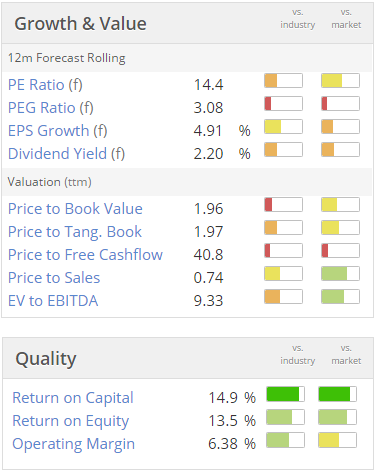
My opinion - I reported here on 26 Nov 2015 when Lathams released its interim results. My conclusion at the time was that the forecasts for 44p EPS this full year looked light, and that 47-50p EPS would be my personal estimate, based on strong interims & reasonable outlook statement back then.I'm sticking with that view, which is reinforced by today's update.
This is a well-run company, with very sound finances, that looks priced sensibly. It's cyclical, but I don't see housebuilding, on which it heavily relies, slowing down any time soon - do you? We clearly need so much more housing in the South, that I imagine production is probably going to be increasing, if anything.
So there could be another leg up in Latham's share price building up, perhaps? It looks quite tempting to me at the current price, but bear in mind that it's a tricky share to trade, as so tightly held. The 2% divi yield looks surprisingly mean - the company could easily afford to pay out much more.
Hornby (LON:HRN)
Share price: 30.5p (up 7.1% today)
No. shares: 55.0m
Market cap: £16.8m
Update on banking covenants & trading - Barclays has given the company a bit more time to sort itself out;
The Group announced on 10 February 2016, that the Directors considered there to be a risk that the Group would breach the covenants of its banking facility in March 2016. The Group is engaged in constructive dialogue with Barclays Bank plc and is pleased to announce that the Bank has agreed to waive the March covenant tests.
That's clearly good news in the short term, and the shares have rallied a bit in response. However, the fundamental problem remains that Hornby needs to do another equity fundraising, to steady the ship. There's been quite a long delay now since this became apparent, which looks worrying to me - perhaps Institutions are baulking at putting in more funding?
I suspect the next equity fundraising could be at a deep discount. Look at what happened in similar circumstances at Stanley Gibbons (LON:SGI) recently. Therefore anyone buying the shares now could end up being a lamb to the slaughter, diluted heavily in the next Placing.
Current trading - this seems to be stabilising, which is encouraging;
The Group confirms that recent trading remains in line with expectations. Sales for the second half of the year to date*, have been down 2% year on year, within which the UK business has been up 4% year on year.
Whilst it seems that things are not getting any worse, do bear in mind that expectations are currently for a heavy loss for y/e 31 Mar 2016. The company guided previously to a range of -£5.5 to -£6.0m losses for this year. I reported in detail here on 10 Feb 2016.
My opinion - Hornby's balance sheet doesn't look bad at the net assets level, but the trouble is that it chock-full of inventories. So I suspect the restructuring will have to involve a big write-down of slow-moving stock. If the company does a big de-stocking, then it might be able to get by without an equity fundraising perhaps, or just a small one? That would be the ideal scenario for existing shareholders.
At the moment, this share is really only for gamblers, as we don't know how events will pan out. Clearly, breaching banking covenants, and relying on the goodwill of the bank manager, is a precarious position to be in. The bank manager will almost certainly be applying considerable pressure for the company to raise some fresh equity, to reduce his own risk.
I think this situation should be salvageable, but it's anybody's guess what level institutions might squeeze the company down to, if another fundraising is required. At some point it might be a good turnaround share, but my feeling is that it's far too high risk to get involved in at the moment. I'd rather wait for a fundraising to be completed.
Bonmarche Holdings (LON:BON)
Share price: 181.5p (up 0.8% today)
No. shares: 50.0m
Market cap: £90.8m
(at the time of writing, I hold a long position in this share)
CEO appointed - you might recall that shares in this value, niche retailer plummeted on a profit warning, and the CEO who had impressed institutions at the time of the IPO then decided to leave. Not good.
As I reported here on 15 Jan 2016, I was very tempted to buy some shares in this, but given how bad stock market conditions back then were, I decided to defer that purchase, in the hope that it might be possible to get them a bit cheaper.
Well since then, stock market conditions have improved, the share price has remained solid, trading sideways, and today we have news of a new CEO being appointed. It looks quite a good appointment to me, someone with highly relevant experience;
The Board of Bonmarché is pleased to announce the appointment of Helen Connolly as the Company's new Chief Executive Officer. Helen will take up her position later in the year and a further announcement will be made at the relevant time.
Helen is currently Senior Buying Director for George at ASDA, where she is responsible for all women's clothing, non-clothing and male and female essentials. Previously, she was Category Director for Buying and Design, and Buying Manager of Womenswear at George at ASDA. She was formerly Head of Sourcing for Womenswear and Girlswear from China, Thailand, India and Sri Lanka at Next plc and has also worked within Arcadia Group as Head of Buying at Dorothy Perkins.
Helen brings significant relevant experience from the value retail sector, with particular expertise in women's apparel, which is Bonmarché's core market.
Whilst I can't comment on the individual concerned, as I don't know her, or know of her (yet), but her experience seems a perfect fit. In my view the best small to medium retailer CEOs are ones who understand the product, and the supply chain, inside out.
For this reason, and the shares looking good value, I've dipped my toe in, with a small, entry-level sized long position this morning. I'll then keep an eye on it, and see how things progress, and either add to the position later this year, or chuck it out, depending on how things develop.
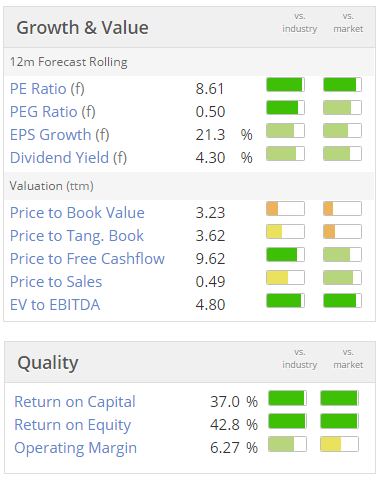
Based on current forecasts, it looks good value. All the more so because it has a good balance sheet, with plenty of cash. The risk though is that, having lost its previous CEO after a profit warning, there might be further problems yet to come? So it's a tentative buy from me. Position sizing is so important - so that when losses do occur, they're relatively small. I only really load up into big positions if I'm super-confident about the company performing well.
Tasty (LON:TAST)
Share price: 165.5p (up 2.2% today)
No. shares: 53.2m
Market cap: £88.0m
Results, 52 wks ending 27 Dec 2015 - as an aside, some retailers like to prepare their management accounts on a 4 or 5 week basis throughout the year, and then report the year as a 52 week period. Imy FD days, I tried that for a while, but it didn't work out well. The problem is that comparatives become difficult during the year, as you often end up trying to compare a 4 week period with a 5 week prior year period, or vice versa, which renders comparisons largely meaningless. Also, the full year accounts are skewed every few years by having to do a 53 week year. Monthly, and annual accounting, is far better in my experience.
Tasty currently operates 43 "Wildwood" and 7 "Dim t" restaurants, and is a straightforward roll-out - i.e. its using its cashflows, and bank debt, to expand the number of sites. What is interesting is that the people behind this chain are very experienced, having set up several very successful chains in the past, the Kaye family. So they know what they're doing. Therefore it is tempting to buy some of these shares, and tuck them away for 5 years, whereupon you'll almost certainly make a profit, based on management track record.
Revenue rose 20.4% to £35.8m
Adjusted operating profit rose 27.9% to £4.0m, driven by new site openings - that's a good enough profit margin, at 11.2% to confirm that the format works, and is worth rolling-out
Profit before tax is £3.1m (2014: £2.6m) - this is a more conservative measure of profit, as it is stated after £644k of pre-opening costs (for new sites), £133k share based payments, and £116k finance costs.
Diluted basic EPS is 4.58p. Although note that this is stated after only allowing for 697k share options, whereas there are 4,164k in the money options in total, but some may not yet have vested. Also there is further dilution from 500k A shares, and 600k B shares, which look like further management bonuses from what I can gather. So check this area carefully!
Valuation looks very expensive - it's currently on 36 times EPS. However, it's a roll-out, so it will be expensive during the growth phase.
Capex is heavy, due to the fit-out costs for new sites.
Operating cashflow is very good, so it's worth noting this, especially as the depreciation charge is becoming quite considerable - so once you strip that out, the existing sites are throwing off plenty of cashflow to finance new site openings - a virtuous circle.
Debt has risen significantly, but is not a problem due to the cash generation.
Has the restaurant sector reached excess capacity? There have been so many new restaurants open in recent years, that is a key question I think.
Director remuneration - this is an interesting point. Total Director pay at Tasty is low by listed company standards - the whole Board cost £404k in 2015. I'd say that's at least £300k (perhaps more) below what might be considered normal for this size of company. This has the effect of boosting profits by about 10%. That's worth considering, as it effectively puts about £8m onto the value of the company.
The Directors are also major shareholders, so I suspect they've twigged that they can create far more overall value for themselves by restraining their remuneration, thereby boosting profits, and having the company valued on a very high multiple of profits (because it's a roll-out), this has a material positive benefit to their overall wealth. It also means less dilution should they need to raise more equity. Smart thinking!
Although as investors, we really should normalise Director remuneration, before we compare valuations of companies. Normalising remuneration here would take the shares up to a PER of about 40. Pretty toppy!
My opinion - it's tempting, but the price is too rich for me, especially after all the share options, A, and B share potential dilution is taken into account, and once you've reduced profits to reflect normalised Director pay.
Have any readers eaten at the main Wildwood format restaurants? What did you think? I've found that Kaye family offerings tend to be very much me-too in terms of the menu. So basically a carbon copy of Pizza Express, with a few tweaks.
Looking at Wildwood's menu online, it seems to be following fairly closely to the standard Kaye format - lots of pizza & pasta options, which of course are very high margin. All a bit unimaginative.
IMImobile (LON:IMO)
Share price: 148p (down 1.0% today)
No. shares: 59.4m
Market cap: £87.9m
Trading update - there's an upbeat-sounding update from this software group today. The upshot is that they're trading in line, but lots of positive Directorspeak.
Key points today;

It's not the easiest thing to value. Very interesting company & terrific management.
I've run out of time today unfortunately, will have to leave it there.
Regards, Paul.
(usual disclaimers apply)
Disclaimer
This is not financial advice. Our content is intended to be used and must be used for information and education purposes only. Please read our disclaimer and terms and conditions to understand our obligations.

30 comments
Then again, maybe not. Bonmarche Holdings (LON:BON) Shares down 20% in early trade!
Bonmarche Holdings (LON:BON) trading update RNS just posted with a bit of tweaking to the NEDs.
http://www.investegate.co.uk/bonmarche-holdings--bon-/rns/trading-statement-and-board-changes/201604080700065671U/
LFL sales are slightly ahead but indicating PBT will be at lower end of the revised (downwards) forecast range given in December (£10.5 to 12m I recall). Current trading OK but still bemoaning "the wrong sort of weather" and pretty downbeat view on consumer confidence. Following recent appointment of new CEO and apparent stabilisation of business might be scope for clawing back the 30%+ sell off after December 15 profit warning although may still be an overhang from the original IPO investors following the ex-CEO out of the door.
Hopefully Paul can comment later.
Best,
Gus.
I made a decision quite a while ago to avoid investments with a heavy BTL component, and not to do it myself either. Seemed to me that it had got too big and, at best, margins would come under pressure and risks would rise. And at worst that lenders and the government would target it. Latter seems to have started. House prices usually defy gravity but it's not a sector I want to get further into atm.
Paul,
My understanding is that XLMedia (LON:XLM) has created software and protocols which direct (mug) internet punters to particular gambling websites in return for a cut of the house winnings. Online gambling companies need ongoing new customers for their survival and growth, so XL have an important role in what is admittedly a grubby, but lucrative sector. Its not really surprising that XL don't want to spell out how they do things, for fear of attracting additional competitors. I personnally view this as a trading opportunity rather than a long term hold. Ian
I've had the chance to read the PRA's condoc now. They estimate that this will affect 10-20% of BTL mortgages. I don't know the % of rental flats bought with a BTL mortgage as opposed to for cash but will guess at 75% (although in my network it's more like 25%). So this will take 7.5 - 15% of new money out of the market.
The banks will still want to lend though so will drop their fees and rates and attract a slightly better funded applicant (with lower LTV) who can pass the new tests so the actually impact will be watered down to probably 5% or so.
It's pissing in the wind I'm afraid. I support the move - anything that reduces risk on debt has to be a good thing but it ain't going to take the heat out of the market any more than the 3% tax did.
I find it is generally better to actually read documents before speculating on what they may or may not contain.
I've read the PRA proposals. I'm not a banker, however I am interested Aldermore and/or Paragon as potential shorts at some point in the future as the various BTL changes start to bite.
Assuming these proposals come in pretty much as is, it looks to me as though any new BTL lending will be demanding either a yield before cost in double figures or something like a 50% deposit from the borrower.
There are exemptions for existing borrowers, however those exemptions only apply as long as the amount borrowed will be no more than existing borrowings.
That will kill one of the most popular BTL models stone dead. Buy a house with a 25% deposit. Wait. Re-mortgage using the rise in price using the extra borrowing for a 25% deposit (spending most of your potential CGT liability at the same time) on another place. Most of the recent changes (Clause 24, 3% extra stamp duty, PRA proposals) specifically target this model. Clause 24, for example, is business as usual for LL who have bought with cash. It is only the highly leveraged who are targeted by Clause 24.
So the question is, just how many BTLers have seen their business model completely destroyed? I'm not sure the data available is that great. However we do know that around 60,000 people are sufficiently concerned that they've signed an online petition against the changes. OK, some of those might be family and friends of over leveraged BTLers, but equally how many don't understand Clause 24 or don't know about the petition? It's hard to say exactly, but it does look like quite a significant number of potential buyers are going to be removed from the market.
It would be hard for the 3% extra stamp duty on purchases to take the heat out of the market. It doesn't start being applied until tomorrow. If it's done anything so far it's been to bring demand forward. Let's see what happens in the months ahead.
My best guess from now is a few months of stagnation as the market dries up completely. Estate Agents, who need sales to survive, encourage motivated sellers to drop prices. The indexes start to show falling prices and people who've been expecting capital gains and not bothered about yield begin to think about selling. 2017 starts to see meaty price falls as Clause 24 starts to loom large.
It's so hard to work out how this is going to unwind.
There are lots of hotspots as has been identified where demand will remain high (university towns, young professionals etc. etc.) and in these places, as and when new properties are built or come on the market they get snapped up by investors. A lot of those investors are buying with cash to augment their income in the absence of meaningful investment income from elsewhere. Some are old-hand BTL investors who have paid down their existing BTL mortgages from 15 years ago (more in this category than you might think and some of them at scale too) and are looking for something to do with the money that's accumulating (I know one personally who buys a new flat every 2 months using his property portfolio income alone) or boomers who have downsized and have more than a few hundred k to derive some income from. Again, there are a considerable number of these around too. So, if the cost of borrowing does rise and force some landlords out, there will be a willing set of buyers who aren't struggling with interest payments. The third factor is foreign money looking for a safe haven. The view from these people is that rental property in the right places in the UK is a great place to store money and derive some income from it. Again, not taking on debt, just a load of money looking for income and thinking long term. I know an Indian guy who is buying rental properties regularly (he must have 15 - 20 2/3 bed flats in and around Guildford town centre so he's not poor) for cash for his grandchildren's futures. He is in his 30's....
On the flipside, there are also areas that aren't hotspots where the demand is less consistently strong and maybe if interest rates rise and rental demand dries up a bit and the banks get a bit stricter about affordability there might be sudden and sharp price drops. But it will be localised. Let's be realistic about this. Is the % of new BTL mortgages currently taken out that would be affected by the tighter rules actually significant? I'm not sure it is.
And what of all that pent up demand? All those kids in their 30's living with their parents.. They'll snap up flats at the slightest hint of a price drop as well.
Perhaps a sustained period of high interest rates might deter new money and tempt people who have flats to switch out of property into a different asset class but given the hassle, I'm not sure it will though.
Don't get me wrong, I'm not saying this won't unwind somehow, but BTL isn't the same as the subprime debacle. There might be the odd nutter out there who is overleveraged and will struggle with higher interest rates but unlike subprime, there are plenty more who will be happy to step in and pick up the pieces, with cash.
I've eaten at the Wildwood restaurant in Covent Garden. Their restaurants, London ones anyway, are quite smart looking and that branch has quite a novel downstairs seating area in the form of theatre-style seats. However, I cannot remember if I liked the food or not and I have never been back there so that's probably not a great sign! As you say, there are tonnes of pizza and pasta places already. Their USP seems to be that they do burgers alongside pizza and their restaurants are a bit smarter than some of their rivals.
In London there is growing popularity for restaurants that focus on only a small number of dishes and do them really well. Like Honest Burger or Franco Manca. As these chains grow I think they will eat into (sorry!) the profits of these "we do everything" chains.
Hi Paul
Re: Tasty
Has the restaurant sector reached excess capacity?
It will be interesting to see the impact of the living wage on the operating costs on the menus in the sector versus the 'expected' increase in sales from people having more free cash . Maybe there will be a move towards takeaways?. I've seen some fairly aggressive mark ups from service charges being applied in some outlets in anticipation of the living wage. Any thoughts?
A few weeks ago the FT magazine run an article claiming a large number of curry houses were shutting down, as all the customers were going to Nandos and other chain restaurants.
Think they reported the number of curry houses in Stevenage had shrank from 28 to 17 or, something like that. If that is extrapolated nationally, well I see how the restaurant chains can survive.
I made a modest top up to my holding of Tasty this morning, although at 1.2% of the portfolio, this is hardly conviction.
Hi Paul
I dont know whether it is within your area of interest but XLM reported today. The results are very good. they are even better than the Tradin Update in Nov prior to the end of year end December. I would be interested if you have anything to add on what I think is a very good company, but the SP is not demonstrating this. Perhaps the so called Strategic Review announced earlier in the year is putting people off, though the CEO did go a long way to say what the strategy is and how it is being achieved in the Finals today. I guess the aspects of the strategic review whiuch are up for grabs are even bigger than that - merge, sell, take private etc and that could be concerning. I dont know whether you regard this as a foreign company and which you would view with some suspicion - Jersey based, Israeli management with a lot of their market penetration outside the UK (though this balance is changing, and the rest is principally in other 'respectable' parts of Europe - ie Scandinavia. Your thoughts please?
A Channel Island registered, Israeli company, traded on AIM, which generates traffic for online gaming sites doesn't really sound like Paul's thing. And the prospect of major changes from a strategic review doesn't help unless you know and trust the directors. And the last 4 major holdings announcements have been reductions - Investec, River and Mercantile, Hargreave Hale, Inflection Point.
I agree that the numbers look good and the cash generation seems huge, but didn't see any hints about the Strategic Review. Majority of shares not in public hands - 2, presumably Israeli, partnerships have over 50%; unsurprising with a recent IPO, but presume that their dissatisfaction with share price progress was cause of Strategic Review. I doubt if the outcome will be to their disadvantage.
Also seems unusual to have announced and paid the final dividend before the results are out.
Paul has commented on XLMedia (LON:XLM) in the past and yes concern about non EU management, but the risk/reward numbers look very good to me. Leon Boros has met and was very impressed with smart management which is an added bonus. Ian
I don't like XLMedia (LON:XLM)
The starting point for any investment has to be an understanding of where their profits come from. XLM has obscured this. That tells me, that it's probably something which is not sustainable.
Therefore, it's not an investment which would interest me.
Regards, Paul.
Thanks for that Paul. Disappointed in the absence of your very valuable detailed analysis which breaks down balance sheets and especially the difference between EBITDA and clean earnings. This is such a valuable aspect of what you do and why I and my friends are so appreciative of your insight and analytical skills which help us all invest more competently, even in grubby areas - and there are plenty of those!
Hi xcity
Thanks for that. Not a long way from where I come from. I wasn’t aware of the reduced shareholdings of the major institutions you quoted. When did they take place if you have that information to hand?
As for Paul, he has commented on several occasions in the past and usually does with XLM, but not this time for some reason. I thought these results would have led to a comment of more of the same from his point of view, or that XLM is starting to behave more openly and deserves credit for it.
For example, a presentation given by their CEO recently seems to have been well received from PIs attending according to the bulletin boards I cover. Also, although the strategic review is ongoing, the CEO in the finals clearly stated what the strategy for the company is and that it is being consistently and successfully pursued.
So yes, I would have expected a comment from Paul, on past experience and the results. I would have welcomed his very searching approach to the balance sheet and to the detailed analysis of the links between ERITDA and diluted earnings which he does so well…..and yes, I would have thought that this is one of the companies he normally covers.
AFAICS, in the finals the CEO was talking about successful implementation of the business strategy but made no reference at all to the Strategic Review (sell, merge, etc). The original statement about the strategic review (ie about the failure of SP to reflect successful earnings figures) suggests to me that the underlying issue is the major holders wanting to get money out, and it is not at all clear what precise options are being considered (it seemed to be an invitation for people/companies to approach them) or where it will end up. Everything seems very positive if you trust the management and directors and the PIs who attended the presentation may feel they are able to do that. A longer track record would also help.
The reductions in major shareholdings are all in the RNS. Nothing major but, given how well the company appears to be going and how relatively cheap it looks, I would have expected them to be holding on if they were confident. It is 4 of the 5 significant shareholders mentioned on their website.
So there is no shortage of residential property in the UK ..? Fascinating !
Correct. See data on table 615: https://www.gov.uk/government/statistical-data-sets/live-tables-on-dwelling-stock-including-vacants
610,123 vacant dwellings in England as at 6th October 2014. 205,821 long term vacant.
Much greater than the number of people who are classified as homeless which is around 50,000 and far, far greater than the number who actually sleep on the streets, estimated to average around 500 every night across England.
Paul
re Bon, are you not a teeny weeny bit worried about that massive stock overhang? Is the Sun Cap 51% share not going to put a lid on performance until it is gone?
Paul thanks for the Richard Crow transcript, my hearing is ok but I do find that looking at it on the page far easier than listening to it on audio. Its also far easier to find certain companies and see which companies are covered, this is especially useful if you want to find something months afterwards. Maybe those companies could be linked to the Stockopedia discussion search? It would make searches so much easier in the future.
Interesting what you say about slow moving stock on Hornby Paul. I have a son who loves scalextric but whenever they have offers on they never have any stock. Normal priced items are just way over priced. Shame for such a good brand name.
Paul, thanks for James Latham (LON:LTHM) review, re construction I'm not so sure, construction has already slowed down in the last year, maybe that was due to the election? Post election I would have thought it would have taken off but it has not. Prices in some areas, such as London are looking high, too high? There is a rush to best the BLT deadline but after next week not sure what will happen. Last recession housebuilders et al were badly hit, think we are near the top of the cycle.
There is no shortage of housing. Only excess speculative demand.
Hi Underscored,
I think it depends what areas your are talking about.
Certainly where I live (London, and Hove), there is a chronic lack of overall housing supply. People are being forced into tiny homes (often sub-divided flats, made into even smaller flats) because prices are so high. I'm talking here mainly about lettings actually. Private lettings happen almost same-day in Brighton/Hove. You have to agree to take the flat there & then, at the viewing, or it goes to the next person waiting outside to view.
Buy-to-let landlords are taking advantage of very high demand for rentals, and high rents, by hoovering up a lot of the supply of flats for sale.
That leaves privately-owned housing only for the elderly (who bought when prices were cheap, decades ago), people in highly paid jobs, and those who get assistance from family members to stump up a large deposit.
I agree though that ultra-low interest rates are driving up prices, as mortgages are so cheap now. However, I'm looking at overall housing supply/demand (including rentals), and in the South there are many places where there's a really chronic shortage.
Regards, Paul.
Buy to let (borrow) to let are causing increase in rentals by out bidding owner occupiers with poorly under written interest only loans. We know how that ended last time and if you take the time to read what the Bank of England published yesterday, moral hazard has come home to roast in British lenders. Between the chancellor and the boe btl has been killed stone dead. Will post data, numbers and links if I have any energy after work.
Absolutely 100% on the button.
Clause 24. 3% Stamp Duty. Reduction in Capital Gains Tax for everything except residential property. Now the Prudential Regulation Authority are going to force banks to ensure the Borrow to Letters can actually afford what they want to borrow. The mood music is clear. Buy to let is in the sights of the Government and it's bank.
It's not the only problem of course. There is plenty of empty property in London where overseas investors are using London property as a laundromat or attempting to time the UK property bubble. Meanwhile workers in the UK pack themselves like sardines onto trains and travel for hours each day to and from London. Or worse we take money from those poor saps on the trains and give it to people via Landlord benefit so that others can live in London not working.
There are lots of problems with UK property, but a shortage of property isn't one of them.
Surely most overseas speculators have a tenant in their laudromat, it's free money for them, and reduces the risk of having to deal with squatters.
Table 615 here shows 20k vacant dwellings in London which is nothing to write home about, and steadily declining.
Hi Paul,

Thank you for taking the time to reply. I am very familiar with both Hove and Central London, and am now living just outside of Cambridge. Along with Oxford these are hotspots where housing is being sub divided, HMO’s beds in sheds etc.
I don’t think that the entire market can be condensed either into a homogenised single entity, or have a single factor driving it.
However, I think the data are very clear. Credit and access to it are driving the housing market. The more that people can borrow, the more that prices go up, stimulating further demand, stimulating extra borrowing, in the anticipation of future increase in borrowing. Classic speculative bubble stuff.
Furthermore as per the English Housing Survey 2014-2015 (https://www.gov.uk/government/uploads/system/uploads/attachment_data/file/501065/EHS_Headline_report_2014-15.pdf):
• Rates of overcrowding remained low but under-occupation increased, driven by an increase in the proportion of under-occupied homes in the owner occupied sector
• While social rents increased between 2013-14 and 2014-15, private rents remained stable. Although this was not the case in London.
These two points are not consistent with a shortage of housing. Indeed there is an additional factor at work as illustrated in Figure 1.1 and Figure 1.3. The displacement of owner occupiers with private renters. Primarily amongst the young (without prior bubble equity), and here from the BOE Financial Stability Report 2015:
This is interesting, because clearly 4/5 private renters (less the 18% receiving housing benefit) can pay the rent, but their salaries cannot stretch to meet the mortgage affordability that the BTL borrower can (see mortgage market review).
The BOE provides us with an explanation into how BTL borrowing is achieving that feat. http://www.bankofengland.co.uk/pra/Documents/publications/cp/2016/cp1116.pdf
SUBPRIME LENDING. Interest only mortgages, with no repayment plan other than the sale of the property itself, where no assessment has been made of the borrower’s ability to afford the loan, especially in changing circumstances (eg rates).
2.5 When assessing the minimum ICR threshold, consideration should be given to the following costs where the borrower is responsible for payment: management and letting fees, council tax, service charge, insurance, repairs, voids, utilities, gas and electrical certificates, licence fee, ground rent and any other costs associated with renting out the property.
2.6 The PRA also expects firms to take into account any tax liability that is associated with the property. For the avoidance of doubt, this should include the tax changes announced by HM Government in the Summer Budget 2015 with respect to mortgage interest tax relief.
Currently this does not seem to have been previously included.
I am out of steam after a long day, but I think this is the gist of my argument.
Although I can't resist linking this, where the house building industry met the speculative "demand" with actual real world supply... https://www.youtube.com/watch?v=ccJp6C1xdZ8&feature=youtu.be
Paul - thanks for the transcript of your interview with Richard. It's much appreciated.