Small Cap Value Report (30 Oct) - THAL, ABM, UTW, QRT

Good morning! The American markets hit all-time highs last night, and with the S&P500 now up almost 27% since late Dec 2012, this is all starting to feel a bit crazy. Therefore I'm preparing myself for a sharp correction, which must be due at some point, and the stocks that will be hit hardest will be the over-priced growth/story stocks where price has detached from value.
We've seen with Globo (LON:GBO) how flaky these things are - yes it was subjected to a bear raid from Evil Knievil & others, but it seems that few investors had much conviction in the valuation, as they stampeded for the exit once it began falling, thus doing the job of the shorters for them. Whereas with the relatively safe, solid Value/GARP shares that I focus on, when they fall sharply, investors like me just buy more, as we know our research is correct, and that falls are buying opportunities. So the Bulletin Board maniacs hurling abuse at shorters should be questioning their own skill and actions, as well as the scare tactics of the shorters.
Also, as a long term investor, I am perfectly comfortable with the fact that every now and again my portfolio will take a (say) 10% hit on a market correction. It's not a problem, as my long term portfolio is not geared, indeed has surplus cash on the sidelines, waiting to buy the dips. Small caps can provide fabulous buying opportunities in a market correction - it only takes one clumsy seller, and you can see a small cap down 20-30% for no fundamental reason. If it's a good solid company, at an attractive price, then that's an opportunity, not something to worry about.
I also run a more racy, geared personal portfolio with generally shorter timeframes, and I'm increasingly worried about that, so have bought some insurance with S&P500 Put Options, and am easing back on a few position sizes, to ensure the gearing is not too high. What is too high? Personally I've found that 1.5 to 2 times equity is normally OK (other than in a proper bear market, where no gearing is the only safe option), if it's spread over plenty of different stocks, and they are all safe, solid companies, usually dividend paying & with net cash. Given how frothy the market is now though, I'll be de-gearing to the lower end of that range in the coming days & weeks.
Everyone I talk to is worried about the market being too frothy (most of my network are High Net Worth, savvy investors who've been doing this for a while), but most also see the opportunity - that we're in the most buoyant stage of a bull market, nobody knows when it will end, but there is fabulous money to be made, providing you get out before it all goes wrong & don't believe the hype.
Thank you to the member here who posted this fantastic chart of market sentiment:
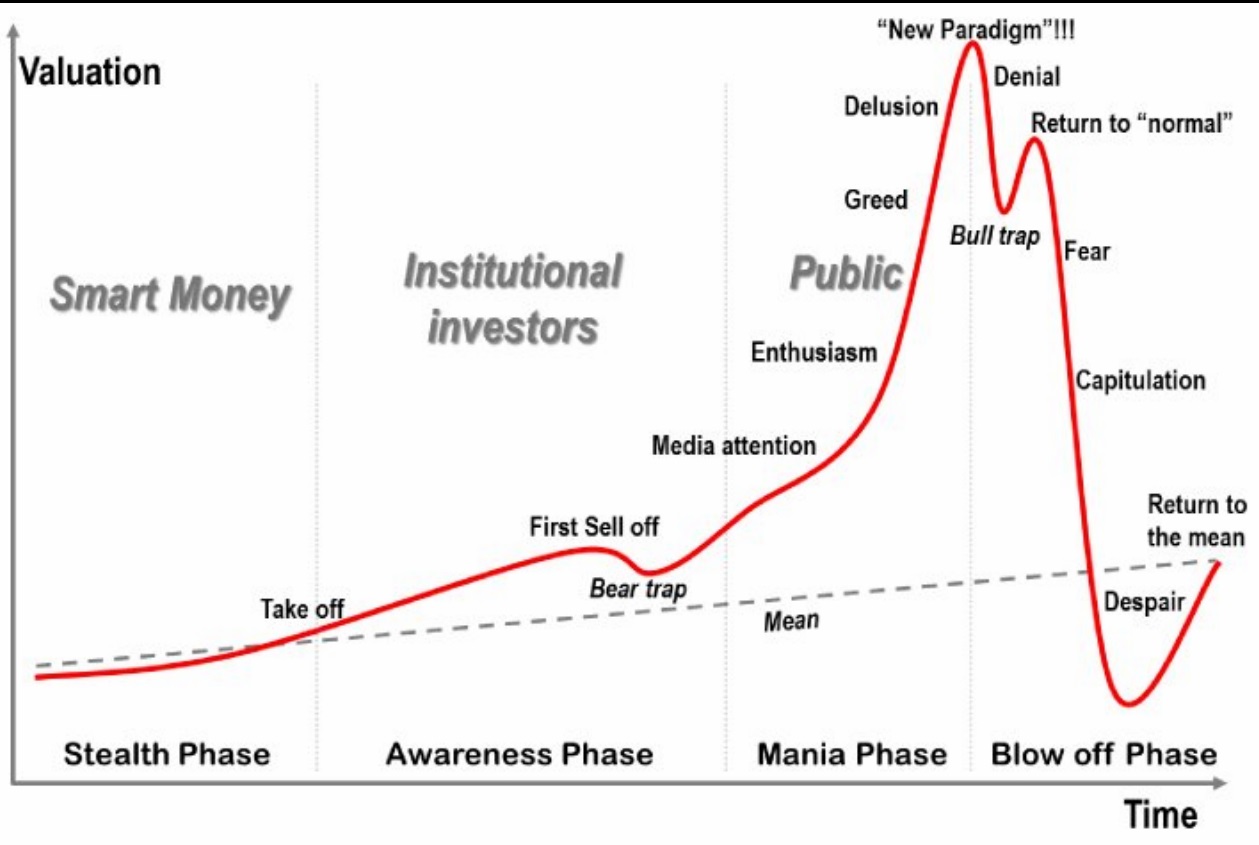
I've seen it before, but good to have a reminder, and I've set this picture as my desktop background, to remind myself every day of the time-honoured market cycle. The key question being, where are we now? I think we are already in the "Mania Phase", but possibly somewhere between the "Media attention" to "Enthusiasm" stage. Nobody in real life has given me any share tips (a classic sign of a market top). My personal litmus test is that when kebab shop owners want to swap share tips with me, that's when we're at the top of the market.
Thinking back to 1998-2000, the bull market went on far longer than anyone thought it would, to a point where anyone who wasn't putting money into crazily over-priced tech stocks was considered a fool. This wasn't just private investors, it was Institutions too remember, the whole market collectively took leave of its senses for a couple of years, I remember it well.
So overall my market view is that we are now in the later stages of a bull market, which could go on for a year or two longer, and get considerably more frothy as new retail investors join in the fun. Story stocks will do best (in the short term), so I'm beginning to position myself partially into some more racy growth companies, but only if the valuation is still reasonable, and the potential is real - so zero turnover companies don't interest me, neither do heavily loss-making story stocks. However, companies where growth is taking off, losses are small (or it's moved into profit), and the potential market is large, are where the best potential gains are in this type of market.
In terms of price, I'm prepared to pay a bit more than usual, but not go crazy. So the sub-£30m market cap level is where I'm looking hardest for good growth stories. That's where the multi-baggers of next year are probably sitting currently, as they are off the radar. Once these shares are picked up by the press, tipsheets, etc, and naive novice investors (who come into the market in droves at this stage of a bull market - that was where I began in 1998!) begin hoovering up the shares, the gains can be spectacular. Then top-slicing into strength both locks in the gains, and recycles the money for the next one. Repeat until the bubble bursts, then get the hell out of them all, and into cash, ASAP. The challenge will be seeing if I can pull it off this time & not get caught up in all the hype that fooled me in 1998-2000 as a naive novice investor!
Thalassa Hldg (LON:THAL) has announced a relatively large Placing. Its market cap is about £45m, yet they have today announced a Placing of £18.1m, which is to issue 7.24m new shares (there are about 16.36m currently in issue). I think that's wrong. Existing shareholders should not be diluted to that extent - this is a 44% increase in the number of shares, so they should have done it properly through a Placing & Open Offer, so that existing holders could also take part.
Having said that, the 250p Placing price is not far below the 266p market price, but it's still annoying for smaller shareholders that they have to pay up 266p in the market to buy more shares, when Institutions are getting in at a 6% discount.
The growth potential must be pretty convincing though, for WH Ireland to have successfully done such a relatively large Placing at a modest discount. I wonder why Thalassa needed to raise so much cash? The statement today doesn't say what it's going to be used for. They do seismic data, so perhaps it's for a new ship? Would have been helpful to give more detail in the announcement I think.
Albemarle & Bond Holdings (LON:ABM) has successfully gained more time from their Bank, as reported in a financing & trading update this morning. On reflection, I think this situation has overall been a colossal cock-up. It's the job of management to anticipate the level of funding any business requires, and put the necessary equity and debt facilities in place in advance, with the necessary headroom to be flexible. So this company running headlong into a funding crisis that should have been prevented, just strikes me as poor management. On the other hand, how many good managers would actually want to work for a pawnbroker? I wouldn't, would you?
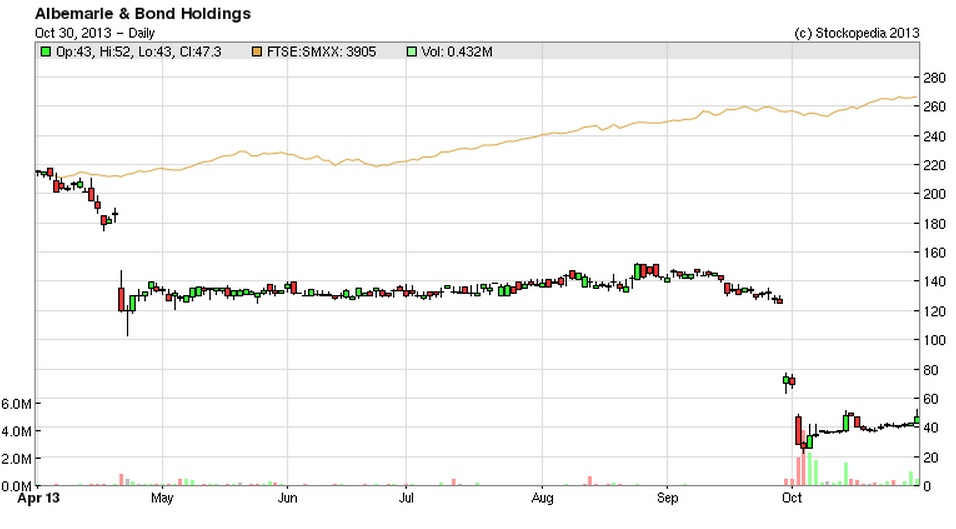
The shares have bounced 18% this morning to 50p on news that the Bank are extending the date for deferring testing of covenants to 3 Feb 2014. One imagines that should give ABM enough time to raise some equity, and agree a reduced bank facility. So I think it's unlikely they will go bust - mainly because their Balance Sheet has enough reasonably liquid assets (stock and the pledge book) to cover the Bank debt.
I had a quick trade on the initial bounce from 24p a little while ago, which worked very well, but this is not a share I'd want to hold for more than a couple of days, so am happy to be out now.
Just look at the destruction of shareholder value in the last six months:
Going back to my point about small caps out-performing, just take a look at the FTSE100 over the last 2 years, with the FTSE SMALL CAP INDEX XIT (FTSE:SMXX) plotted against it. As you can see below, if the FTSE100 had kept pace with small caps, then it would be about 9,400 now! So make no mistake, this has been a spectacular bull market for small caps in the last two years, and it's very difficult to see how the market overall can go much higher - it will now all be about stockpicking, rather than a rising tide lifting all boats, in my opinion.

Audited results for Utilitywise (LON:UTW) have been issued today, for the year ended 31 Jul 2013. This is rather unusual, in that the company issued preliminary results on 15 Oct 2013, which I reported on here. Some changes have been made, relating to revenue recognition, which has resulted in diluted EPS rising from 7.9p to 8.5p.
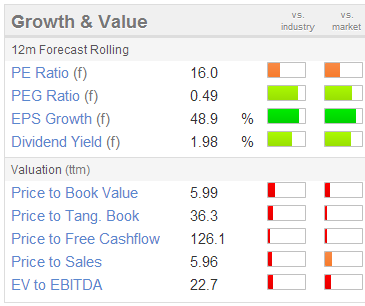
The shares have been on a remarkable streak upwards, and are now 214p. Sorry, but I just thnk that is too high, at a PER of 25 times. Sure there is more growth in the pipeline, but this is really not a very robust business model at all. It's entirely dependent on commissions from the utility companies, and that landscape could change at the drop of a hat, if the utlility companies decide to cut back on commissions paid for new business.
So I would say that the market is ignoring the potential risks here, and getting carried away with the growth, so it's not for me - risk/reward is not attractive at the current share price in my opinion.
Although I did spot the potential at 102.7p per shares, when I added it to Paul's Value Picks (my online notes of potentially interesting Value/GARP shares to research further) back in February 2013, so a nice 114% gain chalked up there.
Non-fiction publisher, Quarto Inc (LON:QRT) issues its Q3 IMS (Interim Management Statement). Operating profit is flat against last year at $9.5m for the nine months to 30 Sep 2013. However, almost a third of that is consumed with interest cost. A glance at the last Balance Sheet shows that this group has far too much debt, so it's not for me.
They present EBITDA of $24m for the nine months, which sparked my interest, but that looks a pretty meaningless figure, since it ignores the huge amortisation charge of pre-production costs. As usual, EBITDA just leads people up the garden path, so one needs to be very careful about putting any reliance on it.
If I was going to invest in a publisher, it wouldn't be Quarto, it would be Bloomsbury Publishing (LON:BMY), with their bulletproof Balance Sheet, and it's not expensive either, despite big recent rises.
Right I'm done! See you tomorrow morning as usual!
Regards, Paul.
(of the companies mentioned today, Paul has no long or short positions)
Disclaimer
This is not financial advice. Our content is intended to be used and must be used for information and education purposes only. Please read our disclaimer and terms and conditions to understand our obligations.

38 comments
Thanks Paul, I shall try harder, you are forgiven. I have just doubled up my holdings with GLOBO.
Lightningtiger
Am I glad that I am out of the insurance business. I learned a lot in the 14 years and all the rules & regulations that go with it. Having seen interest rates go up to 18% I think, people were handing back their house keys to their lender. They had had enough. I can remember a couple wanting a mortgage, more than was sensible amount. I was not prepared to do it for them. About 18months later a frantic telephone call from their parents. The couple had just 72 hours to come up with the money or be re possessed. There was a small child & in spite of 3 jobs, the money could not fund the mortgage. With only 72 hours left, it was impossible to do anything to help. Had I have known a bit earlier, he was on emergency tax because he had 3 jobs that extra tax prevented him from being able to fund the mortgage. If the emergency tax could have been sorted out earlier they would have just been able to cope.They lost their house through lack of knowledge.
Now mortgage money is cheap to borrow. The figures : £200K @ 5% say = 10K/year but at 18% = 36K/year.
Annuities now are at a really low level. The big problem is we are all living longer on pensions & there is not enough people working to fund them.
I just heard on the news tonight that about 3 trillion trades go through every day with currencies being traded. That sort of figure has its effect on one of my stocks Plus500 that I spotted from Stockopedia. We need to keep our eyes peeled to what is happening.
I am really looking forward to close of business tomorrow because since the end of September, the profit from my portfolio has really surprised me. All I am saying is %age increase in this month is in double digits, & the first digit is not a 1.
I still have not read up on all the lessons of Stockopedia yet either.
Cheers from Lightningtiger
Pls ignore my last reply, as the original post seems to have improved considerably, so I withdraw my objections!
Regards, Paul.
I am holding THAL . UTW is on my hit list, a definite buy from me. Good to here another TEP fan a happy bunny & still a buy from me.
Out of my 20 stocks 14 are in with one screen or another with Stockopedia.
Sorry to here Paul, you have bought SOCCO today, I wish you well, but Socco is not for me until it moves up like GLOBO has done, with a sharp correction because of it being overvalued. I am still holding GLOBO, in spite of a definite stop loss sell. This is of course a very risky thing to do, & I do not recommend it. However the previous trend was strongly up, so balancing the scales of growth way in excess of 100%, a setback of about -30% has to be taken into account. I am expecting it to come back with a short period of time. like DART group.
Same sort of thing, different company.
I guess it is all about confidence, what you are happy with. Consider the different sectors & overall which are good. OIL not for me thanks.
Cheers from Lightningtiger
Come on john,you can do better than that load of drivel. It was nice to meet you at theinvestor event recently, but that's a crap post. Try harder please. No offence, but I demand better standards here. let's keep the drivel on advfn.
Regards, paul.
Paul,
Gordon Brown and Sir David Tweedie are responsible for ruining what was great British asset; final salary defined benefit pension schemes. You can't blame companies for closing down these schemes when "mark to market" leads to so much volatility in the asset value of the pension scheme and normally hits rock bottom at a time that the sponsoring company's profits are at a cyclical low!
When I managed these schemes in the late 80's/early 90's we held typically 60% in UK equities. Nowadays I think it is around 10-15%. The only bullish thing about this is institutions don't have many UK equities left to sell and may start switching out of bonds and back into equities. This might just give this bull market more of a secular feel to it rather than just cyclical!
If you need no clearer signal that we are already well into bubble territory in certain spheres - I have just seen a business plan / prospectus from a crowd funding website, where a ssas/cloud accounting business, still loss making after 5 years, turning over under £500k (historic, though claiming now to be at £60k per month) is available to investors at a pre-money valuation of... £18 million.
And this is not the only crazy valuation I have seen on other crowd funding sites.
I really wonder if this could even be the next financial scandal. I'm all for separating the fool from his/her money but this is beginning to resemble a turkey shoot.
I am reducing exposure to the quoted arena, a blow off cannot be far away.
The horse may already have bolted before the barn door is shut, but in an effort to prevent future excesses in the crowdfunding area, the FCA last week issued a consultation paper on proposed changes in the loan-based and investment-based crowdfunding platform space.
http://www.fca.org.uk/news/cp13-13-regulatory-approach-to-crowdfunding
The proposals include introducing regulation to certain crowdfunding activities for the first time. New measures look similar to more conventional asset management firms with Retail clients, and include:
The rules will come into force in April 2014, with three years for firms to fully comply with the prudential requirements. There will still be scope for rogue firms to operate in this space but the new rules will considerably increase consumer protection, which is to be applauded.
SM
Sounds blindingly obvious, I know, but nothing will degrade one's long-term returns than attempting to time the market and no-one, as far as I know, has ever timed the market consciously and consistently.
The alternatives to timing the market are (1) to buy securities that are mis-priced no matter what the implied equity risk premium is attached to the broader market, or (2) to buy shares in good businesses with the intent of holding them for 10, 20 or 30 years.
You can always time the market. The trouble is that nobody ever has any cash at the bottom, or any sense at the top.
The flipside is having too much cash too early: Klarman et al have basically sat out the biggest rally in 10 years because they thought that equities were already overpriced last year. That, too, has a cost that's worth counting.
Perhaps it reflects my own biases but it seems to me that the truly outstanding investing records have been put up by those who, like Greenblatt's Gotham, ignored market sentiment altogether and just bought deeply discounted securities with definite near-term catalysts.
I figure that most of us are small enough investors that we should be able to find enough of those to constitute a portfolio. Market sentiment, interest rate policy, etc are , in my view, for the funds with hundreds of millions (or billions) in AUM to worry about.
For example and just to make my thoughts more concrete, in my own portfolio I have
(i) one net-net that's turning its inventory into cash which it will return to shareholders,
(ii) one pro-cyclical business that is exactly offset by a counter-cyclical business (and both of them have highly marketable & severable assets that are worth more than enterprise value)
(iii) three businesses that should be showing 20% to 30% FCF yields in 11 to 24 months time when the catalysts take hold
(iv) one forever stock
(v) 20% cash, just in case I find the perfect security
I don't think that it will make a blind bit of difference to the value of my portfolio whether the cost of equity is 7% or 11% .
There are certainly other ways to succeed in the market but this approach saves on from having to think about market sentiment.
The one way to put oneself at the mercy of the market is to buy a stock that one thinks should be trading at 15x instead of 10x. That's the game that most fund managers play and it rarely leads to a deliriously happy conclusion :)
Awesome discussion today...IMO best forum on the net for UK stocks...agree that pockets of value still exist (they always do) such as the small/mid-cap E&Ps mentioned above (quite like the look of HOIL myself).
Just a bit of fun but FTSE 100 since inception in January 1984 with trend line. I wouldn't give up on this bull market yet!
In all seriousness I prefer to worry about the stocks I hold, rather than the markets where timing is notoriously difficult.
Still quite a lot of stocks turning up on the "JR VGM" screen for me to look at in the next week or so!
Great conversation - as a relatively recent investor, it is interesting to read "seasoned" opinions on where the market is. Having done plenty of research, and then drip feeding into the markets, I think as long as you do your research thoroughly and invest a considerable % of your portfolio in long term positions with solid cash generating businesses, you will cover yourself regardless of the madness around you.
As an aside, as one of those who counts as a member of the "young generation", I resent the sweeping generalisation that we all just live for the moment and not think about the future!! It may be true for a lot of people but a significant minority DO care, and DO make provisions for the future.
Hi mrmodha,
You said;
"As an aside, as one of those who counts as a member of the "young generation", I resent the sweeping generalisation that we all just live for the moment and not think about the future!! It may be true for a lot of people but a significant minority DO care, and DO make provisions for the future."
Absolutely, but as you admit in your post, younger people such as yourself who are planning for & making provision for retirement are a minority. That was exactly my point - the broad mass of what might loosely be called the working class, are not making any provision for retirement at all, whilst only some of the middle class are.
That's going to be a massive problem in say 20-30 years' time, where most pensioners will need additional taxpayer support beyond the basic state pension.
I blame politicians from Gordon Brown onwards, along with the financial sector itself (which let's face it, is full of greedy, self-serving halfwits) who destroyed the public's confidence in pensions, and saving generally. So many people don't bother saving for the future, knowing that the State will have to support them when they retire into poverty.
Also, people have a mindset of believing that their home is their pension. That's fine whilst values remain at artificially high multiples of salary, but I believe mean reversion will happen at some point, and as we saw in 1998-1996, prices can dramatically plummet, and I can remember a lot of friends who bought property in the late 1980s being significantly underwater with negative equity, and working to the bone to make the mortgage payments to keep the roof over their head, which by that time was worth 30-50% less than their mortgage! It took a good 10 years for that to wash out of the system, and people today have forgotten.
If interest rates are forced up by a run on the pound (QE won't work forever), to a level of say 10%, then it will cripple millions of households. It's not difficult to imagine in those circumstances house prices falling by 50% generally, and considerably more in London. I'm not saying that is a likely scenario, but in the range of possibilities I'd say it's a 10-15% chance of happening in the next 5 years. In my view people generally are placing far too much certainty on inherently over-valued residential property, in the South at any rate. Those prices have to come down, substantially, when interest rates rise. And given that prices are set by the marginal transactions (only about 3% of the total housing stock changes hands each year), those prices can collapse if/when we get a tidal wave of Buy-To-Let landlords panic selling, as they see their capital value melting away. Marginal supply will shoot up, buyers will be scared off, and you have a recipe for disaster.
Current Govt policy towards the housing market is totally irresponsible, and a dangerous gamble in my view.
Regards, Paul.
I agree with you Cisk,
Rich Dad Poor Dad by Robert Kiyosaki changed many of my views on life and how best to save and invest. I wasn't as keen as him to get involved in property, but his advise to join a network marketing company for the education and income stream it would create was spot on. TEP has been a 10 bagger for me and is showing no signs of slowing down. Just goes to show, reading one book can completely change your life.
Pete
The quality of debate on Stockopedia is nothing short of fantastic - today's discussion probably the best I can remember. So long as we avoid mentioning our old friends Quindell and Globo of course! I don't know why anyone bothers with ADVFN any more - stupid people posting, and visually the page is a mess - looks liek something from 15 years ago (unlike the beautiful, web 3.0 design we have on Stocko!)
I really can't make up my mind. A number of holdings in my portfolio have now reached prices which I wouldn't even comtemplate paying for those stocks - so do I sell now and say thank you kindly to whoever will buy them at silly prices? Or, do i stick with them and hope that even sillier people want to get involved in the party, and push prices yet higher?
Not sure....but I certainly have an itchier 'sell' finger at the moment than I do 'buy'...
Great debate here today. One book that really changed my view was Rich Dad Poor Dad - and I wish I had read it 20 years ago. There's nothing earth-shattering in it, just a reminder to save as much as possible and don't think of things such as assets that actually cost money to own, such as your primary property. I'm in total agreement with you Paul about the spend-now-save-never generation. I'd thoroughly recommend it for those that haven't read it.
I've tried to position my investment themes around demand that will be relatively sustained - so personally I like aviation / aerospace, medical instruments / diagnostics and medical care.
Speaking of SOCO International (LON:SIA), one area which has been badly performing of late is the junior S&Ps - there are many bombed-out stocks there.
Anyone any views on whether the sector is a buy?
The Junior S&Ps is probably in the despair phase of the graph above! Which would suggest now is a good time to be buying....
History may not be a guide to what will happen in the current cycle. The bull market of the last couple of years has been driven by hyper-low interest rates and QE making equities attractive compared with cash and bonds. Market sentiment is being driven by news cycles around what might happen to interest rates. This seems to be quite a different set up from previous bull runs.
My feeling is that developed economies could be entering a phase of structural depdendence on low interest rates where any upwards movement in interest rates (or even just a hint) will start acting as a drag on economic growth, which seems likely to remain feable. So interest rates could stay very low for a very long time. It is not beyond the realms of possibility that this phase could last decades - Just look at Japan. If you buy into this scenario, equities are still pretty cheap.
There are plenty of dangers on the horizon though - a new housing bubble or financial crisis. These seem to be more likely drivers of the next stockmarket crash. But stockmarket mania? I just don't see it.
Big problem with Quercus QUPP is that its on the ISDX Mkt(Old Plus Mkt). Spreads are massive and you cant deal on-line. Apart from that if the company can turn the growth into profits this Xmas, then it makes BMY look very expensive.
Hi Guys, Fantastic conversation on here today - lots of food for thought! Paul - have you had a look at Quercus Publishing which seems to be good value? or am I missing something??? They are on a very low PE and have no debt. The stock rank is 82 and value rank 89. It's a very small market cap (£13m) and the business did extremely well from mid 2010 when they published the Stig Larson trilogy 'the Larson effect'! I would really appreciate some other views, opinions and analysis on this one from anyone who would like to contribute.
Many Thanks.
bsharman, Regarding QUPP. I nearly bought it in 2011 when the numbers were unbelievable. The F-Score was off the scale and it seemed to be beaming green from every angle that hits my buttons on the valuation and quality angles. Sometimes these things can be too good to be true, and my instinct was not to buy but wait as I wanted to see how the post-Larsson period went. The management is by all accounts terrific but taking a 1 author company to a multi-author company is a very difficult transition. The profitability metrics (ROCE/ ROE etc) have nose-dived in last couple of years and scanning the fin summary shows that they are getting low on cash. It seems they've paid out almost £3.5m in dividends the last couple of years... which has drawn down their cash resources considerably. On a TTM basis it looks like they were down to the last £310k but admittedly they have no gearing and £12m or so tied up in Working Capital.
I really haven't followed QUPP's story the last couple of years, and I imagine the prospects are v. v. based upon whether or not they've managed to invest in good pipeline. One thing that I would like to see is some buyers get behind the stock as evidence that the crowd can see things moving forwards. It's been 2 years with the price heading south which is never a good sign.
Paul, just wondering would you consider going into large / mega caps for the latter stage of a bull market, or is that just too boring for you? ;)
I've read some research that the largest companies tend to outperform towards the end of bull markets as the retail hordes get pulled in, and you can certainly see it with some periods (e.g. late 1990s). There's probably a self-reinforcing element to it, also. (E.g. Certain mid-caps become large caps, due to the mania phase!)
On the other hand that Allianz small cap research paper that was released last week suggested that for the past decade or so, small caps have only underperformed during bear markets. Though 10 years isn't very long.
Personally I've been offsetting some of my outrageous gains from small caps made over the past 1-2 years with some larger companies such as GSK and BP. In the mega-cap area you can stock pick some really cheap companies still, if you're able to look past / see differently their different well-publicised woes.
Hi Monevator,
You asked;
"Paul, just wondering would you consider going into large / mega caps for the latter stage of a bull market, or is that just too boring for you? ;)"
I would consider going into anything if the price is attractive! So if small caps get to a point where they are all ridiculously expensive, then I would naturally just move into cash - because I top-slice into rises, and sell completely when things look fully valued.
If there was obvious Value in large caps, then I'd be happy to use some of that cash to buy large caps.
Although what you tend to find is that, regardless of market conditions, there are usually pockets of value somewhere. E.g. I think the resources sector is coming alive again now, and is a natural home for speculative money in this type of market, so I'm very keen to find more good value opportunities there, given that it's been a pretty horrible bear market for about 2 years now for that sector - because so much junk Floated on the markets, that the golden goose of the previous decade was killed off.
One of the things I need to learn, is to have the temperament to be happy sitting in cash, if there isn't any value out there. That's difficult to do with one's personal portfolio, but it's a lot easier to do when you have to make decisions over a portfolio as part of a team.
Regards, Paul.
Good point about indiscriminate flotations - and it has certainly been a tough few years for the mining sector .....and for the oil sector too, despite the cash still rolling in for producers with oil prices at levels that were only materially exceeded for a brief pre-Lehmans period in mid-2008.
You'll forgive me for mentioning it ..... and I'm primarily doing it here because the stock concerned won't (I think) turn up on most screens due to data perception constraints (I think that is a polite way to put it.... ;-)).......but I should mention SOCO International (LON:SIA) , which recently paid out a 40p dividend to shareholders (so, with a share price of c.400p, you can work out the yield on that quite easily....). More importantly, they have clearly stated (in their interims) that they will be making annual payouts in future based on 50% of free cash flow. Based on current production, most analysts seem to think that will likely be a c.30p payout next year - so a prospective 7.5% yield.....but since that interims announcement they have confirmed a major increase to their assets/resources in Vietnam - and IMO that offers the potential prospect of a step change in production (by which I mean 50-70%)...and therefore cashflow.....over the next couple of years.
Furthermore, as you know, I think they are a prime candidate for a bid, with Vietnam exploration now virtually finished and production increases highly probable over the next year or two and with the executive management at retirement age. IMO it is a certainty that they will be bought out - but even if that doesn't happen as quickly as I might expect then shareholders are being paid well to wait. And I should also mention that the share price has been depressed in the last couple of weeks as various institutional investors have continued to be browbeaten into selling down by a mendacious, misguided and irrelevant PR campaign by the WWF concerning SOCO's assets in DRC (which are so tiny that they could frankly be thrown away without writing off more than 1% of assets). In other words, I see it as a decent entry point for a very strong story with big upside in prospect and downside well-protected by the payouts to shareholders (especially as many databases ignore them , and so the yield hounds who rely on screens have been buying Royal Mail as if it was going out of fashion whilst ignoring a company on double the yield). Much more on all this in the usual place though..... ;-)
All the best
ee
Hi EE,
OK - I give in. Have just bought some SOCO International (LON:SIA)
Cheers, Paul ;-)
It wasn't compulsory.... ;-)
All makes sense to me!
I think if you look towards the top of the size scale there are still apparently cheap to fair value companies around. E.g. BP, MRW or SBRY, GSK, maybe a RIO or BLT if you believe the economy isn't going to completely roll over (as opposed to the market just go through a wobble).
Nice yields and P/Es around 10 or less (way less in the case of BP, which is one of my favourite big caps although admittedly it has just had a bit of a spurt).
All the best!
What we really need is growth - I said a few times during the conference last week that one of my rules of thumb is how many stocks are qualifying for my favourite small cap stock screens. e.g. the Zulu Principle screen only has 7 stocks in it. A year ago it had 25. Unless EPS Growth catches up and brings the valuation (PEG) of a few stocks down a bit then that could be an omen that the market needs a pause.
FYI - The median forecast earnings growth for stocks with estimates is 15% in the UK (see the homepage). Brokers are notoriously over-optimistic of course. Maybe we need a range bound passage for that growth to come to fruition - it would certainly be welcome in my opinion.
Another great piece Paul. I couldn't agree more with your stance on the market.
We do have plans to build a market sentiment / timing module into the website which I think can help in some respects - though it's a very difficult thing to do well. I have a few rules of thumb I personally like to use across valuation, momentum, monetary and sentiment measures which maybe we should research further and publish as a checklist.
Clearly sentiment is getting ahead of itself which is usually a contrary indicator and valuation is above par, but monetary stimulus is being maintained while interest rates are still low compared to equity yields and the market still has good momentum. It's certainly delicately balanced. I could put some more thought into this, though whenever I try and predict where the market is going I normally get it wrong. As Lao Tzu once said - "those who have knowledge don’t predict and those who predict don’t have knowledge".
The only thing an investor can do is stick to his principles, maintain a set of buy and sell rules and trust in the process. Good outcomes come from good processes.
Ed,
Could you add guru market timing tools like those of Marty Zweig, Coppock plus a table alerting the turning points in the 20 day, 65 day and 200 day moving averages (for all the indices) onto the home page? It would be good to be as exhaustive as possible so that the data is out there. I think using the range of documented indicators would be a far better use of time than trying to agree who thinks what should be put into a composite Stocko indicator.
Regards
Hi Funnymoney - yes I've read the Zweig indicators and have used them with some success at times. I especially like his 9:1 volume indicator - that has been brilliant at market bottoms, especially when used with the Coppock. Sometimes (!) technical indicators do work !
I believe though that Zweig's Monetary indicators stopped working. Maybe because the Fed started behaving differently in the 1990s and very differently since. So it's a balance really. I still think there's a lot of sense in the Fed Model (difference between Earnings Yield and Bond Yields) but then again Bond Yields are being manipulated.
I'm more for a 'meter' approach, much like the Piotroski indicator on Stock Reports - where we use a checklist that has a few key components which are fairly commonly renowned in each section.
Valuation indicators (like Tobins Q and the CAPE) can be SO wrong for SO long that I'm not sure how useful they are year to year. Certainly at big market tops and big market bottoms they are invaluable though. i.e. keeping the hell away from stocks in 2000. But then again, even then, if you'd just rotated into old world value stocks that paid divis you'd have done brilliantly. There's always somewhere in the market doing well.
We are focusing on this ownership database that we hope to have live next month. After that's out we'll try and focus on the market timing - it could be good timing to release it then ;-)
Commenting on the Placing, Duncan Soukup, Executive Chairman of Thalassa, said:
says it all. interesting to see the price open up.
Just looking at the chart above, one might conclude that there are big profits to be made - but I should point out that the line marked "mean" is nothing of the kind - the real mean for that chart would be much higher.
So.....the chart is misleading (and simplistic) but the key issue here is how much the various phases differ from the mean and whether the time axis is close to right. If you stretched out the time axis 3- or 4-fold then you have a very much less compelling picture for the bulls......
.....and that is pretty well the way I see things. Solid but not spectacular.
I don't see the prospective peak being as high as implied by the chart (ie not as far above the mean) and I don't think that a mere handful of years after a really serious bust is long enough for any sort of mania or delusion to take hold.
Furthermore, I think that the baby-boomer demographics are pointing towards a steady equity withdrawal over the next 20 years - and this (above any other factor) will cap market rises.
So...in sum....I think the equity market is in reasonable shape but (like the UK property market) there are some bits of it that have become extremely expensive relative to the rest (so I generally agree with Paul and think that the place to be may be in the unloved smallcaps and sectors that have fallen out of favour whilst the market has obsessed over dividends, big caps etc). But it will also be the case IMO that there is a need to look hard at the sectors and business models that companies are following - because making a play on recovery will only work if the events of recent years haven't permanently damaging the market for a company's products .....and many companies seem to me to still be quite unsure about that (especially in the UK regions)!
Personally, as my oil plays of 15 years ago start to unwind, I will be looking at areas such as home improvements (where plenty of upgrading of properties seems likely to have been deferred for the last few years) - though the main problem here is that many companies in that sector are in private hands.
Hi EE,
Excellent post - some really good points.
I agree with you that the "mean" line on the market sentiment chart should be much higher, but I think it's not meant to be taken literally, more a schematic, so it looks like they put the mean line where they did to give room for all the text!
The unwinding of the baby boomers, with their huge property wealth & final salary pension schemes will also be very interesting over the next 20+ years, as you rightly suggest. Since there is virtually no pension provision for younger people, it's not quite clear what is going to happen. But you must be right that a vast unwinding of pension funds equity & bond holdings has to happen. Who will take up the slack? We might end up becoming a society where hardly anyone saves, but just consumes 100%+ of their income. That seems to be very much how the under-45's think & behave already.
So people with inherited wealth will enjoy a comfortable retirement, and those without will be poor in retirement. It amazes me how people don't seem to care, people just have a "live for today" attitude.
Cheers, Paul.
You do need some people who "live for today" if you want your portfolio companies to have some revenue... and it's also good if you're the only saver in the village, as literally every other villager will work for you.
As for pensions of the next generation, given realistic retirement ages are inevitably going up with longevity and improved health, they will still have plenty of time to save even if they start only when they hit middle age, when such concerns tend to become more obvious.
Scared market getting too high? Don't be - Presenting Bubble Trader Pro http://d3j5vwomefv46c.cloudfront.net/photos/large/818375753.png?1383077140 from @Not_Jim_Cramer