Small Cap Value Report (4 Dec) - CSG,PRV, FLOW, SEE, NRR, MDM

Good morning. It was an interesting day yesterday, dominated by Sweett (LON:CSG). I think the lesson learned there, is that companies need to be very careful to ensure that the headline figures demonstrate the underlying performance of the company accurately & in an unambiguous way. In the case of Sweett Group, many investors (including myself) looked at the headline numbers, and thought to themselves, hang on the growth they are trumpeting has all come from this one-off gain on a derivative. That is what led to the sell-off in the shares yesterday - and incidentally this was NOT triggered by my report, because I always glance at the share price when I publish comments on companies, and in that case the share price was already down 7p when I published my first comments on them here. So clearly many investors had drawn the same initial conclusion as me, indeed that was also clear from comments on bulletin boards and Twitter.
The morning process is two-staged. Investors have to speed-read announcements between 7-8 am, and then make an instant decision by 8 am whether to buy/hold or sell. If you have multiple positions in your portfolio, or are reporting on many companies, as I do, then there simply isn't time to wade through the detail, and make adjustments to the figures. So it's vital that the headline figures and comments are presented clearly, without any ambiguity, and presenting the true underlying trading performance of the business. I think Sweett slipped up there, by not putting in adjusted profit/earnings figures with the one-off gains/costs stripped out. That's what investors are most interested in. Even the table that purported to do that, later on in the announcement, was wrong - because it stripped out one-offs from last year, but left them in this year! All in all a bit of a muddle.
The second stage of the morning process is to then plough through all the detail of the results, and discuss them with other people. In that process I certainly revised my opinion on Sweett from negative to neutral/mildly positive, hence the updated article here.
Anyway, my (admittedly rather over the top, sorry about that) comments here led to one of the company's advisers getting in contact, and we had a useful and amicable conversation to discuss the figures. I was then happy to publish an update, clarifying the position - I'm only trying to get to the truth in these articles, so will happily modify anything that is factually wrong, or has the wrong emphasis. Overall I'm reasonably happy with those shares now. The true underlying EPS forecast for this year (ignoring the one-off derivative gain) is 4.8p. Therefore at about 62p the shares look sensibly priced to me, at a PER of just under 13.
I think another point to make is that the company had issued a series of extremely bullish-sounding announcements throughout 2013, which had painted a very positive picture, and fuelled a big rise in the share price. So when there is a lack of clarity in the headline figures, people tend to rush to lock in gains after a big rise in share price. There's no room for uncertainty in shares that have doubled or tripled in price, indeed investors will tend to expect results to beat expectations, not just meet them.
Porvair (LON:PRV) shareholders will be pleased with the company's pre-close trading update this morning, with the key paragraph saying;
Porvair has traded well throughout the year and the Board expects to report full year results ahead of expectations. Revenues for the full year, at constant exchange rates, are 10% higher than the prior year.
Broker consensus is for 12p, and it's a good thing they are going to beat that figure, because at 285p the shares are on a very rich valuation of almost 24 times. That effectively prices-in profits virtually doubling in the coming years. Why pay up-front for that? What if something goes wrong and they disappoint at some stage? Risk/reward doesn't look attractive to me at this price, although it depends how much they beat expectations by. With turnover 10% ahead of last year, and 9.2% turnover growth expected by brokers, then I would imagine the profit beat won't be huge, maybe by a penny to 13p EPS? That would put them on a PER just under 22, still pretty rich.
This price is factoring in some strong growth in the future, so investors would have to be very comfortable that the company is likely to deliver that growth. Nice company, and I like management here, but the price is too rich for me - how much upside could there be from the current high price? I would look closely at it on any future profit warning though, as I like buying quality companies after they disappoint, rather than when they are out-performing, as they're much cheaper that way.
Flowgroup (LON:FLOW) looks an interesting speculative company. They have developed a special kind of household boiler that also generates electricity, if I've understood it correctly? They are the latest company to tap the market for fresh cash, in what is becoming a remarkable wave of capital raising, both for companies new to the market, and existing companies. This has to be very good for the economy overall, and is capitalism doing what it's supposed to do - investing capital in growth, rather than hoarding cash (as has all too often been the case in the last five years).
Anyway, Flowgroup has announced a substantial fundraising, to finance the manufacture of 390,000 boilers, in what seems to be the current trend, of a large Placing, and a small Open Offer. I think it would be better and fairer to modify these fundraisings to a roughly 50:50 split between Placing and Open Offer - the reason being that both Institutions and private investors are equally important. Money can be raised quickly & cheaply from Institutions via a Placing. However, if companies have too many Institutional shareholders, then it results in a lack of liquidity in their shares - which then causes the bid/offer spread to widen, which then deters new investors from buying the shares. The result is that liquidity dries up in a vicious circle, and the share price drifts down as there are no buyers when existing holders want to sell.
Whereas an Open Offer is fairer to existing holders (who should be allowed to participate in a fundraising), and it will generally lead to the shares being much more liquid afterwards, as the new shares have been distributed more widely, and in smaller parcels. Remember that it's private investors who create the liquidity, which narrows the spread, and leads to a higher valuation. So the structure of companies shareholder register is very important, and is too often neglected - a good mix of management, Institutions and plenty of private investors is the healthiest structure for a shareholder base, and that needs to be managed.
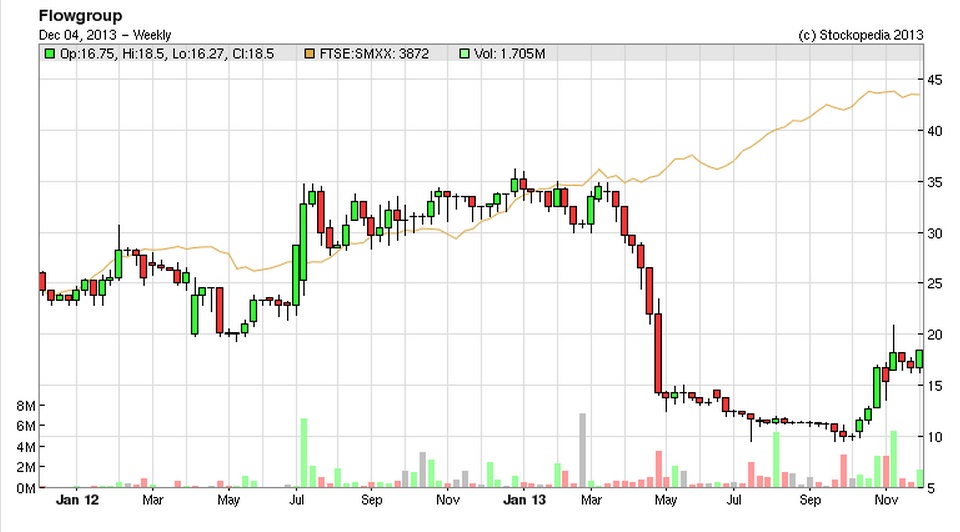
The above two year chart for FLOW immediately raises the question of what happened to trigger the share price plunge in April 2013? Some major disappointment by the looks of it. That would need checking out.
I note with Flowgroup that the Placing price of 16.25p has not acted as a magnet for the share price, which has actually risen this morning to 18.5p. Much the same thing happened recently with Seeing Machines (LON:SEE), where a large Placing was undertaken at 5p, but the share price (which had been 7p Bid beforehand) only dipped briefly, and ended up virtually unchanged around 7p.
This is all real bull market stuff - investors seeing the glass half full, and it also shows that people investing in Placings are not flipping the stock for a quick buck, but have obviously bought in because they are backing the story. It's very important that financial advisers put serious investors into Placings, and not spivs who want to flip the stock, and so far that certainly seems to be happening, judging by the share prices of both Seeing Machines and Flowgroup (so far, but it's early days).
Speculative companies are so difficult to value, and I have no idea what price to put on Flowgroup - as that type of investment is really a leap in the dark, unless you have had access to detailed projections.
I'm amazed at the rapid progress being made by Newriver Retail (LON:NRR), which is a significant value-focussed shopping centre owner/operator, that has been built from scratch in the last few years by an experienced & ambitious management. They really know what they're doing, both in terms of doing astute deals to buy assets, but also to find ways of enhacing the value of those assets. I'm a big fan of this management, and am coming round to the idea that the premium to NAV might actually be worth paying, for long-term holders, since the NAV is likely to rise from the development opportunities that the company has underway (e.g. adding on a new build Morrisons supermarket into unused space in one of its sites).
They have announced another excellent-looking deal today, to buy several shopping centres from the Administrator, for £24m, representing a pretty remarkable 10.4% net initial yield. Not bad going! New River already knows these assets well, having managed them on behalf of the Administrator for the last year. New River just oozes shrewdness by the bucketload.
MDM Engineering (LON:MDM) is something that has been coming up on my value screens (low PER & high divi yield) in recent months, and their interim results to 30 Sep 2013 are out this morning. The market clearly doesn't like them, as MDM's share price is down 8.5% to 145p this morning.
The big problem is that this company, which is an engineer and project management company to the resources sector, is seeing falling demand due to the big reduction in capex in this sector - due to weak commodity prices.
So revenue was down a lot - 32% to $53.6m for the half year. Although pre-tax profit held up well considering, at $5.0m (down 38%) - remember that profit normally rises or falls by a much greater percentage than turnover, due to operational gearing. So it looks as if this company has managed its costs down well.
They pay out half earnings in dividends, so the interim divi has been cut to 4.35 US cents, but there is also a 3.65 US cents special divi on top of that.
The Balance Sheet is great here, but they present it in that horrible American format, where all the Assets are shown in a long list, and then below all the Liabilities are shown in a long list. Dreadful, and totally counter-intuitive to read, as it's much harder to spot the relationship between current assets & current liabilities for example. The British format is so much better, but maybe that's just because I'm more used to it?
The crux here is whether you think they can chug along and still make money in the future. I really don't know how to form a conclusion on that, but I want to flag up the idea as possibly interesting, for people who understand the sector better than I do.
I've run out of time there, as I've got a busy afternoon of meetings in London, so have to jump on a train shortly. Also there's not a great deal of other news today anyway, so will leave it there. See you tomorrow!
Regards, Paul.
(of the companies mentioned today, Paul has a long position in SEE, and no short positions.
A fund to which Paul provides research also has a long position in SEE)
Disclaimer
This is not financial advice. Our content is intended to be used and must be used for information and education purposes only. Please read our disclaimer and terms and conditions to understand our obligations.

9 comments
Hi Paul,
Regarding NewRiver Retail (NRR), just having a quick look at the Stockopedia page shows about £132 million in debt, net profit of £1.5 million, a current ratio of 0.84, interest cover of 1.23.
Usually these would be signs of a business in serious trouble, if you have time could you give a quick explanation why that doesn't apply in this case?
Also their ROCE is 3.5%, isn't that going to be less than their cost of capital?
Re Flowgroup (LON:FLOW) it's difficult to have visibility here but the phrasing "to finance the manufacture of 390,000 boilers" is a bit off. First it's "up to" in the press release, they may end up making 2000 for all we know. If they do make the lot, and we guess the cost at say £1000/boiler (generous for funky immature tech) we have £16M funding £400m of stuff and as they plan to effectively rent them to customers they (with Jabil) need to come up with the whole amount upfront. Bit leveraged that.
Shares in Jabil (who get paid if it works out, and get the company IP for free if it doesn't) may be the better deal if you buy the story.
On MicroCHP in general I'm a bit sceptical. The elephant in the room is that state of the art mainstream tech (condensing boiler) is 90% efficient or thereabout, so there's hardly anything to gain on the heat side, and the electricity side seems a mixed blessing without heavy subsidies.
SWEET is on my hit list, and FLOW is definitely not. The proof of the pudding is that there are a lot more people buying,( compared with the average volume) SWEET shares than FLOW. That is not surprising to me. FlOW'S share price over the last 5 years looks like a stormy sea! On the other hand SWEET shares are doing well and no where near as volatile either. I too wonder why the sudden huge drop in FLOW'S share price in April from about 35P to 15P? Also noticeably is the estimated turnover is up and at the same time profits are down further into negative territory.
Cheers from Lightningtiger
I fear your suggestion of 50:50 placing vs open offer may be unrealistic. The problem, at least for a fixed sized funding requirement, is what happens if there are few takers for the open offer? This can quickly snowball into a loss of confidence causing a price crash, which in turn takes the cost of doing a replacement placing for the shortfall through the roof, none of which is good for passive existing shareholders either. In the large cap world they solve that problem with investment banks underwriting offers as a buyer of last resort, but they charge dearly for that. For small cap whose funding needs are a good match for middling institutional deal sizes, I would think placings are the cheapest way to achieve same. Then having icing-on-the-cake open offers seems to makes sense.
Hi Paul -
Re.Sweett. As a generalisation, I have picked up a tendency from company reports of being very selective in what they highlight. More so than in the past. Reports are becoming more akin to marketing brochures than objective statements presenting a balanced picture. When a report for example highlights right at the top fabulous revenue and gross profits but no mention of eps or net profits before tax, then invariably you will find these numbers way down as disappointing and not too pretty to trumpet. So now I get suspicious and look for errors of omission. At the end of the day there is no substitute to analysing a report in full. The bulletted highlights to me are quality gates. If they pass muster than there is further work to do before making a call.
This makes your quick once-over reports difficult to make but I would prefer you to continue to make them getting a very occasional one wrong,
Thanks, Ram
Any thoughts on GVC (positive update today) which you have written on in the past & I wrote on recently here:
http://www.stockopedia.com/content/gvc-coming-up-on-screens-looking-cheap-seeking-views-79409/
Sadly seems nobody has a view on it here.
Morning Paul, NRR paid £24 million not £24. Regards, Chris.
Chris,
Thanks, I've corrected the article.
Cheers, Paul.
Test.