Small Cap Value Report (4 Sep 2014) - TAST, TRAK, EMR

Good morning! It's very quiet for results today, so I'll have a ramble about something else - the Scottish Independence vote. Putting aside the politics of it, which would not be appropriate for me to comment on here, it's the potential impact on the markets which worries me. With the latest poll at 47% Yes, and 53% No, it's now looking very close, and the Yes campaigners seem to have momentum, and to be successfully convincing many voters through a mixture of emotion and highly questionable economics, that a Yes vote will be economically beneficial for Scotland. Whereas it seems to me the consequences would be potentially catastrophic. Sadly the main flaw with democracy is that you are asking people to make a decision on things that very few properly understand.
In all likelihood an independent Scottish Govt would massively over-spend, and would eventually default on its debt. So existing holders of UK Gilts are now facing the possibility that their Gilts might perhaps be split into an English part (which should remain pretty solid), and a Scottish part which would inevitably be regarded as far more risky, and could eventually default - bearing in mind that the oil tax revenues are not reliable, and are declining. Why would anyone who bought UK Gilts want to hold Scottish debt? So a run on UK Gilts could easily happen. A run on sterling might also happen - what if UK base rates have to be hiked up to (say) 5% (or more) in order to stem the capital outflows? It would plunge us into a horrendous Recession.
There would be years of uncertainty, which markets hate, as hundreds of years of laws & commercial relationships are unpicked & replaced. It seems to me complete madness to be doing this at a time when the UK is still running a gigantic annual budget deficit, and is dependent on ultra-low interest rates for a recovery. Why put that at risk? Whoever had the idea to do this Referendum now needs to be pensioned off before they can do any more damage!
Even if there is a No vote, if it's close (as seems likely) then the Union will be holed beneath the waterline, and without a convincing vote of popular support, markets will surely realise that it's only a matter of time before the Union eventually breaks up.
Trouble is, I don't want to adjust my shares portfolio, as the bid/offer spread can be 3%+ on small caps, so to sell now, then buy back after this vote would be very expensive. Hence why I've decided to buy some Put Options on the FTSE 100, as insurance. I don't hedge my long term positions, but I do sometimes hedge my short term, geared portfolio, which is what I've done now. Options are a horribly expensive way to insure a portfolio, as they nearly always expire worthless, and the time decay is extremely depressing, as you see the losses mount on an hour by hour basis. However, where there is a specific and potentially catastrophic risk on a certain date, as in this case, then it seems to me that situation is what Put Options are ideal for.
I'd be interested in readers views about the economic risks, but let's try to avoid getting sucked into the political stuff, as I discovered on Twitter it's a black hole for time, and nobody changes anyone else's mind anyway.
I don't want to sound alarmist, but the potential risks here are starting to worry me considerably. When people have a yearning for freedom, common sense about practical issues goes out the window, which is understandable in some ways. I'm sure we'll muddle through one way or another, but this could be very disruptive for the markets.
Tasty (LON:TAST)
Share price: 104p
No. shares: 52.9m
Market Cap: £55.0m
Interim results for the 26 weeks to 29 Jun 2014 are out this morning, and look quite good. It's a small restaurant chain, so assessing the shares is just a question of working out whether it has roll-out potential to expand to a lot more sites?
Profitability - it's harder for a small chain to make a decent profit, as they have fewer sites to absorb the central overheads than bigger groups. So in this case I'm impressed with the 8.8% operating profit margin (£1.2m adjusted operating profit) generated on £13.8m turnover in H1.
Turnover is up 25.6% against H1 last year, although adjusted profit is only up 15.8%, which concerns me a little, as the operating margin should be going up as the company expands, not coming down. Although this might be the impact of new sites trading below par in their early days, possibly?
Roll-out potential - I don't have a view on the restaurants themselves (called "Wildwood" mainly), as I've never been to one. However, if you can make an 8.8% profit margin, then the format clearly works, and has roll-out potential. Therefore this is a stock I will consider investing in, if it can be bought at the right price.
Interestingly, looking at the company's Bal Sheet and cashflow, I reckon it is already generating enough cash to self-fund its roll out, at the current rather pedestrian pace. More funding would only be needed if they decide to accelerate the roll-out of new sites.
Valuation - trouble is, the price is high. Broker forecasts look realistic for this year & next, which put the company on a PER of 23 times 2014 earnings, and 16.5 times 2015 earnings. That's not outrageous, but it's about the right price for where the company is currently, in my opinion. Although if they carry on opening new sites, and assuming they all trade well, then I could see these shares going higher next year as the market factors in 2016 earnings increases. That's the beauty of retail roll-outs - they generate their own growth, which snowballs, providing nothing goes wrong of course.
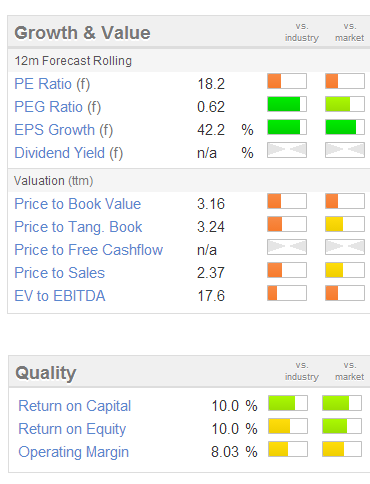
My opinion - I like this stock, but it looks fully priced to me as things stand right now. However, it's going on my watch list as the sort of share that I'd probably buy on a market sell-off, but I'd want it a good bit cheaper than the current price in order to make risk:reward stack up for me personally.
I'm surprised that it only scores 37 on the StockRank system.
The roll-out potential comes through from the graphical history below, but also note that there's no dividend yet, and that profit seemed to almost flat line for the last three years, despite increasing turnover, which is worrying me a little. That suggests to me maybe the restaurant format may not work everywhere?
As a former retailing FD myself, I'd like to meet management of this company & discuss the company & their plans.

EDIT: Sorry to contradict myself, but after pondering this some more & doing a bit more digging, I've decided to buy a small opening stake in this company. The shares are not cheap, but a roll-out never is. Also, as a reader commented in the comments below, it's much better value than CRAW, which is another retail roll-out that the market has got very excited about recently, so on balance I changed my mind & decided to just pay up for a small opening position. I can always buy more if there are any future dips in price.
As usual, I'm NOT giving any recommendations here, this is personal opinion only. I just feel that where I change my mind & buy a bit of stock in something, then readers should be told, even if that doesn't make for a terribly logical flow in this article! What probably tipped the balance for me was the reader comments, where someone pointed out that the Kaye family are behind this stock. I did very well on Prezzo, which I think they were also behind, and on looking at Wildwood's menu, it's very much repeating the same format - although I am a bit concerned that the menu on their website looks terribly unimaginative. I think they may need to revamp the format somewhat & bring in some more interesting menu choices.
Trakm8 Holdings (LON:TRAK) - This telematics company seems to be going from strength to strength, which has been reflected in its share price. The AGM trading update today reads well, with some positive detail about strong organic growth, as well as a contribution from the acquired company called BOX. The summary says;
The Board is confident that, with this good start to the current financial year, the Group is on course to achieve expectations for the year as a whole.
Interestingly though, the shares still look quite good value - broker consensus is for 5.7p EPS this year (ending 31 Mar 2015), so the PER is 13.8 times at the current share price of 78.5p. That doesn't look demanding for a growth company in my view. Watch out for capitalised development spend here though, which flatters the reported profit quite a bit.
Empresaria (LON:EMR)
Share price: 49p
No. shares: 44.6m
Market Cap: £21.9m
This is a relatively small recruitment company. An astute friend told me this one is worth a look, but previously when I've reported on it here the Balance Sheet put me off. I reported on an in line with expectations trading update on 22 May 2014, then on 11 Mar 2014 I reported in much more detail about what I don't like about the company's Balance Sheet - namely that it under-reports net debt by offsetting non-recourse invoice financing against the debtor book.
Interim results to 30 Jun 2014 have been published today. The headline figures look OK, and note the significant impact that currency movements have had - which could reverse a bit in H2, as sterling has depreciated somewhat in recent days, although the main drop recently in sterling seems to have been against the dollar, not particularly the euro, so I doubt the impact on this company will be much.
Profitability - adjusted operating profit rose 20% (despite the currency headwind) to £2.4m in H1, which looks a good result to me. That's 2.2p EPS for the half year.
Outlook - this sounds positive;
Despite currency headwinds we see exciting growth opportunities ahead and are confident in our ability to deliver profit growth over the next few years. Based on performance to date, we are confident that earnings for the full year will be in line with market expectations and look forward to delivering further growth.
Valuation - it looks superficially cheap on a PER basis, with 6.4p EPS forecast for this year, that means the PER is low, at 7.7 times. However, once you factor in the debt, it's not so cheap.
Net debt - the company reports today that net debt fell 27% to £6.5m. I don't accept this figure. Total debt was actually £14.2m, which is the figure I would use to calculate the enterprise value. That's nearly 32p per share, so it's a very material item. The PER would go up considerably, into the low teens if you adjust out this debt, hence in my view the shares are probably priced about right at the moment.
My opinion - The dividend yield is miniscule here, below 1%, which reflects the fact that the Balance Sheet is not in a great shape - net tangible assets are slightly negative at £0.8m. I continue to dislike the company's policy of offsetting non-recourse invoice discounting against debtors, as that hides additional debt in my view. Once that additional debt is factored in, the valuation looks about right. So for me, I'd rather look at other recruiters with better balance sheets & dividend yields, which in the round might actually be cheaper than this. My current favourite (on valuation grounds) is Impellam (LON:IPEL).
That's it for today. See you tomorrow!
Regards, Paul.
(of the companies mentioned today, Paul has long positions in TAST & IPEL, and no short positions)
Disclaimer
This is not financial advice. Our content is intended to be used and must be used for information and education purposes only. Please read our disclaimer and terms and conditions to understand our obligations.

49 comments
Paul
On Empresaria could you expand a bit on the non-recourse invoicing. I had thought that this was a form of factoring in which the factors take on the risk of a failure to pay. If so, how can this create a credit balance in the balance sheet that could be set off against debtors?
Thanks
Julian
Julianh,
With Empresaria (LON:EMR) my understanding is that some debtors are sold to a bank on a non-recourse basis, and hence are shifted off balance sheet. So this has the effect of shifting both the Debtors and the related bank financing off balance sheet.
Therefore, if this financing facility were withdrawn, then EMR could potentially go bust - because it is relying on this debt facility for day-to-day funding. It's a big risk, and it's not reflected in the net debt figures they quote, although it is mentioned in the narrative to the accounts.
I can't think of any other Listed company which I cover that adopts this accounting treatment.
I need to see all the debtors, and all the creditors, on the Balance Sheet.
A fundamental accounting concept is "no netting off", but that seems to be exactly what Empresaria are doing!
Regards, Paul.
"Not entirely right. When you say the English taxpayer bailed out Scotland, that's not true is it?"
Hmm population of England 52.9m. Scotland population 5.29m, Wales 3m odd.
England is, indisputably, where the majority of the wealth lies. As indeed is where the majority of the tax paying public given the clear population numbers.Hence the majority of any tax revenue raised,and that borrowed(secured on the tax revenue of England as a guarantee) will most definitely have come from England to bail out predominantly Scottish banks, both run into the ground, one by a Scot.
So yes. The English taxpayer effectively bailed out Scotland.
Sterling is also the currency of the Union - not England's specifically. So you leave the Union, you don't get the currency.
Salmond's threat of "if you dont give us Sterling, we wont pay out share of the debts, both those arising outside of the bank bailout , but also though directly coming from bailing out Scottish banks" is a hollow one.
Sure he can threaten that. But then, if Scotland doesn't take it's share of the debts, then England is perfectly entitled to say they don't get their share of the assets(ie North Sea Oil - which isn't actually Scottish, the majority belongs to the Shetland Islands. Perhaps we should give them a referendum as they have more in common with Norway than Scotland)
Perhaps Salmond will take those assets. Population Scotland 5.29m, England 52.9m +
Don't rate Scotland's chances in any major war frankly especially as it's an myth the majority of the British Army is Scottish.It clearly isn't.
Whatever happens in the forthcoming referendum, if the Vote is NO, but very close, there will be calls for more devolution. No issue with that as long as England, in similar fashion, gets devolution and more powers as well
If the ungrateful Scots vote YES they will be an economic basket case within 3 years, they currently gorge off of the English taxpayer via the ridiculous Barnett formula which provides C£1800 extra public spending for every Scot, that is how they can have free tuition fees, free nursing care etc. etc.
Salmond is a slimy chancer, effectively trying to blackmail his way to using sterling by threatening to default on Scotland's liabilities. The English taxpayer has already bailed out Scotland once when RBS and BOS nearly bankrupted the UK and I hope the idiots at Westminster don't agree to a sharing of our currency, let them join the dodo, read euro or revert to the groat (an ancient silver coin worth about six old pence).
A break up would be bad for the union, however, there would be a major benefit as it would kick out a lot Labour MPs and hopefully Britain would revert to a more "right of centre" political scene instead of the liberal extremism we have had for the past 20 years.
PJB
Not entirely right. When you say the English taxpayer bailed out Scotland, that's not true is it? The UK banks were bailed out by a UK Government being able to borrow and print new money. The UK banks, all of them regardless of where they were based, took advantage of conditions and laws passed and approved by the UK and other Governments which more or less began in the 1980's, big bang onwards.
You don't believe that the UK Government actually had the money at the time in 2008 to do the bailouts do you? They didn't have the money, but the one advantage that the State has is that it can tax both now and in the future its citizens and businesses. Markets know this and it's why they like to increasingly see Government guarantees and backing in the event things go wrong. Hardly a free market, but that's the way it's become.
So, all of the UK citizens including those in Scotland who are taxpayers are used by the state as the guarantors. Because the monetary system is inflationary by design, countries like the UK simply add it to debt that will at some stage be paid back in the future, aided by inflation which helps to inflate it away, backed by the taxpayer now and into the distant future. It was not the English taxpayer that rescued Scotland, just as "English" banks leading up to the crisis were not a model of prudence either.
Hi all,
Interesting situation if Scotland DOES vote for independence and negotiations start for unwinding of the Union.
There's a General Election in rUK next year, do the Scots get to vote during the transition period ?
Assuming not (how can you vote if you're leaving?), then the Conservatives seem a shoe-in.
They have committed to hold a referendum on post-negotiation Europe.
If rUK decided to pull out of Europe, where would that then leave 'newly independent Scotland' - still trying to keep the pound ? Or still processing its application to join the Eurozone ?
A bit messy, whichever way you look at it, and markets HATE uncertainty !
And - since there's no cost (to the individuals) attached to the process, even a vote to stay together won't settle the matter : what's to stop the pro-independence lobby from seeking another vote in a few years' time, cf. the 'neverendum' seen in Quebec ?
ATB
Scottish Independence means fewer Labour MPs in London. I would vote for that.
No vote currently 1/4 on Paul, not too many poor bookies around, Calllm down calllm down as they said on Brookside
We shall never cease to be astounded by politicians decisions in their quest for glory; as with A .Salmond he will get it with either 'Yes' or Divo' Max but to achieve it he is putting at risk the future of both countries for a decade if it is close to a 50:50 vote. The Nuclear position is indeed that. If the markets collapse don't expect a 150% recovery bounce in 5 years as this time
Don't need to go back to 17th. century to highlight the wizardry of Scottish financial acumen ...remember the Investment Trust debacle & the Two banks of very recent times.
As of Scottish ancestry I am appalled.
Flack - All English parliament? Think again!!
Why?
Really good discussion today, thanks for all the interesting points made!
Regards, Paul.
Tasty is now where Prezzo was about ten years ago. Back then, Prezzo raised about £8m I think via a placing that really kick-started the group's growth. Look back at the placing details and adjust for the share split and you can work out the share-price gain for anyone bagging Prezzo at the time. I spoke to Sam Kaye at the Tasty AGM this year and the update is on the ShareSoc website.
Mayn
An independent panel should commision a report on the potential beenfits and risk of independence.
Then, to take a vote on the matter your should have to read said document and make up a decision based on those finding rather the tirade of two parties with a interest in manipulating the figures to their own goals.
I do think this has become a serious issue for the asset markets as they stand.
Cost-benefits is a bit of a mug game in the long run, and surely people should draw up country boundaries, which are pretty sticky, based on cultural allegiances and how various groups get on together, rather than speculative bean counting? It's a bit like people who decide who to marry by commissioning someone to do a discounted cash flow analysis of their prospective spouse's lifetime earning potential.
Today, as a Standard Life shareholder (10% of my SIPP), I have nothing but praise for the Scots. :)
Quirk of history that the Union was only formed to rescue Scotland from financial ruin caused by their over reaching ambition - The Darien Scheme.
The colonization project that became known as the Darien Scheme or Darien Disaster[1] was an unsuccessful attempt by the Kingdom of Scotland to become a world trading nation by establishing a colony called "Caledonia" on the Isthmus of Panama on the Gulf of Darién in the late 1690s.
From the outset, the undertaking was beset by poor planning and provision, weak leadership, lack of demand for trade goods, devastating epidemics of disease and increasing shortage of food. It was finally abandoned after a siege by Spanish forces in April 1700.
As the Darien company was backed by between a quarter and half of all the money circulating in Scotland,[2] its failure left nobles, landowners – who had suffered a run of bad harvests – as well as town councils and many ordinary tradespeople[2] almost completely ruined and was an important factor in weakening their resistance to the Act of Union (completed in 1707) -( wikipedia)
plus ca change plus ca la meme chose
Just to add to the discussion from a pure capitalist point of view.
I think a YES vote will be a disaster for both England and Scotland as we will both pay for it via the capital markets. Forget the fringe benefits of companies moving South.
Whilst we English may laugh at the financial problems of Scotland, before the vote this will be short lived if they vote YES. International currency and debt markets will immediately price in the new order. That is the "united we stand and divided we fall". Both the rest of the UK and the newly minted Scotland will BOTH be deemed much less credit worthy by international capital markets. i.e. both will be much more risky. Capital markets will devalue Sterling and the cost of UK borrowing will go up for all. Interest rates will have to rise to protect sterling. As for Scotland it will be deemed much less creditworthy. Interest rates and dedt borrowing will be very high if an independent BoScotland is indeed an end result - I fear the Scots dont see this one coming. Their fixed (Scottish) assets will be looted, and there will be a house price crash in Scotland.
Both Scotland and England will be big losers with a YES vote in financial terms. Weaker £, means BoE will have to raise interest rates sooner for all English mortgage holders. Small companies with debt will be hit hard south of the border as well as north. Will be even higher interest rates North of the border in Scotland.
If you don't have savings, or a mortgage, or a job, then you will be fine with a YES vote. Nothing to lose. If you have any of the above you will be hit irrespective of whether you are English or Scottish.
However, having said all this, I always look at the betting (bookies do't give away money for free). They still say the NO vote will win by a significant margin.
Yes vote: 3/1
No vote: 1/3 (odds on).
http://www.oddschecker.com/politics/british-politics/scottish-independence/referendum-outcome
They always said the Scot's were a canny lot.
That was my purely capitalist view.
On a lighter note, and as an Englishman I have always got on with my Scottish friends. Most are grounded, clever, and very witty. So on a personal note .. better together, I say.
Just for a little balance on referendum discussion
There is anti-scottish sentiment around too. No more than from Paul Scott who has no regard for the scottish if you have read his PERSONAL views on twitter on several occasions .Its no wonder that some scots feel unwelcome in the union.Throw into the mix media friendly officials such as boris johnson effectively dismissing us and this compounds the anti scottish sentiment around. Unfortunately , a few high profile people can influence a lot of people and Salmond is capturing a lot of it and turning it into votes.
Like Paul Scott, the majority of the union want to remain only because of the untold pain to our economy and all our lives. I am not fooled by the thought of the utopia that Salmond promises as its unachievable and the scottish electorate will pass a no vote by 60 to 40 in my book. Its on the tip of everyones tongue up here and the debate is healthy but there are too many doubts.
unfortunately in the aftermath all that is left is a bitter taste for all concerned regardless of the result.
pye, (A scot with lots of english friends and a soon to be English wife)
long live the union.
pyemackay,
That's totally untrue! You clearly don't understand that Twitter is my outlet for banter & sometimes irreverent comments about politics. I'm not in the slightest bit anti-Scottish, there is a bit of a clue in my surname!!!
My views on Scottish independent have ebbed & flowed, as time has gone on & I've listened to various views. As with a lot of English people, there is a degree of exaperation about this issue, in that we've had never-ending media coverage, so you do reach a point where you're sick of it & just want a decision either way. Sorry if you misinterpreted that as anti-Scottish, it wasn't intended as such at all.
Also, I feel that if people want to be independent, they should be, and that getting rid of the Scottish MPs in London would also allow us English to have the Govts we want, not skewed by the tax & spend socialism of Scots. So good all round in the long run probably.
However, as the date of the vote has neared, I've played out various scenarios in my mind, and it's becoming increasingly clear that there would be several years of potentially massive disruption for all of us - this could easily derail the economic recovery & trigger a run on the pound, maybe even a run on British banks again? Should we collectively be risking that right now? Definitely not, this is madness in timing anyway.
In my view the nationalists have stirred up a hornet's nest of negativity, and there's probably not a way back from here, for either side.
So on balance (and this is subject to change) I would probably prefer England & Scotland to separate, but just not at the moment whilst the economy is still on life support.
Also, I feel that having a load of politicians & ordinary people shouting at each other, expressing polarised views, is not the way to decide this matter. A detailed, impartial panel of experts is needed, to go into great detail about every aspect of independence, and report back in a balanced way about the options & likely impact. That just hasn't been done. So people are being asked to take a wild leap into the unknown. Look at how it's dividing Scots - families, and in particular age groups. The whole thing is a mess, and the sooner it's over with, one way or another, the better.
Paul.
On a different topic, could someone please explain this statement from Panmure Gordon & Co (LON:PMR), because I don't have a clue!
Share capital reduction
Following the announcement made at the time of the Company's preliminary 2013 results on 25 March 2014 and the issue of the Notice of Annual General Meeting dated 9 April 2014 in connection with a proposed reduction of the Company's share capital (the "Capital Reduction"), the Board of the Company is pleased to announce that the High Court today issued an order confirming the Capital Reduction. Following registration of the Court order with Companies House, the Capital Reduction has now become effective.
As a consequence of the Capital Reduction, all of the Company's deferred 36p shares have been cancelled and extinguished, the amount standing to the credit of the share premium account of the Company cancelled and the Company's share capital comprises of 15,545,473 ordinary shares of 4p each, with each share carrying the right to one vote.
Hi Ben,
The item you linked to about Panmure Gordon & Co (LON:PMR) concerns their desire to pay dividends. That was not legally possible, due to company law on distributable reserves. So the way to fix that is to apply to the Courts to cancel some of the company's share capital reserve, and reclassify it as distributable reserves.
This is done by splitting existing shares into a new share (with a much lower nominal value), and a worthless deferred share. The deferred shares are then cancelled.
Don't worry about the technical detail, all that matters is that the company has gone through a legal process where it can now pay dividends. So that's a good thing for shareholders potentially, as presumably the company intends to pay divis in future, otherwise they wouldn't have bothered sorting this out.
Cheers, Paul.
The topic of reduction of share premium came up on a previous occasion here:
http://www.stockopedia.com/content/small-cap-value-report-13-dec-vlx-per-trk-vlk-off-aly-snx-79920/
Hi Paul
Thanks for your comments the coming Scottish vote, I might add that the Lowlanders and Highlanders haven't a good word for each other never mind their attitude to the English. Back to company reports, thanks for your comments on TAST and TRAK, have you time and energy to comment on Avation and Redde both of which have reported today? Roger
Hi Delpher,
I did have a brief look at Redde (LON:REDD) (formerly HelpHire), but switched off after a while, as I'm not interested in revisiting the company now it's moving into the personal injury ambulance chasing side of things.
Also I'm not interested in investing in an airline leasing business, so didn't look at Avation.
Sorry about that.
Regards, Paul.
Ironically Scotland leaving the union could be the cleansing event that the UK needs. Without defaults on debts that can never be repaid (extend and pretend) Japanisation awaits, and that is not good for any small investor.
Look at the state of the supermarkets, people are cutting back on spending on essentials due to overpriced assets (houses), as a younger person I would welcome a clear out,
Hello Paul,
I have followed the Scottish referendum debate very closely throughout. Your comments seem somewhat one-sided. Surely objectivity should rule?
The 'No' economics seem to me at least as questionable, and the current state of the UK economy is not a good basis from which 'No' criticises the alternative economic strategy of 'Yes'.
You may well have a point about the potential catasrophic consequences of Scottish Independence; do you have an example in mind where independence for a reasonably well-developed (or any!) country led to economic catastrophe?
I am gently suggesting that, despite your protestations, you are giving us the benefits of your political opinions and emotions. Neither, it seems to me, have any useful place here.
Perhaps we investors should just stick to our lasts?
In answer to your question "do you have an example in mind where independence for a reasonably well-developed (or any!) country led to economic catastrophe?". The list is extensive if you care to research it. But Russia / Ukraine and the potential spit up of Iraq are both very topical. The Ukraine economy is a complete mess, with capital markets treating it as a barge-pole job. The smaller brother always comes off worse, but the big brother does not fair too well either! In debt markets 4 + 2 = 8.
Thanks for this Rick. Good example. I suppose that's what happens when the large country really wants to hold on to the smaller one and resorts to extreme bullying and economic vandalism. Hope that's not what England has in mind for Scotland if there is a 'Yes' majority.
Don't think you need to invoke vandalism (although true in Ukraine), the capital markets will give both Scotland and the rest of the UK some stiff punishment. But the irony is that the Scots will have to negotiate with George Osborne for sure if they vote YES. He is not known for his generosity!
As an Englishman I'd be glad to see the back of them
And before I get the counter arguments thrown at me - let's just remember/reflect on the fact that whichever way the vote goes it will undoubtedly confirm that an approximate 50% wishes to leave us, largely because of their anti-english views
And following the vote we should have an all English parliament in any event - to vote on matters solely relating to England
r.e. An English Parliament - do you really need another government, another set of civil servants, more expense accounts and more rules? I live in Wales, and have the pleasure of dealing with the Welsh Government, and it's a nightmare. I have a friend in the Welsh Civil Service who tells me they waste huge amounts of money, need huge amounts of staff to do anything (6 people to answer a letter, if you believe him) - meanwhile services are suffering because they aren't getting enough of the funds. Business is a nightmare - we had a new product created recently, and were then told that while it conformed with EU and UK regulations it didn't conform with the Welsh government's interpretation of those regulations.
As an Englishman living in Scotland, and with a vote, I have been rather annoyed that the impartial economic argument is not really there, and you have to rely on the opinion of Yes or No camp, which tend to vary widely. This is true of such things as the amount of oil in the ground, the impact on business and the impact on households. I tend to think it will not be as bad or as great as people think, so will probably land somewhere in the middle, i.e. not much change. The problem is that if there is a Yes vote, then that is just the beginning of an independence process that will apparently only go on for 18 months, but will probably go on for years. Given that very little will change, why bother?
Swing voters are likely to chicken out on the day in the Scottish referendum. Wealthy ageing electorates rarely vote against a comfy status quo, even if they like toying with an idea the day before.
The market reaction should be muted either way, short term at least, because we're in a pretty robust bull market: if Putin polishing up his nukes and various full blown wars in oil regions don't do it, it's not the prospect of a somewhat bothersome contractual disentanglement process that's gonna do it.
Paul, I think you are right when you say the main flaw with democracy is that you are asking people to make a decision on things that very few properly understand. I'm sure that is the case with the Independence vote especially when you look at the potential fall out over the issue of Scotland keeping the pound. The Bank of England would be Scotland's Central Bank. They would not have true independence when it came to economic and financial policy as it would be dependent on what happens in Westminster, the BofE and market perception and response to policy decisions taken by Britain.
It's crazy that many on the yes side seem to think that this isn't a problem or that it can work. Without your own Central Bank and the ability to create money as a lender of last resort you have no independence to react to the way the current financial system works. Does the average voter anywhere really understand this? If the Scottish people want independence, then they really need their own currency and Central Bank or be part of a currency union like the EU in which both parties want it. The no side have dismissed this hence Salmond talking about defaulting on debt obligations if he doesn't get his way. It's the worst kind of brinkmanship and I doubt the market will respond kindly to a yes vote given the currency uncertainty.
To look at it another way, had Scotland been independent in 2008, who would have rescued RBS and Lloyds? Their potential liabilities are many times the size of the Scottish economy, big enough to bring down the British economy without the drastic QE response that we got. How would Scotland with no independent Central Bank deal with it? Memories seem to be very short, especially in politics.
Paul I am really glad that you have mentioned this today as its focused my mind on the need to have a good look at my portfolio and asses the potential risks.
As a Scot who has worked in England most of his adult life I find it rather disturbing that if you strip some of the debates down to the base level most of the Yes campaign stuff has a general undertone of Anti Establishment bias (or lets be honest Anti-English bias) which I find disapointing because when I came to England to work many years ago I was never treated as anything other than an equal. Perhaps it may have been different many years ago, but for the life of me I have never worked out why some of my fellow countrymen have a slightly skewed view of England, the majority of Scots I know who move down tend to stay and prosper.
The economic arguements for maintaining the union are compelling, but thats very hard to convey when your oppostion are shouting louder and promising the world. Last nights debate was a classic point, the SNP claiming that tuition fees would be free in an independant Scotland, but how could that ever be true when the SNP may not even control an independant govt in a few years time? No surprise that the mob booed anyone sugesting this which when you think about it is the only truthful answer.
I suspect the big winners will be the punters that take a position on the FTSE nearer the time, rather ironic really when you look at Alex Salmonds dream of utopia.
I think Scottish Independence could actually be good for UK businesses in the long term. First you would get a lot of Scottish Headquartered Business moving to the UK for the more stable economic environment creating jobs and tax revenue south of the border. The loss of the NS oil would weaken sterling making productive industry more competitive in a reverse of the 'Dutch Disease' effect - the oil revenue is declining so the quicker productive industry builds in it's place the better. It would also give the Conservatives a clear majority in Westminster who are historically more pro-business so assuming this doesn't overly empower euro-skeptics this would be positive for business.
I still think the societal impacts of an independent Scotland would be negative for both Scotland and the rest of the UK. However from a pure business point of view I would expect the rest of the UK to be a net winner long term and that to be reflected in the UK stock market. Short term markets hate uncertainty so we could see some volatility though.
Hi Paul,
I read a while ago some analysis on the economic effects on the rest of the UK from a Scots yes vote by Nadeem Walayatt on Market Oracle which made some interesting points (see highlighted link above if that's of interest.
Regards
jjis
Twitter: @CompoundIncome
Website: Compound Income
The Scottish vote is a worry definitely. Its 6 points different but only a 3 point swing to make it 50/50.
Here's the poll data if anyone fancies a read: http://yougov.co.uk/news/2014/09/02/full-results-scottish-independence-28th-august-1st/
My big concern with polls this close is that voter apathy might lead to a yes vote because the no vote doesn't mobilise (people might be more motivated to vote for something new rather than no change). However the poll doesn't suggest that, it actually says that people are more likely to vote if they are planning to vote no.
The 8% still undecided and 2% won't votes are excluded from the 53/47 number. So maybe it is a number for the media more than anything else.
Good morning Paul
I think the REDD f/y results issued today are worth reading. The company doesn't appear to have become a QPP as you thought it would. Following the publication, in June, of the CMA's Provisional Decision on Remedies on the Private Motor Insurance Market with a comprehsive package of proposals the industry will be free of the bad practices if and when they are adopted. REDD has already adjusted for the anticipated outcomes. With the introduction of non frictional protocols the easy money being made out of accident chasing should be something of the past, vastly improving the industry's image. The result is a leaner, well capitalised company with increased margins, well positoned for growth in the newly regulated industry. I would very much welcome your comments on the accounts. Roger
Regarding the Scottish vote, I hope we will see a rather more convincing 'no' than the polls suggest. I am informed by friends there that few over 55 will vote 'Yes' because of their pensions, and their pending dependence on the welfare state. The SNP has made a conscious effort to garner support from ethnic minorities and immigrants, and this has also apparently stirred up some casual racist opposition. Having said all that, I totally agree that there is likely to be a short disturbance to the markets whatever the result. Also, once the referendum cat is out of the bag, it will keep returning for another saucer of milk. Independence is only a matter of time now.
(It is perhaps worth noting Red24 (LON:REDT) ,the risk management people, are transferring their HQ out of |Scotland!)
I don't understand Put Options anything like well enough to chance buying any, but one simpler way of hedging against a Yes vote, if one believes there is any real chance of it happening, would be to have a bet or series of bets with one or more of the bookmakers offering odds on the referendum. For example, William Hill is offering 11/4 on the Yes vote winning.
Steve
Disclosure: English, living and working in London. No opinion on the 'best' outcome.
Restaurants - fickle business at times, honeymoon periods and then soon fall out of f(l)avour, always reminds me of artisan bakeries I used to frequent, huge initial success, a cookbook soon afterwards, declining trade and administrators picking over the crumbs though if you get the formula right and it can stand the test of time (fad free, think fried chicken/Nandos etc) then the High Street's your oyster........
Paul
What do you hear about what the large fund managers are doing to protect against a Scottish Yes vote? I assume they can't be piling into FTSE Put options or the market would already have fallen noticeably.
I rather doubt that the BoE would raise interest rates to protect Sterling, as it's not their remit. If the increased competitiveness led to an export boom and increased company profits and the imported inflation from higher import prices looked as though it might feed through into wage inflation, they would raise rates - but that would be many months later. I like holding some index-linked assets for this scenario, because it has always been hard to control inflation once it starts rising significantly.
Hi Paul
Try this;
http://www.fool.co.uk/investing/2014/08/28/is-tasty-plc-better-value-than-crawshaw-group-plc/
Must admit I hold Crawshaws and intend to hang on to them.
Cheers
Mike
Probably the main reason why Tasty (LON:TAST) is so highly rated is because Adam and Samuel Kaye (brothers) are involved. They have a long family tradition of successful restaurant roll outs. There is probably nothing these guys don't know about how to do this successfully. They were the people behind the Ask Central and Zizzi chain. They are also directors of Prezzo (LON:PRZ) which is run by their cousin, Jonathan Kaye. It reduces the risk considerably if you know the management have a successful record doing the same thing. Tasty (LON:TAST) had a bit of a false start as it was originally planned to be a chain of dim sum restaurants which didn't really work so they switched to the Wildwood format and are now expanding that chain. I did read somewhere an opinion that Tasty (LON:TAST) would not be expanded quickly until Prezzo (LON:PRZ) had been sold as there could be a conflict of interest if both chains had sites in similar locations.
Someone recently compared Tasty with Crawshaws on Motley Fool. The result was that Tasty was a lot more palatable.
Mike
Hi tads,
Interesting, do you have a link for that? I think that makes sense - Crawshaw (LON:CRAW) looks way too expensive to me for where they are at the moment, and there is not yet proof that their margins are sustainable. Plus they don't have the management team to actually do the roll-out yet.
Whereas Tasty (LON:TAST) has proven its business model with a good & sustainable operating margin, and is getting on with it, although at a rather sluggish pace so far. The valuation doesn't look unreasonable.
Actually, the more I think about it, the more I realise I should just buy some & tuck them away. So have just picked up a few.
Regards, Paul.