Small Cap Value Report (5 Sep 2016) - CAMB, VTU, SDY, KOOV, BLV, CARR, REDS

Good morning!
This morning's report comes to you from an alley on a side street in Corfu old town!
I'm flying back to the UK on Weds. So there will be a normal report today & tomorrow, but Weds will be late I'm afraid, as I don't get back home until about 3pm. I'll still do a report, but it will be late afternoon/early evening on Weds. Sorry about that.
My experiences of fund management
EDIT: Clarification - Fundamental Asset Management
I seem to have accidentally caused some confusion, for which I apologise. Fundamental Asset Management has asked me to clarify that the only part of their business I was involved in was a minor portfolio service called the Small Cap Value Portfolio.
So the SCVP had nothing to do with FAM's core business of IHT portfolio management, which is of course continuing completely as normal! (and is an excellent, well-run, strongly performing service).
One reader apparently misunderstood, and thought that FAM was shutting down, which obviously it isn't! This has caused a few red faces, for which I profusely apologise.
Over the last 3 years, I helped to run a portfolio management service, called the Small Cap Value Portfolio, through an excellent FCA-regulated firm called Fundamental Asset Management (who are specialists in IHT planning portfolios). Working with FAM has been terrific - they're really genuine, decent people, and have a wealth of experience in AIM stocks.
I've not mentioned it here before, as it could have been seen as a conflict of interest (i.e. being seen to drum up new clients by mentioning it here), so Stockopedia asked me not to refer to it here in the past. I did however declare all positions held, within my usual disclosures here, as if I held them personally (which I did in nearly all stocks anyway).
However, seeing as we're winding down the very small SCVP service (due to failing to reach critical mass to make it cost-effective), I thought it would be worth a mention, to pass on some snippets on what I've learned from 3 year's work, helping to (as part of a regulated team) manage other peoples' money.
NB. This has no effect on FAM's main activities, as noted above.
Firstly, it's incredibly stressful! If you lose your own money on a share that goes wrong, it's annoying, but you learn the lessons (if there are any - sometimes it's things you could never have foreseen), and move on. When it's someone else's money, the emotions are far more painful, I found. You feel that you've let the clients down, and take it much more to heart. Especially where clients are also friends.
This can then induce fear of taking action. You spot share opportunities, but think - I'd better not take the plunge, until I've researched it to death, and am 100% certain I'm right. Of course, by then, the opportunity may have passed, as with bargains you often have to act quickly.I found that you become particularly indecisive after a series of losses - it saps your confidence, and makes you question your own ability.
At the opposite end of the spectrum, even Neil Woodford said something similar, when early in his career he had a 2-year+ period of poor performance - I think it was in the tech boom period from 1998-2001, where he refused to participate in the madness. He sounded quite emotional about it when giving a talk on his career, and I think he came close to giving up back then.
Going back to the bottom end of the spectrum, the mandate for my portfolio service was on value - so low PER, high yielding shares, with decent balance sheets. Unfortunately, I just seemed to mainly pick stocks which then slipped up - so the market was telling us something by applying a very low PER - it was anticipating problems ahead.
Therefore, these days I'm much less attracted to low PER stocks - even if they don't slip up, they seem to stay cheap forever. It has been a much better strategy in recent years to go for the best quality businesses, and paying up with a higher PER (say 15 or more). Part of that has been a re-rating of growth stocks, which of course could easily reverse once the market loses its fizz. So value may come back into fashion, but it's not been a good area to hunt in, in the last few years, I've found.
I tend to look for businesses with good growth potential now, and if I can buy them on a low PER due to some market panic (e.g. the Brexit referendum), then so much the better.
One area where we did very well, was concentrating on your best stock ideas. When I researched Boohoo.Com (LON:BOO) after its profit warning in Jan 2015, it seemed very clear to me that this was an excellent buying opportunity. So, even though it was a very tough thing to do at the time (as the company had badly disappointed, and was half its IPO price), we loaded up with BOO, making it our largest position in the portfolio at about 24p. It's now more than triple that price. So I firmly believe that concentrating into your highest conviction shares is a good thing - providing you get it right more often than wrong.
We've not sold any BOO shares since. I wanted to take profits along the way, but our fund manager said no - he said you're onto a winner there, so just run the position. We did, and it's worked brilliantly - the BOO position has hoovered up all the other losses. Despite a period of lacklustre performance, now all client accounts (bar 1, who happened to open the account with unfortunate timing on purchase prices) are in profit. So we'll close the portfolio service on a high, and having beaten our benchmarks.
The key point in the last paragraph though, is to run the winners. Easier said than done, but in the future I am going to resist the urge to top-slice & take profits, and instead run my highest conviction positions for the long-term.
That said, if a lower conviction share in my portfolio zooms up, and looks expensive, then I would still sell some of those ones. It's the big, conviction buys that go right, which one needs to stick with, in my view.
Liquidity - as PIs, we moan about liquidity in smaller stocks. Well it's far worse for fund managers! As their funds under management grow, buying & selling become even more difficult. Plus, if they're trying to get out of a position, having to put out an RNS every time they cross a % threshold telegraphs their intentions to the whole market. So sensible PIs will often hang back, and wait for the price to fall further, and only buy a share once the selling fund manager has exited.
So I can see why many fund managers avoid small caps. Risk:reward for them is terrible - if something goes wrong in a small cap, they can't get out. Whereas the average PI can exit from a failing position, usually.
Although in times of serious market dislocation, then liquidity can disappear almost entirely. That was certainly the case in 2008. You can only sell things that are liquid, so you end up with a remaining portfolio of all your mistakes, which are too illiquid to sell.
Gearing - generally speaking, I think it's a mistake to use gearing with small, illiquid stocks. I've covered this ground many times before, so won't repeat it. Even though our portfolio service was based on using spread bet accounts (to make it flexible, cheap to run, and tax efficient), we applied strict rules on not using more than a smidge of gearing.
Moreover, unlike others who run services like this, we actually stuck to our rules, and hardly used any gearing at all. For this reason we were able to ride out a period of lacklustre performance, and come out the other side with a closing position of nearly all remaining clients being given back usefully more money than they originally invested. I am convinced that our disciplined management of gearing was key to this positive outcome.
Structure - there's a massive difference between open-ended (where clients can withdraw their funds), and closed-ended (e.g. an investment trust). Open-ended is just horrible - what tends to happen is that when things go badly, clients get cold feet, and some pull out. This crystallises their losses at often the worst possible time, so they lose out. Also, it forces the fund to start selling at the low point, which can worsen the price falls, getting into a vicious circle.
Therefore, I would only do something again in fund management within a closed-ended structure. This means clients can't withdraw money from the fund itself, but they can sell their shares in it. However, this structure is costly, and involved a lot of admin. It does however free up the fund manager to concentrate on taking a long-term view, and not having to devote time & energy into reassuring wobbly clients.
Overall - working in a fund management team for 3 years was an interesting, but rather stressful experience. It sapped a lot of my time & energy, for negligible returns. However, I am grateful for the opportunity (that sounds like The Apprentice!), and have learned a lot from it.
I was determined to see it through to a point where client accounts moved back into profit, as a matter of honour (and latterly for zero fees), and in all but one case that has happened, for clients who stuck with us until the end. So I feel that I've done the right thing. That's more important than money in terms of motivating me. I wish that more people in the city had the same ethical approach - there's a huge ethical deficit in the financial sector generally.
As for readers, if friends or family ask you to manage a portfolio for them, I have just one word of advice - don't!
It's too likely to cause unnecessary stress & strain on your personal relationship. Far better to outsource it to a good fund manager, with a decent, long-term track record.
For me, I'm taking a break from fund management for a little while, although there is another possibility bubbling away, which might develop into something, who knows?
Right, onto today's trading updates & results statements.
Cambria Automobiles (LON:CAMB)
Share price: 71p (up 6.0% today)
No. shares: 100.0m
Market cap: £71.0m
Pre-close trading update - this is for the year ended 31 Aug 2016, for this expanding car dealership group. It reads well to me, the key part saying;
The Board is pleased to report that trading in the second half of the financial year continued strongly following a good first half.
Trading in the first 11 months of the financial year was substantially ahead of the corresponding period in 2014/15 on both a total and like-for-like basis.
The Board is confident of delivering results for the full year in line with the revised market expectations.
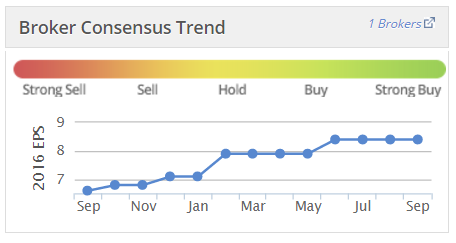
Looking at the Stockopedia graph for broker expectations over the last year, there have been a series of upgrades to forecasts. Although some of this is due to acquisition of new sites remember;
The comments on new car sales sounds more upbeat to me, than the recent comments from Vertu Motors (LON:VTU) - which mentioned a softening since Apr 2016 in new car sales.
Current trading - also sounds positive;
Heading into the important September trading period, the new car order book for the Group is building well and in line with our expectations. The Board expects the Group to deliver another strong trading performance in this crucial month.
Valuation - it looks really good value, and I would have bought some shares recently, had it not been for me already being overweight in this sector with Vertu Motors (LON:VTU).
I remain of the view that this is an excellent value sector, if you expect interest rates to remain low for a long time. Also, I'm not at all convinced by the argument that manufacturers will sell electric cars direct to customers in future. This may be the case for niche cars, such as Tesla (I am currently short of this share), but for mainstream cars I think most people want a proper dealership where they can test drive, compare models, etc. Also, it's so exciting going to a car dealership, and choosing a car. I would always want that experience, as it's so enjoyable.
Although with much less to go wrong on electric cars (far fewer moving parts), then maybe that might put strain, longer term, on aftersales revenue/profit for dealerships?I'm not too concerned about that, as my interest is purely to hold my VTU shares until they re-rate to a more sensible valuation, then I'll move on to the next thing.
CAMB looks excellent value, and is well worth a look, in my view. Although note the divis are low, as it's concentrating on growth.
Speedy Hire (LON:SDY)
(at the time of writing, I hold a long position in this share)
This is getting ridiculous! Toscafund has issued yet another statement today concerning its imminent EGM (9 Sep). Today's comments from Tosca can be summarised as: my Directors are better than yours, so there!
For me, the crucial factor is that Tosca wants to push Speedy to buy the basket case competitor HSS Hire, which is loaded with huge amounts of debt. That's a complete no-no for me. I don't want Speedy to take on HSS's debt whatever the benefits of combining the two companies.
So I feel that Tosca's resolutions deserve to fail.
Koovs (LON:KOOV)
Share price: 64p (up 7.6% today)
No. shares: 149.7m
Market cap: £95.8m
Trading update - this online retailer is trying to become the Asos for India. I remain very cautious about this company, because it is still a million miles away from demonstrating that it has a viable business model.
The model Koovs has adopted is to throw huge amounts of money at marketing, in order to drive customers to its website. Marketing spend is the major issue that fashion websites have - barriers to entry are minimal, but you then have to spend serious marketing bucks in order to drive traffic to your website.
So whilst Koovs can publish exciting-looking top line growth figures, as it has done again today, the actual amounts are still very small. It only achieved £5m sales (tax inclusive) in the 4 months to 31 Jul 2016. Sure that's up 115% year-on-year, but is still tiny. Moreover, we're not told what level of marketing spend, nor overall losses, were incurred to achieve this fairly trivial level of sales.
Heavily loss-making, cash-burning companies like this are always reluctant to publish the figures that matter - losses, cash burn, and remaining cash. Sure enough, I can't see any of those key figures mentioned today by Koovs. Instead, a lot of other KPIs are given, which are largely irrelevant as far as I'm concerned.
One KPI which alarms me is that the company now has 10,100 product lines! So they must have a large warehouse full of stock, yet is selling only a small amount of it. That doesn't sound like good business to me, at all.
If you look at how successful online retailers have grown, e.g. Boohoo.Com (LON:BOO), they specialised in key product categories first, e.g. dresses. Then once critical mass had been achieved in sales & profitability, then gradually expanded the product ranges into other categories. This is the sensible way to do it.
Whereas Koovs has taken, in my view a potentially disastrous approach of trying to run before they can walk. The result is large, ongoing cash burn, and a requirement for more fundraising in future. Note this comment today;
Koovs continues with its phased capital raising to support the Company's three-year business growth plan.
I reckon they came close to failure with the last fundraising, it looked knife-edge stuff. Who's to say investors will be happy to continue pouring in more money? Existing shareholders are in a very risky position, facing continued, unknown extent dilution. I would never invest in anything like that, as it usually goes wrong.
Overall - if you like punting on blue sky stuff, then every now and then you might win big. However, in the vast majority of cases, the losses will be 90-100%.
Maybe Koovs will work out, who knows? All I'm saying is that, to date, there is no evidence to suggest this is going to become a viable business any time soon. It needs further cash to continue its high cash burn in the meantime, so people are really taking a big risk here.
I hope it works out for holders, but it's far too risky & over-valued for me. I'd rather stick with profitable, growth companies in this sector, which have already proven they are viable, and have no further funding requirement - e.g. Boohoo.Com (LON:BOO) and MySale (LON:MYSL) , both of which I currently hold long positions in.
A few quickies to round off with;
Belvoir Lettings (LON:BLV) -
I've reported reasonably positively about this franchised property lettings business. It's expanding by buying up smaller competitors. Interim results to 30 Jun 2016 are out today.
The figures look alright, but it's difficult to tell when a company is making acquisitions. So I look out for the crucial comments on performance versus expectations, which sound fine here;
"Belvoir is on track to meet its objectives for the year as we continue to make good progress against our multi-brand strategic plan."
That seems to be saying in line with expectations, just using different wording.
Broker consensus is for 9.1p in 2016, and 10.2p in 2017. At 133.5p per share, that works out at a PER of 14.7 and 13.1, which looks about right to me.
However, anyone considering a purchase should look at the balance sheet. It's really not good. As I mentioned here in my report of 7 Jun 2016, the latest acquisition was financed mainly using debt. So there is now a total of £14.4m in debt and deferred consideration combined. That looks a hefty amount for a business which seems to be paying out the bulk of its earnings in dividends.
So I worry that management may be trying to stretch cashflow too far - a cut in the dividend looks necessary to meet the cash outflows required in future years to pay down debt, and meet deferred consideration payments too.
Overall therefore, it's not for me.
Redstoneconnect (LON:REDS) - this company is basically the decent bits previously within the dog's breakfast of companies that used to be called COMS. It has new management, who I met fairly recently on a visit to their London office.
I was impressed with their strategy, and there seems to be good potential in a number of new software & services products, on a theme of "smart buildings". This covers many aspects of the building, from aircon, IT, access controls, management of hot-desking, booking of meeting rooms, you name it.
The company has existing outsourcing contracts with some seriously big clients, so the door is already ajar for it to sell new services into major clients. The contracts are typically long-term too, so revenue/profit should be decently predictable.
Today it says that trading for H1, to 31 Jul 2016 is in line with expectations.
I'm not sure how to value it, as the broker consensus shown on the StockReport looks a bit odd, with a PER of only 2.32. I'll see if I dig out some recent broker research, and will update if I manage to get hold of anything useful.
OK, all done for today! See you in the morning.
Regards, Paul.
(usual disclaimers apply)
Disclaimer
This is not financial advice. Our content is intended to be used and must be used for information and education purposes only. Please read our disclaimer and terms and conditions to understand our obligations.

66 comments
Yes, that's the reality with multibaggers - the prudent thing is to top slice along the way for portfolio/risk management purposes. It is a fine line between that and running your winners.
Constellation Healthcare - I have googled the history of the CEO, he is indeed a colourful character (as someone mentioned on this site), indeed somewhat too colourful to my liking. I decided to sell my shares to avoid feeling uncomfortable.
http://bigcatrescue.org/paul-parmar-a-man-of-the-world/
He's not short of self confidence is he?
He reminds me of a certain Mr Terry, CEO of spectacularly failed Quindell.
Own interest at heart, not shareholders interest, IMO.
Interesting, the FT100 since 1978 is up about x15 and inflation is 5.6x. However as we knew the FT100 has not gone in the last 16 years. Although if you include dividends it's probably ahead of inflation. Ashtead (LON:AHT) has gone up about 30x in last 7.5 years, if you hold for another 10 years you could well have a x100. Also I remember when Stagecoach (LON:SGC) fell to 10p wish I had topped up but did not want anymore exposure, then they went to over 400p before falling back to 200p. Timing is the key with many shares.
Have you read the Naked Trader's book?
Hi Herbie
Were you replying to me?
Michael
Hi Paul,
Thanks for the report. Hope you've enjoyed your hols.
Any views on the Half Yearly Report from SDM this morning?
just wondered what happened to CARR
Hi Paul
Thanks for your short piece on REDS. I took a small speculative position in this company recently. This mainly on the back of the new board seemingly sorting out the previous tangle which the company had got into. The board now seems well qualified to deal with the demands of this small company and this on the back of a reasonable cash position very low PE.
If you are able to dig out any more information from the brokers( which I have been unable to do), I should be very grateful for your efforts.
As always thanks for your daily excellent Blogs (for me tuition).
BB
Only reading this morning as on hols myself.
If u think CAMB is excellent value and trading sounds more encouraging than VTU, why not sell ur VTU and buy CAMB? I looked at VTU a while ago and thought it was poor value in the sector, I currently have LOOK (which have done well for me in a short amount of time) and MMH (which seem to put out good results and news but share price doesn't reflect it for long)
Paul - a bit off topic, but is the Sharesoc event in Brighton on 13 September still going ahead?
Avesco - I liked the look of it, so I scratched my head for a while and then, when placing a separate order, spoke to my broker. He pointed out that AVS shares are quite illiquid and have / had a yawning wide spread, and so I declined to buy - just a few weeks ago - at just over 200p.
Lesson? more courage of convictions required!
B2V
Avesco (LON:AVS) spread is not that wide about 3% at most, often is lower, actually spread today on 1,000 share trades is 2%. Yes they are quite illiquid they are correct, so buying/selling large amounts maybe difficult. I do execution only transactions.
Question Paul,
What PE would you not normally go below seem to remember you saying sub 5 from memory understand will be the odd exception like Trinity Mirror. Re running winners even the great Naked Trader made the bulk of his money from two massive winners in Telecom Plus I think from £1 to £18 odd and Dialight.
Hi clarea,
What PE would you not normally go below seem to remember you saying sub 5 from memory understand will be the odd exception like Trinity Mirror.
It depends. I always work on forward PER, so that relies on broker forecasts. So my first port of call is to check the broker forecasts for reasonableness. What I find with small caps, is that the broker forecasts can often be wildly wrong. So it's a huge mistake to just adopt a mathematical approach which assumes that broker forecasts are going to be 100% accurate.
I look at broker forecasts, try to get hold of the detailed notes, then dissect them. You can sometimes find situations where the broker forecasts are way too conservative, and completely out of kilter with what decent companies are saying in their narrative, with trading updates & results.
Avesco (LON:AVS) is a good recent result. That has been obviously under-priced for a long time now (and still is), which is why I keep going on about it.
Stockopedia's momentum score is great for this - as it measures stocks which are seeing broker forecast upgrades.
In my view, overall, there's no substitute for really getting stuck into the numbers, doing detailed research. As with everything, the harder you work, the luckier you get.
To go back to your question, I think a PER of under about 8 right now, is probably signalling that something might be wrong. The first place to check, is the balance sheet - debt, and wobbly working capital. The second place to check, is management. Who are they? Why does the market have little confidence in them?? In conjunction with that, check the ownership structure. Is there a dodgy shareholder with a controlling interest?
Obviously, if it's overseas + AIM, then it's probably dodgy. Apart from USA companies, which I find are usually OK.
I could go on!
Regards, Paul.
Excellent article Paul on the fund management experience.
Being contrary I'm going to disagree with those saying the best lessons come from our mistakes. Surely the advice to run your winners is a key example of being prepared to learn from and build on your successes? Catch yourself doing something right and do more of it is my summary.
Surely a mistake is over trading and selling too early! Choose the better companies and have confidence in your decision and them! Ian
Hi John,
You said;
"Surely the advice to run your winners is a key example of being prepared to learn from and build on your successes? Catch yourself doing something right and do more of it is my summary."
Absolutely right, I agree!
A friend/mentor told me simply, when I asked for his advice, "Do more of whatever works!"
So I wrote that down & pinned it on the wall next to my desk.
For me, it's always the speculative stuff that goes wrong. Whereas most of my other things do pretty well. I have one family account which has a set of strict rules on keeping gearing low, and stock selection (quality small-mid caps only). It's done remarkably well. Whereas other family accounts which have speculative stuff in them too, seem to always rack up losses which dissipate the gains on the sensible shares.
So I'm now changing the strategy on the other accounts, to bring them more in line with the one which does consistently well.
Regards, Paul.
Brilliant- thanks for all the good write ups!
Thanks for the insights into your portfolio management experience. I find the general comments about market behaviour and strategies really useful alongside of course the company analysis. It's good of you to share too.
Regards
Andrew
Hi Paul
Thank you for sharing your experience with fund management. Your point about loading up on your high convictions and running the winners remind me of this piece written about Ben Graham...
"In 1948, Ben Graham through his company Graham-Newman Corporation bought 50% of GEICO for $712,000. By 1972, this investment was worth $400 million, a 562 bagger. The gain in GEICO would contribute more profit to Graham’s partnership than all the gains from all other investments combined. The irony is that Graham rarely invested more than 5% of the firm’s capital in one company, but with GEICO he invested 20% of the firms capital. Graham’s most successful investment ever came when he broke his rules and made an educated concentrated bet."
First million is a #####
http://microcapclub.com/2015/01/the-first-million/
The microcapclub article is well worth reading-don't think I will join though. It would be interesting if readers had some examples of companies which fit the investment criteria listed. Maybe Avesco!
Certainly one learns more from losses than gains in terms of how to develop a portfolio. Sad fact of life.
How true that you learn more from your mistakes. Its tempting to congratulate yourself on a few successes, but if its really a big helping of dumb luck what do you learn from that?
In the past I tried several systems (Value, Zulu etc) often buying companies with below market average PE and shunned higher PE shares as too risky. After about 2 years I realized that it is big mistake for me to bottom fish in a lot of low PE stocks because I have not got enough patience to wait years to see if/when they will come good. The result was many shares that track sideways, or worse and overtrading.
Higher PE shares normally have more growth/momentum potential and a track record of financial success, so I now have a mixture of high QM/high PE companies (like accesso Technology (LON:ACSO) and £ABDP ) and cheaper lowish PE/High Stockrank ( like Somero Enterprises Inc (LON:SOM) and £TRI ) hopefuls that look undervalued. This way a foot in 2 camps and and I can relax in the belief that a wise selection of quality companies (cheap and dear) will ultimately outperform the market. Ian
"How true that you learn more from your mistakes"
I really like the following quote from Rita Mae Brown (I have no idea what her investing style is!);
Good judgment comes from experience, and experience comes from bad judgment.
The first paragraph of the microcapclub article is such obvious rubbish, that it has put me off reading the rest of it. It said;
"Getting Started is hard work. Warren Buffett’s right hand man, Charlie Munger is quoted, “The first $100,000 is a #####”. Warren Buffett made his first $100,000 in the early 1950’s when he was still an individual investor, compounding his capital 50% annually over several years. $100,000 in 1950 is equivalent to about $1 million today. So perhaps Munger’s 2015 version would be, “The first $1 million is a #####”.
Sorry. $100k in 1950 is NOT equivalent to about $1m today. Nowhere near. Who writes this crap? Maybe 50-100 times in terms of stock prices (or more). Not 10 times. That's ludicrous.
Paul.
Hi Paul
I have taken 30 seconds to qualify your comment and come up with this...
http://www.dollartimes.com/inflation/inflation.php?amount=1&year=1950
I hope the link comes out as I had it. It is essentially an inflation calculator, put $! / 1950 and it calculates the value to be $10.02 in 2016 so the article appears to be spot on.
Are you using the 50 - 100 times as an example of had you invested that money in the stock market at that time? If so I think you may be confusing the metrics.
I follow @IanCassel on twitter and find his articles very informative for investors.
K
The bit I liked in your referenced post was 'What I look for and why'. Those criteria are useful though they might point you towards a few blue sky companies. Like Paul I have really avoided this space for some time and indeed the mining world. for me avoiding the ones which go wrong has been a big help to recent rather good performance -over and above the market bounce from the Brexit vote.
Actually I think inflation is about 10x from 1950 to now. I did find this: http://data.bls.gov/cgi-bin/cpicalc.pl?cost1=100&year1=1950&year2=2016
I agree Paul, those Microcapclub articles which are so popular at the moment are a bit silly, trying to suggest that just about about anyone can invest like Charlie Munger or Warren Buffett and get 50% annual returns. It's all very promotional and disingenuous. Apparently a 10 bagger isn't even enough now, that site talks about 100 baggers! Like you can just stroll into a supermarket and pick one of these of the shelf!
I think people would be much be much better off to listening to the likes of a Lord Lee. He talks about the same thing (good companies, good track records, good management, hold forever) but without the promotional aspects. Buy a basket of about 8-10 of these companies, keep tabs on them ever 6 months and you will get rich (slowly). Of course, that's the catch in all this that Microcapclub seem to gloss over. The process of getting rich will take at least 10 years for the ordinary person.
Talking about supermarkets, Tesco (LON:TSCO) always comes to mind when WB is mentioned, how many million did he lose on that? Not that keen on these american articles either, pity there are not more UK based ones.
Yes I do follow Lord Lee, sure he has some long term holdings but he does trade quite a bit, it's hard keeping up sometimes.
Where/How do you follow Lord Lee Herbie?
Well it started about 1 year ago he had all his holdings in one article since then I just look up his registered interests on his House of Lords profile. There were several articles about him and interviews last year, his trading seems to have settled down since January.
Thanks Herbie
Hi Tabhair
While I agree very much what you say in post 38, I will say this about Microcap club.
It makes the point that if you are looking for 10 or 100 baggers they are quite right to say that it requires a great deal of effort and analysis to find such a company, also you cannot expect to get a multi bagger company without having the conviction to hold, it is so easy to think I have doubled my money so will take the profit etc. etc.
The problem for any investor writing blogs etc. is that if you write enough articles then it becomes more and more likely that someone will be able to pull apart something that you have said, so I think when reading such articles, it is the thrust of the content that is important and not any small inferred pieces that distract from this. It must be rather frustrating for authors to write an articulated article only to have it torn apart due to small detail.
Lord Lee is an excellent example of the ideal mentor for investors to learn from but I expect if you read his book (which I have) there are some detail that can be contested, but the thrust of his investing methods is excellent.
One of my favourite articles from Microcap club is "I passed on Berkshire Hathaway at $97 per share" (1982).......
http://microcapclub.com/2015/05/i-passed-on-berkshire-hathaway-at-97-per-share/
I couldn't find a time in that year when BH was $97, but the article is excellent all the same.
K
"swell chicks"
It's words such as that which I found so off pointing in some american articles. I take your point about the overall content but I do find some of the language very grating.
I don't think I am being too unfair.
Let's say you are incredibly smart/visionary/lucky and you found the next Berkshire Hathaway today. Ignoring the fact that you managed to someone how find the stock that will perform in the top 0.1% in the overall stock universe over the next few decades, you plonk down your $1000. Assuming Buffett's exceptional 21% average returns, you still have to wait 12 years before you have your ten bagger. If you're looking for the 100 bagger, the wait will be 24 years.
I think the point about the 100 bagger idea is that if you can find a 100 bagger (let a lone two) in an investing life it can change the returns of your portfolio as it did for Ben Graham. Asos has is currently a 263 bagger but would you have spotted and stayed with it? It is not about finding a stock that is going to perform averagely it is finding the next ASOS or Coke or Nike or Amazon. The list is huge.
People who run small businesses do that all the time. The start a business with a small amount of money and after 20 years end up with something incredibly more valuable.
I think one has to think very long term at least 20 years and probably more like 30 or 40 years. But if you put £20k into a business and stick with it..... I think it is the patience to stick with a stock that prevents more people from having multi baggers. Certainly my best performers have been those where I have held through thick and thin for three or four years.
A current example is Boohoo.Com (LON:BOO) this is now up 237% since i purchased in November and represents 18% of my portfolio. I intend to hold. Even if the stock halves I am still well ahead of where I would have been with any other stock that has come across my radar but if it manages say £5 by 2020 then it will transform my portfolio returns. I am prepared to take that risk.
I recently read a book 100 Baggers which I found informative
https://www.amazon.co.uk/100-Baggers-Stocks-100---1-ebook/dp/1621291650/ref=sr_1_1?s=books&ie=UTF8&qid=1473186035&sr=1-1&keywords=100+baggers
May be the above shows some naivety as a relative newbie.
Problem with multi baggers is they become your portfolio.
If Boohoo triples again you have all your wealth in boohoo - therefore for portfolio management purposes you are better selling down - even though it reduces your return it dramatically reduces your risk.
It's true if you only have one. Looking at ASOS (LON:ASC) that crashed down so I think it is a good idea to take some profits along the way. I don't think Boohoo.Com (LON:BOO) will do as well as ASOS (LON:ASC) because it is already £1bn, ASOS (LON:ASC) is £4bn but has gone up over 200x.
Well currently if Boohoo.Com (LON:BOO) triples and in the same period (the period does not matter) the rest of the portfolio increases 30% then Boohoo.Com (LON:BOO) almost exactly 33% of my portfolio and 66% in my other 17 holdings. I am talking just equities not inc cash, property or my business (which preBrexit had a value!:-)).
It may not triple or double from here but I am just trying to explain my thinking.
On the £ASC v Boohoo.Com (LON:BOO) argument I will have to do some more studying of their comparative merits.
Yes I quite like MC2 but doubt I will join but Brooks Macdonald (LON:BRK) was in the $90's in the 70's and in 1982 it was in the $500 to $800 range, which makes me question the veracity of the article.
While I do like Microcap's punchy, optimistic articles, I do have a nagging doubt about Mr Cassel.
He has been asked about his own returns from the strategy he articulates, but has admitted he does not calculate his returns -- let alone publish them. I'd have thought if he's enjoyed several immense winners from his 5-7 share portfolio, he'd be more than happy to write about them for his site.
Instead, he and his contributors cover impressive big winners that none of them own and generally would only have been bought using a fair bit of hindsight.
"Sorry. $100k in 1950 is NOT equivalent to about $1m today. Nowhere near. Who writes this crap? "
http://www.dollartimes.com/inflation/inflation.php?amount=100000&year=1950
Calculate the value of $100,000 in 1950
Inflation Calculator
$100,000.00 in to Calculate
$100,000.00 in 1950 had the same buying power as $1,002,224.58 in 2016
Annual inflation over this period was about 3.55%
http://www.saving.org/inflation/inflation.php?amount=100,000&year=1950
Presumably two sites are linked.
Just catching up on some reading hence I have seen,since posting, someone has already linked such.
Hi Paul
On an inflation adjusted basis US$100,000 is now $998,535.27. See
http://www.usinflationcalculator.com/
However using the S & P as a proxy for stock prices it opened at 16.66 in 1950 and now stands at 2,183. So up 131 times as opposed to inflation's 10 times. Which shows what a good hedge against inflation stocks are.
I think it is correct to say "$100,000 in 1950 is equivalent to about $1 million today." But that is just my opinion.
Kind regards
Michael
Hi Michael,
Oh well, I stand corrected.
It still doesn't feel right to me though, whatever the statistics apparently say.
Regards, Paul.
Hi Paul
I know what you mean but if it was the UK the £100k in 1950 is the equivalent of £3.2m. So maybe that's why it doesn't feel right!
http://www.thisismoney.co.uk/money/bills/article-1633409/Historic-inflation-calculator-value-money-changed-1900.html
Enjoy you duvet day today.
The final step in my investment decision process is to decide on my conviction level for the share at the current price. This can range from "very firmly convinced" to "Not convinced" I will invest larger amounts in companies which I decide that I am very firmly convinced about. "Not convinced" means zero investment.
Re Koovs (LON:KOOV) : looking at their July results, I couldn't reconcile the fund raising and loans with the stated movement in cash and NAV. It looks high risk to me and the Stockopedia computers seem to hate it, but the market has driven the price back up and seems happy with the trading update. The performance of this share is a complete mystery to me!
Hi,
Is there a reason why you haven't commented on the excellent Koovs (LON:KOOV) update today? You have always commented on it in a very negative way previously.
Hi Etonkush,
We crossed in the post! I have updated the article for the latest trading update on Koovs (LON:KOOV)
Regards, Paul.
Paul
Very interesting to hear about your fund management experiences. I have some money in Fundsmith, an open ended fund which applies numerous filters to their choice of companies, and once chosen they do not chose to sell often, and Terry Smith advises the Fundsmith investors to do likewise.
I think the state of mind required comes not just from discipline, but also having enough money to satisfy oneself that if it is the right strategy, then to stick to it, with some degree of equanimity.
When exposure to potential losses is material, inevitably we spend our time looking at our stocks. This is why running winners is amongst the hardest thing to do.
I am trying to decide before I invest whether I am in a particular stock for the short term, or the longer term, to help me make that call. The jury is still very much out, as to whether I am an any good at making those judgement calls (its a daily battle!).
One of the things I like about Stockopedia is that controlling the 'monkey mind' is its central tenet, and applying filters. But then monkeys are in general foragers, and arguably really we need to be farmers.
A headline some 2 months ago
"Tesla took delivery of large quantities of battery cells from Samsung"
I have a vision of Tesla cars unexpectedly blowing up .
Paul, I think it says something very good about you that you feel worse about losing someone else's money than losing your own. I think this probably makes you better-suited to fund management than many in the industry. Perhaps it's a little like power: those most fitted to wield it are often those least likely to want it.
Lee Freeman-Shor's book "The Art of Execution" has a lot of interesting things to say about running winners. I was particularly struck that his analysis of his best-performing fund managers showed their win/loss ratios were the worst of all the groups he looked at: their majority of their picks were losers. What made them successful was their ability to run winners and cut losers: to "materially adapt" as Freeman-Shor puts it. It's a fascinating book and I recommend it to any investor. I originally learned about it on SCVR, so many thanks to whomever first recommended it here.
I'm sorry to say I sold out of Boohoo.Com (LON:BOO) in Jan 2015, following my rules at the time. My experience with BooHoo actually persuaded me to change my rule on profit warnings.
Hi Paul,
I own a Nissan Leaf, and I am not convinced that the servicing costs will be that much lower in the long-term. The extra weight of the electric engine mean that the tyres and brake-pads wear out quicker than conventional cars. But I have no idea what the margins are for that sort of repair. But we end up getting the car serviced as regularly as we used to with petrol/diesel ones.
Does any reader know of a listed company that installs the electric charging points at home? That is a huge growth market!
I am invested in Vertu Motors (LON:VTU) also. But my pick of the sector remains Caffyns (LON:CFYN).
Enjoy the remainder of your holiday!
Electric car brake pads will last longer due to regenerative braking.
The longevity of the battery pack is the biggest concern. Although rated mileages are very high experience with laptops is not encouraging.
Isn't that at least partly because laptop batteries run very hot?
I understand that Tesla (who are quite possibly not representative of electric vehicle manufacturers in general) have extensive cooling to ensure that the battery does not get too hot, hence reducing the effect of excess heat on the battery pack.
There are a number of other factors in play here, not least things like usage patterns:
https://cleantechnica.com/2016/05/31/battery-lifetime-long-can-electric-vehicle-batteries-last/
The Samsung problem was reported as a manufacturing fault that caused accasional fires during charging. The 777 Dreamliner had lithium battery problems too - also (from memory) attributed to a manufacturing fault. The underlying problem seems to be that lithium batteries can lead to significant fires once a fault occurs (whether this is because lithium is highly chemically reactive or because of the high power density in the batteries is not clear to me). Some airlines have stopped allowing lithium batteries as cargo because of the fire risk.
Battery lifetimes seem to be based on the number of charge/discharge cycles, and teh instructions with my Macbook advise running the battery nearly flat before rechargeing, to prolong batter life and capacity. That's not the way most electric car users will want to manage the charge in their vehicle, in my opinion.
Lithium-based batteries are very prone to thermal runaway (https://en.wikipedia.org/wiki/Thermal_runaway#Batteries), and normally contain active protection electronics to stop the battery being used outside safe limits. Manufacturing faults, an unsuitable environment (e.g. too hot) or failure / damage to the battery management circuitry can create dangerous conditions for lithium batteries. Metallic lithium is highly reactive and can burn spontaneously in air, so if the battery package fails to keep air or water off the lithium it can start a fire which causes the failure of other nearby cells. (EDIT: Lithium ion cells avoid using lithium in a metallic state for safety reasons).
Lithium batteries are supposed not to have a "memory effect" so discharging before recharging shouldn't be necessary. My own experience with (mainly) laptops over the years suggests lithium ion batteries used to have a bit of a memory effect about 15 years ago, and had short working lives, but over the last 5 years or so I've found the long-term charge storage greatly improved. I've read more recent advice suggesting life is based mainly on amount of charge added / drawn, so discharging before charging actually shortens life.
This problem can probably be solved in software: split the load among the (many) cells so that they each remain close to their optimal cycle regardless of usage patterns at the whole-car level.
Some comment that the weight of car batteries is leading to a requirement for increased brake pressure, leading to more brake pad dust entering the atmosphere as a pollutant.
An interesting thing to do with the car dealers is to plot the share price against new car registrations. There seems to be a pretty tight correlation, well there was until the correlation broken down a few months ago (car sales went up, share prices went down). Seems to me that the market is forecasting a decline and that's baked into the share prices even if we haven't seen it on the bottom line.
Tabhair: If the correlation with car registrations reverts to the mean, what would be the % increase?
If you're to go by new car registrations, then most of the car dealers should be hitting new highs. Of course, you shouldn't value a dealer on the wider car registration figures, you should look at the underlying earnings being generated. However, the earnings figures themselves also suggest the share prices should be at new highs. So it's clear that someone sees bad news for the dealers, and has sold to try and get ahead of the news. Whether the bad news exists or not, I have no idea!
Disclaimer - no position in any of the car dealers for me. Not saying it won't turn out to be a good investment. It's just I am not sure I want to invest in a cyclical retailer that's selling into a sector that is experiencing record sales. If you were to put a gun to my head though, I have been impressed with Cambria. They generate excellent returns, are smart about acquisitions, have good management with skin in the game, and are still a tiddler in the UK market, so the runway for them to grow is huge.
I could be out of date but I think the Leaf has the ability to switch off or reduce the regenerative mode. You need to have Mode B selected for maximum regeneration and minimum brake use which does take a bit of getting used to.
Regarding charging, remember that the majority of UK households don't have driveways to charge their cars on.
From the comparison charts, it seems Cambria Automobiles (LON:CAMB) has outperformed Vertu Motors (LON:VTU) - is there a sector index that would be useful to compare, or a sector ETF?
Just wait till Dyson starts making cars. He's already bought the battery technology for it.