Small Cap Value Report (8 Jul 2016) - AVN, CHH, IND, JPR

Good morning!
At the moment a lot of investors are asking me why particular shares have gone down, when logically they should not have done so (e.g. a company like Somero Enterprises Inc (LON:SOM) which is mainly US-based, hence its profits will translate into a higher sterling amount).
I think the answer is that we're not in an entirely rational market at the moment. We're still in price discovery mode - where the market often over-reacts on the downside after a shock to the system, then prices gradually find a level where demand & supply for each share balances out. This is a particularly chaotic process in small caps, which can move on the tiniest of volumes.
None of us know for sure what the economic outlook is going to be. It's safe to say that the UK economy is slowing, but how much, and for how long, nobody knows.
The FT today mentions that the latest consumer confidence reading has sharply deteriorated. Of course it has, that shouldn't come as a surprise to anyone. The latest reading is that 60% of people expect the UK economy to worsen, up from 46% a month ago.
If you're bullish (like me), then you probably see this as a blip, and expect to see a gentle recovery in confidence. Still a slowdown, but not turning into a recession (2 consecutive quarters of economic contraction).
If you're bearish, then you might see this as the thin end of the wedge, with the economy gradually sinking into a recession. Bears are also more nervous about the banking sector, with yet another Eurozone crisis brewing at the moment with Italy's banks, and Deutsche Bank's derivatives exposure is a big worry.
You need to have a view on the macro picture, because otherwise you can't logically make decisions about which shares to buy, hold, or sell. So it's not pointless guesswork, it's vital to our investment strategy. If in doubt, then arguably play it safe, and sit on the sidelines in cash. Whatever you decide is best for you.
Empresaria
In such interesting times, I'm trying to do more CEO interviews when time permits. I've lined up the CEO/FD of staffing group Empresaria (LON:EMR) to do an interview next week. So if you wish to submit a question for me to ask, please fill in the form here.
I've also hopefully got the CEO of Norcros (LON:NXR) lined up for an interview too, I'm awaiting a date on that one.
Retail margins
I've recently taken on a couple of NED roles for small private companies. Yesterday afternoon I had a meeting with our CEO for a small wholesale/ecommerce fashion business. They wanted some guidance on product pricing, margins, etc, given the big movement in exchange rates.
As a small company, it doesn't have any forex hedging in place. So, we went through all the costings, for mainly Far East production, and I calculated that they would need to raise UK wholesale prices by 16% (because they are currently pricing things based on £1 = $1.50). Yikes. We decided that the market just wouldn't take that, so compromised on an initial 10% price rise, with further price increases planned for 2017, if the customers will take that. If customers stop placing orders, then we'll have to backtrack to maybe just a 5% price rise.
Therefore, there's no doubt in my mind that prices in the shops are going to rise significantly next year. We could see overall inflation rise to say 3-4%, I reckon. Higher prices mean that consumers will buy lower volumes of goods, which will affect freight companies, plastic bag manufacturers, and all sorts of other companies in the support chain for retailers.
It probably also means job losses in retailers, as rotas are trimmed to take into account lower profits, and lower sales volumes. I think retailers will have to absorb some of the pain themselves, with lower gross margins too. Therefore it's going to be a particularly tough sector next year, in my view.
Mind you, the above is assuming that sterling remains low. We don't know what will happen. Most commentators just extrapolate from whatever the current trend is. So most people are saying that sterling will continue to weaken. Nobody knows in reality. In an ideal world, sterling might recover somewhat, thus mitigating the problems mentioned above.
So when looking at retailers' shares, I'm taking the broker forecasts with a pinch of salt at the moment. In fact generally, I think broker forecasts need to be treated with great caution at the moment. A lot of forecasts have been cut back, but we need to keep a close eye on whether they're being cut enough. History suggests that profits often fall a lot more than broker forecasts expect, when an economic downturn starts.
EDIT - also see Jane's comments in the comments below. She makes the excellent point that retailers will not be passive. They will be putting a lot of pressure on Far Eastern suppliers to reduce their cost prices, to offset some or all of the impact of weaker sterling. There will also be product modifications, to lower cost I think. Great point, well made, thank you Jane!
Avanti Communications (LON:AVN)
Share price: 20.6p (down 26.5% today)
No. shares: 147.4m
Market cap: £30.4m
Trading update & financing requirement - an update yesterday effectively says that the game is almost up here. This won't come as a surprise to readers here, as I've explained in several articles before how the junk bond financing and falling prices for its satellite bandwidth meant that the equity is worth nothing.
I certainly didn't hold back in my report here of 16 May 2016 (shares then at 88.9p), concluding;
"Overall, this looks a total dud. Insolvency looks inevitable, it's only a matter of time before it runs out of cash, and the bondholders wipe out equity holders. You would have to be completely out of your mind to buy this share, in my view. The company is the living dead - due to its insurmountable debt pile."
Why on earth didn't I short it? Schoolboy error, as this was easy money.
The company said yesterday that;
...it has now become probable that as a pre-condition to the full availability of the facility and to satisfy working capital requirements the Company will need to raise at least $50 million of equity.
I cannot see how that could possibly happen, whilst the company has $645m of 10% junk bonds outstanding. Why would anyone stump up fresh equity, when the company has crushing debt liabilities, and interest payments?
The only way this company can survive, in my view, is a debt for equity swap. That is likely to dilute existing shareholders down to virtually nothing.
Management are hoping that a new satellite launch will save the day. The trouble is that there is price deflation for satellite capacity of about 20% p.a.. So they're trying to run up an escalator the wrong way I reckon.
The Board is focussed on ensuring that the Company has the best opportunity to benefit from its early market advantages and forthcoming launch of HYLAS 4, which will more than double available capacity without materially adding to the Group's operating cost base.
The Board has also identified possible cost saving initiatives in operating and capital expenditure to save up to $58m over a three year period.
If Avanti is not able either to secure the above funding or deliver on contingency cost reduction or deferral measures, the Company may not have access to sufficient liquidity to meet its funding requirements through Q2 FY 2017. The Company will keep the market updated as appropriate.
The way I read that, it looks like the company is finished. Or rather, the equity is finished - i.e. worth nothing.
It's the junk bonds that have killed off the equity here. If you take on a massive pile of debt, at very high interest rates, without any means of paying the interest, let alone the capital, then it's game over.
A debt for equity swap will have to happen here in my view, as the figures just don't stack up otherwise.
If people are daft enough to hang on to their shares, they're facing in all likelihood a 100% loss. The only glimmer of hope is that someone with crazily highly rated paper might come along and bid for it. Apparently that has happened before with apparently doomed satellite companies.
As regards shorting, in my view it's usually best to close short positions before the shares are suspended. This means you can bank your shorting profits and move on. Whereas if shorters hold out for the last scrap, their profits are often tied up for a very long time - months, or even a year or more, before the profits are actually paid out.
Also, bizarre things can happen, so in my view if you've made 80%+ profit already, then it usually pays to bank the profit and move on, rather than get greedy for the last little bit, and then have a big profit suspended for a long time. The SB companies often move it to 100% margin as well, once the shares are suspended - this can be very inconvenient, as it could force you to close other positions to free up margin for the suspended shares. A lot of money is tied up for no reason, for a long time - which has an opportunity cost.
Well done to the shorts here. Longs - well what can I say? Take a course in how to read accounts maybe, as this one was so obviously doomed. Or protect your remaining capital by just giving up investing/punting altogether maybe?
Churchill China (LON:CHH)
Share price: 725p (up 2.1% today)
No. shares: 11.0m
Market cap: £79.8m
Half year trading update - a solid update from this pottery maker, very much better than the recent one from Portmeirion (LON:PMP) . Churchill China (which is focused on practical, hard-wearing pottery for the hospitality sector), today says;
Following our positive AGM update in May, the Group has continued to perform well in the period to date. We have achieved strong growth across the business as a whole, with particularly good progress in our target Hospitality export markets.
Whilst the result of the recent EU referendum has introduced some uncertainties into our markets, our business is increasingly international and focused on attractive markets with good potential.
We remain confident that we will continue to deliver against our performance targets.
A good geographic spread of business is absolutely key at the moment, as it mitigates or even benefits from forex movements. Although as we saw with PMP, if one large market goes wobbly (or two, in their case), then things can get difficult.
Valuation - this looks about right to me, but there's no scope for anything to go wrong on this sort of PER;
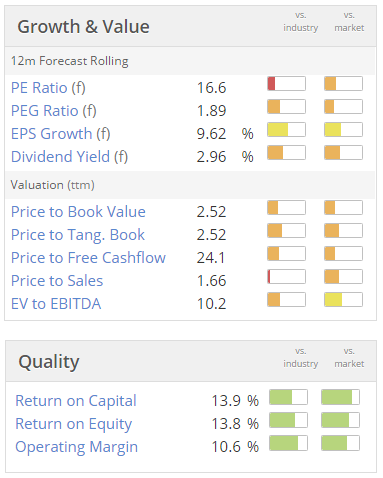
My opinion - I like the company, and it has a good balance sheet.
I expected this one to go wobbly (as it serves the hospitality sector), and PMP to remain solid (as they do decorative items mainly), but I got that wrong, as the opposite has happened to date.
Am not sure I'd want to rush in and buy at this point in time, given the economic situation.
EDIT - it's now Sunday afternoon, and Andy Murray has just started playing the Wimbledon final, it's 2 games all, in the first set. Sport doesn't interest me, although tennis & rugby are about the only ones I don't actively dislike. I blame the education system - I went to a very sports-focused state grammar school, where we were forced to participate in team sports. That just created a lifelong aversion to sports in me.
So instead of cheering on Andy, I'll catch up with some gaps in this report. We had another health crisis at my adopted family in London - our house Mum tripped over, walking the dogs. So I got a frantic call, mid-afternoon on Friday, and rushed over to the accident spot, to find her sitting on a dining room chair in the middle of the pavement. Some locals, and kindly passing Londoners, had stopped & made her comfortable, and called an ambulance.
I went with her in the ambulance to UCLH (a credit to the NHS, I should add), and we spent 6 hours in A&E, and it was bad news - a fractured hip & knee. They operated on her yesterday, and I'm pleased to say that the operation was a success, and she's sitting up in bed, remarkably perky considering.
Anyway, enough chit-chat, here are a few more comments on Friday's results/trading updates:
Indigovision (LON:IND)
Share price: 123.5p
No. shares: 7.6m
Market cap: £9.4m
(At the time of writing, I hold a long position in this share)
Trading update - as with everything, what's happened in the past doesn't matter, because we can't change the past. All I'm interested in is the future - i.e. all things considered, is this company worth more, or less than its current market cap of £9.4m? That's the only thing that matters when it comes to deciding whether to sell, hold, or buy more.
Here is the latest update for the 6m ended 30 Jun 2016;
Sales in the six month period to 30 June 2016 amounted to approximately $21.8 million, 3% below the corresponding period last year. Within this, camera volumes increased markedly but this gain was offset by lower camera product margins arising from continued competitive market conditions. Notwithstanding the market challenges, gross margin remained broadly in line with 2015 as a whole and within the Group's normal trading range.
The impact of overhead reductions made in 2015 continued to flow through in the six month period. As a result, the Group expects to report that last year's first half operating loss of $1.26million has been largely eradicated. Working capital management remains strong, with net cash of $4.6million at the period end.
Note that IND reports in US dollars, which makes sense since most of its product purchases, and sales, are in US dollars. All manufacturing is out-sourced, with IND choosing the spec for its cameras & encoders, and then getting world class manufacturers to make them. Therefore IND is mainly these days a software company - the hardware is really a means to get customers using its highly-regarded software.
A Motley Fool reader warned me, years ago, that IND would ultimately face price deflation as its early technological lead would be eroded by competitors. He was absolutely right, that's exactly what has happened since. Wish I'd listened! This is actually a very important theme for many investments. Companies which generate soaring profits for ground-breaking new products are often hauled in by competitors, chasing & then gradually eroding the fat margins. That's how capitalism works - super-normal profits attract competition. So I definitely need to think more deeply about how sustainable profit margins are for all growth companies.
H1 last year was particularly poor ($1.3m loss before tax), but H2 2015 was better, with a profit of $0.5m.
It sounds as if H1 2016 will be a small loss, driven by overheads reductions, so that's a good improvement against H1 2015, but a sequential deterioration against H2 2015. One of the positive things about IND, is that it has a largely flexible overheads base. So the company can adjust overheads to suit prevailing market conditions.
Net cash of $4.6m is great news - that's £3.5m, more than a third of the market cap. Note the benefit from forex movements too - each dollar is worth more, in sterling terms, than it was 6 months ago.
When net cash was last reported, it was $2.8m, at 31 Dec 2015. Therefore a big improvement in cash, in a near-breakeven half year, suggests that inventories & debtors have been usefully turned into cash.
So we seem strongly asset-backed at the current valuation. With flexible overheads, and a very strong balance sheet, IND remains copper-bottomed - there's no danger of it going bust for the foreseeable future anyway. This improves risk:reward considerably - especially as a strong balance sheet also means there's no risk of a discounted placing, which is so damaging for shareholder value at many other small caps. IND has had about 7.5m shares in issue since the dawn of time - unlike a lot of tiny companies which issue new shares like confetti.
Outlook comments - none given. Probably wise, given that the company has enormous difficulty forecasting performance. This is because just one big contract can mean the difference between a lousy year, and a blockbuster year. Shareholders simply have to accept that there is little to no visibility over performance, given that IND often has long-gestation major contracts.
My opinion - I'd like to exit, as I think the really big opportunity, to become a major player in the sector, globally, now seems unlikely to be achieved. However, IND is still very much in the game, and has a good suite of products, and numerous excellent reference sites, globally.
It spends a lot on product development, and has a good current range, with e.g. body-worn cameras with excellent features - such as a button to start recording in the past - 10 seconds ago - after a security incident has occurred. I think this is done by constantly recording on a short term loop in the background.
Overall, I would accept an exit at about 400p per share, but selling at 123p per share now doesn't make any sense at all to me, so I'll sit tight. Management have reasonable stakes, so interests are aligned. There's a good geographic spread of business, so Brexit impact should be mitigated. The recent exchange rate movements should be beneficial, as the sterling overhead base in Scotland just got cheaper, relative to gross margin in US dollars.
I think the company is fighting well, but is possibly too small to go it alone. Perhaps a takeover bid, or a JV with a larger player might make sense?
Johnston Press (LON:JPR)
Share price: 14.25p
No. shares: 105.9m
Market cap: £15.1m
The i newspaper sees record increase in readers - this is pure fluff. The equity is worth nothing, as I've said for years.
Debt ranks ahead of equity.
This is a nice share to punt in, so could be very volatile, but has no underlying value. Management are delusional, in my view.
Disclaimer
This is not financial advice. Our content is intended to be used and must be used for information and education purposes only. Please read our disclaimer and terms and conditions to understand our obligations.

46 comments
Interesting that some companies will prosper others suffer, I have friends working in it companies in the south east where I live. Some are telling me that many major deals are on hold, and that their budgets are all dollar denominated so they're really struggling.
Another was telling me that he's considering moving jobs into the area, from Poland, because the change in the exchange rate means that price difference of engineers here rather than Poland has shrunk to a point where it's not worth the hassle of remove working/cultural differences etc. I can't believe he's saying it's now cheaper to employ people here, but obviously there are downsides to split working and it's more productive to be based in one place with less language and cultural differences. So for people with the right skills, this might be good, for many this might be very bad. (note this company bills entirely in dollars).
My fear is that people who are in these companies having a bad time, then become cautious about spending themselves and it becomes sell forfilling that they don't spend on their houses, or on holidays, cars etc, and the slowdown becomes inevitable.
However who can see what the future exchange rate will be ? do you make decisions like moving jobs from eastern europe only to see it bounce back over 2 years ?
The uncertainty in exchange rate in itself is a problem,
Longer-term, I'd definitely like to run some courses to help non-accountants understand company accounts better, specifically for investing. Trouble is, like everything, it's all about finding the time. It would be an enormous project, to prepare really good quality presentations. But certainly something on the to do list, longer term. Hopefully also these SCVR articles are useful in pointing out plenty of red flags in company accounts.
The 100% losses are usually very easy to avoid, if you ignore the story that Directors are telling, and instead dissect the published numbers - which is actually quite quick & easy once you know what to look for.
Trouble is, most people don't want to spend the time or effort dissecting numbers. Instead, they want an easy to digest, positive story. Surely we've all learned by now that such stories nearly always go wrong?!
Regards, Paul.
I agree with your thinking/observation. I decided to get out of all low margin holdings - it just doesn't take much for such companies to get into trouble, especially in a downturn. My mindset at the moment is to look for quality; strong IP, high margins, good cash flow and low debt. This said, I'm not in any rush to buy as I think there will be some further market-wide shockwaves.
You're spot on when it comes to Avanti. It's all over.
The model here is totally broken. Satellite companies suffer from incredibly bad depreciation of their assets. There is a duel depreciation here. First the tech becomes obsolete (newer satellites have more capacity and similar fixed costs so cost per unit falls) and then the satellites fall out of the sky. Gravity attracts mass, if you don't keep pushing the satellite back it's going to fall into the ocean. Eventually you run out of fuel to run the boosters to maintain the orbit and your assets are worthless. Then earning power of the asset falls and then it dies. The business sucks.
I don't believe the debt holders will get their money back before their current fleet falls out of the sky. If there isn't enough money for debt holders equity holders get nothing. Avanti is finished.
Hi Connor,
I'm a bit out of the loop (geddit?!) about orbits, as I last studied Astronomy as a subsidiary subject at Uni, 25-30 years ago!
But my recollection is that when objects are put into orbit, they stay in orbit of their own accord, since the attraction of gravity from the earth is offset by their momentum to continue travelling in a straight line.
I thought the main risk to satellite was from space dust? Even tiny fragments of space junk can cause catastophic damage, as travelling at something like 20,000 mph. Apparently the space station has to track, and regularly adjust its position, to avoid collision with tiny particles which could puncture its skin.
AVN's main mistake was funding its operations with a ridiculous junk bond at 10% interest, when it had no means of paying the interest, let alone repaying capital. And price deflation for its services.
Regards, Paul.
You are right that I'm wrong on how satellites die but they do in fact effectively die. The sentence "gravity attracts mass if you don't keep pushing the satellite back it's going to fall into the ocean" isn't correct. Oops! This is quite embarrassing as I'm actually trained as an engineer! More helicopters than satellites though. Better look up my old notes and explain it properly (and correctly this time). The basic point that satellites have a short fixed useful life (and hence rapidly depreciate) is correct but the explanation of why is way off. Here goes...
Ultimately satellites will eventually end up in the ocean due to orbital decay (might take 1000+ years though). In practise, they have a fixed useful life of up to around 15 years and are limited by the propellant. After the propellant is used up you can't maintain your orbital slot or effectively point the satellite. Space isn't completely free of friction and complex gravitational effects cause a satellites orientation to drift which needs to be corrected which uses up propellant. At the end of the life of a satellite it can either be de-orbited and crash down into the ocean (reducing space junk) or be put in a graveyard orbit. You can insure away many risks like collisions but you can't insure against the inevitable fact that you will run out of propellant. Those tiny particles however cause incredible damage due to their insane speed. There is also something to do with the solar activity cycle which is a big risk but can't remember how it works.
The bottom line is that all of Avanti's current space assets will be worthless within about a decade. I think this is an extremely important point to consider when valuing Avant (historically that is as it is now screwed) and was one of the things that gave me confidence to short it (if things worked out magically it helped to limit the downside). I expect that the debt will never be repaid. The current fleet is, at best, not far off half of its useful life and most of the capacity has not even been sold yet. Every day that goes by the amount that bondholders can recover goes down as the propellant slowly runs down.
Hopefully that makes more sense and is correct this time.
Hi Connor,
Thanks for your response.
It sounds like satellites need a small, but finite amount of rocket fuel to make minor adjustments to maintain their orbit.
Also, the technology they carry will rapidly become obsolete, making the satellite commercially worthless after a few years.
Is that a fair summary?
Regards, Paul.
Yeah, that's the idea (and better explanation is here: http://www.satellitetoday.com/publications/2013/03/01/satellite-life-extension-reaching-for-the-holy-grail/). You see the double depreciation effect? Finite life + obsolescence + junk debt + huge leverage + failure to sell capacity =???
If you are not making huge returns in the early years you are in serious trouble. When Lucian says that the business model doesn't work he's right. When I asked my old lecturer (who taught spaceflight systems) about Avanti and explained that they had satellites in space for several years with less than 25% of the capacity sold he thought it was hilarious. In order to make enough money get a return over the cost of the junk debt means selling an insane amount of capacity to Africa. They launched the capacity and its not selling.
That's great.
Let's get points across in as few words as possible in future maybe?
Brevity is good.
P.
Buyhard,
Not thick it just that it is written in a secret code! 25yrs ago I took on the VAT returns for my wife and to help did level 2 RSA book-keeping at the local Adult Education Centre. My daytime job was consultant surgeon, got to less than half of tutorials but the tutor was very supportive and with her help, past papers and helpful comments on what I handed in I scored a distinction. I could then (and only then) understand Holmes and Sudgen, an idiots guide to accounts. Amazon have the 1990 edition (the one I had!) from 1p:
http://www.amazon.co.uk/Interpreting-Company-Reports-Accounts-Geoffrey/dp/085941650X/ref=sr_1_15?ie=UTF8&qid=1467990534&sr=8-15&keywords=read+company+accounts
I also had a red book of the same era, even more simple, might have been from FT but that was lent to a friend and never returned and cannot see it on Amazon. Well worth a visit to local charity shops, they end up pulping most financial books, I had always wanted to read Benjamin Graham and picked up a copy for NZ$1 (50p), hours of entertainment!
Regards,
Seadoc
Surely if the Dollar/Sterling relationship continues for a good while, some aggressive investors are going to be piling into what they consider under-valued UK stocks, and/or for acquisitive US companies go on the acquisition trail.
With US interest rates staying low, it must be almost the perfect time for large US entities to look at the UK?
Hello Paul,
Thanks for keeping up the excellent articles.
Exchange rates are the one point I would like to debate. When you refer to "sterling remaining low", is that based on anchoring to last month's price ? Or some independent fair value figure ?
As far as I can see, at the previous exchange rates, all we could do was run a horrendous balance of trade deficit, exceeding 4% of GDP. Long term, we cannot have equilibrium with such a deficit. A fall in the pound was inevitable & whilst it may be unpleasant for consumers, it is what the economy needs.
For me, the real question could be is the current exchange rate too high or too low ?
Jeff
Having just heard from a friend, up here in the north, that his company is laying off 50% (40 heads) because they can no longer afford to buy the materials they need to keep in business. I'm not so sure a lower £ is what the economy needs. It will benefit companies with strong IP and probably labour based, but I think small engineering manufacturers, with low margins in highly competitive markets are going to suffer.
Hi DJLJ,
Your comment does not pass the truth test. You said;
Having just heard from a friend, up here in the north, that his company is laying off 50% (40 heads) because they can no longer afford to buy the materials they need to keep in business. I'm not so sure a lower £ is what the economy needs
BS! Any proper business would not dream of getting rid of 50% of their workforce. You made that up!
Imported things will go up in price. Businesses will have to juggle prices, and everyone will survive.
Your mate sounds like a total clown!
PP.
Paul,
I don't know the detailed planning thats behind those figures or what timescales it will be over, but I belief it was the truth and I have a great deal of respect for the individual. I believe we will see a lot more of this happening (see yesterdays Sunday times ref. business's on south coast).
So while many businesses will survive and some no doubt thrive. Brexit and the fall in the valley of the £ is going to cause real problems for some business as they may not have the leverage to juggle prices and as consequence will have to take steps to manage their business.
Which was the real point
I also have Waterman (LON:WTM) I was annoyed I was going to sell it but someone persuaded me to hold onto it, next time I will go with my own instinct.
Norcros (LON:NXR) is down 24% post-Brexit vote so an interview with them would be interesting. I'd be particularly interested to know whether their raw materials are imported although presumably the weaker pound will benefit their South African operations which have been their main source of growth. Will ask that in a question nearer the time!
Paul,
Because Somero Enterprises Inc (LON:SOM) is a US company that reports in USD and has 70% of sales in the US, surely the only time the USD:GBP exchange rate effects UK investors is when the dividend (which is declared and paid in USD) gets paid into a UK broker account? In terms of Somero Enterprises Inc (LON:SOM) revenues from outside the US the main exchange rates of interest are the Euro and Chinese Yuan. This was my understanding last time I looked at the results, but even some of these revenues may actually be paid in USD.
With regard to exchange rates, it's happy days for my company. We always invoice in USD outside of the UK which accounts for 80-90% of revenue.... and we have a very inefficient balance sheet :-)
All the best, Si
Not really if the share price is in US$s and you buy before £ went down then its worth more? Its like buying at a discount, however buying now it could go the other way.
Not really if the share price is in US$s and you buy before £ went down then its worth more? Its like buying at a discount, however buying now it could go the other way.
But the share price is not in dollars. In real terms as a UK investor it's only the value of the sterling dividend that increases, but yes, I guess you could make the case that because the dividend yield and profits in sterling terms has increased that the share price should follow all other things being equal.
However, this isn't the same thing as being invested in a UK listed company with significant overseas revenue that is converted to sterling on the balance sheet - these are the exchange rate situations I'm most interested in investing in currently. Of course, you have to take the view that sterling will be depressed for some time, which I do.
All the best, Si
OK I see, sorry, I thought it was converted from a US$ price. Yes I would agree with you then.
I still find reading company accounts hard going (maybe I'm just thick?) Perhaps other people here have similar issues. Are there any seminars out there that cover this area? Paul, perhaps you could run one, for a small fee of course ;)
When I started out and wanted to get better at interpreting accounts I went to the library and checked out all of the books I could find on the subject.
I found some of them didn't hold my interest for very long. I would guess that there are many different ways of investing and I just wasn't on the same wavelength as the authors.
But one of the books I read (can't remember which, sorry) everything just clicked into place. It now seems so trivial and obvious that it's hard to believe I struggled so much at first. So my advice would be to start at the library.
If you do ever remember the name of that book please let me know :) Now, where's my library card...
buyhard,
There's a one hour video on YouTube by Bill Ackman that covers some of the basics early on.
William Ackman: Everything You Need to Know About Finance and Investing in Under an Hour
https://youtu.be/WEDIj9JBTC8
Hi Paul,
Pertinent comments on retail margins, exactly matches my thoughts in the comments section a couple of days ago as I imagine we're in a similar position to the company you mention. Working costs out at $1.50 should have been setting off some alarms somewhere a while ago though!!!
We've got some meetings next week to explore further hedging options for the future. This is something that small businesses in particular must be getting caught out on as they don't have the expertise or knowledge, and probably stick to forward contracts or buying at spot. Surely though, as we are as a business, people are becoming more aware of the need for hedging, perhaps an opportunity for growth by businesses like Record?...
I don't entirely agree with Jane's comment above about being able to minimize price rises by hard-nosed negotiation, surely this is just good business practice whatever the situation? You have to remember that we weren't really in a 'good' position regarding the exchange rate pre-Brexit (excluding the day before...), so importers will already have been trying their best to alleviate any price rises.
As a working example, we have a large customer who we encourage to place a Christmas order as early as possible each year, which normally works out to be about mid-February. This year, we had protracted negotiations because the rate had dropped to around $1.40 at the time, down from $1.50ish a year prior, so these issues aren't strictly Brexit related. These fluctuations are often compounded by raw material price rises in the Far East, but this is all nothing unusual..
Will
Will,
I would look in the first instance to share the currency risk with your suppliers. Maybe buy in RMB or GBP instead of $US? Not knowing your products I don't know how much of the cost is actually for raw materials priced in $US but I assume the manufacturing costs and overhead will all be RMB or other local currency. Whether you can do this depends on your supplier relationships, how important you are to them, your payment history, etc.
Longer term you may need to look at different supply chains - find cheaper countries as costs in China ratchet up or source closer to home as and when transport costs eventually rise.
I'm personally short the pound against the dollar and the Japanese yen, so I guess that means I think hedging short term could be a good idea, but it only delays or softens the blow. It might be better to take it on the chin and look afresh at your sourcing arrangements?
Hi John,
Thanks for the comments, we have these sorts of discussions with factories fairly often.
We're tend not to use a factory unless we can put at least around 75 TEUs of business through them annually, and have a lot of factories that we have used continuously for 20 years+. We aren't the type of business that will go to a trade fair, find the cheapest supplier and just use them, as is so often the case now, instead, continuity of supply and reliability are the key things for us, which naturally helps in negotiations because it means that we are normally the key customer for the production sites that we use. I understand that this approach differs to many importers, who perhaps are more focused on cost on an order by order basis, but in the long term the relationships that we have give us much more bargaining power in situations such as this where external factors may be affecting our margin.
Will
I've been pondering whether there is an opportunity for Record (LON:REC) as well. I used to hold but sold last year because the business seems to have lost its mojo a bit in recent years. I assume Record's clients are very large. From memory they have about 54 clients, and about $54b notional under management. Perhaps clients with well under $1b aren't worth their while?
Interesting to think of a bust satellite company, with satelites in orbit.
Paul
Thanks for your insights into retailers. Would you consider commenting on Boohoo.Com (LON:BOO) and Laura Ashley Holdings (LON:ALY) in this context both of which I believe you hold. I hold both.
Thanks.
It's quite straightforward to calculate the impact of currency moves for retailers e.g. Boohoo.Com (LON:BOO)
Year ending Feb 2016, Boohoo had Cost of Sales of £82.4million.
If we assume this is all souced in USD, then this will have now risen to £92m due to the 12% fall in GBPUSD since the UK Referendum.
This £10m rise in Cost of Sales is significant for a company making an Operating Profit of just £15m i.e. the currency move implies a 66% drop in profits.
Offsetting factors:
1. Boohoo could increase prices (though they have preferred not to in the past).
2. Forex hedging will protect the company in the short term, though the Accounts don't reveal the length of the hedges.
3. Maybe not all Cost of Sales are sourced in USD.
4. There will be some (local) USD SG&A costs.
Everyone assumes that Boohoo sources everything from China but from my brief chat with the MD at a recent investor show I don't think that's the case. The fancier product lines items with lots of labour content to add sequins and the like come from China, but the simpler items where fast turnround and market responsiveness is key are sourced in the UK. Perhaps Paul can comment?
Correction - should have written FD, not MD.
I doubt costs will all be in US$s, what if 50% are in Chinese yen, that has devalued this year. Also a lot of Boohoo.Com (LON:BOO) sales are abroad so will not be in £s.
"I think the answer is that we're not in an entirely rational market at the moment. We're still in price discovery mode - where the market often over-reacts on the downside after a shock to the system, then prices gradually find a level where demand & supply for each share balances out. This is a particularly chaotic process in small caps, which can move on the tiniest of volumes."
Great comment, Paul.
It's also a time that throws up tremendous opportunities - for the brave!
(PS: I think you may find that inflation in retail sectors is actually held back by manufacturing overcapacity in China, as well as by the desire of the Chinese central bank to see a depreciation of the yuan, both these giving the opportunity to British buyers to compensate for weakness in sterling and minimise price rises through being hard-nosed in the prices they are prepared to pay their Chinese suppliers).
Hi Jane,
Great point. You're right, that UK retailers will indeed be doing everything they can to strip costs out of the supply chain, to mitigate the impact of weaker sterling. I think it was IG Design (LON:IGR) who said something along those lines recently - re-engineering products to reduce the cost of production, etc.
So we should never under-estimate the ability of UK companies to adapt to changing circumstances.
I spoke to Boohoo.Com (LON:BOO) management recently, who said they are not increasing selling prices at all. They want to disrupt the market even more, and take market share away from the High Street, by offering even keener prices to the customer.
They didn't explain in any more detail, but my guess is that they'll be hammering their suppliers to reduce cost prices in dollars, so that the end product can be sold for the same price in the UK. I reckon they might have to take a bit of a haircut on their own gross margin too, but recently they've had a really good strategy of accepting a lower gross margin, but recouping it by an equal reduction in marketing spend. Thus achieving the same overall net profit margin, but achieving high sales growth because their products are so much better value for the end customers. It's a fantastic approach I think, hence why I still like BOO shares, despite it looking expensive on conventional metrics. I don't think people realise just how disruptive they are in their markets.
Regards, Paul.
I know this is a Small Cap Value Report but I guess this is where I would struggle with the Value approach. Why would I want to be brave in an uncertain market when I can deliver a 3 year annualised return of 20%?
I don't want to have to be brave ... if I wanted to dabble with sharp knives I could have joined the circus.
Best of luck
Phil
PhilH - How can you deliver a 3 year annualised return of 20%?
http://www.stockopedia.com/fantasy-funds/philhs-fund-4060/
Is Michael Hill New Zealand still going?
My understanding is that they are in the process of moving index and/ór changing ticker
Thanks PhilH, hope you keep it up, very interesting trading history.
I see thanks, just coming up on Stockopedia as inactive.
You and me both spooky.
Thanks
Phil
Are you ever going to do another investor interview? Reckon we're due one!