Small Cap Value Report (8 Sep 2014) - Scots Indy again, SEE, CCT, GTC, PEN, ESC, MUR

Good morning! If you're not interested in my macro musings, then ignore this next bit.
Revisiting a topic from last week, I'm still trying to get my head around the possible implications of the now knife-edge Scottish independence vote. To stress again, it's the economic/markets impact that matters as regards this column, not the political side of things, which is best discussed elsewhere.
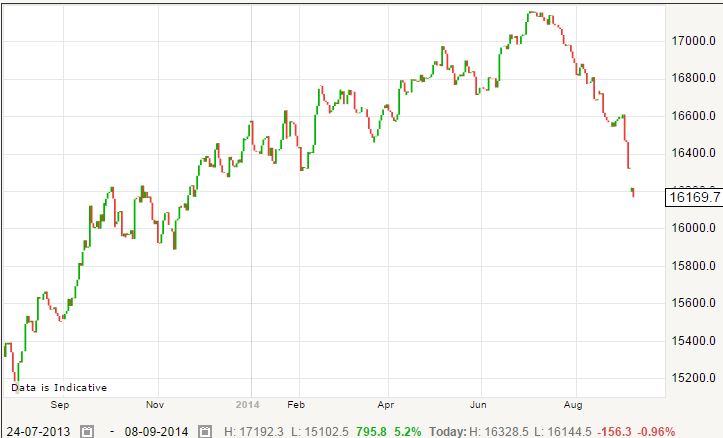
Sterling vs dollar - Looking at currencies first, commentators this morning are gushing about how the pound is weakening (a 1% move down against the dollar, to £1 = $1.617 this morning alone).
As you can see from the chart on the right (courtesy of IG Index) covering just over a year, sterling's move down against the dollar in the last two months has indeed been significant.
However, that's been reversing the previous trend of strengthening sterling, so we're now back to where we were in autumn of 2013. This is probably a good thing for investors, as numerous companies have been citing the strength of sterling against the dollar as a reason for disappointing earnings in the last few months.
So as long as the move doesn't turn into a rout, then I see the weakening pound against the dollar as a mostly good thing for my shareholdings. To recap, a weaker pound makes UK exports more competitive, makes UK manufacturers more competitive in the domestic market against overseas competition, and means that dollar denominated earnings translate into higher sterling earnings (e.g. with mainly dollar earnings, 4imprint (LON:FOUR) should benefit from the recent exchange rate movements).
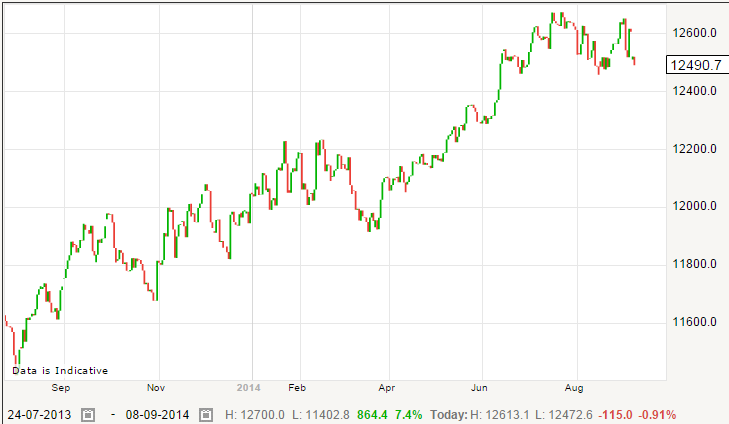
Sterling vs Euro - As everyone seems to be attributing recent sterling weakness against the dollar to the Scottish independence vote, I assumed that sterling must also be plunging against the Euro?
However, that is not the case at all. In fact, sterling has moved very little against the Euro recently, as you can see from the sterling:Euro chart on the left.
The Euro has got its own ongoing problems of course, but if the forex markets were really scared about the Scottish independence vote, then sterling would have sold off heavily against the Euro too, which is hasn't.
So it looks as if the only factor we need to consider (so far) as investors is the impact on our portfolios of the sharp move of sterling against the dollar.
UK stocks - Maybe investors will become more wary of buying or holding shares in companies with Scottish exposure, but personally I won't be making any adjustments to my portfolio. I like investing in companies in Northern England, and Scotland, as you tend to have more grounded management, who are less greedy, and more committed to the companies they run.
I have two Scottish companies in my portfolio Indigovision (LON:IND) and Spaceandpeople (LON:SAL). I cannot see any significant impact on either from Scottish independence. It will just be business as usual, in my opinion. So there's no reason to make any adjustments to my portfolio. In fact IND will be gaining from the recent dollar strength vs sterling.
Portfolio insurance - since the Scottish vote is very soon, on 18 Sep 2014, and Sep 2014 FTSE Put Options expire on 19 Sep 2014, then it seems to me they make a good insurance policy against the market having a panic sell-off, if an upset looks likely. So I bought some FTSE 100 Puts last week, which is looking a good move so far, as they have almost doubled in value already.
At the very least, I think a Yes vote could push Scotland, and maybe even the whole UK into another Recession, as the substantial uncertainty is likely to curtail business investment. How can businesses invest, if they don't even know what currency they will be using, what interest rates will be, etc?
The timing of this whole thing is insane. Surely it could have been delayed until the economy was stable, and growing sustainably? I seem to be far more worried about this than most other people, so perhaps I'm fretting unnecessarily? It does strike me as a big issue though, in terms of potential risks to the market, hence why I'm nervous.
Seeing Machines (LON:SEE)
Share price: 7.5p
No. shares: 822.2m
Market Cap: £61.7m
There's been excellent newsflow recently from this small Australian developer of eye-tracking software & equipment. Although it's worth bearing in mind that the company is likely to be loss-making for a couple more years. However, we're still in a bull market, and investors are prepared to pay up-front for exciting technology such as this.
The company already has a relationship with Caterpillar, selling its equipment for large trucks deployed in mines. The second market is road transport, with a couple of deals already announced there. Today sees a third strand added to SEE's activities, namely a "memorandum of understanding" with Samsung. No financial details are given, so one shouldn't get too excited about this, however it does look encouraging, with the two companies formalising a joint R&D effort.
I particularly like the endorsement of SEE's technology from Samsung;
Mr Sunkyu Lee, VP of Product Planning at SEMCo said: "SEMCo has been working with Seeing Machines for some time now and recognises their eye tracking algorithms as industry best. I believe that our joint development and commercialisation of these technologies will radically enhance the user experience and ultimately change the way that people use their electronic devices to interact with their online and offline environments. "
I know that the most cynical of you will disregard such quotes, but it doesn't do any harm getting high quality third party confirmation that SEE are indeed the leaders in their field.
The market cap of SEE is getting rather on the warm side again, but given the strength of the newsflow, personally I'm not inclined to sell my existing holding.
Character (LON:CCT)
Share price: 214p
No. shares: 21.3m
Market Cap: £45.5m
There's a positive trading statement from the company today, saying;
...the Group anticipates it will report that the financial year ended 31 August 2014 has performed in line with management forecasts and therefore expects to deliver results in line with market expectations.
The shares look cheap to me;
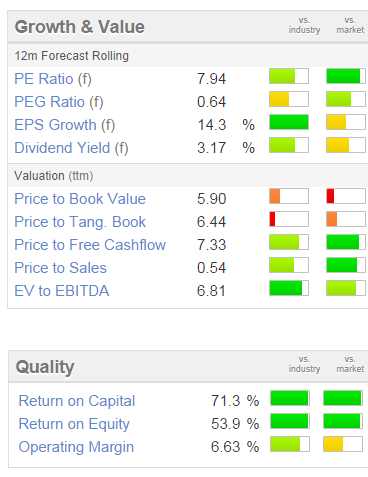
Although in the past the company has been subject to the vagaries of demand for toys, with the occasional bad year thrown in, as you can see from the Stockopedia graphical history below;
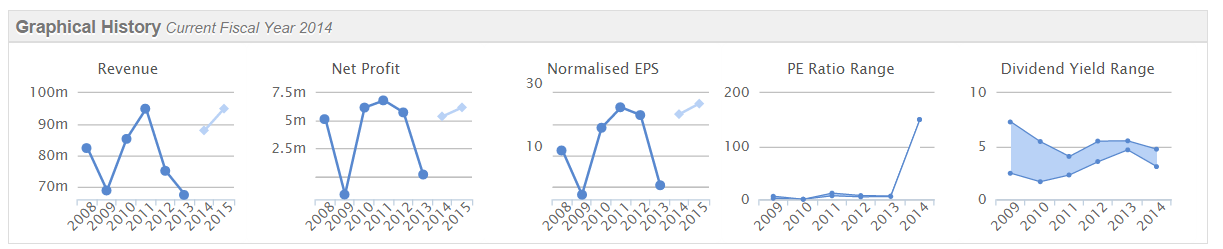
The only reason I don't currently hold any of these shares in my portfolio is because the bid/offer spread has been too wide, and the shares are horribly illiquid, which puts me off. Having said that, it's probably a mistake, based on the current valuation I should probably hold this share, but don't. Might pick up a few on the next market wobble.
BREAKING NEWS! - In a separate announcement, CCT announces that is has signed the Teletubbies!!!
Getech (LON:GTC)
Share price: 64.5p
No. shares: 30.3m
Market Cap: £19.6m
Shareholders at this oil services company (they do seismic mapping & data for oil exploration cos) have endured something of a rollercoaster this year, with a rather odd series of negative, then positive announcements in rapid succession.
This morning's headline from the company is striking;
Largest ever new contract - $5 million
The customer is the Angolan national oil co, Sonangol. More detail about the contract is given, the most important bit being this;
The work is due to start immediately and the Company anticipates that most of the income will be recognised in the current financial year. This is an excellent start to the year and gives confidence that the Company will meet the current year market forecasts.
So before getting to carried away, it's worth noting that they are only talking about meeting, not beating market forecasts. That said, given the debacle earlier this year, it makes sense to play it safe. Also, as the company has a 31 July year end, they are only just over one month into the current year, so it would be a bit mad to suggest outperformance this early on, especially as the company has lumpy revenues, and they don't know how the rest of the year will pan out.
The shares are up 19% today to 66.5p, which given the inherent uncertainty about performance, looks high enough for the time being, in my opinion. This translates into a PER of 10.8 times broker consensus forecast of 6.13p EPS this year.
A 2.1p divi is forecast for this year, giving a useful yield of 3.4%.
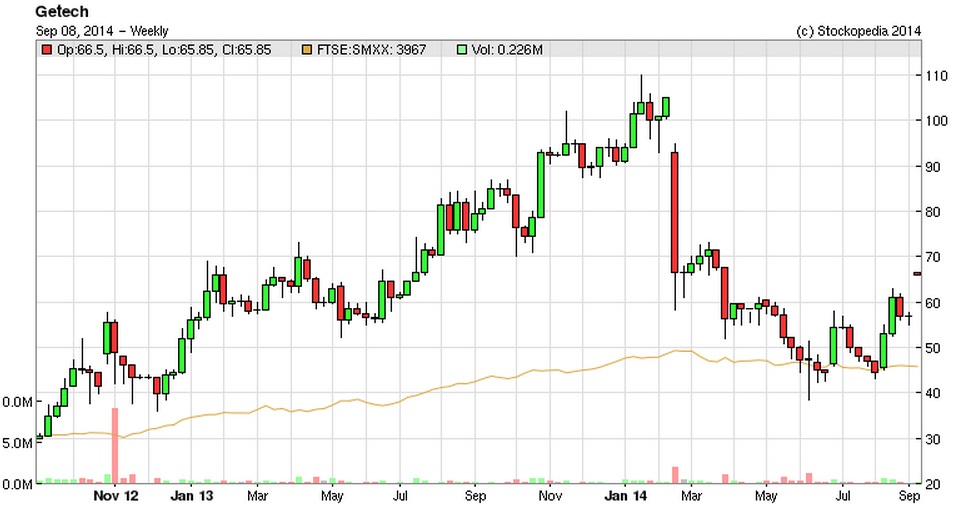
As you can see from the two year chart, shareholders need to be prepared for volatility here. Also I feel it's important not to let the valuation get too stretched, otherwise you're the wrong side of risk:reward if something else goes wrong, as inevitably it will at some point - since small companies like this are heavily dependent on a small number of key clients & contracts.
Pennant International (LON:PEN)
Share price: 86p
No. shares: 26.3m
Market Cap: £22.6m
Next I'm having a quick skim through the interim results to 30 Jun 2014. Pennant is a small group of companies that seems to mainly operate in the flight simulator area, and similar.
The interim results are roughly flat against last year. EPS rose slightly to 3.47p. There was no H1:H2 seasonality last year, so assuming the same this year and doubling H1 EPS gives us just under 7p full year EPS. So that puts the shares on a PER of about 12.3. That looks about right to me.
The Balance Sheet look solid, although debtors look slightly on the high side, but similar to 6m and 12m ago, so no change there. Net cash has grown to almost £1.9m, which I like.
The outlook statement says;
The pipeline is active and there has been significant on-going dialogue with a broad spread of potential customers on a number of significant opportunities particularly in the defence and rail sectors. While the timing of these opportunities is generally outside our control, the Group's good relationships with its customers and its strong balance sheet provide a firm position from which to build and realise the opportunities as they arise.
So that's completely vague really.
Overall, it looks priced about right I reckon. The 5p fall today doesn't look like a buying opportunity in my opinion, as there's nothing to go on about future potential. So if the company executes well, then the shares will go up, if it executes badly, the shares will go down. I've no idea which it will be, time will tell!
Escher Group (LON:ESCH)
Share price: 280p
No. shares: 18.7m
Market Cap: £52.2m
Interim results to 30 Jun 2014 from this software provider to many postal services globally, look poor to me.
Revenue fell 14% to $11.1m (note the company reports in US dollars), and operating profit fell almost 50% to only $692k. That doesn't look much good in the context of a £52.2m market cap (stated after today's 8% fall in share price).
I'm not keen on this company - whilst it has won impressive contracts with major customers globally, it doesn't really make much profit relative to the market cap, and the profit trend seems to be downwards. The business model relies far too heavily on unpredictable licence fees, in my view. There are no dividends either.
The company might have some strategic value, to an acquirer that is keen to gain access to a critical software provider to many large postal services. However, I can't see much value in it as a standalone company.
The outlook statement sounds mixed;
As the point-of-service automation supplier of choice for postal organisations across the globe, the Group will continue its drive to penetrate this market. Although lead times are long, the Group has been in contact with several postal organisations for some time and is confident that new customers will be signed during the next 12 months.
The recent move to a subscription based revenue model changes the profile of our revenue recognition and while positive in the long run will have a materially negative impact on the Group's revenue for 2014 and associated adjusted EBITDA.
The Board's expectation, adjusted for a subscription based model, for the financial outcome for the full year remains dependent on a license sale and the rollout by a major customer of its integrated Riposte solution. When this has been rolled out to a certain number of workstations, Escher will recognise significant license revenues. Progress with rollout is continuing and the expectation is that rollout will complete in 2014.
The new digital services and interactive retail markets are developing well and the pipeline of opportunities has expanded over the last 12 months. The South Africa Post Office RiposteTrEx contract win in December 2013 is the start of the commercialisation of this opportunity and proof of the emerging demand for these services.
Escher's Interactive Services have also developed a range of technologies including NFC to loyalty and couponing on mobile phones, which has led to an increase in the number of opportunities in the market.
Given the quality of the Group's pipeline and current technology set, Escher remains confident about the prospects for 2014 and beyond.
My opinion - the shares are difficult to value, and in my view there are too many uncertainties to make me want to pay a premium valuation for uncertain performance.
Lunch beckons, so a couple of quickies;
Murgitroyd (LON:MUR) - I've been saying for a while that shares in this European patent attorney are too expensive, and that is very much confirmed by disappointing results for the year ended 31 May 2014 published today.
Turnover rose 6.7% to £38.4m, but profit before tax fell 9% to £4.1m. Basic EPS fell from 38.2p last time to 33.2p this time. That puts the shares on a historic PER of 15.2 (based on current share price of 505p). That valuation only stacks up if you expect profit to recover. Although in fairness, broker consensus was slightly lower at 32.4p, so the company has slightly beaten expectations.
Net debt has been almost eliminated, and is now only £0.4m.
Reflecting the mature nature of the business, management say a more aggressive dividend policy is being adopted.
It doesn't appeal to me. I'd be looking to pay a PER of 10-12 tops, to attract me into these shares.
Cambria Automobiles (LON:CAMB) - There's a nice trading update today;
...the Board is pleased to report that the Group has continued to perform well and that the results for the year ended 31 August 2014 are expected to be ahead of current market forecasts.
Current trading sounds good too;
Heading into the important September trading period, the Group's new car order book is ahead of the same point last year, reflecting the continuing strength of the new car market. The Board continues to view prospects for the new financial year with confidence.
The shares look pretty good value to me, but as always please be sure to DYOR.
Phew bit of a mammoth report today, I might need a lie down on the sofa after lunch!
See you tomorrow!
Regards, Paul.
(of the companies mentioned today, Paul has a long positions in SEE, IND & SAL, and no short positions)
Disclaimer
This is not financial advice. Our content is intended to be used and must be used for information and education purposes only. Please read our disclaimer and terms and conditions to understand our obligations.

24 comments
IMHO the politicians (all of them) have made a complete mess of this and wasted a lot of time as a result... There are basically two questions to be settled: do the Scots want independence, and if so, what the practical arrangements for it should be. The sensible way to have resolved those would have been first to have a Scottish referendum asking whether independence is wanted, on the understanding that if it produced a 'Yes' vote, there would be a prolonged period of negotiation about the separation terms, followed by a referendum in each of Scotland and the rest of the UK about whether those terms are acceptable. The first referendum could have been done quite quickly - I would say at least a year ago, probably more - and if it produced a 'Yes' vote, there would have been that much more time to negotiate the separation terms.
As it is, we've had a lot of arguing about the separation terms that has all been done with the primary aim of winning the upcoming referendum rather than of deciding what the separation terms will be. I.e. the serious negotiations about the separation terms will only really start if and when there is a 'Yes' vote later this month - everything up to now has basically been posturing... :-(
The net result is likely to be that the total period of uncertainty is far longer than it need have been, various Scots have been alienated by interference in the "do you want independence?" question that (IMHO quite rightly) they regard as up to them and them alone, while very probably quite a few of those interfering have felt they had to because there was no clear later opportunity for their legitimate input on the separation terms, rest-of-UK voters like me feel alienated by the fact that important changes to our country's currency and central bank are being discussed without even a hint that our approval will be sought, etc.
A total mess, and in the event of a 'Yes' vote, I shall be very surprised if the 18-month period before actual independence results in anything better than a paper-over-the-cracks solution. So IMHO we need to be prepared for a very considerable period of uncertainty.
Gengulphus
My friends up north don't advertise that they will vote no, because they don't want a brick through the window.
If a yes vote results then they expect to return to england.
Passions are running very high and a narrow victory for either side, i think, will generate lots of bitterness which will take years to overcome.
There is no doubt in my mind that that a more positive focus on the benefits of the union would have been a better approach.
If Scotland gets independence, they can no longer sent all their Labour MPs down to Westminster to vote on matters that don't affect Scotland.
Personally, I see the prospect of more Conservative government as good for business and good for investors.
So good for the remainder of the UK. I would vote for that if we had the chance down here.
I suspect you're wrong in relation to the impact of Scottish MP's and next years General Election where apparently they are, at the moment, still to be included in "the count"
Such that next year Milliband and Labour might win with a majority, but come 2016 when all the administration related to a "Yes" vote will be be complete, suddenly find himself with a minority government - and thus we'll have another election!
Ludicrous. Far better to take the Scottish,and Libdem MP's(arising from Scottish constituencies) out of the equation immediately on the result being declared....
And yes, agree. As a result we'd get a more Conservative government ultimately, the due redrawing of the boundaries to reflect marked constituency population differences and a full blooded Conservative government. Plenty to be optimistic about - particularly for NE England regeneration from the relocation of shipyards, the Nuclear Subs, and new border controls, all contributing local employment opportunities. With an official population of 53 million I don't see England struggling going forward.
I would be very surprised if there was not a run on the Scottish banks and sterling, plus a sharp sell-off in shares, if Scotland voted yes on September 18th. Fortunately HMG still retains a sizeable stake in Royal Bank of Scotland, the most vulnerable bank, so this should offer some protection from an all-out financial crisis. However, the international ramifications of the break-up of the United Kingdom, one of the pillars of the global financial system, should not be underestimated.
In the event of a 'yes' vote on 18 Sept, there will follow 18 months of protracted, ill-tempered and partisan negotiations on key issues such as currency, defence, natiional debt and re-allocation of assets. The uncertainty on such fundamental questions will jack up interest rates, damage sterling and business confidence. UK's recent recovery is still fragile and based largely on consumer spending. A yes vote would almost certainly pull the ftse down in double digit percentage for the short and medium term. Methinks it is time to throw out any share in my portfolio that cannot be justified on pure fundamental grounds.
The £/Euro graph shows that the Sterling fall against the dollar has little to do with Scottish independence.
Can Scotland "default" by not accepting a share of UK sovereign debt?
The debt is backed by UK assets (most of which, by value, could be said to be in the South East of England and which Scotland won't share proportionately - so why should Scotland accept the debt proportionately?).
If the lenders don't face default (because the UK Treasury has guaranteed to honour all the debt (Which, after all, is UK debt issued by the UK Treasury), why would lenders assume that Scotland would default on future debt just because Scotland declined to take on some of the UK debt unless a currency union was agreed? Surely, future lenders would look at Scotland's ability to repay any loans (and require a suitable premium in return) rather than worry about some notional past "default" that hadn't actually happened.
Salmond may lower corporation tax rates to keep companies headquartered in Scotland and to attract inward investment. Indeed, Scotland might become a tax haven for wealthy UK nationals who would benefit from non-dom status.
More important to me is the impact on UK interest rates. The BoE would want to keep them low, but the markets might require higher rates on new Gilt issues. Can they work that trick, other than through a new round of QE? It's a mystery to me.
It is very interesting what is happening with the Scottish referendum. History says that 'don't knows' will decide to stick with the status quo. The 1999 Australian referendum on becoming a republic is one example. In the Quebec referendum in 1995, the 'Yes' camp had quite a big lead but lost it on the home straight. In Scotland the 'don't knows' appear to defying convention by swinging into the 'Yes' camp.
The big problem is that the three main UK parties have all aligned themselves with the 'Better Together' campaign and so the 'don't knows' appear to be deciding based on the one thing that they are certain of, which is that they dislike the entire UK political establishment. What better way to stick it to all of them at once! If all the leaders had adopted a neutral stance then we probably wouldn't be in this situation.
However, there could be another twist here. The "No's" still don't have an outright lead and there are still 7% or so who have yet to make up their minds. Fear is a more powerful emotion than hope and two weeks of stockmarket turmoil could be just what it takes to keep Britain together.
Hi I am totally against independence purely on an economic basis unfortunately there are many scots who will be voting with their heart not their head.I agree with what you are saying ,its about emotions, not the facts ,and if there is a yes vote ,there will be no political party in the rest of the uk offering any deal on currency especially with a general election next year .
I have to disagree with the view "Smaller ones [companies] as mentioned shouldn't really suffer accept in the event of a wider market panic impact."
Small Scottish companies will suffer the most, particularly if there is no currency union (and why would Osborne agree to one?). The likely hike in interest rates of any independent Scottish bank (due to market confidence in the ability to service debt) will hit small Scottish companies the greatest. They also have the least ability to withstand a sudden change in credit conditions.
Just like the EU experiment (think Germany and Greece) sharing a currency with another country with a divergent economy is never a good idea.
That may be the case, but most of those issues may be some time ahead and dependent on what happens in any post yes vote negotiations. There's clearly the potential for it go very wrong, which is why I think many of the bigger, especially banks and finance related companies, will relocate and look to do it quickly. Scotland would not be able to set up a credible currency or Central Bank of its own overnight. I mean the pound in Scotland doesn't become null and void the day after a yes vote, but if no means no the clock will be ticking and if politicians drag their feet then the markets may well force the issue as they often do.
True the pound does not become null and void. But it will reflect a new regime, i.e. Scotland + rUK as opposed to the union (which is much more credit worthy that the two independents combined). This will be priced in immediately. If it significantly hurts sterling then an interest rate rise is the main defense of the BoE, until the details of the new order are determined. So likely to hit both rUK and Scots companies. But longer term it is likely to hit small scots companies the hardest if there is indeed a currency split. Which is far from certain.
Hi Paul,
Re impact of "Yes" on Scottish cos. like Indigovision (LON:IND) . There is one potential problem I can see, which is the uncertainty about Scotland's post-independence currency. Clearly if there is a "yes", a series of protracted negotiations on matters including currency & apportionment of debt and assets between Scotland and rUK will follow. This raises questions such as what currency future contracts will be drawn in, what currency will IND's staff be paid in. There will also be questions such as future corporation tax rates (IIRC, Salmond has suggested these will be low) and social security tax rates (ISTM that they may have to be hiked - v bad idea IMO - to pay for promised social spending).
Client uncertainty re currency matters could be disruptive to sales (hopefully not).
Not fundamental reasons to be bearish, but collectively they do raise some uncertainty about valuation of investments in Scottish-based companies like IND.
The issues are potentially larger for my investment in Premier Oil (LON:PMO) , which has been hit quite hard (-1.8%) today. Glad I topsliced not long ago (though, at the time, "yes" looked unlikely). "Yes" could kill the goose that lays the golden eggs, i.e. Scottish oil revenues, unless Salmond clears up any uncertainty about oil & gas regulation & taxation very promptly. We've seen this impact before when Osborne's cack-handed tax grab caused numerous projects to be postponed or cancelled with a big loss of jobs and potential jobs.
Cheers,
Mark
I would expect the closer the vote gets and if it looks like a yes then more of the bigger quoted companies will come out and say whether they stay in Scotland or relocate. Both RBS and Lloyds will probably announce their intention to leave as soon as feasible after a yes vote. Others are likely to follow if only because they know the one thing markets hate is uncertainty and their share price will probably suffer. Smaller ones as mentioned shouldn't really suffer accept in the event of a wider market panic impact.
The main uncertainty , and there are a few, has to be around the currency Central Bank issue. I'm astonished that some on the yes side cannot see this or think they can somehow get what they want by threats of debt default. Markets will not react kindly to this. The key will be if the UK holds firm on no to sharing the pound and no to the BoE being Scotland's Central Bank and lender of last resort. I don't see how the UK can agree to this or why an independent Scotland would want it.
Hi SevenPillars,
Yes you are right to stress the importance of the central bank issue.
I listened to a programme on Radio 4 over the weekend, trying to assess how independence might work for Scotland, so they went to Slovakia, and investigated how its independence from Czech panned out.
What they found is that people said it took about 10 years to get used to the idea of being an independent nation, but that the public now like it. However, it caused economic upheaval, and the Slovak Finance Minister said in his interview that by far their biggest challenge was establishing credibility in the capital markets.
With that point in mind, I think Salmond has made a huge mistake by being so flippant about Scotland possibly deciding to default on its debt once independent. That could well turn out to be a catastrophic error, in that the capital markets might well demand a big risk premium on the yields for Scottish debt, unless & until it becomes clear that no default will actually happen.
Also, the UK Treasury bizarrely said it would guarantee future Scottish debt, which seemed an astonishingly foolish own-goal, as it then opened the doors to the Scottish Nationalists saying whatever they wanted, with no consequences. That UK guarantee should be wtihdrawn - if the Scots go it alone, then good luck to them, but they're totally on their own, and English voters will expect England to treat Scotland as a foreign country, and hence impose hefty charges for using any English facilities (e.g. embassies, armed forces, use of sterling, and everything else).
This is not going to be an amicable divorce, no divorce ever is!
Anyway, we may still get a No vote, as a bit like with the AV vote, when people look over the edge into the unknown, they often back away and stick with the status quo. The rational ones do anyway. Trouble is, reason has gone out of the window with a lot of people north of the border, since the Nationalists have whipped up a rather ugly patriotic fervour.
Regards, Paul.
I'm kicking myself that i didn't buy into Getech (LON:GTC) when they were at 45p.... They announced a $5million contract today and are pushing 65p.... Well done to those who bought in!
Hi Paul
You suggest that for companies based in Scotland it will be 'business as normal', even in an independent entity. However the Scottish government will have to pay for the increased and improved services it says it will offer. One very easy way to do that is an increase in Corporation Tax,or a rise in business rates. This reminds me of the threat of Home Rule in Ireland c1912, when large Dublin companies, like Jacobs and Guinness, reacted by opening subsiduaries in England. So if independence does come I can see economic uncertainty continuing for a considerable length of time, both sides of the border. A close run thing will offer the prospect of further referenda, and continued uncertainty, both sides of the border! Only a resounding 'No' will help us. I still think that can happen.
Furthernmore independence will force the rest of the UK into considerable non-productive government spending, such as that required for replacing lost defence facilities. Any form of tax dfferential will cause one side of the border to become an economic wasteland, as workers and industries move to follow incentives. Border urban centres, such as Carlisle or Dumfries, will be shorn of their natural hinterlands, and will see permanent recession. The markets hate uncertainty, and that is exactly what is being created here, and possibly for an indefinite period.
Cameron decided to call Salmond's bluff. But you cannot bluff a bluffer!!
£/€ comparison a bit tricky since economic numbers from Eurozone have been weak lately esp. the powerhouse Germany. The ECB has been particularly dovish and kept rates low and hinted at asset purchases. Short term rates even in Ireland have gone negative. This has meant a weaker Euro and to some extent I don't doubt weaker £ too (nothing to do with Scot independence vote) since Eurozone an important economy to UK.
The FTSE put hedge looks sensible here (although I've not done it myself).
Log
Hi Paul -
"At the very least, I think a Yes vote could push Scotland, and maybe even the whole UK into another Recession, "
Worst case scenario would be ...?
Hi Ramridge,
Worst case scenario would be a run on sterling, a run on UK banks, and interest rates having to be hiked up to 5-10% to stop the rot. I don't think that's likely though, but it's possible.
It would probably take some other major world catastrophe, not just Scottish independence, to trigger that sort of thing though.
Our saving grace is probably that the Eurozone is so weak at the moment.
Regards, Paul.
hi Paul. Good news from Getech this morning. http://www.investegate.co.uk/getech-group-plc/rns/largest-ever-new-contract----5-million/201409080700100188R/
Hi DLG,
Yes I know, am coming on to Getech (LON:GTC) and Pennant International (LON:PEN) next!
Cheers, Paul.
Ireland became Eire and adopted the Punt, so Scotland could become Caledonia and adopt the Pant then the fun begins
Indeed. I think Scotland will have to create their own currency, and central bank - after all, you're not a sovereign nation without that. Or they could adopt the Euro, and be dictated to by Brussels instead of London. There's no way England will agree to a formal currency union in my view, although in all likelihood Sterling would continue to be widely used as a day-to-day currency in an independent Scotland, especially if the Scottish pound devalued.
In all probability independence would work well in good years, when the oil revenues are high, and would cause horrendous problems in bad years, when the Scots would face levels of austerity that would dwarf anything that London has ever imposed - since the Scottish economy is so heavily dependent on public sector spending that they wouldn't be able to sustain on their own, in my view.
Being part of the UK smooths all of that out, a message that doesn't seem to have been even mentioned in this utterly chaotic independence campaign, which seems to be all about emotions, and extreme posturing, than rational analysis of the facts.