Small Cap Value Report (9 Feb 2015) - QRT, FLOW, HSS, PLA, ACL, HDD

Good morning! Here we go again, another week of reports. It's quiet for news today, so a leisurely start to the week.
New audiocast - for anyone interested, who hasn't already come across it, I published a new audiocast yesterday, interviewing renowned investor Richard Crow (@RebelHQ on Twitter). Richard (rightly) has a large following in the private investor community, and he gave us some fascinating insights into his investing approach - based on common sense, turnaround situations, some contrarian thinking, and charts signaling to him when sentiment is improving. Lots of thought-provoking comments, so well worth a listen - click here.
Mello Bloomberg - another event from David Stredder! He's teamed up with Bloomberg, who are kindly hosting a one-off event at their London HQ, which I am told is a pretty funky & exciting place to visit. The hospitality is excellent too, I am reliably informed. Speakers for the tech-themed evening include Mark Slater, and Ben Rogoff of Polar Capital. Networking over drinks and a buffet, will follow.
This unique event will be held on Thu 12 Mar 2015, from 5pm-approx. 9:30pm. No doubt we will spill out into a nearby pub at the end. To book your ticket, please use this link. NB! We have a special Stockopedia discount code, so if you enter DISCSTOCK you will get £14 knocked off the ticket price (reduced from £49 to £35). Hope to see some of you there!
Quarto Inc (LON:QRT)
Share price: 156p
No. shares: 19.7m
Market Cap: £30.7m
Refinancing - this book publisher has entered into a new four-year syndicated bank facility with four banks. It's a mixture of overdraft and term loan, but no financial details are given.
I wonder how much the banks stung them for, in arrangement fees? I bet it was a hefty amount.
My opinion - it's good to see the banks being supportive, but what if they hadn't been? The company could have sunk under the weight of its excessive debt.
As covered in my report of 2 Feb 2015, the debt situation here is clearly excessive (which the company tacitly admits, with frequent comments in its announcements about the need to reduce debt). It is strange that the company continues paying generous dividends, whilst having a weak balance sheet with far too much debt. That seems reckless to me.
The EBITDA figure is meaningless, as the company capitalises so much onto its balance sheet, within current assets as "pre-production costs". If you more conservatively write off such costs, then the balance sheet looks extremely thin, in my view.
Overall, risk has clearly reduced with new bank facilities now in place, and the company is trading well. So perhaps my worries are overdone, but personally I don't compromise on weak balance sheets - why take on extra risk when you don't have to? There are plenty of good companies out there with ungeared balance sheets.
So this share remains something I wouldn't be interested in. It's on a low PER for good reasons.
Flowgroup (LON:FLOW)
Share price: 34.4p
No. shares: 239.5m
Market Cap: £82.4m
Launch marketing - today's RNS gives information about the marketing campaign for the launch of the company's new type of domestic boiler. It generates electricity, as well as conventional heating of radiators. This electricity is fed back into the grid, and the feed in tariff is used to finance the capital cost of the boiler.
My opinion - the installation cost (over and above the price of the boiler itself) seems rather high, and looks to be not far off the cost of a conventional boiler (fitted). So I'm not convinced that the economics of this product are sufficiently compelling to drive rapid adoption.
It sounds intriguing, but I've decided to sit this one out, on the sidelines, and wait for clearer evidence as to whether this new type of boiler is being adopted by customers in sufficient volume to make the shares attractive at the fairly hefty market cap of £82.4m.
It's very difficult to dislodge tried & tested conventional technology with something new, so I would need to see firmer evidence of commercial success before wanting to risk my money again on this share.
HSS Hire Shops
HSS Hire Shops joins the main market today.
The shares seem to have opened at a discount to the offer price of 210p, being 197.5p at the time of writing. I'll have a quick read of the admission document when time permits.
Most IPOs are over-priced in my view, and it's usually an opportunity for an existing backer to bank their gains & move on. But the odd one does well.
Plastics Capital (LON:PLA)
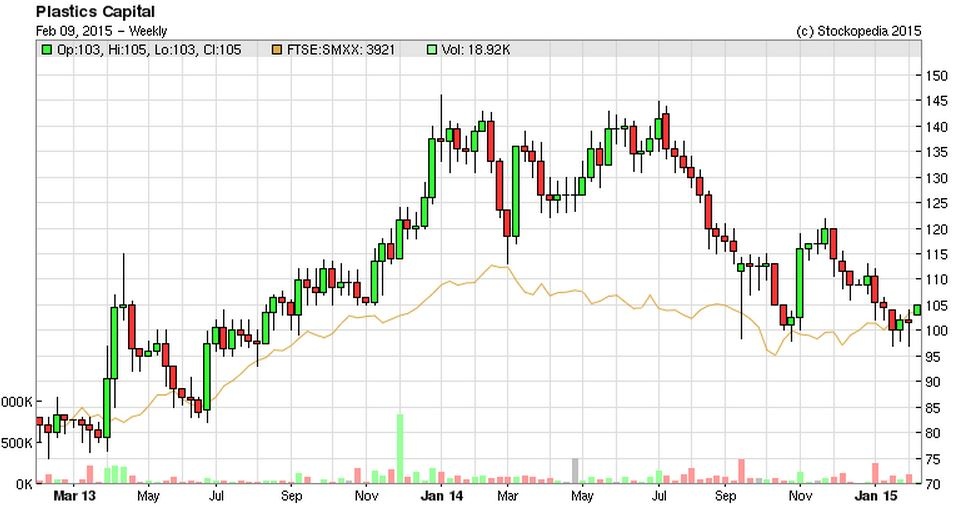
Share price: 105p
No. shares: 35.3m
Market Cap: £37.1m
Trading update - this small, niche plastics group, says that trading is in line with expectations (Q3 is Oct-Dec 2014, as the company's year end is 31 Mar 2015).
Operating margins are benefiting from lower raw materials prices (presumably linked to the lower price of oil), and cost reduction initiatives. It says that the acquisiton of Flexipol has gone well.
Somewhat confusingly, the last sentence seems to slightly backtrack from the positive narrative preceding, saying that H2 will be "broadly in line with market expectations". As we all know, that means slightly below, so it sounds like a very slight profit warning for Q4, but nobody seems to have noticed, and the share price is up 1p today!
My opinion - I tend to blow hot & cold on this share. It looks quite good value, if you believe the adjusted profit figures. Also the dividend yield is now appealing at about 4%. I'll firm up a view on it, when the full year accounts come out, which should be at the end of June.
Webinar tomorrow
I see Ed's doing a webinar on the StockRanks tomorrow at 12:30 - see the banner at the top of the main menu for a sign up link. Should be interesting, I'll be listening in.
I think many of us have seen enough of the StockRank system here on Stockopedia to get increasingly comfortable that it's a pretty good initial filter for sound stock ideas. We still need to do our own research too, but I am increasingly liking it, as it generally rates sound companies highly in my view.
Probably like most people here, I'm inherently suspicious of automated systems for stock-picking, since they can overlook glaring negatives that should be obvious to a human (e.g. the inherent dodginess of Chinese stocks!). But combine a good human common sense filter, with the StockRank system to provide a shortlist, and I reckon that's a very good combination for finding a basket of stocks that is likely to out-perform over time.
Euro / Greece
Following the news over the weekend, it seems that the Euro is yet again facing another potential crisis. It's not just about whether Greece is going to exit the Euro (looking increasingly inevitable, surely?). Worries are building over how other, larger, heavily indebted countries such as Spain, and Italy, might react. If Greece manages to exit the Euro and write off its debts, then that is likely to trigger political turmoil in those countries, with the populace demanding equally radical solutions there too?
Who knows what impact this is likely to have on equity markets? It's starting to make me feel nervous anyway, and I'm reluctant to take on any new positions with another Euro crisis rumbling away, and the undertainty of a UK election imminent (not that it makes very much difference, as whoever ends up running the country after May will face the same imperative to keep trying to restrain public spending, or at least limit the increases anyway).
Acal (LON:ACL)
Share price: 258p
No. shares: 63.0m
Market Cap: £162.5m
Trading update - today's update reads positively. The key paragraph confirms they are in line with expectations;

Group sales are up 30% (40% at constant currency) in H2 to date (from 1 Oct 2014 to date). It's a 31 Mar 2015 year end, so the year is close to finishing. Some growth has come from acquisitions though.
Valuation - see below the usual Stockopedia graphics. Note that the quality scores are low, as this is a very low margin company. As such, I would say the PER and yield look about right, maybe slightly too expensive for this type of business?
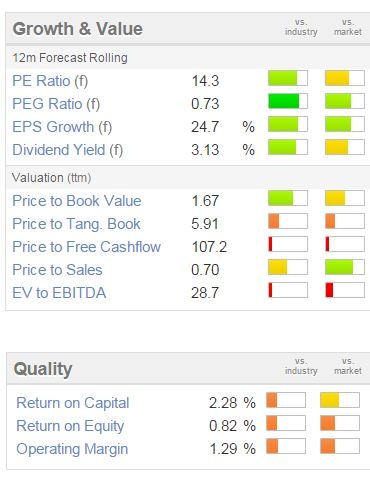
My opinion - it's not a company I'm familiar with, so don't really have a particular view on this one. I generally try to avoid very low margin businesses like this, but if there is scope for margins to rise, then profit can shoot up.
It would be interesting to see if they are benefiting from a trend towards on-shoring of production back to Europe? For the time being, the share price looks up with events to me, at about 17 times this year's earnings, and 14 times next year's. It's difficult to see much upside from that valuation, unless the company out-performs against forecasts.
Hardide (LON:HDD)
Mkt cap £15m at 1.48p/share
Trading update - the company says that trading from Oct 2014 to Jan 2015 is "slightly ahead of budget".
A note of caution is sounded about the potential impact of the lower oil price.
This company looks vulnerable to a potential profit warning later this year, in my view, so I'll give it a miss.
All done for today! See you tomorrow.
Regards, Paul.
(of the companies mentioned today, Paul has no long or short positions.
A fund management company with which Paul is associated may hold positions in companies mentioned)
Disclaimer
This is not financial advice. Our content is intended to be used and must be used for information and education purposes only. Please read our disclaimer and terms and conditions to understand our obligations.

54 comments
Acal not getting very much interest in the face of Flowgroup!
I think the key point about Acal Paul is that they are aiming to get away form the low margin business you talk of. All their acquisitions have been aimed at moving into design and build solutions which are much higher margin opportunities. I was very impressed with their presentation at Mello Derby at the end of last year, and think we will see more acquisitions to come and a reduced dependency on their low margin distribution business.
I saw £ACAL present too and thought they looked interesting as, I presume did several others as they've been rising nicely since Mello.
It will be interesting to see how this one works out.
Regards,
Sully.
The Flow condensing boiler has a modulating burner ranging from 7.2kW to 18.5kW heat output. So it depends on the heat demand of the home and flow temperature as to teh relative proportions of elec generation and gas use. With a condensing boiler you get best efficiency when the return temperature is as low as possible and still have enough heat for comfort. This will also be the best condition for generating more electricity i.e. better to run the boiler at low heat for longer instead of run at high heat and have the boiler cycling as the room thermostat kicks in. (cycling is more inefficient). Whatever the heat output as the burner modulates , if the boiler is on for 2000hrs a year that will be an energy saving of about 2000kWhx 10p (difference elec and gas rate) + government subsidy of 2000kWh x 13.24p (FIT subsidy) = £464.80 per year.
Based on the Flowgroup quote above, if we divide by 2 we get 1000KWh for electric & 17,500KWh for gas, which means in that example, the gas usage is 17.5 more than the electric per KWh used. Gas is much cheaper than electric per KWh by about a third to a quarter of the cost to produce each KWh.
Let us assume we have exactly the same efficiency with an ordinary boiler to the new Flowgroup boiler, the gas bill would be identical but with the Flowgroup boiler there is around £300 definite saving because of the built in electric generator.
Taking the ratio of 17.5 times more gas usage the gas bill would be 17.5 x £300 divided by say 4 = £1312.5 (cheap gas, a 22.8% saving) or 17.5 x £300 divided by say 3 = £1750 (not so cheap gas or more gas used) Even if the gas used was costing £3000 the total bill would be reduced by 10% (£300 saving on the electric)
Bringing the ratio down of gas & electric to say a total bill of £1000 then the £300 saving is a very significant 30% saving on the bill. However in order to save the £300 on the electric how long would the boiler have to be running for? Clearly if less gas is used the boiler would not have to run for so long & thus less electric/ savings would be produced. Somewhere along the line the optimum savings could be tested to give the best savings.
The orders seem to be potentially explosive.
The Flow boiler is a condensing boiler so is around 90% efficient just like other condensing boilers.
Plant electricity generation and grid losses are the reasons why we all pay more than 3 times more for electricity per kWh than we pay for gas. Check your energy bills. So when you generate electricity at home by burning gas at 90% efficiency you are paying gas rate per kWh for electricity (about 3.5p) instead of grid rate (about 14p). Hence the savings on energy usage with the boiler. Additionally there is a government subsidy, the Feed in Tariff, to encourage take up of mCHP appliances, which pays over 13.24p for each kWh generated (whether you use it or not!). If you are gas high gas user it is actually possible to get a repayment (including subsidy) greater than your existing electricity bill.
I think that the sticking point for most Flowgroup (LON:FLOW) customers will be the near £2K installation charge :|
Regards,
Sully.
Re Flowgroup (LON:FLOW) - From what I've followed from the above and from what I know of the company (I've followed and been in and out a few times) is that the CEO did rather well at another 'Challenger' Energy company.
I am a customer for Gas and Electric. My main observation currently is the fact that they are saying that I use enough Gas to make the boiler viable but the PR people say that I need to use almost double of what I do currently.
I'm on the 'list' going forward so will post back if I get a survey done. I suppose that the bottom line would be - if it saves me money and makes me a bit greener - I'm in! If not I'm off.
Regards,
Sully.
And I'm off!
Had a good look at the offering - I can save over £120 with another company from the current Thames tariff. Plus, I could get a new boiler fitted for less that what it costs to fit a Flow Boiler and not be tied in for 10 years :|
Good luck to those holding Flowgroup (LON:FLOW).
Regards,
Sully.
Flowgroup quote: "2000 kWh of electricity if your premises consumes 35,000 kWh of gas each year - See more at: https://www.renewableenergyhub.co.uk/the-flow-microchp-boiler."
Does not sound very efficient to me. But they do claim that the boiler is 92% efficient which is similar to modern condensing boilers. 35,000 kws is a lot of gas, think I use about 8,000. So I will generate about 460kw of electric.
I understand yes, I still think that the few % which may be able to be gained over conventional boilers will not be economical versus capital and maintenance costs but will be happy to be wrong on that front if it is proven otherwise. I would just be weary of marketing lit such as above which is comparing flows boiler vs central generation instead of flows boiler vs normal boiler at 'fuel conversion efficiency'. People who these will be sold to should be comparing flows technology to what they already have, which isn't as stark
Flowgroup: Naked Trader has been in and out believe last time he sold out at 40p which was a lose for him, maybe he has bought back when they fell to 32? I did enquire about getting one, they said my consumption was far too low. Im not keen on some of their advertising, spam?
Flowgroup; Much of today's discussion has been on its technology, efficiency etc.
I think this is worth reading Renewable energy hub
If you do not believe the company's claims for the boiler as outlined in the piece above and achieved in its pilot program then fair enough.
I do and am therefore giving it the benefit of the doubt. To me the main risk is whether they can execute the roll-out strategy to plan rather than the economics of the boiler and their offering.
In answer to cig's point, it only generates electricity when it is on i.e. at peak times; first thing in the morning, in the evening, on cold days etc which is why it makes sense as it relieves the GRID at peak times.
There is another benefit; as Flow provides the customer with dual fuel, when it is purchasing its forward contracts it won't have to pay up for peak electricity as the generators in its customers CHP units will be kicking in. Other suppliers have to be able to supply at peak and will therefore have to pay up for it. The CHP boiler reduces the peaks that Flow energy has to supply.
"If Greece manages to exit the Euro and write off ..........."
Greenspan spoke up yesterday and considered Greece would exit the Euro in time followed by the collapse of the Euro. That WILL create a lot of instability. I am being extremely cautious.
"It's very difficult to dislodge tried & tested conventional technology with something new -"
Agreed ;it took plumbers 10 years to do away with a great big open water tank in the loft & replace it with a sealed 'Megaflow' type system on mains water pressure.
Also just be careful on reading the marketing literature, what the above says is 1kw energy in, approx 90% fuels conversion efficiency. Any new standard boiler will have the same efficiency at turning oil/gas into heat already. That doesn't leave much to turn into electricity.
Hi Beginner,
Marginal improvements over what? There are no standard systems for what this boiler does! Is he saying that it's only a bit better than a standard gas boiler at heating water? That would be a bonus, but it's not the key selling point of the technology, which, as John highlights above, is about local, cheap, high efficiency electricity generation.
A bit more background about using a scroll compressor as a turbine in CHP units here from a Swiss company called Eneftech Innovation SA - http://www.eneftech.com/en/technology.php.
I wonder what is unique about Flowgroup's technology that they have been able to patent?
I have posted this here before I think, but will make the same point again (sorry!). A friend is a boiler engineer. He has installed Flowgroup (LON:FLOW) equipment. Ultimately it is not cost effective for most consumers, he claims. They do have clever sales people and good publicity, but the technology offers only marginal improvements over a standard system.
How has he installed Flow boilers when they were only launched two weeks ago. Older Stirling based CHP boilers such as those made by Baxi were indeed not cost effective for most consumers because they cost about £8,000 plus. Flow's cost £3,750 initially with the price likely to fall with volume. Flow is also offering its innovative financing scheme.
I was thinking about getting one, but he assures me the overall energy/cash saving for a small domestic property like mine would be minimal. He suggested they are actually aiming at the rich tree-hugger section of the market. His experience comes from seminars and training given by the company in Liverpool. I trust him. (The hairy stories he told were too silly not to be true).
I would NOT discourage anyone from investing here though. We all make our own decisions based on the information available to us.The stock will probably go up, but it just may not be judicious to be still holding it in five or so years time. (Also look carefully at the presentation section you have given. Spot the flaw?)
I think that's right. To start with it has to be a four/five bedroom houses with higher than average energy consumption. However as Jabil ramps up volumes the price of the boilers is expected to fall so that it becomes economical in smaller dwellings.
Paul - your first paragraph told me more about Flowgroup (LON:FLOW) than listening to their CEO for 30 minutes (although it seemed like much longer) at a recent ED evening. Apologies if that is a bit harsh and they were the final company to present (so most of us were looking forward to the drinks and canapes by then anyway..), but blimey - what a long, bumbling and boring talk. This maybe an exciting & innovative new boiler but the presenter was not able to captivate and engage the audience. My worry would be that this leadership translates into a rather scatter-gun and directionless business. My impression was that if the CEO was selling one of his boilers to potential customers, it would take a few hours and lots of cups of tea and they would probably buy the boiler just for a bit of peace and quiet. I think the CEO got the talk completely wrong and he should have clearly stated what these new boilers do and why they are different, what advantages they have over conventional boilers, how much they cost to make/install, how much they flog them for and what the size of the market is! Having said all of that, there may have been a lot of substance to his talk and his approach was the antithesis of a slick and polished salesman (which is good) but the way in which he delivered the talk just made me glaze over. Perhaps we should have had the drinks before the Flowgroup (LON:FLOW) presentation.
I should have said the CEO failed to 'ignite' the audience..
Flowgroup (LON:FLOW) Hi Ben, My understanding was that he had just got off a plane form the US and was shattered which is not an excuse for a poor presentation but may be an explanation. In any case I was quite excited by the story; having looked at it a little before I thought that he explained very clearly what the boiler does and the economics of installation.
The website is pretty good as are the presentations on it. See http://flowgroup.uk.com/wp-content/uploads/2012/12/Flowgroup-Innovators-and-Investors-Forum-3rd-February-2015.pdf
It explains the technology, the business model, everything!
Of course implementation of the strategy and take up of the new boilers will be key but I think its marketing strategy makes sense and business model makes sense. I wouldn't bet the farm on it but I have a small exposure.
I'll have a look, Cheers John. I was a bit tired that day also, so probably wasn't as engaged as I should have been!
For those interested re: QRT - I've been a holder for a while. I lay out my reasoning here:
http://expectingvalue.com/shares/quarto-cheap-leveraged-the-sole-survivor
HSS is also an interesting one, particularly with regard to a comp against Lavendon and Speedy Hire. Looks pretty expensive to me, but it also looks like a significantly better company from a return on asset/capital/equity perspective
Quarto Inc (LON:QRT) :I don't hold this one but it was mentioned by Lord John Lee at the recent Mello Beckenham dinner as one of the three stocks he was currently keen on, so I wouldn't write it off. He highlighted new management, the large activist shareholding by Christoper Mills and the very strong free cash flow, (according to Stockopedia it is valued at only 1.6x free cash flow ranking it 28 out of 914 companies!) which presumably allows them to pay the "generous" dividend and over time bring debt down. He also highlighted the predictability of revenue generation in the business. Looks like a good recovery story to me which will be driven by debt reduction and a re-rating. I put it on my watch list and fear I will end up watching it go up unless I do something soon!
Hi Paul
@Wheeliedealer wrote an interesting blog post about the HSS IPO: http://wheeliedealer.weebly.com/blog/hss-hire-is-it-worth-buying-into-the-ipo
It makes for interesting reading, and it looks like the IPO was overpriced. I've been looking at the John Laing IPO, but can't make sense of the financials so will sit then one out as well.
Best wishes,
Imran.
Re. John Laing IPO. The Naked Trader is buying some. That's a good enough nudge for me to do the same.
Hi Ram
I saw that he is buying some, and that was the reason I originally had a look at the prospectus. Have you reviewed the prospectus and the fundamentals?
Imran.
Re, John Laing IPO. Yep. Looks good and ticks a lot my boxes. But hey, DYOR.
The potential advantage also comes from the cost difference between gas and electricity.
Gas is about 1/3rd of the price of electricity per kwh.
Flowgroup - Haven't looked into the actual technology but I would be dubious over any claims that it will save much money. Basic engineering tell us that energy cannot be created or destroyed. If electricity is being generated from the burning of oil process this means that you are:
a) paying for the electricity your are generating
b) reducing the level of energy transferred into the water to heat your home.
The only way it could generate electricity without the above happening would be to use a turbine in the exhaust of the boiler but I don't think this is what the technology is.
Probably another red herring energy saviour.
I too haven't looked at the technology, but it probably uses Stirling engines, which have been around for about 200 years, and well tried - they work well on the waste heat a boiler generates. British Gas were selling boilers that generated electricity, so the principle is well accpeted. I agree though that the economics may well not be there yet unless you are a super early adopter
not Sterling technology, apparently (see this page on the website http://flowgroup.uk.com/why-we-are-different/) but details on how it works are a bit vague. Looks like the hot water leaving the boiler spins a little turbine. Clever.
They are not using Stirling Technology; too expensive therefore not economical in terms of making a decent return through the electricity generated. Its boilers are being manufactured by Jabil Inc in Livingston, who have invested in the plant, working capital etc.
Initial retail price £3,750 but that will come down as it scales up. Initially aimed at larger houses where expected energy saving is about 500GBP per year. Not a bad return, especially compared to other green initiatives.
As the boiler manufacture price comes down then the energy saving required to make the installation of a Flow CHP worthwhile also falls.
Added to all this Flow have a clever new boiler offer; customer just pays for installation, but finances the boiler purchase through an unsecured loan through ZOPA repayable over 5 years. The energy saved pays off the loan over the five years. Customer initially benefits from just paying for installation and then at the end of five years starts to benefit from lower bills as well.
I'm invested and I may get it wrong but at least I have done a little bit of investigation into its technology and business plan!
Probably worth looking into the technology! The reason they are producing the boilers at a price that makes economic sense is because their patented technology is far simpler than the Stirling technology used in the more expensive versions of CHP boilers where the economics do not makes sense in a domestic environment. It uses technology already employed in a fridge/freezer. i.e. basic gas compression/expansion.
As for energy being created or destroyed! electricity generated at a power station loses 70% on transmission through the grid to you house. Electricity generated by your CHP boiler only loses 10% as it is situated at the location of use.therefore very efficient.
Not sure as the exact losses on transmission but was amazed to read 70% with power transmitted at high voltage and transformed down at home. A cursory search says that power and transmission losses on Uk networks is in the 7-8% range (http://data.worldbank.org/indicator/EG.ELC.LOSS.ZS)
which sounds a lot more palatable
I think it is total loss from start to finish of the process not just the transmission but generation etc.
Well I think the power generators will be able to produce power much more efficiently than small time domestic generation. 70% is way way off the mark
I don't really want to get into a fight over this and I guess they could be lying but I'll trust them on this. page 16 of the October 2014 presentation;
No need for a fight, John, just check out the figures! The following graphic is, um, fairly graphic!
http://www.theguardian.com/news/datablog/2012/jul/06/energy-green-politics
70% energy loss looks like a best case scenario....
Thanks JollyBiologist. It agrees with what Flow is saying; 70% gets lost in the process whereas burning gas in a Flow CHP boiler only leads to a 10% loss. 90% efficiency rather than 30%.
The whole electricity cycle is not very efficient, but here the competing technology is not a big power plant + power grid + electric heaters, it's a normal or condensing boiler used primarily for space heating. Basically we have something like:
- normal boiler, about 75% efficiency
- condensing boiler, about 90% efficiency
- flow boiler is a normal boiler (so about 75%) with the exhaust turbine gadget that recovers some of the 25% but not all (it's a mechanical device that itself can't be that efficient, essentially not that different from the larger gas turbine in a big power plant).
The argument that there's some extra savings from producing electricity near the consumer is weak as well (and would only change the result by a fraction of the 25%), because the baseload of a house is very low (close to zero when people are out, a few lightbulbs and TVs when in and in the evening) and a large part of the use is spiky things like washing machine and kettles, that is heat or mechanical energy, which will need to come from the grid. So micro-CHP works out only if you feed back most of the surplus into the grid, so there's little grid-related savings (system-wide at least, though tariffs may be to the consumer's advantage, at the expense of other consumers).
So really the best case scenario is the Flow boiler is perhaps a couple of percentage points advantage over a commodity condensing boiler, to be booked against the extra capital cost. The worst case is that it may turn out less efficient yet cost more. It's a very thin "margin", so to speak.
Bang on Cig. (But sales will be made on 'green credentials', supported by a best case/worst case comparison, not on a true efficiency comparison).
Your CHP loss figure of 10% might be right for when people need the heat, which is in the winter.
In the summer, there is no use for the heat, so the effective losses will be much higher.
Probably worse losses than with existing technology.
A fight? Jeese I'm only questioning how it could be more efficient to generate power at each house rather than at a power station, I mean if that were the case there would be no network. Maintenance also must be accounted for. Aren't domestic boilers 80-90% efficient already? There might be a few % to scim off into electric as there will obviously still be some loss. All the same I hope it come off and sets the world alight. Call me an old cynic, no problem with that.
Wrong choice of words. A discussion not a fight! Appolgies. I do think it is worth reading the attached which does at least explain clearly the economics of its CHP boiler.
https://www.renewableenergyhub.co.uk/the-flow-microchp-boiler.html
Cool no worries, good luck with the investment, I hope I'm wrong as it will mean cheaper energy for me in the long run.
"I'm only questioning how it could be more efficient to generate power at each house rather than at a power station, I mean if that were the case there would be no network. Maintenance also must be accounted for. Aren't domestic boilers 80-90% efficient already? There might be a few % to scim off into electric as there will obviously still be some loss."
The problem with generating electricity at a conventional thermal power station running on coal or oil is that, for thermodynamic reasons, about two thirds of the thermal energy from burning the fuel is lost at the power station as the waste heat in the water vapour going out of the cooling towers or to the cooling water in the nearby river or sea, and only about one third of that thermal energy from burning the fuel is converted to electrical energy that is fed into the high-voltage electricity transmission network. Then a further few percent is lost in the high-voltage transmission network before it reaches the lower-voltage distribution network, and another few percent is lost in the distribution network before it reaches the consumer. A Combined Cycle Gas Turbine (CCGT) power station running on natural gas is more efficient than a conventional power station in converting the thermal energy in its fuel to electricity, because some of the waste heat from the fuel used to heat the gas turbines in the CCGT is used to heat up water to convert it to steam, which is then used to run a steam turbine, and both the gas turbines and the steam turbine are used to generate electricity. However, even a CCGT loses about a third to a half of its thermal energy in its fuel as waste heat, for thermodynamic reasons.
A combined heat and power (CHP) scheme is much more efficient overall than a conventional power station in making use of the thermal energy in its fuel, because some of the residual heat energy that would otherwise be wasted as water vapour up the cooling towers is used to provide heat to a nearby industry (such as an oil refinery) or for heating nearby homes. The efficiency of converting thermal energy to electricity is still just in the range one third to two thirds, it is just that there is good use made of some of the residual heat rather than wasting it.
If it is technically feasible to have a mini CHP scheme in your own home, then I could well believe that the overall efficiency of converting the thermal energy in the gas to useful purposes, i.e. to heating the home plus generating some electricity, would be better than generating electricity at power stations. If some of the electricity generated by the mini CHP scheme is exported from your home to the grid, it presumably would be used by a nearby house or industry, so I would expect the energy losses in the distribution network over that short journey to be small.
RE. Quarto Inc (LON:QRT) At the risk of re-opening an old debate, QRT's StockRank is 91.
Hi Ramridge,
Indeed, the StockRanks don't seem to take much notice of financial strength or weakness on the balance sheet. That's probably fine whilst the banks are being super-accommodative towards Listed companies. But if/when that changes, and banks start taking a harder line with overly-indebted companies, then investors are likely to get some very nasty shocks, if they have ignored balance sheet weakness.
We are not in anything approaching normal economic conditions, with interest rates at ludicrously low levels, which distorts everything. Remember that it was people ignoring risk that got us into a mess in 2008, and I could see something similar happening again, as ultra-low interest rates + QE are creating asset bubbles all over again.
So in my view people who are playing fast & loose with balance sheets & debt, could end up getting some nasty shocks when the credit cycle tightens up again! (says the voice of doom!!!)
Regards, Paul.
Hi Paul -
One aspect of balance sheet strength that is not fully appreciated is the potential impact of pension deficits. During the past 12 months, 15 years gilts yield has fallen around -1%. At the same time equities measured by the FTSE100 index dropped around -2%. This is a double hit on pension fund balance sheets, because the reduced gilts yields will inflate the long term gross liabilities at the same time that value of the equity assets will be depressed. The result is a net pension deficit which could be in some cases be double that shown in 2013/ 2014 accounts.
So companies with weak balance sheets and large pension deficits are very vulnerable over the near future.
Regards, Ram
Just to mention the hospitality at the Bloomberg event will be flowing until at least 9.30pm and probably beyond that time if the 300 strong audience are still happily engaging with the speakers and networking. Bloomberg are very keen to meet with all the serious investors that Mello attracts so very unlikely the drinks will run out !
Who are the speakers?
All our speakers are well known to the wider investment community and have achieved significantly ahead of their peers in delivering returns for investors in their funds or individual companies:
•Mark Slater – Slater Investments
•Ben Rogoff – Polar Capital Technology Trust Plc
•Tom Burnet – Accesso Technology Group Plc
It will be great to see a few of you there.
Hi Paul
Quantum Pharma (LON:QP.) Today's trading update says results will be "...comfortably ahead of market expectations "
Any views ?