Small Cap Value Report (9 Feb 2017) - BJU, ASHM, IDP, WATR, DFS

Good morning,
Quite a few updates today, so I'll try to prioritise those which are most significant (results vs. trading updates) and then see what's left.
Paul is away for a week but has rather dangerously brought his laptop with him!
Cheers,
Graham
Brainjuicer (LON:BJU)
Share price: 730p (unch.)
No. shares: 12.2m
Market cap: £89m
Unaudited results for the twelve months ended 31 December 2016
My third time covering this in as many months.
This share was sitting at 530p when I covered it in December - I've been watching it all the way up! But I think some of you have been participating in the rise, in which case congratulations are in order.
As was well-flagged by prior updates, PBT (profit before tax) comes in at £6.2 million, while net income almost reaches £4 million.
Remember that results are somewhat flattered by a GBP short exposure: gross profit is up by 27% at reported currency, or 15% in constant currency. It has heavy USD exposure, which also contributes to a higher tax charge than might otherwise be the case.
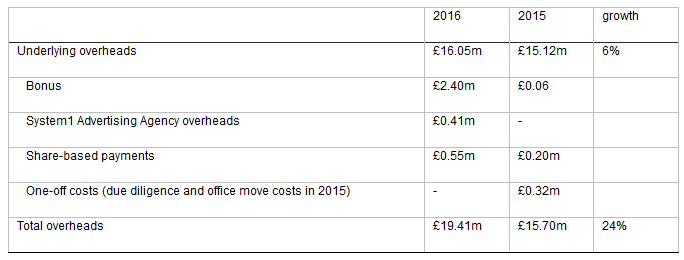
A helpful costs table is provided, so that we can see the non-underlying overheads (I tend to think of them as underlying, but at least the breakdown is fully transparent). Note the bonuses and share-based payments:
Guarded, as per usual:
We will continue to focus on our core products, particularly Ad Testing and Brand Tracking where we are beginning to get a foothold in large clients. These products are comparatively easy to grow and scale, and they also provide more revenue visibility than our other products. Nevertheless, our business still remains predominantly ad hoc, with limited revenue visibility, and as always we need to acknowledge that we cannot predict with very much certainty how revenue growth will unfold over the coming financial year. Having said that, we are pleased with the continued progress across the business and remain confident in its long-term potential.
Cash flow
Net cash generated from operations (pre-tax) was a very healthy £8.4 million, but the difference between that and the PBT figure is mostly accounted for by a working capital movement along with the use of share-based payments and FX gains (see footnote 7). So I personally would not read too much into the large cash flow figures given, from a company valuation point of view.
My opinion
The cash balance at almost £8 million leaves an enterprise value of £81 million, or about 20x net income.
When the market cap was £60 million (enterprise value £52 million), I said I was inclined to think that valuation provided sufficient compensation for the lack of earnings visibility. Most revenues are still ad hoc, after all, and it is very hard to predict contract wins.
Today's valuation, however, does not leave all that much margin for error.
Ashmore (LON:ASHM)
Share price: 337p (+6%)
No. shares: 713m
Market cap: £2,400m
I flagged this up last month after its quarterly Assets under Management announcement, which showed AuM falling against the prior quarter (but up 5% versus 12 months prior).
I still think this is worth a look, for all the reasons mentioned last time.
It's highly cyclical, as an emerging markets fund manager will inevitably be, but that means plenty of opportunities for the market to get the valuation wrong.
Today's results show that revenue generation remains considerable here:
- Net revenue up 24% to £144 million, comprising management fees of £115 million and performance fees of £22 million.
Even better, the managers continue to do very well against their benchmarks. The index fund is perhaps not yet the best solution for every investor!
- 91% of AuM outperforming benchmarks over one year, 81% over three years and 86% over five years (30 June 2016: 69%, 63% and 73%, respectively)
Besides generating fees on client funds, Ashmore invests its own capital to seed new funds: this seed capital generated gains of £26 million in the period.
Put all of the above together and you get PBT of £121.5 million.
Market Review: One of the reasons I follow Ashmore and other fund managers is that they are at the coalface of financial markets - so I tend to trust their perspective on macro-economics.
In terms of reasons why Ashmore might be worth further research, consider their view on emerging markets:
"Valuations remain
attractive both in absolute terms and relative to alternatives in the
developed world, and there remains a supportive technical position with
investors significantly underweight or not exposed to Emerging Markets."
That part in bold is key for me - asset allocators are notorious for trend-following, and they will come back to EM in response to strong returns.
Balance sheet: very strong. Cash generation is highly reliable. No concerns at all on this front.
Dividend: the interim divi is maintained at the same level since Q2 2015 - hopefully we will see a divi increase here before too long. The yield is excellent all the same, at 4.9%.
My opinion: This is on my watchlist, and I'd consider buying for my personal portfolio when I have spare capacity!
Innovaderma (LON:IDP)
Share price: 160p (+26%)
No. shares: 11.8m
Market cap: £19m
By request, I'll briefly mention this one (not something I've looked at before).
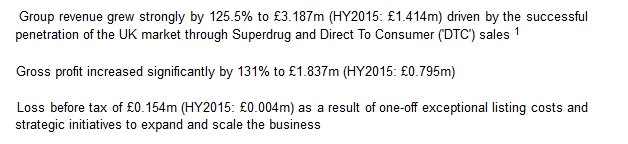
The financials look promising to me, with good gross margins of 57%, very strong revenue growth and operating close to breakeven:
It's a fast-moving story with Superdrug increasing the scale of their distribution, a US launch in November just past, new hair care products being developed, etc.
Outlook
There is a second half weighting here, presumably due to cyclical demand for tanning products?
Outlook for the rest of the year:
The Board is pleased with the current direction of the
business and confident of delivering further growth during the remainder
of the year.
My opinion
With cash at £0.7 million, at first glance this looks to me as if it is fully funded to break into profitability - the most important initial test.
Having passed that test, I would then need to do a bit more research into the popularity and potential of the brands. I'd also like to understand the company's history and the background to its listing in London last September - it appears to have delisted from France.
Worth a second look, I think.
Water Intelligence (LON:WATR)
Share price: 133p (+6%)
No. shares: 12m
Market cap: £16m
Q4 Trading Update and Year-End Corporate Items
This primarily US-based leak detection and fixing business has been going from strength to strength over the past year, culminating in the following Q4 trading update:
The Company's strong financial performance referred to in the Q3 Trading Update on 21 December 2016, continued for the remainder of 2016. Revenue growth exceeded market expectations within all sales channels, including newly acquired UK-based NRW Utilities, with total revenues for the year of $12.2m (2015: $8.8m) with adjusted profit before tax in-line with market expectations.
Costs rose due to a UK acquisition and a few other activities which are not ongoing, so hopefully 2017 will be even better.
Profit margins are expected to grow during 2017 with a full year of trading from the 2016 acquisitions, together with continued organic growth.
There's another small bonus for investors as the company announces that it will release final results on or around 9 May. Last year, investors had to wait until June to get the figures, which is far from ideal.
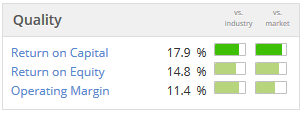
I discussed this company last year and noted the high returns achievable through its franchise business model - see the strong return on capital metric from the Stocko graphic:
DFS Furniture (LON:DFS)
Share price: 230p (+0.3%)No. shares: 211.5m
Market cap: £486m
This share doesn't get mentioned often on these pages but might be of interest for those who follow the home improvement sector.
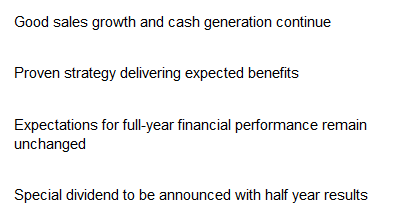
Thing are going well at DFS:
According to my source, brokers are predicting PBT for this financial year (ending July) to be flat at £64 million.
In that context the net debt is manageable, last reported at £137 million or 1.45x EBITDA.
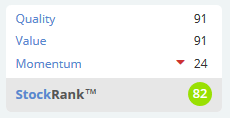
Quality and Value ranks are both excellent:
That's all I've got for today, thanks for reading!
Graham
Disclaimer
This is not financial advice. Our content is intended to be used and must be used for information and education purposes only. Please read our disclaimer and terms and conditions to understand our obligations.

17 comments
ASHM
"In terms of reasons why Ashmore might be worth further research, consider their view on emerging markets:"
ASHM's view on Emerging Markets has been consistently upbeat (it wants to keep clients invested in its asset class after all). But such optimism has hardly tempted clients to come on board.
Here are a few choice quotes from the 2011-2016 annual reports:
2011
Emerging markets equities valuations suggest the upcoming quarter may represent a good entry point with earnings forecast to grow strongly over the medium term.
The opportunity for raising AuM from both developed country and emerging markets sources as they increasingly come to realise the attractiveness of the emerging markets asset classes over developed market alternatives, remains a compelling one.
2012
In summary, more and more investors are seeing Emerging Markets debt as an alternative to fixed income in general, not just developed world corporate credit. Indeed, with yields in the developed world either high for a good reason or yielding next to nothing, Emerging Markets debt looks highly attractive. ??
Furthermore, after a period of relatively poor performance and flows, Emerging Markets equity, which has long been an established asset class, looks to be ripe for a good year given relatively low valuations.
2013
Dedicated long-term investors recognise these characteristics of the Emerging Markets asset class, and can take advantage of the asset re-pricing that results from technical factors rather than a change in fundamentals.
??Demand for Emerging Markets themes with relatively low correlation to the US treasury market will continue: equities, local currency assets, blended debt and shorter duration, higher yielding corporate debt offer attractive prospective returns.
2014
Emerging nations are generally in good health and in aggregate are expected to grow faster than the developed world, thereby continuing to increase their importance to the global economy and exposing underweight allocations.
Rising geo-political risks in certain parts of the Emerging Markets world, as well as elections taking place in key economies, have led to uncertainty and hence price volatility in the short term.??This environment provides opportunities to deliver longer-term performance for managers such as Ashmore that employ a disciplined, fundamental approach to assessing economic, political and market risks, and that continue to invest over the cycle.
2015
Across global markets there is likely to be convergence between asset prices and fundamentals over the next few years. In Developed Markets, this is likely to take the form of inflation and currency devaluations rather than real rate increases, austerity and reforms.
In contrast, after a period of continued volatility, Emerging Markets’ asset prices appear to be discounting a much worse fundamental outlook than is likely to arise, even with higher US interest rates. This suggests that the rational asset allocator will increasingly shift towards Emerging Markets, where there is greater value, more supportive fundamentals, and a need for investors to address underweight positions.
2016
The volatility and weakness experienced recently in Emerging Markets assets, when se against improving economic fundamentals, has provided good investment opportunities for Ashmore’s value-based processes.
Ultimately, though, the value available in Emerging Markets contrasts starkly with current pricing levels for many developed world markets, and this will encourage investors to address their weightings in Emerging Markets, resulting in stronger client flows over time.
And yet over the last 5 years client AUM has dropped from $66b to $53bn, as about $10bn of client money has been withdrawn.
The pretty poor investment performance -- a negative $3bn has been lost by ASHM through its investment decisions during the same 5 years -- has no doubt prompted the exodus.
No wonder the average basis fee points ASHM earns on its client AUM have declined during each of the last 5 years.
Re: optimism, if you look at something like the MSCI All Country Asia ex Japan Index, you'll see it has achieved almost nothing in terms of capital gains since the 2009 rally. Emerging markets globally are on a PE of 12, while the US is over 17.
From ASHM's latest City presentation, it does seem Emerging Market equities have generally traded at a discount to Developed Markets equities:
The discount may have been narrower in the past, but the chart does not make it obvious the current discount is compelling when compared to certain times previously.
Anyway, most of ASHM's AUM is in debt, bonds etc., and the associated relative-valuation charts in the presentation (appendix 2c) do not appear to show obvious valuation anomalies in those AUM categories either at present:
http://www.ashmoregroup.com/sites/default/files/re...
Thanks for the comment Maynard.
unwise, my source is here, using forward P/Es on Thomson Reuters: http://www.yardeni.com/pub/mscipe.pdf
AIUI Stockopedia sources all its data from Thomson Reuters as well, I find it difficult (impossible?) to believe earnings will grown sufficiently to bring down the P/E from the numbers quoted on Stockopedia to 17.
The reason I am labouring the point is you could form 2 very different opinions about the U.S market and global markets in general if the P.E is 17 or 28.
Graham where have you got your information for the PE of the US?
Stockopedia shows the S&P500 on a PE of 21.8 median, 27.8 mean (TTM)
Like Paul I'm on holiday until May , I'm in sunny Cape Town until mid may getting away from the UK winter, not doing any business/ investments until July,?
I'm not sure how that knowledge helps my investments but thank you for posting.....have you tried Trip Advisor? it seems more relevant somehow.
That's very useful investment advice, many thanks. Enjoy Cape Town - I hope that you have a secure compound with CCTV and armed guards.
Ashmore (LON:ASHM) looks like an interesting way to gain exposure to emerging markets.
I haven't looked at Ashmore (LON:ASHM) before but I would also encourage readers to look at City of London Investment (LON:CLIG). It focuses on emerging markets, most of its income is in dollars, it has a wonderfully transparent management which is a role model for all other companies, and it has a shed-load of cash which means it can pretty much guarantee its 24p dividend for some time to come. I am not a holder at present because i am convinced that there will be a dip in share price on the next Trump protectionism announcement, but it is worth a look.
Thanks for the suggestion Paraic
Researching City of London Investment (LON:CLIG) as paraic84 suggested, I saw their RNS of 24 January which links to this research report: http://hardmanandco.com/docs/default-source/company-docs/city-of-london-investment-documents/clig-report-24-01-2017.pdf
This looks very like a broker note, which Paul and many others have argued ought to be published and not restricted to the institutions. My first reaction was - good for the company, this is an example for others to follow. My second reaction was to ask how come this note can be made public via RNS? According to the note itself,
"Hardman Research Ltd, trading as Hardman & Co, is an appointed representative of Capital Markets Strategy Ltd and is authorised and regulated by the Financial Conduct Authority (FCA) under registration number 600843 [...] However, the information in this research report is not FCA regulated because it does not constitute investment advice (as defined in the Financial Services and Markets Act 2000) and is provided for general information only."
However the covering text in the RNS announcement says:
"Our research is provided for the use of the professional investment community, market counterparties and sophisticated and high net worth investors as defined in the rules of the regulatory bodies. It is not intended to be made available to unsophisticated retail investors."
I am confused, first because the two statements appear contradictory and second because surely by publishing the note, the company is doing exactly what the text says is not intended, namely that the note should not "be made available to unsophisticated retail investors."
Can someone with a better knowledge than mine of the regulations explain what the rules are on this?
Thanks Graham , much appreciated.
Re. Brainjuicer (LON:BJU)
I am always wary in investing in a company whose revenue visibility is poor, as readily acknowledged by the CEO in today's RNS:
Nevertheless, our business still remains predominantly ad hoc, with limited revenue visibility, and as always we need to acknowledge that we cannot predict with very much certainty how revenue growth will unfold over the coming financial year.
They have also missed broker forecast of eps of 32p. Actual eps was 30.3p. So that pushes PE to 24 with forecast eps growth of 16%. A bit too rich for me given my first comment.
No position held.
Hi Graham, any chance you could have a look at Innovaderma (LON:IDP) if you get the time / inclination. Todays half year report has a couple of interesting comments. Jan sales at record levels - usually a quiet month , new distrib agreements in the US also not included in figures, 60% margin. Valuation looks a bit warm but looks likely to grow into it?
Thanks
GJR
Hi GJR, I've done the best I can, my first time looking at it. Many thanks for the suggestion!
Graham