Small Cap Value Report (9 Sep 2015) - GOAL, ALY, MONI

Good morning!
Warren Buffett on CNBC
I was very disappointed with yesterday's interview with Warren Buffett by Betty Quick of CNBC - what a missed opportunity - she asked him all sorts of dumb questions about current market volatility. When anyone even vaguely acquainted with Buffett's long term approach would have known exactly how he would reply - that he has no idea what the market will do in the next 10 weeks or months, but that he believes it will be significantly higher in 10 years, and that's all he cares about.
That really annoyed me - what a squandered opportunity - to be given access to interview arguably the world's most respected investor, in his twilight years, and to not even bother preparing intelligent questions. I must email Mr Buffett, to ask if he'll do an audiocast with me instead!
Consumer cyclicals
In the short term, the main indices are starting to look as if a short term bottom has been put in. Although one does wonder how much of this recovery has been manufactured by central banks & Govt action to prop up markets? In my world of UK small caps, it feels like a bull market again. We had a bit of a wobble, but remarkably little selling volume in small caps, when the main indices were falling over recently.
Most small caps I hold, that are reporting decent results, are going up again, even reaching new highs. So it looks & feels like a bull market to me still. Remember that the big indices have taken a heavy hit from oil & other resources stocks declining. That's not relevant to small caps, where I'm mainly focusing on cyclicals, especially UK/Western consumer cyclicals - where demand is rising, due to rising real wages, and the "tax cut" of lower oil, and low to negligible inflation.
That's the most healthy macro backdrop for consumer cyclicals that we've seen since 2007, in my opinion. So I reckon there's plenty of scope for companies in this area to out-perform, if they are well managed, and have decent products. The falling big indices therefore seems a red herring to me, and a false benchmark to follow. I prefer to follow FTSE Mid 250 Index (FTSE:MCX) and FTSE Smallcap Ex Investment Trusts Index (FTSE:SMXX) .
Goals Soccer Centres (LON:GOAL)
Share price: 155p (down 20% today)
No. shares: 58.5m
Market cap: £90.7m
Interim results to 30 Jun 2015 - it seems to be the outlook statement, more than the interim figures, which has triggered this morning's 20% fall in share price. So is this a buying opportunity? I've been following this company for years now, but the investment case has never looked right to me, on my assessment of risk:reward.
Earlier, the balance sheet was too highly geared. That's been sorted out now, with debt under control, but the roll-out has looked too slow, and too capital-intensive. It operates 5-a-side football centres. Now we have poor current trading to add into the mix.
Key numbers from the interims;
- Revenues flat at £17.1m
- LFL sales down 1% (2014: up 3%)
- Operating profit down 10.7% to £4.8m
- Big fall in P&L finance charge, from £1.0m in H1 of 2014, to £0.3m of H1 this year. Reason given is "due to the balance sheet restructuring completed in 2014"
- Underlying diluted EPS fell by 3% to 6.0p
- Underlying PBT increased by 1% to £4.5m
So clearly it's the lower finance charge which saved the day, and recouped the 10.7% drop in operating profit. However, the key number to focus on, as it reflects the actual trading of the business, is operating profit, and that's down 10.7%, so not good.
Current trading - the slightly negative trend in H1 has got a lot worse in Jul & Aug. Revenues were down 10% in the first 9 weeks of H2. Several credible-ish reasons are given - poor UK weather leading to people booking overseas holidays (confirmed by recent airline trading statements). Also the World Cup last year boosted the prior year comparatives.
To remedy this, marketing has been stepped up. However, in my book poor sales, plus additional marketing to boost them equals a doubly negative impact on profit.
All the gains of the last two years have been given up today:
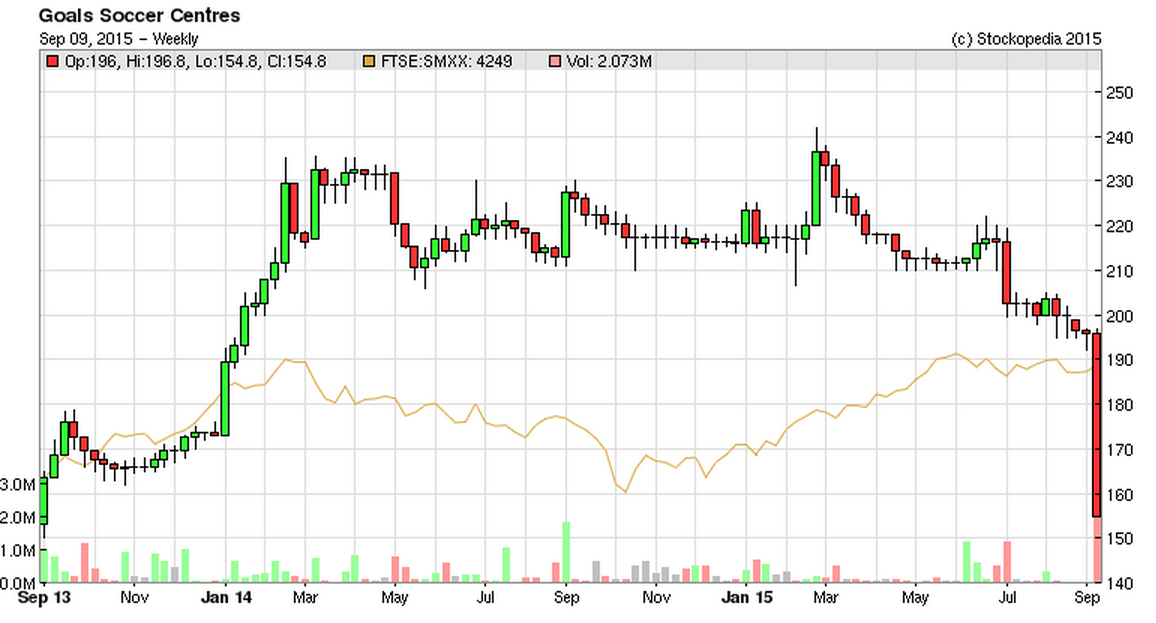
Valuation - helpfully, the company gives full year guidance (ALL companies should do this!) and says it has revised this to a range of £9.3m to £9.8m for calendar 2015 at the PBT level. That doesn't sound too bad actually. Looking back at last year's numbers, it made £10.6m at the PBT level, so profits are dropping somewhat, but not a catastrophic amount by any means.
Take off 21% tax, and that drops out at £7.3 to £7.7m earnings guidance for the FY 2015, or 12.5p to 13.2p EPS. So at 155p share price, my estimate for the PER is 11.7 to 12.4, which actually looks quite reasonable. Sure there is some debt to take into account - net debt is currently about £38m, but that looks reasonable against EBITDA, and also it is structural debt which is funding a ton of fixed assets, or £115.8m fixed assets NBV, to be more accurate. Therefore net debt is 32.8% of the book value of fixed assets, which seems fine to me.
I've had a quick look in the 2014 Annual Report, and all the property is leasehold, which is a pity. I would have liked to see some freeholds in there, which would have given more comfort on debt.
My opinion - I haven't got time to wade through all the narrative published today, but there are some positives in there - more new sites are being opened, the US site is doing well, with more planned.
The reality is that things rarely go smoothly with small caps - anyone who has run a SME themselves will confirm that profits rarely move in a smooth progression. In reality, you have good years and bad years, with the key thing being long term performance.
For that reason, I often take a close look at companies which disappoint in the short term, because (as long as you are highly selective) this can provide some excellent, good value entry points.
So am I tempted to buy into GOAL? In a word, yes. I've not bought any yet, but it's certainly a stock I'll be watching, and if they sell off some more, then I could be tempted to pick up a few. I'm not madly keen on their capital-intensive business model, and competitive pressures from cheaper Local Authority run centres is mentioned in today's narrative. So it's not a stock that I would load up into a big position, but it's starting to look tempting for a potential little dabble.
The key thing now is to get Googling, and asking friends, to see what customers think of these soccer centres. Declining sales is a warning sign that all may not be well. Companies which warn on profits can go into a long period of disappointing share price action, so I'm reluctant to dive in straight away. It's on my watch list now though, as potentially interesting, so I'll do a bit more research on it.
Note that the StockRanks system has again worked nicely here. The StockRank last night was low, at 40 - clearly the Stockopedia computers had picked up on the declining broker forecasts, and drifting share price, as the momentum score was low at 44. I'm using the StockRanks much more as a guide these days, as it often picks up on things I might have missed (such as small broker downgrades - which are an early warning sign that current trading isn't great).
Laura Ashley Holdings (LON:ALY)
Share price: 28.4p (up 2.2% today)
No. shares: 727.8m
Market cap: £206.7m
(at the time of writing, I hold a long position in this share)
Interim results 26 wks to 1 Aug 2015 - firstly, a hat tip to the finance team at ALY, who have published results a month more quickly than most companies reporting at the moment - prompt reporting is nearly always a good sign, of a business that has strong financial controls in place.
The key figures obscure the underlying picture, which is that the company is trading very strongly in the UK, where it operates its own stores. However, overseas trading (which is through franchisees) has been poor - mainly because about half the overseas trade is in Japan, which has been weak.
UK retail sales in H1 were up 7.0% on an LFL basis, which is a stonkingly good result. Note that eCommerce is an important element, at 19% of UK sales. PBT rose 150% in H1, from £1.2m to £3.0m (note that there is a strong H2 seasonality to profits, hence why these figures look small for H1).
International - as this is franchised, the sales figures don't come through, just the profit element. So it's actually a lot bigger than most people realise - at 296 franchised stores, and international actually generated 55% of PBT last year.
As well as Japan being weak, Russia & Ukraine are noted as also having affected results adversely. S.Korea & M.East are noted as better performing regions. The outlook for H2 is more upbeat, with these comments being specific to International;
We expect performance to improve during the second half of 2015. The Laura Ashley brand and product continues to resonate with our many worldwide customers. The acquisition of the Group's Asian head office in Singapore will lead the company's expansion into the Asian market.
I reported on the recent, somewhat bizarre decision to spend £31.1m buying a freehold office block in Singapore here on 30 Jun 2015. So please click on that link to refresh your memory on the deal, if you wish.
Profit before tax ("PBT") overall was slightly down, at £8.4m (2014: £8.5m) in H1.
Outlook - very good current trading is reported (this mainly relates to the UK, I think);
Trading for the five weeks to 5 September is up 5.7% on a like-for-like basis.
So with the UK still powering along, and a better outlook for International in H2, things seem positive to me.
Balance Sheet - absolutely fine. There was no bank debt at 1 Aug 2015, instead the company held cash of £20.2m. Although note that two days after that date, a £20.2m mortgage was drawn down to purchase the Singapore office building, with the balance of about £10.9m being funded from cash reserves.
Therefore on a pro forma basis, ALY now has net debt of £10.9m, but of course it also now owns a £31m freehold property. So the underlying picture is still very healthy. It introduces risk though - if the Singapore property market crashes, and/or if interest rates there shoot up. So let's hope the company really makes use of that impressive office block to dramatically increase its Asian operations, which it appears is their intention. Long term it could be quite exciting - they're clearly not messing around, buying a building of this size.
Please also note the pension fund deficit, which has come down slightly in the last 6 months, and is now reported at £17.5m.
Cashflow - the company presents its figures in a peculiar way, so it looks from Stockopedia as if the free cashflow is weak. This is incorrect, because the company reports free cashflow after paying huge dividends, where of course it actually should be reported before dividends.
As you can see from the condensed cashflow statement (below) published today, the company pays out very high divis, which are looking a bit of a stretch. So the 7%+ dividend yield may not be sustainable. Although I looked at this a few months ago, averaged over several years, and came to the conclusion that it looked just about sustainable.
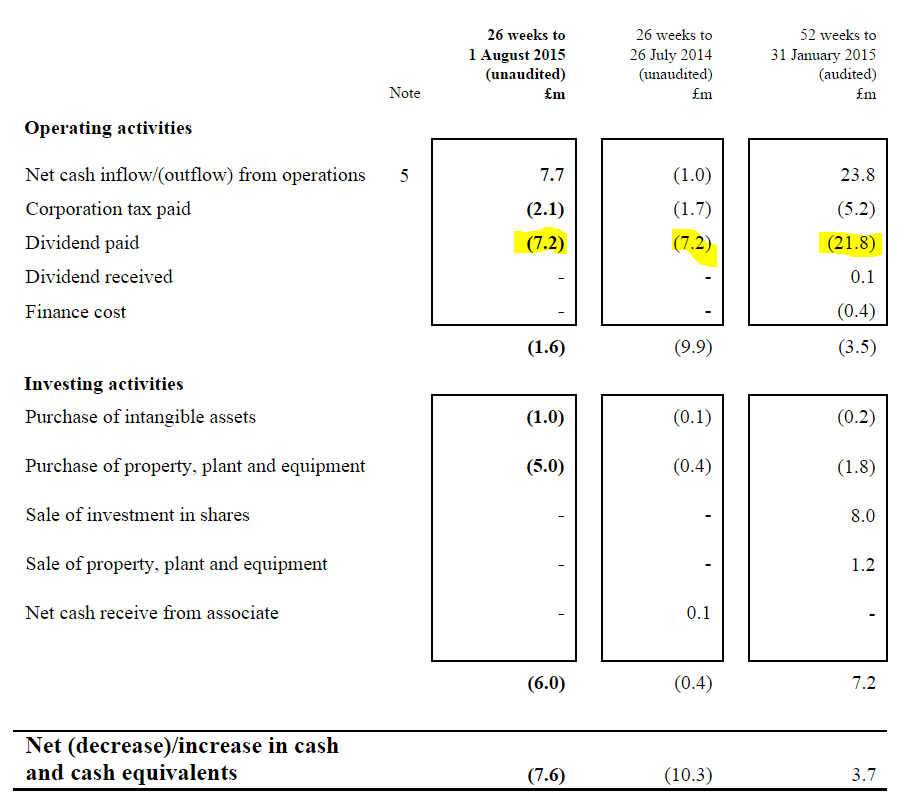
Clearly the controlling Malaysian shareholder likes his divis - which is great, as we minority shareholders get to enjoy them too, and note that Directors here are paid relatively modest salaries - which to my mind indicates a shrewd controlling shareholder who is not going to let management ratchet their rewards to excessive levels, or dream up a VCP (the laughably termed "value creation plan" that Directors at companies like Vislink (LON:VLK) are trying to use as a method of plundering the company for their own personal gain).
So whilst some people may not like the shareholding structure here, with one dominant shareholder, it can potentially come with benefits too - such as keeping Director pay under control, and operating the business with a view to long-term success, rather than chasing short term financial goals. I've not seen anything to suggest that the major shareholder has in any way harmed the interests of minority shareholders, so personally I am happy to be along for the ride.
My opinion - I really like this share. It looks reasonably priced, soundly financed, and the UK part of the business seems to be trading its (floral patterned) socks off! With international looking better for H2, and with clearly a major Far Eastern expansion in the pipeline, through franchisees to keep the risk low, I think there's a lot to like about this share as a long term core position. We're paid thumping great divis whilst we wait for the shares to re-rate too, which is always pleasant, especially in a low interest rate environment.
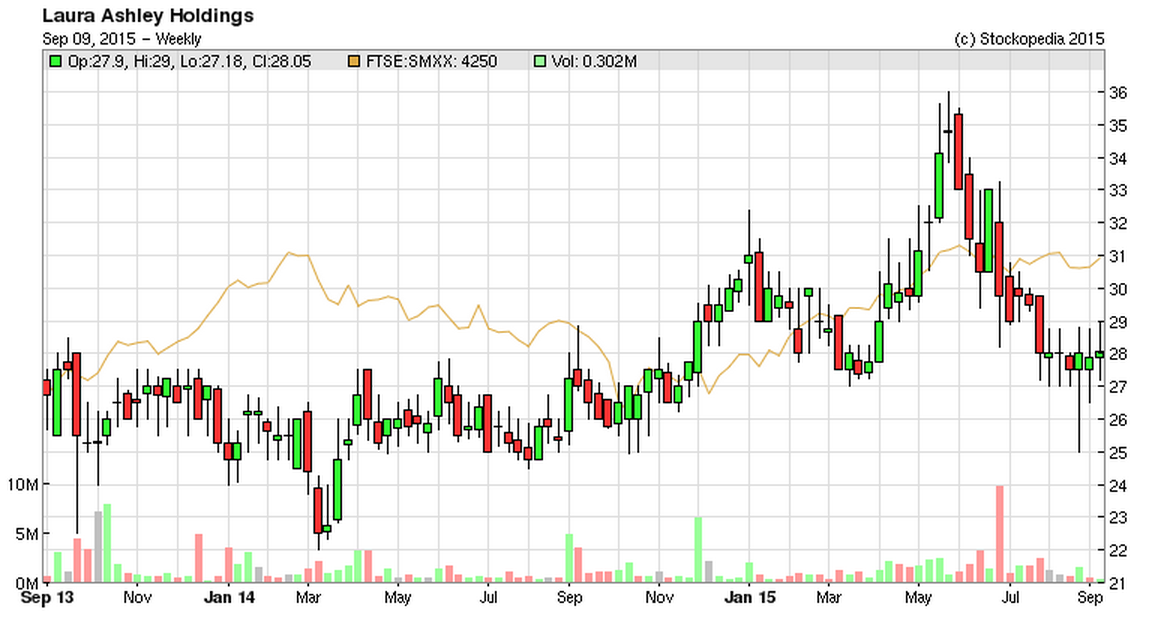
The chart looks quite nice too - ready for another move up, who knows?
Monitise (LON:MONI)
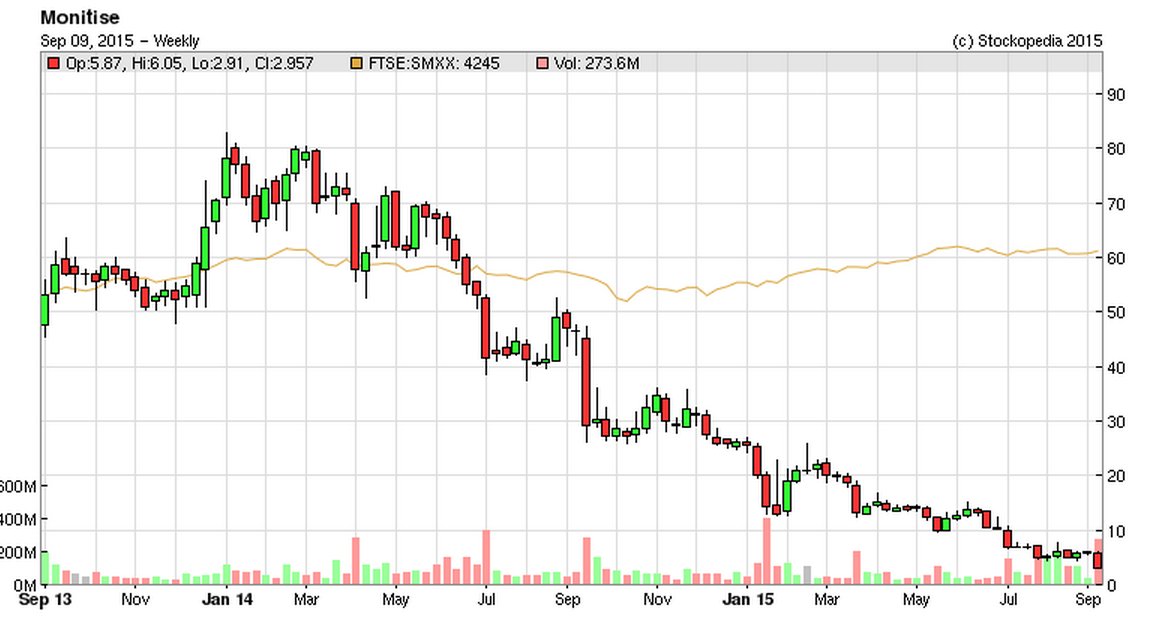
Share price: 2.98p (down 48.7% today)
No. shares: 2,200.3m
Market cap: £65.6m
Results y/e 30 Jun 2015 - a total train wreck! Key figures;
Revenue down 5.7% to £89.7m
EBITDA loss of £41.8m
Capitalised into intangibles £40.8m
Therefore on a cash basis, the loss was £82.6m!
The only figure that really matters now, is how much cash is left in the bank before they go bust? There was £88.8m cash remaining (down £58m in a year!), so by the looks of it, there's only enough in the tank for about another year.
However, they are cutting costs, and management reckon they can get to breakeven before running out of cash, saying;
Going concern
At 30 June 2015, the Group had cash of £88.8m. The Directors have prepared a cash flow forecast, including reasonable sensitivities, which shows sufficient funding to see the Group to break even and beyond. The forecast includes cost savings which will be generated from the business optimisation programme begun during the last financial year, encompassing further headcount rationalisation, exiting from non-core geographies and further property rationalisation. Furthermore, capital expenditure is expected to be substantially reduced during the year ending 30 June 2016 following the development and launch of the new platform in April 2015. This new platform is expected to drive a new, higher margin revenue stream. The Directors therefore confirm that they have a reasonable expectation that the Group will have adequate resources to continue in operational existence for the foreseeable future and accordingly these financial statements are prepared on a going concern basis.
My opinion - Monitise has never had a viable business model, something that was glaringly obvious - I shorted this share when it was over 20 times the current price, but unfortunately didn't have the patience to keep the position running. Pity.
It's very much in the last chance saloon now, with enough cash to give it one last chance at creating a viable business. Is it worth a punt? I don't think so, as the market cap is still lofty, at £65.6m. They say that "we expect the cash position to be in excess of £45m throughout FY16 - well fine that sounds reassuring, but it's only an aspiration. In my experience when businesses like this downsize in a rush to reach breakeven, all sorts of liabilities can come out of the woodwork - redundancy payments, penalties for surrendering leases, etc.
I'd have a punt on it if the mkt cap fell to say £10m, or about 0.5p per share.
I see the CEO has decided to return to America, for "personal reasons". Hmmmm.
Isn't it staggering to think that this had a mkt cap over £1bn as recently as 2014? It's amazing the over-valuations that many investors will give to blue sky projects that have failed to demonstrate any commercial viability, in bull markets. Bottom line is this - if you are selling a product or service which costs more to produce than you can sell it for, then you don't have a business, you have a charity - which is subsidising its clients.
Disclaimer
This is not financial advice. Our content is intended to be used and must be used for information and education purposes only. Please read our disclaimer and terms and conditions to understand our obligations.

25 comments
I think both these measures of fcf are useful, fcf is used to pay divis and in many companies these are a given, so it's useful to know how well the divis are covered by fcf (just as by earnings), because you get a picture of how likely they are to be cut or increased.
K
Paui thanks for the analysis of Laura Ashley Holdings (LON:ALY) I am holder and find it very interesting. My pennyworth on FCF a concept that chimed with me (and I think is a variation of FCF but I am inexperienced so may have got it wrong) when I came across it reading on Buffett or his letters (can't remember which) is owner earnings.
Net Income
+ (b) depreciation, amortization
+/- (b) other non cash charges
- (c) annual maintenance capex (or the full capex)
+/- changes in working capital
The Laura Ashley hotels venture in UK is something else that really puzzles me. I gather that the logic behind it is supposedly that the hotels be furnished and curtained and wallpapered with Laura Ashley products as some kind of "live showrooms". Besides it being a way of spending a lot of money to reach probably a relatively small number of people (and many of those likely to be already fans of the look, that being the reason they choose to stay there), why do all that and then lose money on it and devote management time and effort to it when the controlling shareholder, Malayan United Industries Bhd (MUIB) already has eight established hotels in UK, under the "Corus" brand, some of which (not all) look to be just right for the LA treatment? Why not simply have some of those hotels refitted?
http://www.muiglobal.com/
http://www.corushotels.com/
Anyway, enough of Laura Ashley!
With Goals Soccer Centres (LON:GOAL) as you have pointed out all those fixed assets on the balance sheet are leaseholds. I am sure it is the correct accounting treatment of leaseholds but I do find it a bit counter intuitive that they have the leaseholds as assets on the balance sheet but being operating leases, the future payments are off the balance sheet and not included as liabilities. I am probably missing something but it doesn't seem logical to me.
Hi Paul,you started to review AMO back in june but you ran out of time.
Any chance of finishing it off?
Thanks for the long reply but let's call it a day here as I have been brought up with a quite different fcf (free cash flow) definition than is the common usage here in the UK I think it is much better, you clearly have never thought of it quite in this was which is fair enough. It is another of the things which I don't like in UK analysis and account presentation. Good luck with this one but i am going to continue to leave i alone. I will let you know in the unlikely event that I find anything out in November on the Japanese business which has clearly been a drag so far this year.
Hi WDWombat,
I've done a bit more googling on the FCF issue, as it was bothering me, and I've come across an article which confirms my defiition of FCF, but also mentions that some analysts use a more stringent version, which includes dividend payments.
So we've reached a nice compromise where we can both be right! - there are alternative ways of calculating FCF, although I think my version is the more widely used in the UK.
Here is the relevant article if you're interested, although as you suggest, we've probably done this issue to death already lol!
http://www.investopedia.com/university/ratios/cash-flow-indicator/ratio2.asp
Regards, Paul.
m reading a previous report, I think Goals were trying to get around the not paying the organiser issue with an app that allows the players to pay directly.
Here is the link to the app.
https://play.google.com/store/apps/details?id=com.adactus.GoalsMobile&hl=en_GB
A rating of 3.2 and all the people reporting problems shows very poor execution. The app needs to work. No excuses.
In comparison, the Dominos Pizza app gets a score of 4.6
I just didn't see enough upside in this stock, so it got culled as part of some rebalancing last month. Sometimes decisions work out & make up for the bad ones.
I would want to see evidence of them getting their act together and the directors making large purchases to buy back in.
Thanks for the earlier posts from people who are or know customers.
You have not addressed the main point on the like for like oddity which quite clearly doesn't add up. Free cash flow as I have defined it must be taken after tax. There are different definitons, sometimes dependent on accounting regime, mine is the most conservative. A company that pays out more in capex + dividend than it makes in net profit AFTER TAX less dereciation is not building any capital strength. Its net worth is falling.
Hi WDWombat,
I don't think there is any oddity on LFLs. As is normal practice, ALY quotes LFL figures for company-operated stores only, which is the UK stores. The UK is trading very well, as you can see from the figures. Hence it is reporting positive LFL sales growth, and UK profits rose in H1.
International is trading badly, as they also explain, but as these are operated by franchisees, they are not included in LFL sales figures, as the sales are not ALY sales. ALY just receives royalties, licensing revenues, etc, from the franchisees, which is what they book as revenue.
As regards Free Cashflow, you're right that different people work it out different ways, but the definition I use & gave above is pretty much the standard definition that most people understand as free cashflow.
The free cashflow figures on the StockReport are inconsistent with other companies, because of the way ALY presents the figures in its annual report. So Stockopedia's data provider picks up the wrong (post-dividends) free cashflow figure (unlike most other companies, where it picks up the pre-dividend free cashflow).
I delved into all this in a lot of detail a while ago, because loads of people have been put off buying shares in ALY because they think it is haemorraging cash. When actually, it's generating tons of cash, but as a matter of policy, is paying that out in divis.
This is Stockopedia's definition of Free Cashflow (below), which is clearly pre-dividends, but the figures for ALY are post-dividends, so this is an anomaly which I flagged up to the data people a while ago, but it hasn't been changed, so remains an anomaly.
Everyone I know who has checked the ALY Annual Reports for themselves has confirmed that I am right - ALY does indeed generate plenty of cashflow, which is then used to pay large dividends. As I mentioned in the main report above, I think the divis might have to be cut at some point, as may not be sustainable. There again, with a strong Balance Sheet, I don't have any problem with a fundamentally sound company paying out more in divis than it generates in free cashflow, for a few years anyway. As long as they don't accumulate too much bank debt, then it's fine.
Free Cash Flow is calculated from the Statement of Cash Flows as Cash From Operations minus Capital Expenditures. Unlike earnings, it omits purely "paper" expenses.
Free Cash Flow per share should be compared with Earnings per Share in order to understand whether a company is able to turn its earnings into cash or not! Ultimately every company needs to make cash to survive and without free cash flow a company will have to go begging to shareholders or resort to borrowing. The best companies are 'cash machines' - you should look for companies that make more free cashflow than earnings.
N.B. Cashflow can be very 'lumpy' as capital expenditures are not consistent from year to year. Also growing companies may have to invest heavily ahead of cashflow to keep up with demand.
Goals - checked my local site for availability - there seems to be a good amount of pitches available even at weekends and evenings. Which is probably not a great sign.
I would also expect that the amount of football on television and how well it is spread from throughout the week would effect attendance and bookings. (upto 5 televised Premiership matches over a weekend now)
I would agree with BlueFrew - Creating a team is the easy part, but a little loss of excitement and an injury or two makes running a team week in week out a difficult proposal. From my experience in 5 a side - you get 1 good season with everyone up for it, after that it becomes a struggle and eventually there are just not enough people interested and you fold your team.
Paul, a couple of points:
1. The Singapore property actually cost 34.5m pounds, once S'pore GST and costs are added.
2. Your remark that, "International - as this is franchised, the sales figures don't come through, just the profit element. So it's actually a lot bigger than most people realise - at 296 franchised stores, and international actually generated 55% of PBT last year" puzzles me. I think you've picked this up from note 5 to the segmental analysis of the last full year's results (12.9 as a % 0f 23,5) but there are these notes that follow that breakdown:
"The reported segments are consistent with the Group's internal reporting for performance measurement and resources allocation. The Group does not allocate indirect overhead costs between its retail and non-retail segments. As significant elements of the indirect overhead costs arise from the retail segment, it is decided that the entire indirect costs are allocated to this segment.
Retail revenue reflects sales through Laura Ashley's Managed Stores, Mail Order, e-Commerce and Hotel. Non-retail revenue includes Licensing, Franchising and Manufacturing. Contribution is stated after deducting direct operating expenses, buying, marketing and administrative costs. "
So the "non-retail" figures actually include manufacturing so it isn't all internationally generated while a share of indirect overheads would need to come off as well. So we actually do not know how much profit comes from the international business itself, unless there's something I've missed in their RNS's.
I do remain rather sceptical about ALY. On fundamental business grounds I find the investment case unconvincing for all the reasons we have discussed previously on Stockopedia.
Best wishes,
Jane.
Hi Jane,
The interim figures contain less detail than the Annual Report unfortunately, so it wasn't entirely clear what was what in the analysis today.
I recall when I went through the last Annual Report with a fine toothcomb, I came away with the impression that profits are split roughly 50:50 between UK and overseas, although as you say there might be some muddying of the water because of shared overheads.
Given today's announcement of strong growth in UK, and struggling International, then the profit mix will have shifted more towards the UK.
I think investors are missing a trick with ALY. It's performing very well in the UK, its main market, and the website shows attractive products at reasonable prices. The valuation is much lower than many other retailers, yet it has a better brand, and is delivering stronger current trading in the UK. And the divis of course are fantastic. Plus Asia growth could really accelerate rapidly over the next few years.
It takes time for investor perceptions to change, but I suspect ALY could seriously re-rate at some point over then next couple of years. Imagine if they announce a franchise partner has been signed up to open x hundred stores in China or India, etc. There's nothing in the price currently for expansion overseas, yet it's already proven to work through a franchise & licensing model.
Regards, Paul.
I don't get these Laura Ashley figures They state 'total Group sales decreased by 3.0% to GBP139.7m compared with the same period last year (2014: GBP144.0m). Total UK retail sales increased by 0.7%. How can this be reconciled with a 7% increase in lfl sales and a 2% decreas in floor space?
I don't buy your argument on cashflow either. Take net profits, add back depreciation and amortisation, and then deduct capex and dividends. This is the actual net amount accruing to the company and is in most common use among professional investors aka free net cash flow. I have looked at Laura Ashley a lot over the years but am just not sure thay have a real market appeal in the UK any more though I accept that the 7% lfl increase claim seems to belie that concern. I will try and visit a Japanese store in November but I do know that almost every overseas retail franchise in homeware and/or clothing retail in Japan has ended on the rocks. Though it is true that the GST increase led as usual to a massive pick-up prior to the hike followed by a massive drop-off. Next year will be informative. But I do quite like the sound of the Singapore purchase, even if it does produce a massive fcf deficit, I get the feeling he is trying to re-brand for a serious (non-Japanese) Asian drive in markets he knows. That may be the making or undoing of the company.
Hi WDWombat,
You say;
I don't buy your argument on cashflow either. Take net profits, add back depreciation and amortisation, and then deduct capex and dividends. This is the actual net amount accruing to the company and is in most common use among professional investors aka free net cash flow.
This is wrong. You're right up until deducting capex, but you don't deduct dividends when calculating free cashflow, because the whole point of calculating free cashflow is to see how much surplus cash is available for paying sustainable dividends, reducing debt, and any other purposes.
Here is the definition of free cashflow from Investopedia, which aligns with my thinking on this;
The fact of the matter is, and this is not my opinion so you don't need to "buy it", it's just an obvious fact - Laura Ashley Holdings (LON:ALY) is a cash generative business. It uses that cash to pay very generous dividends.
I agree with your final point though - that the purchase of the large office block in Singapore signals an intent for serious expansion through franchisees into Asia. To my mind, big Malaysian shareholders/mgt are likely to be far better equipped to do this, than a British mgt.
Paul.
Paul,
I suspect if you were a customer of Goals, that would be more than enough to put you off investing in them.
In the main they have 2 types of customer - Those who play in the GOALS run leagues as a 5 a side team, and those who don't, ie typically a group of friends who just want to play a regular game amongst themselves, to keep fit, socialise etc.
Typical problems I saw in using my local goals for 10 years were:-
Huge number of fights spilling over from the league games.
Large turnover of players due to injuries, astro-turf not as forgiving.
You pay for the pitch, so if someone doesn't turn up, not only does the team organiser have to find a way to cover the missing money from that person, the game is also somewhat ruined.
During my time running the finances for a group, I lost count of the times I stood in a queue waiting to pay, listening to arguments with the management about not having money to pay because someone doesn't turn up.
Being the person who's name is in the frame to pay, would not be much fun, when needing to get money from at least half of the types who play there. Hence the churn and lost revenue must be pretty high.
A 5 a side pitch is not cheap, it was approaching £70 when I packed up, but suspect it's more now. You don't need to be let down too often by others before you knock it on the head.
Each venue will have its own issues but ours were:-
I lost count of the times the boiler packed up, and we had to have cold showers in the winter.
The beer in the bar was poor and expensive, and service very inconsistent. We put up with this for a while but eventually decamped to the local pub afterwards. This is a big loss for them, and shouldn't happen.
Balls lost, due to going over fences into areas where they are not recoverable. Quite typical in urban areas. Again more cost to the users unless you can get GOALS to give you a new ball.
Continual management changes, so little loyalty shown to good recurring customers.
Shuts down often in bad winter conditions ie snow.
But the big problem is that its a group situation, where you have to pre-book and pay as a group. Unlike bowling for example where each person pays their own cost to the bowling centre. If the group of part group fails to show someone is significantly out of pocket.
To run a regular booking you need a pool of about 20 people to fill the 10 places on the night. You also need to charge them slightly more than 1/10th of cost to cover weeks where you are short, or even have to cancel.
It's quite an organisational challenge for the customer before you even get to GOALS bit.
Cheers Lee
I used to play in a GOALS league and helped make up the numbers in a group game. Good post which matches many of my own experiences.
To take part in a league you really need a core of 5 people who'll turn up almost every week. Once you drop below that it becomes more trouble than it's worth, regardless of how many occasional players you have. So in the main that will be people with no kids, regular working hours and some disposable income. In most cases it will be work colleagues who live and work in the vicinity of the GOALS site.
I wonder how much issues like high rents, insecure zero hour contracts and youth unemployment are having an affect here. Because it's people in their 20s who'll make up the bulk of the core players.
Hi bicboy,
Thanks very much for your demolition of Goals Soccer Centres (LON:GOAL) from a (former!) customer's point of view. I was shuddering whilst reading your post, at how utterly ghastly it all sounds.
Thanks for scaring me off from the idea of buying any shares in it LOL!
Cehers, Paul.
MCO has been strong recently and it looks reasonably justified. The company has cash on its books and is clearly persuing an aquisition strategy which seems fundamental to its successs. Long term I like the franchisee model which has better margins. The results did confirm a slowdown in the housing market but the estate agency seems a very small part of the business.
Rental demand is on the rise and this is a great little company that gives me exposure to the side of the property market i prefer. Looking fully valued now but i have no intention of selling my holding yet
Good figures from MCO today Paul. Are you going to feature them?
Ref Goal - DOH
I had it in my head they would have plenty of freehold so this might be a similar business to the Car Dealerships or the Lock N Store type stuff.
Paying out a fortune in rent rather than buying property is a shame as nice to have some dowside protection.
I guess the nitty gritty is how much cash they can put aside for ongoing renovations - its like the old bowling alleys everyone must have been to where they owners pimp the cashflow without keeping the customer experience at a decent level - eventually everything gets tatty - sales drop off and then the business closes.
Other questions was 5 a side leagues a bit faddy in that they were springing up left right and centre - once the novelty of a new local site has worn off 5 years later will everyone decamp back to the sofa instead?
Having said that if they do it well and it makes money and they have the strong niche its a nice bit of diversement from the normal stuff one owns.
Final point - should this be a company to add into the "Living Wage Future Profit Warning Alert Company" - perhaps its safest out of companies like this if one is not already invested and it is known that most staff are likely to be on peanuts rather than cashews.
Final point - should this be a company to add into the "Living Wage Future Profit Warning Alert Company" - perhaps its safest out of companies like this if one is not already invested and it is known that most staff are likely to be on peanuts rather than cashews.
I've seen this a few times now and I'm not sure I really understand why there is such concern about companies that employ staff on low wages? It is very simple what will happen, especially if they are a well run, decent business that is worth investing in; they will put their prices up or increase productivity by using less people to achieve the same level of business. This is the way it should be i.e. we as consumers should pay more to ensure our fellow citizens are paid a fair and decent wage.
I have a largish position in Marston's and they and other pub groups can easily increase prices to cover the extra costs with 1p extra on a pint of beer here and there, 25p extra on the cost of a meal etc. Most people wouldn't even blink an eye at such increases. They can also easily adjust the number of bar staff working midweek etc. The Living Wage is a really great thing and a good business should have seen it coming and be elastic enough to easily cope with it, and let's face it some of the additional wages will end up back in the till at Marston's :-)
Si
Hi Simoan
It's hard to know how things will pan out - i have a wad of Marstons shares too so i am hoping the change for them wont be more than 5% of current profits .
Lets look at Marstons as an example though - say £160 million of staff costs - if they had to give 20% of staff a 20% rise thats an extra £6.4 million a year in costs - over the 5% threshold. But not stupidly high. There will probably be complications at all levels - if a trained up Bar Supervisor is currently on the living wage do they need their pay bumping up too? how far up the chain does it go. How will it work with under 25's particularly if you have to be careful about being ageist. £9 an hour has been mentioned as the rate by 2020 thats quite a hike from where we are now.
With regard to passing prices on this may work but consumers can only be pushed so far and often low wage jobs are industries where spending is discretionary. I look at pubs that do well now and they tend to be the outlets that have kept their pricest keenest.
Anyway in summary it all probably depends on lost of factors - but high wage costs with low margins and low earners are the ones i would be most worried about.
Goals mention often mention their booking APP on their company statements.
This gets very poor reviews on the google play store. There is no point in having an app that does not work properly. I see this a sign of poor execution.
Compare with Dominoes who sell lot of pizza and must have a competitive advantage from their app (convenience of ordering). Although, I use neither.
Thankfully I recently dumped this stock as part of a rebalancing exercise.
Hi Paul
Any thoughts on the Laura Ashley Holdings (LON:ALY) interims issued this morning.
Regards,
Imran.