Small Cap Value Report (Fri 12 Feb 2021) - FRP, JET2, FUL

Good morning, it’s Paul here with the SCVR for Friday.
Timing - I’ll be focused on this all morning, so should be done by lunchtime. There’s not much fresh news, but I have plenty of backlog items to catch up on.
Agenda -
Frp Advisory (LON:FRP) (I hold) - Trading update looks good - ahead of expectations
Jet2 (LON:JET2) - another fundraising. I use this as an example to warn of the dangers of dilution.
Fulham Shore (LON:FUL) - Trading update from earlier this week. Takeaway/delivery doing well. Expansion resuming.
.
Frp Advisory (LON:FRP)
(I hold)
100p (pre market open) - mkt cap £240m
FRP Advisory Group plc, a leading UK professional services firm specialising in advisory services, today announces a trading update for the nine months to 31 January 2021.
That means it has an unusual 30 April 2021 year end.
It’s mainly an insolvency practitioner.
Exceeding market expectations - good news here -
The Board is pleased with the continued progress made over the first nine months of the Group's financial year, despite the significant levels of government support and reduced levels of both corporate insolvency and administration appointments across the market. As such, at current trading levels, the Board now expects to exceed current market expectations1, with revenues of at least £75 million and adjusted2 EBITDA of at least £21 million.
1. The Group believes that current consensus market expectations for revenue and adjusted EBITDA average £72m and £19.2m respectively for FY21
2. Adjusted for share based payments including deemed remuneration and exceptional costs.
That’s a good beat, about 10%, although why are they quoting adj EBITDA? I wish companies would report adj EPS, because that’s a much simpler number, which reflects reality, and means we can quickly work out the PER.
EBITDA is not a useful measure to me, because it ignores so many important, real world cash outflows (e.g. interest, tax, capex).
As Andy Brough pointed out in a recent PIWorld interview (a must-watch if you haven’t already seen it), he’s convinced that EBITDA was invented by Americans after Big Bang, to justify higher valuations! I don't think he was joking, maybe slightly, but it's difficult to tell. Here it is again -
Broker update - many thanks to James Fletcher at Cenkos, his latest figures are available on Research Tree. The numbers at FRP are quite complicated, due to the layers of different remuneration for the partners, including a 25% profit share. James very kindly helped me get my head around the numbers last time FRP reported, when I raised a query, much appreciated.
Updated Cenkos numbers this morning show the £21m adj EBITDA from the RNS (which already accounts for the 25% partner profit share). That whittles down to 6.4p adj EPS, giving a PER of 16.3 (at 104p per share currently).
Forecast divi of 3.9p gives a yield of 3.75% - well worth having.
My opinion - I think both Begbies Traynor (LON:BEG) (I hold) and Frp Advisory (LON:FRP) (I hold) are a decent proposition at the moment. Both are trading well, despite Govt support measures meaning that insolvencies are artificially low.
The argument is that, sooner or later, all these zombies companies in sectors such as hospitality, retailing, etc, will need to restructure, providing rich pickings for insolvency practitioners. CVAs are already happening widely, with more likely to come once the moratorium on evictions inevitably ends.
It took me a while to get to grips with the accounts at FRP. On balance, I feel that it strikes a sensible balance between the conflicting demands of outside shareholders (for divis) and management (fee earners wanting to enjoy the fruits of their labour).
I think the valuation looks reasonable, and a 10% improvement today in forecast earnings for FY 04/2021 is encouraging.
.
Jet2 (LON:JET2)
1198p (down 8% today, at 09:58) - mkt cap £2.1bn
Formerly Dart Group, this operates the Jet2.com airline, and package holidays business. It’s been highly successful, and has a wonderful track record of growth & share price appreciate, so a really good business.
The reason I mention it, is to highlight the theme of equity fundraisings, and the impact of dilution.
Many companies raised fresh equity funding in the spring of 2020, there was a deluge of it, as so many companies realised that they had inadequate financial reserves to cope with the unexpected covid crisis.
Entire sectors (e.g. travel, retailing, hospitality) realised with a jolt that their business models were completely wrong, in assuming that revenues would always continue uninterrupted. I still don’t think this message has sunk in with many companies or investors. It seems to be assumed that the Government will always step in with relief packages to take up the slack. But what if the next crisis happens when Governments don’t have such extensive financial flexibility? This time, they’ve printed money to run an unprecedented peacetime deficit. What happens if inflation takes off, and money printing isn’t an option next time there’s a major crisis?
Companies have been very lucky this time, that investors have had plenty of cash, and have been prepared to support fundraisings. What happens if the next crisis occurs in a bear market, when investors run for cover, and only offer fresh funding at a deep discount, if at all?
Hence why balance sheet strength is now more important than ever, as has been demonstrated so well in the last year.
Obviously airlines are still suffering huge cash outflows, and little revenues. Although I was surprised at how modest a loss was reported by Jet2 in its interims. Revenues dropped from £2.5bn in H1 last year, to only £300m in H1 this year (6m to 30 Sept 2020). The loss before tax was only £(119.3)m, which amazed me, that it wasn’t much worse.
Looking at its balance sheet, part of the problem with airlines & cruise ships, is that customers pay up-front, hence cash is flattered by this. The corresponding creditors are called “deferred revenue/income”. Therefore to see how much cash a business really has, one should deduct the deferred revenue creditor from its net cash balance. That can often reveal quite a weak underlying position, if all customers demanded a refund (the worst case scenario).
Jet2 saw its cash position decline from £1,656m at 30 Sept 2019, to £1,008m at 30 Sept 2020, despite efforts to conserve cash. Part of the reason was that deferred revenue fell from £661.7m to £339.7m over the same period (in current liabilities. I’ve ignored the scrap in long-term liabilities).
This shows how an enforced shutdown causes a double pressure on cash - not only does an airline have to continue funding many outgoings, for now idle airplanes, but it also sees cash leaking away from customer refunds, where it cannot persuade them to accept a credit note instead.
Looking back over the last year, Jet2 was able to raise £98m from selling its non-core Fowler-Welch subsidiary. Probably not an optimum sale price, given the timing of June 2020, and it being a semi-distressed seller.
The taxpayer provided a £300m loan facility under the CCFF run by the Bank of England.
A placing of 29.78m new shares was completed in May 2020, at a low price of 576.5p per share.
Another larger placing has been done this week, for 35.76m new shares, at 1180p per share, a 9.1% discount.
Given that many companies have been forced to issue new shares, it’s vital to keep on top of this issue, so that we don’t end up over-valuing shares. Hence i always check the “Average Shares” line on every StockReport, here it is for Jet2 -

This gives you a nice overview of how free and easy (or not, in this case) a company is at issuing new shares, over the last 5-6 years. Cash burning, blue sky shares, usually issue new shares every year, hence this line can often see a huge increase in share count - one of the reasons that blue sky companies usually make such terrible investments - even if they do succeed commercially, the early stage investors have probably been diluted down to virtually nothing, at ever lower share prices.
Remember that the above data is historic, so you also need to check the current, bang-up-to-date share count, which is at the bottom of each StockReport, here it is for Jet2 -

.
Checking through the numbers, this is how the share count has/is risen/rising -
Pre-covid existing share count: 149.0m
Placing in May 2020: 29.78m new shares issued
Subtotal: 178.78m (as shown above)
Latest placing today: 35.76m new shares to be issued
Total share count: 214.54m
Therefore, two equity fundraisings have increased the share count by 44%. The reason that matters, is because it will act as a substantial drag on the share price in future.
You can see from the 3-year chart below, that the share price approached 2000p just before covid struck. That big rise was on the back of superb results published, so it was a logical price move at the time. Then of course it crashed (too far on the downside) when covid struck. From memory, I think we could buy around 300p briefly at the low point, before it doubled in a few days.

.
At 2000p in early 2020, the market cap was £2.98bn (149m shares * 2000p)
However, if the market cap were to recover to a valuation of £2.98bn now, then with 214.54m shares in issue, that would equate to a much lower share price of 1389p.
For this reason, logically there should only be quite limited upside on Jet2’s current share price of 1198p - a rise of just 16% would take it to 1389p, at which point the market cap would be back to its all-time maximum of £2.98bn.
The odds are that some investors won’t realise this, and hence might end up chasing Jet2’s share price up to a new high, possibly, in due course. That would almost certainly mean the shares being considerably over-valued, and set for a sharp correction when accounts are published showing a much lower EPS than people expect, due to the share count being a lot higher.
So do be careful with this issue. It’s vital to check the figures, to see how much the share count has gone up by. Shares with little to no new share issuance could have much better % upside on the share price, due to there being no dilution.
This is a good example of where drawing lines & patterns on charts, and imagining this will predict the future, could deliver completely wrong results - because the chart always needs to be seen in conjunction with the number of shares in issue.
Maybe it would be better to plot the market cap on a graph, and not the share price, which would correct for this flaw?
I thought this was a useful reminder, to point out using Jet2 as a current example of the dilution caused by 2 fundraisings.
EDIT - another point to add, is that many companies have leaned on bank borrowings to get them through the crisis. However, once trading is normalised, then banks could pressurise them to reduce bank borrowings with fresh equity. Therefore, a careful analysis of the overall funding position is necessary. i.e. Just because a company may have got this far without raising fresh equity, doesn't necessarily mean they're out of the woods. There could easily be a gentleman's agreement with the bank, that more equity will be raised to reduce gearing later on. End of edit.
.
Fulham Shore (LON:FUL)
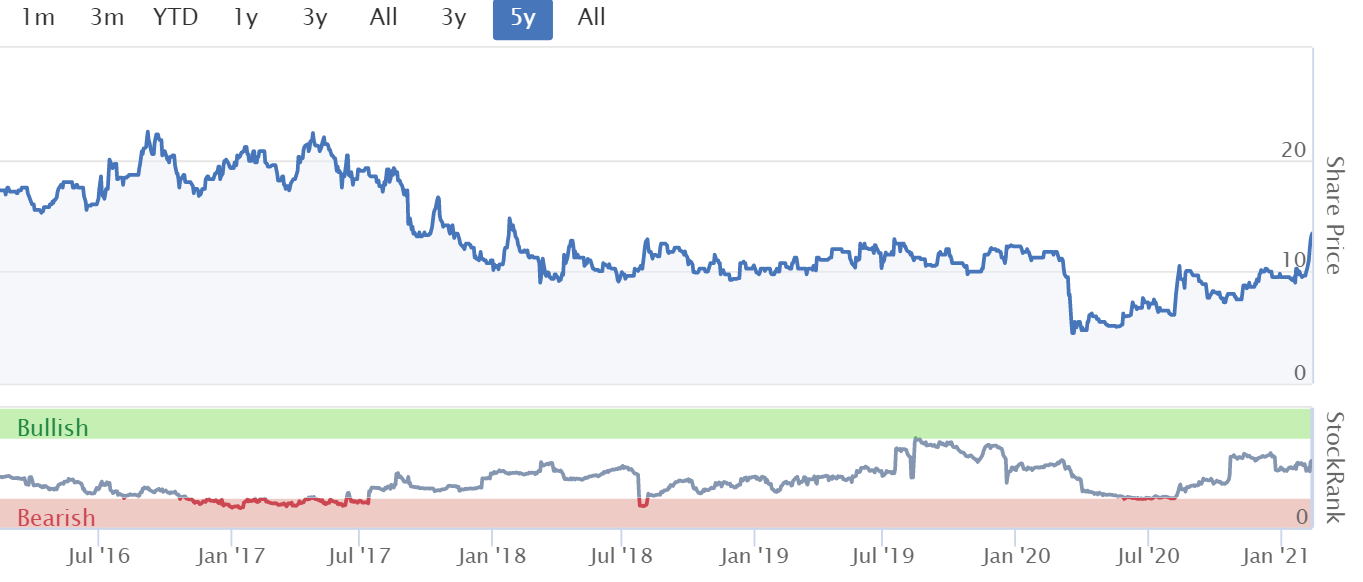
13.4p - mkt cap £82m
As of today, Fulham Shore's restaurant estate comprises 53 Franco Manca pizzeria and 19 The Real Greek restaurants. Throughout the current third lockdown and tier 4, which began on 20 December 2020, the Group has been trading through delivery and take out services at 48 Franco Manca and 10 The Real Greek.
The share price is now actually above the pre-covid level, which seems odd considering its restaurants have been (at least partly) closed.
.
- Operating on lower staffing for takeaways, other staff furloughed.
- Revenues running at 46% of usual, offering takeaways & delivery only (no dine in) - this strikes me as remarkably good.
- Directors confident that revenues will recover once stay at home restrictions are lifted.
Loans - drawn down in full £10.75m CLBIL Govt loan facility, and talking to HSBC to extend March 2022 £14.75m facility. This is a lot of debt, too much, in my view. Although...
Net debt is only £5.7m, so the group is hoarding cash, at the same time as borrowing. There’s probably some creditor stretch too, but we’re not told how much that is. Headroom of £20m looks ample.
Expansion - negotiating for “many sites” at much reduced rents & capital costs. This should lay the foundations for profitable growth in future, once customers return from lockdown.
My opinion - there are two clear positives here: (1) strong takeaway/delivery trading, helping it to survive lockdown, and (2) pipeline of new openings at what should be much more competitive rental terms.
FUL looks a clear long-term winner, in a very tough sector. Hospitality has not just suffered from covid/lockdown, but also from serious over-capacity. It takes many years for over-capacity to clear, because there seems an inexhaustible supply of people who imagine they can create a nice lifestyle by opening their own bar/cafe/restaurant. In most cases this ends in disaster, and they go bust. Then the landlord re-lets the site to another new operator, and the same pattern plays out again. Hence, despite pauses when they’re closed, most bar or restaurant sites continue to operate, just with new owners every now and then.
Given that being the case, will a lot of competition disappear? Maybe not that much, and very slowly. Meanwhile, FUL is probably paying too much rent on most of its existing sites. Why would landlords reduce the rent, when they know FUL is solvent? Also business rates are likely to kick back in.
I can see that FUL is a decent business, but that looks priced-in already. The current valuation is over £1m per existing restaurant, which seems excessive to me. That said, lockdown may have accidentally broadened their business so that takeaway/delivery, combined with a resumption of dine-in, may result in a more profitable business post covid. Trouble is, the share price is anticipating that, so where’s the upside? Risk:reward looked OK to me c.10p per share, but at 13.4p? Forget it, I just don’t see any attraction at that high valuation. A roll out funded by debt would take years. So why pay up-front for it?
.
Disclaimer
This is not financial advice. Our content is intended to be used and must be used for information and education purposes only. Please read our disclaimer and terms and conditions to understand our obligations.

100 comments
Jet 2 Thank you for the information early last Friday so that I was to promptly take appropriate action. Regards Michael
Very enouraging update ref the Pfizer vaccine from israel - its probably too soon for these stats to have any meaningful statistical significance with the time lag between infection and death and lack of age details of sample population used - but out of 520,000 people who have been given 2 doses of the Pfizer vaccine (in this specific sample group) there have been zero deaths - a quite staggeringly good outcome albeit it could be a statistical quirk at present. There does seem to be decent evidence emerging that even those that go on to get covid after being vaccinated seem to be less likely to end up in hospital or end up dying that than those who have not been vaccinated. So even though one may look at sucess rate of say 60% for some of the less effective vaccines or age groups and think thats not very effective hopefully its probable that those in the other % bracket that "failed" may still be getting some benefit from the vaccine.
https://www.businessinsider.com/pfizer-93-effective-israel-0-deaths-520000-maccabi-2021-2?r=US&IR=T
As far as I recall IG Group (LON:IGG) were giving shares to TastyTrade and so don't know if there was a fixed monetary peg.
Be that as it may, investors are displeased to see their investment fall from £9 to £7.80, and it wasn't perceived as a good decision, simply an aspirational or vanity one.
My average on IG Group (LON:IGG) is 575p and so I'm lucky to have a lot of safety and a very attractive yield at that cost price.
750p may turn out to be support level. I topped up @750p in July just to make it a fairly safe working yield investment.
Sounds like a balanced exposure would be good for you Rmillaree sir.
UK Investor's week:-
IG Group (LON:IGG) began Monday @757p, hitting a low twice of 743p but finished the week @780p. May be the daily decline is over?
IG Group (LON:IGG) will have problems with its TastyTrade (US) purchase if its share price continues to decline, eroding the value of shares given to TastyTrade. Maybe the rout is over and the price is stabilising or beginning to rebound, or even over-sold. There are some positive commentaries still out there for IGG. It has also continued to be a good trading environment for CFD and broker platforms.
UK_Investor sealed his ISA allowance, taking £10K in SCS (LON:SCS) +4.5% last week.
This week I took my first trance, £10K in Centamin (LON:CEY). Centamin has been in a down trend since 1st October 2020 when its engineers announced some structural problems in one of its mines, collapsing the share price from 200p down to 109.85p at close today. I'm down -3% so far on my foray.
I'd counter argue: PE 10.8 Q 99 V 92 and the share is now at its lowest point in 9 months, having touched a low of 94p on 18th March 2020. Its probably close to a bottom, with a potential technical rebound if some good news materialises.
Metrics except PEG in the green, Piotroski 9, Yield 5 to 6%.
Looks like Quality and Value to me. I'm under exposed @£10K only.
Next week Wednesday 17th - Plus500 (LON:PLUS) 2020 full year results. Expect anything to happen, could be a disaster, could be spectacular.
And the week after, Wednesday 24th - loan shark International Personal Finance (LON:IPF) (my biggest holding +19%) - Full Year Earnings Release. International Personal Finance (LON:IPF) currently 81p, but she's been floating in the range of 78p to 95p, but most definitely holding at her support level around 80p. If there's good news (December and November's earnings were satisfactory), there will be a spike. I am not expecting the grand revival yet and am setting my time line for over-the-year now.
This week, I'm down -2%.
Excellent weekly summary UK_Investor_8888 - always interesting to see what bods are holding and info ref prospects even if it may be a little OT for some :)
IG Group (LON:IGG)
IG Group (LON:IGG) will have problems with its TastyTrade (US) purchase if its share price continues to decline, eroding the value of shares given to TastyTrade. Maybe the rout is over and the price is stabilising or beginning to rebound, or even over-sold. There are some positive commentaries still out there for IGG. It has also continued to be a good trading environment for CFD and broker platforms.
Is there actually any specific issues ref the shareprice decline and tasty acquisition??- i sort of read the takeover announcment as saying that the amount of shares to be issued was fixed at the £61 mill ? - IF thats the case then does it really matter what happens to the IGG price going forward. I am almost presuming that the share price might go up if the deal fell through? Have to admit i didn't drill down to the details to see chapter and verse.
I still kinda have my finger over the buy button here with 750p being my target price - but there is competion for my next purchase - Pfizer also look tempting - particularly as the pound is up to at least 1.37 against the dollar - which surprised me somewhat when i checked today.
Excellent read as always, cheers Paul
Hi Paul
Some thoughts:
Cheers
A
A message for Paul. Re Jet2 (LON:JET2), thank you for your very helpful reminder about the implications of cash raising by new share issues. You are right. I don't always and it is a vitally important figure when it comes to valuation, and future investor purchase or sale decisions. I did watch it this time because it was quite a quiet time. In fact the 160m in Stocko was a false low IMHO. I raised it with Stocko and this was the conversation.
Me: 'Hello. I am just looking at the Jet2 placing of new shares. I see on
the Stocko sheet that the shares number currently is shown as 160m. The
placing document indicates that should be round 180m, because they have
placed around 36m and the new total is 215. Original figure on Stocko
sheet seems way out at 160m vs near 189m as indicated in the document.
For information only and passing on to your information source only -
and tho check my arithmetic!! '
Stocko response (and by the way I am a long time Stocko customer and am always pleased by the speed and quality of response). 'In most cases share count is only updated with financial reports. I can have a look to see if this can be done sooner for Jet2.'
Me: 'No its just that the figure seemed way out. Hence my suggestion that
the source you used may be using a very wrong figure - being millions
out is quite a lot. Thanks for that. No need to come back to me any
further.'
Paul thank you so much for the write up dilution, share issuance and debt. Really instructive and useful.
Regard
Michael.
Thanks for the analysis of JET2. As former holder considering going back in, it was very helpful
Nice article, nice learning for me.
Brilliant analysis of JET2. Well done.
I came across this item today which is that IATA are developing a vaccine passport app.
https://www.iata.org/en/progra...
It would appear that Emirates are trialling it:-
https://www.iata.org/en/pressr...
The only responses I have seen from the UK Gov on the subject are that they are not considering a vaccine Passport (probably civil liberties, discrimination, etc). This would not seem to prevent the airlines using it themselves and it may even spill over into cruise operators such as Saga (LON:SAGA) . This would seem to be a positive for safe travel and associated shares.
Sensible, and obviously in the self-interest, of IATA to develop something like this.
On the surface that looks interesting but a lot is going to depend on international standards being developed for the data entered into every single field. Individual countries may become very discerning on exactly what:
Indeed, some countries may decide that they won't accept the accuracy of data entered by specific other states, and may choose to completely act as though no negative test or jab has been adminsistered
Whatever follows from this, it could become the accepted international store for this type of information... ...for use by airlines, cruise companies etc
Bump in the N Brown (LON:BWNG) share price during the morning - looks like a member of the Alliance family bought a big chunk of shares at 65p.
Boohoo - Top Shop - Burton 'on the button' Dorothy Perkins (maybe not?) - N Brown er - get a name change bro. N Brown (LON:BWNG) - and change the moniker £COOL
Playing Devil’s advocate, the other side of the Jet2 (LON:JET2) fundraising coin is that by raising fresh equity they de-risk the company making it a safer investment. If, as suggested by the RNS announcement the fund raise is being done for prudential/liquidity reasons (as opposed to filling a hole to cover for sunk cost/operating losses), then the cash from the equity raise after fees etc., is still presumably an asset on the balance sheet so the market cap should also increase £ for £.
In Paul’s example above, the equivalent benchmark market cap of £2.98 billion should arguably be increased by the net amount of the new equity raised before dividing this value by the total number of shares. This offsets a fair bit of the apparent value dilution. Going forward, future earnings per share are indeed diluted (essentially the same earnings divided by a higher share count so lower eps etc.) , but then again is Jet2 (LON:JET2) more likely to be around to make such earnings if it’s “fixed the roof while the sun is still shining”?
As a holder of Jet2 (LON:JET2) shares I’m reasonably sanguine and trust the management who have a strong track record to manage the business appropriately. If they feel the need to build up liquidity headroom so be it.
Gus.
£Jet2 - Reply to Gus
.... but you also need to take account of the amount of cash consumed.
As we are talking about dilution I see Kromek (LON:KMK) have done another placing. From past news it look like they have done a place every two years since 2015.
Excellent section on Jet2 (LON:JET2) Paul, something i'd never considered, i've learnt a lot, thanks!
Interesting, generally bullish article re Boohoo (LON:BOO) , which I do realise is not a small-cap, but is much discussed here :-)
"Can Boohoo really create an online equivalent of Inditex?"
https://www.theindustry.fashio...
With thanks to alibx11 who posted the link at ADVFN
Hi shanklin,
Thanks for the link to Boohoo (LON:BOO) (I hold) article. What a refreshing change to read a journalist who actually tries to achieve some balance when reporting on BOO - noting the positives and negatives. That's very different to the clear vendetta many other publications have against the company & its management.
Regards, Paul.
Re Boohoo (LON:BOO)
Might be worth remembering that close linkage between retailer and some British manufacturers was the fundamental business model of Marks and Spencer in its glory days. Shares in its suppliers always had a premium rating
That’s a good beat, about 10%, although why are they quoting adj EBITDA? I wish companies would report adj EPS, because that’s a much simpler number, which reflects reality, and means we can quickly work out the PER.
EBITDA is not a useful measure to me, because it ignores so many important, real world cash outflows (e.g. interest, tax, capex).
Don't you think both are useful? In my company we found EBITDA invaluable for internal discussion, as this was what the coal face team, footfall, purchasers could make a difference to and we felt more accurately reflected like for like performance improvements both between sites and year on year. We aimed for high single digit LFL growth at mature sites but much higher in sites growing into their market share. Working this out on an adjusted earnings basis would have been a nightmare.Adjusted Earnings on the other hand to a degree depends on stuff like how aggressive the tax strategy is re capitalisation, amortisation, depreciation and whether tax losses from prior years are being brought forward and the like. All important stuff quite agree but easy to lose sight of the underlying performance of the business. in the smoke and mirrors. It all depends on who is doing the adjusting and what the motive is, At least EBITDA is easy to define. Some accountants work in black and white, some in black and very very dark grey. :)
We looked frequently at a whole host of KPIs, Footfall, transaction yield, rolling annual client yield, as well as all the obvious variable overhead %s but the holy grail each month was the site EBITDA and return on sales.
I do however agree that there is a temptation to value on a multiple of EBITDA which we did when I sold my group :)
Maybe there is a market for another measure EBITDA per share?
I can't see why EBITDA and adjusted earnings etc can't all be listed in a trading update. The company concerned will have all that info to hand after all.
excellent explanation on dilution Paul, thank you
Great summary of £Jet2 Paul. Dilution will limit short term growth prospects but there are also other factors to take into account long term. I think Jet2 will emerge as one of the stronger players post Covid. The rising share price pre-Covid looked like it was on a strong trend and may have continued if not for the Covid disaster. Post-Covid I think pent up demand will lead to rapid re-rating for Jet2 especially with the void left by collapse of Thomas Cook.
Paul's point about Jet2 (LON:JET2) dilution and market cap is well made. I was looking at this with regard to J D Wetherspoon (LON:JDW) this morning.
Pre-covid they had 107 million shares in issue at a share price of around £15.20 with debt of £737 million for an Enterprise Value of £2,363 million.
Now they have 129 million shares in issue at a share price of £12.18 with debt of £1,372 million for an Enterprise Value of £2,943 million.
I haven't checked these figures, so definitely don't take them as gospel without cross-checking - but in what world would it be sensible for JDW to be more highly valued now than it was pre-Covid?
The only, vaguely, rational reason I can think of is that the competition will be decimated, but it seems to be taking a lot on trust. We can't even be sure when they'll reopen, on what basis or what the customer demand will be.
You can find similar examples all across the sectors that have been most badly affected. Buyer beware.
timarr
.
Certainly the founder would seem to endorse your view!
Haven’t checked your calculations but assuming they are correct and J D Wetherspoon (LON:JDW) is overvalued as per Paul’s analysis (i.e. the share price has been chased up above fair value) is it a shorting opportunity? I have no idea but according to shorttracker there are no shorts on £JDW over 0.5%. Perhaps there are other stocks which merit the same analysis. However, given the GameStop frenzy perhaps shorting by Hedge Funds/institutions has fallen out of favour!
J D Wetherspoon (LON:JDW)
Now they have 129 million shares in issue at a share price of £12.18 with debt of £1,372 million for an Enterprise Value of £2,943 million.
Where have you got your net debt number from ?- per announcement of 19th January net debt at 14/1/2021 was £900 million (that number being directly compared to your 737 million comparitor quoted total) that figure is quoted directly before they raised the £90 million quid 5 days later so i have net debt of £810 million or so as at 19/1/2021 unless i am missing something.
That gives me a figure in line with pre covid -which seems just fine to me the lower shareprice roughly matches the extras shares issed which have kept the business in a kind of lfl position. So shareholders have lost out as funds have been raised to cover high % of covid related losses. But overall debt has not gone up £500 million as far as i am aware on any sort of lfl basis !!!!
Note its more compicated than this simpistic apporach as JDW may have naturally been adding debt to aquire freeholds or repaying debt - so there may be other issues at play here - i would guess they may have increased "other payables slightly!" - shoudl be calculable number though when it all pans out.
On the upside covid will deffo have massively impacted the opposition so going forward JDW may be able to either increase margins if competitors are doing the same to claw back losses - have less competittion if sites have closed or be able to add new sites reasonably on the cheap and possibly buy freeholdes at lower market values if there is excess of pub type freeholds going round. Ref pricing i know my local whetherspoons was dirt cheap (under £2 a pint !!) purely down to the 3 local main competitors also being dirt cheap - if those competitors go or arent dirt cheap going foreward i would be gobsmacked if they dont up their prices to closer to the local next cheapest place or ar least have material uplift. So culling of the week competitors could perhaps make them moref profitable going forward perhaps all other things being equal. I fully expect my ability to buy pint of beer under £2.20 never mind £2.00 may be over unless i am resorting to the cheap tatty fare that no one wants to drink.
Where have you got your net debt number from ?- per announcement of 19th January net debt at 14/1/2021 was £900 million (that number being directly compared to your 737 million comparitor quoted total) that figure is quoted directly before they raised the £90 million quid 5 days later so i have net debt of £810 million or so as at 19/1/2021 unless i am missing something.
I took it straight from Stocko, for want of anything better. It's probably too high, probably better to take the company's own worst case estimate of just over a billion.
And yes, agreed, it's more complicated for all sorts of reasons. But still, can we really justify the price recovery seen so far? It has 20% more shares in issue and more debt and no income for the foreseeable future.
It'll be OK, obviously. But investors are making some very brave assumptions about future growth.
timarr
J D Wetherspoon (LON:JDW)
And yes, agreed, it's more complicated for all sorts of reasons. But still, can we really justify the price recovery seen so far? It has 20% more shares in issue and more debt and no income for the foreseeable future
well i am happy to hold - and the shareprice here is down 26% from the end of the last calendar year - so no recovery to anything like pre covid levels !
Lets look at facts
ref debt looking at the companies scenario 1A 19/1/2021 they expect net debt at ye July 2021 to be £879 mill (969 number less £90 million raised not included in quoted total - as per note) - thats neither £1.37 bill that you first quoted or the £1 billion that you quoted the second time around. Note net debt at 2020 year end was £817 mill - so its not really a material increase at all based on scenario 1A. ok they may not hit 1A but thats first on their list and covid cases are decreasing slightly.
Note trade and other payables at 14/1/2021 was down £65 mill on year end 2020 and down £100 million on 2019 and half year 2020 levels - so what they owe out short term is very under control.
If you compare funds raised of £135 mill and 90 mill thats 225 mill raised.
They expect to lose £112 before tax to july 2021 - say £90 mill after tax rebate
losses ye july 2020 ignoring property lossses was under £50 mill post tax rebate
So expected losses over the two year period July 2019 - July 2021 at £140 milion is well less than the sum of funds raised - note they were investing heavily pre covid - so that partly explains the debt increase - they spend £98 mill on freehold reversions ye July 2020 - so that "splashed cash although increasing debt comes with the bonus that they own the property freeholds and will presumably not now need to pay rent going forward.
So based on the above figures the increase in debt is very manageable if we take the viepoint they will be back up and running "sometime in next 3 months" - note their scenario 1A starts at a level of sales being down 50% and slowly increasing. I think they may be slightly behind this expectation ref opening date but at such a low level of sales planned initially a later opening with closer to normal sales may get the same result - facts are company hasnt revised these expectations.
Ok getting back to your elephant in the room the 20% more shares in issue - facts are that since 31/12/2019 the shareprice is down 26% - or 20% using your lower shareprice probably from mid january. So its not as if there has been no hit in the shareprice the declline exceeds the new shares issued.
So overall as the sum of the expected "cash" losses 2 years to july 2021 is less than funds raised and the shares are down by as much if not more than % of new shares issued i don't really think the shareporice is particulalry pimped out at all - i hold and am happy to continue to do so. I have not added to this share since march as i have done with some others so i won't argue with those that say the donwisde risk here is to big - i am confident enough ref pubs re-opening sometime in next 3 months if i wasnt i would probably be selling - but for non holders who needs to take the risk buying here now - probably no one.
I believe J D Wetherspoon (LON:JDW) is worth buying.
But I haven't worked out when.
If I wanted a punt on bars/public houses recovering earlier than most consider likely,then I would opt for Revolution Bars (LON:RPG)which is still at a huge discount to it’s pre Covid price.
Revolution Bars (LON:RBG)
If I wanted a punt on bars/public houses recovering earlier than most consider likely,then I would opt for Revolution Bars (LON:RPG)which is still at a huge discount to it’s pre Covid price.
err there is the elephant in the room here that shareholders from pre covid days have had their percentage onwership of the company shares massively diluted . On simplest lfl comparison i would say that you only have 40% (estimation please check) of what you had pre covid ref % ownership of your company - due to issue of 70 odd mill new shares!! - other than spike up in January/February 2020 shareprice is equal to or below the comparitor figure (40% of prior shareprice) for most of 2019 in that regard ! RBG were unlucky as they did seem to have turned the corner early in 2020 ref trading and shareprice trend.
I have just noticed directors gave themselves nice xmas present on 24th December here of 1 mill+ virtually free options - subject to themselves agreeing in future they are they are worthy of the freebies in the future - i am confident the "underlying" business will be doing fine in that regard even if the actual busines is doing pants at the relevant decision time :)
Revolution Bars (LON:RBG)
I have loaded up, especially in recent weeks, on an assumption that Revolution Bars (LON:RBG) will survive until May and then will be significantly undervalued, irrespective of the share dilution & debt load.
My workings from mid-December 2020:
gives me a 2021 Market Cap target of £60m (=£85m-£25m)
ie 100% upside to current valuation
The 3 main risks I can see with the above:
Can anyone think of any reason, particularly quantitative, why my logic might be flawed?
A
Revolution Bars (LON:RBG)
Great stuff Abtan - the debt / other liabilities total is the other main part of the picture so nice to have some projections in that regad.
Personally i don't like the risk reward compared to the 50/60p range pre covid if debt will be up at £29 mill - it was only when it was getting down in the £10 to £15 range or less that i felt comfortable that they had the wriggle room to cover contingencies. Lucky for me i never bought back in here around the turn of last year. £30 mill debt again puts them back in the very little wriggle room zone - they will (presumably you will agree??) be in hoc to the bank until such time as they can get debt back down so they have a decent safety net ref planned reductions in debt etc.
On the plus side presumably the rents/unprofitable units issue has been mostly been resolved in their favour?? - not sure how much extra that should bring in compared to pre covid but if thats £1 mill plus a year they are better off thats a decent positive kitty of safety net from which to be working from.
As we know the road back to where they were pre covid from the poor trading days was a long hard slog of slowly improving metrics - i do worry that it might be similar here when they reopen.
I would say if hit the £8-£9 mill consistent cash generation per year then it wont take long for the market cap as you say to get closer to £50 - £60 mill per year you would think. My caution isnt that i don't think they will be there its just the cost if they arent there and need to do another fundraise.
Revolution Bars (LON:RBG)
Thanks for the quick reply.
In response:
In theory the business should be a cash cow in just a few months so the debt should be paid down very quickly creating more wriggle room within a matter of weeks/months.
The risk you mentioned is therefore if they need funds in the next 3-4 months, which leads me to...
I saw a cash cow that was consistently incorrectly valued - look at any of the old cash flow statements, taking care to split out expansion/refurbishment capex (the former could have been stopped at any time), and this is quite evident.
The P&L always had non-cash adjustments making it look like the company was always performing badly.
Given my current position size I would urge any non-believers to please pray that my thoughts above are correct.
Cheers
A
Given my current position size I would urge any non-believers to please pray that my thoughts above are correct.
Hi abtan
You're constantly in my thoughts :-/
Not least because I concur with the financial analysis, albeit only in a small way.
My worst case on reopening is now:
The main problem with this scenario is that it means pubs and bars don't really benefit from the pent-up demand because their ability to supply is artificially capped. However, at this point all I require is the ability to generate enough cashflow to limp through another year.
I agree that there's no plausible reason for the banks to call in the debt or that a further fundraise wouldn't be successful. For this to go south I think we're looking at a virus variant that escapes the vaccines - which is possible, but not forecastable.
Put it this way - I think Revolution Bars (LON:RBG) is a better bet than anything that requires overseas travel in the foreseeable future ...
timarr
Revolution Bars (LON:RBG)
Thanks Timarr
A good point and one I've thought about.
If they can open and then crawl along until society fully re-opens, then that's good enough for me. 100% upside in 1 year would be great, but if it takes up to 3 years then that still implies a decent return.
As an aside, I personally don't think lockdown will last that long, even with virus mutations. I think if covid looks like it will be sticking around, society will just learn to live with it; it can't stay inside forever.
Also note the following Israeli deaths by age (I can't find something similar for the UK) and contrast it with the demographics for a normal Revolution Bar.
Irrespective of the financials of a chain of UK bars, fingers crossed the vaccines work on all mutations and everyone can return to their normal lives as quickly as possible.
A
Irrespective of the financials of a chain of UK bars, fingers crossed the vaccines work on all mutations and everyone can return to their normal lives as quickly as possible.
Amen to that.
As I said, it's a worst case scenario. My thesis is that if an investment works on that basis then if things turn out better that's just upside. It's worked out well for the last twelve months.
The age profile of CV-19 mortality is well understood - if that was the issue Revolution Bars (LON:RBG) would never have closed - but the real issue is hospital capacity. It's an existential issue for the government to not let the NHS collapse - and the last data I saw showed that nearly 40% of UK CV-19 hospital admissions were under 65. They mostly won't die, but they do block beds.
So overall we could still end up with a problem next winter if not enough younger people get vaccinated (take up is expected to drop off as the age groups fall) or if there's a mutation that the vaccines don't block. The prevalence of CV-19 around the world - which is likely to persist until 2024 - unfortunately means that such mutations are quite likely for the next few years.
I'm not saying any of this is highly probable - I don't think it is. But it is possible and I'm always anxious to avoid total loss of capital on any of my investments.
timarr
Hi Timarr and anyone else interested.
I'm sending the below for reference, which shows positive cases currently in a "Difficult Situation" by age, again from Israel.
(Israel Health Service is the source: https://datadashboard.health.g...)
It looks like about 1,000 people people fall into this category, of which c20% (about 200 people) are under 50.
Israel's population is 9m.
Hi abtan
I'm following the Israeli data but it's not telling anything the Pfizer trial results didn't - well, other than the Pfizer trial results were accurate, but that was never really in doubt.
There'll be two issues that drive future UK restrictions - how many people are unprotected in the over 65 group and the tracking of variants that reduce vaccine efficiency, particularly in terms of hospitalisation. UK government policy is being based on modelling commissioned by Sage:
Early relaxation of non-pharmaceutical interventions (NPIs), before sufficient immunity has been established is shown to precipitate a large wave of infection with resultant hospital admission and deaths; a similar impact is predicted from any final release of NPIs if herd immunity has not been achieved.
https://www.medrxiv.org/conten...
Broadly - keep social distancing and mask wearing in place until we reach herd immunity levels, which will be sometime in the summer, assuming younger cohorts take up the vaccination in sufficient numbers. In the meantime we need better data on the effectiveness of vaccines on the various mutations in circulation.
In terms of variants, the question that's keeping scientists awake at the moment is what exactly is going on in Manaus, which is experiencing a serious CV-19 outbreak despite having apparently achieved herd immunity. There are multiple theories but the worrying one is that the P.1 variant has evolved to evade antibodies. This article gives a good overview, but note it's journalism, not research, although it links to the underlying science:
https://www.bmj.com/content/37...
Mobility data in Manaus shows a gradual increase in people going out to socialise, shop, and work after the first wave of cases. Activity peaked at Christmas shortly before hospitals buckled. Careless behaviour from the local community, which did not appear to adhere to social distancing, and insufficient action from the state governor, have been blamed.
This behaviour was at least partly driven by a belief that herd immunity had been obtained - and it's very easy to translate that to the UK, post-lockdown, this summer.
Based on the above I think it's realistic to assign a reasonably high probability to hospitality businesses seeing restrictions until the end of winter next year. That's not the worst case, of course, the variant in Manaus has triggered our own government's doomsday scenario of a healthcare service collapse.
The government will come under huge pressure to release all restrictions as soon as the over 50's are vaccinated. If they do then the probability of greater restrictions later in the year would increase. The route back to normality will be a tricky one and not just for investors.
timarr
Thanks Timarr
Thanks for the Manaus link; I know you've mentioned it earlier, but I didn't get a chance to read it before now.
I wonder whether the UK would consider going down the NZ route, if it is able to get domestic cases under control, but mutations continue overseas?
A
I wonder whether the UK would consider going down the NZ route, if it is able to get domestic cases under control, but mutations continue overseas?
Well, I have an opinion, but I'm not sure that counts as evidence?
I can't see that the UK, as an international hub, can isolate itself without doing permanent economic damage so we need to figure out how to do the opposite - to find a way of safely managing international travel while protecting ourselves from subsequent CV-19 waves. The limited evidence on reinfection is that immunity lasts 5 to 8 months and even people who have been infected and recovered can be carriers, so this is going to require a rolling vaccination program, an effective track and trace system and world beating gene sequencing of variants.
Fortunately we now have the platform for all of these. I think it will take until next year to deliver all of it, but we have to figure out how to because CV-19 isn't going away. New Zealand has done a fantastic job of protecting citizens but a zero Covid strategy is unsustainable in the long run. How do they move on?
On a different note I was looking hard at Everyman Media (LON:EMAN) on Friday for the obvious reopening inspired reasons. But I'm struggling to see how the financials work - it was running negative FCF before CV-19, so it's not obvious to me that a recovery will turn this into gold. But you clearly think differently - so what am I missing?
timarr
"I can't see that the UK, as an international hub, can isolate itself without doing permanent economic damage"
Perhaps this would be the lesser of 2 evils? A well-structured quarantining regime would surely be better than locking down society?
We're in very deep speculation territory here, so I'll move onto some thoughts on Everyman Media (LON:EMAN)
Survivability
Future Cash Generation
Valuations
Current EV = £128.5m
Let's assume EV = £135m by the time this lockdown eases
There are understandably a few assumptions in there, but assuming things start to re-open this year, the downside looks limited, with big upside.
Fingers crossed as always.
A
You're assuming the government treats all drinking places equally for COVID purposes.
When in fact, they've already shown that "late night" venues can still be shut while "day drinking" venues like regular pubs have been allowed to re-open.
If I could place a bet, I would say that J D Wetherspoon (LON:JDW) would be allowed to trade much sooner than Revolution Bars (LON:RBG) will be allowed to by the government this spring.
Re £RGB (I hold) - to add to the discussion I think 2 factors not mentioned are
i) How much competitive hospitality actually goes under - so far it has actually this has been relatively muted ie the owners hammered but unable to re-open (promising the bank to clear debts over a boom in 2nd half). Ironically, a final cull from an extended lockdown may help RGB
ii) relatedly how much (at brand/outlet level) Revolution and Rev de Cuba have been able to prepare to re-orientate and add more daytime/early evening trade to the core Nighttime trade. (Where they should do well; their no 1 competitor Deltic went bust and closed outlets). This was a focus pre-Covid but I am not clear where it will emerge.
iii) I agree your point re nightclubs open after bars - here the question is how long after
FWIW I think point ii) will be enough to keep it ticking over through 2021 and do very well in 2022 .
I urge anyone with shares in travel companies to look at the risk of further equity fundraising.
Jet2 (LON:JET2) today, and likely Ssp (LON:SSPG) in the next few weeks. Who else has weak balance sheets, or runways that assumed a full return to normal this summer?
While TUI reported robust summer bookings.. If the same had happened at Jet2 (LON:JET2) they would have deposit money now, why did they need to raise more money at this point? It must be that their bookings activity hasn't really picked up? Haven't read the announcement today so apologies if already addressed by them.
I've always though market cap graphs wd be useful rather than share price graphs for the very reason paul mentions but they are hard to come by even on professional data offerings like Bloomberg and factSet. Anyone found any
Re: Jet2 (LON:JET2), I'd taken a look at this one on Feb 2nd, the last time it was mentioned in the SCVR.
The chart was looking positive, and I was looking for a brief consolidation before a breakout, on volume, into the buy-zone. We can now see from the chart below that this didn't happen, and the SP has now understandably dropped off. So an entry was not taken.
I note Paul's comments: "This is a good example of where drawing lines & patterns on charts, and imagining this will predict the future, could deliver completely wrong results"
I agree that that drawing patterns on charts cannot predict the future; but the intention here is to identify an optimal entry point, where risk can be managed and downside contained. If price had broken out and then reversed, the loss should be limited to max 8%, while profit could be allowed to run. It's not for everybody, but I find it to be an effective methodology.
Safe to say that for the time being, I am removing JET2 from my watchlist :)
Hi Breakout Trader, I always enjoy digesting your graphs and charts which try to predict a possible 'buy' entry point. However, reading Paul's excellent writeup and observing the increasing number of shares in circulation it is clear that £Jet2 is currently exhibiting the properties of a typical stochastic chart on this occasion.
Hi David, yes, I would agree - the fundamentals aren't there now on JET2, and the dilution is a red flag.
It needs to re-build, but I suspect the chart will be moving sideways or downwards for a while. It will likely take time to present an actionable setup, but I'll be staying clear of it for the time being.
Plenty of other setups out there.
Paul,
That is a great explanation of dilution and its effects.
Thank you.
Richard
Here are my SCVR heat maps for today (prices as at ~10:00am).
Small Caps with RNS news today ("N!!" in bottom row of the heatmap tile means report / update today):
Big movers today in the SCVR world (moving more than a 20d EMA of the ATR against either yesterdays close, or today's open):
See my main heat map thread for more (not small cap specific) heat maps, and keys to the heat maps contents:
https://www.stockopedia.com/co...
Media speculation about CGT
I know and accept that paying CGT is a first world problem and arguably a nice problem to have, but there is speculation that Sunak may have to look at raising CGT as a revenue source to fund covid. Is anyone else looking at crystallising gains in the current tax year and at the current known rates just in case or is it just me?
Is anyone else looking to switch form share ownership into low leveraged CFDs for the same reason?
Or is the consensus that the risk of a CGT hike is low?
Personally I do not think we will see many if any personal tax increases in March. Too soon with the furlough scheme due to end, unemployment rising etc. I do think there will be a freeze on personal allowances (I am almost certain the £50,000 level will not be increased) and perhaps higher taxes on oil products and alcohol. Corporation tax levels might be a target for a 1 per cent increase but again not this year with Brexit costs and more red tape hurting imports and exports.
CGT raised less than £10 billion last year and a lot of investors will have lost money this financial year and of course a lot of dividends have not been paid. Look at popular Ftse 100 shares like British Petroleum ; a year ago it was £4.70. Just £2.55 today. So reform will be perhaps a longer term ambition but many investors will be recording losses this time around with HMRC.
Council Tax is due to rise by a thumping amount in April (up by ten per cent in London) and business rates are due to be reintroduced (at a cost of £30 billion to business). Other ideas such as pension reform and raising the retirement age to 67 faster (currently due to start in 2026) raise / save vast amounts and we might see some movement here. National insurance could be raised in future years I suspect.
The trouble for Government is that the tax take is already at almost record levels in generations and increasing it even more is politically sensitive. Think how much VAT has increased over the years. People get incensed at the thought that taxed money is then taxed again (which of course it is).
No because most of my holdings are within a SIPP / ISA so CGT n/a .
Paul - regarding Frp Advisory (LON:FRP) (I hold): I like the company, the results, and most of the fundamentals, but I have a question about the Free Cash Flow. The FCF conversion rate has always been very low but the forecast for FY 2021 is spectacularly low at 26%. This level is normally a red flag. Is it depressed as a result of their remuneration policy?
Can I take this opportunity to say how useful and enjoyable your stock analysis is (and I'm not just saying that to get you to answer my question!)
Regarding Frp Advisory Frp Advisory (LON:FRP), there is quite a lot of change in the insolvency/restructuring space with the practices looking like they will be spun out of the big 4 to more stand-alone ventures (due to being conflicted out of too much work, interest from outside investors etc.). Might have a bearing on the competitive landscape if you are holding longer term. It's not my area, so please take this observation with a large pinch of salt....
For anyone with a few minutes to spare this morning you could do worse than read this.
Blain’s Morning Porridge – 12 Feb 2021: Tech, Luck and Megatrends
Thought provoking as usual.
One of the lessons I take from that is that we, as PIs, should not shrink from holding boards to account when they extract the urine on e.g. executive remuneration. Otherwise, in his view, the current capitalist model will be severely altered, probably to our detriment.
The majority of my holdings are in an ISA and therfore through nominee accounts. I'd love to be a more active shareholder, vote at and attend AGMs etc and feel like an owner. Do you know if there is there a way to achieve that while still using an ISA wrapper?
Gdawgeedawg I have an ISA with II and there is an opt in button to vote at shareholder meetings depending on where you hold your ISA it might be the same
I'm with HJ and AJ bell - will give them a call, thanks
I've just moved into ii from the Share Centre and it appears that ii enables the PI to do so as I had an immediate invitation to vote at a Meeting of a company I hold. This in the Trading Account but there is also the ISA Account and I don't see this will be any different.
Silver
That's good to know. I just rung HL and within the ISA wrapper it is only possible to hold nominee shares. They can be converted to physical share ceritifcates (in non-COVID times) but then they cease to be ISA-wrapped. HL can pass on your votes and you can attend AGMs it seems, but your name isn't on the shareholder register.
RE:- HL and names on share register - I believe the same situation applies with a SIPP (Not physically registered for ownership, NO voting rights)
According to the Share Soc website
If your shares are held in a nominee account, as most are nowadays, then it gets a bit more complicated. In essence you will have to get your nominee operator (stockbroker) to submit your votes on your behalf because they technically own the shares not you (i.e. their name is on the share register). You just have a “beneficial interest” in them. But the voting rights are still yours.
If your shares are held in an ISA account then the ISA rules require that the nominee operator will vote your shares when requested, i.e. they have a legal obligation to do so. The best brokers provide easy electronic systems to enable you to do that. But others will do so upon request. For non-ISA nominee accounts, the legal position is not as clear cut but in general all good brokers will vote your shares when requested.
From my experience ii is the only platform that has made me aware of this and makes it easy for me to vote.
It is not just the matter of voting but also (when normal times resume) attending AGMs. The procedure is for the nominee to issue you with a letter authorising you to attend and vote as their proxy in respect of x number of shares. Again, brokers vary - iWeb will send you a letter for free but xo will charge you £20.
Great piece in today's FT by Carson Block, aka (the other) Muddy Waters, about $GME and the distortions to markets caused by passive funds.https://on.ft.com/3qbr9RA
Thanks for posting, for anyone interested in the distortion that passive funds have on markets I would highly recommend listening to the podcast by Mike Green (mentioned in the article) https://www.logicafunds.com/me...
It was part of the "End game" series by Grant Williams - All worth a listening to IMO
+1 for The End Game series by Grant Williams. Superb interviews.
Really interesting interview with Mike Green. And a nice flow to the Grant Williams podcasts. Outside of his, does anyone have any other must listen podcasts to share?
T
I would defend Oakley there. They did what we often ask for by engaging with private investors with an open to all webinar. Perhaps Yellowstone have posted about it in various places here once too often now but I wouldn't put it in the ramping category myself.
I do think it would help if Yellowstone, PIWorld, Mello etc etc, would give some indication of the remuneration they earn from promotional videos. I agree they're a very useful resource, which we seldom had in the past, but there's a niggling feeling they may gloss over negatives. I'm not suggesting they need go to the lengths of Edison, who typically state they charge companies £49k pa for analysis services to Jo Public, but perhaps an indication of whether it's genuinely for free or at digestive biscuits level or even custard creams level?
Ideally Stocko could insist on some potential conflicts statement before allowing such postings.
I think you make a valid point Wilbraham. I think "suppliers" posting here should at the very least declare their "interest" in a company, whether they represent them in some way or have earned a fee. That would make it clear to us mere mortals where they stand. One for the Stocko team perhaps to look at?
cheers
Francis
I would agree. I think that anyone who posts on this board who has received any form of payment or incentive for promoting a share should make such a declaration.
It wouldn’t take any time at all to do so and would increase transparency.
I disagree that such disclosure is particularly beneficial. It should be assumed that all posters have some sort of interest in the shares which they're talking about. Except perhaps for MrContrarian who seems to enjoy ripping the veil from puff-piece RNSs.
I think also that a distinction should be made between companies providing access to management (ie piworld, Yellowstone, Mello, ShareSoc, InvestorMeetCompany etc) and those providing "independent" broker research. With the former group you're hearing directly from the horse's mouth and you can decide whether or not to believe the directors. It's with the latter that there's more of an issue because you're being fed someone else's view about a share and you always have a conflict of interest.
Either way I don't think that Stocko should be policing such things in the same way that they don't censor what we say here (beyond dealing with abusive posts).
I.ve held Chesnara for a while ,sold them on the grounds that they need interest rates to rise along with bond prices due to the nature of their buisness model.
Interest rates are not a major delta, but interest rates falling are more of a negative than interest rates rising.
Well its looks like quite a quiet Friday on the news front so if you want to catch up on something from earlier this week there was very interesting presentation from Steven Tredget, partner at Oakley Capital on Oakley Capital Investments (LON:OCI) on Wednesday. OCI is a listed Private Equity fund and trades at a 27% discount to NAV which has shown consistent growth over many years. The discount looks anomalous given the strong track record of NAV growth. There is a write up on the Stockopedia discussion page of OCI and here is a recording.
Hosted, it should be said, by Yellowstone Advisory!
Paul – Chesnara, Chesnara (LON:CSN) is worth revisiting ahead of their full year numbers. The market cap is currently £410m. I have recently been buying some.
Do your own research, as always.
I have done mine.
a) I pointed out that I cannot see any equity research at all on Chesnara and that is a big thing for me to say as I receive most of the bulge bracket research every morning. Panmure and Investec are the brokers but the CEO said, interestingly, that the company is trying to expand coverage. In my world, the smaller brokers tend to focus a lot of their 'TLC' on the companies that have difficulties (in the hope of generating a very significant fee on a fundraising etc.) rather than the stronger fundamental equity stories where MIFIDII has crushed day to day revenue potential.
b) The full year results are due on the 30th March. The CEO was of the view that the figures would provide the opportunity to present their investment case to a wider audience.
So it looks to me like a catch up move vs. the market is due and there is a catalyst due on the 30th of March for that. The final dividend on its own will pay you 5.1% yield to hold the shares over the numbers.
Interested in your £csn analysis. Could you add anything to the "dividend well covered" angle - because when I look at the stock report it says the ratio is 0.71. Anything less than about 1.5 isn't well covered in my book - but this might be an exception due tot he type of business? What's your view?
Do not know the company well, but Stocko metrics don't really work well for life insurers. A large part of earnings is the release of capital as liabilities unwind, but this is far too complex to get picked up in the metrics. I understand Chesnara are conservative in terms of the dividend and should be well covered but not looked in detail at this. However I would not rely on Stocko metrics to form any such analysis, but do your own research.
Thanks for the reply. Sounds a bit beyond me.
Yes complex stuff. Actually the thing that puts me off on Chesnara is they seem to be very sensitive to equity markets - if you look at last results they report quite a big drop in economic value (which seems to be their preferred measure, roughly equivalent to NAV). This contrasts with Phoenix who hedge their sensitivity to equity markets.
Last seen from their presentation in September 2020...re the Symmetric Adjustment they use for equity market conditions... -10% in Q1, -6.72% in Q2.
Data for the Symmetric Adjustment is published monthly by the European Insurance and Occupational Pensions Authority and while they calculate it on a rolling three year basis...the point I would make looking at the published data from the EIOPA...
is that we are basically back to around zero at the point in time, as at the Dec. fiscal year end. So, in my world, things have improved, the rolling adjustment will be less negative in Q3 and improve further in Q4 when reported on by Chesnara in March. What the EIOPA monthly data says to me is that we have moved close to zero on the adjustment......zero reflects a normalisation of equity markets on this measure.
In September 2020 when they last updated they gave a forecast for Dec. '20 cash of £59.8m. Have a look at the short interview with the CEO Proactive Investors. See what he says about the dividend.......still worried? I do agree, however that they need to get their message across more and they have that on board.
Chesnara (LON:CSN) Small typo, from their website the XD is 8 April. 9 April is record date
I stand corrected...XD is indeed the 8th April.
Not a sector I know at all but Phoenix Group (LON:PHNX) offers a 6.7% yield that is covered 1.6 times so not sure I would pick Chesnara (LON:CSN) over that.
An 8% yield and see the reply to Bouden54.
Chesnara (LON:CSN)
Last half year results reported cash generation 12.9m at the Group level, compare 33m cost of full year dividends.
Cash generation with insurance is tricky due to the balancing act between liabilities and revenues. Have a look at page 28 to see the breakdown of cash generation by division:
UK +4.7m
Sweden +21.7m
Netherlands – Waard Group +2.8m
Netherlands – Scildon -19.5m
Some big swings here in the detail, driven by bond yields and investment markets.
Could be good, but you would need an understanding of their asset mix and a macro view.
For this reason I usually avoid insurers. For supposed boring companies they can end up a leveraged bet on the economy.
Have held Chesnara (LON:CSN) in the past - feel its a great company but the Mkt has changed so much - and now so volatile I am not prepared to go back in. Would add that re Phoenix - the deal several months ago with AbnStndLife seemed to me so leveraged, could not get my head round it and have stayed away from this much bigger more 'prestige' company. Maybe for all the wrong reasons. Technical points raised here are all very good but it is how the Mkt responds that counts.
Chesnara (LON:CSN)
In September 2020 when they last updated they gave a forecast for Dec. '20 cash of £59.8m.
My morning smallcap tweet: MODE à la mode with Bitcoin
Northamber (LON:NAR) Mode Global Holdings (LON:MODE) Frp Advisory (LON:FRP)
Northamber (NAR) H1 rev up 13%, pretax £230k (£9.8m or -£400k before property sale) . Div 0.3p unchanged. Gross margin up from 8.8% to 12.8%. [SP=60.5 Cap=16m]
Mode Global (MODE) launches Android version of its iOS app. It allows "free and instant GBP bank transfers and Open Banking top ups in British pounds, and start buying Bitcoin in just minutes." iOS app is ranked (?) no 2 in the UK finance category. [SP=NA Cap=NA]
FRP Advisory (FRP) Q1-3(Jan) strong. Will exceed market expectations (for Q1-3?), with rev >=£75m and adj EBITDA >= £21m. [SP=100.05 Cap=240m]