Small Cap Value Report (Fri 13 March 2020) - TRB, and 25 other shares mentioned

Good morning, it's Paul here, with Friday's SCVR.
As usual, this post is initially a placeholder, so that readers can add your comments from 7am, whilst I start writing the main report section by section throughout the morning.
Estimated timings - I have to finish early today, so will be done by noon.
Update at 12:29 - today's report is now finished.
Coronavirus
I think it's quite important to keep a record of what's going on, and how it affects the markets, given that it looks like we could be about to experience potentially the biggest crisis of our lives in the next few months this year. That's if coronavirus does sweep through the population, as experts are now predicting. Boris Johnson gave a stark warning last night, that families must prepare to lose loved ones (sick, and elderly people) before their time. What a dreadful thought.
In my family, my main concern is for Mum, who is 83 and badly asthmatic. She nearly died from heart attack & pneumonia a couple of years ago. The NHS came up trumps in this instance, and sorted her out. The miracle of stents now means that she's enjoying a new lease on life. I rang her last night, and had a long talk, emphasising that I wasn't being alarmist trying to put her in lock-down about a week ago, that it was really necessary. She reluctantly agreed to cancel forthcoming social events, and is already doing food shopping online.
We've got another more distant relative in a care home, suffering from dementia. The care home have now banned visitors, so my family are asking to get Skype set up, so that we can stay in touch. I dread to think what would happen, if a member of staff accidentally brought the virus into any care home - it would kill off many of the residents, for sure.
Personally, I split my time between London (in a household of 4, including 1 elderly person who is house-bound), and my own place in Bournemouth. Therefore, I have decided to self-isolate today, and travel back to Bou'mth. Once there, and living alone, I actually want to get the virus, so I can get it out of the way & build up some immune system response to it. Living alone in Bou'mth, I won't be at any risk of passing it on to anyone else, especially an older person, which is my main worry at the moment being here in London.
If/when I do get it, then I'm hoping to be well enough to post about it here, in addition to (maybe scaled back) articles about shares.
Above all, I wish everyone well in my network of friends & contacts, including all readers here.
The futures bounced overnight, so we should hopefully get some respite today. The extent of the market falls seems so extreme, that in my view we must be near the bottom. But it depends on Govt policy. They have to make decisions that I wouldn't want to make - i.e. tighter controls on day-to-day life, which would slow down the spread of the virus, but would do irreparable economic damage. E.g. try modelling how restaurant/cafe/bar/retailer would fare if revenues ceased altogether, even for 1-3 months. It would bankrupt many, or even most companies in those sectors. That's my main worry with Revolution Bars (LON:RBG) and why the share price has fallen so much. I calculate that it would need additional funding from shareholders within just a month of being forced to close all venues all of the time. I don't see such an extreme action as being likely, hence why I continue to hold (and have been buying more) RBG shares. But it's undoubtedly a risk. The same is true for many other companies in the retail/hospitality sectors. The costs are largely fixed, so the next few months will be a question of survival.
Companies with strong balance sheets (net cash) should survive, and of course will probably have less competition, once people recover from the virus (which is mild for most people) and start travelling, eating/drinking out, and shopping again.
Banks are crucial right now. Many companies will need extended bank facilities to get through this period. To take on that risk, then it's not unreasonable for the banks to require a Govt guarantee. There was such a scheme mentioned in the budget, but I can't remember the details. Something similar was done in 2008-9 I seem to recall. At least policymakers & civil service have experience of dealing with a crisis - they can re-use the policies that worked in 2008-9, and invent similar things this time around.
FCA shorting restrictions - there are 2 announcements from the FCA, banning shorting of particular shares today. It looks like Italian & Spanish stocks only, judging from some of the names that I recognise. I wonder if this will widen into other stocks/sectors/countries?
Thinking back to 2008, I remember some shorting restrictions being put in place at the time on UK stocks - maybe it was banks? It brought some temporary respite, because I remember that the spread betting companies forced short sellers to buy back existing short positions. Although it was really just tinkering around the edges. What the banks needed above all was re-capitalisation, which Gordon Brown forced through.
Wider financial crisis? - Italy was already in really bad shape financially before it shut down lots of its economy over coronavirus. Therefore, the biggest risk right now looks to me like a collapse of European banks, and another sovereign debt crisis as Govt deficits rocket as tax receipts dry up & Govt spending soars. So we could be back to 2010-12, with the European financial system teetering on the brink, and firm action only being taken by the EU at the last minute, thus prolonging the crisis. Ultimately, the Germans don't like having to backstop other European countries. But too bad, that's what they signed up for (by implication) when they created the Euro.
This health crisis is almost certain to mutate into another, serious, financial crisis, in my view. Share prices are anticipating that.
The mountain of debt built up by corporates, and Govts, could well come home to roost now. I think risk has been mis-priced for a couple of years, with some bonds not reflecting the considerable underlying risk of default, and equities having been over-priced for the last couple of years. The equities side of things has corrected now, with valuations generally looking more sensible now.
Recent purchases
Just FYI, these are not recommendations, I've been buying this week, including;
Dart (LON:DTG) - I picked up some yesterday. Its strong balance sheet means that this airline is going to survive, as competitors potentially go bust en masse. It was trading its socks off before the crisis. Once the crisis has run its course, then this group looks to be in a great position - less competition (I think many airlines likely to go bust this year), and a restricted public eager to take holidays again.
Newriver Reit (LON:NRR) - the profile of its tenants means that it should carry on receiving rental income largely as normal. Buying now, locks in a 14% yield. Sure that might come down a bit, but this is no Intu, it's much safer than that.
Topping up both Sosandar (LON:SOS) and Revolution Bars (LON:RBG) - I think SOS should produce superb performance in the first half of calendar 2020, because its spending much more on marketing, which proved highly effective in H2 of calendar 2019. Therefore it's up against really soft comparatives. Plus it raised a lot more cash, and people will be buying more online instead of going to shops. Bored people self-isolating at home, are likely to be doing a lot more internet shopping than before. RBG is a risk, but would be over 100p without coronavirus, as trading was recovering, driven by refurbs and other initiatives. Therefore, I feel risk:reward is good, providing they're not shut down by Govt.
Bigdish (LON:DISH) - also an existing holding, I bought lots more at 1.5p. Conditions right now are perfect for signing up more struggling restaurants for its dining app. Therefore this company should be one beneficiary of the crisis. Needs to raise cash later this year, which should be fine I think, due to rapid growth.
Eddie Stobart Logistics (LON:ESL) - covered recently in SCVR. Business has been saved by new financial backer. Looks cheap now.
Gear4Music (G4M) - I've tentatively dipped my toe back in here, with a very small opening position. I'm not worried about China supply issues any more, that seems to be working itself out. The bigger problem now is demand. Although again, being an online company, it should be fine.
Joules (LON:JOUL) - half of its sales are online. An affluent customer base may well buy online during this crisis, thus helping offset retail losses to some extent, I hope. I paid just over 100p, which I think should be an attractive long-term entry price.
Scs (LON:SCS) - similar thing. A bombed out share price, for a good, cash-rich company. Its stores are out-of-town, where people are not in such close proximity. I think it can ride out a few slow months. Again, weaker competition could go bust. People in secure jobs likely to have more money, if they don't take a summer holiday.
Somero Enterprises Inc (LON:SOM) - just a small position. I see c.200p as an attractive entry price. Pots of cash, so no solvency worries, even if business does turn down this year.
Spectra Systems (LON:SPSY) - bank note cleaning company, which is bound to be topical. Was doing well before the crisis, now much cheaper, so I bought average 120p.
Tekmar (LON:TGP) - very small opening position. Covered here a few weeks ago. China disruption should pass.
.
Watchlist
Others on the watchlist which I haven't yet bought;
Dunelm (LON:DNLM) - lovely business, excellent recent results, now looking cheaper (although obviously at risk of forced store closures)
Zytronic (LON:ZYT) - now not much above the value of its own cash. But I imagine its likely to warn on profits at some stage.
Car dealers - some are now looking really good value.
Restaurant (LON:RTN) - looks cheap, but I'm worried about debt, and whether it can survive this crisis?
Boohoo (LON:BOO) - best in class eCommerce fashion business. Not clear to me why the shares have fallen so much. Has gone from very expensive, to just expensive. But long-term, this could be a good entry point c.220p
Norcros (LON:NXR) - down a lot, but pension schemes worry me a lot, as facing a double whammy of lower asset values, and higher liabilities (due to bond yields being so low - although as mentioned above, maybe that could change?)
OnTheBeach (OTB) & Hostelworld (LON:HSW) - travel platforms have much better cost structures, as little fixed costs. Their main costs are marketing & staff, both of which can be quickly reduced if needed. Hence both companies should survive the crisis, and share prices might then recover once business returns to normal. Hence could be an attractive entry point now, since they've roughly halved in price.
Loopup (LON:LOOP) - should be benefiting from businesses doing more remote meetings. But I am worried about debt, and management incompetence. Hence probably won't buy any.
Greggs (LON:GRG) - lovely business, now coming down to a more reasonable valuation. Obviously likely to suffer badly in the short term.
De La Rue (LON:DLAR) - I'm tempted, as recent turnaround performance looks impressive. But debt & poor balance sheet have made me too scared to buy any.
PPHE - looks very cheap now. Balance sheet looks good, if you substitute in open market value of freeholds. I need to do more work on the terms of bank facilities though - risk of covenant breach possibly? I tried to buy some yesterday at 960p, but couldn't get any.
Up Global Sourcing Holdings (LON:UPGS) - I was impressed with my recent audio interview with the company. It sounds like UPGS should be able to fix its China supply chain. However, I think they could now be facing a demand issue. With retail footfall likely to be much lower in the coming months, that could trigger a profit warning. Let's hope they've located a supplier of hand sanitiser & toilet rolls. Forget Bitcoin, in a few weeks we could all be using hand sanitiser & loo rolls as a makeshift currency!
NB. Please remember that I have a much higher risk tolerance than most investors, so these shares will not suit more conservative investors. Also, I'm not a tipster, but am a professional investor sharing my journey with you here. Some of my share ideas go up, and some of them go down. I buy with a time horizon of 2 years+, and am not trying to perfectly time the market. Always do your own research please!
The problem is that, we know we're facing an imminent health & economic tsunami. Therefore, I completely understand why some investors will want to sit on the sidelines, in cash, and may feel it's too early to be buying. They could well turn out to be correct, we don't know yet. Anyone buying now is taking a longer-term view. Once the dust has settled, and we know how things are panning out, then share prices would in all likelihood be more expensive. You have to pay up for certainty. That said, we should obviously be expecting profit warnings to come thick & fast from many sectors as this grim-looking year progresses. Also expect emergency fundraisings, if the worst case scenario does pan out, for companies with stretched balance sheets & too much debt.
Above all, balance sheet strength is paramount. Well-financed companies should sail through this crisis. Companies with stretched balance sheets at the start, could go under, or at least be at the mercy of the bank manager. Why would anyone want to hold any share where the difference between the share price now, and zero, is at the whim of the bank manager being prepared to give a waiver to breached covenants, and to extend the overdraft to enable the company to trade through the crisis? There's huge risk there.
Tribal (LON:TRB)
Share price: 64p (down 5% today, at 09:14)
No. shares: 204.2m
Market cap: £130.7m
Tribal (AIM: TRB), a leading provider of software and services to the international education management market...
I initially assumed this was going to be good news, but the share price being down 5% suggests that it's not.
There was an announcement on 20 Jan 2020, which I hadn't spotted at the time, saying;
Platform dispute
The Group has now reached a non-binding, in principle agreement to settle the dispute with a platform provider for past royalties and a new 10 year agreement for royalties due on future sales and renewals. The Group expects to pay in the order of £9m to settle all historic liabilities, including related legal fees, and will fully provide for these costs in 2019.
[source: RNS dated 20 Jan 2020]
Today's update just confirms the previous announcement, so really shouldn't move the share price at all. Today it says;
...the Group announces that it has signed a settlement agreement for payment of the agreed amount of £8.9m for full and final settlement of past royalty disagreements, which will be paid from our existing cash resources. We have also entered into a new 10 year VAR agreement, with effect from 1 January 2020. This provides a platform from which we can develop new modules and enhanced functionality.
I do wish companies wouldn't use abbreviations that they are familiar with, but some readers of announcements may not be. I've just googled it, and VAR means value added re-seller. There should always be a footnote to define every abbreviation used, in every announcement.
As you can see below, the share price reacted positively to the original announcement in Jan 2020 saying that this legal dispute has been settled;
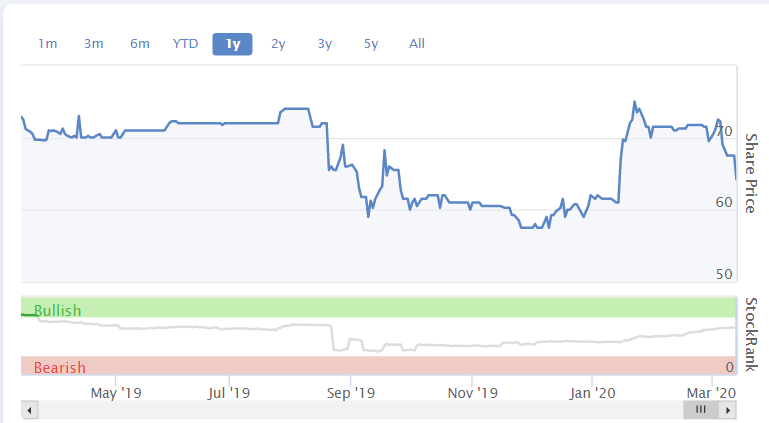
.
Note that I'm using the new Stockopedia site now. One of the spangly new features is that the historic movement in StockRank is shown below the share price chart. As you can see here, Tribal has been meandering around in the middle, but showing a gradual improvement in StockRank since Sept 2019.
I'm guessing that Tribal's share price has held up relatively well in recent market carnage, because it has recurring revenues, with educational establishments. Hence not likely to be too badly affected by the current crisis.
I've looked back through Tribal's previous announcements, to check what they said in the past;
24 Jan 2019 - dispute with platform provider, potential material claim, will vigorously defend it
19 Mar 2019 - legal claim of £15-30m
Therefore, I suppose a settlement of £8.9m isn't too bad.
I've commented before on Tribal's balance sheet being thin (negative NTAV), so paying out this £8.9m, on top of recent outflows for an acquisition, sounds like the balance sheet would need careful checking when the company next reports. It reassured on 28 Jan 2020, saying this;
The Group has a strong balance sheet with net cash at 31 December 2019 ahead of the Board's expectations at £16.5m (2018: £20.0m) following a positive collection performance in the final quarter. During the period Tribal invested £6m in the acquisition of Crimson Consultants and a further £6m in the development of the Tribal Edge platform.
That's probably a seasonal high for cash. Software companies are fortunate, in usually receiving cash up-front from customers, hence they can operate normally, even with weak balance sheets.
My opinion - it doesn't interest me. Too accident-prone. Also, how did it amass these large arrears from the provider of its software platform? This also makes me wonder how much value Tribal adds, given that it's using third party software as its base?
In case you missed it - Jack has recently written an excellent article here about one of my favourite shares, Best Of The Best (LON:BOTB) - well worth a read. Note that being 100% online now, it is not in any way affected by lower airport footfall (it's gradually closed all airport sites).
People self-isolating may be more inclined to have a punt on winning a supercar, I reckon. Therefore I suspect the current crisis could benefit BOTB.
I'm leaving it there for today. Thanks for all your interesting comments, which are really useful - at times like this in particular, I'm interested in hearing the perspectives of other investors. There are not any results statements or trading updates of interest today.
Best wishes, Paul.
Disclaimer
This is not financial advice. Our content is intended to be used and must be used for information and education purposes only. Please read our disclaimer and terms and conditions to understand our obligations.

171 comments
Their modeling leads them to believe that clamping down hard now will lead to Y deaths now and 12xY deaths in the winter, clamping down more lightly will lead to 3Y deaths now and 3Y deaths in winter (numbers made up by the relative scaling is in the model).
Where have you seen these figures? One of the many objections from those in the field who question the current approach is that they haven't seen the modeling it's based on. If it's as clear cut as you suggest then I doubt there would be such a degree of criticism from professionals in the field.
If your figures are correct then they support the current UK approach. But they are very defintely just theories, apparently as yet untested by many in the field, and certainly untested on the ground. The Chinese and S Korean approach appears to have been to clamp down hard, successfully. They appear to now be applying a cautious approach to lifting restrictions - they are not simply removing them, but keeping some restrictions in place. Clearly with the idea of keeping the bounce back way less than the 12xY deaths you are suggesting. There seems to be a fair bit of logic behind that approach, and I think most would want to see some real world evidence before assuming it's going to be the catastrophe in a few months time that you are suggesting.
Massive 1% Fed rates reduction just announced
https://www.usnews.com/news/us/articles/2020-03-15/fed-slashes-rate-to-near-zero-eases-lending-rules
Paul
I don’t know you but need to sell all those positions and quick.
Retail / leisure/ online retail / restaurants will be completely destroyed.
We are no longer in containment phase. We are going into lock down phase meaning only essential travel for food / meds and staying indoors / social isolating.
This may be for months to years as the hospitals cannot allow it to spread fast.
The stocks on watchlist and purchase will be crushed.
I’d get to cash and if you wanna buy something..it’s bs is post bail out and BP on crude price war finishing.
Retailers / leisure companies are 10 a penny and easy go bust / re start.
Banks Pharmaceutical and Oil refiners are building blocks of society
Don’t want you losing your shirt mate
Thanks
as an investor is a few restaurants in the U.K. I believe you are not taking into account that most restaurants have loss of business interruption cover and there are ways of reducing costs in such difficult times,including delaying payment of VAT,renegotiating leases,reducing dramatically stock and delaying paying various creditors until the situation improves. It will be very hard of course but many will survive
No market crash is ever the same & usually no one sees it coming or can time it, until after the event and this Corona Virus is certainly a very different cause, Health not primarily Finance. With most of the developed world in lock down with even shops as well a bars closed down & folks isolated the money supply in circulation will be severely reduced & profits hit hard. Working economies & businesses will take a good time to recover and get back to somewhere near normality; but that will not mean stocks achieving their previous highs for possibly > two years. In such conditions i believe the markets have further to fall and consider there is no need to rush back in. Time this time looks as though it is on our side.
Thanks to Paul & Graham for their professional daily input and a Happy smooth recovery for everyone.
Hi all (esp. NickRay, cmpeckham, gromley and herbie 47 - as most interested in this aspect),
Here's a lookback at how this began; what has happened; and what's coming down the pike...pls ignore the somewhat 'clickbaity' title, the article addresses the numbers and projections in most of the reference countries (China , S Korea, Italy) before heading to the author's home turf, the US
https://medium.com/@tomaspueyo/coronavirus-act-today-or-people-will-die-f4d3d9cd99ca
It's had 28m hits, so is either interesting or informative...and hopefully both !
ATB
Thanks, already seen some of that before, it is already out of date (projections, Spain is well ahead of France) and I don't agree with his comment about South Korea, yes Italy did not act soon enough, also the USA was very slow off the mark, thanks to you know who. With hindsight China should ahve been lockdown but never was. We need to do far more, I see 200 scientists have written to the Govt. urging them to change policy.
I'm just seen that they are advising over 70s stay isolated in their homes for 4 months, what does anyone think about that?
I presume that such advice is to slow down the admission of Boomers to hospital and flatten that sombrero (whilst all of the deaths I have seen reported in the UK have been 'underlying health issues', I also assume that age in itself alone is a risk for hospitalisation ) It is certainly vital to retain a functioning health system as long as possible and few over 70's will be economically productive so on that basis its a good idea.
Whether it is practical to have a voluble chunk of voters under house arrest I very much doubt. I was trying to envisage enforcement procedures (?)
PS No offense intended
PPS no not a joke either
few over 70's will be economically productive
This is a very strange view which arises from the peculiar definition of GDP. That definition only exists because it is easy to count. On this definition housewives were always unproductive unless they got a job, volunteers are unproductive because they're not paid and I am unproductive if I decide to work pro bono. And someone who is disabled and needs carers is unproductive but their carers are productive - even though if the disabled person dies and isn't replaced by another disabled person the carers themselves become unproductive because they no longer have employment.
The economic effects of anyone or any group dying are complex, and the whole of the impact on the economy and society needs to be understood before it makes sense to talk about any group as unproductive.
The black Death wiped out a third to a half of the population of England, iirc. There was no GDP then: output fell - but wages went up. Societal changes then led to a substantially more productive society and more equitable for more of the population.
Herbie,
Much as I rarely rely on SkyNews - I was amused by their assessment :
More armchair experts?
Maybe that is correct but our policy seems out of step with most other countries which presumably have experts advising them. The WHO are advising differently, they urge countries to track and trace every case.
True, but I haven't heard anywhere that the UK has stopped tracking and tracing. Or did I miss that?
However, the latest UK guidance - "if you have symptoms, self isolate for 7 days but do not automatically call 111" - does make (somewhat) explicit the point that no jurisdictions are identifying every case.
The statement on Thursday suggested that in the UK we might be detecting 5-10% of actual cases (although some of that will be time-lag rather than total non-detection) and I have seen similar estimates for other countries.
Undetected mild cases that may not require any medical intervention may still be contagious.
I do understand the level of disquiet about the UK position, but I don't actually think it is quite so radically different to other countries as has been suggested. I do though think the concerns are exasperated by the very limited data that is being released in the UK.
They're still tracking and tracing near me. In areas where there are a lot of cases, they might feel it's a wasted effort
I heard they were only to test the most serious cases, so if they don’t test how will they know who is infected? If they don’t know then how can the track and trace contacts? Here is an article: https://www.theguardian.com/world/2020/mar/13/who-urges-countries-to-track-and-trace-every-covid-19-case
We can have a Korea strategy or we could go down the Italian route, I prefer the Korean one although there maybe some resistance to that in the UK, or somewhere in between. Less testing in my view is not a good idea. You could have a look at Fauci speeches in the USA, who is the top advisor there and very respected.
There's a degree of local variability in strategy depending on local circumstances. The numbers being tested are actually significantly higher. The UK strategy changes have come about because of a number of factors including the rising number of cases that have no link to any known source and a limit on the number of tests that can be carried out.
The South Korean strategy was based on starting with a high testing capability (a leftover consequence of their experience of SARS) and a small cluster number. Tracking and tracing is probably also easier. We have done more testing than most countries and have increased the capability, but there's a limit to the number of analyses that can be run even if it is easier to produce more kits. Resources are limited and choices have to be made as to how best to deploy them. We started by chasing each case hard but the decision has been made that we have reached a stage where that is no longer efficient.
In ideal circumstances everyone would be tested every week, which is what would be needed to identify those who are infected, but I doubt whether everyone would cooperate even if it was possible.
Well last week or maybe before they announced testing was going go up to 10,000 a day, now they are saying they can't test that many people and the latest advise is "In the UK, the medical advice is now that anyone with a cough or high temperature should stay at home for seven days, keeping away from other people, including those in your home if you can. This applies to everyone, regardless of whether they have travelled abroad."
I see they have ordered some kits from Novacyt SA (LON:NCYT) which may help as results are quicker. If people can get a result in a few hours that may help but who are they testing?
The advice about staying home if you have symptoms isn't directly linked to the numbers being tested. It's linked to the amount of community transmission being observed. It's a step or two away from lockdown. Was rigidly enforced in China.
The WHO is China dominated, so it's not surprising that they have different views.
One set of experts believe that the Wuhan policy is wrong long-term and that cases will spring up again when lockdown ends. They seem to believe that the disease can no longer be eradicated and will become endemic unless it fades away as Spanish flu did.
Chinese stats are hard to interpret because they are made up of two strains with the less severe being dominant outside Wuhan/Hubei.
But the Chinese have much stronger government control and surveillance. They have only locked down Wuhan and sent medical staff there from elsewhere in China. In many other countries the infection is widespread, especially where it's linked to skiers returning from Italy
If the UK science advisor is right, then locking down too much now will lead to more deaths in the end because it will maximise the second wave. And with Spanish flu that was responsible for most of the deaths.
Yes there are lots of different views by experts but a lot of it is theory, we don't know what will happen, will it die down in the "summer" like flu and then come back again or will it not go away, hotter countries are also getting many more cases now, probably because some of them have something to test for it, or will it just fade away. If China had not taken any action then millions of people would have caught it and presumably quite a few died, this got out of control because China did not take any action for 3 weeks and it spread out of China. It is possible like SARS it won't come back but we don't know. Maybe they will produce a vaccine by the end of 2020?
Everyone agrees that containment and eradication is the best option where possible. China was in a position to do that early on. Italy was in a position to do that later. Neither realised how serious it was at the beginning - China because it was downplayed by regional managers/politicians, Italy because local hospitals didn't pick it up and then nationally they insisted it was only 11 towns although anyone with a knowledge of local geography would have known it had to have progressed further afield. Other countries were in a different position once it was widespread in northern Italy.
Calling expert views theories is downplaying the degree of knowledge behind it. There are assumptions and probabilities, but all the considered views are based on the evidence. Their modeling leads them to believe that clamping down hard now will lead to Y deaths now and 12xY deaths in the winter, clamping down more lightly will lead to 3Y deaths now and 3Y deaths in winter (numbers made up by the relative scaling is in the model). With both choices some will die who would not otherwise have done. They all know that there is a limit to what is politically possible because of the media etc. Part of the UK approach is based on the NHS being overwhelmed now (as are all health systems) but knowing that a much larger scale in winter will be full blown chaos.
No-one expects a vaccine before 2021, even if they bypass the full testing procedures. Vaccines are never 100% effective and one that has been quickly cobbled together is likely to be much lower than that.
I would have cut of arrivals from Italy much sooner, but I was aware of the evidence that doing so would add less than a week delay and that it would at that point have been hard to carry off politically because of the number of school ski parties and well as adults and families. Austria closed its border with Italy, but could only hold to that for a few days.
PS I have observed that many of the critics of the model being used are politically motivated and that most of the others come from a very limited perspective.
So what you are saying is China and South Korea took the wrong action because this will now come back 12 times worse next winter? If they had not taken any action then it would not have been 12 times more cases/deaths now it could have been 1,000+ times. You can see the forecasts in the USA if no action is taken. Of course China should have been locked down but never was, now countries are panicking and locking down but it is already inside them.
We don't know if this will go away in the summer, The WHO are not counting on it. This is not flu although the symptoms are similar. Swine flu I believe increased in summer months. At the moment hot countries have not been so badly affected but it is growing within them now, several doubled their cases in the last few days, look at Malaysia, Thailand and the Philippines.
It is an interesting debate, if we don't do anything then the health services will be overwhelmed and other non related Coronavirus patients could die. Maybe if everyone caught it the death rates would be lower, say around 0.2%, so maybe we are overacting but currently on reported cases they are much higher.
Thanks extrader, yes I saw this article a few days ago. ( I think it has changed somewhat on the 12th March edit).
It certainly is interesting and is written in a very compelling fashion. However my reading of the article initially was that there is some quite questionable maths/science ; particularly confusing correlation with causality ; comparing quite high level numbers without any consideration of the underlying demographics and spread and combing numbers measured on very different criteria.
I won't comment in much detail (as I recognise I am likely to come across as an "armchair expert"); but there is one factor I do fell compelled to mention as I have seen similar misinterpretation of the data in multiple cases.
The article presents the issue that "recorded cases" probably under-count the "true" number of cases by a factor of x20 (or more) - there are in fact two main reasons for this : (1) the time-lag between contracting the virus and it becoming detectable and fitting the criteria for testing and (2) the fact that some (many?) cases will be sufficiently mild that they never meet the criteria for testing. I was pleased that the UK guidance is now to self isolate for 7 days if you present any symptoms and whilst I understand the instruction not to clog up 111 by reporting this, the fact that there is no effort (that I am aware of) to record the number of such cases, strikes me as a significant missed opportunity to mine valuable data on the outbreak.
The other factor in the article that I wanted to address is the evidence that c. 20% of cases require some degree of medical intervention / hospitalisation. (Although the article then cites another source suggestion that only 5% of cases require hospitalisation.)
I have seen multiple discussions that conflate the predicted number of cases (based on the higher "true cases" number) and the required hospitalisation rate. In fact however it seems to me that the required hospitalisation rates of "true" cases may actually be more in the region of 1%.
I probably come across from this analysis as being complacent. Not so, three of my "nearest and dearest" are potentially in the high risk groups and this makes me quite fearful and considering a quite extreme potential action plan. I do though think the broader societal risks are being overstated by those that want to "just do something" rather than do something that is best overall.
I will find it hard to resist the temptation, but I am to post less on this now unless I have something clearly material to contribute.
Larry McMillen, the renowned options trader, is recommending caution still in his latest free weekly update.
Stock Market Commentary 3/13/2020
By Lawrence G. McMillan
Markets are in total disarray. I traded through the Crash of '87, and through the Financial Crisis of 2008, and this is worse. On Wednesday night, March 11th, I was asked "Do you think we're going to crash?" My reply was, "I think we already have."
Extreme oversold and volatile conditions exist, as do a few buy signals. An oversold rally -- and I am speaking about one that lasts more than a day, which is all we've had so far -- generally reaches and slightly overshoots the declining 20-day moving average. That could mean a rally as far as 3000, closing the gaps on the chart.
Equity-only put-call ratios remain on sell signals. They won't generate buy signals until they roll over and begin to trend lower, and since they are 21-day moving averages, that's not going to happen anytime soon.
Market breadth has been the worst in history. The "stocks only" breadth oscillator is at the lowest level in its history, at -1464.
Volatility has gone crazy. $VIX traded at 77.57 on March 12th, the highest level since the financial crisis, when $VIX spiked up towards 90 and was in the 80's on several days. $VIX didn't exist during the Crash of '87, but when its formula was invented in 1993, the CBOE back-tested the data for the Crash, and they estimate that it would have reached 150 at that time and remained above 100 for the next six trading days. Even if the market rallies, $VIX is likely to remain in the 40's and 50's for a while, as is its usual wont in the aftermath of devastating market declines.
The trend of $VIX remains higher. The trend change was registered in a very timely manner on February 20th, right before all of this began. The circled area on the lower right of the $VIX chart shows when this began.
In summary, the major trend is down. Oversold conditions are at record levels, though, and so a considerable rally could unfold. But I would expect a retest of the lows after that rally fades. The bulls are used to "V" bottoms for the last 7 or 8 years, but that may be changing finally. Wait for confirmed sell signals, and even then don't chase rallies.
Click here to view this week's charts
The Weekly Updater Stock Market Commentary is an abbreviated version of the commentary featured in The Option Strategist Newsletter.
hi paul
Just saw first sosander ad on tv
Channel 4
Yesterday, I had 3 separate people that don't usually invest, asking me about investing, asking about investing in airlines, asking basic questions about ftse100. Not quite sure what to make of that.
Hello Paul,
Great to hear your views on your purchases and poss. future buys. Cant disagree with your choices ! Hope you and family stay well.
Brilliant Matt cartoon in The Telegraph tonight:
"If you show the early signs of becoming an armchair expert you must self-isolate until 2021."
You mean an armchair expert who says that the governments approach is "textbook" according to the WHO when in fact the WHO is very clearly saying the government's approach is wrong?
Various headlines this morning which are critical of the government, but even the normally supportive Daily Mail goes with:
"WHO calls out the UK for scaling back coronavirus testing and issues stark warning to governments 'not to just let this fire burn' in thinly-veiled swipe at Boris Johnson's handling of deadly outbreak"
This is the same WHO that has previously said it tries hard not to be critical of governments, and very rarely is. We need to listen to the global experts and act on their advice. To believe we know better, with so little supportive evidence, and when so much is at stake, is pure arrogance.
Yes - obviously I include myself in the set. But not you. Obviously it does not include you.
Nick, the tone of your reply suggests you're upset. I'm guessing that's because I pointed out you were wrong on this issue. I don't want to upset anyone, but I make no apologies for pointing out the truth because this is about something very important, so it's a point worth making. I also get things wrong. I do it frequently. I try not to get upset when it happens but sometimes I do. None of us is right all the time. That's life.
I said above that I'm not an expert on covid-19, armchair or otherwise. But as I also said, we now know enough to have informed opinions. So, again, I make no apologies for discussing something that is so critical to this country and the world. Neither should anyone else.
"If you show the early signs of becoming an armchair expert you must self-isolate until 2021."
That is brilliant! I think that doesn't go far enough though and it's really quite complacent of the government to take this stance; they should also stop them posting on social media. Of course, the government policy is clearly to rely on us fellow users of social media to develop a herd immunity to their posts :-)
All the best, Si
Hi Paul
Thank you for the great work during what has been and will I think continue be turbulent times, socially and economically.
I would like to think that we are near the bottom, but believe that we have someway to go yet. When good, perhaps great UK companies like Halma (LON:HLMA), Avon Rubber (LON:AVON) and Spirax-sarco Engineering (LON:SPX) are selling on earnings multiples close 20 times or less I think that the bottom may well be near, but in fairness I have no idea and you may well be right. I certainly hope so.
All the best
The WHO Director General has now issued specific advice for European governments, which stressed:
"Not testing alone. Not contact tracing alone. Not quarantine alone. Not social distancing alone. Do it all. Find, isolate, test and treat every case, to break the chains of transmission … Do not just let this fire burn.”
I thank him for that. He is now saying publically what they have no doubt previously been saying privately. I hope that my government is capable of taking outside advice, but I'm not sure why they would take the public advice when they obviously rejected the private advice. I hope they will now change course, act promptly and do what the WHO are imploring them to do. I fear that they think they know better.
The World Health Organization has announced that dogs cannot contract Covid-19. Dogs previously held in quarantine can now be released. To be clear, WHO let the dogs out.
Completely off - piste I know but following on from Paul’s introductory comments yesterday; when this virus subsides and the wreckage of economies is apparent , perhaps some thought will be given as to the type of country that allowed it to source and propagate. Obviously not some long term Chinese plot!
does anyone have a view on premier oil - down 80+% from highs at end of last year - had a big bounce and retreat today
Not sure we are done selling: the past two weeks of selling has left the FTSE 100 in the most bearish state since 2008. The spate of selling has sent the FTSE 100 price to levels last seen in 2012 with the likes of J Sainsbury (LON:SBRY) and TUI AG (LON:TUI) making all-time-lows yesterday while Vodafone (LON:VOD) was sent back to 2003 , Royal Bank of Scotland (LON:RBS) revisited lows not seen since the banking crisis in 2009 and Royal Dutch Shell (LON:RDSB) took a visit to price levels last seen in 2009 ( and is making a new one today after rallying 10%) We are now firmly in bear territory so rallies may prove short lived and prone to being sold-off.
I've written a mini crash report for those interested .. the VIX level is suggesting the S&P has to go a good deal lower (or the VIX has it wrong).
Not surprised about TUI AG (LON:TUI), countries are increasing their restrictions, Vietnam has just cancelled all visa for UK and Schengen countries. Lots of people are cancelling their holidays, not so much because of catching the virus but being stuck somewhere under quarantine. Oil is of course to do with the oil prices and dispute between Saudi Arabia and Russia, that could blow over but seems it may take awhile. Banks, low interest rates and not good for profits I believe. Supermarkets, not sure, are people going to be buying less food?
"the VIX level is suggesting the S&P has to go a good deal lower (or the VIX has it wrong)"
Dscollard, I'm struggling to understand your interpretation of what VIX 'means'?
The level of VIX is derived from at-the-money options activity in the SPX. There is no reason to suspect that options traders have supernatural foresight. Not least because the current option activity is in part a result of put options writers desparately closing their heavily loss-making positions.
Forced closures are occuring in other asset classes too - who would have thought that gold would fallen 9% in the face of this weeks Equity market turmoil?!
Note that the predictive power of VIX is a myth. Rather then looking forwards, it tends to look backwrds & track what has happened. Notice the correlation between VIX (red) & rolling 30 day past returns (blue):
This correlation has persisted ever since the VIX began to be calculated in the early 1990's:
Today's elevated VIX levels have been experienced twice in modern times (1987, 2008). Equity returns in the subsequent months were up, not down (albeit a sample size of two limits one's ability to generalise).
In theory, the level of the Vix says nothing about market direction. A high Vix says that option buyers are allowing for large moves, but it could be in either direction. Puts and Calls will have the same implied volatility. If they didn't there are easy ways to arbitrage the difference away for a profit.
In practice it doesn't quite work like that because the volatility of the stock market tends to be much greater when the market is going down than up (as you may have noticed recently) and volatility is mean reverting over short periods, as you may be able to see in Howard's chart.
As a result there are various profitable trading strategies that are based on the idea of buying the market when the Vix is a long way above it's trailing average (e.g. when it is 5% above it's 10dma), holding for 5 days, and selling similiarly when it is below its trailing average. These systems are consistent with the Vix implying positive market returns at this point because although the Vix fell on Friday, it is still a long way above its 10dma.
I don't mean to advocate these systems: they may work on average, that doesn't mean they work every time. Also, it's possible they've stopped working in the last few years, although I have no reason to believe that's the case. However, in as much as there is meaning in the level of the Vix versus its recent history, this evidence points to the market now moving up in the short term, not down. Long term, we can be confident the market will eventually be higher from this point, and the longer the term, the higher it will be.
I guess it could be argued that this is also what we would expect from economic theory where in simplified terms - on average over time - you gain greater reward from taking on greater risk. High Vix signifies a high risk stock market, which signifies high reward.
Ciovacco covered this on last week's weekend video and it was very interesting. Basically, when Vix spikes very high, the market crashes. The market then usually recovers a little then drops again, usually to between 0-5% below the previous low. But, the key thing is that second move down is on lower volatility, with Vix already coming down. After that second dip down, on every occasion in history, the markets have recovered by at least 25% without another draw down (even in bear markets).
So that's the thing to watch for: a move down on lower volatility. Vix is the key now: anything above 31 and, according to Hedgeye, it means markets are in panic mode and you want to be in cash. That's been right so far.
High Vix signifies a high risk stock market, which signifies high reward.
The VIX itself is derived from out of the money call and put options. In essence if the VIX is high it means that there's a high degree of volatility in pricing of the underlying S&P500 options - basically when people are uncertain about the market direction they buy options to protect their position - driving up options premiums.
At the same time direct equity holders are selling shares for the same reason - and thus you get an apparent correlation between rising volatility - implied by an increase in option premiums - and falling share prices.
However, correlation isn't causality and the VIX is based on empirical observation rather than a fundamental theory. Research looking at how it would have performed during the Great Crash of 1927 suggests it would have completely broken down.
Broadly there's nothing wrong in using VIX as a handy indicator of market sentiment but I'd be wary of overusing trading strategies that utilise it. Empirically based solutions have a nasty habit of failing just when when you need them.
timarr
@Howard totally get that and agree it tends to overshoot so is normally backward correlating on a reversion to mean. To be abundantly clear no one has any supernatural foresight on market direction
In terms of historical data, the VIX rose above 60 in October 2008 by this time the S&P 500 had dropped over 35% from its 2007 highs (nicely backward correlating) . The VIX continued to rise in October 2008 reaching a peak of over 80 on 21 November 2008 by which time the S&P 500 was down over 50% from its high (nicely backward correlating) .
We have had a VIX above 70 for a 23% drop in the S&P... that was rather my point.... it is totally out of whack with the move (based on analogous historical precedents) .
I accept this could be short vol unwinding very quickly but I'll stick with my assertion ... there's a clear imbalance... based on historical precedents of which there are few. There are a several market dislocations of late that have no historical precedents
@Timaarr your empirical sentiment-based interpretation is probably more salient than a options-based mechanistic rationale
Today's price action acts as a postscript to this discussion and vindication of my original observation
Well yes dscollard, reading too much into a sample size of one could be prone to being mislead (!)
But let's suspend judgement. Let's assume that the 2008's VIX price action is a perfect analog for the current bear market.
In 2008 the VIX did what it always does - it reflected the volatility that had already occured by tracking the 30 day rolling historic volatility.
The VIX is no more forward looking than a rear-view mirror.
except the magnitude of the move wasn't reflected in the price action whether you consider that rear viewing or otherwise...
It was by comparison with historical data and price action that the observable was made in the first place. From the point of view of establishing an hypothesis, that is more than a sample size of one.
I understand your points, I understand how the VIX is constructed but I drew different conclusion from what was to me a clear disconnect: that my analysis is vindicated by the subsequent price action gives some validity to the hypothesis even for a small sample size, You may well conclude it was arrived at through a misunderstanding of the VIX and blind luck so we have a different narrative .
Net-net, as the old adage goes in trading, you can be right or you can make money.
I appreciate your responses and your insights: I'll leave it as an agree to disagree with the upmost respect
just of interest, was looking at previous crashes in UK, dot-com 20 odd years ago UK markets dropped 50% over 2-3 years. Financial mkt crash around 10 years ago, UK markets also dropped 50% but over about a year. Markets had dropped 30% yesterday over last month. Maybe not much more to go? But who knows.
Markets had dropped 30% yesterday over last month. Maybe not much more to go?
Evidence suggests that the larger the fall, the longer both it's duration & eventual recovery:
And if we are to endure a 50% fall in the current bear market, then mathematically we still have another 28-30% drop to come.
The US markets were up over 9% yesterday, what does that tell us, is that likely to be reversed next week, our markets fell on the news of a national emergency being declared in the USA, yet their markets soared after we closed. I feel there could be a bounce here but then further fall backs.
Hi Howard
Are you sure you're on the right board? I thought this was exclusively reserved for amateur speculations about the UK's response to Covid-19 ...
Anyway, that's interesting - it already indicates that the recovery would take over 12 months and probably longer. If we note that this period covers the US election it'd be surprising if don't see a lot more volatility in the weeks ahead.
Of course, this time it might be different - the S&P500's fall into a bear market was the fastest ever, but that probably reflects the heady valuations in stocks prior to that anyway. Over here there are still a lot of very good companies on excessive multiples - Halma (LON:HLMA) or London Stock Exchange (LON:LSE) for instance. Analysts tend to be way behind the curve in adjusting forecasts down, it's unlikely they're going to be any quicker this time so we can expect to see a raft of downgrades over the coming months.
The PER on the All Share touched 12 on Thursday before recovering a bit yesterday. Assuming earnings forecasts are overstated by, maybe 20%, then it would still only represent fair value - but that's somewhat biased by those companies on very high multiples. There is definitely value emerging but not only do you need to be selective you also - as you point out - need a long time horizon.
timarr
I don't have any data to support but based on experience and knowledge of history I'd say the sharper the drawdown the faster the bounce back will be...although reaching the old peak, the final mile, is tough. The exception to this is when systemic failure occurs. This has happened in 1929 and 2008 in the US. The 2008 recovery was quicker probably as learning from 1929, hegemonic fiat currency and China did 'whatever it takes'. The less tethered you are the US and its free market economy the harder the bounce back can be.
Note, I'm not saying we are about to bounce back. I can see how we will go lower including a lot...I'm not forecasting that. I am simultaneously bearish and bullish. The two operate on different time horizons but do simultaneously overlap plus bearishness has super high reflexivity and the failure of Fed/govt to forestall eurodollar crisis from escalating (a la 2008) this week makes me reflexively bearish short term.
We are now in a doom loop whereby the 'free market' cannot price abyss risk = growth fear/over valuation + COVID19 + eurdollar/financial plumbing/ debt deflation layer cake. I'm not convinced that Trump's speech and action on Friday halts the doom loop. In fact it will likely intensify without further quite extreme action....
A clearing price that sets up ability to take risk aggressively (not necessarily bottom) is probably about another 20-30%+ down....hit that and we may still go a lot lower but real money will buy quality value aggressively there (big hand waving).
The other way the doom loop stops is to close the market and effectively stall all banking/credit (the govt would need to underwrite that) until we can look through COVID19 disease bottom. I think this is what they will do as the feedback loop is so destructive and as Thursday showed has the potential to catalyse a bigger economic failure. They should do it this weekend but probably wont as they will wait to see how the state of emergency plays out (not well enough as valuations not low enough to look thro such remaining uncertainty).
This leaves investors between a rock and a hard place. However, I believe the lowest risk route (based on scenario thinking and history) is to be long shares in the real productive economy (I exclude real estate) particularly if the market music is stopped. People may counter that if this is going to get worse then I'll short or be cash but then your danger is that the worse it gets the more a debt deflation crisis looms and the more massive the ultimate response function must be and the greater the extent that market re-open will be remarkably ramped....think a 30,40, 50% open! (Perhaps aided by a large govt/Fed bid first in line). Holding cash or shorts will be made unhealthy for you....inflation expectations will be designed in)
The above sounds crazy....but it is less crazy than letting a COVID19-global debt deflation cycle cause a Great Depression 2. We haven't arrived at whatever it takes but 2 or 3 more days like Thursday will take us there. Radical thinking is close to policy circles and will get in the door on this stuff.
mad mojo out
xxx
This is my worst case scenario and I think the market action that might provoke it would in turn be the result of a massive increase in US cases. That itself is dependent on them getting their testing act together which is 'real soon now'.
This (worldofmeters) indicates that we are only just getting started. We know that there will be earnings disruption. We know that eventually a new normal will assert itself. This might be the start of a V shaped recovery and further bad news will be countered by bigly economic stimulus. If this is the case then volatility will likely continue with fluctuations.
So thinking about where I would like to be positioned in the doomsday event, I came to the conclusion that:
On reflection very Greenblatt.
The higher the EY relative to the ROCE the greater the margin of safety. The higher the ROCE (in normal times) the faster the recovery and in bad times, the more likely to be supported. However, consistency is important to lenders, so historic 5yr average > 10 is my arbitrary threshold.
I need to eliminate companies that require physical interaction or have complex international supply chains. They'll be the ones to switch to after the beginning of the recovery, if they survive. Now I sound crazy to myself too. However, food, on-line retailers and software/games are looking promising, if they get cheap enough. I'll see what gets past the screening.
Once I have my shortlist I'll update my limit orders, splitting them at Earnings Yield / discount thresholds, which if triggered, should give outrageous bargains, if all goes to plan. Relying on getting through to a broker during wild swings isn't a good strategy.
I plan up to 2/3 of my share capital be potentially committed this way. 1/3 will be held back for armageddon and another lurch down beyond these thresholds. If any of the orders get hit I'll be happy to hold for a while.
Then I'll re-read Greenblatt, then Minervini (who would not support this at all) and see if my courage holds.
And if we are to endure a 50% fall in the current bear market, then mathematically we still have another 28-30% drop to come.
FWLIW I don't think we're done yet and I am going to be sitting in a lot of cash for several months. This is not what I had originally planned on such a big pullback, but when the facts change, so does my plan. I believe too many people are extrapolating forward from life prior to the virus and assuming this is something like a bear market crash. I believe this is likely to be the wrong way to look at things. When it subsides, I believe the world will very likely be a quite different place and more importantly a lot of people's psychology will change.
I believe it likely that it won't just be the US Government calling the whole concept of Globalisation into question and the result could be bad for China with countries bringing manufacturing back home etc. Talking of which I read some interesting commentary in the Fundsmith Emerging Equities Trust (LON:FEET) 2019 Annual Report yesterday with regard to China:
China’s economic progress since the post-Mao liberalisation has been staggering but its main economic indicators are starting to slow. 2020 GDP growth is likely to be below 6% which will be a 30-year low. Setting aside the economic model of investment driven growth and the misallocation of capital that brings, there remains unanswered questions in the Chinese economy which we believe could catch investors unawares.
The Chinese economy has weathered the trade spat with the US well, potentially too well. In spite of the signing of an ‘interim deal’, reaching a broader second round agreement with the US in an election year may be a somewhat harder task. We would also not be surprised if US authorities start to take a greater interest in imports from China which are routed into the US by way of third party countries.
Then there is China’s debt. The Institute of International Finance estimates that China’s total corporate, household and government debt is now somewhere in the order of 300% of GDP and close to 15% of global debt. Most of China’s debt is not issued by the central government but by local governments (often in special purpose vehicles) or state-owned enterprises, the latter area quite often operating in industries with major overcapacity. Although there has been some success in curbing the activities of the shadow banking sector in the country, its role in the economy has increased in 2019 amidst tighter credit conditions. One study suggested that shadow lenders accounted for 45% of corporate lending in Q3 2019. We also note that the level of margin lending in the stock market, after several years of the authorities trying to reduce it, is now back over the RMB1trn level. Throw property into the mix, and China appears to have a triple bubble in investment, real estate and credit. Arguably the People’s Bank, with eight cuts to its reserve ratio requirement in the last 24 months, is exacerbating this.
Very few countries have accumulated debt at the rate of China in its economic boom and have made it beyond the middle-income trap. And China’s position is not helped by a birth rate which is at a multi-decade low and a rapidly aging population.
All the best, Si
FWLIW I don't think we're done yet and I am going to be sitting in a lot of cash for several months. This is not what I had originally planned on such a big pullback, but when the facts change, so does my plan.
Although £UNLV is now at a 4% forecast dividend? ;-)
But I agree. The immediate market gyrations are because of dislocations in the financial system which central banks can alleviate but the longer term effect is dependent on the course and impact of the virus which are dependent on government response. If the latter's course continues to run in the same way we saw in China and South Korea we're probably a month away from a peak in Europe and the US. Only when it's under control there will we be able to look through the current mayhem and get some understanding of valuations going forward.
In the short-term we have to assume some fairly swingeing profit warnings - in travel, physical retail and entertainment obviously but also in other areas where supply chains have been broken or where demand is drying up as people stop spending. There will be other knock-on business impacts - most conventions and conferences are delayed or cancelled and that will mean lost sales over the next 9 to 12 months. We're looking at a minimum two years to recover lost earnings and that's probably optimistic.
I'd also note that there will be an impact on the underlying payment systems if a lot of travel companies go bust. The demise of Thomas Cook cost the sector around £500 million and travel companies may find the ongoing cost of payment services significantly higher, if they can get access to them at all. Payment companies will be a good trade, at some point, but probably not yet (although note that Visa and Mastercard don't take any liability).
The good thing here is that there doesn't appear to be any systemic stress in the banking system - yet. If that holds then the markets will stabilise, although at what level I couldn't begin to guess. And as you point out there will probably be some rethinking of supply chains.
On a specific point I note that Fundsmith Emerging Equities Trust (LON:FEET) had a portfolio turnover of 28% last year, which doesn't seem to be in line with Terry Smith's invest forever mantra. We also have Lindsell Train Investment Trust (LON:LTI) at a small premium to NAV (down from double it last year, via its price halving) and Finsbury Growth & Income Trust (LON:FGT) and Smithson Investment Trust (LON:SSON) at a discount (although the PERs of some of the latter's stock holdings remain eyewatering). Putting your trust in star managers is all very well, but it's still our capital they're playing with.
So yes, this is a time for caution, but I certainly intend to be a net buyer over the next 18 months. There's no point in sitting in cash waiting for a market pullback and then being too scared to invest when it happens.
timarr
Although £UNLV is now at a 4% forecast dividend? ;-)
Yes, but only because of GBP weakness against EUR in the past week! I also said sub £38 which it seems unable to break through.
On a specific point I note that Fundsmith Emerging Equities Trust (LON:FEET) had a portfolio turnover of 28% last year, which doesn't seem to be in line with Terry Smith's invest forever mantra.
To be honest I've never bought into his "do nothing" mantra. Whilst he probably trades less than most other funds he does seem to dump things because he loses faith in management etc. He sold his whole Nestle holding because of their agreement with Starbucks, for instance. I still don't understand why he dumped Proctor & Gamble, so I bought some for my own account.
As you say, Fundsmith Emerging Equities Trust (LON:FEET) has been a very disappointing investment to date. The basic investment thesis makes some sense but it's clear the approach does not work so well in emerging markets when everyone else is putting funds into ETF's. The portfolio turnover last year was way too high but I believe this was the new managers exerting their influence. Only bright side is a massive 3.2p dividend! I found the point about TSMC being 40% of the Taiwan Stock Exchange interesting. On the face of it, that seems a quite scary situation...
So yes, this is a time for caution, but I certainly intend to be a net buyer over the next 18 months. There's no point in sitting in cash waiting for a market pullback and then being too scared to invest when it happens.
I'll certainly not take as long as 18 months. I've been a net buyer this year and have 8% less cash than I started the year with, mostly invested in the past two weeks. For some reason cash is still the same percentage of my portfolio as it was two weeks ago! :-( I'm excited rather than "scared" but have decided to deploy cash more slowly than my previous plan because this doesn't look like a V shaped recovery situation to me, so no rush IMO.
All the best, Si
When a teenager I remember quite vividly the 73-74 crash. Lasted nearly two years and I recall that the market lost almost 80%.
As a young man with no investing experience I was struck by how many times I thought the market could not possibly go lower - but it did.
Having invested through many subsequent bear markets there is always a different reason for its start - but the end seems to come when optimism has been exhausted and the investment industry has largely given up trying to talk the market back up.
I think that Howard is right to inject a note of caution here.
Dunelm (LON:DNLM) is very interesting. I believe they have plans to increase both in-store and online presence and the management are capable to carry out plans efficiently. Gaining market share from higher priced retailers with a sharp eye on costs. Any short term reduction in trade will hopefully be only that.
The more I read some of the technical documents on the WHO and CDC websites, the more I realise how much more is known by the health care experts than the rest of us - and in very quantitative terms too.
It's clear they are working from data and models in the face of a huge noise of politicians and media celebs piping up with their favoured "solutions".
Just an small example from just one CDC document:
Note: NPI - non-pharmaceutical intervention. The three NPI goals mentioned are
What strikes me is that the "doubling every 3-4 days" is exactly what is happening at present in the UK and many other countries at present. They've seen this before and they know how it develops. The three NPI goals are very similar to what all the debate has been about in the last couple of days.
Even the debates about the trade-off between health benefits and social/economic costs and the need to match NPIs against the public's perception of the severity are documented.
So I see now that everything I might think is just second-guessing something that has been modelled and thought about in far more depth by professionals in that field for many years.
Nick, the issue isn't about what the professionals know, that's been set out clearly enough. The issue is what do the politicians (and Dominic Cummings) do about it. That's the critical piece, and it's a choice.
As you say the current rate of propogation that we are seeing corresponds to the typical unmitigated rate of outbreak. Over the last 3 months we have learned where that leads. As you also point out, we know that various mitigations can have a dramatic impact to change that. The government have chosen to adopt a very limited sub set of possible mitigations, mostly of the "nudge" type in typical Cummings style. There is no evidence that this approach will be successful.
It is precisely because of the actual medical evidence that the UK government's approach is so alarming.
The Govt. is taking scientific advice. Only time will tell if this is the right advice.
You seem obsessed with Cummings!
Here is the WHO document about NPI for pandemic flu. Well worth reading section 1.1 about how health systems handle pandemics and then looking at table 1 and table 4. If you have a solution in mind you can then look up what research is available about it further down the document.
Nick, the WHO disagrees with you. From Robert Peston:
"It was striking that last night on my show when I asked Margaret Harris of the World Health Organisation to name a country that was adopting an optimal strategy she cited South Korea - which has a mass testing and quarantining programme that is on an utterly different scale from what prevails here.
I gave Harris many opportunities to say something positive about the UK’s failure yet to impose serious restrictions on our freedom to move around and socialise.
She conspicuously failed to take that opportunity, though equally she resisted the temptation to criticise."
It doesn't sound to me as though they would describe our approach as "textbook".
Yet another great update from Paul and useful comment here. Thanks.
As for next move for markets? As has been pointed out big rallies are common in bear markets and a chance to sell in to that strength any shares we’re doubtful about at sometimes much better price than on a down day. Huge falls like yesterday are a great time to nibble or small buys, as long as accepting high risk they could fall a lot further. Current prices for many bombed out shares, including those Paul highlighted today, should look a steal in time.
Was yesterday the final blow out sell off?
Just possible If markets are only pricing in Coronavirus negatives, But if pricing in the consequences of throwing yet more confetti money at it, and a repeat of 2008 or worse, then surely potential for further big market falls,
We’ll know with hindsight. If only we could know in advance!
"Forget Bitcoin, in a few weeks we could all be using hand sanitiser & loo rolls as a makeshift currency!"
Many a true word spoken in jest. :)
"Forget Bitcoin, in a few weeks we could all be using hand sanitiser & loo rolls as a makeshift currency!"
Using the latest technology and advanced algorithms, the American have devised Bitcoins.
Using loo rolls as a medium of exchange is something that only the British could come up with.
That reminds me of a recent incident. I bought some baking potatoes from Sainsburys, and on a whim popped into the Lord Clyde for a quick pint on the way home. Slapping my big bag of spuds on the bar, I quipped to the barman, "Is it OK if I pay you in potatoes?" They don't normally get my humour there, but quick as a flash he responded, "Yes that's fine, I need 400".
They are called Britcoins - and unlike Bitcoins they might be useful if they collapse in value!
'This also makes me wonder how much value Tribal adds, given that it's using third party software as its base?'
One might ask the same question of any provider of computer systems. I believe that they all, or almost all, use third party software platforms to build their computer systems on.
Tribal uses third party software platforms as bases for the computer systems it creates and sells. The provider of the particular software platform in question has been used by by providers of computer systems in the public sector for many decades. The software platform does not provide the services the end users need. The platform is simply a base on which computer systems for end users' purposes are built.
Tribal adds value to its customers, largely universities in the English speaking world, by supplying them with the computer systems they need to run their organisations. I suppose the platform suppliers could go to the next stage and employ armies of systems developers to develop all the different computer systems the end users need but that might be uneconomical and beyond what the are able to do. Or the end users themselves might purchase the platforms and employing armies of their own systems developers.
Tribal had been a quite successful company until one of its CEO's who had been a spad to David Cameron, got it into his head that Cameron was about to embark on the wholesale privatisation of the NHS. Said CEO borrowed zillions to buy up a host of health service providers in anticipation of making massive profits from the privatisation of the NHS. When Cameron did not do as the CEO expected, it left Tribal with unprofitable health companies and massive debts. Tribal almost went under, has never really recovered and was only kept afloat by the healthy profits provided by its University systems that were built on the third party software platforms referred to above.
A new CEO sold off all the loss making health companies and kept Tribal going by negotiating a new loan package at cheaper rates. He was only able to do so because of the continuing very healthy income stream from Tribal's university customers.
I was a very happy holder of Tribal shares until Cameron's spad took over and trashed the company. I haven't held Tribal shares for years but the company is still on my watch list. If only for old times sake.
Hi Meldrew, thanks interesting reply. What do you think these platforms would be? I assume databases - Oracle maybe?
Great article Paul - brilliant insight and as usual your humanity shines through.........good luck with both catching the virus and your portfolio
Back to the Coronovirus topic (sorry) - nice to see this:
LONDON (Reuters) - Supermarket group Morrisons plans to pay its smaller suppliers within 48 hours to help them get through the coronavirus pandemic, it said on Friday.
This health crisis is almost certain to mutate into another, serious, financial crisis, in my view. Share prices are anticipating that.
The mountain of debt built up by corporates, and Govts, could well come home to roost now.
Household debt is said to be high again too, and household incomes seem likely to fall over the next few months.
Paul, I don't see the attraction in Bigdish (LON:DISH) as it seems to depend on a client base that is going to be struggling badly. Wouldn't a takeaway delivery company be likely to do better than a cash-strapped company offering discounted sit-down meals? Or have I misunderstood the business model?
I assume Housemartin is making some kind of joke to provoke a storm of response.
Trident - I don't really understand your response to my post 53 above. I wonder if your response was because you thought it irrelevant ( not small cap directly related I know but I thought a view from a higher risk group might have some interest. Others have posted their personal intention and views here) or is it the content. If the latter I am afraid I cannot see anything that is objectionable ( which I felt was in implication).
Provoke a 'storm of response' Do not understand why that would be the case. Hardly controversial content. In fact I think it is in line with current govt guidance
Clearly I am being somehow socially naïve or, at least, gauche so I apologise
Paul, you say that Revolution Bars (LON:RBG) "would need additional funding from shareholders within just a month of being forced to close all venues all of the time." Given the large proportion of fixed costs, doesn't this imply that only a much smaller fall in revenue , over say 3 months, would leave them needing more funding? That seems very likely to me. I saw a news report last night showing this king of effect already across all hospitality. I can't see that situation improving soon.
On the wider issue of the virus, I see various comments to the effect that "if we isolate the elderly and the rest of us catch it, that will solve the problem". I am very sceptical of that sentiment. The evidence suggests that this will not be a good strategy at all. I saw on John Dr John Campbell's channel that the median age of those requiring hospitalisation is 65, i.e. a large number of young and middle aged people will require hospitalisation. So, a rapid escalation in numbers catching the virus will leave the NHS totally unable to cope.
The evidence suggests a 1% death rate where the health system can cope, and a 3 or 4% death rate where it can't. If 60% of the UK population get the virus, then a 3% death rate means 1.2 million deaths from the virus. There would also be an increase in deaths from other causes due to cancelled surgery and lack of available care.
We have talked on this blog recently about repeated failures to learn from history. Well, here is history playing out in real time and we should learn from it. The learning is that the only way to beat the virus is to follow China and various Asian countries. We need to be locked down now.
Best wishes to Paul and everyone else with investments and the more important thigs.
"The learning is that the only way to beat the virus is to follow China and various Asian countries. We need to be locked down now"
Yes, but the Western leaders know this, they have been briefed by medical experts and given the infection numbers. They won't take tough action until it gets worse, so the public are on side. Suspect they think that if they asked for a total shut down right now, many people wouldn't comply and also there would be howling on the impact. When a lot of people have the virus and the public get really concerned, then tough measures may well come. All schools close, work from home, close the underground, etc.
China has a more authoritarian system, so different set up.
[edit - just read this]... from the BBC
Sir Patrick said it is hoped the government's approach will create a "herd immunity in the UK".
"Our aim is to try and reduce the peak, broaden the peak, not suppress it completely," he said.
"Also, because the vast majority of people get a mild illness, to build up some kind of herd immunity so more people are immune to this disease and we reduce the transmission.
"At the same time we protect those who are most vulnerable to it."
He also said the new coronavirus is likely to become "an annual seasonal infection".
https://www.bbc.co.uk/news/uk-51865915
Closing down schools may exposure more elderly people to the virus, also it will disrupt people's work if they have to take time off.
There are so many problems with this "herd immunity" approach, including:
1. There are 2 strands of the virus, L and S. There is no evidence that immunity from 1 gives you immunity against the other.
2. There is no guarantee that other strands will not emerge. The more widespread the disease, the more likely other strands will emerge. Attempting to achieve herd immunity makes the disease widespread and gives greater opportunity for more strands to emerge.
3. There is evidence that recovering from the virus only gives you partial immunity from contracting the same again.
Given the above, what chance is there that herd immunity will work? But, let's assume we're now going to try it. Then:
4. What % of the population is required to achieve herd immunity? If we assume 60% then we know from evidence so far that 20% of those will require hospitalisation. In the UK that's 7.8 million people. There are about 165 000 hospital beds in the UK in total. Of these approximately zero are currently free. Critical care beds are a small % of the total (I don't know what%).
5. If you think through the implications of this, with the number of people mildly sick, badly sick or trying to care for others, that represents a society and economy in virtual shut down anyway. What chance is there that we will keep calm and carry on? I think zero (see loo roll panic buying). Is this chaotic version of a shutdown better than a controlled shutdown?
I don't have any medical expertise, but it seems to me we now have enough evidence to have informed opinions. Based on this, the only reason I can see for the govt adopting the current approach, is a belief that we, the people, wont believe in the need for a shutdown until we are really in trouble. This is extremely poor leadership and defeatism. We are going to pay a price anyway, but I fear this will make it much worse.
Cmpeckham. I agree entirely and think contrary to most that Johnson is not making good decisions.
I am, though retired, immersed in the tourist industry and if tourism is the canary in the coal mine then there is gas everywhere and the mine is about to blow.
Of course our psychology is greatly effected by our environment so this closeness to tourism and a brutal 25% fall YTD in my pf may mean I am being too pessimistic but I feel we are a long way from the end, the bottom is another 15%/20% away from previous high and far worse if government policy is for 40,000,000 to catch the virus. That is 8,000,000 needing hospitalisation. If that takes place over 6 months that is 304,000 hospitalisations per week (not to mention maybe 1.3m deaths) in a system that has 160,000 beds in total, everyone of which is already occupied. If this is policy then I think things are going to get horrendous.
I suspect events will catch up with the authorities and we will end up going down the same path as Italy and France.
I am staying pat for the moment with 29% cash/gold.
I heard that interview and it's ridiculous. If you actually try and work out what 'herd immunity' means in terms of deaths, there's no way our system can cope.
https://www.ovg.ox.ac.uk/news/herd-immunity-how-does-it-work
For herd immunity to apply, depending on transmission, it means 90-95% of the population needs to be immune.
If 90-95% of our population got coronavirus (no vaccination being available) at a death rate of 2.3%, popln 64 million people, 1.5 million people would die. Presumably hugely higher numbers going through the health system. That's just not feasible.
Of course it's much more complicated than that in the reality of how you'd calculate it properly:
https://academic.oup.com/cid/article/52/7/911/299077
But we're still talking about a very high number of deaths and a completely overwhelmed system. Other countries have handled this much better (Singapore, Hong Kong) by shutting the whole thing down.
Whatever argument you make about herd immunity isn't borne out by what has happened on the ground . You just have to look at the spread and the problem in China and the subsequent one in Italy on what happens when you don't clamp down early. Both countries have had to take very extreme measures because they've been completely overwhelmed.
This is the best assessment of the facts I've seen on coronavirus:
https://www.vox.com/future-perfect/2020/3/12/21172040/coronavirus-covid-19-virus-charts
In my view our government is being criminally irresponsible.
“ In my view our government is being criminally irresponsible.”
Or, they are listening to the advice of our scientists and for whatever reason our scientists have got it completely wrong.
I think it is unreasonable in this situation to slag off the government for following the advice of our scientists.
I think it is unreasonable in this situation to slag off the government for following the advice of our scientists.
If that is the case, then you are correct. However, since several cabinet members are known to think along the lines "people have had enough of experts", or "we have had enough of experts telling us things we don't want to hear", I don't think it's a safe assumption that the govt is simply following the advice the given. It's far from impossible that they have chosen to interpret it in ways that differ from it. And we certainly wouldn't be told about that if it were the case.
There clearly are judgment calls to be made here, and their decision may be as straighforwardly based on the advice as suggested, and it may yet prove right - but given that you would need a very significant proportion of the population to get infected (certainly 50%+, probably nearer 70-80%) to get signficiant herd immunity the govts approach does seem somewhat strange, and it's no surpise it doesn't seem to be the WHO's preferred option.
Hi Peter
I would be very wary of equating expert advice in the Covid-19 crisis with expert advice in the Brexit debate (which is where that “had enough of experts” comes from ).
Virus epidemics are well understood and there is considerable experience of modelling them due to the fact that there have been many virus epidemics already.
With Brexit there is no prior example to use as a comparison. So, the situation is fundamentally different with Brexit. Adapting the economic models we have to the impact of Brexit involved making a vast array of assumptions and then trying to make sense of the economic scenarios produced. Fraught with difficultly with no back testing possibilities due to it being a unique situation.
I’m surprised that you don’t think that it is safe to assume the government are following the advice given by their top scientists. The two top scientists involved share the press conference with Boris. If their advice was being ignored then, with thousands of lives at stake, you’re implying that they don’t have the integrity to say so. And equally, none of their immediate juniors have the integrity to do so either. I find that much harder to believe.
It seems to me that we are following WHO recommendations as Nick Ray has said but it is just that there is a debate as to what stage we are on the curve. So, it’s a timing issue. Our scientists are saying it is too soon for draconian measures but others are suggesting we are far enough along that we should be imposing draconian measures. If you listen to what WHO say about social distancing in today’s press conference it is clear that they have basically the same caveats about it as our scientists.
However, it seems that at least some social distancing measures are going to happen anyway as sport is being cancelled all over the place. And perhaps that’s a good thing as it is probably easier for the ardent fans to accept being shut down by the sport’s own governing body than by the government itself.
I would agree that it seems highly unlikely that we are not following the scientists, although sometimes these decisions can be compromises where 'collective responsibility' kicks in.
It wouldn't be unheard of for the scientists to have give a range of possible actions and for the government to have chosen the one that matched the health with the economics in the way that most suited.
Despite the somewhat generic WHO guidelines that Nick points to, it is hard to read some of Dr Ted's tweets and briefings today and conclude that he is fully behind the UK stance.
This said, the UK line has been to take the appropriate action at the appropriate time and it was clear that there were further actions that will be taken when the time is right.
Given the statement that we are c. 4 weeks behind Italy then it is reasonable to assume some more aggressive interventions in the next 1-2 weeks.
It is a tough one to call and I think we do have to trust the experts (accepting that they don't appear to be fully in consensus) - there is so much bad amateur science out there - dressed up in good prose; that it is very easy to find an alternative view to believe in if you so wish!
edit :
Was writing that at the same time as cmpeckahm's post, which refers to one of Dr Ted's statements. It does at face value seem to be quite a pointed dig at the UK position. But when he says : "Do it all." If think we are, but just not necessarily at the same time - that's not meant to be flippant, just that seems to be the key area of doubt.
Gromley, I'll have to disagree with you when you claim common ground between Dr Ted and the UK govt. I agree that we are doing something in all areas, but not much, at least the government isn't doing much. The lead has been taken by others.
The key point is that there is a totally different strategic approach between the 2 parties. They are aiming in totally different directions. The govt wants to allow the virus to spread in something close to an unmitigated fashion, so that "herd immunity" is achieved quickly. They have stated their concern over next winter, so presumably they want the main event over before then. The WHO is shouting as loud as they are politically able, that this is a really, really bad idea. Instead the govt should be following the lessons learned in Asia and aiming to shut the virus down now.
If you've read my posts, you'll know that the WHO position makes more sense to me. More importantly, it makes sense to the experts in virtually every other country. No one else in the world is talking about herd immunity and no rational analysis has been given of what this would really mean, even if it works. Shouldn't that at least make us stop and question?
“ The govt wants to allow the virus to spread in something close to an unmitigated fashion,”
Really? Really? Come on, their position is nothing like this.
Graham, as described above, the fact is that the virus is spreading at something close to an unmitigated rate, so if this isn't their plan then something is going wrong.
They have, so far, done little of significance to prevent the spread (other parties have done so independently). Instead they've talked about hoping to achieve about 60% of the population being infected, and by implication, to achieve that by the end of summer which is about 160 days away. That requires a close to unmitigated spread initially if, as they suggest, the spread is naturally slowed in warmer weather and immunity is established in those already infected. Also, they presumably want to spread the load on the system across those 160 days as much as possible, which means that they need to get close to breaking point as rapidly as possible before they try to slow things down, which also implies an unmitigated initial phase.
What do you think their plan is? Why are they currently accepting a close to unmitigated spread if this isn't their plan?
I agree we need to do far more, just been watching a program about it on channel 4, one study by Southampton university I think it was, found that if China had started to contain it 3 weeks earlier it would have been reduced by 95%. Korea had a high level of testing, isolation and comprehensive tracking of contacts, it had a large number of cases but relatively few deaths. Italy started far too late. There now seems a big problem in Spain. Not sure why Germany has so few deaths. The USA wasted weeks partly because of Trump and the cdc failed testing and is only now taking some action. If we let this spread then it will be like Italy here. I don’t understand the WHO policy on not restricting travel, that is why it has spread so much, if China had been locked down then we would not have this big problem now. 60% infection rate I don’t understand, flu infects about 5% of the population, there are theories that this will go in warmer weather and it is true it is mostly affecting cold countries. We shall see.
On a brighter note the US indexes closed up 9%.
It does seem odd.
If herd immunity is the goal then the quickest way to develop it in 60% of the population is to inject those not deemed at high risk with the virus....
Personally I think herd immunity is something of a red herring (at least for this year) and I'm puzzled why they are waffling on about it.
As I understood the original argument that was being made, was that the objective is to flatten the curve and delay it into the summer period. If you act too aggressively you can end up pushing the peak into the start of next winter which would not be at all helpful.
Act even more aggressively and there is (or at least was) a risk that you apparently eliminate the virus altogether, only to see it come back - probably next winter. (That is where herd immunity starts to become a factor, but it is still quite tangential)
We don't have all of the data that PHE do, so hence cannot see the split between genuine community transmission and the after-blow of the Italian /Mainland European outbreak.
I hate being so starved of data, so I cannot obviously be totally confident of the stance the UK is taking, but I'm not a sufficient conspiracy theorist as to believe that the scientists are deliberately misleading us.
It is in my view a little early to suggest that the growth trajectory in the UK looks like unmitigated spread. I was expecting today's figure to be substantially up as they have stepped up the number of tests they are performing. "Today's" 208 positives came from 3,007 test whereas two days ago 83 positives came from only 1,125 tests. If we accept that the previously reported numbers were representing only 5-10% of the actual cases, then you might expect to see detected cases increase with an increasing number of tests.
Don't get me wrong - I don't trust Boris further than I could throw him - but I am not at all convinced that PHE have been corrupted.
I do think the UK arguments are credible and that we are in a different place than China or Italy were or some of the other European nations now are. However I do think we need much better feedback and explanations from PHE.
We will see how this pans out over the next few days.
"Act even more aggressively and there is (or at least was) a risk that you apparently eliminate the virus altogether, only to see it come back - probably next winter. (That is where herd immunity starts to become a factor, but it is still quite tangential)"
We don't know it will come back next winter, so many people could die in the next few months because we did not act aggressively enough, I doubt we will eliminate it completely. At least we will be prepared more for it, if it does come back, that is assuming that it does go away this summer. China and South Korea seem to have controlled their outbreak within about 2 months, I feel we may not be able to do that with the current policy.
The government plan has been described in the press conference. They have clearly indicated that they are seeking to delay and flatten the curve.
If you don’t realise this then I don’t think I can explain it.
I think they acted too late, should have stopped flights to northern Italy weeks ago and stopped high risk countries visitors coming here. The guy on C4 who advises the Govt. said that containment had not worked. Boris said up to 10,000 people in the UK could already have the virus.
Many are saying the Govt. plan does not go far enough and this herd immunity is criticised by nearly everyone. Many other countries are closing schools, cancelling events over x number of people, working from home, blocking flights and people from high risk countries, have checks at airports etc. Some countries have now stopped visas for British passport holders or people who have been to the UK within the last 14 days. Some have blocked everyone. Maybe you get my drift.
Here is an interesting article: https://www.inquirer.com/health/coronavirus/coronavirus-democracy-south-korea-trump-testing-china-20200312.html
I imagine the virus could be spread quite easily on the underground in London, is still as packed as usual?
Hi Herbie
“ I imagine the virus could be spread quite easily on the underground in London, is still as packed as usual?”
The Northern Line was packed on Thursday. But it is so packed normally that even if you reduce the numbers by 15% it would still seem packed. The theatre on Tuesday was also full.
I do think that there are many people who work in London who could relatively easily work from home either full time for a period or at least part time and I would have thought that could be implemented immediately without harming the economy.
The stats on worldometers for the number of cases per million of population do show that for whatever reason we seem to have far fewer cases relative to our population than most other European countries so we are not quite as far along the curve as they are. But then again it seems pretty clear that a large number of cases are not detected in most countries so that’s not a reliable measure.
Anyway, more than enough from me on this topic I’m going to shut up about it for a while.
Graham, I don't think anyone is questioning what the plan outlined by the govt was (though it's apparently already been changed!). What's been questioned is if it's a viable or sensible one. The notion of achieving herd immunity just doesn't stack up well with the claim they are going to flatten the curve significantly. To get 60+% infected implies a massive infection rate in the next few months - and in the developed country with one of the weakest rates of intensive care provision that is a very high risk strategy. Particulalry for those who are high risk, and many/most of whom will lose out in the inevitable rationing of ventilators.
I can see the economic benefits of the approach, keep disruption of the economy short, make considerable savings in forward pension payments, but I'm not convinced those should be the driving issues.
I am presently in South Africa and although the virus has only just reached here can you imagine how many poor people will die from this over the next 6 months.? SA has the highest HIV population in the world and millions living in appalling conditions in townships . We will never get exact numbers but I am expecting that the death toll will be in six figures ,especially as the public health facilities are terrible.
I mention this,partly to put things in perspective, but from a business point of view,you should consider what this high casualty rate will have on mining and other businesses operating from here
Of course,many other countries such as Zimbabwe and Angola and likely to suffer similar deaths.
Terrible and sobering times indeed .
From what I have read 2.3% appears to be a little on the high side but as deaths are concentrated in those who are old and/or those with existing medical vulnerabilities, in advanced western societies they should make up a higher % of the population and therefore you may be right.
Given the high contagious nature of Covid-19 and ability to infect without symptoms and with no previous immunity (because its new), then infection rate is surely likely to be high. It seems to me that all governments can do is to delay the spread. It is going to always be there. Governments have chosen to delay the spread in different ways with the aim of helping medical services to cope. I feel that categorising this governments choice as criminally irresponsible is a little harsh.
Yes 1.5m people may die (though I think you have not taken off the normal expected death rates from those groups for whom the virus will be fatal). I think what we are discussing here is the timing of those deaths and other hopspitalisations. I don't think that government action is going to make much practical difference to the overall death outcome. This is after all a pandemic.
“ The learning is that the only way to beat the virus is to follow China and various Asian countries.”
The trouble is that there is a strong possibility they haven’t beaten it. Rather what has happened is they have won the initial battle but may not win the war because with no herd immunity established they will continue to have a substantial risk of new outbreaks.
I must admit I am worried that two relatives going back to China at the end of this month having been stranded by flight restrictions up to now may walk back into a re-occurrence of the virus in Chinese Cities.
It is a sad truth that we can't know whether the Chinese authorities have restricted statistics in order to get their economies back on the move. However, in the South of China transmission of the virus seems to have been low from anecdotal evidence.
Admittedly in an authoritarian system like China, it generally treats any problem as a nail to be hit by a hammer, but perhaps given this all occurred in the middle of their winter, the quarantine and lockdown was perhaps judicious?
Temperatures will start bubbling up into Springtime very soon in the South, and maybe this will be a bit of a blessing.
Paul, you pikc out Dart again. their shares are down to where they have been since around June 2018. What was it that caused them to spike recently - and will that factor still be in play when the Covid 19 panic ends?
The Dart price increase really got going in September 2019 upon the demise of Thomas Cook and the expectation that Dart would pick up a whole heap of additional business. I would argue that with the likely demise of more competitors (in the package holiday, just flights, and travel agent space; all of which Dart could benefit from) will make this factor be in play even more by the time Covid-19 panic finishes.
Of course there could be a drop in total holiday demand as people will be seeing many pretty awful news segments about issues in Italy, Spain, & France for the next 3-6 months so may not all be back flying to the sunny beaches in 2021 either.
thanks for the commentary - very helpful
Hi
Anyone interested to look into pushing investment into possible Covid-19 healthcare. They might like to look at Novacyt Sa (LON:NCYT) and French-Anglo company (duel listed UK/France) manufacturing Covid-19 testing kits. Graham wrote about it a few days ago.
They released this RNS 12/03/20.
https://www.investegate.co.uk/novacyt-s-a---ncyt-/rns/coronavirus-test-update/202003120700038486F/
A very volatile share price (not for the faint hearted).
I hold a small position with a very wide stop loss (not my usual approach, but a special case in special tims I feel).
Regards
Howard
Paul, you say in your summary: 'Companies with strong balance sheets (net cash) should survive, and of course will probably have less competition'. Is there some way on Stockopedia of search for companies with good balance sheets?
See : www.stockopedia.com/ratios/
Look under financial strength, balance sheet statements, some per share items.
See examples of use in the screens highlighted, for each measure. Copy a screen then you can get to edit it.
Wowser Cheers- only joined a month ago -didnt see this !!
Wowser Cheers- only joined a month ago -didnt see this !!
New site version under learn: app.stockopedia.com/ratios ah both urls take you to which version of the site you are currently logged into, despite my efforts to make them distinct!
Fantastic - thank you very much.
Hi
Just cancelled a trip to Sri Lanka from Vietnam to watch the cricket, as the tour has been cancelled. The economic impact of such cancellations and also of thousands in self-isolation cannot be easily ameliorated by fiscal stimulus or QE. I think it might be worth waiting at least until companies have reported in Q2 and Q3!
Have a good weekend and stay safe.
jim.
I'm quite tempted to get back into Hipgnosis Songs Fund (LON:SONG) , which should in theory not have too much correlation with the rest of the market, but I'm in no particular hurry.
Yes, I picked up a few more Hipgnosis Songs Fund (LON:SONG) yesterday when I saw them @ 98.56p.
I agree re correlation, they may suffer a bit short term with concerts and advertising campaigns being cancelled/postponed but I can't see it making any difference to their income from radio/tv and streaming. If anything, streaming might pick up a bit more with people going out less.
I'm quite tempted to get back into Hipgnosis Songs Fund (LON:SONG) , which should in theory not have too much correlation with the rest of the market.
I don't understand? Surely now is the best time to be correlated to the market. There are likely to be all kinds of unforeseen issues ahead for individual companies with many a profit warning to come, so IMO stockpicking small caps is to a certain extent a bit of a mugs game currently. I'm happy to stick to large caps, if necessary buying the whole market at this stage. Stockpicking amongst the small cap debris can wait until things become clearer and we see who was swimming without any trunks on.
Just my 2p...
All the best, Si
Hi Si,
I believe that Hipgnosis Songs Fund (LON:SONG) will become part of the FTSE-250 as part of the next quarterly reorganisation, so it's not really a smallcap anymore, more of midcap that pays steady quarterly dividends.
I suppose, too, that if lots of people are at home self-isolating, they could be streaming more music, although I wouldn't regard that in itself as a reason to by.
All the best,
Gostevie
I believe that Hipgnosis Songs Fund (LON:SONG) will become part of the FTSE-250 as part of the next quarterly reorganisation, so it's not really a smallcap anymore, more of midcap that pays steady quarterly dividends.
I suppose, too, that if lots of people are at home self-isolating, they could be streaming more music, although I wouldn't regard that in itself as a reason to by.
I don't have anything against Hipgnosis Songs Fund (LON:SONG) per se. I took a look at it several months ago and decided it wasn't for me for a number of reasons e.g. single person risk, constant fundraisings, increasingly poor quality catalogues being acquired etc.
I just think there are lower risk ways of buying into the recent crash than picking single stocks right now - I'm happy increasing my correlation to the market currently, picking off a few income generators (prefs, trusts etc.). Adding alpha can wait until I see which way the wind is blowing.
All the best, Si
I started investing in November last year after doing a year of paper trading. thinking I was doing well over Christmas with the Boris Bounce and into Jan/early Feb I was doing well. Luckily I took some profits before mid Feb but what I have left is now in the red. My plan is to hold what I have and weather this storm, my thoughts are that if they're good companies with little debt/net cash then they should recover. It's a scary time for a new investor (and seasoned investors I'm sure) and I'm certainly learning a lot about myself and the things I'm doing. Mainly to plan what I'm doing and not rush into anything based on what others are saying, or what the market is doing on the day. It always helps me readying your daily SCVR and I especially like reading your thoughts on what's going on in the world.
Paul. Thanks very much for sharing your recent purchases. I note that you do not attempt to time the market. Have you or anyone else ever tried to time the market according to some sort of system? Would anyone like to share their experiences of this? What approach was tried & what was the result? I know that the fund managers always say that we should not attempt it. But they are just talking their own book, because they want us to remain fully invested at all times, so that they can keep taking their fees. Also many investment magazines also say that we should not attempt to time the market. But I believe that this editorial stance is taken because they cannot afford to upset the fund management companies that spend a lot of money advertising in their magazines. If it was possible for private investors to time the market with some success, then it could lead to a big improvement in investment performance. So would anyone like to share their experience of attempting it?
Re: market timing.
I have been market timing, of a sort, since 1999. At first I didn't know what I was doing. I got better through experience and lots of research. Key things I would say:
1. Market timing is possible across various markets and timeframes. When people say it's impossible what they are really saying is they don't know how to do it.
2. It's possible to time with the long term trend ("trend following") and against the short term trend (e.g. "swing trading"). Doing the opposite is possible but less profitable.
3. Although it's possible, it doesn't work in all circumstances. The current situation is a good example of that. Only systems that are both short term oriented and price action oriented would have escaped the carnage. In the long term, these are not the most profitable systems.
4. There are various components that all need to be in place to succeed. The easiest part (for me) is the technical systems. The most difficult parts (for me) are the psychology and discipline required.
5. I believe that these behavioual factors would also be the most difficult part for others. So, the lots of research should be focused on systems that you individually will be able to implement, both practically and psychologically. To a large degree, you will only find this out by doing it yourself, so start small and be prepared to pay for your learning.
These days there is lots of info available on the net, so you don't need to start from first principles (you're lucky!). I would suggest starting with the 200dma, the coppock indicator and any books/articles on swing trading and then doing lots of research.
Thank you for your reply. I will improve my process by incorporating a question about where the FTSE All Share index value sits in relation to its 200 day moving average.
I have since early 2008. Some success.
Back in the day as an actuarial student (started in '89 gave up '92) we valued pension fund liabilities at a discount rate of 9% (say) and then we valued assets by taking yield on index * index * annuity factor
annuity factor was worked out discounting at the same rate (9%) and assuming a growth rate of 4% (say).
Before anyone starts, yes that is a very imperfect method of valuing anything, but, did clearly show the '87 crash, and also a clear sell signal in June 2007 (which is why I started using it).
The calculation has been refined back then but remains essentially the same. No, it gave no indicator for what we see now.
At the core it is really simple, if the dividend yield on the index is below X, chances are in a year or so the index will have risen - and the reverse.
I thought I was clever but recently read an article by Chris Dillow in the IC (https://www.investorschronicle.co.uk/comment/2020/03/12/a-new-case-for-cash/) and now see that this is old and well known.
Underneath it is a sort of lagged, averaged measure of the profits the market is making.
Other - probably better - timing indicators are available.
Thank you for your reply. I will improve my process by incorporating a question about how the yield on the FTSE All Share index compares to its long run average.
While I am well aware of the short term risks with C-19 I do think there is an element of hysteria creeping in. Doom and gloom are all pervasive, expectations of financial crises etc etc. The pendulum seems to have swung too far.
The fact is at some point this crisis, like all others, will end, and I fully expect a return to long term average valuations in equities. Off the top of my head the long term FTSE 100 average PE is 15, and is currently 10.1. I am not going to state the obvious but if you sit tight, pick up some quality stocks now, many of which are paying eye watering yields (Bp (LON:BP.) over 12% for example), then in time you will do well.
What was it that Buffett said? Be greedy when all others are fearful. Well its worked for him. It can work for us!
Good luck.
As people are talking more generally.
It's an ill wind......... I've been thinking about insurance. Life companies will be hit (early payouts/reduced premiums). Pension companies will benefit (reduced liabilities/ marginal effect on premiums as fewer young die). Assets will take a beating, but short term if the virus clears - if it doesn't, presumably expectations of life will reduce and so will liabilities. Am I wrong?
Assurance companies may take a hit this year but premiums will go up and they will recover, that hit is probably priced in already. Best time to buy insurance companies is after a huge loss, capacity in the market goes down because some companies stop writing that type of business and therefore rates go up, US companies were very fickle about what wrote. The large profits in insurance was in high risk areas such as War.
Thanks. I was thinking to buy Legal & General (LON:LGEN) - lots of pension business, not much life. Lots of relatively stable gilts and very diversified portfolio
As of yesterday L&G had fallen some 42%. Surely too much, when the FTSE had fallen only 32%, bearing in mind the above comment. However, it seems to have risen by 6% so far today, having been up 13% at one stage. Wild fluctuations. A sure sign of hysteria. A buying opportunity somewhere for those with cool nerves.
Hi Paul if you have time could you analyse the growth numbers on this virus. If infections double every six days from 10,000 cases yesterday that makes 10m by 11 May, with no lockdown. That would also mean 8m would subsequently recover (assuming 80% have mild symtoms), gain immunity and be ready to spend! Of course the government can't allow this to run out of control but it sounds like they do want 'herd immunity' to be built up. If those most vulnerable can be safeguarded in the meantime, it could work relatively quickly.
Hi Paul if you have time could you analyse the growth numbers on this virus.
Sorry, definitely not! That sort of thing is outside the scope of my expertise, so it wouldn't add value having a layman trying to analyse medical data.
Apart from my VCTs, which I can't sell for tax reasons, I sold out of all my other shares between December and February because I needed the cash, which as it turns out was quite fortuitous. I bought back into Royal Dutch Shell (LON:RDSB) and Legal & General (LON:LGEN) on Monday and am currently down about 10% on the former and 11% on the latter. So my timing wasn't great, but I'm confident they will both bounce back in the fullness of time, and I'm happy to collect the generous dividends in the meantime.
Stevie, I also bought RDSB , should have enough cash to hold the divi and LGEN , underpriced I thought , did you consider any others for purchase?
Thoughts from a long term investor in collectives for retirement.
As with other posters, I have learned not to sell in panic. Many shareholders have done.
Subjective experience suggests corrections (- 10 to 20%) snap back, but bear markets (- 20% +) continue for about a year; so be patient and sit back for 2020.
With no scientific analysis, I am surprised Tech/ Growth shares, if anything, have done better than cyclicals, so perhaps Quality wins through. As Paul says, companies with good Balance Sheets should come back in time.
fine wine for sure especially Burgundy which is way overpriced and Bordeaux . I am in the wine business and a substantial investor in wine so have already liquidated some of my holdings
fine wine for sure especially Burgundy which is way overpriced and Bordeaux . I am in the wine business and a substantial investor in wine so have already liquidated some of my holdings
Do you want any help "liquidating" your Grand Cru Burgundy collection? I could use a drink after the past couple of weeks :-)
All the best, Si
Just wanted to say thanks to all contributors recently. It's a lot easier to not panic when facing a sea of red when you have reasoned thoughts and debate from others in the same boat. I've faced this numerous times, starting with the dotcom crash, and I'm finding it a lot easier to cope with mentally this time due to the thoughtful musings of this site. Even more kudos to Paul for bravery in posting his recent buys and putting both the financial and human side in his reports.
I believe that the market will continue to decline for a while. Consequently, I sold everything a fortnight ago. I have no intention of buying back until I am reasonably satisfied that we have reached or passed the bottom.
Following the Naked Trader advice I stop loss everything so no emotional attachment, so took a 20% cut and now can buy the same good companies slightly lower over time.
The only exception to the above was Sylvania Platinum (LON:SLP) just couldn't bring myself to stop loss, went from 54% gain to 5% loss, emotion got in the way.
Certainly learning a lot about myself going forward
My first time posting here and i'm going to start with something off topic - probably frowned upon - but I was wanting to ask you Paul what your thoughts were on the Vanadium Mining company Bushveld Minerals. Their SP has taken a pounding - but they appeared very undervalued before the outbreak. With plans afoot to develop Vanadium Redox Flow batteries - to which they intend to supply the Vanadium - could they not be a very good long term bet?
https://www.bushveldminerals.com/
Hi macbev,
Sorry, I don't cover any resource sector stocks. It's an area where you need specialist knowledge, and many of the smaller resource companies are speculative junk, sometimes run by thinly disguised fraudsters.
Paul.
Hi Paul, Given you're sharing what you're buying today I thought I'd join you . I bought some additional Greggs (LON:GRG) and Redrow (LON:RDW) this morning. Greggs (LON:GRG) is not cheap but has a very strong balance sheet and the hit of losing out in the short term will IMO be more than compensated by the loss of competition in the medium term. Redrow (LON:RDW) - housing demand isn't going away. One thing I am also doing is reinvesting my dividends across the board.
Overall I think this crisis will be gone in 6 months - it will do some real damage to balance sheets and be terminal for some outfits but ultimately it will make the best outfits stronger.
Don't hold any airlines but do have Stobart (LON:STOB) (which is making me nervous) and £SIG. Would be interested in peoples thoughts about the winners and losers in this space - and price points.
Good luck on the personal front.
V difficult to say where the bottom will be. I keep thinking we've reached it only for things to take another big leg down. This pretty much sums up the situation for all of us invested in the stock market right now....!
While self-isolating and having plenty of time on your hands this interview with Michael Osterholm is in my view well worth listening to. It explains carefully what the virus is, its origin and its effect not only on the community in terms of health but also distribution. He does not intend to scare you out of your wits but rather scare you into your wits.
https://www.youtube.com/watch?v=E3URhJx0NSw&t=181s
Warning the interview lasts 90 minutes and is on point with viruses throughout.
From Drapers.
“We had a whole shipment ready but there were no boxes to put clothing in,” said Ms Smilovic, whose company sources its fabric in northern Italy and manufactures much of its clothing in China, both heavily disrupted by the deadly coronavirus outbreak. “Material is not being made in northern Italy right now. Zippers are in short supply.”
“You can miss a whole shipment just because you don’t have a zipper — a stupid, 80 cent zipper,” she said.
I got a tick down for this last time I posted a similar comment, but I think all asset classes are going to come under negative price pressure this year - houses, art, classic cars, collectibles, equities you name it - there’s going to be a lot of forced sellers in my humble.
I’m tempted to nibble at a couple of the stocks Paul lists having been a holder of several until end of January / early Feb when it was obvious this was coming down the track. But, I usually hate the term, right now it’s true (again imho) cash is king.
Yes am tempted to have a nibble..went on to EQI.co.uk to buy some shares for my SIPP and found they are experiencing problems. Anyone else having issues today with EQI???
Yes, I had problems yesterday buying RDSB on Selftrade - not exactly a small cap! Went to Charles Stanley and had no such issues. I really think that Selftrade/EQI is going downhill.....
Paul,
All the best to you and your family too and stay safe. I am not as sanguine as you perhaps just more cautious. I think there is room for more downside but it was interesting that Australia bounced back last night.
Hi Camtab,
Yes I agree there is room for more downside.
If the nightmare scenario plays out, of bodies piling up in the street, health service completely overwhelmed & unable to treat the sick, retail & hospitality shut down, etc, then I could easily see share prices being a lot lower.
However, the market also looks forwards. Therefore at some stage (we don't know when) investors will be looking beyond the virus, and seeing a resumption of normal habits in travel, shopping, eating out, etc. The companies that survive the crisis would then see their share prices recover, which in many cases would be double or more the current prices. Hence I think there is a risk of being too cautious, and missing out on potentially superb entry prices.
It's a tough balancing act isn't it? Personally, I'm not any good at market timing, and I usually buy too early. So I am relaxed about suffering say 20-30% initial losses, if I think the long term picture should be 100%+ gains.
Regards, Paul.
So I am relaxed about suffering say 20-30% initial losses, if I think the long term picture should be 100%+ gains.
Paul- can we have your view on how long will it take to get to say 100% gains.....?????
Late addition to the party and sorry about that since I have noot read every comment to date in full. However, looking at quite a lot of shares, they are still up on 12 months ago and o/ or the low for the last 12 months. It seems to me that there is still much further scope for a further fall when the profit warnings start to come in; holiday bookings reductions start to really bite; airlines, restaurants, even really strong companies like Greggs (LON:GRG) show lower footfall/sales; Scs (LON:SCS) and Dunelm (LON:DNLM) seem srtill very highly rated for my likine. Who will have the money and / or sentiment to replace sofas, soft furnishings. I still feel the demand side is assumed to recover to far and goo fast in current share prices. All very much IMHO. All the best to you Paul. At 77 with underlying health problems, though pretty fit (still ski), I wont be rushing to join you!
They have to make decisions that I wouldn't want to make - i.e. tighter controls on day-to-day life,
Paul - the above does not work. What happens after quarantine? Boris called it right. And even if you cancel all schools, order WFH etc this is not a controlled state like China. ......People would prob not obey (chance 0.95, 1) they would end up going out, kids meeting up to play etc. Would solve nothing and irreparably damage businesses.
The point of a quarantine is to slow the spread and flatten out the distribution of cases and buy the health services space to treat a steady flow rather than an avalanche of cases.
Then once exposed gradually population immunity is acquired. In the absence of a vaccine/effective treatment this is the only way to deal with it. Flattening the curve also buys time for the boffins to see if any drugs can be used and put them to use on later cases.
We will see shortly who has made the right call - France, Ireland etc are in a much stricter lock down than the UK.
(Thoughts based on a past experience of medical statistics)
"I actually want to get the virus, so I can get it out of the way"
Believe this is the Government plan, that we all get it but spread out over a longer period. If you self isolate before you get it, then your idea may be counter-intuitive though. Just carry on as normal, but stay away from vulnerable relatives maybe. In the great scheme of things, our losses on the market are not that important.
Hi Bob, yes that's kind of what I meant, but I expressed it badly!
My main worry is to get out of London, because one of the people in my London home is elderly & house-bound. Therefore my main worry is to not infect her. Hence I'm being very careful with handwashing, and not going out much. But above all, I need to get back to Bou'mth today, where I live alone. Hence I want to get the virus once I'm back in Bou'mth, so I can recuperate at home alone & not infect anyone else.
"I actually want to get the virus, so I can get it out of the way"
Believe this is the Government plan, that we all get it but spread out over a longer period. If you self isolate before you get it, then your idea may be counter-intuitive though. Just carry on as normal, but stay away from vulnerable relatives maybe. In the great scheme of things, our losses on the market are not that important.
Yes, this is exactly what the CSO said on Today half an hour ago. The reason for self-isolating is to delay the spread within the community only. It sounds like we're all going to get it at some point because he said this virus will likely become seasonal like the flu - so if you don't get it this winter you probably will next winter. As Paul said it's best to just get it out the way if you're young and fit because the virus itself is quite mild. However, the breathing difficulties that follow is not a direct effect of the virus; it's a delayed adverse reaction to it by the body.
What the country actually needs is younger people to get the virus to gain protection in order to build up wider and longer term community protection. This is why they have not banned sports events, closed schools etc. Only time will tell if this is the best approach but it's quite different to the path other countries have gone down.
I would recommend everyone listen to what he said.
All the best, Si
I don’t think I have ever had flu, so I don’t think everyone will get it, the question is will it behave like a flu virus and disappear in warmer weather.
You've probably had flu and just didn't notice it much.
With hindsight its possible I may have had COVID19. I had number of high risk exposures inc northern Italy and a lot of Chinese people in a rather (for virus transmission) intimate setting (sadly not an orgy) in late Dec, early Jan (so seems too early) and Italian friends from north staying with me in mid Feb. I had cold/flu like symptoms inc shortness of breath which is not something that has ever happened liked that before (I'm 50, reasonably fit, very athletic past, known big lung and heart capacity). Bit unwell that lingered, didn't feel great, didn't feel too bad, but irritated by persistence....
Or might just be seasonal something...its super hard to know and most people don't get this sort of thing checked out. Govt says 5000-10000 probably have it already and I've always wondered whether higher than that. London is incredibly open global city, Wuhan is massive and a global city. This thing is highly infectious
Yes that is possible but I did not have a cold for over 4 years and I only got that by flying to Thailand, so I don’t think everyone will catch this, how many people catch flu each year in the UK?
I have been in self isolation and had a Coronavirus test which was negative. I think you should have a test if you have symptoms still. I had a cough but no fever.
Re test it is not that easy to get one, I know someone who has returned from the Philippines who has the symptoms but 111 said no need to have a test as the Philippines is not on their list even though it probably has more cases than Thailand, but they don’t have many test kits there.
The above assumes that Covid 19 doesn't develop new strains. The experience with flu is that new strains are evolving every year - vaccines work as long as the NHS manages to predict in the summer which strain is going to hit us the following winter. From what I've heard on the media, it's too early to say whether or not Coronavirus will follow the same pattern.
That was my take also from listening to an expert on Newsnight yesterday. What is interesting is that we seem to be the only country taking this approach - isolate the vulnerable and hope the rest get the disease as quickly as possible to build up herd immunity. Once there is herd immunity, the disease should die out. I note that anyone who has worked with the WHO seems to think the opposite and that the China approach of total shutdown is best. Although they are not saying it, the implication from what our experts are saying is that countries like China will experience the disease returning again and again until we get a vaccine. And what will China do if it has another outbreak - another shut down? It was also interesting the argument from the expert against closing schools which was that many of the kids will be looked after by the grandparents thereby mixing the vulnerable with the not vulnerable. Also talking to friends last night, apparently Waterloo and the city line are empty. Many businesses are splitting their workforce in two. One goes into the office and the other says at home, then switch. I'm a bit more hopeful than I was, though balanced by the realisation that if these preventative measures work we are looking at 3 months or longer for it to work itself out.
I think another reason on the school's front is that it allows more NHS workers to continue their duties rather than looking after their children at home.
I am in a household of 2 people, both 70. Currently we are both recovering from a cold which we are pretty sure is not Covid-19 (from the symptoms) but just a medium cold. Neither of us have any underlying illnesses or are on medication. We have decided not to curtail our normal social activities. We will be in our local pub over the weekend. Only one of our friends has any underlying illness and we will consult with them before any interactions.
We have decided that as the virus will be endemic, we will catch it at some time and just hope it is not too serious. It may be better to catch this version and have some immunity in case the next mutation is more virulent.
Interestingly we are due to attend a wedding next week where the main actors are 75 so there will be a large group of old people together. We await any updates from there but subject to that we intend to attend.( For us it will involve several hours on trains and tube)
Codemasters Group (LON:CDM) announces delay to Fast and Furious film release and means that they wont release their new game until that time
"Timing for the launch of the Game is now uncertain but, provided the Company releases the F&F Game in Q1 of FY21, the Board anticipates that the later release date of the F9 Film will not have a material impact on its financial expectations for FY21."
Redx Pharma (LON:REDX): not only a possible cash offer at 15p, but an actual cash offer at 15.5p, a 210% premium. Pity it's a done deal as otherwise we might have had a bidding war (or perhaps that is what happened behind the scenes?)
My morning smallcap tweet: Redx 210% premium offer
Saga (LON:SAGA) Frontier IP (LON:FIPP) Redx Pharma (LON:REDX) Norish (LON:NSH) Tribal (LON:TRB), Directa Plus (LON:DCTA)
SAGA (SAGA) suspends cruises until May. £10m-£15m pretax hit. Related advance customer receipts for this period are £22m, some or most of which will be refunded. Co has significant available liquidity and £37m coming from 2 recent disposals.
Frontier IP (FIPP) a portfolio company The Vaccine Group starts work on developing a COVID-19 animal vaccine based on its novel technology. Hopes to prevent COVID-19 and related coronaviruses jumping from animals into humans. Very very early stage.
Redx Pharma (REDX) recommended mandatory cash offer at 15.5p as offerer who walked away 2 weeks ago buys 40%.. The SP fall from 9.3 to 5 may have something to do with it.
Norish (NSH) FY contains this "Notwithstanding disruption in shipments to China year to date, we believe that activity in our cold store division will return to anticipated levels over the balance of the year. The fundamental market opportunity of facilitating exports of protein to China remains intact."
Tribal Group (TRB) dispute with its platform provider fully ended with payment by TRB as guided. Signs new 10 year reseller agreement with the provider.
In line: Directa Plus (LON:DCTA)
Why is the FTSE going downThe rate at which it is going down must be due to European institutions withdrawing the capital.Pound also fell by two percent which means money is withdrawn from the country .Do you think selling will continue.Would you recommend your investors to wait for the markets to stabilise or invest when the govt initiates another round of quantitative easing.It is very confusing.I hope you can guide your investors through these troubled waters.
sady, I don't advise readers to do anything! This column is all about giving my personal analysis & personal opinions, and flagging up risks, etc.. Then we discuss in the comments section. Then readers need to make up your own minds. Stockopedia's ethos is all about educating & discussing, not telling you what to do!
No the falls are simply due to people running away from risk on investments all over the world.
Nothing to do with the localised actions of European institutions, its investors everywhere running away from risk and into cash and sovereign bonds.
I know you don't cover Oil and Gas Paul but Premier Oil (LON:PMO) now with a share price under 13p have put out an interesting RNS about their hedging and operating costs
They claim at $30 a barrel to be cash neutral
I assume this RNS planned was before the suspension of short selling but probably as a result such pressure on their share
Tread carefully . I follow /trade Oilers daily . There is no short restriction on this stock . This Co. is heavily indebted as are many others. The potential reward is great ...but could be a total loss on the risk side. Read this from todays RNS "Premier is focused on managing its forward covenant position which could be impacted by ongoing oil price weakness"
So what is this all about...
https://www.londonstockexchange.com/exchange/news/market-news/market-news-detail/other/14459824.html
NOTICE OF TEMPORARY PROHIBITION OF SHORT SELLING
Limited to today and a list of non-UK companies.
Is this a sign of things to come?