Small Cap Value Report (Fri 14 Aug 2020) - NRR, QUIZ, EZJ, TEG

Good morning, it's Paul here with the SCVR for Friday.
Today I'll be looking at;
Newriver Reit (LON:NRR) - trading update
Quiz (LON:QUIZ) - extension to bank facilities (I hold)
Easyjet (LON:EZJ) - sale & leaseback
Ten Entertainment (LON:TEG) & Hollywood Bowl (LON:BOWL) re-opening tomorrow. (I hold both)
Plus a few other bits & pieces that are outstanding on my notepad.
Today's report is now finished.
.
Newriver Reit (LON:NRR)
Share price: 63p (up c.3% today, at 09:30)
No. shares: 306.1m
Market cap: £192.8m
About NewRiver: NewRiver REIT plc ('NewRiver') is a leading Real Estate Investment Trust specialising in buying, managing and developing essential retail and leisure assets throughout the UK.
Our £1.2 billion portfolio covers 9 million sq ft and comprises 33 community shopping centres, 25 conveniently located retail parks and over 700 community pubs.
We hand-picked our assets to deliberately focus on occupiers providing essential goods and services, and avoid structurally challenged sub-sectors such as department stores, mid-market fashion and casual dining. This focus, combined with our affordable rents and desirable locations, delivers sustainable and growing returns for our shareholders, while our active approach to asset management and inbuilt 2.5 million sq ft development pipeline provide further opportunities to extract value from our portfolio.
I don't cover many property companies here, but we've followed this particular one since it floated in 2016. I remember seeing them at a FinnCap meeting, and liking the value-focused retailers strategy & active management of properties to enhance yields.
The current share price is at a big discount to last reported (March 2020) EPRA NAV of 201p per share (down 12.3% on LY). The big questions are;
- How much further will NAV decline in future?
- Will that trigger debt covenant issues in 2021 or beyond?
Because I don't have any clear idea on these key issues, I previously sold my holding, and am sitting on the sidelines, until the picture becomes clearer, as mentioned here on 9 July.
Today's update - this comes across positively. Key points, with my comments;
The Company's trading performance in the first quarter ended 30 June 2020 was in-line with our revised expectations as outlined in our Full Year Results on 18 June 2020.
Rent collections - looks encouraging.
June quarter day rents (for c.July-Sept);

To put this into context, rents are arguably voluntary at the moment, since the Govt has frozen evictions until end Sept. NRR's rent collections are well above some other property companies. Why?
Tenant mix - NRR has a focus on value, and essential goods retailers. Many of these are trading normally, hence paying rents normally. It has little exposure to mid-market fashion, and hospitality. Hence a favourable positioning in a time of crisis, as we've seen this year. Hence why NRR is collecting in rents a lot better than the owners of the big, glitzy shopping centres, with sky-high, now unaffordable, rents.
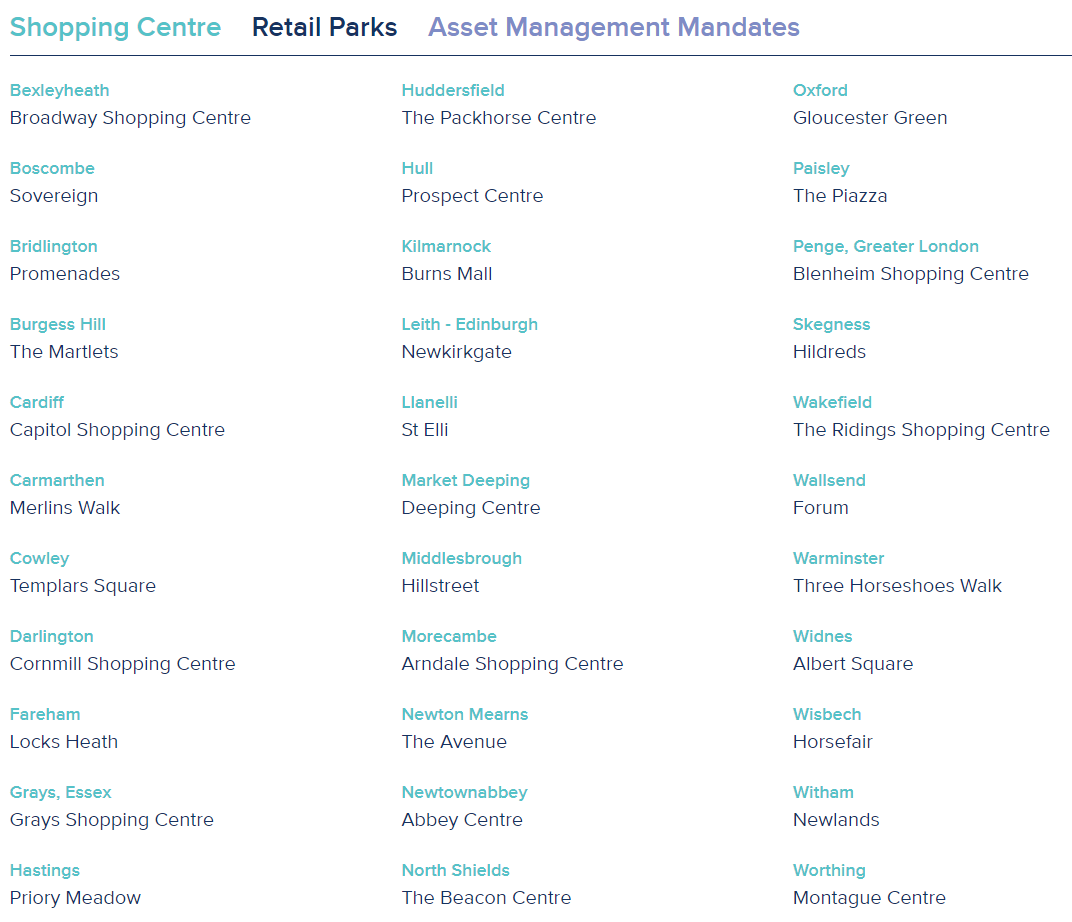
Low rents - NRR owns 33 "community" shopping centres, and 25 retail parks. Looking at the list, these are very definitely not prime sites! But that's arguably a good thing. Rents are dirt cheap, and they have local footfall;
.
.
The Sovereign Centre in Boscombe is walkable from my flat. So I must mystery shop it & report back. Now, where did I put my stab-proof vest? (only joking, it's not quite that bad in Boscombe, providing you avoid the areas where the druggies hang out).
The average retail rent (i.e. excluding the pubs business) is now only £12.48 per sq.ft.. So a 1,000 sq.ft. retail unit (typical for a basic, smallish clothes store, for example) would only have rent of £12.5k p.a. (plus service charge). That's tiny. To benchmark that, in my days as a clothing retailing CFO, from 1993-2002, we would typically pay £75-150k rent for a unit that size, in good town centre locations. Here we are 20 years later, and NRR's rents are a small fraction of that, because its sites are sub-prime in terms of location & footfall.
Given how low its rents already are, then arguably it should be possible to attract tenants for empty units, with incentives, since these rents are very affordable. Hence I see NRR as in a better position than say Hammerson (LON:HMSO) with its mid-market shopping centres, on much higher rents, which are no longer affordable for many tenants. Plus of course we saw what happened to INTU, with its high end, big rents shopping centres.
March quarter day rents (for April-June) - I was worried that tenants might dig in their heels, and refuse to pay these rent arrears, since they were forced to close by Govt policy. Today we are told;
We have also made further progress in collecting rents for the period from 25 March to 1 June, which we last reported on in our Full Year Results. Rent collected for this period has increased to 57%, from the 52% previously reported, and rent outstanding has improved to 18%, from 21%.
Slightly confusing wording there, it would have been better to put in another table, like the one above.
This shows that it's still a struggle to get tenants to pay up for the period when they were closed. Once the eviction ban ends, then NRR could increase the pressure, and ultimately go legal with tenants that still cannot or will not pay. However, that risks tipping tenants into insolvency. We must bear in mind that current conditions are artificially supported, and without further Govt support, many retailers are likely to go bust later this year, and early in 2021. Many will not be able to afford to catch up with overdue rents, VAT, payroll taxes, etc. Therefore I see this as the calm before the storm. However, this is a highly interventionist Govt, so there's potential for a rent furlough scheme, which has been mooted, whereby Govt would share the pain with landlords, 50:50, or 33:33:34 with Govt, landlord, and tenant. Something will need to be done, as I can't see withdrawal of support, leading to mass unemployment, being politically tolerable.
Re-gears - these are where the landlord & tenant agree to cancel the existing lease, and sign a new, longer lease. That helps the landlord, by propping up its capital values, and I imagine would help the tenant by including an initial rent-free period. In that way rent arrears disappear. Although the risk is that it's a face-saving exercise, which might only defer the insolvency of the tenant.
Disposals - this is important in reducing gearing. and LTV (loan to value), if sale prices near book value can be achieved. Progress is being made here, at decent prices. Although the risk is that the best properties are sold, leaving NRR with the dregs, possibly?
In line with our strategy to dispose of £80 million to £100 million of assets this financial year, we have completed, exchanged or are currently under offer on disposals totalling £52.5 million, a significant improvement on our last reported position on 18 June 2020 of £30.3 million. In aggregate these disposals are in-line with March 2020 valuations. In addition, we are in active discussions relating to a number of further disposals, which we are currently targeting for completion in FY21.
.
Liquidity - as reported previously, there are no immediate concerns here. The potential issues might occur in March 2021, if properties are heavily revalued downwards again. The update today sounds good;
The Company currently has £87 million of cash reserves and £45 million of undrawn revolving credit facilities, providing sufficient liquidity of £132 million. In April 2020, we received confirmation from the Bank of England that we are eligible to access £50 million of committed and available funding under the Covid Corporate Finance Facility ('CCFF'). This facility is currently undrawn, but improves our available liquidity position to £182 million.
Retail portfolio - this is the shopping centres listed above, plus 25 retail parks.
93% (by rent value) of tenants are now trading again, with the remainder expected to re-open soon. This must exclude empty units, as occupancy is "stable" at 93.4% - although I would expect empty units to rise once Govt support schemes wind down.
Footfall - has improved, but is still well below what is commercially sustainable for many tenants. Last week footfall was 32% down on 2019. The average spend per customer would need to be considerably higher, to make that low level of footfall work. A key question, is how much footfall has gone for good (online), and how much might come back, especially if covid is beaten with treatments/vaccines in due course? Nobody knows at this stage.
Tenant insolvencies - so far little impact, only 1.2% of annualised income affected by CVAs/administrations. That's likely to rise, as practically every day Drapers Record's email flags up new insolvencies. New Look is apparently limbering up for its second CVA, and Select its third! I don't know if these are NRR tenants or not, I'm just flagging the reality that for many retailers, a CVA or pre-pack admin is the only realistic way to survive. NRR's focus on value retailers should partially shield it, but it won't escape completely.
Hawthorn Leisure - this is NRR's community pubs company. This sounds good, I think;
- 90% of pubs now open
- Performance "solid", with LFL sales down only 13-15% since re-opening on 4 July - well ahead of industry average of -27%
- Benefiting from: suburban locations, low overheads wet-led pubs, 86% of sites were refreshed during lockdown, especially outdoor space (70% have outdoor space - many performing well), active management of portfolio by NRR
- Sold 13 pubs & a convenience store, raising £5.1m, but doesn't say how that compares to book value
- Emphasises alternative use value of pubs, which supports book value
.
My opinion - I've gone through it all in detail, and am not quite as positive as I was on first reading the announcement.
Liberum have kindly provided another excellent update note, available on Research Tree. It lowers forecast NAV to 155p, and points out that the current share price of 61p factors in a 33% fall in property values. That might be excessive, given the value-orientated nature of NRR's assets, but who knows? It depends on whether footfall recovers, and whatever happens with covid.
Overall, I'm leaning towards buying back into this one, on a small scale. I'm not convinced of the alternative use value of NRR's shopping centres though. The risk is that they might have to offer longer & longer rent free periods (and reverse premiums) to attract new tenants, thus hurting book values.
Also I'm worried about the impact of a covid second wave. It seems to be popping up all over the place again, although there doesn't seem to be any evidence that shopping centres are a problem. Food processing plants seem to be a bigger issue.
So, lots of unknowns, but I see today's update as encouraging overall. There's no immediate funding issue, and if the economy continues recovering, then the situation might look more positive in 2021.
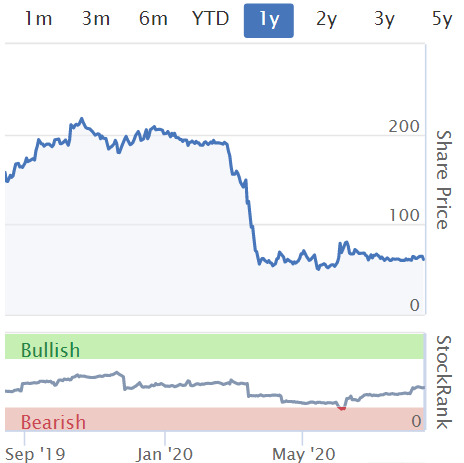
As you can see below, the stock market remains distinctly unimpressed so far.
.
.
Quiz (LON:QUIZ)
Share price: 7.0p (up 13% today, at 10:06)
No. shares: 124.2m
Market cap: £8.7m
(I hold)
Extension to banking facilities
This is a special situation, and should be seen as high risk.
Quiz dismally failed as an IPO, we know all that. It's now a special situation, because the key element is that it has already done a pre-pack administration of its store portfolio. I think the market has not yet grasped the significance of this, namely;
- All lease liabilities are gone, and hence all loss-making shops gone - it can walk away, with no penalty, and at any time it likes, from loss-making sites
- Quiz can cherry-pick the best sites, and do new deals with landlords to continue trading, but only where profitable, and at lower rents
- It can walk away, with no penalty, and at any time it likes, from loss-making sites
- Inventories bought back from the administrator at pence in the pound, hence gross margin will be very high for first few months of resumed trading as this stock is sold (hat tip to my friend Alan for pointing this out)
- Relationships with suppliers trashed, as they've been stuffed with bad debts. Hence new stock intake difficult to fund - may require cash payments up-front
.
Bank facilities - announced today;
- HSBC has extended total borrowing facilities from £1.75m to £3.5m - good news
- Expiry date very short term, at end Oct 2020 - not good news. Clearly the bank wants to monitor this closely, hardly surprising after the company has just done a pre-pack administration
- No covenants - makes sense, as the company is basically re-starting from scratch, in terms of its retail stores (but remember it has an ongoing, significant, online operation too)
- Net cash position at 13 Aug 2020 of £5.7m - looks quite healthy. Combined with bank facilities, that gives headroom of £9.2m, which I think could be enough to re-stock a reduced number of stores, but am guessing there
.
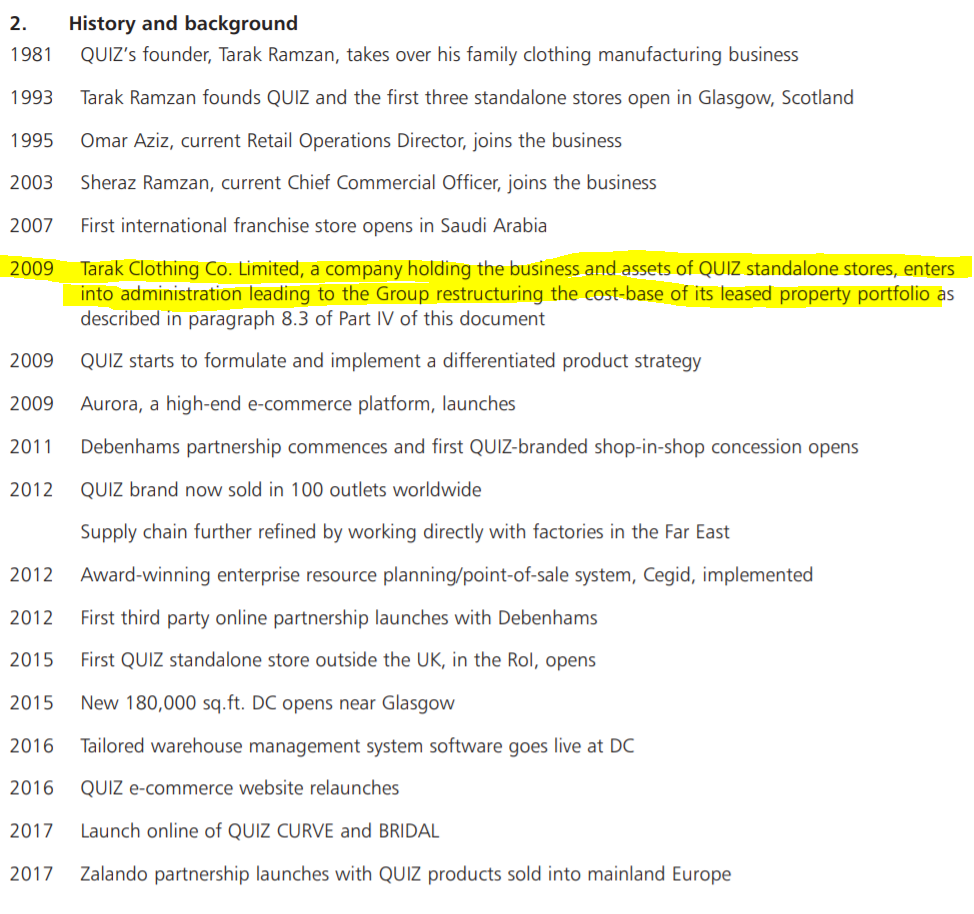
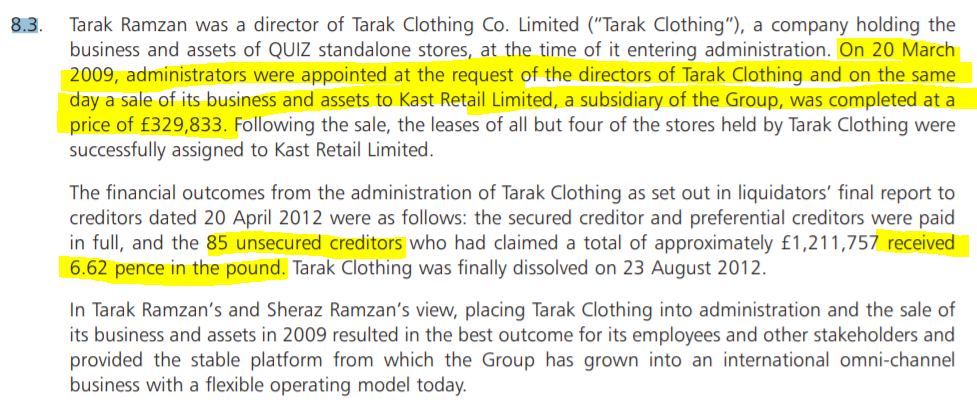
My opinion - even though the market cap is below my usual £10m cut-off point, I'm still reporting on this because I think it could multi-bag, if they pull off a successful recovery from the pre-pack admin. Crucially, they've done it before! As disclosed in the IPO Prospectus, the business had previously gone bust, during the 2008-9 financial crisis & recession. It then went on to be highly successful/profitable, and the founding family banked a ton of money in the 2017 IPO.
Here's the company's history, taken from page 16 of the IPO Admission Document;
.
.
And more detail here, from page 98 of the AIM Admission Document;
.
.
There's no shame in this. Nobody could have expected the financial system to meltdown in 2008, nor policy solutions taking far too long, and wrecking the economy (a lesson learned this time with covid).
In similar (far worse actually, for retailers) situation now, Quiz was quick to realise they couldn't keep paying unaffordable rents on shuttered shops, so they did a pre-pack administration announced on 10 June 2020. This involved;
- Buying back shop fixtures & fittings, plus inventories of clothing, for just £1.3m
- None of the old leases transfer to the new company
- 822 of 915 staff move to the new company under TUPE regulations
- Seeking turnover rents with landlords (New Look is also doing this in its proposed CVA)
In my view, this should be transformational for Quiz, and a much better, more profitable business could emerge, which is precisely what happened after the pre-pack administration done in 2009.
So far, the stock market just hasn't twigged that this is what's happening. Maybe investors think that Quiz has deeper problems, and might end up collapsing completely? But why would it, given that its cash position looks fine?
My opinion - the founding family & related parties still own nearly half the company, and one would hope they feel honour-bound to rebuild shareholder value for outside shareholders (and themselves). Although the current market cap is peanuts compared with the money they withdrew at IPO. So there is a risk that the family might take the company private, on the cheap, but let's hope they have more integrity than that.
This is quite high risk, but in my view, the potential upside here could be considerable, if in say a year's time it has settled down as a smaller retail chain, with all stores on low, or turnover-based rents. That would give a massive competitive advantage.
Plus Quiz has an established online business, operating at a reasonable scale. Its margins are high, so that should give the online business a decent marketing budget to continue attracting customers.
I think the £8.7m mkt cap looks much too low, given the recovery potential from having done a pre-pack administration. But we'll have to wait and see if things do pan out positively, or not. Nobody outside the company really knows what's going on (same with most shares actually), so it is educated guesswork at this stage.
.
Easyjet (LON:EZJ)
570p (down 6.6%) - mkt cap £2.61bn
Travel shares are getting whacked again today, probably on news of France being added to the UK quarantine list, due to rising numbers of covid cases. I think this reinforces how completely uncertain everything is with this sector. Airlines & cruise ship operators are bleeding cash, as so many costs are fixed.
One way to raise cash is to do a sale & leaseback of aircraft, which is what Easyjet has done. Apparently this was previously announced, and today has completed, raising £608m, for 23 aircraft. Some financial details are given.
The reason I mention this, is that I saw a piece on CNBC recently, from an American company which specialises in taking the other side of these transactions (not with Easyjet, but with other airlines). He basically said that airlines are desperate for liquidity, anywhere they can get it, and the sale & leaseback arrangements are extraordinarily lucrative for the lender, at a return on capital as high as 17-18% for the most wobbly airlines.
Therefore, I think investors should celebrate the improved liquidity, but work out the actual cost of these deals. A sale & leaseback of assets can keep a company going, but if done on adverse terms in a crisis, could prove extremely costly in the long run - meaning that profits may never recover to pre-covid levels, even if customer demand does (and who would want to bet on that at the moment?)
To be clear, I'm not suggesting that Easyjet's deals are bad (or good), I don't know. It's just to flag up the risk with airlines doing sale & leaseback deals in order to survive. The terms could be unfavourable. If covid drags on for a long time, we could be looking at a situation where the equity of airlines & cruise ships could be worth little to nothing, as debt ranks ahead of equity remember.
Or it could all straighten itself out next year, if the scientists deliver a vaccine. We don't know.
Key point - sale & leasebacks are not necessarily a good thing, if the borrower is desperate.
.
By the way, if you're wondering where the cruise ships have gone, apparently it's too expensive to keep them in dock, so some of them are bobbing around in Bournemouth Bay, and all along the south coast apparently! With skeleton crews. One entrepreneur locally is even selling boat tours, to visit & circle the dormant cruise ships. Apparently the captain of one cruise ship has made a 6-foot styrofoam or wood hand, which he waves at the tourists as they circle his ship in their smaller boat! (Source; the internet, so it must be true!)
I took this photo last night, from Bournemouth beach. There are 3 cruise ships there, and it's amazing how much they move about in a day - must be anchor drag, hence why they need to be crewed & have engines running, so they can adjust their position to stop them washing up on the beach (which would be quite a sight!). I did wonder if we might get to a point where some desperate owner might do an insurance job?
.

.
Ten Entertainment (LON:TEG)
128.5p (up 3% today, at 13:07) - mkt cap £87.8m
(I hold)
Re-opening of 35 (bowling) centres
Good news here, it's re-opening nearly all of its 10-pin bowling centres tomorrow morning at 10am.
Key points in today's commentary;
- Ample space for social distancing
- Ordering of food & drink on new web platform
- 6,000 people registered for free NHS bowling - clever move, as good PR, but the company could counter criticism by replying: if the NHS staff think it's safe, then who are you to disagree?!
- Sanitising & distancing measures put in place go beyond Govt guidelines (cleaning their balls after every use!), alternate lanes not in use
- Emphasises focus on families & children (30% of visitors are kids)
- Praises extraordinary levels of support from Govt
.
My opinion - I've got modest long positions in Ten Entertainment (LON:TEG) and Hollywood Bowl (LON:BOWL) - because of the size of these sites, I'm more confident that social distancing can be done well, but we'll have to wait and see what happens. I suspect consumer demand could be strong.
.
Larger rival Hollywood Bowl (LON:BOWL) (I hold) hasn't put out any update today, but did say on 31 July that it was expecting to re-open on 15 August also, following a Govt-inspired delay from the original 1 August re-opening date. Its shares are up 8% today, which is nice. I've just checked its website, which confirms that BOWL's centres are also opening tomorrow, 15 August.
That's probably enough for the day, and the week. Thanks for reading & commenting, and have an enjoyable weekend!
Best wishes, Paul.
Disclaimer
This is not financial advice. Our content is intended to be used and must be used for information and education purposes only. Please read our disclaimer and terms and conditions to understand our obligations.

83 comments
Looks like you might be right about demand for bowling Paul, Hollwood bowl wrote this on Twitter yesterday.
"Thanks to all who bowled with us today. Many centres sold out due to our covid-safe reduced capacity, and we’re very sorry to anyone who experienced issues when booking online or by calling. Thanks for your patience and understanding - we look forward to welcoming you back soon!
8:59 pm · 15 Aug 2020"
Others have given their year on year returns for 5 years or so or pointed to various studies showing expected average returns in various circumstances.
I am afraid after the first few years I have not bothered to note my annual returns. However, In 2001 I transferred most of my insurance company administered pension funds to a self invested SIPP. Since then the total returns including funds withdrawn have increased by just under 520%. I withdrew nothing for the first 11 years but in 2012 I started withdrawing funds and about 32% of the total funds have now been withdrawn but I am still up over 350% on my initial investment. I have invariably had investments in over 50 companies and tend to be over diversified. In addition I have often held up to 30% in cash for excessive periods through caution. So plenty of mistakes.
However, it does show that a reasonable return can be achieved over a fairly long period. I am not a finance professional but have benefited from regularly reading Motley Fool and more recently had a subscription to Stockopedia.
However, I have not had to rely on withdrawals to fund my life for over half the period of investment and I think targeting any particular return year on year and having to rely on on this to fund your living expenses would be a considerable mental strain unless you have a very large fund to start off with.
If you used a short selling strategy via spread betting this could have potential to limit / cover falls in a bear market.
Indeed Forbsy, but don't get me started on that or I'll definitely not get anything done.
Regarding what return is achievable from investing, I haven’t seen anyone mention the issue of tax yet. Are the returns stated after tax or before? Some may be referring to the gains inside an ISA and so there is no tax to pay, however you have to have a very large ISA to be able to draw a decent income from it even if you can manage 10% cagr within it.
While I agree that the private investor can be more nimble than institutional investors as it is easier to invest in smaller companies if you are only investing small amounts, if you are trading outside an ISA or SIPP then you may end up having to hold on to positions that you would rather sell to avoid a big CGT bill, and the institutions don’t have that problem.
I also agree that looking at five year returns from a bull market are not likely to be representative of the average returns that one might achieve. I would think a ten year period more appropriate. It’s also important to think about what inflation might be. If you are achieving 5% with inflation at 1% to my mind that’s better than someone achieving 7% when inflation is 2.5%.
The other thing to remember of course is that the big gains come from compounding over a long period of time. If you cannot leave much gain in the portfolio because you have to withdraw it to live off then you are going to miss out on the hugely beneficial effect of compounding.
Even if we get a vaccine how long is going to take to manufacture, distribute and (if not self-administrable - unlikely) to administer, what 4 billion + doses; possibly x 2
To be fair to the uk gov (for once) they have been fairly active in that rgeard
from todays daily mail
British officials have ordered another 90million doses of experimental coronavirus vaccines in support of efforts by pharmaceutical companies Johnson & Johnson and Novavax.
If all the vaccines pre-ordered by the UK are successful and go into production the country will have a massive stockpile of 340million jabs - enough to give every person in the country five each.
hmmmm - i hate needles sigh
"Or it could all straighten itself out next year, if the scientists deliver a vaccine. We don't know."
A couple of points on the vaccine (all just opinion):
Personally, I think at some point we are going to have to consider living with the virus (which will include, social distancing, masks etc, protecting the extremely vulnerable. With a large number (I have no idea how large) taking one for the team (humankind). I do not see how the current state of affairs can go on for several years of course I could be completely wrong. Life might be transformed into a dystopian non-travelling, non socialising technology dominated world.
My wife has travelled on a plane twice in the last two weeks and she is still alive! I know this is an N of 1 but it would interesting to know how many people who have travelled by plane in the last couple of months have contracted covid 19.
I know this controversial but I don't believe we can go on like this.
Interesting interview with Mr Gates the other day. I'd wager he knows more about vaccines/ therapeutics than most of us will ever learn in a lifetime
https://www.stitcher.com/podca...
If It is as flawed as some of his Software, I'd be worried.
Would you bet your life on Windows 95, Windows XP (v1), Windows Vista, Windows 10 and Azure?
Yes and I wonder why when he is a software guy. The alarm bells go off when someone is so concerned about the wellbeing of people especially in the poorer parts of the world but they then stand to profit from campaigns such as vaccinations.....
As a former multi-year shareholder of Newriver Reit (LON:NRR) it is interesting to follow developments from the sidelines and your commentary Paul. I held them for a number of years, even seeing a share price around £3 and a nice yield. However the price was on a steady decline pre-Covid due to Woodford and Barnett holdings selling off and general sentiment to the retail sector. I also wasn't seeing enough positives in the results to buy more, I was just trying to ride it out. Then once Covid struck I bailed, thankfully at a higher price than now but a notable loss all the same; dividends over the years softened the loss on total return.
I do follow their portfolio a little with some interest. I grew up in Wakefield and remember The Ridings shopping centre being built, it was a real boon for the city at the time. Now it has been superceeded by an outside complex called Trinity Walk where all the big names have relocated to. The Ridings has since seemed to have been on a journey trying to reinvent itself and becoming a destination. More recent efforts include attracting cinema interest. Whilst now I only enter The Ridings maybe once or twice a year it is a real shadow of it's former glory. Numerous empty retail outlets and low footfall.
I left the Wakefield area decades ago and now my nearest city is Hull so I know The Prospect Centre. This is a relatively small but well maintained, clean and appealing site in a central Hull location.
When I first moved here The Prospect Centre was second fiddle to the much larger and newer Princess Quay which was the main shopping destination. In recent years a newer rival has emerged in St Andrew's Quay. In my mind a relatively small complex but it has a Tesco supermarket as it's flagship store and has drawn in all the big name labels. This has proven very damaging to Princess Quay which has really looked run down, empty units, low footfall and trying to reinvent itself as an Outlet location. NRR's Prospect Centre is now maybe third choice in Hull but is actually doing very well. It has Wilko as a flagship store, although it did lose a big Curry's unit a few years ago. The Prospect Centre does have a number of big name jewellers on site which attracts a good number of customers and is a maybe a sign of NRR doing well.
All IMHO of course, but just my observations.
As a quite day, would love to know if any views on Supply@me Capital (LON:SYME) ? Having a massive run this week on big volume in what seems to me like a pump & dump, but interested in others views.
Thanks for write up on Quiz (LON:QUIZ) . I stupidly failed to sell when had doubled vs. my entry, and broke the "rules" by buying more to average down post the pre-pack, as I too think this looks cheap and that this should have transferred a lot of value from creditors / landlords to equity holders. I am not buying more, but am quietly confident.
Does anyone else just not get on with the Stockopedia "new site" which I keep getting drawn back to (and warned with a big red banner when I frustratedly move back from it)? I keep thinking it MUST be better, and yes it looks snazzier, but I just find it so much less intuitive. A particularly annoying bug-bear is the complete absence of the Risers/Fallers feature of the old site which lets you immediately see which stocks across multiple indices are up or down on the day. I'm not moaning or saying that the new site is utter rubbish (the significant holdings feature is an improvement) I am just asking - IS IT ME? I have used Stockopedia for many, many years, and value the product, but can someone convince me the new site is worth the effort?
I can only agree. Risers and fallers feature was useful and I find the new Screens layout much less user friendly
I haven't looked at the new site for quite some time, but did try it for a couple of weeks. I kept on reverting back to the old website to find the information that I wanted - I think it was Magic Formula ranking in particular. As a result I decided to stay with the old site until they turned it off.
Completely agree. The framework UI for the new site has severe defects, which I think makes it unsuitable for what it is trying to do. I used to earn a living doing this sort of thing - the design makes mistakes which I have seen many times before.
I am remaining with the old site, but regretfully I have decided that I will have to move on - there is no point in sticking with SP if they are going to persist with this new site in its current form.
It’s a shame as a lot of time (and money presumably) is being spent developing the new site, but I also find it less user friendly and also slower, and things I find quickly on the old site I either can’t find at all, or it takes ages to find, so I reverted to the old site again several weeks ago.
No, it's not just you, and I'm really glad someone has come out and said it so clearly. As a software engineer myself, I simply can't understand what is going on with the transition to the new site. It has all the hallmarks of a software death march. I mean, why is there a transition to a "new" site anyway? I assume that this involves some sort of incompatible technology transition from old to new that may be better in the long run, but that is back-end stuff and should be totally invisible to the user. At the minimum, it would be helpful if it was explained to us why there is a disruptive transition going on involving 2 incompatible sites.
And then all the existing stuff that is simply broken on transition to the new site. I've already ranted on another thread about grey volume bars on the pop-up charts on the new site, compared to standard red and green on the old. I mean why?? Why not just copy "if(day == down) { colour = red }; if(day == up) { colour = green }" from the old site?? This is simply basic stuff. I read a comment somewhere that 20 or 30 developers are working on Stocko behind the scenes. If true, this is simply gob-smacking to me, somewhere there is a serious issue with development and testing.
Anyway, rant over, and I do appreciate the existance of Stockopedia that has certainly helped me make money, whilst not making money yet itself I believe. So consider this rant as frustration that something I like appears to be undergoing a totally unnecessary cock-up. I will be trying Sharepad as a trial a month before this year's Stocko sub expires though.
I agree about the Risers and Fallers and some other features missing on the new site. I contacted Stockopedia about this and received a fairly blunt reply saying that they were still available by looking at each market index on the new site. Hardly the same as having a list across the whole market.
I have found that if you put your comments into the green button (on the bottom right) a lot of the time they get actioned by the team and you get a thank you back too which is always nice.
A lot of the time we assume that others know what we want and appreciate from the site, I have been using since 2013(ish) but I realize now that Ed and the team are not like Mr Bezos and do not track every single click and minute of viewing in the website, so do not know all our exact habits and views.
Anyway cut and paste and send it to the team as a "please can you add this back in" or "is there a way you can do that" and a lot of the time they either come back with an answer this is how you can do it on the new site, or lets see what we can do!
I keep trying the new site and then quickly going back to the old one. I view Stockopedia on a computer and I think the new site has been designed to work better on a mobile. I find the extra frames on the new site annoying and I waste time minimising them whenever I go to a new page, and I also find it annoying that pages seem to take longer to load on the new site.
I'm the same. There's a reason that other sites design bespoke mobile apps rather than trying to set up their site to work on a mobile. I think that Stockopedia has made a big mistake by not going down this route as, in my opinion, it severely compromises usability on a desktop.
Also, they seem to have made changes just for the sake of it. I mainly use Stockopedia for the discussion board. This looks good in the old version but horrible in the new version and there is also less information, eg the new site does not say how many are reading an item.
Agreed, I miss the Risers/Fallers feature of the old site too. I did ask when this basis feature would be made available on the new site a but can't even recall what the answer was. However, all is not lost, there is a fantastic free site which provides daily R/F, 52wk H&L and many more technical features including Michael Taylors Volume Advancers and so on. For momentum/technical investors & traders this is a fabulous site. Pure objectivity without any bias subjectivity or a comments/rants section.
https://www.barchart.com/uk/st...
I fire this site up first thing each day, to catch the news see what the movers and shakers are. Also covers US and Europe for free too.It's worth a look. I definitely find it useful in the filling the Stockopedia market colour gaps.
re NRR - the OH works for a high street value clothing retailer. Their sales continue to much stronger than last year (think +20-40%), benefiting from people shopping locally. Footfall is down, but not by as much as May, but average basket much higher. That shift in shopping trend seems to be quite sticky which should help underpin NRR's position with community based retail.
Sadly her employer isn't directly listed!
Thanks Paul for that superb update on New River Reit. For so many shares your updates are not just a real high quality service for us on the day, but also later, when checking out potential investments. And this one today on NRR is a classic example. I can’t work out how you cab absorb so much information so quickly, and then write in such detail in no time too. And not just on one share a day, but often several.
I held NRR pre covid, but sold out in the big market falls. Will probably stay on the sidelines for now, partly for fear of genuine second wave coming and not just flare ups of the current wave (with evidence for now that cases are often milder). But against that total lockdowns look less likely even if there is a second wave, and hopes that a vaccine by then.
The reassuring news on the NRR pubs portfolio perhaps reinforces the case for Revolution Bars? Hope so as I averaged down yesterday. Great anecdotal evidence from Cambridge branch posted here again. If that is happening elsewhere that would be great news. Wish they would open up across the board though!
I second this. A number of times recently I've been examining shares (Ted Baker (LON:TED), Headlam (LON:HEAD)) and gone back through Paul's write-ups, not just for the most recent, but to earlier missives, to see how the situations have changed.
A real treasure trove, thanks again.
Newriver Reit (LON:NRR)
The average retail rent (i.e. excluding the pubs business) is now only £12.48 per sq.ft.. So a 1,000 sq.ft. retail unit (typical for a basic, smallish clothes store, for example) would only have rent of £12.5k p.a. (plus service charge). That's tiny
I guess there is an added bonus with rents at this low level that its likely many units will not have any business rates to pay (not sure if anyone can confirm if thats true or not). Business rates is a biggie when it exists and any units that come in just under the exempt amount (15k?) are in the nice little sweet spot. Having little shops of quirky stuff that keeps things ticking over (compared to empty units) is deffo the way to go with any town/retail park that is struggling - bonus if some of those are micro pubs!
so what are your thoughts on NRR?---looks like a real recovery stock
As it's a relatively quiet day I hope you'll forgive me for a rather basic enquiry. I'm trying to figure out what level of return is realistically achievable from full time investing. I'm sure that question has been asked many times before and mostly the answer is 'how long is a piece of string' or 'depends of many many things' etc. But it would be good to get anecdotal responses from this community as it seems the most informed / rational I've seen so far and seems to reflect my personal style preference. Please feel free to point me to any other discussions / threads if that's more appropriate (I've had a quick look but couldn't easily find anything). I'd say that I can commit to a full time research of 30-40+ hours a week (I'm slightly embarrassed to admit that I find business and investing so interesting that I regularly read financial articles, books etc for 'fun'.) Have had reasonable success for the last 20 years or so on a part time basis (good at finding stocks, bad at selling long term losers) but now need to consider whether potential future returns are enough to leave corporate life. Medium term average returns of 10-15% would probably be enough for me. Thanks all.
These might give you an idea. However, as you say it depends on so many factors. To be full time you need size and/or a system. Both of these bring their own constraints and may lead to a lower average but a tighter spread of returns. One year never seems to me, to be representative of the next (which presents its own issues).
2017: https://www.stockopedia.com/content/stockopedia-subscriber-performance-survey-2017-252083/
2018: https://www.stockopedia.com/content/stockopedia-subscriber-performance-survey-2018-428233/
2019: https://www.stockopedia.com/content/stockopedia-subscriber-performance-survey-2019-558501/
All the above will probably not be reflected in 2020!
I think one should be very cautious with interpreting the results of surveys of Stockopedia subscribers' performances. It's human nature for people who've had a good year to be more likely to participate in the survey, so the results might be unintentionally biased.
I agree but that is an assumption. In contrast how likely is a poster who has had a bad year or two to supply an attributable anecdote. I'd think they are more likely to take part in a survey. Also if someone had a system that returned a consistent 30% yoy how likely would they be to state that. More importantly why are they even here?
Any sample is likely to be biased (even if it is designed to be completely random) but by thinking about the bias you can hypothesise bounds upon the likely range. The range of responses also helps to illustrate the variability. Just as 'all models are wrong but some are useful' all surveys are biased and summaries throw away information (but may help comprehension).
FWIW the long term average is ~8%. https://www.ig.com/uk/trading-strategies/what-are-the-average-returns-of-the-ftse-100--200529
Any active strategy should be aiming to, I think, beat that. However, it is the volatility that will present most people with issues and if only consistently 1-2% 'better' it is hard to determine if this is due to chance or skill.
Deleted
I personally know of someone who makes 18-25%, but he was a financial journalist for many years and extremely experienced. He also worked with one of the UK's top investors. For us mere mortals, I think a much lower return is likely. I made 31% (in 8 months) after selling in late February following similar rules he used, combined with Stockranks, but I am not sure this is sustainable. Buying and selling fees, bid-to-offer spreads etc., all reduce real returns dramatically. That 31% would have been over 50% without costs (I included ALL costs, even discounting my Stockopedia subscription). I think if my old friend could make around 21% on average, then half that would be good.
There is a good book / podcast called Money for the rest of us which I read / discovered recently which has a simple value investment style. The point made is that while there is an upside there is also a downside - a drawdown can be as much as 50% and the average recovery period is four years.
Hi CBC19
That's an interesting question.
FWIW here are some of my stats as it's the best way I can think of to offer you a view.
From 60 months of investing I have had a gain of +29.51% on my total portfolio. On a simple annualised basis (simple being divide total by 60mths, multiply by 12mths, so not compounded calculation) this equates to +5.90% p.a.
In contrast the FTSE 100 over the same period fell -11.92% or -2.38% p.a.
The important consideration though is to appreciate volatility as all our circumstances are very different and that can have a big bearing on the investors mind-set over time.
Therefore to contrast to the annualised figures above here are annual variations.
In 2016 I had +5.87%, FTSE 100 +13.26%
In 2017 I had +26.18%, FTSE 100 +7.63%
In 2018 I had -4.28%, FTSE 100 -12.48%
In 2019 I had +1.28% FTSE 100 +12.10%
In 2020 7 months I have +0.22% FTSE 100 -21.81%.
My returns are quite volatile, and have missed a boat a couple of times, so I know others on here do a lot better.
But a point I wanted to emphasise, towards the question you posed, is less about the annulised returns. I think its also very much about how much volatility will you be able to work with?
I will be interested to see what responses you receive from your posting.
Good luck with your deliberations.
Regards
Howard
The thing I found is that spending more time on it doesn’t necessarily make me any more successful in investing. Yes I pick up some opportunities I would otherwise miss but the temptation is there to over trade because I have the time to do it.
Also risking money that I can live without if I really have to is a lot less stress than needing returns to pay the bills. But we’re all wired differently. I would say that 10 - 15 % returns is do-able and really a minimum level for it to be worth your time. But I’m not sure this market is the best place to start from! There’s quite a disconnect from the real economy.
fwiiw, the long term average return on US pension funds is around 7.5%. These will be managed by able people doing the job full-time for a living, and with an emphasis on caution. From my own very limited experience, it is possible for an amateur to do a bit better than that without spending his life on it, or without even being very good at it. To do a lot better is much more difficult.
The pension funds take vast “research fees” taking your money to pay for internal costs and bonuses. They should do much better than that 7% but someone has to keep the fund managers and analysts in champagne and Ferraris
Hi CBC19,
I think that to achieve 10-15% per annum you would need to have a concentrated, relatively high risk portfolio and be prepared to tolerate material volatility year-on-year.
I invest almost exclusively in UK small caps and never have more than 20 holdings. I target 15% total return per annum (measured on an IRR basis to take account of occasional cash flows) but have managed just 12.4% per annum since the start of 2015 to date. That overall figure hides massive volatility, however, with my best return being +44.0% in 2019 and my worst being -18.3% in 2020 to date.
I don't think you need a high risk portfolio.
I was looking at FUNDSMITH EQUITY fund returns yesterday and it has made 140% in the last 5 years, I don't think it is high risk.
Making 10-15% is good but it usually takes quite a bit of time and effort, I'm questioning whether it is really worth it when I could invest my money in funds.
Terry Smith sees an investable universe of around 50 stocks which he hardly ever trades. We have 20% of our money in Fundsmith and always put our ISA money in there.
I also hold Fundsmith equity, and SSON, and Keith A-L's UK buffettology fund. They are clearly extremely competent managers, and I would back them to outperform the benchmark (and probably myself, but I find picking my own stocks fun) over the very long term.
However, I don't think you can extrapolate their long term performance from the last 10 years. They have possibly had a style tailwind, and benefited from P/E ratio expansion as interest rates have dropped and "quality stocks" have come into fashion. Some of the valuations of companies they now hold are very full on any measure, and generally these things are likely to mean revert.
"Medium term average returns of 10-15% would probably be enough for me"
I'm honestly sorry to say this, but you are very unlikely to achieve 10-15% without taking a very high level of risk and getting lucky. This is a good place to start answering your question:
https://www.blackrock.com/institutions/en-gb/insights/charts/capital-market-assumptions
It shows the return assumptions published by Blackrock and gives, for example, a mean estimated return over the next 30 years on UK equities of 7.7%. This is the total nominal return i.e. it includes dividends and inflation. I see no reason for Blackrock to be overly pessimistic sincce thay are trying to sell you these investments. Indeed, their projected returns are higher than other published numbers. Note too that this is the projected return for equities. If you want a more reasonably balanced portfolio including cash and bonds then your returns will fall significantly.
Some will say that returns have been higher historically and yes they have been - a little. But, all else being equal, higher historical returns imply lower forward returns because the current price is that much more elevated. You should understand the concept of "equity risk premium" and know that risk free returns are now at historical lows, which means that other assets such as equities are logically priced that much higher, and forward returns that much lower.
All of that means that, if you are to achieve 10-15% then you will have to outperform the market in a very significant way. How will you do that? It can be done and some will do it, but how will you do it?
Good luck and I hope you get what you want, but unless you take lots of risk and get lucky, or have a skill set that you have not revealed, then you should lower your expectations significantly.
That's the expected return of the entire UK equity market though, which is dominated by mega-cap companies.
If you are focusing on mid-small cap companies and have a decent understanding of businesses and investment then 10% pa isn't that difficult over the long term. To get 15%+ pa you need to have a high level of skill though (or luck).
"Medium term average returns of 10-15% would probably be enough for me."
If you can achieve that, you also need to ask yourself whether you have enough capital for a 10 to 15% average return (if that is achievable) to provide a high enough income to cover your living expenses if you give up work to become a full time investor.
Also, you should ask yourself whether you would be able to cope with the likely volatility of annual returns. If you withdraw a fixed amount (ignoring inflation) of money from your portfolio each year for your living expense, that would have a disproportionally large effect on the capital value of your portfolio after a major drop in stock markets and would reduce your return in subsequent years when markets recover. It's the opposite effect to the generally beneficial one of pound cost averaging when investing.
It's a similar problem to the one that pensioners relying on investment income or capital withdrawal have of choosing a suitably small withdrawal rate, in order to minimize the risk of running out of money in retirement. Of course, if you do give up work and find that being a full time investor is not as successful as you hoped, you have the option of going back to work if you are young enough to get another job and your skills and experience are in demand. But finding work when you are unemployed is generally harder than changing jobs when in employment, so what you are considering has its risks.
If you take out the whole 10-15% you won’t see any capital growth either and inflation will start to bite
HICBC19. It a really good question possible you start a new tread?
I think three numbers will help provide a useful framework for you:
0% per annum - first rule of investing is don’t lose money. Do better than 0% and you are complying with the first rule;
10% per annum - this is definitely a good result if you can compound this consistently. Markets have historically done around 8% per annum (which you can get via index funds and no effort) so a 10% return means you are doing well (most professional fund managers fail to achieve this, they underperform the market);
20% per annum - if you can do this consistently for a very long period of time then you will become one of the richest people in the world (power of compound interest). Warren Buffett delivered 20% annualized for 40+ years and that took him to the world top 5 richest people from very ordinary beginnings.
Somewhere between 10% and 20% is excellent (and also very difficult to achieve consistently).
Hi CBC19.
A good question and one that has made me think. To be honest there are so many variables in terms of your risk appetite, the overall market direction (we can all make money in a bear market) etc etc.
I personally have changed my style over the last few years to becoming much more actively involved in my portfolio and moving ever more funds out of collectives and into single company shares. Ive also become a lot more diversely invested across the globe - hopefully by undertaking all of these I will have increased risk in some ways but balanced that with a more diversified portfolio.
Even so, I know I still make many mistakes; holding onto losers too long, being too risk averse, following too many "trends" etc etc.
My annual returns have been;
2015 - 10.4%
2016 - 14.6%
2017 - 18.0%
2018 - (-7.5%)
2019 - 17.2%
2020 YTD - 19%
I would love to spend more time on investing, but would probably be too risk averse to do so. I do rely on a number of sites such as Stockopedia to get my ideas flowing and discussions on this site are exceptionally good to help in decisions.
Best of luck.
A good place to start would be "What works on Wall Street", which gives returns over a long period of time for a whole range of quant strategies in the US. The edition I have has returns over a 40 year period, which is far longer than the track record of probably all current fund managers and stockopedia subscribers, and the latest edition will have an even longer record.
Anyway, the best absolute return they found over the last 40 years using annually rebalanced strategies was mk cap between $25 - 250m (so US microcap), P/sales < 1, top 25 stocks by 1 year relative strength. This gave 24.32% annualised over 40 years, with a maximum drawdown of 55.6%.
There is extra detail in the book such as chance of a negative decade, etc. However, I would suggest that this represents a likely absolute upper bound on long term performance, and that 10-15% is probably realistic for an investor fishing in the pond of high stockrank small caps.
Just make sure that your extra time doesn't simply result in you finding the time to get suckered in by story stocks!
FWIW, my annualised return over all accounts from when I started in 2015 is currently 8.95%, having remained fully invested through COVID. The annualised return in my more concentrated "best ideas" ISA is 16.05% over the same period. However, I believe the outperformance of that ISA was due to a large amount of luck early on, rather than skill.
Warren Buffet has made 19% p/a with no dividends paid.
Hi CBC19,
Some good replies to you and I won't add anything further to what they say. Using myself as a personal example , when I started investing I aimed for 10% returns a year for it to be worthwhile. My investing style is a mixture of value and growth at a reasonable price, and I particularly look out for companies that are about to re-rate which the market hasn't quite spotted yet for one reason or another (e.g. shift to online or disposing of a low or zero profits division). I have a full-time job and basically rely on this report and the stockranks for my research and ideas.
For your interest this is my returns to date (this includes anything I hold in 'cash' so if you exclude that the returns are higher - and worse in the case of 2018). I am extremely grateful for my performance this year!
2020: 12.9% (as of today)
2019: 19.1%
2018: -8.8%
2017: 18.4%
2016: 4.8%
2015: 4.2%
2014: 25.2%
The other thing I'd add is that I think you have to enjoy it and see it as a hobby to be motivated to maintain your portfolio and take the time to spot investments. I learn a lot about business and the world through investing, and love the competitive element of trying to make a decent return on my money.
Good luck.
You need to be aware of sequence risk as well
https://www.challenger.com.au/adviser/insights/sequencing-risk-explained
Still working I'm afraid.
I might consider doing it if ;
Returns have been good, but work keeps me busy and allows me to sleep at night. (10-year rolling average returns below).
BSV
I don't think you can set a target return because if the FTSE is going up, making money is really easy, and if the FTSE is going down, making money is really hard. I measure my performance against the FTSE 100 and FTSE 250. If there is a slump we will all struggle to make money.
Two other points. Pension funds, etc, not only buy stocks and bonds but make money on other investments like property or a share in the profits from a wind farm. My guess - with no evidence - is that it is on this other stuff where they really make their money.
Second, I think you have to evaluate a company three ways - financial (Paul and others do a fabulous job here), business model (is it a good opportunity) and management quality. Your edge as a private investor is in specialist knowledge pertaining to the business model and - maybe if you are lucky - knowing the management/company culture.
Oh and a final point. Luck matters. I did really badly in 2018 and have done really well in 2020, but largely because I bought Avacta and ITM Power and top sliced before they fell too much.
"My guess - with no evidence - is that it is on this other stuff where they really make their money."
Actually, all the evidence I am aware of suggests that over the long term equities outperform every other asset class - cash, gilts, corporate bonds, commidities, precious metals, property both residential & commercial, farmland, etc. Hence why I am 100% invested in equities.
It always amazes me that DB pension funds that by definition have very long time horizons and hence could withstand significant volatility aren't actively encouraged to be 100% in equities the entire time. Instead the trustees seem to be very risk (or volatility) averse, put a significant percentage in gilts and bonds to try and match the liabilites, and end up in the long run with an unnecessary deficit for the sponsoring company (or the taxpayer via the PFF) to sort out as expected gilt yields drop.
I would suggest that the OP (or any competent PI) should be able to outperform almost any pension fund for 2 reasons: 1. they have the freedom to invest 100% in equities with no restrictions, and 2. size matters, it is much easier to run a smaller account, and the return premium for smaller companies (when adjusted for quality) is an ideal factor for PIs to harvest.
Just looking through the replies, something else needs saying...
A lot of the posts are along the lines of "here are my returns since 2015 ...". With all respect to these individuals and their genuinely good returns, these should be ignored. You need to consider timeframes including a true bear market and think what that's like when you're dependent on it for your 10-15% a year.
So far, 2020 has not been a true bear market. It's been a 2 month correction that has since been retraced (depending on your index). It's been remarkably pain free. True bear markets are different. The year long decline in 2008, or the 2 year decline in 2001/02 were true bear markets. It's not the decline that kills you, it's the repeated rallies along the way. You won't know what that's like until you have traded through it with your livelihood on the line as you say you are considering doing. It's a very different thing to owning a few shares as a sideline in amounts that you can afford to lose. When you come out the other side of that you won't be the same person. You might end up a better investor or you might end up worse.
My honest advice to you is to consider that side to it very carefully before you give up your job. How well prepared are you for the stress and the sleepless nights? There are all sorts of things to consider including how understanding your partner is. Good luck whatever you decide to do.
I totally agree with this point, just imagine these hypothetical returns
Unless your especially adept at handling a bear market, your real long term returns may be anywhere between a half or a third of what you really think they are.
And it gets worse, if you convinced yourself mid-way through his sequence that your returns were 20%pa for ever, you might conservatively decide to withdraw 10% per year as income. In year 8 to maintain living standards you are selling off 20% of your portfolio, possibly at the market bottom.
Then you get so despondent, that you decide to go and do something less risky instead, thereby probably missing out on the market rebound.
In terms of what level of performance is achievable, it depends on a whole load of factors especially what approach you take and how good and disciplined you are with it also whether you can differentiate between your approach having a bad patch rather than ceasing to work permenantly.
Here's a useful benchmark perhaps.
Performance of SR > 95 , Market Cap > £50m rebalanced annually.
The performance is tracked from 29th April 2013 (so a little over 7 years)
Up until 24th Feb 2020 - this "portfolio" had a CAGR of 13%
By 16th March it had fallen to 7%
And has now recovered to 10%.
2020 is not a "proper" crash, SR 95+ only suffered a peak to trough fall of 33%, whereas you are likely to encounter a -50% event at some time, but maybe it is an "average" crash.
So there is some support here for the idea that you can maybe achieve 10% pa without doing anything too racey.
I chose the rebalance annually option because the reduction in churn means that you can perhaps assume that dividends received (most high SR stocks are dividend payers) broadly cancel out dealing costs and spread.
There should, I think be roughly 70 odd stocks in the SR 95+ bucket and as is being discussed in another thread you would probably want to hold ALL of them to eliminate random chance.
There would be a temptation though to invest in a smaller number of them, and employ some additional criteria that might improve returns - trouble is that sometimes it might have the opposite effect!
But the past may not look like the future.
Global economic growth to date has essentially been driven by productivity improvements and population growth.
I'll pass on commenting on the former (I have somewhere else to be tomorrow) but there is a lot of evidence to suggest that population growth will stall and then decline in the not too distant future. Great news in many ways, but not if you are reliant on riding the wave of global economic growth to make your living.
On a more immediate level, I have some strong concerns as to whether the StockRanks can continue to be predictive over the next couple of years as they will swing wildly for some companies depending on the company's reporting cycle relative to the lockdown period(s)
But hey ho enough of this, I've got a bag to pack!
Over the years ( there have been many ) my "fees" in learning in how to be a successful investor boils down to, I believe, how much you lose in a true bear market. I think it is relatively easy to make good returns in a rising market. It's in a bear market that will probably make or break you - financially and mentally.
I have been investing more seriously for about 6 years now and have an average return of about 8%. I feel I am relatively conservative but have made a ton of mistakes as I have learnt the trade ad whilst I am sure I have a lot more to learn I think there are a lot of mistakes that I won't make again.
I like others want to hang up my corporate badge some day and have enough cushion to live off. Given I have lived in a few different countries my assumption is zero pension and if I get something somehow it'll be a bonus.
I know roughly what I need to live off to have a comfortable life and be able to travel and would only consider retiring until I can live off the dividends (about 2-3%) so that I wouldn't have capital depreciation. In good years of 10%+ capital gain I might put some into a rainy day fund in case dividends crash like they did this year.
I've been having a tough time this year workwise (with politics) and seriously considered giving it a go even though I am still quite a way below my rule but have thankfully landed a new job which I start in Sept with a Unicorn, so hoping if they have a successful IPO in a few years I might be a lot closer to the goal.
Look at companies that generate high levels of cash and reinvest it to grow then you might just be lucky enough to reach your target as an average over several years.
Many thanks all for your responses to my earlier query. Lot's of valuable advice. Too many posts to respond to individually alas, and some time needed to reflect on responses, but I think some immediate takeaways for me are:
1. 8-10% is probably a more realistic 'target return' (any more, say 12%, is a bonus)
2. The emotional impact of drawdowns (potentially multi-year) should not be taken lightly and could scupper long term plans
3. Even with hard, intelligent work, there will always be an element of luck involved - a risk that can be minimised through stringent process and discipline, but not eliminated
4. I should factor in returns vs probable risk / stress. One probably (if this isn't too obvious a statement) needs to think more in terms of sharpe ratio and one's own risk appetite.
5. These are peculiar and unprecedented times we live in, making future returns potentially even harder to achieve!
Thanks again all and best of luck with future investing!
I've enjoyed reading forum member's comments about performance targets and note that they are all well below the 20-25% that Robbie Burns considers realistic for a full time investor (P.21 Naked Trader 5th edition). Also, Mark Slater inferred similar returns are available to PIs in his recent PIWorld interview.
Should these guy's opinions be taken with a pinch of salt?
Yes!
Slater Growth is up about 50% over 5 years (8.45% CAGR). Now, considering that Mark Slater is a top rated manager and likely to do better than the typical PI even taking into account fees, it is clear a typical PI will do nothing like as well as 20-25%. However, there will always be someone no doubt who happened to be lucky of being in the right stocks at the right time and will tell you they did much better. So, I expect that RB and MS are more referring to what what might be achievable by the best and the lucky rather than the typical.
I describe my strategy as "tripple detonation".
I live on £10K a year mortgage free. Everything after tax and input costs from my two other businesses is reinvested. Dividends and Capital Gains are reinvested.
The ISA is filled first. I flip shares within the annual Capital Gains allowance. Everything else sits in a Corporate account.
2 hours a day reading and admin.
Can't quite say percentages since there is constant recirculation of cash.
I'd guess 15% to 20% PA growth.
Just to let folks know that Supermarket Income Reit (LON:SUPR) are doing an open presentation for their full year results, registration details in the extract below.
Supermarket Income REIT (LSE: SUPR), the real estate investment trust providing secure, inflation-protected, long income from grocery property in the UK, will announce its full year results for the year ended 30 June 2020 on Thursday 17 September 2020.
A webcast for analysts and investors will be held at 8.30am on the day of the full year results. To pre-register please email SUPR2020@atratocapital.com.
I hold.
Anyone have any thoughts about Just (LON:JUST) ? Good results yesterday. PE low. Seems to generate a lot of cash. Divi not great but covered by income. Products (equity release, DB pensions etc) seem to be aimed at sector that is not impacted by COVID greatly and could actually benefit from over 50's being impacted by redundancies etc
Just (LON:JUST) were on my watchlist.
firstly the chart view: to me there looks to be a chart bottom at c.44p after 3 years of falling. Interestingly the 200d is pretty flat since 1 Jan 2020 - but a very volatile share price over that time! however the steady 200d as the market tanked and rebounded led me to conclude that people were beginning to see a floor in value on the multi-year recovery.
my position: i had bgt at the 44p floor last week, but also bgt after the results yesterday at 55p (and thought i was clever as they hit 59p) - ouch!
fundamentals: they declared an increase in NAV + solvency surplus. this seemed positive when contrasted with the decline at MNG in solvency the day before. JUST are at 0.35times book. MNG are at 0.8times book. MNG though have a higher solvency and pay a possibly 10% dividend per current policy. Both situations (as per mgt stated strategy) are about capital management (as opposed to sales and profits). Just (LON:JUST) the new mgt team have released capital very well so far and in the stmt yesterday said they would continue to make progress in this area thus the NAV and solvency % should increase in time. Just (LON:JUST) current trading seems very positive... a few months at 70% LFL but now 100% and they hopefully about LFL growth in H2. This makes sense from general observation - people taking more advice re retirement. i agree with you also that a poor economic situation means more people are likely to look at equity release products for example. so all very positive.
risks: their biggest risks are UK house prices (they own a lot of UK residential property) and longevity assumptions (they have commitments until death with people). UK house prices? my view a 10-20% fall is possible, unlikely to be that severe, but priced into share price at today's price. Longevity I think works in their favour. Covid is disproportionate to the elderly. Covid lockdown has a knock on effect to other services... cancers, obesity etc... my view longevity assumption will likely reduce. at worst not change from last year. taken together the risks are manageable and priced in for my conservative investing strategy.
my conclusions: i see that the mgt team are doing what needs to be done and doing it well. it is a 3 to 5 yr project. they are in a growth market. they are a hedge verses covid second wave. they are a hedge against poor economics as this will only increase the pressure on people to seek retirement solution products. my analysis concludes downside case of a 20% fall in NAV in 2 years of c.160p and market priced at 0.6t book. risk reward is thus 100p vs 44p chart support.
That was a superb summary on JUST tft, many thanks.
many thanks - excellent analysis and overview. I have bought some this morning at 52.7p. There are risks, as you clearly point out, but the income stream and PE seem attractive medium term. Hoping the dividend will increase as cash grows.
Great summary, thank you. I have been watching this for a while now, its the debt that is slightly putting me off, not massive but debt is always one of the first things I look at. Thoughts on that?
RBG - I thought I would follow up on my research of last week when I visited on Tuesday evening. You may recall the lady on the front desk said they were doing better than expected. So I thought I would try a Thursday night. Both what I thought would be quiet nights. Please note I hold, also this is only relevant to the Cambridge branch and I know nothing about the rest of the group out of hearsay. So I went along at 8.30pm last night. There was a queue of 34 people outside, all very young. I looked through the windows of floor one it was full. Distance was being observed I would say and people were sat at tables but it was humming. I waited 10 minutes and decided that a bald man, with knock knees and a bit of a belly was a fish out of water in there and concluded they are doing very well at present. Hope that little bit of info helps.
Thanks Cantab. Useful. Your amusing fish out of water self-profiling made me chuckle. I hold too.
If that Thursday was yesterday, wasn't that A-levels results day?
TBH at the moment I still think we're in honeymoon mode and every factor is in their favour: discounted food, people being locked up for months and not had a night out, refreshed finances from reduced spending, hot weather, no school/work commitments.
Come winter a lot of these trends will be reversed so I think this will be more telling.
I bought a starter position here; I don't believe the night trade will end up being what it was, but I do think their venues have potential as a more versatile place, particularly if others drop out of the market.
Thanks Camtab. I’m holding, but only since quite recently. The first bars opened about 6 weeks ago, does a longer term holder know or think it likely we’ll get a trading update soon to say how things are going, or is that not the company’s style to do impromptu updates?
Hi Paul,
If you get the chance, you might want to take a look at Croma Security Solutions (LON:CSSG), which released a trading update at 11:00 yesterday giving the following news:
https://www.investegate.co.uk/...
It's a real shame that such a good announcement was issued late in the morning, so missed the attention of the market and this community. There is also no broker research, which no doubt puts a lot of people off.
Market cap is only about £12m but the business has been profitable for many years, pays dividends on an escalating trend, and seems to be making good progress in developing and implementing its business model.
I hold.
EDIT: I tell a lie on broker research. WH Ireland have just published a note on Croma Security Solutions (LON:CSSG) this morning.
Croma Security Solutions (LON:CSSG)
Thanks for flagging that one up - i like the cut of their jib per the most recent update - covid crisis they are up for it.
One of the advantages of managing a business with a strong military ethos is that there is within the management team a familiarity with adapting to a crisis situation. The Company had in the ordinary course of managing the business run a series of business continuity scenarios in December 2019 which were directly applicable to providing the operational response in the last 3 months.
Lets have a quick look under the bonnet at the balance sheet at 31/12/2019.
Inventories 865k
Trade and othe receivables £7.8 mill
Cash £2.3 mill
Trade and other payables £6.9 mill
Borrowing some but rounded down to nowt
I will ignore lease liabilities (current 400k)
That gets a B+ from me - nice simple balance sheet with sound surplus of £3 mill adding receivables +cash and subtracting payables - the rest of the guff being ignorable (if thats a word)
Note the receivables is highish compared to profits - could be an issue if they have any large customer who owe a big wad (do they have insurance cover?) - if its all trade debtors thats about 2.2 months worth probably what one would expect in their line of business - as an establish business i have no issues with the total being what it is. But it is factor if one customer can wipe out an entuire years profits by going pop.
I am guessing the market is unlikely to give this a premium rating unless there is a clear signal that future profits are expected to grow. I do like the cut of their jib though "military style planning " is something that attracts me - they shouldn't fail for lack of trying one would think.
Also security as sector - seems reasonable decent at present with the amount of professional criminals on our streets and not where they should be. I guess the one issue is could be is it like other "outsourcing sector" companies where competition can be so keen to secure work that it could be the cae that decent margin work may be harder to come by than in some other sectors? I havent really looked into what they do though so thats idle speculation on my part - any company with £30+ mill turnover should be concentrating or margin as number one priority generally speaking.
rmillaree,
At the risk of over-doing pushing my own book, you might find this thread I started on Croma Security Solutions (LON:CSSG) helpful to get a quick overview of what they do and how they are doing.
https://www.stockopedia.com/content/croma-security-solutions-the-long-story-527236/
Hi Effortless Cool,
An excellent summary of Croma Security Solutions (LON:CSSG) - many thanks for this - I really like it when subscribers here post stuff like that, as it saves me from having to do all the work!
It looks quite good. I don't have anything to add to your comments, but thanks very much for posting this interesting information.
Regards, Paul.
My morning smallcap tweet:
Newriver Reit (LON:NRR) Angle (LON:AGL)
NewRiver REIT (NRR) Q1 in line with 80% of rent either collected or had alternative payment terms agreed. Recent disposals in-line with March valuations. Pub LFL rev better than UK average at 13% down. [SP=61.1 Cap=187m]. I hold.
Angle (AGL) 'breakthrough' research shows potential to use Parsortix to assess whether non-small cell lung cancer (NSCLC) patients will respond to immunotherapy drugs. [SP=52 Cap=90m]