Small Cap Value Report (Fri 17 Nov 2017) - Portfolio management, CTO, REC, CLLN

Good morning and Happy Friday!
This is the usual placeholder article, published the night before, to enable early comments and suggestions from readers.
Best,
Graham
Good morning!
It's quiet in RNS-land, with only a few announcements of interest today.
So I thought I'd spend a few moments explaining what I've been doing with my personal portfolio this year - and please remember that these articles don't count as advice, merely discussion!
One of the practical reasons an article like this can never offer an advisory service is because each of us has our own individual situations, with our own individual investment goals, time horizon, risk tolerance, liquidity requirements and tax situation.
Because of this, even if we all had exactly the same opinion on particular stocks, and by some miracle it was the correct opinion, it wouldn't follow that we would all want to invest the same way. We would still have to tailor our portfolios to each of our individual needs.
With that out of the way: this is what I've been doing in 2017.
In the first half of this year, I added IG Group (LON:IGG) and Next (LON:NXT) to my portfolio (currently 5% and 4% of my portfolio, respectively).
In the second half, so far, I have mostly been selling. This was due to my personal situation where I was bidding on a property and needed to be ready to buy it. So I sold up my lowest-conviction shares and moved 40% into cash.
However, bids on that property eventually moved to a level which I thought represented poor value, so I let it go.
Since then, I've been trying to figure out what is an appropriate level of risk exposure for someone who wants to make a property purchase within the short-term (e.g. within two to three years). As always, greed and fear need to be balanced. There is not going to be an exact or a perfectly scientific answer.
One thing that plays on my mind is the belief that with the FTSE at c. 7400 and the Dow at 23,500, there is the pronounced risk of a broad market sell-off.
In normal circumstances, I would welcome such a sell-off for the buying opportunities it would present, but in my specific circumstances, I might not be able to exploit those opportunities and could instead be a forced seller into those weaker markets.
The S&P 500 PE ratio is currently estimated at c. 26x, and this at a time when corporate balance sheets are weaker than usual and earnings are potentially at the top of their cycle after a decade of zero interest rates. There is an air of complacency in equity markets and perhaps even more in the bond markets, as indicated below:
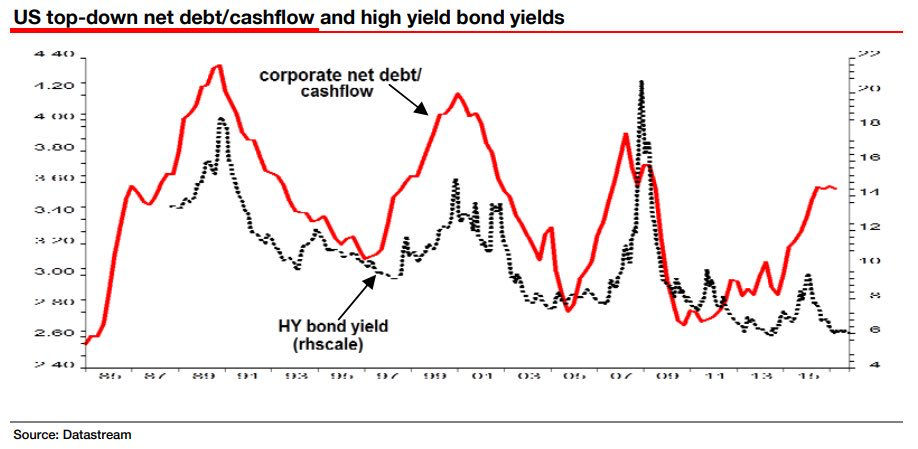
(Hat-tip: Jesse Felder)
And if the US markets sneeze, I expect that the FTSE will catch a cold.
To reiterate something I said in the recent interview with Paul: I'm not trying to time a crash in the equity markets. What I'm trying to do is invest in a responsible way, given my belief that the markets are potentially vulnerable. UK retail sales have shown their first annual fall since 2013, the job market is mixed, and equity valuations generally are full.
So I'm still 40% in cash, despite having made a few small purchases in recent months. I'm inclined to move slowly back into equity, in a controlled way, and perhaps on the condition that I see some cooling in the overall temperature of the markets. Because while I do hope and intend to outperform the overall market, I'd much rather not have to outperform in order to generate a decent return, particularly since I might be a forced seller in the next few years.
Of course, readers are unlikely to face precisely the same dilemma as me. I imagine that most of you are saving towards retirement, in which case you probably have a longer time horizon and a sell-off over the next two or three years can be handled in a different way. But I know that some of you do try to manage your equity exposure depending on the temperature of the markets, so I hope this was interesting for you. What do you think - is now a good time to be fully invested? If we are confident in our stock picks, should we be fully invested regardless of the overall temperature in the markets?
T Clarke (LON:CTO)
- Share price: 76.25p (+4.3%)
- No. of shares: 41.8 million
- Market cap: £32 million
Thanks to readers for suggesting continued coverage of this building services group, which announced an in line trading update today.
Our trading performance during the period has continued to justify that optimism and the Board is pleased to report that the results for the year ending 31 December 2017 are expected to be in line with current market expectations, which are an underlying profit before taxation of £6.5m and revenues in excess of £300m.
Checking back in the archives, I see that the underlying PBT was previously forecast at £6.1 million, and revenues were previously forecast at £300 million (rather than in excess of £300 million).
The broker consensus trend chart illustrates this year's earnings upgrades very nicely: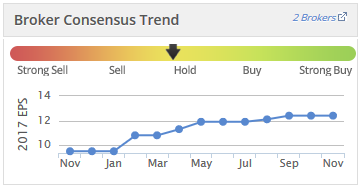
The update also helpfully lets us know that the company's cash position is strong (£9 million) despite £3 million in unusual capex on an acquisition and a prefab manufacturing facility.
Contract-oriented groups like this often see chunky cash payments and a consequently volatile cash position. T Clarke (LON:CTO) emphasises that its cash position is affected by the timing of its payments.
We are also presented with a highlight reel of noteworthy recent project wins, and the final paragraph is as follows:
There remains a clear demand for our specialist services in the markets in which TClarke operates. We have already secured £190m and £100m of our planned revenues for 2018 and 2019 and beyond, respectively, and we are encouraged by the number and quality of the opportunities that continue to be available both within our established M&E markets [GN Note: Mechanical & Electrical] and from the new opportunities that we are pursuing, driven by sustained investment at national level in both technology and infrastructure. The future for the Group remains encouraging.
So that's £290 million of revenues secured for the next two financial years and the key leading indicator, the forward order book, now stands at £380 million, just a small decrease compared to the record high achieved a few months ago.
It can't be expected that the order book would go up in a straight line. Instead, it's the bigger picture that counts. This metric is up nearly 20% against where it was a year ago.
Readers have pointed out the strength of £CTO's Value Rank, but questioned whether it might be illusory:

There is a case to be made that the company is not as cheap as it first appears.
On the pension front, checking the interim results, there is a deficit as follows:
| 30 June 2017 | |
| Present value of obligations | £56.9 million |
| Fair value of assets | £34.6 million |
| Deficit | £22.3 million |
The assumptions underpinning these estimates are all helpfully laid out, so actuarial nerds can check if they might be on the optimistic or the pessimistic side.
As you can see, there is an element of leverage involved here since a 1% increase in the pension obligation would increase the £22.3 million deficit by 2.5% and reduce T Clarke's equity by almost £600k.
From 2019, T Clarke is scheduled to make payments to reduce this deficit of about £2 million per annum.
On the positive side of things, I expect that the mismatch between "underlying PBT" and reported PBT is going to reduce now that the major non-recurring cost associated with cash going missing from one of its subsidiaries may now have been fully accounted for.
At the interim results, £0.4 million of associated non-recurring cost was included. Hopefully this will fall to zero in H2.
In my view, the big question is whether you want to invest in this sector and at this particular point in the construction and property cycle.
The operating margin reduced in H1 to 2.0% despite management's stated goal to improve this metric. Long-term, this company and this sector never delivers great margins, which unfortunately means that there is never a great margin for error when things go wrong, as they occasionally do with large and complex projects.
If you have a strong positive view that this sector can continue to enjoy a lot more positive momentum of the kind that it's been enjoying, then maybe I can see the case for investing here. But with £2 million going out the door every year for pensioners for the foreseeable future, and given the low margin for error, it's still not one that appeals to me.
The enterprise value is c. £54 million when you include the pension deficit. Value territory for me would be when the enterprise value was c. 7x forecast earnings.
Record (LON:REC)
- Share price: 46.25p (-2%)
- No. of shares: 199 million
- Market cap: £92 million
This is a specialist currency asset manager. We already knew its Q2 Assets under Management thanks to a previous trading update, and I commented on that last month. Now we get the complete half-year results.
It's a steady set of figures. As I've mentioned before, client numbers are modest at 59, which is somewhat concentrated in my book.
Overall, though, I like this company. It bought back a decent chunk of its own shares a few months ago, too, which seems like a smart move to me, as the valuation seemed reasonable and the company was holding an excessive amount of cash. I like buybacks compared to dividends, because they are usually structured to allow shareholders who don't wish to participate, to increase their percentage stake in the company. So everyone's a winner.
Anyway, back to these results:
- AUME1 increased to $61.2bn / £45.6bn ($58.2bn / £46.6bn at 31 March 2017) [GN Note: we already knew this.]
- Client numbers remained at 59 at the end of the six month period [GN Note: we already knew this, too.]
- Revenue2 of £12.2m was in line with the second half of last year, and represented an increase of 14% compared to the six months ended 30 September 2016 (£10.7m)
Here is a quick explanation of AUME, for those who are new to Record:
As a currency manager, Record manages only the impact of foreign exchange and not the underlying assets, therefore its "assets under management" are notional rather than real. To distinguish this from the AUM of conventional asset managers, Record uses the concept of assets under management equivalents "AUME" and by convention this is quoted in US dollars.
PBT is up 6% to £3.8 million.
The operating margin here is 31%, in stark contrast to the first company I covered today.
We also get a surprisingly large, 39% increase in the interim dividend, up to 1.15p. Shareholder rewards are a big priority for Record at the moment. Though if you adjust for the lower number of shares outstanding now, I think the size of the payout in total cash terms will increase by something closer to 25%.
As discussed previously, UK clients in the Dynamic Hedging products withdrew funds, switching to passive products. My interpretation of this is that they abandoned efforts to time their sales of GBP, instead preferring to sell up immediately. The vast majority (85%) of Record's AUME is in a lower-margin Passive Hedging product, though there has been an encouraging increase in the Currency for Return offering.
Despite its low average percentage of total AUME, Dynamic Hedging was responsible for 23% of management fee income:
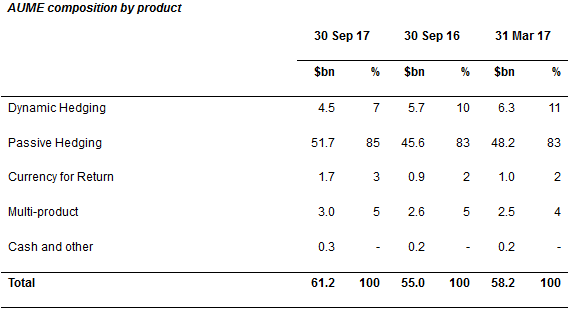
Passive hedging fees are only about 3bps per annum, versus 14 - 18bps in the other categories. So it's really important to try to sell the higher value products.
My opinion
I still think this is a fine business, and am still keeping it firmly on my watchlist and contemplating a purchase. I'm just a little disappointed with myself for not buying it when it was cheaper! The share price was less than 30p for most of last year.
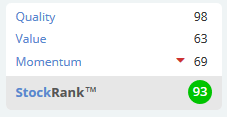
It's certainly something I'd like to build a position in, and Stockopedia agrees:
That's it for today and this week, cheers! See you next week.
Graham
Footnote:
Carillion (LON:CLLN)
- Share price: 22.375p (-46%)
- No. of shares: 430 million
- Market cap: £96 million
I thought I should briefly mention this construction/support services group, whose shares have crashed today and which was covered heavily in the mainstream media.
Today's update informs us that self-help measures will not be sufficient to reduce net debt/EBITDA to the target of less than 1.5x by the end of 2018, and so:
The Board is therefore in discussions with stakeholders regarding a broad range of options to further reduce net debt and repair and strengthen the Group's balance sheet. This will require some form of recapitalisation, which could involve a restructuring of the balance sheet.
This isn't too surprising. It's confirmation of what most people have thought for a while, including the many shorters of this stock. At least 16% of Carillion stock is still out on loan, according to the most recent disclosures (this figure was over 20% earlier this year).
Even my untrained eye, back in July, said that an equity raise could be on the cards.
What's more interesting and was not confirmed up until today, was that covenant failure would happen as soon as December:
The Group now expects that a combination of delays to certain PPP disposals, a slippage in the commencement date of a significant project in the Middle East and lower than expected margin improvements across a small number of UK Support Services contracts, partially offset by cost savings initiatives realised in the fourth quarter, will lead to profits for the year to 31 December 2017 being materially lower than current market expectations. Given the impact of delays in receipts and disposals, the Group now expects full year average net borrowing in 2017 to be between £875m and £925m.
Based on its latest forecasts, reflecting the items mentioned above, the Board now expects a covenant breach as at 31 December 2017.
It's the same old litany of bad news from support services contractors: delays, slippages and margin vulnerability.
That forecast average net debt range is significantly worse than the forecast range given at the half-year results, of £825 - £850 million.
What it means is that on an enterprise value basis (market cap plus average 2017 net debt), Carillion's valuation is still around the £1 billion mark. This does not include a pension deficit of c. £600 million.
Drowning in debt and uninvestable before it has been recapitalised, I'm afraid.
Disclaimer
This is not financial advice. Our content is intended to be used and must be used for information and education purposes only. Please read our disclaimer and terms and conditions to understand our obligations.

41 comments
Thank you Jon for your care. But if all else fails, I will sell the house and garden room and live on the boat. I needn't go anywhere. By the way owning T Clarke shares would be my sort of nightmare. I like the Prudential - its large and very boring - that's perfect for an old goat !
At 79, my take is different ! I moved to a smaller house and trousered the difference. And I am spending it . I bought a 32 ft motor boat and built a garden room to view the plants and the flowers and I am soon off to holiday in Barbados. Kids these days would not thank you for an "inheritance" - if they live in expectation , tough. As for the markets, I just don't care if they fall - i will stop spending, flog the boat and retire to the garden room to eke out a bucolic existence Who needs capital ? You can't take it with you. So sell up and spend !
Sounds good, quantockriser, but a word of caution. If the markets fall you may struggle to sell a boat at any price. When times are hard who wants to acquire a new cost centre? I suspect you won't care, so fair play to you.
Jon
Graham,
Interesting musings, I would like to be 40% cash. 22nd will be very interesting, sticking plasters or major surgery? I think sticking plaster but then again what if I were an ambitious politician in No 11? Two observations:
This is SCVR. Rightly or wrongly I am hugely over represented in AIM shares, risk decision over the last 10 yrs on my part and despite nearly 30% fail rate I have done well, but that may just be luck. But some positions are 10 or in one case 17 times over NMS so the only time I can sell is while the sp is going up. I used to think that the advantage of being a PI was being able to go "all-in" and "all-out" but beginning to see the reasons the big boys ignore small AIM shares. For ten years I have sold to maximum of CGT allowance and as far as possible moved favoured shares to ISAs. I have still got about £100k in shares I would like to sell from AIM outside ISA and I have already gone well over my annual CGT allowance. Do I sell more and get taxed at 40% (if I sold all it would be at marginal rate of 45%) or assume the coming correction will be less than 40%?
When Gordon introduced the SIPP it seemed like a good deal to me, so having maxed into ISA each year over my last five years at work, I also put nearly all my 40% tax earnings band into SIPP, albeit by cashing in NS&I bonds. The gap between my work pension and higher rate tax is about 5 times my remaining SIPP (and I have deferred state pension getting 10.6% pa return). I could take less from pension and reduce CGT on shares. I guess I have to take a view on how long I will live and more importantly my risk of dropping dead without the chance of reviewing the option on the state pension.
5 (4 in NZ) days to go.
Regards,
Seadoc
Edit: Days to go is to the Budget, and hopefully not to my demise!
CGT is currently at a very generous rate of 10/20% (except for residential property gains). This is the lowest for many years so I would take advantage of this low rate - unless you intend to die in the next few years where CGT is zero on death.
No intention of dying, ever! Many thanks will follow this up and sell most, if I can, at cgt of 10% if that is after taking income to top of higher rate band. Got a link, cannot find on HMRC site?
Thanks,
Seadoc
Got a link, cannot find on HMRC site?
Try this - http://www.rossmartin.co.uk/private-client-a-estate-planning/capital-gains-tax/110-capital-gains-tax-rates-a-allowances
or the more complicated - https://www.gov.uk/hmrc-internal-manuals/capital-gains-manual
rpannell,
Thanks, I would take your advice to sell at 10% except I tend to draw down my SIPP to the limit of higher rate tax band so I would pay 20%. But much better than 40%.
Hi be careful with deferral if you are married as spouse may not get all pension on death could be 50% best case, you could be better taking it and recycling into another pension to build up death benefits if your still working.
clarea, Thanks, good comment, yes I am married and you are right if I were to drop dead suddenly. But (doc here) at age 67 there is a much bigger chance of some sort of a warning that I am dying and so have the chance to "put my affairs in order" The really interesting calculation is when to start drawing a 10.6% (pa) higher pension against the fewer years that I will have left to draw it. Without any clear health problem I am looking at early 70s. If I found that I had a terminal problem I think I still have the option of taking a standard pension and take the back dated pension as a lump sum. At the moment I probably need to draw down my SIPP as fast as I can while remaining in basic rate tax band. But, hey ho, such thinking beats watching day time tele!
Thank you Graham for your interesting question (at the start of this SCVR).
Yes, we all have different investing objectives. In my case my investments pay my rent and expenses as well as (hopefully) growing in value enough to give me a comfortable pension pot for my retirement. Given where I stand now I expect to continue as an active investor for quite a few years to come.
I have never in the past been any good at timing the market. So I am doing my best to watch carefully. What strikes me most is:
1. this bull market has had a good long run. All good bull markets come to a close sooner or later (even if the central banks keep pumping up the lilo with fresh supplies of ultra cheap money
2. volatility seems to be increasing in the high growth shares that have done so well over the last few years (BOO, BVXP, ACSO, KWS, FEVR...)
3. We have no idea how Brexit will turn out. Will it be a brave new future (as some say)? Or will there be lorries queued up at Calais and Dover unable to complete the paperwork necessary to allow them process our exports and imports? And if so how will those businesses that depend on imports and exports survive?
In response I am now 30% cash and gradually working through my portfolio selling off or reducing my lower conviction or more risky holdings. And I am trying to apply stricter criteria to my new purchases. Of course I might miss out on some of the next leg of the bull market. But then again I will find it easier to sleep at night.
And if all of that sounds confident and composed.... well actually I really just wish I knew what was going on but, given that I don't, this seems like my best balanced guess as to a decent way forward. My fingers and toes are very firmly crossed.
Looking at ten year charts the FTSE100 is only up about 15%, the FTSE all share is up a third and AIM100 is only just back to where it was (early-mid 2007). In the grand scheme of things that doesn't seem unreasonable, if fall and recovery are just parts of the historic trend upwards. That reassures me a bit but having said that, as Graham says, when America sneezes.
A lot of money has flowed into UK equities, of course, but apparently that has started to reverse. Funds are still growing but putting money elsewhere now.
As Paul sometimes suggests, the bigger macro picture is important and if May is pushed out and the Brexit 'negotiations' stop, stocks, good as well as bad, could suffer a harsh slide.
I started investing (again) after the post-referendum crash (I was far too slow to take advantage), and I'm curious what was it like for PI's over those weeks. What happened on a day to day basis? Was everyone being stopped out and at prices well below their stops? Were spreads ridiculous discouraging buying back in? And when did people start buying back their shares and at what kind of price difference? I suppose I'm wondering what is the best strategy should something similar happen again?
It is rather tricky - no, impossible -on my computer to see the dates below that very interesting opening chart - US net debt/cashflow versus junk bond yields. The latter are generally issued by companies with low ratings due to already poor balance sheets or companies trading unprofitsably. So it is a total picture of the (I assume) listed corporate sector versus a pretty specific group of listed strugglers. I wonder is there is any correlation between these and the US stock market, say the Fortune 50?
Anyway, the real concern for me is that the p/e, imprecise as it is, is so high at a time when corporate America has reportedly been increasing debt to buy back shares, which should theoretically reduce the p/e. I know this trend reversed in the data released for the most recent quarter - that is net buying by corporate America reversed - and the p/e has anyway been very high for ages now. But I still can't see anywhere else to put money safely except the bank in devaluing sterling. And if the US sneezes we still all catch a cold.
So then Graham, when do we get your fantasy fund to compare with Paul's?
Re T Clarke (LON:CTO) , I think this company is run for staff and customers not shareholders , they’re a great employer, they have a DB pension scheme still live (not so it appears to be now closed)when it looks unsustainable and they pay directors v well, last year board pay was c £1.9m vs net profit of £2.4m and dividends of c£1.5m , that is crazily out of whack when TSR has been disastrous over the last 10 yrs. Finally they do great work but with tiny margins so customers love them as well. Not for me
Good to get your comments Graham and appreciated.
I agree with your opinion of raising cash levels with myself working towards the same outcome with a sell-off in mind although that has been since November last year at cash levels of 30%......
In the same sort of timeframe as you I see be able to invest a property sale amount into the market so would prefer the healthy pullback before putting the money into the market.
Maybe some Premium bonds which I also have would be one option for a small amount.
Thanks for sharing
Hi Graham - really appreciate your thoughts on portfolio management. I think this latest EY report on profit warnings in Q3 2017 also makes interesting reading for us: http://www.ey.com/uk/en/issues/capital-and-transactions/restructuring/ey-profit-warnings
Key points:
- UK quoted companies issued 75 profit warnings, 21% more than the third-quarter post-credit crisis average of 62
- Profit warnings rose 10% year-on-year
- Home Improvement retailers made up almost half of retail warnings in the last six months.
The last bullet tallies with some of the commentary on this blog - although Norcros (LON:NXR) appeared to be bucking the trend yesterday.
Interesting dilemma there graham. I found myself in something of a similar position this time last year when I started accumulating for my current house. I remember at the time it was a tough decision as I found that all the research I did indicated that equities were a much better long-term investment than property especially given the risks associated with being based approx. 20 miles from a (soon to be European border) however I was sick of renting/ landlords having had horrific experiences with leaks and finding one of them in my flat without my knowledge, so I sold out somewhere close to 50% of my portfolio to fund the deposit. Since then my portfolio performance has been excellent (on paper at least), sometimes rue my decision to sell back then but I suppose one year down the line is nothing in the grand scheme of things and how can you put a price on having a secure home?
I don't really have much of a view on the next correction as I try to bury my head in a micro economic sandbox but every-time I listen to the adventures in finance podcast or for example read about the future of monetary policy cold shivers run down my spine.
Cheers for the comment WhaleHQ, sounds like an extremely similar situation you had there! It's a real conundrum for house buyers in general when the house prices themselves are a moving target and of course you never know what your equity portfolio might be worth a year from now. It doesn't matter how good an investor might be, predicting movements over a 12-month period is impossible. And the big macro risks are yet another reason to stay frosty (cautious). Thanks for sharing your story.
Real estate is cyclical.
About 20 years elapse between Buyers' and Sellers' markets.
Also we tend to buy and sell for personal reasons so do not think of it that way. Neither are there statistics like Stock market ones. It is an illiquid asset.
From what you have told us your Stock market style tends towards Buffet's 'the ideal holding period is forever.' He held Coca-Cola through the Tech bubble. It subsequently dropped by 50% and he had to admit publicly that it had been an error not to sell some.
Personally I attach great value to the daily price fluctuations in the Stock Market. One can always buy and sell, albeit often at a loss. Not so a house.
So what of Peter Lynch's remark that more money has been lost trying to forecast the next crash than in the downturn itself?
It is true.
However I regard it as Insurance and therefore prefer paying the premiums than looking at a portfolio that has lost 50%
'Markets will fluctuate' Keynes said that.
'Cash is your starting and finishing point' I said that.
I am in the fortunate position of having owned one house or another for the last several decades. They have gone up and down (twice with mortgages pushing me into negative equity) an at the moment I can show that a house so far has been an excellent investment.
But...
It isn't an investment, it is a home, and despite now being mortgage free and sitting on a much higher value I can no more eat it than I could at half the value. I like being here and, while it may make a difference to my inheritors, it will still feel the same if it falls in value. There are those who view a home as just an investment and hop from one to the next as they attempt to maximise their gains (and Robert Kiyosaki has got wealthy advising people to think of it as purely as an investment).
Each to his own, but maximising its pleasure as a home may help you get over whether or not it stacks up against a "jam tomorrow" biotech!
Good luck!
Re. T Clarke (LON:CTO) The last HY report in August reported that the pension deficit had increased and an additional £0.5m p.a. contribution will be necesary.
I think that takes the annual contribution this year to £1.5m . That's a chunky piece out of a profit before tax of £2m for the HY ; roughly (1.5/4*100 =) 37.5% .
I don't know about the business but if it is cyclical, then the risks jack up materially.
Thanks for pointing that out Ram. It gets worse from 2019 when pension payments were already scheduled to be £1.5 million, so I interpret the HY comment to mean that payments will rise to £2 million from then.
SCAPA (SCPA) - Hasn't been covered for 2 years by Paul.Graham your thoughts. Recently dropped into the William O'Neil CAN-SLIM-esque screen last month. I have been following this method/screen after reading his book. VCP in here also, I bought and up 10% so happy. Pauls mention of SCPA's Pension deficit in the last review 2 years ago in the Other Liabilities, Total of the balance sheet has come down from 40 million pounds in 2013 to 16 million pounds in 2017. The chart is classic Mark Minivini with it side tracking looking like its ready for its next upward growth. I am fully invested at the moment but like this one.
T Clarke (LON:CTO) puzzles me. It has an A+ magic formula score and rising broker forecasts, but a low Altman Z2 score and even the house broker doesn't give CTO a Buy rating.
On a PER of 5.05 something must be wrong, all I can see, in my simplistic view is that Pension and Operating Margin, hopefully "Our Graham" can help put us out of our misery.
T Clarke (LON:CTO) has exactly the same problem as Norcros (LON:NXR)
Two cyclical businesses sat atop a ticking pension time-bomb
The p/e's of 5x for both are hence illusory
Keep up, Howard - the pensions time bomb went off a year or so ago.
In my view, the poor understanding of investors as to how to allow for pension deficits in their valuations has led to most afflicted shares being underpriced. With prospects for deficits narrowing now much more favourable, I see potential for significant rerating as the deficits diminish, clear or even reverse, and the affected businesses get a very significant boost to their free cash flows.
I Hold T Clarke (LON:CTO) because of valuation, order book and div. The pension deficit is approx £20 m, but with assets of approx £33 m and obligations of £53 m. So compared with some companies, the deficit to liabilities ratio is large. In the accounts, T Clarke estimates that a 0.5% change in the deficit would reduce obligations by c10% (£5million). So for CTO, it would take a very significant change in the assumptions to eradicate the accounting deficit.
As far as I can see the DB scheme is still open (DYOR) - there can't be too many companies in that situation.
Wimbledonsprinter, I am put off holding these purely because I have been burnt on Interserve and Carillion in the past year and the attractive metrics you mention: valuation, order book and div look very similar to me. Unfortunately so does the very low margin.
I could well be wrong (and hope I am), but I am concerned that just one misplacing / error in a contract could have quite serious repercussions to the whole business a la IRV and CLLN.
Once (actually twice!) bitten......
Re. T Clarke (LON:CTO)
Actually the scheme is closed to new members. Here is an extract from the last full year report.
" The Group has proposed an increase in employee contributions from 8% to 10% of pensionable salary and is consulting with employees on this proposal. The scheme is closed to new members and the Group continues to meet its ongoing obligations to the scheme."
And fair play, they are trying to get existing members to contribute more from their pockets..
EC, you refer to "poor understanding of investors as to how to allow for pension deficits in their valuations" but perhaps you could explain how investors should allow for pension deficits. A pension deficit can transform into pension surplus, and vice versa, on a simple periodic actuarial review. As pension funding takes precedence over other cash distributions this can increase risk enormously. A member of a defined benefit pension will get a periodic review, but as far as I am aware companies are not required to post the reviews on their websites, and there is usually precious little information in the annual report. As very few companies are continuing DB schemes now this problem will eventually disappear, but it will take a very long time. Meanwhile, if anyone who is actuarially qualified can give advice on how to approach this, I for one would love to learn..
cic - further to T Clarke (LON:CTO),
I allow for pension deficits in my valuations the same way I allow for debt. I add back the contributions to fund the deficit (net of tax) to income before applying a valuation multiple and I deduct the deficit (net of deferred tax credit) from cash in making my cash/debt valuation adjustment.
PS I am actuarially qualified, although I have never worked in pensions (thank God).
EC - I do the same, actually, so that is reassuring, but as I am usually a long term investor what I really want is a handle on the effect of the pension long term on the company. Usually, in a DB scheme the pension contributions in the short term are fixed as a result of a negotiation between the company management and pension scheme administrators. The current contributions could be too low, in which case I am investing in a company with a nasty shock in store next year, or the year after. Or they could be too high, resulting in a shareholder benefit when they are reduced. I have no way of estimating which applies. What I really want is info to enable me to make an evaluation of future pension effects on profitability. The effect of normal debt does not vary in the same way - there is not the possibility of regular debt evaporating as there is with pension deficits, so using this model is only useful forecasting one or two years out. That is what I am trying to get my head around. I hope this makes sense.
cic,
Yes, a pension deficit involves a high level of potential variability that is very different from a debt. I think that the only way to try and model this accurately would be through stochastic simulation using an economic scenario generator, but this is hardly realistic for most of us.
If you want to impose a "charge" on your valuation to reflect the potential for the deficit to increase, I would suggest basing that on the sensitivity tests in the full results. These sensitivity tests cover the discount rate (+/- 0.5%), inflation rate (+/- 0.5%) and life expectancy (possibly +/- 0.5 years). Take the biggest of these, which is the discount rate for T Clarke (LON:CTO), with a 0.5% decrease increasing the pension liabilities by 12%, which is £6.4m.
You would need to give some thought as to how to calibrate this adjustment, as sensitivity tests are not standard. For example, Macfarlane (LON:MACF) reports on movements of 0.1% and 0.1 years and quantifies the impact on the deficit, rather than the obligations alone. (This makes sense for them as they hold substantial liability driven assets that are intended to hedge against movements in the value of the liabilities).
Anyway, suitably calibrated, this method would provide a sensible adjustment for DB pension risk that would also reflect the riskiness of individual schemes.
It's all too complicated for me, however. At the moment, I just take the view that any discount rate shocks are much more likely to decrease the deficit (higher discount rates than implied by the current yield curve) and that, therefore, future uncertainty on the pension deficit is biased on the favourable side.
Hi Graham,
Interested in comment on T Clarke – 73.13p – £30.6m – PER 5.05 - If you have the time.
Trading Update From 1-July-2017 To Date – Expecting 2017 to be in-line, PBT of £6.5m and Revenues in excess of £300m. This is a really nice update, both in its clarity and content.
Tempted here – 2 majors holding me back - The Pension Deficit of about £20m (over 60% of Mkt Cap) and the low Operating Margin (about 1.5%). I wonder where this company will be in 3 to 5 years time – Can it become a MGNS, COST, KIER? I am still on the fence.
Thanks in advance and a good weekend to you - And all.
My morning smallcap tweet:
Simigon (LON:SIM), Seeing Machines (LON:SEE)
SimiGon (SIM) gets final regulatory approval for $2m order from Israeli Air Force. Exp rev in this FY.
Seeing Machines (SEE) AGM stmt reads like a gushing Oscars speech. "it's wonderful to offer people the opportunity to come to work knowing that, every day, they're saving lives...Over the last four years, our incredible founders and their teams of technical experts have leveraged Artificial Intelligence...to put us in a world leading position...I'd like to personally thank everyone for your incredible inputs into making the organisation what it is now today...We look forward to delivering the expectant [sic] returns that our broad stakeholders and shareholders deserve."
Half year report from specialist currency manager Record (LON:REC) released this morning. Pretty much in line with trading update released in October covered by Graham. Slightly higher volumes, no new customers and slightly lower margins. Reasonable but may not be high octane enough for current Super Stock market expectations.
Gus.
Morning Graham
It's fairly quiet this morning for results. Versarien (LON:VRS) has put out an RNS this morning that sounds very bullish about its collaboration with a global consumer goods company for their use of grapheme, which has now materialised into an order, although no numbers are given.
https://www.investegate.co.uk/versarien-plc--vrs-/rns/collaboration-with-global-consumer-goods-company/201711170700057734W/
If we are to believe everything we hear, graphene is set to be the new wonder material, being incredibly light but incredibly strong, and thus it can be applied to many markets (motor, batteries, aviation - the list is almost endless). There is quite a bit of money going into it here in Manchester from Government.
The company recently raised £2.9m in an offering that was over-subscribed, and the RNS concludes with the following:
"Our recent fund raise is allowing us to rapidly scale up our graphene production capabilities and we are seeing ever increasing interest from global OEMs. We are currently showcasing our graphene technology at the IDTechEx show in Santa Clara, California, where we have been delighted with the interest received on the first day of the show including many from large global companies."
I know that history is littered with the "next big thing", but momentum does seem to be building in the application of graphene.
Regards
Paul
Graham,
T Clarke (LON:CTO), please. Price has been weak in recent weeks, but there was a "meeting expectations" trading statement this morning. They look very cheap to me, especially as they are hauling themselves up the technological ladder towards (hopefully) high margins.
They also announced what looks like a decent non-exec appointment this morning.
Thanks for the suggestion, I'm covering T Clarke (LON:CTO) next.