Small Cap Value Report (Fri 18 May 2018) - CPR, CTO, reforming fundraisings, CVAs

Good morning, it's Paul here! Graham is having the day off today.
There's not much news today.
CVAs
There seem to be lots of interesting things going on at the moment. Mothercare (LON:MTC) seems to be pressing ahead with its CVA & refinancing. I didn't get time to report on that yesterday.
Carluccios restaurants is apparently the next chain lining up a CVA.
I wonder how long landlords will tolerate this tidal wave of CVAs? There was an interesting tweet today from a leisure sector property fund manager, who pointed out that CVAs are meant to be a mechanism for saving struggling companies. Instead they are now being used as a property restructuring tool. It sounds as if attitudes are already beginning to harden.
CVAs are also a reward for failure. Poor old French Connection (LON:FCCN) (in which I have a long position) has had to soldier on with all its loss-making shops, continuing to occupy them & pay the rent, because it had a big cash pile (somewhat depleted now). Whereas financially weaker retailers can just threaten to go into Administration, and then negotiate a CVA instead, and walk away from all their problem shops - thus subsequently having a big competitive advantage.
Short squeeze
Yesterday was a good reminder of the dangers of short-selling. The price of Ocado (LON:OCDO) went through the roof, on an impressive contract win for its technology. These deals have been a long time coming, but they do seem to be happening now.
In what was a very crowded short trade, the squeeze (where shorters become forced buyers) was eye-watering just to observe. It's certainly made me think twice about whether I should be doing a relatively small amount of shorting at all? Although I wasn't short of OCDO, so it didn't affect me personally.
Carpetright (LON:CPR)
Share price: 36.7p (up 10.4% today, at 10:50)
No. shares: 71.3m before fundraising, 303.8m after fundraising
Market cap: £26.2m before fundraising, £111.5m after fundraising
The main points of this deal were already known, apart from the price, which has been set at 28p, a 15.8% discount to last night's price. This is a surprisingly modest discount, given that the company is insolvent without this fundraising.
New shares: 232,463,221 new shares are being issued in this placing/open offer. I have shown the before & after valuation above.
CarpetRight is in the happy position of having strongly supportive major shareholders. Without them, I think it would have probably gone bust. Its biggest shareholder, Meditor, has already provided it with a £12.5m bridging loan, to enable it to continue trading until the Placing funds have been received, and is also taking up as many shares as it can (without triggering a bid) at 29.99% of the resulting shares in issue both before and after the fundraising.
Crescent, which holds 12.08% of the shares, is doing the same, in taking up enough new shares to maintain its position.
Open offer - I'm a bit confused about how this is going to work, so have asked my broker to clarify, and will amend this section once I have the answers.
The open offer seems to give full pre-emption to existing holders - who can apply for 88 new shares for every 27 existing shares. If you multiply that out from the existing 71.3m shares, it works out at 232.4m potential new shares going to existing holders, if the take up rate is 100%. That equals the full number of new shares being issued. Clawback from placees is mentioned.
So it's sounds as if other participants in the placing could be squeezed out. After all, it makes sense for existing small holders to take up their open offer entitlement, if the share price remains well above the 28p open offer price, which it currently is. That would give an instant profit, and they could even forward sell in the market now, given that this is no longer inside information.
Incidentally, I was made an insider on this deal a couple of days ago. Because I respect, and strictly adhere to the rules on inside information, I did not breath a word to a soul. That's the way it's supposed to work. I strongly disapprove of any commentator breaching confidentiality, and broadcasting, or gossiping about fundraisings which are underway. You won't ever get anything like that from me.
Here are some other key points of the CarpetRight fundraising (NB. This is not a comprehensive report, so as always, you should read the company documentation in full if necessary);
Prospectus will be published today on the company website
The deal is underwritten, and is being undertaken by Peel Hunt, so the company is highly likely to get the money - therefore this deal is largely de-risked now.
Fees - are huge, as you would expect - £65.1m gross, £60.0m net, so £5.1m in fees.
An (unnamed) aggressive new competitor is mentioned, as having harmed CarpetRight's performance, as well as the general malaise for consumer spending. This is a worry - what if CarpetRight is in structural decline, and may fail again in future, if competitors eat its lunch? Can anyone tell me who this competitor is, so I can check them out?
Closing 92 sites, of which 11 are non-trading sites.
Rent reductions of 30% or 50% on 113 sites, creating £5m of annualised cost savings.
Break clauses on reduced rent stores - providing further flexibility to exit from the weaker sites in future.
Profit effect - I'm not 100% sure on this, but the company seems to be saying that it expects profit to rise by about £19m p.a. That should transform the future performance of the group.
My opinion - CVAs are a much better solution for problem retailers, than pre-pack Administrations, because the business can continue trading as normal, and trade creditors are not affected in this case.
CVAs are in effect now being used as a tool to restructure property portfolios, thus giving struggling businesses both a lifeline, but also a competitive advantage over their more solvent competitors. That clearly isn't fair, as it's rewarding failure. However, as with many things in life, sometimes being pragmatic is the best overall option.
My main worry with CarpetRight, is that it might be a long-term declining business, and that the CVA could give it a shot of adrenaline, which would then wear off, as competitors continue to erode its business.
On the other hand, this restructuring gives it the best possible chance, as all problem stores are being ditched simultaneously. That will allow big cuts in central costs, and also they are raising enough money to refurbish all the remaining stores.
There has been some disruption to trade, as you would expect, and there is also reputational damage to think about. However, in say a year's time, when decent profits should be rolling in, then I suspect investors might quickly forget the problems of the past. For that reason, I have attempted to participate in the placing, but am not sure currently whether I definitely got any shares or not.
Anyway, we'll see what happens, but this company seems to be almost out of the woods now, with this restructuring likely to conclude successfully.
Ideas for reform of fundraisings
I don't agree with the current system for fundraisings. In my view, once we're out of the EU, we should persuade Government to drastically simplify & speed up fundraisings for listed companies. In future, fundraisings should be done;
- Fast (1-2 weeks max)
- Electronically
- With full pre-emption rights
- Simple, and abbreviated prospectuses, or even no prospectus at all for smallish deals
- Minimum paperwork
- Shares should be suspended the moment the process starts
- Price should be set by demand & supply, through an online auction process
- Full access should be given to private investors, on the same terms as institutions.
Alternatively, if companies want to get specific institutions on board, then there could be another process to allow placings to be done the existing way, providing the discount is no more than 5% of the open market price, and dilution is no greater than say 25%.
We have the technology to make the above process easy. It's inertia, and vested interests in the City (just look at the fat fees earned for fundraisings now!), and our EU membership, that prevent these changes from happening.
Whether you agree with Brexit or not, there is no doubt that once we've left, there are all sorts of opportunities for us to create a much better, simpler legal & regulatory framework in the UK, and thereby enhance London's position as a leading financial centre.
T Clarke (LON:CTO)
Share price: 84.5p (up 4.45% today, at 12:58)
No. shares: 41.8m
Market cap: £35.3m
AGM Statement (trading update)
This is a building services group, concentrating on complex electrical & IT installations, e.g. at new build & refurbished office blocks.
Today's update says;
We are pleased to report that we continue to expect revenues and profits for 2018 to be in line with current market expectations.
To put those in context for the year ending 31 December 2018, these are forecast to be revenues of £300 million, underlying profit before tax of £7.0 million and underlying EPS of 13.2p.
We also expect to maintain our trend of underlying positive movement in net cash year-on-year.
How wonderful to see the middle paragraph, where the company clearly sets out exactly what the market forecasts are. Top marks to the company & its advisers! This information is vital for private investors, who cannot get hold of broker notes, after the disaster that is MiFID II. I'll keep banging on about this issue, until all companies are giving us this vital information. Waffley text is not good enough - we need facts & figures, as given above.
It's so important that smaller companies are shareholder-friendly towards their private investors. After all, we create the liquidity in the market, and we set the share price. So treating us with contempt (as many companies still do) is an act of self-harm by smaller companies. They need to engage with private investors, and provide us with the information we need to decide whether to buy the shares or not. Some brokers & PRs get this already. Others are stuck in the past.
Order book - reassuring information here too;
Our forward order book has been replenished and as at 30th April 2018 stood at £368 million, increasing from £337 million as at 31st December 2017.
Encouragingly, we are seeing no lack of opportunities, but we maintain a strict policy only to bid for projects that meet our internal risk analysis and where we are comfortable with the covenant and market reputation of the contractual counterparty.
A list of impressive-sounding contract wins is given.
Directorspeak - upbeat;
Once again, TClarke has made an excellent start to the year and the Board looks to the future with continued confidence.
Valuation - clearly it looks very cheap. However, it should be cheap, because it's a very low margin contractor, whose workload is highly cyclical;
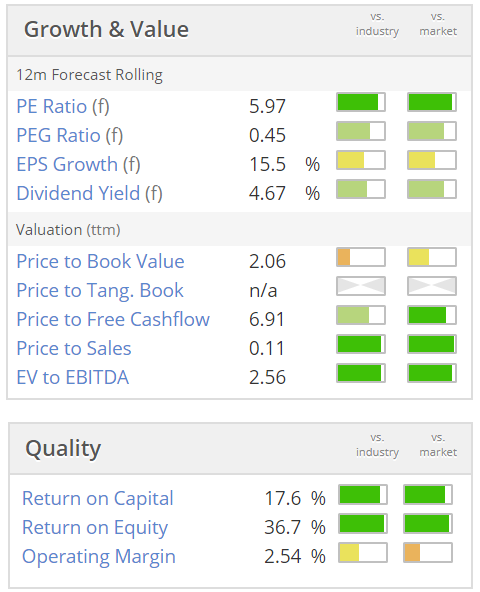
My opinion - it's a share that I've held before. It certainly looks superficially attractive on a low PER, and with a decent divi.
The balance sheet isn't great, but if you strip out the £23.4m pension deficit (which is a manageable, long-term issue), then NTAV would swing from a negative to a positive number.
The big problem with low margin contractors, is that these large, complex contracts, can easily go wrong. There's little profit to absorb extra costs from rectifying problems. That makes shares in this sector very risky. That is reflected in a lowly valuation.
We also have to consider cyclicality. There's a lot of commercial construction work going on at the moment, because interest rates are so low. That won't last forever (mind you, we've been saying that for almost 10 years now!)
Overall, I've decided not to buy any contracting companies at all any more, it's just not a sector that interests me. If you are prepared to touch this sector, then CTO certainly seems good value - providing nothing goes wrong with any big contracts.
Stockopedia likes the numbers too, calling it a "Super Stock", and with a high StockRank;
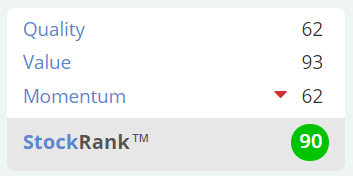
I'm not convinced that the algorithms consider cyclicality, and sector risk though.
That's it for today.
Regards, Paul.
Disclaimer
This is not financial advice. Our content is intended to be used and must be used for information and education purposes only. Please read our disclaimer and terms and conditions to understand our obligations.

25 comments
CVAs are also a reward for failure. Poor old French Connection (LON:FCCN) (in which I have a long position) has had to soldier on with all its loss-making shops, continuing to occupy them & pay the rent, because it had a big cash pile (somewhat depleted now). Whereas financially weaker retailers can just threaten to go into Administration, and then negotiate a CVA instead, and walk away from all their problem shops - thus subsequently having a big competitive advantage.
I have heard the following on the CVA grapevine...
1 Joe Public hears about a retailer closing stores/CVA-ing/having financial problems and starts to think twice about shopping there because, say, a carpet order may not actually be delivered if the firm goes bust.
2 Staff at a troubled retailer become available for work after CVA, so rivals could pick up decent employees. Also staff still at a troubled retailer could be more likely to seek stronger employers as workforce morale will be low
3 Prominent CVAs are helping stronger rivals with their own landlord and rent discussions. Landlords should be becoming more pragmatic about rent levels and may in time trade lower rents for a stronger tenant covenant.
So it may not be a complete disaster for rivals of a CVA retailer.
Hear hear to your suggestions for fundraisings.
Glad to see that Paul is having a look at Andrews Sykes, one of the few companies which can genuinely blame the weather for its ups and downs. The usual complaint is about the illiquidity of the shares and the risk posed by the dominating voting power of major shareholders/management but, up to now, this does not seem to have stopped the company from providing decent long term returns to all its shareholders. Perhaps a play on the apparently increasing extremes being shown by the weather in many areas.
hi paul
any comments on s and u
Paul
With the exception of the Prospectus Directive, I can't see how the EU restricts your ideas about fundraising. The prospectus requirement is intended to protect investors but I agree that it is heavy-handed (who actually reads all of them?) and that a more streamlined requirement would benefit everyone.
In my view, the UK Govt could already improve the fundraising process in several ways - but chooses not to do so.
As regards T.Clarke (CTO), it's undoubtedly cyclical as you say. However, the commentary omits an important paragraph from today's update which confirms that CTO have already secured their revenues for this year to 31/12/18 (and a substantial portion of next year's too), so any cyclicality won't be a problem for some time to come:
"Overall, the planned Group revenues for 2018 have now been secured with some capacity in the North West and Newcastle businesses to address. Future secured revenues are £145 million for financial year 2019 and £40 million for years 2020 and beyond."
On forecast 13.2p EPS that's a current year P/E of only 6.4. And presumably any new business won will further contribute to this year's outturn.
Plus these (N+1 Singer's) forecasts are based upon 2.7% operating margins, whereas CTO have themselves confirmed they're now targeting 3% margins.
It's also worth noting that CTO have diversified from their more traditional (and more cyclical) M&E business into higher margin and less cyclical areas like "Intelligent Buildings":
http://www.tclarke.co.uk/our-b...
Which may explain why CTO are winning business like the new Dyson campus, Battersea Power Station (where Apple will be based) etc. I don't think the market has fully appreciated this shift yet.
Paul -Carpetright (LON:CPR) 's aggressive competitor is named as Tapi in an earlier post but there is also new competition from Flooring superstore. It started online but this has the disadvantage that people like to check and compare colour and feel of carpets before buying so it is rolling out showrooms where you can do just that without the disadvantage of large rolls of stock on each site. See:
https://www.flooringsuperstore.com/stores
Paul,
The Carpetright competitor is Tapi, founded by Lord Harris who previously owned Carpetright and run by his son.
Lots of colourful stuff online about the “vendetta” between the two businesses.
E.g.
http://www.thisismoney.co.uk/money/news/article-5565403/As-Carpetright-fights-survival-Lord-Harris-floors-boss-bold-bid-snap-100-stores.html
The same thing happened recently at Safestyle UK (LON:SFE). It went public a few years back, some of the management team then sold their shareholdings, went off and set up a new company doing the same thing, poaching staff from the old company to go into direct competition.
An owner operator selling shares in their business, and then leaving the company (assuming they're not retiring) should be a serious red flag to investors.
pwozzy,
Yes, Seeing Machines (LON:SEE) 's announcements have generally been fairly level headed which indeed lends much weight to their "extremely positive impact" comment. This is emphasised again today with the care they have taken in summarising the EC press release - I have added a * to each word that provides a step of separation that has to be passed before someone's DMS is actually present in all new cars in member countries:
"the Commission has put forward* measures to lead* an integrated policy* for the future* of road safety, with specific proposals* to mandate* that new models of vehicles are equipped with advanced safety features*."
I also spotted that they are now saying the first production by the two German OEMs is due 2021 (which could mean first sales in 2022 even if on target), whereas the RNS below definitely says "mass production launch starting in 2020" for one of German OEMs. This appears to a be timescale slip and makes a further nonsense of the claimed "EU" 2020 new-model deadline.
https://www.stockopedia.com/sh...
For comparison, here is a potted history of ABS (anti-lock brakes):
1920 - First patent
1971 - First electronic automotive implementation
1993 - First OEM to make it standard across range
2004 - Mandated by EU for all new cars
2013 - Mandated by US (as part of stability control)
As a road user and shareholder I hope and believe DMS will move much more quickly, but still my best guess is it is 5 years away in the EU and 8-10 in the US. Furthermore any perceived monopoly by a AUS/UK company has the potential to cause political delays in what are both increasingly protectionist trade blocks.
leo
Proposal is all new cars need to be fitted with Seeing Machines (LON:SEE) type tech by 2022 to be legally sold in EU.
Between 2020 and 2022 all "Type Approval" cars need this tech, which are basically new models.
Thus you will likely see a phased requirement to fit the tech over a 2 year window at which point all new cars/models will be required to have the tech fitted. The key point is that you are unlikely to get a bunch of lobbyists against said proposal as car manufacturers are largely supportive of adopting it anyway.
DMS market is enormous though, even without it being legally mandated, and Seeing Machines (LON:SEE) have a material advantage of (a) being a number of years ahead of competition and (b) already in use in mining equipment etc. so plenty of practical demonstration of reliability/performance etc.
It is a blue sky stock to some extent but I think somewhat de-risked from the types of blue sky stocks we are all too familiar with since revenues are now starting to expand dramatically.
The key now for me is how much of the market share it can gain as that is the fundamental KPI for the forward valuation I think.
David,
Seeing Machines (LON:SEE)
My reading of both the reality and the proposal do not accord with implementation in 2020 / 22. I have explained why I don't think 2020 is feasible (an OEM signed over 6 months ago won't start production in 2021). Additionally close reading of what I believe to be the definitive proposal suggests mid 2021 at the absolute earliest:
https://ec.europa.eu/transport/sites/transport/files/3rd-mobility-pack/com20180286-proposal_en.pdf
"Article 17 provides for the date of application of this regulation as of 36 months from the date
of its entry into force. This will allow the Commission to adopt the respective delegated acts
in advance and to provide sufficient lead time to manufacturers to adjust to the new
requirements."
"This Regulation shall enter into force on the twentieth day following that of its publication in
the Official Journal of the European Union.
It shall apply from [PO: Please insert the date 36 months following the date of entry into
force of this Regulation]."
"Article 14 refers to the implementation dates for the different safety requirements as specified
in Annex II. The respective implementation dates for the newly introduced requirements are
as follows:
– the bulk of the safety measures will start to apply from the date of application of the
Regulation for new types and 24 months after this date to all newly produced
vehicles;"
So the steps are:
1) publication in OJEU - although significant consultation has taken place, it is currently a proposal and so I have no idea how long that could take.
2) then 20 days after that: entry into force
3) then 36 months after that: application (it starts to apply) for new type approvals
4) then 24 months after that: application for existing cars.
Nonetheless, there is plenty to be positive about, for example reference to "visual attention" appears to require a video based solution.
Great work unraveling the timeline.
The question that remains is - if you're correct and the timeline for regulatory enforcement of the technology is extended out to 2021/22 and beyond, what happens in the mean time?
- Fleet: This business has to keep growing to cover cash flow needs, so what is the likelihood of it reaching enough velocity to sustain the whole business?
- Auto: If Seeing Machines (LON:SEE) can secure further contracts with OEMs, I believe they receive upfront cash payments for engineering fees
It would be useful to see broker notes to better understand their DCF models & cashflow projections but I don't have access to them. Looking forward to discussing SEE's numbers when they are next released
Thanks - that's concise, comprehensive and useful so a thumbs up from me.....
I agree, plenty to be positive. I have a relatively small long position and really want to buy some more but am parking my enthusiasm for now until I can see tangible evidence that revenue growth curves are genuinely in the ballpark versus my expectations. It is important that we see revenues move into the $40/50/60m over next 6 -12 months. Then I think they will get assigned a big growth multiple but likely not before given the length of time it has taken to get here and the fact that we are 3/4 years away from mandated DMS
Have often looked at Ocado without buying. We have always bought Waitrose products through them rather than from Waitrose themselves. The reasoning being that while Waitrose couldn't deliver their own goods on time Ocado could. We just thought they were such an efficient company in their deliveries that they had to succeed some way. A lesson to use our own eyes when buying shares - I certainly would never have thought of shorting it.
To summarise the bear case for Seeing Machines (LON:SEE) : A jam tomorrow company that is continually having to raise more money and missing breakeven target dates (which a few months ago was supposed to be this year), whose share price is bid up by large numbers of unsophisticated speculators (see advfn boards) whenever some positive news or rumour goes around and is currently at another of its peaks. Yesterday's EC announcement was a vague political statement of intent and it will be years before anything of substance will come of it (if ever). Even if DMS does eventually become standard (like ABS) there is no guarantee that video will be a requirement, and if it is that Seeing Machines (LON:SEE) will be dominant, and if they are that the margins will be more than a couple of dollars a vehicle. And anyway they need to raise more money which will severely dilute current shareholders.
The bull case: This is the major breakthrough we have been looking for. Development is substantially complete and sales momentum is strong. Therefore retrofit / fleet sales will drop straight into profits from next year followed by large volumes of OEM sales from 2020. SEE are too small for the big institutions to buy in quantity or to spend the time researching and so small shareholders have a big advantage here. SEE have the best product and it has been proven over many years creating a big moat and margins.
The advfn case: Hold on to yer hats, going north big time, £10 by Christmas.
Hi Leo
Thanks for highlighting the bear case, it's easy to sometimes put on blinkhorns when long on a stock!
You were correct, Seeing Machines (LON:SEE) have released an RNS, indicating this isn't a trivial development:
"Seeing Machines is a world leader in, and one of only a few technology companies which is already reliably supplying, automotive grade DMS. This development will have a significant impact on OEMs in automotive and heavy vehicle manufacturing and the Company expects that there will be an extremely positive impact on its near and long-term business outlook as a result."
"Extremely positive impact" is bullish wording which isn't their usual style. You're correct that the suggested regulation doesn't necessarily mean video face tracking technology but its a positive regulatory tailwind nonetheless. It is interesting to see the debate over which technology should be adopted being played out in the press at the moment with the debate over whether Tesla should have adopted facial tracking rather than opting for the 'hold the steering wheel' method of checking whether a driver is paying attention. This keeps coming up because any Tesla crash that happens brings into focus their Autopilot feature, which is usually involved.
As with all blue sky stocks, the story is very compelling! But the numbers arguably matter more, which will be interesting reading when they're announced (I believe end of fiscal year is weeks away). As Paul always says, chance of a takeover isn't a good reason to buy but it's not a huge leap to suggest a Tier 1 OEM provider might want to buy Seeing Machines (LON:SEE) for a measly $200m.
Indeed, Ocado (LON:OCDO) squeeze was fairly huge: price rallied almost 100% during the day with what must have been desperate covering.
Could be argued that it is relatively misunderstood and should be placed in a tech sector and not F&D retail.
It was net 7% short up until yesterday. clearly that number will have changed dramatically in the intervening fall-out
Hi dscollard
What is the web address for that sector short data?
I searched for www.runprofits.com but cannot find it.
Thanks
L
it is not yet a live service though you should be able to register interest at www.runprofits.com
Seeing Machines (LON:SEE) benefited yesterday from an apparent moves by the European Commission to mandate Driver Monitoring System (DMS) for all cars and a supportive Cenkos note. I'm sure many people are shareholders precisely because they think such systems should be mandatory and were hoping for something like this. This follows on from news that Euro NCAP are considering giving points in their safety ratings for the presence of such systems.
The following share blog has a lot to say about it Seeing Machines (LON:SEE), including the latest headline "EU mandates DMS for 2020": http://www.safestocks.co.uk/
Unfortunately not only is that headline unsupported by the body of the article (which instead claims that the EU has recommended mandating it for new designs from 1st September 2020 and all cars from 1st September 2022), it contains no reference to the supposed EU announcement, nor can I find any such announcement for myself.
The closest I can find is the following, which neither says it will be mandated or gives any datesL
http://europa.eu/rapid/press-r... - European Commission press release dated yesterday 17th May that refers to "Advanced Safety Features" in general terms, and cites a few (but not DMS). Following the link to the full list takes you here:
https://ec.europa.eu/docsroom/... - An infographic of "things wot yer car might have in future" mentioning "Drowsiness and attention detection" as one of 15 new safety features.
Given that on 30th October 2017 SEE announced an agreement BMW or Mercedes (arguably could have been VW) for implementation of DMS that wouldn't start until 2020, presumably nearly a full 3 year lead time, I am very sceptical that it would be possible for manufacturers to implement DMS for all new designs from Sep 2020, even if the EC had firmly announced yesterday that it would be mandatory from then.
So, unless I've missed something yesterday's announcement contained no firm news and actually (judging by previous articles in safestocks and EC press releases) nothing new.
I sold half my position in Seeing Machines (LON:SEE) yesterday and am going to be watching with interest today.
(I am going to justify positing about a company that haven't issued any news today by speculating that a further sharp price movement in SEE may result in an RNS statement later today)
Good morning to you Paul, hope you're very well.
A wee bit quiet this morning so I am going to request your fantastic coverage of S&U (LON:SUS) who issued an AGM statement today which basically looks like general all round progress to date of about 20% or so.
My thoughts are - I keep missing out from gains in this sector (automobile) as I am wary of the sector. Here we have a PER of about 10 for a company growing (steadily) at about 20% per annum. This was on my Watchlist at 2000p (I will up that to 2500p now) although I do believe it may be worth paying uphere – Perhaps!
matylda - you describe S&U (LON:SUS) as being in the automobile sector but it is really in the finance sector and at the loan shark end of that:
"Car and vehicle finance for customers with previous credit problems. We can often help in cases where no-one else can".
"Representative APR 29.26%"
"For some customers who have sought to maintain living standards by taking new lines of credit, this has reduced capacity and been reflected in a rise in impairment to £19.4m this year. At 24.6% of revenue this is still relatively low versus the average for the previous 10 years of 27.2%".
My morning smallcap tweet: Special Carpetshite rescue issue. Tread carefully.
Carpetright (LON:CPR), Hunters Property (LON:HUNT), S&U (LON:SUS)
Carpetshite (CPR) Roll up, get your discounted shares in our best ever placing and open offer. Only 28p, a suprisingly slim 16% discount for 326% of existing share cap. Fully underlayed, er underwritten.
Hunters Property (HUNT) AGM stmt: H1 expected to end slightly better than the Board anticipated. Proposals to regulate the industry and to ban certain tenant fees expected to be less significant than on other lettings only based participants.
S & U (SUS) AGM stmt: New motor loan transactions since 1 Feb were at similar levels to last year's record performance. Trailing 12 months impairment 25.8% versus 24.6% at year-end, "still comfortably within the average for the previous ten years of 26.4%." Outlook "Despite a slowing UK economy, the value used car and residential markets in which we operate remain strong and resilient. Our continuing focus on customer selection and excellent service gives us great confidence for sustainable future growth."
Watkin Jones (WJG) has today announced its appointment of a new CEO with a lot of relevant experience in the student accommodation sector. As a holder, I am quite satisfied with this selection as it looks like Richard Simpson will be a good fit for the company.
B2V