Small Cap Value Report (Fri 21 Aug 2020) - SOS, RBN, SUR, VANL

Good morning, it's Paul here with Friday's SCVR.
Today's report is now finished.
Catch up day! Today I'll be writing about;
Sosandar (LON:SOS) - interesting points from my call with management
Robinson (LON:RBN) - results from Tuesday
Sureserve (LON:SUR) - trading update from Weds
Van Elle Holdings (LON:VANL) - final results from Thurs
.
Sosandar (LON:SOS)
15.88p - mkt cap £30.5m
(I hold)
Call with management -
Subjectively, management struck me as more confident & calm than previously.
Key points;
Marketing - the TV ads in autumn, and early spring, lead to a large number of new sign ups, registering interest on Sosandar's website. These then often convert into sales at a later date, as emails & direct mail catalogues stimulate buying interest. Hence sales growth this year has been boosted by last year's marketing spend. Database now much bigger, so can utilise free channels (like email), and social media posts. Hence marketing activity ongoing, but drastically scaled back in spending terms, to conserve cash. Still getting a decent (but reduced) number of new sign ups on website. Intention is to cautiously expand marketing spend in Sept onwards for peak season. Likely to be about half level of last year. Will flex marketing activities depending on what works best at the time. Was overly reliant on Facebook ads, broadening it now. Will split marketing spend in future about a third each in: social media, direct mail, and TV. Customer acquisition cost is c.£40 - 1 year payback (2 orders).
NB - cost of marketing is now falling, as there's less competition for online ad spend, and TV, due to competitors reining in their marketing spend.
Cash burn - as stated in RNS, virtually no cash burn from May-July. I (mistakenly) thought that creditors must have been stretched in order to achieve this (e.g. VAT, payroll taxes). CFO confirmed that there has been no deferral of VAT, and only a low amount of other taxes deferred (with agreement of HMRC), under £100k. This is very significant. It means the business genuinely ran at cash breakeven for 3 months May-July. True, those conditions were not normal - e.g. a lot of staff furloughed (most are now back at work), and cash is likely to be needed to stock up for the peak Sept-Dec season. But even so, it's an important demonstration that, when cash is tight, costs can be drastically scaled back. I find that very encouraging. Physical retailers would love to have that kind of flexibility on costs, it's a big competitive advantage for Sosandar & other online retailers. "Incredibly agile business" (CEO). Very low fixed cost base.
Product - "we got the product right". "We're good at anticipating needs of customers". Repeat orders strong. Average customer orders twice per year - good customer loyalty. Difficulty of doing photo-shoots during lockdown, so have changed tack - models get their boyfriends to take shots of them at home/in garden on iPhones! Works really well, as resulting images are relevant to lockdown customers (who can't relate to models in glamorous overseas locations). Some customers are buying holiday clothing, possibly for escapism! (sit in garden in a bikini, pretending they're on holiday?).
Reaction to covid/lockdown - reduced the number of new styles. Reduced minimum order quantity by about half, then repeat styles which work best (test & repeat). New in stock is selling out faster than ever - helps sell at full price, as educates customers to buy now, or lose it. Focus on new denim ranges has worked well, strong sellers. Footwear also doing well. Much more evenly spread product mix - less dependent on dresses - also helps reduce returns rate, as dresses are a more complex fit.
John Lewis/Next - launching in 2 weeks. Cautiously optimistic. Business model for this, is to send all the product to Next, who look after everything - warehousing, dispatch, returns, etc. They charge a commission for this. Restrictions on price discounting (which Next/JL don't like). Investors should focus on the bottom line per sale, not the gross margin, i.e.
Sale through Sosandar's own website - carries a £40 CAC, so first sale to that individual customer is overall at a loss, but second & all subsequent sales then profitable.
Sale through Next/JL - gross margin lower, but there is zero CAC, hence all sales are profitable.
Next/JL will only hold a small ("capsule") range of Sosandar product, so if customers like the brand, the hope is they will seek out Sosandar's own website & maybe order direct in future. It's therefore mainly a marketing thing.
Fundraising? - these questions were partially dodged! I suppose that's not surprising, as they can't say anything about this issue. CFO indicated he's running a range of scenarios, and left it at that. Anyone who's looked at the numbers should be able to work out for themselves that another fundraising is going to be needed. Personally that doesn't bother me. As demonstrated before, Sosandar has no trouble raising top-up funding. A (say) £3m placing would only be 10% dilution, and should be easy to do, so what's the problem? This is not a deal-breaker for me anyway. Management didn't give any indication either way about whether they will raise more money. Let's just assume they will, and then nobody will be surprised.
Tough comparatives? - the company is currently trading strongly up, but against soft prior year comparatives. The autumn/winter season will be harder to beat prior year comps, because that was when the big marketing spending kicked in last year. Management acknowledged that, yes, the comps will get tougher in the autumn, but that the bottom line improvement should be massive (since marketing spend in 2020 will be so much lower).
My opinion - the key points for me are;
Creditors not stretched, therefore cash breakeven from May-July 2020 is very encouraging, although costs artificially low due to furlough
Increased revenues, and greatly reduced costs, should see a big reduction in losses this year FY 03/2021
This year has demonstrated how Sosandar is highly flexible, with a very low fixed cost base.
I'm happy to hold at a £30m mkt cap. My view is that this is definitely going to work - remember that the original (very ambitious) revenue targets of Yr1:£1m, Yr2: £3m, Yr3: £9m have been achieved, or beaten. The only question is how long it will take to reach breakeven, and how much more fresh equity will need to be raised to get there. The original business plan woefully under-estimated the cash burn required to achieve that growth. But who cares now? Those are sunk costs, and someone buying the shares now is buying into the current situation, not the historical position.
There are no other online-only fashion businesses in the UK stock market, other than Asos (LON:ASC) and Boohoo (LON:BOO) , both of which have been stunningly successful for investors. Therefore, I reckon SOS could have scarcity value, and soar in market cap, if future trading is strong. Which may or may not happen of course, time will tell.
Summary - speculative, definitely needs another fundraise I think, but prospects look potentially good, in my view.
.
Robinson (LON:RBN)
Share price: 148p
No. shares: 16.6m
Market cap: £24.6m
Robinson plc ("Robinson" or the "Group" stock code: RBN), the custom manufacturer of plastic and paperboard packaging based in Chesterfield, announces its interim results for the six months ended 30 June 2020.
These figures came out on Tuesday, and caught my eye as looking good, but I ran out of time to review them on the day.
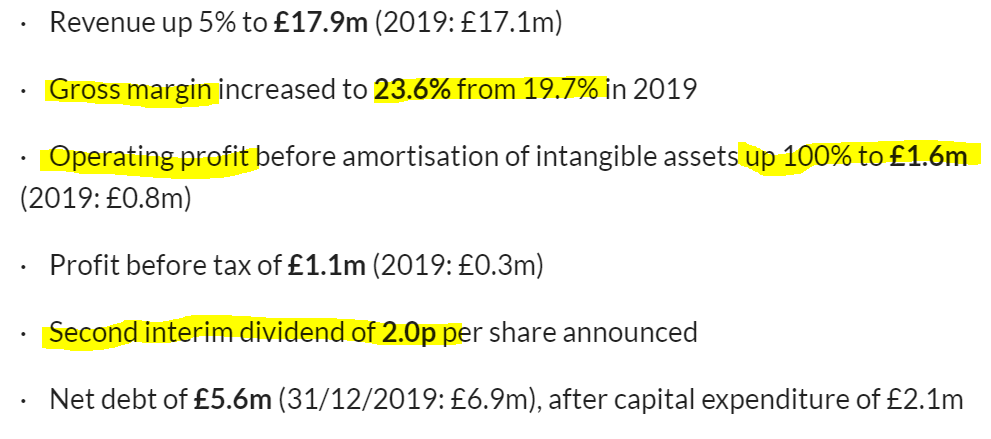
Financial highlights look good (bear in mind that many companies cherry-pick the best figures here, so we need to look at the full numbers also, for the full picture);
.
.
Note the low, but improved gross margin of 23.6% (LY H1: 19.7%)
Similar revenue growth is expected in H2
Operating costs will be "significantly higher" than in 2019
Guidance -
Notwithstanding this increase and subject to any disruption to trading that may arise from the ongoing pandemic, we expect full year earnings to be slightly higher than last year and remain committed to ongoing delivery of our target of 6-8% return on sales*."
That's rather disappointing, given that H1 profits are much higher than last year.
Property - there's surplus property, providing hidden upside potentially, although I don't know what sort of money we're talking here, in terms of disposal proceeds? Do any readers know?
Negotiations are progressing for disposal of parts of the surplus property in Chesterfield. Subject to the necessary planning approvals, we would expect sales to be achieved in the latter part of 2021 or early 2022. The intention of the Group remains, over time, to realise the maximum value from the disposal of surplus properties and to reinvest the proceeds in developing our packaging business.
Doesn't sound like a special dividend is in the offing from property disposals. But it should reduce debt, and allow further expansion of the business.
It's a capital-intensive business, with £2.1m capex in H1. I prefer capital-light business models.
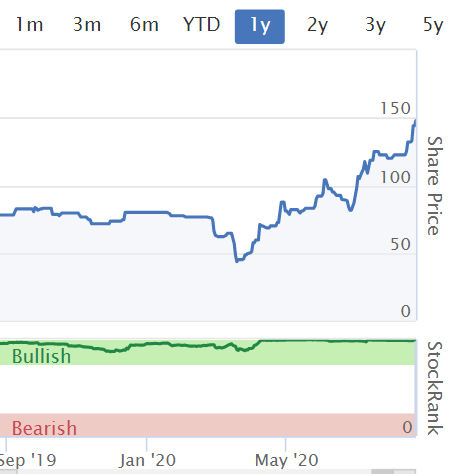
My opinion - shares have done well recently. The key question is how much value is likely to be extracted from freehold property disposals? The packaging business itself looks fairly uninteresting. Shares are very illiquid.
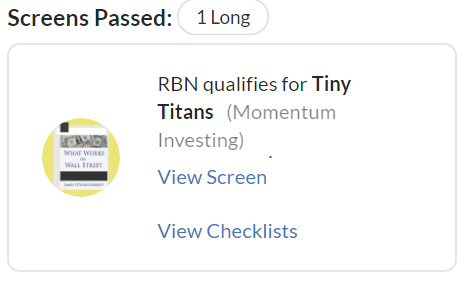
I see that RBN qualifies for the "Tiny Titans" Stockopedia screen (inspired by James O'Shaughnessy), which is an interesting screen that sometimes throws up some good stock ideas, I've noticed in the past. Worth a look (link below);
.
.
.
Sureserve (LON:SUR)
Share price: 47p
No. shares: 159.3m
Market cap: £74.9m
Trading Update: Delivering a strong performance
Sureserve, the compliance and energy services Group, is pleased to provide an update on trading.
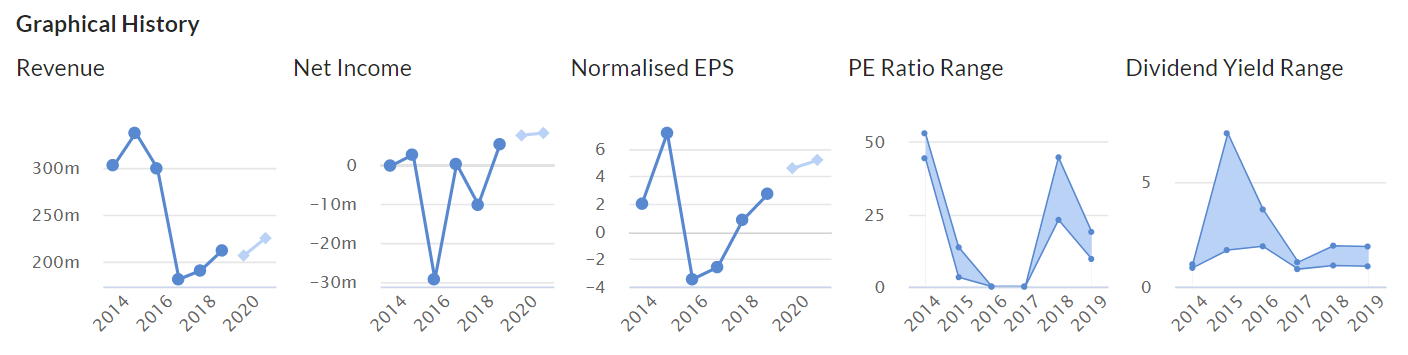
This company used to be called Lakehouse. It floated in 2015, then got into a mess, but seems to be recovering, judging from the improving EPS graph in the middle, below. Its financial year end is 30 Sept 2020.
.
.
I've had a quick look at the most recent interims, 6m to 31 Mar 2020, and those (mainly pre-covid) results look OK. The balance sheet is weakish, with only £2.7m NTAV.
Latest update is reassuring;
Despite the challenging circumstances, our financial performance is strong, demonstrating the resilient nature of the business and the essential nature of much of the work we perform. The Board remains confident that trading for the financial year ended 30 September 2020 will be in line with management's expectations.
Order book - strong. Strengthened bidding team, to win more new business.
Dividends - considering a sustainable dividend policy.
Liquidity - paid off all its borrowings at end July. That's quite impressive, if sustained. Also a £25m RCF facility available. So no concerns here over cash.
My opinion - I don't invest in this sector (contracting businesses), but this is more a maintenance/inspection type business, which is a lot lower risk than building major infrastructure. So I suppose it's really a recurring services type of business.
Overall it looks OK, nothing special. Valuation is reasonable - about 10 times current year earnings, and it's shown resilience during covid. I'm not motivated to buy any, but can't see anything wrong with the share either. There could be upside if it can demonstrate more growth, and higher profits in future.
.
Van Elle Holdings (LON:VANL)
Share price: 36p
No. shares: 106.7m
Market cap: 38.4m
Van Elle Holdings plc, the UK's largest independent ground engineering contractor, announces its results for the year ended 30 April 2020 ('FY2020').
Poor results, even though covid only hit the last 6 weeks of the year, although the company says this is a "critical trading period", and resulted in the loss of about £10m in revenues. Take account of operational gearing, and it stacks up that this would have hurt profit quite badly.
- Underlying PBT has plunged from £4.7m to £(0.9m) loss.
- Placing in April raised £6.3m, at 25p per share, and was material dilution at 33%.
- Q1 (May-July) activity improving, slightly ahead of mgt expectations
- Advanced discussions with lenders re larger borrowing facilities
Balance sheet - quite strong, but top-heavy with lots of fixed assets (£38.6m) - so a capital intensive business. NTAV: £43.7m, which is more than the market cap - indicating that the market currently thinks this business is making inefficient use of its capital.
Outlook -
Whilst the majority of customer sites have safely re-opened and trading for the first quarter of FY2021 was encouraging in the circumstances, the exact trajectory of the wider industry recovery remains uncertain. The Board is mindful that this market uncertainty will likely persist well into the current financial year. However, the Group's customer focused approach and committed investment programmes across several sectors, gives the Board confidence for the Group's prospects over the medium-term.
.
My opinion - on a quick skim of the numbers, I think this looks a potentially interesting recovery share. If it can get back to the level of profits made in 2016-18 (see graph 2 below), then the share price would be a good bit higher than it is now. Although as graph 4 shows, it's never going to be on a high PER, which limits the upside.
.
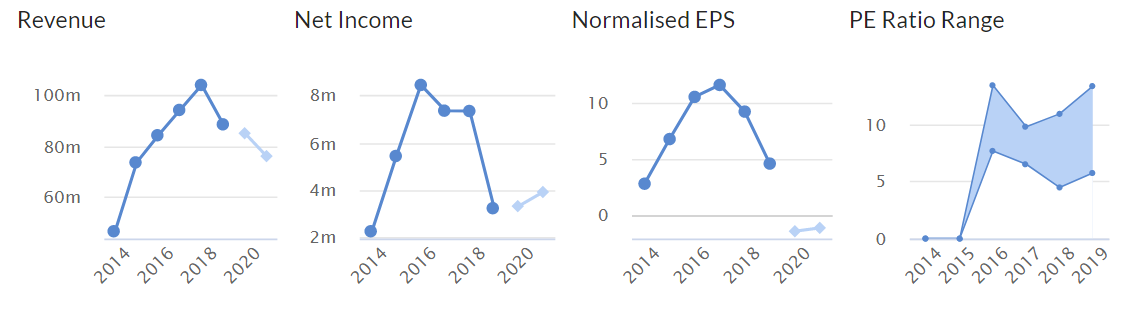
.
Another key positive for me, is the asset backing. That underpins, and limits the downside risk, and banks like lending against assets, as it gives them some level of security. Looking at the 2019 Annual Report, it has £6.2m freehold property (security for bank borrowings).
Overall then, quite an interesting potential recovery share, that looks well underpinned by assets.
.
That's it from me today, and for the week! Thank you for your interesting comments!
Have a great weekend :-)
Best wishes, Paul.
Disclaimer
This is not financial advice. Our content is intended to be used and must be used for information and education purposes only. Please read our disclaimer and terms and conditions to understand our obligations.

36 comments
Revolution Bars (LON:RBG)
Mark Ward has popped up today with a 4% shareholding here. Anyone know who he is?
might be coincidence but there’s a freelance interior designer on LinkedIn with his name and mentioning work done for RBG.
I think the RNS attributed by Stockopedia from Geoservices about seismic survey to SWG is in fact a completely different company in Norway. Nothing to do with SWG. Possibly confused with GeoLang?
A quick question, I have been watching Yellow Cake (LON:YCA) for a while now and looked to pick some up this morning, but Halifax basically said they did not think that the share existed no matter how you searched for it...
Is this adding to the get on with changing platform to Ig Group (LON:IGG) or Hargreaves Lansdown (LON:HL.) ?
Thoughts appreciated...
Tommy
Give them the ISIN code, for yellow cake is JE00BF50RG45.
Try A J Bell. Yellow Cake (LON:YCA) is easy to trade there.
I use IG and was able to find Yellow Cake very quickly in the search function. Trade 3 times in the prior month at £8 a trade then your trades are £3 a trade the next month with IG for share dealing. Not an all singing or all dancing platform but it serves my purposes. (I just find it odd that you can use stop losses on IG for spread bets but not for share holdings.)
Called it up instantly on ii and x-o but, like you, iWeb (part of Halifax) denied it existed
Thx as always , Scotty. Good piece on VANL and it will be interesting to see what difference a new management team (and almost a new Board) makes when comparing past performance and ratings. All companies need decent markets to operate in, but there is a lot of 'self-help' in this one to contribute to growth as well.
Enjoy w/end
On Robinson’s, the AGM presentation has the surplus property at £10m+, which seems a useful amount for a company with a £25m market cap. Intended for future capex, which could be transformative in the hands of a recently refreshed management team. I’m a shareholder.
Continuing my ramblings on house builders and why Persimmon (LON:PSN) may have done so much better than all the rest. It occurs to me that yesterday I committed the cardinal financial sin. I presented balance sheet facts with share price performance facts.... and concluded the correlation was therefore causal. This little trick is what analysts, fund managers, journalists etc etc do everyday, but it is just a trick.
For this blog I realise Redrow (LON:RDW), Crest Nicholson Holdings (LON:CRST) and Springfield Properties (LON:SPR) are potentially of greater interest. However since Persimmon (LON:PSN) has lead the way Im intrigued as to whether we can take a lead from those that follow to push us to allocate more money to the sector. Graeme Neary has been publishing favourable Covid analysis which may encourage you anyway.
In the chart above Taylor Wimpey (LON:TW.) and Bellway (LON:BWY) are pretty much identical. They don't have identical balance sheets. Taylor have £500m of cash - Bellway have a zero balance. Taylor raised money - but relative to Bellway have not been punished.
If I take the Stockopedia 2021 forecasts which is by no means accurate but as a guide... Taylor Wimpey EPS is currently forecast to fall -38% compared to 2019. Bellway -36%. OK, interesting. Redrow -36%, Barratts -32% and Persimmon -16%.
On this crude measure it seems 2021 forecast have played a roll. Paul has been critical of companies non standardised approach to disclosure and this sector is so guilty. In the trading statements you have a variety of period ends and some covering 12 months, others just 6. The degree of help through govt schemes etc is hard to work out.... and there is a range of terrible numbers for 2020. We expect this. 2021 we hope is more normal.
Now its hard to say why Persimmon nos have held up so well, a contribution of factors that include greater analysts confidence no doubt. Never the less if the industry leader is right, then maybe you can expect the earnings of the more risky competitors to follow. So you would expect upgrades to follow. Ironically, financial gearing is your friend in this scenario.
In the two years ending 2019 and 2018 accepting the differences on accounting period end etc which I haven't looked at... Barrats, Redrow and Bellway appeared to do better, with broadly similar outcomes.
As an aside Springfield Properties (LON:SPR) nos are still forecast to rise in 2021 which I assume just means the nos aren't up with events yet. It had the best performance in the years leading up to 2019... and strong growth potential... but be aware the balance sheet risk.
What does all this tell us? On its own not much but you may see something early in one of these stocks. Given they have all lagged and all done broadly similar and have an earnings effect much worse than Persimmon... should one start to move its probably reasonable to expect the others to follow. If one has upgrades following a statement....then maybe.. the others will catch up. You can build your own pecking order or perhaps just follow them to pick the best time to add or start exposure. If you believe 2021 will be ok, then non of the stocks apart from Persimmon reflect this. The larger ones have better balance sheets but a rising tide catches all boats as they say. Its definitely an interesting sector... particularly if we do take an inflationary turn.
RD Howarth
Thank you for your interesting analysis.
It is unclear to me why US Housebuilding has done so well due to very low interest rates whilst UK Housebuilders who also enjoy very low rates have not made much progress. Part of the reason is I think that most of our Banks are being very conservative and insisting on 15% deposits. This requirement does seem rather harsh and should I think only be applied on a case by case basis.
Persimmon does appear to be the sector leader in many ways and certainly leads in terms of the headline ratios including ROCE, Operating Margin and Relative Strength.
Another ratio which I think is important in Housebuilding but isn't quoted so often is the Book Value per Share. The 5 year CAGR Book Value per Share for Persimmon (LON:PSN) is 7.4% whereas for Redrow (LON:RDW) it is 19.2% and for Springfield Properties (LON:SPR) it is 30.2%. This suggests to me that the headline ratios for Persimmon may not be representing the power of compounding that one would expect from this company. This may be partly due to share based payments and was obviously the case in 2017 when excessive payments were made to some directors.
On the question of Springfield I think the increase in EPS forecasts are largely due to the expansionary nature of the company and the large increases in debt and share capital that have been recently applied.
You also mention Crest Nicholson Holdings (LON:CRST) which also appears to exhibit good value. Although the Investors Chronicle tipped it as a Sell yesterday I believe that its recent fall has been disproportionate to the facts.
I think all the Housebuilders mentioned are certainly worthy of further investigation. I think the main question to consider is at what point does the new business cycle begin in earnest?
Hi Paul,
Thanks for your report today, great as usual!
Just one question: given the apparent fundraising ahead for Sosandar (LON:SOS), and dilution of around 10%, is it not better to buy (for somebody who doesn't hold now) at that time? Or am I wrong by some silly simple miscalcs?
Anybody's comments and thoughts are appreciated.
Cheers.
Hi symt, great question but alas one for which there is no right or wrong answer.
Firstly, it depends on what price they manage to raise the money at. Will it be a discount to the prevailing SP or the same price or a premium?
Secondly, will the market respond positively or negatively immediately after the raise. Variables include the amount raised, the market's perception as to how long this fresh capital will last, director and existing shareholder participation and perceived 'quality' of new investors.
Thirdly, what might happen to the SP following the raise. There are many instances of share-prices racing up and many where the sp ends up falling below the raise price. £TW currently trades well below their recent raise and Sig (LON:SHI) also fell well below the 30p raise before recovering. Marlowe (LON:MRL) by contrast raced well above their recent raise. (Disclosure: I hold all three).
Cheers
Francis
Hi
An interesting piece on the Ocado (LON:OCDO) and Marks And Spencer (LON:MKS) joining up. Also offers an insight into the retail landscape.
https://www.hl.co.uk/news/2020/8/21/m-and-s-puts-all-its-eggs-in-ocados-basket?cid=halDM136921&bid=554823738&e_cti=2135170&e_ct=T&utm_source=AdobeCampaign&utm_medium=email&utm_campaign=EONRM_Daily%20Newsroom_Opt%20in_21.08.20&theSource=EONRM&Override=1
Regards
Howard
Paul, Thanks for your update on Sosandar (LON:SOS) it is very helpful
Andyin
Had lunch yesterday at a Gaucho steakhouse in Richmond and was absolutely amazed to see how busy it was. By 1.30 pm every available table had been taken and the Manager told me business had been “mental” since the beginning of August. Obviously yesterday was outside the £10 off scheme but that certainly had not deterred anyway from eating there. The Manager added that there had not been any really quiet days in the last few weeks and forward bookings were encouraging.
My hunch is that people are far less reluctant to socialise in bars and restaurants etc than lots of people imagined. I was in the City on Wednesday evening and a number of places were getting pretty busy there too. We got turned away from one large bar as all tables were full. Pub was busy and even a small high end restaurant/wine bar had a good number of people in it. More locally to me all the restaurants and pubs are busy all week now. My suspicion is that this probably bodes well for the likes of Revolution Bars (LON:RBG) but also for pub portfolios and even the likes of Newriver Reit (LON:NRR)
I also noticed in a recent video interview from Immotion (LON:IMMO) (where I am long on the recovery) that they have said that their attractions are almost back to pre-covid levels of attendance and of course many of them are set in theme parks and aquariums, so that was interesting. You'd imagine people might get put off by wearing/sharing the VR headsets but with the cleaning Immotion (LON:IMMO) have done it appears not. I ponder over whether that has positive read across to the likes of Ten Entertainment (LON:TEG) where people have assumed demand will be restricted due to concerns over sharing balls but given the current evidence of behaviour quite possibly not. I might have a look at taking a medium position on Ten Entertainment (LON:TEG)
Hi davidjhill,
I particularly like the bowling alley shares, and hold both Ten Entertainment (LON:TEG) and Hollywood Bowl (LON:BOWL) - the reason I like them, is that they're financially secure, have re-opened, and the share prices are still so bombed out - thus providing good potential upside.
In both cases, they seem to have sensible policies in place re social distancing, hygiene, etc. Bowling alleys are large sites, not like a cramped pub or restaurant, so it stands to reason that virus transmission risk would probably be lower. They're disinfecting the bowling balls after use, and personally I would take some latex gloves with me, to use whilst handling the balls, then throw away.
Markets (especially in America) seem to be assuming a virus/treatment is only months away. Yet some UK small caps seem to be assuming perpetual crisis. They can't both be right! I'd rather buy cheap stuff where recovery potential is being ignored, so may increase my bowling alley holdings. People have to book in advance, therefore there's a greater potential for business to be spread more evenly across the week, as they cannot have over-crowded peak trading any more.
I suspect consumer behaviour may be changing - recognising that leisure activities now have to be booked, rather than walking in. Hence to get a limited availability slot, nights out/events/dining out need to be planned in advance, and sometimes happen on days/times when you wouldn't have previously gone out.
I'm less attracted to investing in pubs or restaurants, because social distancing is more difficult, unless the valuation is so cheap that the share is offering a potential multibagger once normality returns (e.g. Revolution Bars (LON:RBG) ). I've also bought a few Loungers (LON:LGRS) recently, but only a tiny position size.
It'll be interesting to see how this pans out. I always keep in mind that human ingenuity & technology/innovations, means that we overcome all crises in some way, eventually. Either fixing things, or finding a work around. CV19 is likely to be the same. After all, all other human pandemics have been overcome, since the beginning of time, otherwise none of us would be here!
Regards, Paul.
I suspect consumer behaviour may be changing - recognising that leisure activities now have to be booked, rather than walking in.
Interesting thought. On reflection, I probably agree this could be a lasting COVID impact. Technology is making booking ever easier but also gives businesses more scope and ability to exercise flex pricing and efect price discrimination to boost margins if/when socially distanced capacity is reached. Dynamic pricing systems used to be the preserve of airlines; now almost anyone can afford the IT, certainly national bowling chains. Limited availability always = opportunity to price up modestly - a mix change that goes straight to the bottom line. Pre-booking means making your personalised pricing decision before you leave home.
When the good weather inevitably breaks (and we have had 6months of almost unrelenting good weather here in Portsmouth!) all those patient people/families queuing or eating/drinking outside will want to go inside for some warm, relatively cheap leisure. With everyone binging on TV/netflix at home, cinema is less exciting with few new releases and many people with more time due to less commuting. I think bowling will do very well.
There's something that makes me nervous about Ten Entertainment (LON:TEG). They announced on 26 Jun that the CEO had decided to resign. And then buried at the bottom of the announcement was a small paragraph saying: "The Board wishes to place on record its gratitude to its Senior Non-Executive Director, David Wild, for his time on the Board over the past 3 years. He has notified the Board of his decision to resign from the Company with immediate effect." The fact that there was no further detail given, and that the timing of the announcement during the Covid pandemic was to my mind less than ideal, makes me wonder if they know something that outsiders don't. I had been tempted to invest for recovery, but I take the view that TEG is presently a hot potato!
"....After all, all other human pandemics have been overcome, since the beginning of time, otherwise none of us would be here!"
The worst of the bubonic plague outbreaks (such as that which arrived in England in 1348) wiped out half the affected populations.
We are fortunate to live in modern times.
Thanks Paul - I tend to agree. Only two things put my off the bowling sector
1) Management say they are easy spaces to social distance yet the Government kept them closed right until last so do they not agree and if so why not?
2) The mandatory face coverings effect
Before I buy any shares I am tempted to book a lane for a couple of games and see how busy they appear to be. It would, of course, be a little more helpful if I knew what the pre covid looked like so I had a comparison so maybe my logic is flawed there.
Ten Entertainment (LON:TEG)
I ponder over whether that has positive read across to the likes of Ten Entertainment (LON:TEG) where people have assumed demand will be restricted due to concerns over sharing balls but given the current evidence of behaviour quite possibly not. I might have a look at taking a medium position on Ten Entertainment (LON:TEG)
I own teg but i am thinking they are in a much weaker position than bars and restaurants at the moment due to the fact that it is mandatory to wear facemasks - its all supposition on my part but i am guessing trading will be very weak until such time as mandatory facemasking (is that a real word?) is ditched - unfortunately i don't see the goverment ditching the mandatory facemask rules anytime soon.
hi rmillaree
Yes, the face coverings bit bothered me a little too, mainly because I dislike wearing them intensely. However, so many people seem less fazed so I wonder if I'm an outlier.
Hi
For those interested the latest survey coving social impacts. A few interesting stats might interest some.
https://www.ons.gov.uk/peoplepopulationandcommunity/healthandsocialcare/healthandwellbeing/bulletins/coronavirusandthesocialimpactsongreatbritain/21august2020
Regards
Howard
Hi Caper4,
Thanks for this anecdotal evidence, which seems to tie in with something I read to the effect that the £ 10 scheme has perhaps almost become superfluous , with businesses reporting LFL turnover was actually ahead of last year's comparatives...
Can this be...and if so, how ? It has to be more than just 'Eat, drink and be merry...' ?
My nephew, who works for a FTSE-100 company shares that the outside caterers it uses are using the scheme in the staff canteen.
No doubt there's a lot of 'creative' working the system going on !
ATB
Thanks for this anecdotal evidence, which seems to tie in with something I read to the effect that the £ 10 scheme has perhaps almost become superfluous
This is only the case if you think about the scheme in a very short sighted way. Unlike the short sighted perspective of the restaurant, the government is only interested in the bigger picture as to what that £10 really buys - it's Keynesian economics using the Multiplier Effect.
From what a friend who has a PhD in Economics told me, once that £10 ripples through the economy it is worth more like £80-90 of stimulus. Hopefully, there is a trained economist in the house! My only knowledge of the multiplier effect comes from a brief discussion during a walk...
All the best, Si
Si, my understanding is that the multiplier you quote is more appropriate for a closed economy. For an open economy, as the UK's is now, part of the effect seeps abroad (through value going to foreign owners, manufacturers, labour and providers of services) so whilst a high rate might apply globally, for the UK itself, the effect is diluted.
pj8,
Thanks! That's interesting and obvious with hindsight. I have no economic training whatsoever, not even an O level. Perhaps it's something I should get more interested in but my preference is for behavioural economics.
All the best, Si
I once spent a while creating a load of jobs abroad in another English speaking country. In tax discussions with the Government officials there they valued my £ at roughly 2.5* In other words for every £30k job I put on the ground they estimated a ripple effect of £75k+ through the economy. They were therefore very happy to offer generous tax breaks to win my business. This is a similar effect on a bigger scale.
Interesting point about the ripple effect of the stimulus Si, there are certainly many ways that you can see this can flow through to further output, but I would say it takes a massive amount of guesswork to identify the scale.
When I used to have a lot to do with economists it was always seen that the best way to stimulate the economy was to put cash in the pockets of the lowest paid as they were most likely to spend it and create the ripple. As things stand though many would be more likely to do some frivolous like pay the rent to avoid eviction.
This I think one of the challenges at the moment as there is quite a gulf between 'winners' (still in a job and probably with pent up savings from the lockdown period) and 'losers' (lost job and financially challenged across the board). Whilst we currently seem to be getting quite a lot of stimulus from the winners, unless tackled the losers could put quite a drag of the 'v-shaped' recovery over the next year plus.
"...once that £10 ripples through the economy it is worth more like £80-90 of stimulus"
I think that might be a misunderstanding. If £x of stimulus generates another 8 or 9 times £x of stimulus, then you would pretty soon have an economy approaching infinite value, even if that stimulus did very little.
The fiscal multiplier is often discussed in terms of £a of stimulus being worth £b in value of increased GDP, which I think is what you were referring to. The mutiplier is b/a. But estimates of that "multiplier" are typically much lower than 8 or 9. Proponents of govt spending might claim a multiplier of 2, but not 8 or 9. Perhaps your friend was saying that the initial £10 is re-spent 8 or 9 times? That's a related but different question.
The actual value of the multiplier is very much dependent on the context and the method in which the initial stimulus is applied. If the economy is flat on its back and the stimulus is well targeted, which might well be the case with this £10, then the mutiplier will be high. If the economy is roaring along and the "stimulus" is tax cuts for the wealthy (who will have a low "marginal propensity to consume"), then it's likely to have a multiplier of less than 1.
I think that might be a misunderstanding. If £x of stimulus generates another 8 or 9 times £x of stimulus, then you would pretty soon have an economy approaching infinite value, even if that stimulus did very little.
The fiscal multiplier is often discussed in terms of £a of stimulus being worth £b in value of increased GDP, which I think is what you were referring to. The mutiplier is b/a. But estimates of that "multiplier" are typically much lower than 8 or 9. Proponents of govt spending might claim a multiplier of 2, but not 8 or 9. Perhaps your friend was saying that the initial £10 is re-spent 8 or 9 times? That's a related but different question.
Hi cmpeckham,
Thanks for the economics lesson. I think you'e correct and I have misremembered what he was saying (it was a few months ago) and that the 8 or 9 factor was the number of times the original £10 is recycled within the economy, not a direct multiplier. At least I remembered the basic principle!
Personally, I'm more interested in the behavioural economics of the £10 EOTHO offer. Virtually everyone I know that has used it has had something extra (another course, more expensive bottle of wine, and even a £10 cocktail!) they would not otherwise have consumed without the £10 offer. And of course when it comes to alcohol, this is where the restaurant really makes their margin. This was entirely predictable to a behavioural economist and even the friends I explained the power of the "free £10" to, and who could not understand why the government had done such a "silly" thing, have succumbed when they have used the scheme.
EOTHO is an incredibly powerful "nudge".
All the best, Si
My morning smallcap tweet:
Silence Therapeutics (LON:SLN) Tiziana Life Sciences (LON:TILS) Eddie Stobart Logistics (LON:ESL) Omega Diagnostics (LON:ODX) SIMEC Atlantis Energy (LON:SAE) Manx Financial (LON:MFX) 600 (LON:SIXH) Holders Technology (LON:HDT), GYG (LON:GYG)
Silence Therapeutics (SLN) takes a step towards listing ADSs on NASDAQ. [SP=461 Cap=382m]
Tiziana Life Sciences (TILS) gets US patent for use of Milciclib in combination with tyrosine kinase inhibitors such as Sorafenib for the treatment of hepatocellular carcinoma (TILS) and other cancers in humans. [SP=157 Cap=299m]
Eddie Stobart Logistics (ESL) its 49% indirectly owned associate GreenWhiteStar wins 3 year contract to provide transportation services from two Morrisons distribution centres. [SP=7.6 Cap=29m]
Omega Diagnostics (ODX) gets Prequalification for VISITECT CD4 Advanced Disease test, the only currently available handheld lateral flow point-of-care test for identifying patients with advanced HIV. Allows allowed PEPFAR and UN agencies to get the test incorporated into their budgets for 2021 [SP=58 Cap=103m]
SIMEC Atlantis Energy (SAE) gets 'agreement' up to £170m loan to fund 100% of Phase 1 (110MW) of the Uskmouth conversion project. "This agreement is not legally binding save as to a 6 month period of exclusivity, which may be further extended by mutual agreement and is subject to borrower rights of termination including ongoing assurances regarding the ability of both parties to deliver against the terms. The framework agreement is intended to be replaced by full form loan documents prior to financial close." [SP=17.99 Cap=88m]
Manx Financial Group (MFX) Conister and CFL have been selected to provide Government-backed funding to assist SMEs [SP=8.25 Cap=11m]
600 Group (SIXH) gets £1.2m covid loan. Order backlog has returned to acceptable level, 15% down YoY. FY accounts delayed by up to 3 months, to Dec. [SP=8.1 Cap=10m]
Holders Technology (HDT) H1 rev down 10% as guided, EPS -2.13p (+1.17p). "Board considers the result for the first half to be acceptable...Encouraged by recent improvements in some divisions, both in quotations and order intake, as compared to the first half but cannot be certain that this will follow through to the end of the year." [SP=42.5 Cap=2m]
In line: GYG (LON:GYG)
Great update. Thank you