Small Cap Value Report (Fri 25 Mar 2022) - Webinars, WIX, EMAN, STAF, PEBB

Good morning! It's just Paul here today, I think, not certain, can't remember, it's too early. Correction: Roland is joining me today, so we've decided to do some catch up reviews from earlier in the week, as there's not much news today in small caps. We'll get cracking, and there will be a full report up by noon (EDIT: make that c. 13:30!). Today's report is now finished.
Agenda -
Paul's Section:
Brief comments on some interesting recent webinars.
Staffline (LON:STAF) - results for 2021 are a whisker ahead of guidance given in Jan 2022, so no surprises there. Positive outlook. Balance sheet problem debt has been fixed with a placing last year. It's a very low margin business, but there could be a decent trade here, if you think it can beat guidance for 2022. My sector picks would be much higher quality, and reasonably priced Robert Walters (LON:RWA) and Sthree (LON:STEM) for the longer term, although STAF could be an interesting shorter term trade, possibly?
Pebble (LON:PEBB) - 2021 results were published on Tuesday, and are rather good - profit now exceeding pre-pandemic levels. Balance sheet is fine. Cashflow isn't great, with profit being flattered by capitalising development spend. Nevertheless, I think this could be an interesting growth company for subscribers to research further.
Roland’s section:
Wickes (LON:WIX) - 2021 results from this home improvement group show continued growth last year. But sales fell during the second half and one-off factors relating to Covid and the group’s separation from Travis Perkins (LON:TPK) are still distorting the results.
Everyman Media (LON:EMAN) - operating metrics suggest this premium cinema group is enjoying a strong recovery and could return to 2019 levels. But I think a lot of the good news is already in the price. I’d want to see concrete evidence of returning profitability before considering a purchase.
Explanatory notes -
A quick reminder that we don’t recommend any stocks. We aim to review trading updates & results of the day and offer our opinions on them as possible candidates for further research if they interest you. Our opinions will sometimes turn out to be right, and sometimes wrong, because it's anybody's guess what direction market sentiment will take & nobody can predict the future with certainty. We are analysing the company fundamentals, not trying to predict market sentiment.
We stick to companies that have issued news on the day, with market caps up to about £700m. We avoid the smallest, and most speculative companies, and also avoid a few specialist sectors (e.g. natural resources, pharma/biotech).
A key assumption is that readers DYOR (do your own research), and make your own investment decisions. Reader comments are welcomed - please be civil, rational, and include the company name/ticker, otherwise people won't necessarily know what company you are referring to.
Paul's Section:
Webinars
I'm delighted that many companies are now doing webinars for private investors online, as a matter of course. This has been such a good innovation, stimulated by the pandemic of course. I can't remember the last time I went into London for a company meeting, which essentially took up the whole day, if I had to travel up from Bournemouth. Although I tended to bunch meetings together, and stay up in London for a few weeks (I've got a permanent base in London, which is handy, but more for social purposes these days).
Online meetings have been very useful recently, including -
Beeks Financial Cloud (LON:BKS) (I hold) - it's well worth watching the recording on InvestorMeetCompany (IMC) from yesterday. I'm super-bullish on the long term potential for this business, because big contracts are now rolling in rapidly (most recent quarter was 3* previous record quarter for order intake). Management are very open, including freely admitting "our balance sheet needs strengthening, that's fairly obvious", but they're also considering other options for improving financing, including putting larger contracts onto annual up-front payment (instead of monthly), and asset financing for capex. They have strongly supportive institutions, so a placing would be a doddle, I reckon, hence should not be an impediment to investing. After pondering things, I must admit to buying some more BKS shares a couple of hours after the webinar, which can be a mistake sometimes, after reaching peak bullishness due to a good webinar! Sometimes a cooling off period is a good idea.
It's also obvious from management answers to Q&A that they think forecasts should be beatable (so we should expect upgrades in 2022), and mgt sees "a massive amount of growth potential".
The market cap is already up to £93m, so how much further it can go in the short term, in this bear market for small caps & growth stocks, I don't know. It's the long-term that interests me, where I agree with the CEO that it should be worth "multiples" of the current price, whilst admitting "I'm biased!"
I have to sheepishly admit, that I only partially understand the different services Beeks offers. Some of the technical detail in the presentation left me floundering a little, so will have to watch it again over the weekend.
Hostmore (LON:MORE) (I hold) - this is another good webinar recorded on IMC, from 14 March. I've watched it twice now, and cannot believe how low the market cap has sunk. It seems extraordinarily cheap for a self-funded roll-out of 3 brands. Although in a tighter consumer market, I do think the company needs to reduce its pricing. Value for money, the product is not. However, the worrying thing is that management seem to think everything is great. Maybe there's a bit too much focus on gross margin, which can damage a business longer term.
However, listening again to the webinar yesterday, the business is really on the front foot, and they have so many growth initiatives underway, that this looks a long-term winner to me. In the meantime though, the market doesn't like it, and seems to be pricing in a profit warning already.
Interestingly, the CFO indicated that 80% of the shares are held by the top 20 institutions, who are (all but one) firm holders, and highly supportive. He said the selling is coming from small shareholders. At some point obviously the selling will be finished, then the shares should re-rate. When that happens, no idea. As a 2-year hold though, I think it's stunningly cheap, but we can't discount a rough patch in 2022 due to squeezed incomes - although I think the press coverage of this is a little OTT. Next (LON:NXT) confirmed that yesterday, in its guidance, actually raising 2022 prospects for UK sales (but offset for them by loss of Russia/Ukraine business).
Portmeirion (LON:PMP) - I haven't looked at his one yet, but is on the list of recordings on IMC. Energy costs make me a bit wary, but possibly they're hedged, I can't remember? The company is doing a lot of self-help things, and has so far been a very good turnaround, so energy costs might not be a longer term issue. I was talking to oil & gas sector experts earlier this week, who are selling their investments into current strength, saying that the current price is just a spike, and higher production is likely to cause a glut of oil & gas in the not-too-distant future. Especially as politicians have finally woken up to the reality that energy security is actually rather important, and becoming dependent on cheap Russian gas was an incredibly stupid policy from Germany and others.
Virgin Wines Uk (LON:VINO) - quite a good webinar, again on IMC, I thought. Although growth is now quite pedestrian, and wine subscription services are competitive. The share price has lost its fizz, on what was (like so many others) an opportunistic float on unsustainable lockdown growth. The business looks OK, and the valuation could even now be a bit too high, so the webinar didn't tempt me to buy any.
Headlam (LON:HEAD) (I hold) - I've bought back into this, with the webinar from PIWorld reinforcing my view on the impressive results for FY 12/2021. In particular, cash is booming, so a special divi & buybacks are helping to support the share price. This carpet distributor has pricing power, so confirmed it is passing on higher input costs (a key thing right now). Also, a comprehensive turnaround strategy, is improving margins, and opening up the potential for growth (e.g. rolling out successful strategy to grow sales counters - small branches, focusing on winning contracts with larger retailers which had been ignored in the past).
So combined with a modest valuation, I decided to buy back into Headlam. A key point for me right now, is that companies need to be improving their operations in a way which more than offsets the inflationary pressures, and the risk of reduced demand. I don't want to be buying (or holding) anything where investors are just hoping the company copes with macro pressures - they're the ones most likely to warn on profits. The trouble is, the market punishes under-performance twice - firstly by de-rating the share heavily in anticipation of a profit warning, then a second time with a further plunge on the day of the profit warning.
I made a terrible mistake, deciding to look through supply chain issues as temporary. I should have just sold all my consumer discretionary shares last autumn, with hindsight. Anyway, as mentioned yesterday, the damage is done now & can't be undone, and valuations in many cases are now so low, that the upside looks greater than the risk of short-term weakness.
Next (LON:NXT) / Macro - from my recent discussions with a number of shrewd & highly successful investors, the mood seems to be turning, in that market & media gloom is starting to look overdone, possibly. There were some superb reader comments in yesterday's report here I thought, making similar points - keep them coming! I'm part-way through reading the recent results from Next (LON:NXT) which has such a good commentary, as always. They're surprisingly upbeat about the UK. Its commentary obviously mentions all the negatives that we know about, but also points out that wage inflation is +4.8%, and that UK employment is high, partially offsetting a lot of the negatives. So maybe the market could be approaching peak macro gloom? Who knows, as always.
Saga (LON:SAGA) (I hold) - another interesting one, there is a webinar on IMC today at 10:30, so I'll down tools for that.
Many thanks to the subscriber who pointed out the slide deck and results video on SAGA's website here. Again, I'm part way through that, the sunshine coaxed me away from my computer yesterday! There are a lot of moving parts in SAGA's numbers, but the core point is to reverse the heavy losses from the travel division, into profits in future years, and it's then obvious that the group should be decently profitable and able to de-gear. So a 2-year picture, but at some point the market is likely to anticipate that, once the fog has cleared with current worries.
There are loads more webinars available, but these are the ones which I found most interesting.
Staffline (LON:STAF)
64p - market cap £106m
Circling back to results from this staffing group, which were issued on Tuesday earlier this week. It also put out 2 contract win announcements separately, so they obviously are keen to get the share price moving up!
There was also a recent boost from Small Company Share Watch (SCSW) - a very good tip sheet with an excellent long-term track record, which featured Staffline. Although that can be a mixed blessing, as it often pulls in punters with a very short attention span, causing short-term spikes up in share price.
Customer Win - no financial details are provided, but STAF says it has signed a long-term contract to supply staff to BMW Group (BMW, Mini, and Rolls-Royce) in the UK. BMW is expected to become a top 5 customer. STAF expects the automotive sector to return to pre-pandemic levels of production in H2 2022 - interesting read across there for the car dealers?
My opinion - obviously a positive for STAF, but remember that STAF makes miniscule margins, and I imagine BMW would drive a hard bargain due to the prestige of suppliers being associated with it. Hence a nice to have type of announcement, rather than a game changer. Also remember that companies tend to announce new customers, but don’t usually announce customer losses, unless they’re material to profits, when they have to!
Contract Win - a separate RNS, to maximise the impact?
It’s a 5-year extension of an existing contract with VINCI Construction, to provide temps, through Staffline’s subsidiary called Datum.
STAF says this “points to encouraging signs of recovery in the construction industry, historically a strong sector for Datum”.
My opinion - again, no financial details are provided, so I assume this contract is again a nice to have, rather than material to future profits.
Moving on to the main announcement, it’s results for FY 12/2021. These were preceded by a strong trading update in late Jan 2022, which I reviewed here, being impressed with the turnaround back into profits (doubled in 2021 vs prior year), and with a much better balance sheet - with almost terminal levels of debt having reversed into a net cash position by end 2021, thanks to a bail out from shareholders with an equity fundraising in June 2021.
Plus the business was only able to get through the pandemic thanks to a flexible bank, and a big deferral of VAT. Still, that’s history now, and the business is now much more stable, and adequately financed.
Staffline Group plc, the recruitment and training group, announces its audited results for the year ended 31 December 2021.
Strong performance across FY 2021, exceeding market guidance
It has slightly exceeded market guidance, to be more accurate!
Actual underlying operating profit is £10.3m (up 115% on LY), guidance was £10.0m
Net cash of £6.9m is exactly the same as guidance in Jan 2022.
Very low margin - note the gross profit margin is only 8.8%, remember that is before STAF’s own costs. So gross profit of £82.8m on large revenues of £942.7m. The revenues are mainly pass-through, being mostly the wages of the temps that STAF supplies. It’s just not a very good business model - working hard, for wafer thin profit margins - what’s the point?! This type of business model leaves no scope for things going wrong, as we’ve seen in the past, with near-death experiences.
Gross profit per fee earner (salesperson) seem very low to me (below). Recruitment consultants should be earning fees well into 6-figures, not just £71.5k, to pay themselves a decent salary/bonus, and leave something left to cover overheads, and some profit for the company. I reckon STAF’s low figures here (although better in Ireland) would mean that the best staff are likely to leave, to earn more elsewhere -
· Significant productivity gains have been achieved as a result of a new focus on incentivisation
o Recruitment GB: gross profit per fee earner up 14.6% to £71.5k (2020: £62.4k)
o Recruitment Ireland: gross profit per fee earner up 2.2% to £111.5k (2020: £109.1k)
o PeoplePlus: revenue per employee up 18.3% to £62.6k (2020: £52.9k)
Outlook - sounds encouraging -
Current Trading and Outlook
· The Group has an encouraging pipeline of opportunities emerging across traditionally strong sectors such as automotive and travel as the UK economy continues its recovery from the Covid-19 pandemic
· The Group has today announced a major contract win with BMW and a material extension with Vinci an existing customer, demonstrating Staffline's scale, reach and its capacity for increasing market share
· Whilst macroeconomic uncertainty has increased, the Group's strong market share in resilient sectors such as food distribution, logistics and on-line sectors provides good visibility of revenues
· Overall, the Board of Directors is confident that Staffline has the operational and financial foundations in place to deliver sustainable growth
· We have made a strong start to 2022 and are confident in meeting our expectations for the full year
Valuation - I think it’s self-evident that STAF is a poor quality business - because it only ekes out an absolutely tiny profit margin, for doing a lot of work, essentially managing part of the workforce on an outsourced basis, for its clients.
It also has a chequered past, with lots of problems, bad acquisitions, and an apparently competent previous CEO who cashed out for multi-millions shortly before the whole can of worms was revealed.
Still, we’re investing in the future, not the past, and STAF has managed to survive, and emerge from the pandemic in better shape under new management. It’s profitable again, and has reasonably sound finances, with debt no longer a problem.
So I can see that there is a bull case here, for potentially further recovery in share price. Also, staffing is a good sector to be in right now, with full employment, and upward pressure on wages due to skills shortages. Candidate shortages might allow staffing companies with good quality available workers to boost their margins.
Personally, as mentioned before, I think Sthree (LON:STEM) and Robert Walters (LON:RWA) seem much higher quality businesses, and are currently only rated at PERs of about 11. Why anyone would buy STAF in preference to those, I don’t know. Well, maybe people are looking at STAF more as a recovery trade, which does have some logic, and not as a long-term hold? It’s sometimes easier for a poor quality business making almost nothing in profit margin, to double profits, than it is for a high quality business that’s already maximised profit margin to double its profits.
Overall - if you think STAF is likely to beat forecasts in 2022, then it could be an interesting trade. The business seems to be on the mend, so I can see why some people might like to have a punt on this share. It’s definitely not something I would want to own long-term though.
Bear in mind the shareholder register - an Asian staffing group took a 14.5% stake in STAF a while back, and there was talk of a takeover bid. Maybe that could give a profitable outcome for small shareholders? A recent major shareholder also topped up its position.
.
.
Pebble (LON:PEBB)
103p - market cap £172m
Don’t confuse this share with Pebble Beach Systems (LON:PEB) which is a completely different company.
This share caught my eye on Tuesday (22 March) when it shot up 20% on publication of final results for FY 12/2021.
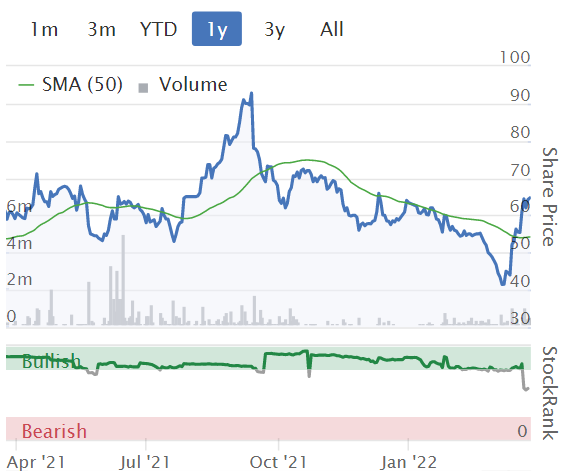
Although zooming out on the chart to a year, it’s barely a blip in a downtrend, and it looks thinly traded too, judging from the volume bars (a nice recent addition to the standard charts) -

.
We’ve covered Pebble here a few times, but I’ve never fully understood what the company does. That the shares always looked expensive, didn’t motivate me to dig any deeper. It’s something to do with promotional goods.
Financial highlights table (below) - shows impressive results for 2021 - now well ahead of pre-pandemic levels of adjusted profit.
Adjustments boost profit in 2021 by 17% compared with statutory profit (and 22% last year). Note the biggest adjustments occurred in 2019, pre-pandemic (relating to the IPO).
The PER is 103p (share price) divided by 5.14p adj EPS = 20.0 times - quite a punchy rating in a very nervous market, for a cyclical business.

These are the two divisions -
Facilisgroup - a small, but highly profitable part of the business, making a remarkable £5.1m operating profit on just £12.7m (nearly all recurring). It’s a SaaS business based in the USA. This looks very interesting. It provides eCommerce software, and the strategy is to accelerate growth - which could be very interesting on such high margins. There was a heavy loss in 2019 though, which would need investigation before buying any shares. It sounds like a better version of Altitude (LON:ALT)
Brand Addition - revenue of £102.4m in 2021, now back above pre-pandemic levels, and operating profit of £7.1m. Again, in promotional products market -
Working in close collaboration with its clients, Brand Addition designs products and product ranges, hosts client-branded ecommerce platforms, and provides international sourcing and distribution solutions…
Our client retention has been high and new contracts won in 2021 will positively impact 2022. Additional sales opportunities also remain from those clients that have not yet returned to pre-COVID-19 levels.
Supply chain - problems have been “controlled & minimised”.
Outlook - I can't get this format right, but here it is, in italics -
The new financial year has started well and in line with our expectations and the Group Board looks forward to the year ahead and beyond with confidence.
- At Facilisgroup, year to date at 18 March 2022, Gross Merchandise Value ("GMV") was up 57% year on year with Partners implemented or contracted awaiting implementation totalling 211 | |
- At Brand Addition, year to date at 18 March 2022, the order intake has been positive and sales invoiced or received to be invoiced was up 11% year on year. The supply chain continues to be well controlled |
Balance Sheet - looks OK. NTAV is £18.9m, which looks healthy, for the size and type of business. It has £12.1m in cash, with no interest-bearing debt, so that’s fine.
The only item which jumps out at me is receivables seem a little high at £29.4m compared with £115.1m revenues - so customers don’t seem to be in much of a hurry to pay invoices, which can sometimes indicate underlying problems.
Cashflow statement - not great actually. The problem is £4.6m capitalised intangible assets (see note 7 - this is mostly “software & development costs”) (£4.9m last year), which together with lease & interest payments, consumes most of the operating cashflow.
So I think profit numbers are flattered by capitalising development costs, with free cashflow being a lot less than profit.
My opinion - I was expecting to find this share uninteresting. However, we always try to look at companies with an open mind here at the SCVR, and I have to say these results look quite impressive.
Facilisgroup in particular looks potentially exciting, if it can accelerate growth meaningfully, which is the plan. Although the massive profit margin is helped considerably by capitalising development spend onto the balance sheet at a rate which is higher than the amortisation charge.
Based on a quick skim of the numbers, I think this share might be worth readers taking a closer look at, to better understand the group and its prospects. My view is neutral at the moment, because I haven’t done enough work on it, but decent results & positive outlook strike me as a good starting point.
I also like that the share price has fallen heavily in the general market sell-off, which makes a new purchase more attractively priced.
Our friends at PIWorld published a 30 minute results presentation from PEBB here.
.
Roland's Section:
Wickes (LON:WIX)
Share price: 185p (+8% at 08.15)
Shares in issue: 259.6m
Market cap: £448m
“Trade customer order books at record levels”
Home improvement group Wickes was spun out of builders merchant Travis Perkins (LON:TPK) in April 2021. The group serves three customer segments; local trade, do-it-for-me and DIY. Today’s results cover the 53 weeks to 1 January 2022.
The pandemic triggered a huge surge in home improvement activity. Some of this may have been additional work driven by lockdown living, but much of it is likely to have been demand pulled forward.
This implies that we could now see a slump in activity as consumers direct their surplus cash into sectors that were shutdown during the pandemic, such as leisure and travel. Today’s results from Wickes suggest this may be happening to some extent, but the numbers still look quite strong to me.
Financial highlights
Wickes has only been an independent business for 11 months. So we don’t have a long track record of RNS reporting to look at. However, the demerger prospectus includes accounts from 2018-2020, so I have been able to go back and look at comparative figures from before the pandemic.
Today’s results show that 2021 trading was substantially ahead of both 2020 and 2019.
- Revenue: +14% to £1,534.9m (2020: £1,346.9m, 2019: £1,292.4m)
- Like-for-like sales up 13% on 2020 and 18.6% on 2019
- Gross margin: 37% (2020: 37.8%, 2019: 38.8%)
- Adjusted operating profit: +42.5% to £116.3m (2020: £81.6m, 2019: £95.8m)
- Adjusted operating margin: 7.6% (2020: 6.1%, 2019: 7.4%)
- Pre-tax profit: £65.4m (2020: £28.9m, 2019: £22.7m)
- Earnings per share: 23.3p (2020: 10.4p)
- Dividend: 10.9p per share (2020: n/a)
- IFRS net debt: £618.7m (2.8x leverage)
A few quick takeaways from the numbers.
Sales: I’d expect revenue and profits to be ahead of 2020, given the disruption during the early months of the pandemic. It’s good to see sales ahead of 2019, too.
Inflation: Although the falling gross margin suggests some pressure on materials costs, it looks like this is being managed quite well so far. Wickes appears to have been able to pass on higher costs to customers last year, reporting full-year price inflation of 7%.
Profit margins: Last year’s adjusted operating margin of 7.6% is comparable with the reported operating margin of UK competitors:
- Kingfisher (LON:KGF) - 8.7%
- Topps Tiles (LON:TPT) - 8.1%
There’s a big drop from Wickes’ adjusted operating profit to its reported pre-tax profit. This is because the group’s results have included some big adjustments over the last couple of years. For example, the company spent over £14m last year on separating its IT systems from those of former parent Travis Perkins.
I’m willing to give the company the benefit of the doubt for 2021, but I’d hope to see a much lower level of adjustments going forward.
Dividend: There’s a useful dividend, giving a yield of around 5.9% at current levels.
Debt: Net debt appears to be quite high, but may include significant lease liabilities. I’ll look at this in more detail below.
Operating highlights
Anecdotally, it’s still hard to find tradesmen to do work on your home. I know one family member who has been waiting for months for a builder to start a small extension. He has blamed both labour and materials shortages.
High levels of demand may be one factor. Wickes says that Core sales (DIY and local trade) rose by 15.1% to £1,234.7m last year. The company added 80,000 new trade customers last year, taking the total to 630,000.
DIFM (do-it-for-me) sales rose by 9.4% to £300.2m over the same period.
However, sales growth was heavily-weighted to the first half of the year. My sums show that Wickes’ revenue fell by 11% during the second half of last year (vs H1).
Cash flow, debt & balance sheet: Let’s take a closer look at the potential risk areas.
As I suspected, Wickes’ IFRS net debt of £618.7m is driven by £742.1m of lease liabilities, which are reported as debt under IFRS 16.
Excluding leases, Wickes ended the year with a net cash position of £123.4m. This compares to a pro forma net cash position of £125m at the time of last year’s separation. The balance sheet doesn’t show any financial debt at the year end.
I don’t see any obvious concerns here, assuming that the group’s store estate continues to be profitable and actively managed.
Cash generation appears to have been quite strong last year, with operating cash flow before working capital movements rising by 15% to £204.2m.
However, Wickes has spent an extra £50m rebuilding its inventories after Covid disruption and ahead of the peak Spring trading season. These costs, together with lease payments, mean that by my estimate, underlying free cash flow was roughly zero last year.
This may not be a major concern, but I think it’s something to monitor as the twin impacts of Covid and the group’s separation fade away.
Current trading: Trading during the first 11 weeks of 2022 is said to be in line with the same period last year. The company isn’t explicit on this, but my reading of the commentary is that DIY sales have dropped off, but trade and DIFM remain strong.
Trade customer order books are said to be at record levels, but I wonder if any of this relates to supply chain bottlenecks?
The DIFM order book is said to be double that of one year ago, giving management confidence that delivered DIFM sales will be ahead of 2019 levels in 2022.
Outlook: Management expect further progress and believe that trends such as hybrid working, millennial DIY interest and high energy costs should continue to drive demand for home improvement.
However, the board is mindful of current geopolitical and macroeconomic uncertainty.
My view
Wickes is a well-known UK brand with decent market share and a popular offering. The business looks promising to me, and the shares do not seem expensive at current levels.

However, I think I’d like to see a little more progress under normal trading conditions before taking a strong view here. This sector could suffer in a recession and we haven’t yet seen the full impact of the post-pandemic return to normal.
Everyman Media (LON:EMAN)
Share price: 132p (+2% at 09.00)
Shares in issue: 91.2m
Market cap: £118m
“Admissions are returning to pre-Covid levels”
Everyman Media is a cinema group which runs 36 venues around the UK. The group operates 119 screens and has a committed pipeline of four new venues for 2022.
The company’s aim is to provide a premium cinema experience. This includes licenced bars, fresh hot food and a range of seating options and a broader-than-usual range of films.
Today’s results cover the year to 30 December 2021.
Everyman appears to be making a decent recovery from the pandemic. Management says that admission from re-opening on 17 May to the end of 2021 were at 87% of 2019 levels.
Since full reopening on 21 July 2021, admissions are said to “have reached 103% of 2019 levels”, although confusingly this is on a “non-like-for-like basis”. I’m not sure what this implies. Even so, admissions numbers seem promising to me.
However, Everyman shares have already made a substantial recovery from the 2020 crash.

Remember that the company raised £16.9m in equity in 2020, increasing the sharecount substantially. Future earnings per share will be diluted, even if profits do return to 2019 levels.
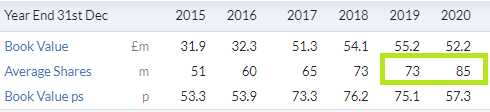
The question for investors today is whether Everyman’s financial position and valuation support a further recovery in its equity value. Let’s take a look.
Financial & operating highlights
- Revenue: £49m (2020: £24.2m, 2019: £65.0m)
- Adjusted operating profit: £8.3m (2020: (£0.3m))
- Reported pre-tax profit: (£5.4m) (2020: (£21.8m), 2019: £2.3m)
- Net cash from operating activities: £12.2m (2020: (£5.4m), 2019: £15.9m)
- Net bank debt: £8.4m (2020: £8.7m)
- IFRS 16 net debt (inc leases): £90.2m (2020: £87.8m, 2019: £86.2m)
KPIs:
- Admissions: 2.0m (2020: 1.2m, 2019: 3.3m)
- Average ticket price: £11.44 (2020: £11.81, 2019: £11.37)
- Food and drink spend: £8.96 (2020: £7.89, 2019: £7.13)
Outlook
Management are optimistic about the current year, naturally. But this view does seem to be supported by strong admissions performance since last July and a good slate of films for the remainder of the year.
Everyman says that admissions momentum has continued so far this year. Based on the firm’s commentary about H2 trading, this seems to suggest that admissions should be comparable with 2019 levels. That seems encouraging.
My view
Everyman says its cinemas are now operating profitably on an adjusted basis, with positive cash generation. The group also reports liquidity headroom of £24.6m, which seems adequate to me.
My impression from today’s results is that if trading continues as expected, the group probably does have the financial resources it needs to return to normal without further refinancing.
However, I’m not convinced that the valuation leaves much room for further gains. If we look back to 2019, we can see that Everyman’s pre-pandemic profitability peaked in 2019, with an operating profit of £4.7m and a net profit of under £2m.

Everyman is expected to remain loss-making in 2022, but the group’s market cap of £118m means that this business is currently valued at around 60 times historic peak profits.
I believe there’s room for this business to continue growing and expanding. But I’d want to see more concrete evidence of improved profitability before buying the shares at current levels.
For my money, Everyman’s share price is already well up with events. Interestingly, Stockopedia’s algorithms appear to share this view, awarding the stock Momentum Trap status ahead of today’s results.

Disclaimer
This is not financial advice. Our content is intended to be used and must be used for information and education purposes only. Please read our disclaimer and terms and conditions to understand our obligations.

69 comments
A notice a very positive update from Phoenix Copper (LON:PXC) today... this really still seems to be a hidden gem while all conditions are converging for massive growth.
re Staffline (LON:STAF)
Excellent coverage Paul. “Why would I want to own a business of such low quality” is a perfect summation of my view.
I would add in defence of the share that the new MD is a smart guy, more margin focused than his predecessors. And you are spot on with the point that the turnaround here could yield a bigger growth in profit- and therefore valuation - until the first sniff of a downturn, when investors should run for the hills (or to the quality two we both prefer?)
Have a good weekend.
Are Staffline really such a low margin business. Yes, if you look at their revenue being the pass through revenue for the contractors/agency workers, but that's a misleading way to look at the business. They are not like a consultancy company which needs to keep up the margins and utilisation rates to cover the cost of employing the consultants. Staffline don't employ these people. The moment the work stops the contractor/agency worker is told to sling their hook. There are no associated costs of employment (except when they mess up as they did back around 2018 or so). Their costs are the cost of selling and their revenue is really just their cut of the rates their customers pay. On that basis their margings are higher than they appear.
If you compare Staffline (LON:STAF) with Robert Walters (LON:RWA) and Sthree (LON:STEM), you will that their margins have been a lot worse, not just around 2018 either.
Are Staffline really such a low margin business. - JCPr
If you compare Staffline (LON:STAF) with Robert Walters (LON:RWA) and Sthree (LON:STEM), you will that their margins have been a lot worse - Rustbucket
I didn't describe Staffline (LON:STAF) as low-margin, I described it as a business of "low quality". And you can't directly compare operating margins of recruitment companies because the primary driver of overall margin is the split between temp/contract and perm placements, the former producing vastly lower margins owing to the pass-through element of the cost.
What you can compare is the fee percentage on either type of placement, which is an indicator of "moatiness", or quality, driven by the technical abilities and market knowledge of the recruiting teams. Because this varies from placement to placement it's a very hard number to pin down from company reports but the reliable rule of thumb is that specialist recruiters in tech etc earn the highest percentage fees while generalists are forced by the market to compete on price. Sthree (LON:STEM) has some strong brands with pricing power while Staffline (LON:STAF) is a price taker. That is what I mean when I describe the latter as being of lower quality.
Further on that description, the fundamental difference between a generalist hiring firm and a tech recruiter is cyclicality. As I have stated before, the structural shortfall of tech skills outweighs all but the most severe of downturns so that the more competent continue to thrive throughout the cycle, something you cannot say for the high street.
Hi BnB
I recall you having some background knowledge of recruitment firms, with one particularly insightful post a couple of months ago which I can't seem to find, so I hope it's okay to message here.
I'm working through my to do list and came to KForce ($KFRC), a Technology and Finance focussed recruitment company based in the States.
Their recent numbers look really good and I believe their offering is in a sweet spot right now.
https://www.stockopedia.com/sh...
https://investor.kforce.com/ne...
I wondered whether you had ever heard of them and/if you might have an opinion?
The cash generation looks excellent and their long term share repurchases are a big plus in my book. I can't imagine growth backtracking for a while now either given the area that they operate in.
There's not much cash on the balance sheet, which I'm fine with as there could be if management wanted there to be. There's a $200m debt facility which is essentially unused (there is a net cash position.)
It appears to tick a lot of boxes.
Any thoughts, if you have the time, would be much appreciated.
Cheers
A
Hi Abtan
Thanks for the approach. I’m flattered you ask. I don’t know the US market and hence neither the name. But the general principles are the same everywhere. I’d say any tech recruiter is a good bet today, particularly if, like SThree (LON:STEM), they are beaten down on recession fears. That doesn’t appear to be the case in the stronger US economy so I’d check for profile and quality of revenues. You’re looking for a balance of 65% contract at a gross margin of 15% for recurring and predictable revenues (earnings) and 35% perm at a gross margin of 17.5% for cash generation (dividends and buybacks). Hopefully you can find the granularity in the SEC filings or annual report.
I do play the IT resource shortage theme globally, but in the US I prefer the outsourcer/systems integrators. $ACN is the big daddy and offers the highest quality services. But my favourite today is EPAM which has been severely re-valued on account of the Russia/Ukraine conflict - 30% of employees are from these two countries. Impressively, delivery has been barely interrupted - see last week’s quarterly report - and the business is rapidly reconfiguring resources to eliminate any remaining conflict risk. Analyst have been rapidly re-upgrading target prices but the market has yet to follow suit.
Sorry for the rushed reply but I’m heading out now and I’ll add any further thoughts tomorrow.
To clarify, those margins are fee rates not profit margins. A top recruiter should deliver an EBIT margin of 10% + but you won’t find that easily in the listed sphere
Thanks BnB, insightful stuff - I'll be sure to keep it in mind when doing more in-depth research into KForce.
I have looked at $ACN in the past, but it always looked too expensive (for me.)
I haven't looked at $EPAM though so will have a look when I can.
Thank you again for taking the time to reply, it is most appreciated.
Cheers
A
Looking again at the figures this morning, the margins suggest a 70/30 balance perm/contract - the wrong way round for extracting higher lifetime revenues per placement and thus making the business more cyclical. I’m also deeply unimpressed by the revenue profile in the 5 years leading up to the pandemic. Compare almost zero growth to double digit growth pa for Robert Walters (LON:RWA) and £STEM. I’m not seeing much to get me excited and certainly not especially good value.
Accenture is always pricey but has rewarded shareholders very well. EPAM is currently an interesting value proposition - with accompanying risks - and I do hold.
Hi BnB
It's amazing how much has changed in the 48 hours since this comment :)
The supposedly strong US economy seems to be struggling more than many of us realised. In any case I remained intrigued by Kforce and have done some more work on it.
The short version:
I am actually quite impressed.
The longer version:
As a Technology and Finance recruitment firm they've been able to ride a growing wave for a number of years now, taking advantage of rising salaries and increased competition for workers in niche areas.
Beyond this, I feel their key strength over the last 5 years has actually been their cost
control. Check out the declining payroll costs since 2017, which have then fed through to higher OP% and NP%:
Beyond this focus on cost control, I am also impressed that nearly all excess cash is used to buy back shares:
You mentioned some other points that I also looked into:
Is this a strength? I would assume demand would be "safer" here in a recession as firms might not want to recruit permanently.
Usually a 3%-4% top line growth wouldn't interest me, which is why I mentioned the decreasing SGA costs before. Combining these makes the company much more appealing.
---
It's on the watchlist for now. I have a feeling that the worst is not over yet and, as much as I like the fundamentals of the business, now might not be the best time to buy.
Thank you again for taking the time to reply.
Cheers
A
Hi Abtan
Let me try to comment on your points:
Beyond this, I feel their key strength over the last 5 years has actually been their cost
control. Check out the declining payroll costs since 2017, which have then fed through to higher OP% and NP%:
Cost control is always good but my read on this is that they might be commoditising their service, relying on brand rather than expertise, which always leads to disappointment in the service. Although it could mean a change in delivery mechanism or IT investment that has improved productivity. Hard to be sure.
Beyond this focus on cost control, I am also impressed that nearly all excess cash is used to buy back shares:
It's the American way! And more tax efficient for UK investors than dividends currently
You mentioned some other points that I also looked into:
Is this a strength? I would assume demand would be "safer" here in a recession as firms might not want to recruit permanently.
Beware this statistic. As perm business has a GP of 100% and contract/temp ("flexi") between 8% and 15%, a 50/50 balanced business will have a vast preponderance of contract/temp revenues. And yes, I prefer a bias to flexi GP as it increases the lifetime value of each placement and improves visibility - very much like a switch from annual licence to SaaS. However, a high emphasis on flexi can betray a low level of technical expertise and a market position in low skill, commoditised areas like first line support, call centre etc.
My back of the envelope calculation arrives at a split of 90/10 flexi/perm on a GP basis with a flexi margin of only 11%. This does not suggest a high quality operator, nor one in the more technical niches - but is consistent with the emphasis on cost control. In other words, I think you are looking at £Hays , not Robert Walters (LON:RWA) or SThree (LON:STEM) .
Growth levels support my comparison with Hays. This business could be more cyclical than you hope.
My broader observation is that the shares have not fallen enough to discount the drop in demand that might accompany a recession - or equally likely, the drop that the market might soon anticipate even if it does not transpire. The UK names have fallen much further and look to be of higher quality - at rushed glance - so I would not rush to invest. I am a buyer of SThree (LON:STEM) in particular at today's levels but I don't think the market understands the company very well at all - so the wait may be longer than the earnings justify.
there’s a bit missing here , you can’tlo g term in this day and age have a premium price without a premium product ,
“premium priced brand “
needs to be
“A premium product at a premium price “
Restaurant customers are a much more knowledgable bunch not than in the 80s and 90s.
Has Hostmore realistically got a product that csn command a premium price ? We all know the answer to that .
Has Hostmore realistically got a product that csn command a premium price ? We all know the answer to that .
Why are their restaurants busy, and profitable then?
You yourself Paul have indicated the food is overpriced ? So that isn’t a premium product with a premium price .
Not seen any numbers that indicate they are busy restaurants currently spiting out a mountain of cash to be returned at sone point to shareholders .
Crap restaurants can of course be busy especially after an entire country has been kept captive indoors for two years so let’s not get carried away with “why are their restaurants busy then” - that’s just not credible .
I do find the obsession with Hostmore a bit tiresome, feels a bit hyped to me on Stockopedia with a lot of fans .
What would Warren Buffet be saying about a tired brand, that doesn’t own its brand, with questionable reviews , and a product that isn’t as goood as the new wave .
Think it is very important that there is a counter point made to the Hostmore love in , and at the end of the day DYOR .
Personally I think you miss the point. What Fridays does is offer an experience. It's an American dinner with all the razzle, dazzle and bustle, very family and party friendly. The food is fine for what it is. If you are a foodie then you are going to be picky (me included here) but thats just not the point. Pizza Express by way of comparison is also very expensive for what it produces, there is much better out there cheaper but again it offers an experience. A trusted brand where you take the kids. We would never eat there on our own but when the kids were younger were there all the time. They loved both places.
I have to say every time I go past a Fridays it is busy. The fact that you consider it a crap restaurant doesn't mean that many others will. What will be interesting is to see how consumer demand plays out over the coming year. I would however pat the directors on the back for having the good sense to hedge energy costs, look after staff and have long term food deals in place. There are many out there that haven't. At a minimum it gives the board a high level of certainty over their cost base.
planetx,
Have a lovely weekend.
P.
Re Hostmore (LON:MORE) and most other consumer facing businesses, the Morningstar publication 'The Little Book that Builds Wealth' is the one that I often refer to.
The simple truth is that some industries are brutally competitive and have awful economics. The book suggests that companies that 'cater directly to the consumer, like restaurants & retailers, often have a hard time building competitive advantages - the percentage of consumer service companies with wide moats is one of the smallest of all the market sectors. The culprit here is low switching costs.. walking down the street from one shop or cafe to another us incredibly easy, and popular concepts can almost always be copied with ease'
Given the squeeze on UK discretionary spend in 2022, now more than ever would appear a time to favour B2B over B2C. It's hard to see where the positive earnings surprises from B2C companies will come from?
Cvs (LON:CVSG) H122 presentation to analysts by CEO, CFO & COO on Thursday 24.3.22. A very strong set of results and a positive outlook with everyone having bought pets during lockdown, although the real earnings from recent pet buys happens as their pets age, shorter term growth will come from strong demand and continued investment and acquisitions.
Video and podcast.
sorry , on hostmore , if paying 4% of turnover - that’s a much higher % in terms of Profit %. , ??
REF - HOSTMORE
This is a very bad sign if true, another big red flag .
"I flagged this issue to mgt on a conf call. They brushed aside this issue, saying they use an aggregator of all customer feedback (including direct feedback from in house emails) called Feed It Back, and that feedback overall is good,"
I had first ha d experience of this when my business transitioned from owner / skin in the game "founder mentality" to professional management managing by % and ratios without wanting to strive to the detail and to build an excellent business.
A typical board meeting would be discussing customer feedback quoting say 95% rating , the founder mentality is absolutely horrified at the 5% of unhappy customers and is grief stricken to improve , he can only see the 5%.
The professional management pat themselves on the back at 95% and brush off the 5% and ask when they can expect a pay rise / bonus . They can only see the 95% .
Of course the run of thumb that any business owner knows is that for every good/ok experience that person tells one person, for every bad experience that person tells 20.
So 95% rating actually means half the comments in the marketplace are slagging you off .
The final thing with Hostmore when compared to its competition is that even before kickoff, with their questionable prices, questionable reviews, they are a massive 4% of turnover down compared to their competition at day one. That is actually a pretty huge chunk when they are trying to compete against companies that are building their own
- highly motivated competition
- that owns their own brands
- that loves what they do and will strive to make very customer happy .
Giving them a 4% of turnover deficit feels like Hostmore are cheap for a reason .
Re Hostmore (LON:MORE) - The founder sold out in 1975 (according to Wikipedia) and it has done OK in the 50 years since that point!
Before it was spun out this year, it had passed through many owners, the last of which was a professionally managed Investment Trust. Arguably it now has a mgt team with much more direct exposure and skin in the game than 12 months ago even.
Finally, despite the pro-founder rhetoric, it really depends on the person. Founders tend to be great at getting things going but can come unstuck as, required by size, it becomes more about systems and proceesses. Some can both start up and run a big group. Others can't. On the other side, some very good professional managers would be no good in a start up. However, we only need a mgt team fit for a £234Mn businesses this year.
Are the current mob any good? They have relevant experience but frankly we will see in the next 12months.
However, if the numbers for the last few years (in the prospectus and now reported results) are correct, it looks very cheap to me. Obviously, a premium priced brand offer in a cost of living crisis is a risk short term, and execution is always the key in hospitality. But the LFL results do not point to massive problems at the moment. (I hold)
Saga (LON:SAGA) interesting presentation
Key note for me is that the 46p EPS out in the market they are clearly comfortable with based on a lower load factor in cruise that they feel they can hit (ie 75% versus low 80's)
On that basis seems we should expect 45-55p eps for this year absent of anything going wrong and north of 80p for the year after. Does seem inordinately cheap now on a PE of sub 5 for this year and sub 3 for next.
Saga (LON:SAGA)
Key note for me is that the 46p EPS out in the market they are clearly comfortable with based on a lower load factor in cruise that they feel they can hit (ie 75% versus low 80's)
Arggggghhhhhhhh
Nothing is clear - what is clear is that SAGA have confirmed they are not providing any guidance. So its anything but clear that they are happy with 46p EPS !!!. Note i don't doubt you may be quoting a figure that may turn out gto be on the money (i certainly hope so) - if that is the reality of where they are at and they had confirmed that to the market then i suggest the shareprice would be back above 240p-250p minimum.
Per the company tuesday
" Given the continued uncertainty arising from COVID-19, the Group is not providing any earnings guidance for the 2022/23 financial year but would expect a return to profit in both the base case and RWC scenarios. "
Specifically
Ref the 46p EPS "in the market" - was this update after or before tuesdays update ?. i would suggest that if no brokers have updated since results day then the company providing no guidance would make any prior notes nul and void perhaps ? as far as the company commenting on their accuracy ? - if thats the case what is the normal procedure do brokers sometimes refuse to provide info if the company says they have nowt to give us? or do they soemtimes downgrade sometimes do nothing and sometimes simply reafirm.
All seams unecessarily opaque+ summit
Rmillaree - I asked a very specific question to the CFO in the presentation. He stated " if we weren't comfortable with the forecasts in the market we would have said so". The forecasts are 46-48p and are current, based on the minimum 75% load factor guidance.
He also said each %age point of load factor adds circa £2m to profit. Thus if they hit their target of an additional 5-8% load factor then this adds £10-16m in profit., hence my upside case of 55p.
I agree it is irritating when CFOs don't commit to specific numbers but we are at least now clear that market expectations are at least guided by management and thus a reasonable proxy of what to expect.
Saga (LON:SAGA)
Rmillaree - I asked a very specific question to the CFO in the presentation. He stated " if we weren't comfortable with the forecasts in the market we would have said so". The forecasts are 46-48p and are current, based on the minimum 75% load factor guidance.
Thats brilliant thanks -it is somewhat ridiculous that he had to be cattle prodded into saying something - at least he has let the cat out of the bag here and commented publicaly so great job in that regard with that prodding stick - perhaps even if he shouldnt have said anything of the sort outside of official rns format perhaps? - as Paul has commented on perhaps his take would be that he didint really say what he was saying formally - what an awakward rod he has made for his own back by the reluctance to go with some best guestimate with wide range
Anyway excellent work you and Paul clearing this matter up i can cretainly go back to sleep here now.
haha - thanks rmillaree.
Yes, I think Paul had the quote down correctly, but nonetheless it has the same effect. I agree that prodding and inferring is irritating though. I understand their reluctance for all the reasons Paul has outlined from the presentation earlier but it is annoying. If you are broadly comfortable with analyst expectations then just say so, or put a margin of safety around it.
Anyway - my take on it hasn't really changed. It's a 3 year play for me but as always depends on the world returning to some sort of normality. It feels like a long time now!!
What the CFO of Saga (LON:SAGA) said, was that if they weren't comfortable with broker forecasts, then "that would be a problem". I wasn't keen on the wording he used, but he's probably been told that he's not supposed to confirm market forecasts directly.
The reasons he gave for not putting out market guidance at the moment were -
1. Cruise profits are highly sensitive to load factors. Each +/- 1% in load factor is +/- £2m in profit. They're indicating 75% load factor, but hoping to get to 80%+
2. Insurance - they only have 2 months experience so far of the new regulation on pricing. Expecting £10-15m negative full year impact, but the "range could be wider than that".
3. It's going to be a profit this year FY 1/2023, but they don't currently know how much.
4. Tour business has been heavily loss-making in last 2 years, and bookings down at the moment, so hoping for breakeven this year, and move into significant profit in future years, once demand has returned to normal. Also 3* duplicated costs have been consolidated into one team, so future profit margin should be in the teens, I think he said.
5. Cruise - fuel is hedged each year at a time, when prices are set. Hedged for whole of this year. Haven't hedged yet for FY 1/2024, because waiting to see where prices settle, then can set selling prices accordingly.
6. Cruise - reckon they're world-leading, with full resumption of fleet (but only 2 ships!), and market-leading increase in "per diem" (daily price per customer)
Overall, I thought it was a pretty good webinar, with them giving a lot of info, and being as open as they felt they could be probably. Nearly all questions were answered directly, except the one on profit guidance.
To reiterate my previous comments, this is all about 1-2 years of recovery in the travel division. If you model that from heavy losses into even small profits (this year) then normal profits next year, it's absolutely tranformative to the group performance. Which then enables it to reduce debt quite quickly.
So as a 2 -year hold, I remain of the view that this could multibag, maybe even 2-4 times from current bombed out market cap. Management agreed, when questioned on share price, sharing the frustration, skin in the game, and think it should ultimately be worth "multiples" of current price, but they'e focused on execution.
I think they're doing the right things, and with customer lifetime value of up to 30 years, it's important they get the fluffy stuff right, on brand image, understanding the customers, great service, etc. They said the brand relaunch (ads which emphasise older people as experienced, and wanting to live life to the full, rather than clapped out) was producing strong early stage results - increased enquiries, etc. Not yet showing through in the numbers though, or actually would be increased costs, if anything.
For these reasons, I think this share could be very, very good, but we'll need to be patient. It's not a quick win trade. Or it might be, I don't know, the share price is incredibly volatile. Valuation right now looks nuts to me, for long-term holders.
Regards, Paul
Judges Scientific (LON:JDG) full year 2021 analyst presentation given on 23.3.21, the day of results: video and podcast. A record year partly due to acquisitions, (they are so straight talking, I love that they point this out.)
For the outlook, they see a more normalised trading environment resuming, and the war in Ukraine exacerbating the supply chain issues, nonetheless they have a record orderbook, which indicates further recovery. They are a high quality company focussed on shareholder returns.
Judges Scientific (LON:JDG) appears to be a very well run business with a great track record and very good at buy and build which is by no means common !
My concern over the medium/longer term is the situation with the CEO and 11% shareholder who is now 71. The business is still quite small ( £90m turnover) so it is possible that it is dominated by the CEO. Not in an aggressive/negative sense of the word but in terms of him being the main driving force behind the business and its business model. And if he moves on, and they lose that energy and expertise, could the business struggle to replicate what has previously been achieved ? I appreciate that the CFO and COO have been onboard a while and of course there are ways of mitigating the change. Perhaps this was mentioned in the presentation ?
My other concern is a short term one and not particularly significant, but I noticed that Trade Debtors over 90 days old had more than doubled from £1m to £2.1m. Hopefully this is not indicative that an important customer is in some trouble. It would be interesting to know the current status , given that these were numbers from almost 3 months ago ?
Thank you Paul for the heads up on the Saga (LON:SAGA) Presentation this morning at 10 30 on the Investor Meet Platform.
For some reason when IMC sent out the Presentations List for this week last Saturday they did not mention Saga so I would have missed it. I hold.
(LON:SAGA) Main concern and always has been since Dehaan re taking the Helm, is the lack of institutional support which perhaps explains some of the volatility. The few shares still owned by them are clearly below notifiable notice levels and stockopedia info is now' insufficient data available.' So looking forward to news on presentation. Gl
Not ANGLE !
Interesting analysis this morning from John Authers of Bloomberg on the Ukraine, Europe and China situations including the potential impact on investment strategy. It concludes
But the overwhelming message is that uncertainty is even greater than it first appears. Therefore, the rise in risk assets since the invasion looks wildly inappropriate. To invest as though there is any degree of certainty as to the outcome is to trust to luck rather than judgment.
You can sign up for his Points of Return free daily e-mail on the Bloomberg site. Wednesday’s issue was also interesting regarding current market signals.
£PEBB full year 2021 results presentation by the CEO & CFO. Video & podcast. To me, the Facilisgroup is the most exciting, albeit, it requires a bit of investment to get it really motoring. It's a SaaS platform for the promotional goods industry, in 2021 it achieved +40% ARR, with an EBITDA margin 60%. That said, Brand Addition is currently 89% of their total revenue, it's had a tremendous recovery from CV19, with revenue +41%, which was 5% ahead of 2019, (incidentally 4imprint (LON:FOUR) have not quite recovered to pre pandemic revenue). For the group outlook, '2022 has started well and in line with expectations.'
Further results webinars forthcoming register for any of them here:
Personal Group (LON:PGH) Full Year 2021 results: Friday 1st April, 12 noon (In a hot space of employer benefits for employees, during the current talent war).
Property Franchise (LON:TPFG) Full Year 2021 results: Wednesday 6th April, 12.30pm (A franchise estate agent, an excellent business model, similar to Belvoir (LON:BLV)).
Tracsis (LON:TRCS) Interim results: Friday 8th April, 1pm (The last trading update guided EBITDA +10%, with Events & Traffic Data recovery, and, we'll hear more about the North American Rail Acquisition.
And, the Stockopedia/PIWORLD StockSlam: Wednesday 6th April, 6pm. Where 10 private investors 'slam' their best stock idea in 3 minutes (with a pitch by the one and only Paul Scott!), followed by Q&A. Register to attend live, here.
Just looking at Volex, a somewhat frustrating share, but based on the Government's plans to roll out charge points in the UK(announced this morning) I cant help thinking this is now a good buy. If they only stopped issuing shares, then I see a great future for upward movement in this share. I like the fact that Directors have skin in the game, with further recent adds. Any thoughts?
Beeks Financial Cloud (LON:BKS) (I hold). It was a very interesting webinar and I expect it will be on YouTube shortly if not already. There was a good technical overview of their products from the CEO. I still have tons of questions about how it works but I know more than I did before the webinar. What was very interesting was the info on Google trying to get into the cloud trading space over the next ten years. It's obvious that they may consider buying up companies such as Beeks Financial Cloud (LON:BKS) to buy in the expertise they would otherwise need to develop. Gordon McArthur mentioned they were taking steps to patent their technology so hopefully they'll not be casual about that.
Re Hostmore (LON:MORE) I've stated before the biggest issue I see is their customer service is dire. The old TGI Fridays was amazing and people have long memories, to the public it is the same business but it clearly isn't. My experience of eating at the restaurants is not good and TripAdvisor still backs that up. I think management need to wake up to this as I think it will bury the business eventually.
Hi Dicky Mint,
Hostmore (LON:MORE) is a multi-site operation, so there will always be some sites operating better than others. You can't just make a sweeping statement that "their customer service is dire", presumably based on a couple of visits to one site!
I've always found the customer service very good in the Bou'mth site. The issues I have, is that the pricing is not value for money, and the coke is always flat!!!
I agree that TripAdvisor scores for TGIs are below those of nearby competition (mainly pizza/pasta), I checked about 10 sites online. I flagged this issue to mgt on a conf call. They brushed aside this issue, saying they use an aggregator of all customer feedback (including direct feedback from in house emails) called Feed It Back, and that feedback overall is good, and they follow up complaints, etc.
It's certainly not perfect, but TGIs is highly profitable, even more so when you consider that profits are stated after accounting for a 4% of revenue fee to use the brand.
I've been trying to find out how the new QSR (quick service restaurant) format is going, as the first site opened in Dundee this week. It's like a small MacDonalds, but with higher quality product, supposedly. There's only one review on Google so far, but it sounds intelligent. Gives it 3 stars, saying they're opposite MacDonalds, and won't tempt in many customers, trying to charge £8.95 for a burger. It sounds like the "Fridays To Go" format is a bit like Five Guys - premium burgers, but also other popular items from the main TGIs menu.
Mgt talked about this new QSR format very enthusiastically in the recent webinar, saying it could end up being hundreds of sites if it takes off. Also they're spending about £100k on IT for each site, with the ability to change pricing (deals, etc) instantly, and providing rich data. So the intention is to flex the offer, to work out optimum pricing/margins, deals at different times of day, etc.
Will be interesting to see how future reviews go, but I suspect Dundee might be a tough nut to crack. Might be better to try this format in more affluent, southern towns?
In conclusion then, I agree that Hostmore (LON:MORE) (I hold) is certainly not perfect, but it's got a lot going for it, and this is the cheapest self-funded roll-out of a profitable restaurant format, that I've ever seen.
Regards, Paul.
I like that Hostmore (LON:MORE) is trying its QSR store in 'tough nut' Dundee. The easy option for Mgt was to 'test' where they are almost certain it will win (rich town, limited competition, brilliant site available) and then say they will roll out to 200 'just like it'.
I was a Hostmore (LON:MORE) sceptic based on my own image of the brand from 20 years ago and its high pricing. However, the more I look, the more I like (geddit).
The numbers (rarely) lie and I am impressed at the new Friday's branding and strategy. If they can execute consistently and just hold pricing, letting inflation improve value, I think they will be a big winner. They have a lot of white geographic space to aim at and will be growing at a great time for the long term (think 15 year site contracts). If it works, the QSR format will let them be visible nationally very quickly and cheaply - McD's get a similar unpaid advertising benefit from all their highly visible stores that complements their above the line aadvertising.
At the current share price, I hold and am now a steady buyer.
I hold a small number of Hostmore as a result of the demerger. I was quite happy as a long term holder of Electra - less so however with the demerged entities.
I am very surprised that management brushed aside questions about quality. The whole point of a brand is that a customer gets exactly the same product quality and service from each and every site. The consistency of the brand removes the uncertainty of purchasing when visiting different locations. A good brand is a powerful advantage.
Consistency is an essential factor in brand premium. If the product is variable the brand premium can disappear completely and II am quite disappointed that the management apparently seem quite unconcerned. Handling complaints is a necessary part of doing biasness, however, the damage isn't rectified just by handling complaints successfully ( if they do,) it is about concentrating on the brand consistency to reduce complaints in the first place. Most customers don't complain - they just don't come back
We are now possibly entering an economic phase where discretionary spending is likely to be reduced. I am not convinced that Hostmore is well placed to handle this possibility.
I completely respect your point of view Paul, I have no doubt some people have a good experience in all the restaurants - it is certainly the case that Bournemouth has a degree of good ratings but it also has a significant number of very poor ones, so I would suggest the experience is dependent on time of day, party size, day or week etc etc. This pattern appears to be true for many of their outlets.
My experience has been poor in all 5 of their restaurants I have visited in the last 5 months - Bristol Cabot Circus, Bristol Cribbs Causeway, The O2, Cheltenham and Cardiff. So it certainly isn't a one shop problem - it's endemic across their estate, you only have to look at reviews for all Fridays on TripAdvisor and the same pattern emerges. It worries me that management "brushed aside this issue" - that is a red flag for me and was the reason I got out at 110p back in December after my second poor experience.
I agree they have some great ideas QSR, 63rd and 1st (which seems to have much higher ratings btw) etc. they are on my watchlist as I do think they have a chance to take off. I also note what the FD said in regards to large holders and that 80% of shares are held by predominantly supporting people.
Personally I want to see some consistent improvement in the TGI Fridays publicly available reviews (that's what the public sees, that's what they make their decision from) and a sustained uptick in share price - then I'll dip my toe in again.
"My experience has been poor in all 5 of their restaurants I have visited
in the last 5 months - Bristol Cabot Circus, Bristol Cribbs Causeway,
The O2, Cheltenham and Cardiff. So it certainly isn't a one shop
problem - it's endemic across their estate, you only have to look at
reviews for all Fridays on TripAdvisor and the same pattern emerges"
Is it service, food or something else which is the main problem? Is there an obvious point where standards started to slip e.g. the demerger?
PS apologies for last post - spellcheck didn't work.
Hi intuitive6191
My experience in all 5 was. Very poor attention to detail, huge delay in delivery of food and drinks, on 3 occasions the food took so long to come off the pass it was cold and we sent it back - only to wait another 40 minutes for replacements. In sone the staff have been just rude, tables scattered with debris from previous occupants and not being cleared. I'll stop there as it sounds like a rant - it isn't honestly - just my experience. Perhaps I expect too much - decent food, fair price, hot on delivery, attentive servers to name a few things.
The food is not of the same quality as it was when TGI Fridays was TGI Fridays of old - in those days my family and I went every week and happily spent a wedge of cash for great food, great service and an experience - someone said earlier that TGI Fridays is still an experience, it isn't at all based on my recent visits, nothing like it was back in its golden days.
As in all restaurants there are a few star servers but they are let down by the wider team. Great servers won't stick around long in these venues from what I can see ...
So as I said earlier - I'll watch this because there is potential in my opinion, if they sort out the basics.
Many thanks for the reply. There may be potential but would fear that it might be a some time coming.
It's a pity. It takes years to build a good brand and I think that the casual dining sector is just too competitive for any loss of brand focus.
I will continue to hold a relatively small number of shares as I don't think the situation is hopeless and there might be some management activity to improve the situation.
Thank you again for the response.
There are a lot of "terrible" reviews. That's a bit worrying...
The simple way I look at it is, if I wouldn't eat in their restaurants, then why would I buy the shares? If I wanted a burger and chips I'd probably rather go to McDonald's for a fraction of the price.
Morning Paul
Yesterday I received an email from Travelsupermarket offering "5% off + extra 10% off on P&O Cruises with Iglu" for summer 2024. I wonder if this was pre - planned promotional activity or possibly a knee jerk reaction to the P&O Ferries debacle. Whilst Ferries and Cruises are separate businesses the whole P&O brand has been tarnished. An obvious beneficiary of any "walkaway" from P&O would be £SAGA. It will be interesting to see if we see a surge in Saga (LON:SAGA) bookings. I hold so hope so!
Very interesting on Beeks Financial Cloud (LON:BKS) but they have now issued 4+ contracts wins which do not seem to trigger any upgrade to forecasts, 2022E has been downgraded in fact. Were these wins already assumed in the forecasts or don't they contribute to numbers for several years - in either case the contract winning RNSs could make this clear?
It was mentioned on the webinar that payback for Proximity Cloud solutions was >1yr
This was explained yesterday in that the size of contracts being announced can take (I think) 10-16 weeks to mobilise, so the revenues for the new contracts recently announced will fall into FY23. They said these contract wins underpin the FY23 forecasts, but if more keep coming in the first quarter of FY23, it seems possible we could get more revenue upgrades once FY23 gets into gear.
Cheers
Chris
Hi FrugalTree,
The stated policy of Beeks Financial Cloud (LON:BKS) is to use revenue upgrades to fund additional expansion costs. For example, mgt said the headcount has rapidly risen to 90 staff, including 30 developers. This was possible by repeated contract wins & revenue upgrades.
However, this also means that profits are not forecast to go up on additional contract wins. That might put off some investors, but for me it's the right strategy - when you have exceptional customer demand, and a maybe unique opportunity to rapidly build a much bigger business, then companies should go for it, and forget about short term profitability in my view. The profits then should flow several years out in future.
There's also a 12-16 week implementation period for new contracts, so recent contract wins will drive growth more in FY 6/2023, with little (if any) benefit in the current year.
Also as the business grows, its margins should rise, because it's currently funding expansion into more & more financial exchanges, but once that infrastructure is in place, they can earn rapidly growing revenues from a largely fixed cost.
I strongly believe this share is a coffee can type share. Over-scrutinising the short term can easily lead to people missing the bigger picture, which is rapidly accelerating growth from a service which is clearly in great demand, and could even become the gold standard in its sector, as there doesn't seem to be much competition.
Regards, Paul.
Beeks Financial Cloud (LON:BKS)
FrugalTree
Very interesting on Beeks Financial Cloud (LON:BKS) but they have now issued 4+ contracts wins which do not seem to trigger any upgrade to forecasts, 2022E has been downgraded in fact. Were these wins already assumed in the forecasts or don't they contribute to numbers for several years - in either case the contract winning RNSs could make this clear?
The company only last month (2/2) updated the market to advise that current years revenues would be ahead of prior forecasts - so from my point of view there has been complete transparency here and very recent upgrade to rurnover.
If you look at the contracts they are all clearly multi year contracts - some for 5 years. So if we only have 3 months to go in this financial year revenues this year may not be material for later signed contracts - not sure if may be loss making too pre start or not (??)
You would be correct in assuming that some of these contracts may already have been in forecasts - eg if they had 5 highly likely to sign it could easily be 3 were in the prior forecasts from earlier times.
Note the company this week also indicated revenues are in the bag "excluding" some potential stuff - so thats great in that there could be a late update reading between the lines.
Finally as confirmed this week they have already upgraded revenue expectations 3 times this year (one of which was the 2/2 update) - so they have not been forthcoming in that regard so far. You should certainly never be expecting an particular contract signup would move expectations.
having already upgraded FY22 revenue expectations three times in the last six months.
So as far as revenues are concerned it seems very unfair to be expecting upgrades on top of the numerous upgrades already delivered - 2 upgrades in a year is great going imho - never mind the potential of 4!
Note - obviously revenue is only half the story - when you talk about downgrades that can only be with regard to profits i would expect. If you are more that doubling turnover in 2 year period and also securing lomg contracts where full payback will likely not be short term - you have to expect it to be natural that you need to incur costs "now" so support that "future secured ramp in turnover".
Ref contracts RNS's being clear - its fairly common that there is no mention with regard to change in expectations - if thats the case you should presume that its a given stuff is sort of in line - albeit the contract be be necessary to avoid late profit waring - or giving you potential for cherry on the cake beat come year end. Note when the 2/2 new contract was announced they obviously realised an upgrade was necessary and informed the market - exactly how it should be as that contract clearly lead to them knowing they would be ahead of expectations.
Angle (LON:AGL)
Sorry to be boring but yet more very positive independent research using Parsortix re ‘difficult’ breast cancer tumours pre and post chemo.
https://www.stockopedia.com/share-prices/angle-LON:AGL/news/rcs-angle-plc-identifying-therapeutic-targets-in-tnbc-patients-urn:newsml:reuters.com:20220325:nRSY9749Fa
I think I’ll give up posting news ‘til the FDA get their digits out.
Wickes (LON:WIX) results look pretty solid with company continuing to take market share and strong order book. Looks very cheap on less than 7x eps. Took a small position first thing this morning.
The only thing that puts me off Wickes is every time I go to a store...they seem dead..I thought the results this morning were excellent, and a suprise to me.
There's always a steady stream looking to pay in my Wickes, not a great number but steady throughput. And of course a lot of their big sales are going out on lorries from the back, so you don't see them.
They say they do a lot of their business online now (click and collect, rather than delivery) so this could explain the quiet stores.
Same here. I drive past our local Wickes regularly and carpark is always lose to empty. It's not scientific but without more numbers it's enough to put me off. Still watching though.
Hi Paul, I flagged Staffline (LON:STAF) earlier in the week after their results. Since then I see there's been an announcement that their largest shareholder as acquired 500,000 more shares at 500,000 ordinary shares at 65.18p. Would love to hear your thoughts on Staffline (LON:STAF) - clearly, I hold!
Morning RajanP,
Yes I did look at Staffline (LON:STAF) actually, but ran out of time to write-up my thoughts.
Today is a catchup day, so I'm planning (might change) to look at:
Staffline (LON:STAF)
Accesso Technology (LON:ACSO)
Pebble
Roland is looking at:
Wickes, and Everyman.
Regards, Paul.
Morning Paul, a bit small but as it’s a quiet day and has been growing could you take a quick look at Aeorema Communications (LON:AEO) please? Interims out today - record interim revenue and first profitable H1 for years, as usually it’s H2 when big events are. They’ve used pandemic to build offering including virtual events and communications advisory, as well as launch in the US and appears to be paying off.
Morning hjg123,
Aeorema Communications (LON:AEO) is too small I'm afraid, at £5m market cap. It's not worth me writing about things that small, because we've got so many readers, that they wouldn't all be able to buy, even if it looked good. That's why we usually have a (flexible) cut-off of £10m market cap. Also things at that level tend to be very speculative, with spikey share prices that are often manipulated by spivs!
Jack had a look at it recently - see the archive here.
Regards, Paul.
Thanks Paul - makes sense
News feed not working today
Lol we’re you out on the town last night Paul?
Actually yes, I did have a couple of cocktails at Revolution Bars (LON:RBG) (I hold) last night. I wanted to mystery shop the food again, which was very good (see below) - 3 tapas type dishes for £13.50 - decent quality though, the food has improved massively.
Sadly, the cocktails seemed to have negligible alcohol content, as my (2 for £10, rude not to) gin + fruit juice didn't have any noticeable effect, but was tasty.
I was home by 8pm, due to early start this morning.
good looks delicious!
Food I meant