Small Cap Value Report (Fri 27 Mar 2020) - HSW, INTU, MPAC, NXT, RMV, RDW, SUPR

Good morning, it's a gradually recovering Paul here, with Friday's SCVR.
Today's report is now finished.
I'm still catching up with what's been going on, over the past couple of weeks. Rightly or wrongly, I'm increasingly coming round to the view that the actions being taken by Governments, in shutting down large parts of the economy, could well turn out to be counter-productive. Hundreds of £billions in economic activity is being killed off, with ruinously expensive compensation schemes being dreamed up. For what benefit? We're likely to end up with millions of unemployed, many thousands of destroyed businesses, all of which might have slowed down the spread of the virus a little.
Seeing police being asked to stop traffic, and accost people in parks, to enforce inconsistent & illogical policies on social distancing, again just strikes me of authorities feeling the need to be seen to be doing something. Meanwhile millions of people are crammed into buses & trains, going in to work as normal. So which is it? Are we isolating, or not? To my mind, we should be rigorously isolating anyone who is vulnerable, and everyone else should be getting on with life and trying to keep the economy going.
In terms of shares, we really haven't even begun to count the cost of the economic mayhem which is unfolding. Forecasts have gone out of the window - we haven't got any sensible guidance yet on how companies might perform. Lots of companies are likely to be reporting huge losses this year, and may or may not survive.
For this reason, I'm losing confidence in the recent big bounce in oversold shares, and have decided to bank more profits.
We're in completely uncharted territory, there's never been anything like this happen before - with an extended shutdown of whole sectors. The losses are likely to be ruinously high, I reckon. On the flipside, Govts seem to be prepared to throw vast amounts of stimulus at the problem. A world that was already unreal, in terms of zero interest rates & mountains of debt, is getting more distorted by the day.
How bad is this recession going to be? Nobody knows. But it's already rippling out. Newspapers are reporting that banks are pulling mortgage deals, so the window to remortgage at historically low rates has probably slammed shut for now.
As regards individual shares, I'm not going to be spending much time analysing historical results being announced now, as there's no point. Profitability is likely to fall off a cliff in many/most sectors, hence if we value shares on a multiple of historic profits, we're likely to over-value them.
But I will be rooting around in trading updates, trying to find any bargains amongst the wreckage. My default position may well end up being "don't know" on most shares we look at.
Let's start off with a few stragglers from yesterday...
Hostelworld (LON:HSW)
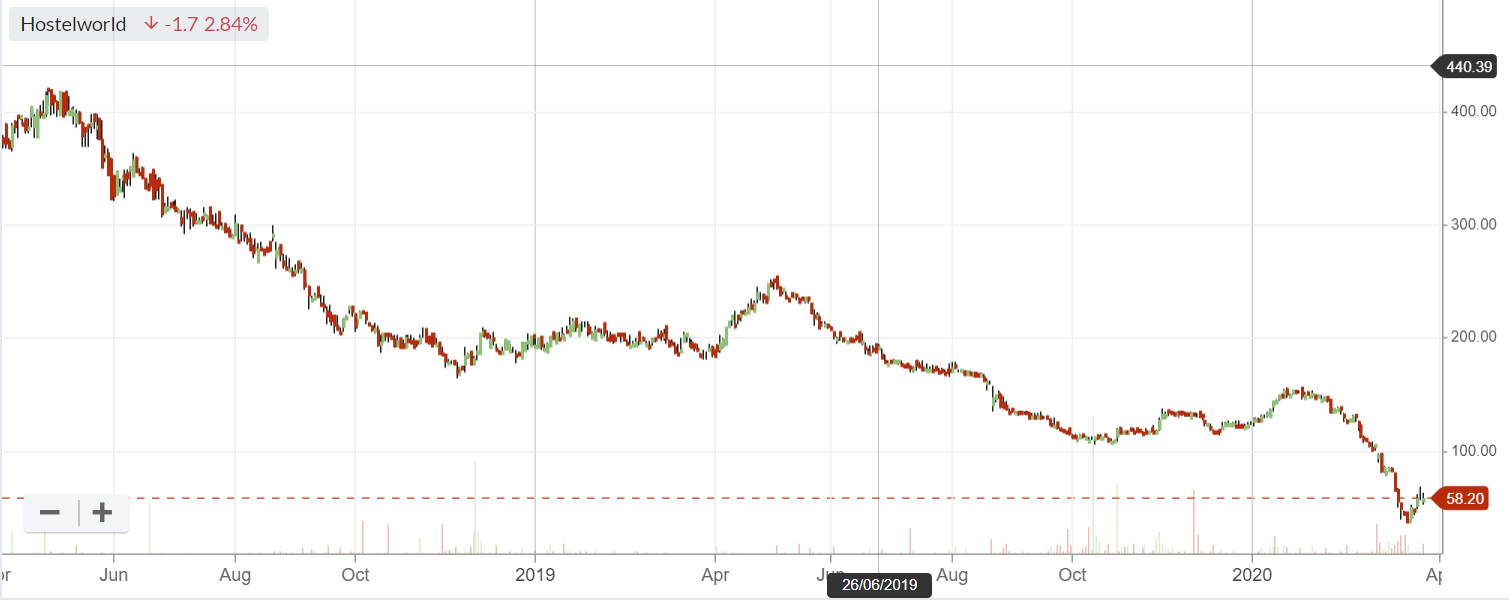
Share price: 58p
No. shares: 95.6m
Market cap: £55.4m
Trading statement & covid-19 update
I last looked at this online travel portal here on 5 Mar 2020. That was when coronavirus was starting to affect business, and it looked like HSW was operating at around breakeven run rate. It has a big advantage, in that marketing & staffing costs can be flexed up & down quite easily.
As you would expect, things have got worse;
On 4 March 2020 at the time of the Group's preliminary results, Hostelworld estimated that the impact of COVID-19 would be a reduction in Q1 2020 EBITDA in the range of €3 to €4 million. Since early March booking trends have continued to deteriorate as the outbreak expanded, and while the Group took immediate steps to mitigate the financial impact, we now expect the overall EBITDA reduction in Q1 2020 to be c. €5.0 million.
Cash position - looks fine to me, so I don't see any issue here with solvency, due to its flexible cost model;
As at 24 March 2020, the Group's net cash position remains strong, with in excess of €20 million of immediately available cash on hand (as at 31 December 2019: €19.4 million). The Group confirms it has no debt obligations. As at 24 March 2020, Deferred Revenue, reflecting customer deposits made under the free cancellation booking product, amounted to €2.5 million. While the rate of cancellation under this booking option has increased due to changes in travel patterns in response to COVID-19 outbreak, we are working to minimise any negative cashflow impacts to the business, by offering credits in lieu of cash refunds.
Dividend - cancelled
Cost-cutting being done, and preserving cash, all as expected
Guidance - none given
My opinion - unlike many traditional travel companies, this one looks likely to survive, as it can slash marketing spending to conserve cash.
The trouble is that the business was struggling for growth, due to competitive pressures, before coronavirus started. For that reason, I'm not convinced it's a very good business, even once recovery does start. I'd probably be more interested in looking at US behemoth Booking.com rather than a minnow UK also-ran.
.
Intu Properties (LON:INTU)
Many thanks to the reader who flagged up the statement from this struggling (bust, basically) shopping centre owner.
The most striking point it made (yesterday) was the extent to which tenants are withholding rent payments;
Rent for the second quarter of the year in the UK was due on 25 March (the quarter day) and we have received 29 per cent of this. We are in discussions with our customers on the outstanding rents. For the same period last year, we had received 77 per cent on the quarter day.
That's a staggering shortfall. Admittedly, the figure is likely to rise from 29% to considerably more, in the coming days. It's fairly normal for tenants to take up to a week to process rent payments, and in my experience landlords are usually fairly relaxed about that timescale.
In these unprecedented times, when tenants have been forced to close their shops by Govt edict, then it's not unreasonable for the tenants to seek some cashflow assistance from landlords.
I've been buying shares in Newriver Reit (LON:NRR) recently, which has a more value-focused tenant profile. Also, its debts are unsecured. Nevertheless, I am worried that NRR is not going to be immune from this. Its pubs division (about 20% of the business) is obviously also going to suffer, at least temporarily.
The big question is whether banking covenants are likely to be breached. NRR has quite a low LTV, and value-orientated assets, therefore I hope it might be able to navigate through this difficult patch. Divis have been paused. If it survives, which it should do, then this could end up being a very attractive entry point - even though asset values are likely to be written-down a fair bit.
.
Mpac (LON:MPAC)
Share price: 220p
No. shares: 19.8m
Market cap: £43.6m
This is an interesting company, which was trading very well until recently. I've been meaning to look more closely at it, to try to better understand what caused its packaging machinery to sell very well (forecasts were repeatedly upgraded in 2019).
The share price has come back down again, because investors must now be worried about business declining due to recessionary conditions. Look at the number of companies which are reporting cash conservation measures, including capex halts. That's bound to impact MPAC, I imagine. I recall in 2008-9, lots of companies initially looked to be riding out the recession, with strong order books. However, what happened then, was that over time those order books ran down, and were not replenished. Therefore profitability ultimately collapsed, after a time lag.
This is what MPAC said yesterday;
The latest government travel restrictions in the regions of our main sites, UK, Netherlands and Canada, and measures implemented are being evaluated and are having an immediate impact, restricting customer interaction and site-based work. However, Mpac remains dedicated to the provision of equipment, spares and services for customers in the critical sectors of Healthcare and Food and Beverage and we are utilising increased remote working wherever practical and possible.
As a result order intake is expected to be lower. Note that MPAC's sector specialisms look to be in good areas.
It is looking at cost reductions.
Cash position - this is a strong message, and certainly reassures;
Mpac has a strong balance sheet, is well financed and remains debt free and is therefore very well positioned to navigate the COVID-19 pandemic. The Group has c.£19m of cash and cash generation in the first two months of the year was in line with management's expectations. Additionally, the Group has access to a £10m secured committed revolving facility which is currently fully undrawn.
Even in cautious downside scenarios which we have modelled, and stress tested, we expect to have sufficient liquidity from existing resources to meet our needs throughout 2020.
That's very good indeed. Companies really must make it abundantly clear that they have enough liquidity, as in this case.
Dividend - is being pulled, which makes complete sense.
My opinion - an admirably clear update.
I like the company, but am not interested in buying any shares in it, since we have little to no visibility on profits or outlook for the time being.
.
Next (LON:NXT)
Temporary closure of online operations
This is a bombshell announcement. I had assumed that Next would likely continue with its online operations, but today it says;
NEXT has listened very carefully to its colleagues working in Warehousing and Distribution Operations to fulfil Online orders. It is clear that many increasingly feel they should be at home in the current climate. NEXT has therefore taken the difficult decision to temporarily close its Online, Warehousing and Distribution Operations from this evening, Thursday 26 March 2020. NEXT will not be taking any more Online orders after this time until further notice.
I can understand why staff (especially those with children) might want to be at home. However, it does beg the question, will there be jobs to come back to, once the crisis has passed? Would it be better to keep operations running at a lower level, instead of closure?
We'll have to see what happens, but this seems to remove the chance of the share price factoring in recovery for the time being.
Fashion retailers are going to be facing horrendous problems with inventories. Warehouses & shop units are full of stock that needs to be sold between now and August. If this crisis drags on longer than that, then summer stock would be virtually unsaleable. How on earth are they managing stock intake? All orders must be cancelled, so how are they going to stock up again with the right products in the autumn?
This is looking increasingly disastrous. I'm minded to avoid retail shares at pretty much any price, unless they're so cheap that it's a binary bet on them going bust or being a multibagger.
Rightmove (LON:RMV)
Suspending its divi - this is becoming the norm from many companies.
Conserving cash.
Profit guidance suspended.
Says it has financial capacity to withstand this challenging period.
My view - the balance sheet is quite modest, but that's because it's a capital-light business model, that in normal circumstances generates huge cashflows. The profit margins are so high, that even if RMV greatly reduces its fees to estate agents, it's likely to remain strongly profitable & cash generative.
Redrow (LON:RDW)
Is shutting down its operations. That's going to mean all the suppliers are likely to come under pressure & may now fold too.
This is going from bad to worse.
Supermarket Income Reit (LON:SUPR)
Announces it has received 100% of expected March quarter day rents.
Q3 dividend will be paid as normal.
With restaurants/cafe/bars closed, the supermarkets are clearly doing well, winning more business.
I'm taking a nap now, and will be back later to do some more updates.
Edit: apologies, I had to spend the rest of the day in bed, so couldn't do any more.
Wishing all readers a peaceful weekend. Those of you that do succumb to the coronavirus, just get plenty of rest, and keep hydrated.
Best wishes, Paul.
Disclaimer
This is not financial advice. Our content is intended to be used and must be used for information and education purposes only. Please read our disclaimer and terms and conditions to understand our obligations.

146 comments
Hi Paul - glad you are on the mend - is there any way to see what stock directors have been hoovering up and reviewing if these have any prospects? Elementis for example not sure if that meets small cap value now it has fallen a fair bit? Thanks, Sam
is there any way to see what stock directors have been hoovering up and reviewing if these have any prospects?
List of most significant trades here:
https://www.sharesmagazine.co....
Mass buying by Plus500 (LON:PLUS) directors, mass selling by Ocado (LON:OCDO) directors and some interesting but solitary purchases by directors of Iwg (LON:IWG), Micro Focus International (LON:MCRO), Smart Metering Systems (LON:SMS) and Wizz Air Holdings (LON:WIZZ) amongst others. Bae Systems (LON:BA.) directors also buying en-mass at around the £300K level.
Management are notoriously bad at predicting their own companies' share prices, but it's probably worth keeping an eye on director dealing over the coming months.
timarr
And what will happen to our future tax rates?
There's a famous Templeton (?) quote 'buy when there's blood on the streets'. It may be that we will have to change it to 'buy when the Small Cap Value Report comments are not about small caps!' The Stocko equivalent of sell those share most discussed on BBs and vice versa perhaps?
We shall see.
It's pretty clear from reading recent SCVR comment threads that there are many people suffering from myopic loss aversion. People are looking at their portfolios too often and seeing nothing but losses. Frankly, if you can't handle this you should really ask yourself whether equity investing is for you.
If you're not familiar with the equity premium puzzle and the effect of myopic loss aversion, then you should go and do some reading. Honestly, it will make you a better investor and reduce the negative effect of your own worst enemy. Here's a good place to start: https://www.nber.org/papers/w4369.pdf
All the best, Si
Another issue we need to think about, perhaps longer term, is that so few individuals and companies seem to hold financial reserves any more.
Thinking back to my grandparents, they were fairly poor & certainly frugal, and lived in houses which were cold & damp. The pipes burst in winter, there was ice on the inside of the windows, I remember getting into bed at my grandparents, and the thick bed linen & blankets were damp. It would take a good half hour to turn the bed from freezing cold into just about bearable, whilst "tinkerbell" (Granny's lit fag end) wandered around the room, putting us to bed & dropping lumps of fag ash into our hair as she kissed us good night & told us stories about the wolf that lived in the eves, and would chase us & eat us if we got out of bed! LOL! I think they used that as a ploy to keep us in bed and not start opening our Xmas sacks in the middle of the night!
Why do I mention this now? Because these days, nobody seems to have any financial reserves. My Mum lives very frugally, but always keeps £5k in her current account. This is unthinkable to younger people, who spend their reserves on new computers, and massive TV screens. People live from hand to mouth, and fill their houses with items that my Granny would regard as pure luxury. She never had fitted carpets. She would cut off-cuts, to make something similar. that would then stay the same for the rest of her life. It never occurred to her to replace carpets. Nobody got in any workmen to do anything. The man of the house would look after all maintenance on the house. Everything.
Even the poorest people would have a few hundred quid under the mattress, for a rainy day.
We need to get back to that.
Like all of you, I'm keeping a close eye on all my nearest & dearest, and pinging over a grand or two to anyone who needs it. No fanfare needed, just do it. and don't mention it once it's done.
Regards, Paul.
All true.
But the wider issue is that there is very little resilience in any part of the system, not just personal. Most essential medicines made in India from Chinese ingredients??? Everything just in time in supply chains covering hundreds if not thousands of miles. Companies only solvent if nothing goes wrong.
Bosch and Randox Labs in northern Ireland have developed a rapid COVID test; naturally will be available in Germany first.
When all this is over, governments need to think about increasing national resilience but that will come at an efficiency cost and ultimately reduce GDP. Something else to bear in mind when thinking about valuations.
Agree with your comments, Paul.
I’m sad enough and old enough to know roughly how much richer I am from not smoking 20 cigs a day over 50 years (approx £150k richer). And as a DIY individual, I reckon my net worth must be another £200k higher because of all the home maintenance I’ve done over 40+ years. Not only does one have a nice environment where everything works but as a higher rate taxpayer it is motivating to work out approximately how much one has saved before tax by not having to bring in a tradesman.
Only disadvantage before retiring was sitting in meetings with high-powered CEO discussing large investments and trying to hide the fact I hadn’t fully cleaned gloss paint off my hands!
And now, one can get a lot of exercise doing those DIY projects which have been put-off and no gym fees to pay!
regards
Potter
Paul - I agree strongly with your sentiments but would take issue with one phrase you used.
Even the poorest people would have a few hundred quid under the mattress, for a rainy day.
Those at the bottom of the heap economically have, and never have had, any chance of this and live a hand to mouth existence, their situation ameliorated only by state subsidy in varying ways. Like death and taxes, the poor are always with us and quite rightly the state (ie the rest of us) provide support for them in various ways.
Thinking about your general point on financial resilience by those who can, I suppose it is a general requirement in a consumer society that people should consume and the more the better for growth. It is economic growth that enables everyone from the state to the individual to have more and better life choices. Frugality, born of poverty and an expectation of a no better future, is not useful in a consumer society.
If fear and want is reduced, the more thinking about a bad future becomes much more of a lifestyle choice driven by the type of personality you are so I imagine there is less propensity to save and 'put by'. I personally have been 'putting by' since my late 20's; a view on life that my daughter defines as 'being a tight arse'
It will be interesting to see if the current economic crash but with extended safety nets from the Chancellor have any effect on attitudes to financial resilience. I suspect in a couple of years probably not but we will see.
I fully agree with the general tone of your macro introduction, Paul. I have no clue about the spread of the virus from here or how long it will hang around for, but the economic shock, right now, is simply massive. GDP contraction this quarter is going to be much, much greater than any other crisis of the last 50 years. And I doubt GDP can simply recover to previous levels within another quarter or two.
The rally in the US markets seems to me a reflection of the state of casual over-optimism which appears to be a permanent feature across the Atlantic. As I write, the S&P 500 is at 2,588, which is down only 24%. This level was seen a few times in 2018, and is higher than any point before autumn 2017. In my view the economic outlook for 2020-22 is far bleaker than the two year outlook was in 2018 or 2017.
Many firms will go bust, but we're only a blink of an eye into this thing, so there simply hasn't been time yet. Everyone knows a friend or family member already out of a job. If you think of your own company, do you really expect head count/production/sales to be higher in October than they were say in October 2019? Demand simply won't snap back to normal. And how long will international trade and travel be restricted for?
Stimulus is the wrong term. It should be a called compensation, and only partial compensation at that. I see US markets moving far lower than current levels over the next 3-9 months. This may be one last golden opportunity to sell into strength or open up a short.
I think the concern with covid 19 is as much the number of infected who become critically ill as the fatality rate. The last WHO analysis I looked at had the "critically ill but surviving" at c. 7% of the total infected. Examples of critically ill are requiring induced coma and ventilation, suffering from organ failure, suffering from sepsis.
There is limited certainty around the percentages because no-one knows the true total of those infected, but if the number of critically ill exceed the capacity of the medical system to deliver critical care then the critically ill will start to die, and the risk is that the death rate then shifts from the suspected 1% to 2% and ends up somewhere between 5% and 10%. Without social distancing measures one infected person infects (according to the experts) between 2.2 and 2.4 others.
If you start with the UK population of 65m and play with some numbers you will see the problem. Presumably this explains the desperate attempts to boost the capacity of the NHS to deal with the critically ill.
If this is correct then short of a miracle cure we are in for a long haul here and I am also struggling with the possibility that, despite the damage to my portfolio over the last month, this may still be the time to sell.
Ultimately we will find out the truth when this thing gets going somewhere densely populated and poor.
Just to set the record straight: Booking.com is a Dutch company not a US company.
Booking.com was owned by Priceline, which is now called Booking holdings which I believe is American.
Booking Holdings is an american company, it brands are Agoda, Booking.com and Priceline.
Booking.com registered office is in Amsterdam.
Hostelworld (LON:HSW) is a different market from Booking holdings which is mostly Hotels, Hostelworld (LON:HSW) is mainly hostels, ie places with dormitories, although they do have some rooms.
I think AirBnB maybe more competition to Hostelworld (LON:HSW).
Its shares are listed on the US market, which is what I meant.
Apologies in advance if people think I am being rude or uncaring, but is it possible to return the comments being posted here to being focused on small caps please? By all means could Paul continue his ruminations and speculations on wider (and relevant) issues, but surely we could refrain from all this pointless and ill-informed speculation about a disease none of us understand. Thank you to all the contributors here.
Coronavirus is the topic of the day. It's only natural that people want to discuss it, and the impact it will have on small caps & the economy. You cannot separate the two.
Paul, I'm pleased for you that you are recovering. I am very much in the danger zone and have been isolated for 2 weeks now, Very boring, but it allows me to keep up with many more news and op.ed. sources. Below is the link to a really fascinating article by a chap I have met. He makes sound sense, I think, and chimes with your opinions .
https://wattsupwiththat.com/20...
Next on-line sales allows customers to return goods if in excellent condition but may have been used/tried on. Is Next worried that customers might have passed on C-19?
Hi herbie 47
These People think nearer. 6,000
https://www.medrxiv.org/content/10.1101/2020.03.25.20041475v1.full.pdf
I’m an arts graduate, so have asked my NatSci (Cantab.) son to comment on the maths...
ATB
Hi extrader,
Had a quick look at that link, figures seem to be based on what happened in China, I think we are well past that stage now, it has spread all over the UK, if we had contained in one area then yes maybe only 6,000. It was published a few days ago so won't have the recent figures which today are not good. They could be right, I hope so, but I think it will be higher.
Hi herbie 47,
Hard to say ;-<
The odd thing is, if you go here :
https://www.euromomo.eu/outputs/zscore_country65.html
you'll see that up to week 12 of 2020, pretty much every reporting European country was showing flu death rates at seasonally historic lows...
Just compare with the (as you'd expect) seasonal spikes in previous winters....
All very odd...and definitely beyond my pay grade !
ATB
Just compare with the (as you'd expect) seasonal spikes in previous winters....
All very odd...and definitely beyond my pay grade !
Not really, it's well known that flu deaths fluctuate widely year by year. Some years are bad (or even extreme, 1918), others quite mild. 2019/20 being a low flu deaths year is just normal variation.
Hi Paul
Glad you are in the mend
Thank you your opening three paragraphs, with which I completely agree. It is brave of you to say it.
World governments are trashing the world economy and saddling future generations (and possibly me I am only 59 for gods sale!!) with a mountain of debt but without the data to really know whether this is going to work to "kill" the virus. It is almost certainly killing the world economy. It is all very well helcoptering money but there won't be anything (apart from mortgages yes the banks get away with it again, while the real economy dies and Netflix) to spend it on.
I certainly think we are heading for an L shaped recession (one where the upturn will come at some unknown point in the future) see Roubini on this. But more worrying is that with such a draconian, both economic and social, solution to the problem we could see very real social collapse. See Branko Milanovic on this.
Have a good weekend and I hope you are fully recovered by next week.
Regards
Michael
Hi all,
Here are ONS figs for UK deaths in 2020 up to 13 March, compared with avge deaths for the corresponding week in the prev. 5 years
https://www.ons.gov.uk/peoplepopulationandcommunity/birthsdeathsandmarriages/deaths/datasets/weeklyprovisionalfiguresondeathsregisteredinenglandandwales
Up to 13 March 2020, deaths are below average..... So we’re not, it would seem, even looking at ‘excess deaths’.
Make of that what you will.
ATB
Winter was mild this year so low deaths from flu.
13th March was some time ago, we only had 11 deaths from Coronavirus then, since then it has risen to 759. Today alone there were 181 deaths, so far.
It is too early to tell how bad it will be, estimates vary widely from 18,000 up to 400,000.
I also read some conjecture a few weeks ago that the low number of deaths associated with flu might be linked to improved focus on hand hygiene.
As herbie points out these figures (to 13th March) are effectively pre-coronavirus, the are around 4% below the five year average based on those figures.
With run rate coronavirus deaths now in excess of 1,000 per week - that is a near 10% rise yet to be reflected in the published stats and we are still potentially in the foothills of this outbreak.
Fabulous - some hard data and thanks for posting. As a mixed English / Euro family I am tired of receiving Euro journo opinions stating what a crisis the UK is in. Will be whizzing this data back to the in-laws immediately
As an aside musing, why oh why doesn't the dreadfully dour Laura Kuensberg report this, instead of being such a drama queen or trying to score petty points in the daily briefings ?
Bring back Brexit for her to worry to death....
I was startled to read this on Twitter:
So our Government policy appears to be largely based on thousands of lines of undocumented software.
Watts Humphrey of the US Software Engineering Institute carried out a study many years ago to find the error rate of professional software developers. This is what he found.
Presumably used to model things over the last decade and validated against real and historic cases? Admittedly this might not have encountered any edge cases and it should certainly be reviewed or re-written with documentation. Why not documented prior? Probably wasn't any budget for that ...
However, I do wonder whether a new hierarchical, peer/public reviewed, agent based simulation model, might be one of the investments made after the event. Or during, if we all have to sit around underemployed, for long enough.
I suggest you read the piece on Dr Ferguson from last Saturday's FT before you mouth off on things you dpon't understand
I suggest you read the piece on Dr Ferguson from last Saturday's FT before you mouth off on things you dpon't understand
To be fair, FREng really, really does understand software and the issues around ensuring it is both robust and reliable.
But, to be balanced, it's clear Ferguson and his team are working incredibly hard under very difficult circumstances having had very little funding for their important work over many years. If they get it wrong it will be with the best of intentions and, frankly, it's too late to worry about it now, the die is cast and all we can do is support the policy as best we can.
I do think that in these incredibly difficult times it behoves all to behave with civility towards each other, even where we disagree. Personally, I find Stockopedia a helpful and thoughtful place during challenging times both financially and personally: the quality of discussion here in a crisis far outstrips anything I've ever seen elsewhere, and I've been around a very long time ...
And on that note I wish all here a peaceful weekend and add my thanks to Paul and Graham, and my best wishes for Paul's friend's mother.
Stay safe.
timarr
I know that it has been put about that the policy change was down to Ferguson's paper, but I'm not convinced that's the whole story. It was becoming politically impossible to stick to the previous plan; criticisms from EU countries (Ireland, France, Italy, Spain, Austria) and WHO as well as all the media. Once the opponents had a scientific challenge to the governments scientific advice it there was no way of holding it. I'm not convinced it is right - it's a model based on very incomplete data and has already been challenged - but we will see.
It will be interesting to look at the Swedish data when this is all over - they seem to be following our original plan with slowly unfolding restrictions as they prove necessary, but keeping everything going as much as possible.
it's a model based on very incomplete data and has already been challenged - but we will see.
Of course, and no one would question that. The data won't be complete till this is over. But decisions have to be made on the basis of what is know now, as far as that goes, and on what tools are available. If we had better tools - readily available antigen and antibody tests, a virus, drugs that could be used to treat patients, combined with lots of IC beds and staff, then a wide range of options would be available. And they may become more available in time.
In the meatime decisions have to be made with limited data, and reflecting what's available now. And given that the evidence so far clearly suggests that CV19 is both more transmitable and more deadly, by some margin, than typical winter flu, the sorts of choices being made by most countries internationally are probably the best that can be made.
One obvious outlier is S Korea, but they caught on early to what was happening in China, had prior recent experience of dealing with Mers, and managed to source large numbers of testing kits to be able to test and track from an early stage.
S Korea also had the advantage of a limited number of clusters with one big one.
I think there is something we are not being told, Prince Charles - mild symptons, Boris and Hancock mild symptons, other cabinet members mild symptons. There is therefore something anti viral that works if they have enough of it if you get it or maybe something like the Pnemonia vaccine which has not been publicised but I paid £ 130 for 2 weeks maybe makes symptons better. I have yet to see someone in a position of power of any age having bad symptons
Or it could perhaps be something to do with this? Obviously, heat and humidity are not factors to reduce the viral load in the UK at the moment!
https://news.sky.com/story/coronavirus-what-is-viral-load-and-why-does-it-matter-for-covid-19-11963393
Its probably their ego's !
Not wishing them ill. But the average age of a member of the House of Lords is 70 years. I would have thought that working in a confined environment in the centre of London would put them in a high-risk cohort in terms of catching the COVID-19 virus. Sure, they may be atypical of the wider population in respect of income and education. But it might be an interesting group to track. Since the start of the year, just three have died. That doesn’t seem a high mortality rate given that there are currently some 789 sitting members. Simply a guess but I suggest that most will live more gregarious social lives than most in the same age group and so are even more at risk of infection.
Importantly, their roles will almost certainly put them under greater scrutiny than most people in other high-risk groups. So there may be a lot of data on lifestyle, movements, general health and so on. It could be fascinating and useful to see how they fare.
The announcements are all made soon after diagnosis. And they have usually been tested soon after symptoms developed. Nearly everyone has mild symptoms at that stage.
The intro was brilliant.
https://www.bbc.co.uk/news/world-us-canada-52012049
Coronavirus: What this crisis reveals about US - and its president
You might also want to read this NY Times article on the situation in Italy which is a few weeks ahead of us!
https://www.nytimes.com/interactive/2020/03/27/world/europe/coronavirus-italy-bergamo.html?action=click&module=Spotlight&pgtype=Homepage
Saw a headline today saying that US has most coronavirus cases in the world. It seems that the US has made a huge blunder in the way it tackled COVID. I think we've adopted a similar approach. What a mess.
Trump is triple screwed and his policies are totally self serving ...
1) He knows if the economy doesn't recover and unemployment doesn't reduce before the autumn elections he's toast
2) If he loses the election he know that the charges will be unsealed against him as the "unindicted co-conspirator" in the Michael Cohen case. This could also result in light being finally cast on his financial position and links to dirty russian money.
3) If the lockdown remains in place his businesses are lacking footfall and they'll fail
US is in deep doodoo
Every time a see a Trump presser, I'm minded to think that my 5 year old grandson talks more sense than POTUS.
Paul, have you not got the message yet! Everyone is vulnerable, just some more than others. My nephew is back on a 24-hour shift as a senior A&E doctor. He has seen it all over the last 10 years, but he has rarely been so distressed, working in intensive care and seeing people of ALL ages fighting for their lives.
cashing in shares sounds sensible but if there's billions of extra £ sloshing around are they going hold their value.
Paul I can guarantee that if you read the following article you will change your mind on policy re Corona Virus.
Read Corona Virus - The Hammer and the Dance by Tomas Pueyo.
If we shut down everything for 3 weeks we WILL get the virus under control quickly. If we do not millions could die because the NHS will not be able to cope.
It is a long article but the facts are very clear.
Indeed, that was a very good article which drew together several of the key issues. It was written on 19/3 (an age ago!) but still absolutely relevant.
To save peope searching for it, it's here:
https://medium.com/@tomaspueyo/coronavirus-the-hammer-and-the-dance-be9337092b56
Hope Boris reads very, very carefully while he is recovering from the virus. An excellent analysis and stark assessment of the limited options. Good to learn that it's never too late for the Hammer.... let's hope sooner rather than later.
Take care, stay safe
https://www.washingtonpost.com/graphics/2020/world/corona-simulator/?utm_source=reddit.com
Same with this. You can't just "isolate the vulnerable" as there will always be leakage into the general population
Great article Tony.
What people don't seem to appreciate is that we are at war.
If we were being invaded by a foreign army we wouldn't be saying "This is going to wreck the economy", we'd be saying "How can we best combat this?"
We need to buy time to take pressure off the front line, rally resources, identify the weakness of the enemy, plan and counter attack.
We pour billions into war without hesitation, this is no different.
I and many other self employed individuals have had to sacrifice their business interests to support the front line NHS staff by keeping healthy.
I don't know about London but in Cardiff the streets are practically empty, buses go past heading to the main hospital in Cardiff and there'll be one passenger.
All the buses I see and travel on ( London Wood Green ) have very few passengers but unlike the Tube they seem to be running a full normal service.
I think part of the issue is the lack of station staff through self isolation, absences etc.
However, it is way beyond time that the London underground tube system was driverless. Basically tube users are held to ransom usually once a year by the Unions, and then when the system is required to limit infections, there isn't the service.
But I am not holding my breath that these 'skilled' workers will ever be replaced.
All very sensible and hard to challenge. Just one bit missing for me as with most of these papers. How to lockdown and enforce it! Go back 3 weeks and imagine trying to enforce a lockdown based on what was known then. Even now with daily deaths in the hundreds people mock the police for trying to enforce moderate rules (yes they are silly but we have to start somewhere). This Government's challenge has always been how to persuade sufficient people to behave accordingly. It is literally herding cats. Too many people remain either cynical or at best sceptical. We have neither the police or the army to enforce a lockdown, the best we can hope for is a progressive realisation that this is serious. We have been and continue to be on a slow but orderly journey to a self imposed lockdown. Yes, it probably needed to be quicker but less anarchy than a forced lockdown of an unwilling population by a Government that wasn't sufficiently prepared (why would we be having spent 3 years as a country fighting over a bloody silly political union).
Against the grain of these comments I agree with the government actions. The shutdown is the only way to get the time to acquire hospital beds, ventilators, tests etc up to a production and supply rate that can carry the inevitable continued growth in cases.
When people believe that if they get sick there is a good chance they can be helped or treated if necessary then we can view the rise in infection/death with more confidence.
If we go back to normal now it is incumbent on those who support that view to say what number of untreatable serious cases they feel is an acceptable cost. Or what increase in death percentage, as a result, feels right for them.
I fully understand why at present the government is not going down that route.
In case my position is misunderstood I am disappointed that the police think it is worth their time to enforce a ban on driving to walk in unattended park and if a barbecue at home floats your boat, then fine.
I also agree with the government actions, albeit that they have probably been implemented too late. It's great that you seem to be over the worst of the virus Paul, but many other people are dying from it and the % increase in deaths is showing no let up at present. The actions are entirely necessary because so many people have been blatantly ignoring a lot of the advice up to now (avoid panic buying, social distance, etc) and making the situation worse and worse for ALL of us. It is, of course, not right that tube trains have been packed with people... but, to an extent, doesn't this show a lack of common sense of commuters and not just a lack of appropriately enforced social distancing measures on transportation? The fact that the police are trying to employ those retired from the Met in the last 5 years shows that, at present, their resources cannot cope with the situation.
But these measures are TEMPORARY, they could be relaxed in 2.5 weeks if the situation has shown any improvement... and they will remain if it has not. Yes, it will have economic damage (and is already doing so across the board), but if it slows (and maybe eventually stops) the spread of the virus so that the NHS can cope with it, a cure of some kind is found at some point, and overall less people die, then isn't that more important?
"......and overall less people die."
Overall, the same number of people will die: 100% of us! It is a question of when and what life we have lived when we do.
As I understand the data, just under 625,000 people die each year in the UK in a normal year. Even if 850,000 die this year (ie an incremental mortality of 250,000), then this will to a large extent simply mean than next year there will only be say 525,000 deaths . Actually, it is likely that at most say an extra 25,000 will die this year the way things are going (ie +4%). Within a very few years we will be back on trend. This is harsh but we need to separate the tragedy for the individual (granny dies in 2020 vs 2024) from the greater society impact to make hard but rationale economic and social choices. In extremis, this is what happens -witness testimony from Italian doctors about priorising ventilators to the young when overwhelmed.
Unfortunately, however, the problem is politically impossible to debate openly - as is a discussion of what we will do with the legendary 30,000+ ventilators (vs 8000 now) in 2021 ie a x4 increase in CAPEX.
Will we i) discard them ii) repurpose them to help more people with breathing difficulties and in doing so create recurring OPEX (supporting nurses, disposables etc) that will either inflate the NHS cost base or compete with eg cancer patients. If we inflate the NHS cost base, there will be less money for eg climate change measures or even higher taxes. If higher taxes, then less economic growth which is proven to be the most effective tool in increasing life expectancy.....
It's not surprising politicians find it hard to make the correct long term choices and simply react to what's in front of them!
Yes I think much of that is true but if our health service is overwhelmed it won't be just Coronavirus patients that are dying unless someone makes that choice. It is also not just the old that are dying, nurses and doctors are also with no underlying health problems. I can see why the Govt. are trying to slow this down. They should have acted sooner of course but you can say that about most countries. It is not just the virus but the amount of money that is being spent on it, as Paul stated, it will take many years to recover. Then how about other countries such as Italy, their economy must be wrecked now, it was not in to good shape anyway.
Yes isn't that the whole point of the governments actions; to stop the Health System being overwhelmed so that the virus peak is flattened and moved further down the graph. There seems to be a lot of criticism of government action but it seems to me to have acted quite reasonably and timely. I don't think that more draconian action earlier would have worked (in the sense that it would have been accepted and acted upon). It is not being wholeheartedly actioned now !
Personally I am a supporter of an approach that concentrates overt protection on the more vulnerable and less on the whole population. I just felt that would do less damage to society in the long run.( I appreciate that apparently healthy people can die from Coronavirus but this is quite unusual and a field for careful study when this is over) However this is just my view and cleverer and better people than I have come to a different conclusion
Different death rates over different timescales will result from different policies. I would not like to proffer which policy is best as I know nothing that would be of value in this debate. I do rather feel that to expect to materially effect the overall deaths seems over optimistic
We have had large scale infections that give a high death rate but are difficult to catch. Here we have an infection which is easy to catch but with a low death rate. Hopefully we will learn something that will be useful when the easily caught and highly lethal pandemic arrives in the future.
Yes I agree lessen the number of people going into hospitals and also the delay will give us more time to buy ventilators, train staff and set makeshift hospitals.
The Govt. could have stopped flights to high risk countries such as Italy, I believe many of our cases came from there. It would have been so easy to do as well. You could also have quarantined visitors from high risk areas. Even now there are flights from high risk countries.
The Govt. could have stopped flights to high risk countries such as Italy, I believe many of our cases came from there. It would have been so easy to do as well. You could also have quarantined visitors from high risk areas. Even now there are flights from high risk countries.
They were working on advice that it would only delay the spread for a short time. Difficult to stop your own holidaymakers returning home, especially when the Italian government said that the risk was limited to a number of small towns (even missing their real epicentre Bergamo). Foreign Office should have given stronger advice against travelling, but stuck to the official Italian policies.
And it now seems that many cases came from Austria. Interesting one that. Didn't affect many Austrians because it was a tourist resort but did infect half of northern Europe.
If we go back to normal now it is incumbent on those who support that view to say what number of untreatable serious cases they feel is an acceptable cost. Or what increase in death percentage, as a result, feels right for them.
As I have said above I have seen graphs suggesting that so far this year the death rate is no greater than the 5 year average for the time of year. Nor is it proven what the infection rate is, but it is believed by some experts that a very large percentage of the population have had/will have it and show no symptoms or very mild ones. Let us hope that is the case, if it is then we may have over-reacted, not gone too slow as most of media are keen to suggest.
With respect Ben that is either hugely naive or disingenuous - as pointed out by Herbie the UK published death rate figures thus far relate to the period before any material number of Covid-19 deaths had been reported.
Given the subsequent known Covid-19 deaths we already know about (c. 750 in the two weeks since the last published figures, compared with 11 previous) and the trajectory (>600 of those deaths in the last week and the likelihood of substantially more than 1,000 in the coming week) really make any implied argument that the numbers are not significant, totally indefensible.
I do accept that there is still an argument to consider whether economic cost are worth the social benefits (starkly lives saved), but denying the figures and the fatality rates is totally Trumpian.
Given the subsequent known Covid-19 deaths we already know about (c. 750 in the two weeks since the last published figures, compared with 11 previous) and the trajectory (>600 of those deaths in the last week and the likelihood of substantially more than 1,000 in the coming week) really make any implied argument that the numbers are not significant, totally indefensible.
It's more complicated than that. The numbers so far are not significant given the total number of deaths we usually have. The issue is that they are excess deaths, over and above the norm. And then we hit a problem because the majority of the deaths have been in the very old, with underlying health problems, and it is impossible to know how much it has shortened their lives. It's been a light winter flu season. The winter flu is a terrible killer and hospital filler but most people pay it little intention because is is rarely very serious for younger healthy people whether or not they have a vaccine. And despite its mutations there is a degree of herd immunity, but despite this and the vaccines it still kills large numbers every year (actual number unknown presumably somewhere between the total number of deaths in intensive care identified as due to flu and the winter excess total - many flu deaths occur in the community).
It’s a market which is impossible to calculate risk – so anything other than cash at the moment is a punt.
I'm sorry but this "end of the world" nihilism is nonsense. Don't take it personally (it's not just you) but there's far too much of this one-eyed view about...
All the best, Si
I don’t recall talking about the end of the world so I don’t take it personally that you have misquoted me.
I don’t recall talking about the end of the world so I don’t take it personally that you have misquoted me.
Great, but you said: anything other than cash at the moment is a punt.
IMHO to be 100% cash in a zero interest rate environment you must think the world is about to end. Everyone's position is different so making glib statements like this is of no use to anyone. Please don't make out that those of us who prudently came into this with a large cash holding because equities generally looked overcooked, and are now selectively buying quality equities and fixed income on great yields for the longer term are "punting". I take exception to that.
All the best, Si
"IMHO to be 100% cash in a zero interest rate environment you must think the world is about to end"
Not really - holding cash in a crisis is a well-established investment strategy. I can’t think of a bigger crisis than the coronavirus?
Not really - holding cash in a crisis is a well-established investment strategy. I can’t think of a bigger crisis than the coronavirus?
Actually, a total banking collapse and whole countries going bankrupt is far worse IMO, so for me, looking over the abyss during the GFC tops this by quite a long way. We mustn't let recency bias colour our outlook. I felt much more scared back then about my financial health than I do about my physical and financial health now.
It's absolutely terrible that tens of thousands of people (mostly old and not economically active) are dying from this horribly contagious disease, but I'm optimistic enough in modern medical science that a treatment or vaccine will be found soon. I recently read the Hans Rosling book "Factfulness" which has helped my outlook somewhat. How come we think it's OK for millions of babies to die worldwide every year? According to Unicef figures, 4.2 million babies died in 2016.
Tbh I don't know any well known long term successful investor who is ever 100% out of the market, so I'd rather stick with them thanks! I'm not an Okey-Cokey type investor - you never need to be all in or all out of the market. It seems old fashioned to express this opinion here. there are so many people far cleverer than me. I'd love to be your broker...
All the best, Si
"How come we think it's OK for millions of babies to die worldwide every year? According to Unicef figures, 4.2 million babies died in 2016."
Absolutely but even if there was a simple solution to this we wouldn't shut down the world economy to achieve the reduction.
Roughly 10,000,000 people die each year from heart disease but we don't shut down the likes of MacDonald's, Yum Brands etc which definitely IMO contribute to the spread of the disease.
"How come we think it's OK for millions of babies to die worldwide every year? According to Unicef figures, 4.2 million babies died in 2016."
Absolutely but even if there was a simple solution to this we wouldn't shut down the world economy to achieve the reduction
I agree. I was only using the number as a comparison to the number of people who are likely to die as a result of Covid-19. I think it will be much less than 4.2 million. Who knows if the approach taken is the best one but in the UK it was enforced by the lack of preparedness and bandwidth within the NHS.
I liked the approach I heard one expert express a couple of weeks ago i.e. send all retired and vulnerable people to the far north of Scotland, keep everyone younger well away and let it rip with life carrying on as normal. Of course, it's totally impractical but you can see where he is coming from as it would get it over with quickly, not unduly over-stress the NHS, and have the least bad outcome for the economy.
All the best, Si
Trying to move on the point just a little - all should be aware that cash is itself a market instrument and rises and falls in value.
People here have a bias towards buying equities as they think they will grow in value (compared to cash).
another, equal way of expressing the same thing is to say
People here have a bias towards buying equities as they think cash will will fall in value (compared to equities).
Consider how you would feel if your cash was turkish lira.
It is just that in the UK, the GBP has been readily exchangeable for other things even in difficult times, and that its value compared to other things has not dropped that much that rapidly over a shortish timescale.
Not that the end of civilisation as we know it is anything other than something barely worth worrying about (some do - google preppers - I think they are fascinating) but I do highly reccommend
"When Money Dies: The Nightmare of Deficit Spending, Devaluation, and Hyperinflation in Weimar Germany" by Adam Fergusson.
Hi Si,
Out of interest, and having had my dividend ETF's smashed! What income shares & fixed interest are you interested in, if you'll share.
Thankyou!
Out of interest, and having had my dividend ETF's smashed! What income shares & fixed interest are you interested in, if you'll share.
I don't invest in shares purely for income, especially because most such companies also have weak balance sheets that it's debatable they should paying out dividends in the first place. As I've mentioned before Unilever (LON:ULVR) would be irresistible to me on a yield of 4.5%. Despite dividends being cut I'd also be happy to accumulate something like IS CORE FTSE100 UCITS GBP(DIST) ETF (LON:ISF) each time the index takes a lurch downwards. My favourite thing to buy recently has been Ecclesiastical Insurance Office (LON:ELLA) though.
Of course, DYOR!
All the best, Si
Thankyou Si,
I hold ELLA, which are down & I have some a top up order in, but I also have some £AV.A & Lloyds Banking (LON:LLPC) - both down quite a lot, do you have a view on those ?
I hold ELLA, which are down & I have some a top up order in, but I also have some £AV.A & Lloyds Banking (LON:LLPC) - both down quite a lot, do you have a view on those ?
Both of the latter have bad form for trying to shaft (Aviva), and actually shafting (Lloyds), their sub-debt holders. I do still hold some Lloyds Banking (LON:LLPC) acquired at way below par back in 08-09 but I wouldn't buy any more at close to the present price. You'd need to trust management for that and I don't. I managed to accumulate a few Ecclesiastical Insurance Office (LON:ELLA) last week on a 7% yield which for me is a bargain given the risk free rate is next to 0% (10 year guilt currently yielding 0.36%).
All the best, Si
Yes, good point on the Lloyds & Aviva management although the PR damage was substantial.
My only reservation with all these preference shares is if inflation creeps back into the system, and then roars like a bear, these could suffer badly.
So having held income shares for quite a while with very pedestrian gains, then to have them hit as badly as growth shares, I am thinking, if something is bought to be held in perpetuity, to really consider the long term risk. For these, it's inflation.
Yes, good point on the Lloyds & Aviva management although the PR damage was substantial.
It wasn't just PR damage though. It means the risk of holding the Prefs increased. This additional risk is priced into them even now, hence higher yields than other "safer" Prefs.
My only reservation with all these preference shares is if inflation creeps back into the system, and then roars like a bear, these could suffer badly.
So having held income shares for quite a while with very pedestrian gains, then to have them hit as badly as growth shares, I am thinking, if something is bought to be held in perpetuity, to really consider the long term risk. For these, it's inflation.
Yes, but if that was the case you'd really not want to be holding cash. Of course, it's difficult to see inflation and higher interest rates being a problem anytime soon unless the government over stimulates the economy with the money it is giving away.
I agree about income shares but I'm not an income investor but you don't have to have a portfolio of either 100% growth or 100% income shares.. I just happen to believe some of the listed Prefs have been oversold and now have yields that are attractive compared to the risk free rate. Who knows how long I will hold them, hopefully for a long time.
All the best, Si
There is no easy answer to a once in hundred year crisis. We are in uncharted territory with absolutely no easy choices.
I think it is impossible to take small measures which will halt the spread of a pandemic with geometric or exponential progress. The “all in” measures of either economic or healthcare collapse are both ravaging – but that’s where we are.
It’s a market which is impossible to calculate risk – so anything other than cash at the moment is a punt.
From the people I’ve spoken to (and my OH who is downstairs right now cancelling stock for a nonlisted value retailer) the consensus seems to be a 60 to 80% cut in stock for at least the next 2 quarters while trying to trade what they have. Everyone’s sales are bombed out at similar levels, footfall is over 90% down and online sales are tanking massively as people tighten belts.
Oddly the one clothing retailer that might make it through in better shape is M&S, propped up by the food division.
From my understanding, the £330b often quoted as the Chancellors largesse is in the form of loans which require good security. As such they should largely be repaid. Over what time period is another matter. So they are not really a cost.
By definition this means that a lot of medium and small businesses will not be able to qualify. Of these some will be the walking wounded capitalism usually removes in recessions but the last 10 years of low interest rates and the shallowness of the 2000 recession, failed to do so. I assume they are unlikely to recover the Corona Virus downturn. Some will have their own resources to draw on but a lot can not survive a prolonged switch off ( and prolonged is weeks not months). Not sure what is available for them
The 80% direct wage payments and NHS extra funding are direct costs and must be recovered through general taxation. One hopes that we don't ( markets allow ?) try and extend and pretend. These policies must be shown to have a cost as otherwise we open the door to all sorts of bad policies of no long term viability
The
A business that goes into coma for 6 months can be restarted. But if members of my family die (or myself), there is no resurrection (as far as i know). I would be infinitely poorer with the latter than the former.
The idea is to flatten the curve. Some get the virus now, some later. I think the government knows that a draconian lock-down will eventually dissolve because after a few weeks people will not bear to continue being stuck at home.
BTW. I fully agree about the police, in Plymouth they were flagging down lone motorists to talk to them, i.e. pass on the virus.
"To my mind, we should be rigorously isolating anyone who is vulnerable, and everyone else should be getting on with life and trying to keep the economy going."
It's great in theory but hard in practice. Most of the people who will be hospitalised will be vulnerable and they're already supposed to be isolating. In a liberal democracy there's only so far you can go with imposing a lockdown - and that's even harder if you're targeting a subset of the population.
The data coming out of Italy is beginning to suggest that it's millennials who are the main transmission factor - which is a real problem, because the people who spread it bear no consequences (and think they're invulnerable anyway):
https://icsb.org/wp-content/up...
Well worth a read as it looks at the economic impacts as well as providing a balanced view of the data and research to date.
At a guess we'll see short-term suppression to make sure we mitigate the immediate impact followed by some targeted lifting of restrictions but aiming to keep vulnerable people out of the firing line. But how long can 70+ year olds be kept out of society?
Either way we're looking at a nasty recession. However, the presentation also makes the point that the impacts are not going to be felt equally. Those of us who can work from home tend to be in the better paid jobs anyway - it's people who are already poor who are bearing the brunt of the economic impact.
No idea how this will pan out, but markets go on regardless.
timarr
Either way we're looking at a nasty recession. However, the presentation also makes the point that the impacts are not going to be felt equally. Those of us who can work from home tend to be in the better paid jobs anyway - it's people who are already poor who are bearing the brunt of the economic impact.
Hi timarr,
I agree. At the very least we're heading for a horrible recession and we're all going to be paying a lot more tax to pay for it at some point in the future. It struck me the other day that many things are going to change going forward as a result of all of this, and I wouldn't want to be invested in commercial property, for instance.
As an example, the next break in our office lease is in August and I think there's a high probability we will give it up and switch to full-time remote working now we are doing it anyway. With video conferencing and cloud access there's really not much upside to all driving through the crowded, pothole riddled roads to the same location and sitting in an office which is by far our highest overhead apart from wages...
All the best, Si
It struck me the other day that many things are going to change going forward as a result of all of this, and I wouldn't want to be invested in commercial property, for instance.
Hi Si
I completely agree. I'm trying to pull together a simple checklist to make an initial triage on any investment that includes this kind of "it'll be different in future" issue.
Something like Rightmove (LON:RMV) for instance, is likely to be fine - people will still want to move houses and even if we see a significant drop in completions then it's such a capital light businsss that they'll still do OK and they'll drive weaker competition out.
But is there any price at all for investing in cruise lines? Packed with old people who've been scared to death and with high, largely fixed capital costs? There's a massive danger for investors in trying to pick winners out of devastated sectors like leisure, retail or travel or linked ones like commercial property. Get it right and you'll make a fortune, get it wrong and you're looking at total wipeout. They may look like shares but they act like options.
And why bother when you can buy Alphabet, Facebook or Apple on significant discounts while sitting on cash piles that would make most nations salivate?
For what it's worth the Congressional Budget Office modelled the economic impact of a similar pandemic on sectors back in 2005 - obviously that was before extreme levels of globalisation but the findings were interesting. I blogged this yesterday:
Overall the analysis showed huge impacts on hotels, restaurants and recreational activities, significant impacts on all travel related businesses and virtually no impact on utilities, information, education, business services and financial services. Healthcare was the only sector that was positive under any pandemic scenario.
It also suggested that the long term GDP impact of a pandemic that only affects old or very young people might be quite small. Which probably only shows that it's hard to predict what's going to happen.
Stay safe, physically and economically.
timarr
"And why bother when you can buy Alphabet, Facebook or Apple on significant discounts while sitting on cash piles that would make most nations salivate?"
Yes. Before I buy any UK small cap I always compare to just loading more cash into Google stock. Google has USD $120 Billion in cash (15% of market cap) and has been growing revenues 20% yoy. Or just buy more of the NASDAQ index even.
Makes me think through the risk reward equation from that perspective.
(you can) "buy Alphabet, Facebook or Apple on significant discounts while sitting on cash piles that would make most nations salivate"
Given that most govt's are going to need to raise taxes, and many are taking new powers, I would expect any "obvious" sources of cash piles to be targets for new taxation schemes, especially if this would have low political cost. Once done, these changes will be hard to reverse.
So (another) thing we need to think about in the "post" CV19 world is new regulatory actions
even if they dont inflation will get that money.
After this is over the government is going to have to print money to manage the debt meaning the value of money going down.
also all the new extra highly secure government bonds will crowd out more risky company bonds, thatll make loans more difficult for companies.
Anyone with cash is best advised to get it into assets, remember after 2008 savers got clubbered
What sort of assets are you thinking of?
Savers have already been clobbered again, can't get much lower interest rates.
After this virus is sorted out then shares should recover.
"people will still want to move houses"
Will they? I remember the last recession in 2008, not many people were moving at all then. If estate agents go out of business, which some could well do, then who will be paying Rightmove (LON:RMV) fees? Last recession Rightmove (LON:RMV) share price went down from 62p to around 16p, obviously they were a lot smaller then.
I remember the last recession in 2008, not many people were moving at all then. If estate agents go out of business which some could well do then who will be paying RMV fees?
Hi herbie
I remember it too, but it's always best to rely on data rather than personal perceptions. In 2008 at the bottom of the market there were about 38,000 residential property transactions in England. In 2018 there were about 90,000.
https://assets.publishing.serv...
However, the world has moved on and the harder it is for agents to sell the more they'll rely on £RMV. Yes - of course they'll take a hit, but they'll still be profitable. In fact I suspect they'd drop their prices to destroy the competition - so you'll see a bigger hit to earnings than that implies - but the long-term effects on profits will be extraordinary assuming they don't get regulated.
Of course, that depends on us not falling into a decade long depression, but we can't foresee the worst case scenarios.
timarr
An interesting discussion on the balance between the economy and Covid-19 effects. Age has a big impact on your perspective of where the line should be drawn. Economies can always recover over time but some people wont. I hope those advocating -lets just on with it, reflect on their comments.
Lets throw this into the debate
https://www.telegraph.co.uk/ne...
Just read the first bit of this article. How wonderfully refreshing! Decisions made by experts, not policiticans, not public opinion, not hysteria.
It isn't just the old who are vulnerable to the NHS being overwhelmed by Covid-19 patients. People of all ages with serious health problems unrelated to Covid-19 would not be treated properly even if they manage to get into hospital. There would be a huge rise in the death rate of people with all sorts of conditions, not just those suffering from Covid-19. I think the government made the right decision with its lockdown policy.
Economies can always recover over time but some people wont
'Every man dies. But No't every man truly lives' - William Wallace
French Connection (LON:FCCN)
Hi Paul, Thanks for all your insight and hope you are getting better. Just wondering if you have any thoughts on French Connection (LON:FCCN)? I see a UK firm WA Capital has just filed a nearly 7% stake.
According to their website they invest in commercial property through Marlborough which is the commercial property company of WA Capital Limited. The company is active in all commercial property sectors in both development and investment. We buy very high quality and hold for the long term.
I am wondering if they see the property portfolio of French Connection (LON:FCCN) as being worth more than the market cap?
"To my mind, we should be rigorously isolating anyone who is vulnerable, and everyone else should be getting on with life and trying to keep the economy going."
Unfortunately, at this stage there is so much community transmission that only isolating the vulnerable isn't enough, but it's very possible we get to that stage and do exactly that.
The total shutdown is to prevent the NHS from getting overwhelmed and therefore preventing many more deaths at the peak. The level of social distancing we have in place should work to lower the number of cases at the peak. It should also buy time to expand capacity to be able to deal with more cases. Once we have more control of the situation (hopefully within a few months), it seems very possible we can begin to restart parts of the economy, and reduce the level of social distancing.
There are some comments around that the shutdown is worse than the cure. I think this could be the case if shutdown lasted any more than a few months, but it is all a delicate balance right now.
"To my mind, we should be rigorously isolating anyone who is vulnerable, and everyone else should be getting on with life and trying to keep the economy going."
I am no expert, but I think that is the plan. But for it to work, the rate of infection needed a reset, and the resources available needed a massive boost. That is what is happening at present.
The biggest requirement is not ventilators and beds, although they are are vital, but tests. The economy can happily run, as long as the infection rate <1, and vulnerable are isolated. If infection spikes, there can be increased tightening of measures. But to manage the situation requires information, and current stats are close to meaningless.
Jon
Phillip Aldrick (The Times) has put forward a solution.
Apart from the obvious impracticalities (such as many businesses being run by those aged 45+), his argument is direct:
" If all 37.5 million Britons below the age of 45 are infected, on its assumption that two thirds show symptoms, 22,500 would require critical hospital care and 13,200 would die.
At that point 58 per cent of the population would have protection against coronavirus, only 2 percentage points short of the level Sir Patrick Vallance, the government’s chief scientific adviser, said is needed for herd immunity to end the outbreak."
Aldrick's numbers appear on the low side, but his message is clear.
It's a solution akin to sending a large army into battle knowing that there will be casulaties.
But questions arise:
https://www.thetimes.co.uk/article/there-are-economic-consequences-in-trying-to-save-lives-on-a-mass-scale-tpgwmw935
Note: A digital subscription is required to read this article in full.
Morning Howard and thanks for posting re the Times Article - Just a small plea from a pedant- When sharing a link please advise if a subscription is required (as with this one) so I don't bother to click on it and get frustrated that by the time I get to the meat of the article it is LOCKED
Hi ezlifeme
You can register for free and then get two articles a week or a month (not sure of exact amounts) without having to subscribe. Of course it means being careful which articles you open and of course you can use different email addresses!
Just read the article and I dob't subscribe.
Regards
Michael
I found some of the images of police droning filming a person alone walking their dog in a remote part of the National Park, and a women being talked to as she sat on a bench alone in a public park, indicative of how sometimes police can be particularly hamfisted when given a public policy statement to follow.
I do wonder what goes through their heads.
Daniel Finkelstein said in the The Times, that following the nudge principle, that maybe more images of people following sensible guidelines should be shown, as compliance tends to encourage compliance in others, rather than wholly negative images.
Just to say on other matters a company I am associated with are working remotely, and one client is taking advantage of quieter times of beginning a project which can be carried out remotely.
I do worry we are giving socialists the green light for more inept state aide by a number of Govt policies, but I do accept the Govt are in a difficult position as the media are relentless spinners of negative issues. The best way is to crack on with wide-spread testing, and get things moving sooner rather than later.
It's a mecca for killjoys. Chief Constable of Greater Manchester: "People are treating the crisis like a holiday & leaving supermarkets with trolleys full of booze & charcoal."
Is he against the public enjoying themselves in their gardens now?
That is undermining consent for the lockdown IMO.
Yip, next they will ban Netflix and YouTube (not just turn down the quality)
Rules either apply to all or no one... Too many people believe they are special and therefore exempt, which is fine but when everyone starts getting in their cars and rocking up to the Peake District, then what? I'd love to take my kids to some nice rural area for their daily exercise, do you advise I take them? If not why not? It starts with one, then a few, then thousands. At what point should the police intervene? Bit like a viral infection... shame we didn't intervene when it was just the one but then it would have been a bit hamfisted :)
We have no idea how this is going to play out. The US remains the world's key economic driver. The virus has not hit there fully yet, and the US seems ill prepared. Things can only get worse there. Africa has limited medical resources, and is also yet to see widespread penetration verified. Statistics from the worst hit areas, Italy, Iran and China, are dubious and not to be relied on.
What we do know is that companies here are cutting dividends, and offering no future guidance. UK economic activity is likely to be at a modern all-time low for at least three months. The only certainty is continued uncertainty.
It may be time to keep your hands in your pockets.
I strongly agree with Paul.
There is considerable risk of Coronavirus lasting for a year or even more, and of it coming and going. And, unfortunately a risk of it returning in far more deadly form than now.
Instead of reacting to that distinct possibility (some medical experts think probability) Governments worldwide have thrown the kitchen sink at it now! It just doesn’t seem to have been thought through. What are they going to do if things worsen? There will be no ammunition left and quite likely no lockdown when it is much worse than now.
Another infuriating thing is (as Paul mentioned) very overcrowded transport in London is OK, INCLUDING for NHS staff on the very front line in their uniforms! Yet I daren’t go for a walk more than once a day in open countryside well away from anyone! Also big queues just to buy a paper as big local convenience store only allowing in 2 at once. 2 in a big space bad. 200 or more crammed in a tube carriage good! Bonkers.
And the lack of proper protective clothing for front line staff is scandalous. Now Dyson has got an order for much needed ventilators that should have been ordered weeks ago, or better still already available for an emergency like this one. Yet Dyson haven’t even started making them yet! It’s on a par with Grayling)’s order for non existent ferries.
From investment point of view; agree that the big rally looks illogical. Markets presumably betting on a V shaped recovery. Doesn’t seem much chance of that yet, unless Governments realise that whatever lies ahead and however dreadful, current policy of total lock down is ruinous, and allow businesses to restart.
Another BIG danger ahead could well be runaway inflation. That would help erode the massive debt, but it would also mean higher interest rates and negative effects of that, including on many with big mortgages at record low interest rates.
The way this has been handled could bring economic disaster on a scale even worse than the 1930s.....unless common sense returns soon. Perhaps best to look on the bright side, and assume that it will, and markets are pricing it in.
Nothing matters to a politician more than opinion polls. They must be seen to be doing something. I think our government intended to be led by the science, but one country over-reacted others had to follow or be accused of not doing enough. If it is true that many many people get without symptoms, or very mildly, keeping people working almost normally and waiting for herd immunity might have been the best approach, but looked heartless in the face of the media onslaught.
I have read that in previous years flu has not been a notifiable disease, so people with other things and for whom flu was the final straw would have had their death recorded as being due to their other illnesses. Covid-19 has been made a notifiable disease so it is going to appear to much more deadly than previous years flu just due to the way the counting is being done! I have also seen a graph somewhere claiming to show that the deaths so far this year are no greater than the 5 year average for deaths at this time of year.
I really fear the cure many be worse than the disease, and it is going to be a very, very long road to get the economy back in decent shape again
I am a retired GP aged 75. I doubt if I would qualify for ICU treatment if thing get worse. My generation have been very lucky and I worry that my children and grandchildren will suffer for years to come. I think we should lock down for a few weeks but after that, the high risk people should be the ones to isolate. As soon as we have antibody tests for Coronavirus, which I hope would not be too expensive, companies could arrange private tests for Corona antibodies and those positive could at least work in close proximity. Why are flights still coming in to the UK from corona hot spots when we are meant to be isolating? As to our markets, it will be interesting to see how the UK and USA markets behave. Any ideas?
Hi Paul,
Welcome back and my best wishes for your recovery and those from your household also affected, especially John’s mum.
Earlier this week Spectra Systems (LON:SPSY) (which I recall you had opened a position in relatively recently) published audited full year results, increased their dividend by 28% (yield at current price is ~7%) and increased guidance for 2020. I am somewhat flabbergasted by the lack of share price response, given a) the market bounce this week and b) the widespread disruption to other businesses and the corresponding dividend cuts and withdrawal of guidance.
I am primarily an income investor these days, so perhaps an increased divi in this environment is more exciting to me than others. FYI, other companies in my universe that have confirmed they are maintaining their dividend are Supermarket Income REIT (LON:SUPR) (as per main article), Renewables Infrastructure (LON:TRIG) HICL Infrastructure (LON:HICL) (all of which I hold) and Greencoat UK Wind (LON:UKW) (that I don’t hold). All of these pay a dividend in the 5-6% range.
Hope this helps a few who are searching for secure income and/or relative safety.
Best wishes
Simon
Rightly or wrongly, I'm increasingly coming round to the view that the actions being taken by Governments, in shutting down large parts of the economy, could well turn out to be counter-productive. Hundreds of £billions in economic activity is being killed off, with ruinously expensive compensation schemes being dreamed up. For what benefit? We're likely to end up with millions of unemployed, many thousands of destroyed businesses, all of which might have slowed down the spread of the virus a little.
I agree that all consumer facing businesses that require face to face meeting are facing serious problems. However, I have just had one of my busiest weeks of the year so far and we've received three orders. In parallel to the obvious chaos there are whole industries carrying on pretty much as normal - we should not overlook this. It's important to remember that the economy doesn't only rely on people working in shops, restaurants and warehouses. These are just the most obvious jobs to everyone.
Meanwhile, if you work in technology then things have pretty much continued as normal because remote working does not reduce your productivity, and I would suggest, with less office based meetings may actually improve it. I am currently working on projects with a company whose factories shut for 3 days only last weekend to be reconfigured to cope with social distance working and are now operating again, yet they are in one of the European countries worst affected by Covid-19. I am in contact with engineers in the UK who are all working remotely, one of whom is self-isolating because their daughter had a cold, and have a number of active US customers working on the early stages of complex projects. None of this activity has stopped.
Yes, going forward it may naturally become quieter, but it's important to retain some balance in this discussion and not just be influenced by the most obvious effects to low paid workers in traditional industries. Many companies are working on technology projects with long lifespans and these don't just suddenly stop.
All the best, Si
Media is definitely now starting to question the whole shut down and finally ask the question, what next after a shut down, So many people seem to think it will be like China, the virus will be eradicated. Wrong, wrong, wrong.
Like Trump, or not, 'the cure cannot be worse than the disease' & 'the US economy was not designed to be turned off'. Again then mans blunt points cut through the political correctness of the situation.
In another thread I asked the question about 1,000,000 infections a month being what we have to accept as a steady run rate. Either that or keep the economy shut and revert to the dark ages.
The human tragedy is going to be enormous, but that is inevitable as we have a new world wide deadly virus.
However:
Now we are getting other sides such as the idea that a lot of the deaths may be being bought forward. Does it support accepting the reality of what the virus will do.
https://www.telegraph.co.uk/news/2020/03/25/two-thirds-patients-die-coronavirus-would-have-died-year-anyway/
Spain is in lock down & there is nothing open except for supermarkets & pharmacies - very little commerce at all, in the whole country., the UK lockdown is very gentle in comparison, and as the cases rise, Borris may do it Sanchez style & then the same, no commerce. The law of unforeseen consequences in business & the credit & equity markets are unknowable.
Edit: And look at this headline today, the interconnected economic society we have will unravel:
Government suspends housing market as banks withdraw hundreds of mortgages from sale
Lenders have been overwhelmed with requests for mortgage payment holidays
So we are already seeing the economy decimated & now trillions & trillions of 'stimulus' If the collective governments realise they need to open the economies back up & very very quickly, and the damage isn't too bad, there are trillions $£ whatever in the system - what then 'Who Knows' to quote Howard Marks (and not our stockopedia one).
Stocks have to super insulated from this to survive, let alone grow. Be a space man, looking down, 'hey buddy, there seems to a 3 billion people sitting inside their homes doing nothing, no travel, no leisure, no socialising, that cant be good man'.
Like a lot of posts, verbalising frustration & feelings & trying to navigate this market. Thankfully this forum is here.
US virus policy will likely be driven by the occupancy rates in Trump's hotels.
Media is definitely now starting to question the whole shut down and finally ask the question, what next after a shut down, So many people seem to think it will be like China, the virus will be eradicated. Wrong, wrong, wrong.
What happens after the shutdown is certainly the key question. But it will almost certainly be something like China. The virus will not be eradicated, it is not in China, and they know it.
But buying time takes the pressure off the health service and allows for testing to be developed and produced, both conventional and antibody. In a few months it may be possible to be clear who has had it and is immune, who has it and who is vulnerable and hasn't had it. That opens up a range of options, if the govt is prepared, as S Korea has successfully, to accept that some compromise on privacy regarding health is worth the benefits to the population as a whole and the economy. It looks like that is the approach the Chinese are following, and it will be interesting to see how it works out. Hopefully we may be better at learning the lessons from other countries once we reach that stage than we have so far.
Hi Peterg,
What happens after the shutdown is certainly the key question. But it will almost certainly be something like China. The virus will not be eradicated, it is not in China, and they know it
I think it most certainly won't be like what happened in China. If you look into what China did it was extreme, in the extreme , eg 1500 * 5 man teams contact tracing every single persons movements who had it, and putting those contacted into full isolation. No western government can or will do that or any of the other measures.
Media is definitely now starting to question the whole shut down and finally ask the question, what next after a shut down,
I am not really seeing this. The vast majority of the media still seem intent of trying to lay the blame on the government, and the shutdown should have happened sooner.
Interesting insight Paul, I can't disagree. Impossible to know where we'll be a year from now. There is no one and no business that hasn't been touched. For now I wonder if it's best to reduce risk, and then sit on ones hands till the dust settles.
As a distraction, we've just published the second piworld interview with Andrew Hollingworth, Fund Manager at HollAnd Partners. This was filmed about 5 weeks ago, and what's striking is how much has changed in such a short time.
Andrew is a Buffett devotee and covers his investing caveats, risk management and more general views on investing. Highly recommended, and engaging watching.
The Investing Principles of Andrew Hollingworth: Part 1.
The Investing Principles of Andrew Hollingworth: Part 2.
Hopefully both eductional and entertaining light relief in these torrid times!
Hi Paul
I think that it has become hugely difficult to have visibility of even the near future for many companies. With Rightmove (LON:RMV) we might think that as they’ve reduced their fees to estate agents by 75% we can assess the impact. And as you say they have huge margins as a cushion. But just this morning I read that the government has basically said don’t move house.
https://www.bbc.co.uk/news/business-52051174?intlink_from_url=https://www.bbc.co.uk/news/coronavirus&link_location=live-reporting-story
Are the agents going to be able to tolerate Rightmove’s fees even if they are reduced by 75%? With no new instructions, existing chains where contracts haven’t been exchanged collapsing, houses that were for sale taken off the market, some agents may demand even lower fees or threaten that they will shut completely for three months and so stop paying Rightmove completely. Suddenly, the high profit margin percentage becomes a low margin percentage on a tiny volume. And it’s anyone’s guess how long that will continue.
Paul, what a brilliant report and all before 8.30! Your comments on the economic impact not being understood yet struck a cord with me. There are two areas I am concerned about.
1) Small and medium low margin businesses. Not many of these will be listed but they are vital employers and suppliers to the UK economy. How many businesses hold enough cash to see themselves through three months of no/ low trading? How many will be able to fund working capital to get back up and running on the other side? I don't know the answers but I know that there is a huge amount of risk here. The economy relies on velocity, it can't simply be paused and restarted.
2) Impact on debt markets. There are already signs of major stress on debt markets. (see here for instance, where a fund manager says he was unable to trade US treasuries for a time: https://twentyfouram.com/2020/03/20/when-will-the-bond-liquidity-squeeze-end/). There are going to have to be a huge amount of debt downgrades and nobody knows what the impact of that will be. Will institutions be forced to sell because paper it is no longer investment grade? How will that impact companies ability to finance themselves? Will major financial institutions become insolvent? Will governments introduce legislation to prevent lenders enforcing security and introduce mandatory standstills? Who knows?
These, and other, second order impacts will determine the shape of the economic recovery and which businesses survive and at the moment it is near impossible to make assumptions on them. I think the investing consequence of this is that strong balance sheets are essential as is a large margin of safety.
Thank you again for producing such a high quality report so promptly!
Paul
'Hundreds of £billions in economic activity is being killed off, with ruinously expensive compensation schemes being dreamed up. For what benefit? We're likely to end up with millions of unemployed, many thousands of destroyed businesses, all of which might have slowed down the spread of the virus a little.'
Agree and we don't know this 3 weeks is the end of it. They could extend this!!! CRAZY.
My own view is that the tide is turning, not in terms of virus spread, but in terms of general public, journalistic and international viewpoint. I gauge more support generally for questioning the total lockdown which I believe will build as fear of economic damage begins to outweigh fear of virus. So far, wholly necessary actions have been taken to buy time for health services, but have been based on poor, missing or extrapolated data.
Whilst fully understandable to protect vulnerable lives, I find more and more support for a return to protection of the majority - therefore halting this escalating demolition of global economies. Whilst models have been used to predict health impacts, I haven't found a parallel model that predicts economic impact and then balances one against the other. I find it interesting that Sweden are sticking to the "stay open" plan - and just like share prices, none of us can know which way that will move the numbers. Time will tell.
Totally understand my viewpoint may sit uncomfortably with some subscribers, but this is principally a forum for investor viewpoints, and this is mine. I don't claim to know the outcome, but I believe that after Easter there will be a rapid de-escalation of total lockdowns and a return to Plan A, the protection of the vulnerable. And by then there will be better data, better testing to validate the data, and hopefully more alignment between the academics on scale and impact.
I may be wrong, but am adjusting my own portfolio based on my own beliefs, managing my own risks and trying to pick through mass hysteria in the press to find opportunites that fit my view. Not easy, but am more a buyer now than last week.
I agree with your thoughts LumpedOn. There's lots of good information out there supporting the view that the reaction to this virus is massively overblown and the 'medicine' will do far more damage than the virus.
A good daily blog here brings some sanity to the whole situation:
https://swprs.org/a-swiss-doct...
Also interesting article here too:
https://off-guardian.org/2020/...
Couldn’t agree more. Over the last few days I have read an increasing number of articles broadly agreeing with this view. Something I thought I would never say, much like the (very occasional) sympathy with Corbyn/McDonnell ideas on the Economy, is that Trump’s comments have some merit. We cannot continue with this strategy - it will lead to economic and social catastrophe for years to come. The Great Depression will look like a mere blip in comparison. Yesterday the Welcome Trust published a report saying that an £8bn investment implemented across various aspects of the NHS (ICU expansion, R&D into vaccines, training, equipment, etc.) could provide the extra capacity to cope with the expected surge in Coronavirus cases. Clearly this should have been done at the outset alongside with isolation of the most vulnerable. Instead the UK government has thrown £330bn (excluding the latest self employed support package) at what is a rapidly escalating economic and societal disaster. The consequences of these decisions regardless of the impact on our investments will damage and possibly destroy the future livelihoods of millions of people. If you want to take a break from watching your portfolio value collapse then some apocalyptic reading which won't cheer you up (!) might include EM Forster’s prescient short story ‘The Machine Stops’ or more recently Robert Harris’s ‘The Second Sleep’!!
My morning smallcap tweet:
John Menzies (LON:MNZS) MS International (LON:MSI) Andrews Sykes (LON:ASY) Finsbury Food (LON:FIF) Sutton Harbour (LON:SUH) Dev Clever Holdings (LON:DEV) Keystone Law (LON:KEYS) Total Produce (LON:TOT) Woodbois (LON:WBI) Foresight Solar Fund (LON:FSFL) Scapa (LON:SCPA) Surface Transforms (LON:SCE) Mitie (LON:MTO) Totally (LON:TLY) Watkin Jones (LON:WJG) Nexus Infrastructure (LON:NEXS) Mattioli Woods (LON:MTW)
John Menzies (MNZS) the aviation services business says volumes have crashed. Seeking gov't funding. Not eligible for COVID Corporate Financing Facility.
MS International (MSI) partial or complete temporary shut-down of manufacturing facilities. Has net cash £15.5m so 'very well positioned'.
Andrews Sykes (ASY) H2 to end Dec was strong. "Compared to many sectors of the economy, such as hospitality and retail, the impact on the Company to date has not been severe, but we are mindful that this situation could change very quickly." Net cash £28m.
Finsbury Food (FIF) retail sales resilient but foodservice business significantly impacted. Cancels div. Confident can withstand the current situation.
Sutton Harbour (SUH) FY to end Mar - no material impact but now tough. Seeking additional funds from bank.
Dev Clever (DEV) staff remote working and operations are continuing largely as normal. Current trading remains strong, increased demand from schools for remote-based learning. Co adapted its third remote learning platform, Launchpad for Employers, towards educational establishments.
Keystone Law (KEYS) trading in line until covid. £4.4m net cash. A high proportion of its cost base which is fully variable and layer fees are on a paid when paid basis. Passes div.
Total Produce (TOT) continuing to trade satisfactorily and supply chains are functioning adequately. Co is comfortably within its covenants. However FY earnings likely down YoY.
Woodbois (WBI) covid likely to result in supply chain disruption within the timber industry. Factory may be halted for an indeterminate period.
Foresight Solar Fund (FSFL) no operational disruption. "May be a further short-term reduction in power prices due to an anticipated drop in demand, however power prices are forecast to improve over the medium term."
Scapa Group (SCPA) guides FY to end Mar in line. Co expects economic activity and consequently trading to be impacted. All sites are operating, with the exception of India. Passes div. Leverage is 1.6 cf covenant 3.
Surface Transforms (SCE) business remains fully operational and is manufacturing brake discs with sufficient raw material and component inventory to continue to do so for some months. Covid could impact revenues though.
MITIE (MTO) expect little change in demand from public sector - 30% of rev. Finance, Professional, and Banking sector expected to continue at close to normal - 12% of rev. Same for Data Centres, Telecoms and Drug Manufacturing - 6%. Demand for Cleaning and Security Services from food and On-line Retailers are increasing - 11%. Other sectors reducing demand. Now seeing material downturn in projects and non-essential maintenance spend. Cutting costs.
Totally (TLY) confident that performance will remain strong. Co "has requested additional funding from the NHS and Commissioners for the additional, enhanced services delivered."
Watkin Jones (WJG) will close its active development sites temporarily, with the exception of a small number of sites which will remain open whilst essential services works are completed. "We are working very closely with our university partners, international agents and other key stakeholders, particularly in respect of the impact on this summer term and potentially further ahead."
Nexus Infrastructure (NEXS) cutting costs. Has a "very strong balance sheet and net cash position...believes that the Group has sufficient funding capacity to meet its commitments for the foreseeable future."
Mattioli Woods (MTW) continues to be fully operational. Q1-3 in line but expects disruption to trading in the coming months. Guides FY to end May in line. May pass final div.
Mr C your ability to digest all of this and report this on here within 51 minutes is outstanding, cracking work!
I'm also concerned that many of those making all the new rules and restrictions (eg today's suspension of housing transactions) are themselves largely insulated from the economic impact of their decisions through their DB public sector pension entitlements. I'm not saying things would be different if they had significant DC pension assets but I sometimes wonder. On the other hand it's in some underlying form a generational transfer from old to young and that's no bad thing.
£NXT A blow from the left field! One sentence from Lord Wolfson in the recent annual report has stuck in my mind.
"People do not buy a new outfit to stay at home."
Re Next (LON:NXT). The warehouse jobs are hard. If someone is paying you 80% of your earnings for staying at home, would you not think this is a thing to consider ?
(Of course it may be that warehouse staff are not employees but 'contractors' in which case this would not be a consideration)
Just a thought
I think you may be right. I think right from the start of this some of the media made it sound like the plague, and some people have got more frightened than is probably justified. In that situation people may well think 80% of earning and staying at home is better than 100% and being at risk of dying.
Yes but also even if things get back to "normal" we almost certainly be in a recession/depression and people will be rebuilding there "personal balance sheets" not shopping at Boohoo (LON:BOO) or Next (LON:NXT) . Indeed the whole episode may make them question the need to be continually buying stuff.
On the subject of "personal balance sheets"- I do not think everything is as 'doom and gloom' as some suggest.
Whilst everyone has a different level of protection against the economic impacts, a significant proportion of the population are going to be on 80-100% of normal income during the lockdown.
Meanwhile some areas of expenditure will be significantly curtailed. From ONS figures on house expenditure :
These aren't going to drop to zero, but will be significantly reduced.
It seems to me that some people are going to come out of this with materially improved personal balance sheets and a pent up urge to go out and splurge. (Personally I already 'owe' two family meals out for a birthday and mothering sunday)
Is anyone else keeping a spreadsheet of the outgo savings we're making since the start of the epidemic or am I just a tight git? It's quite instructive, but being a tight git, I can't see myself going out and splurging all these savings if/when restrictions are one year loosened.
A guy I cycled with last week works with small business and eloquently summed up the economic impact of batflu - the normal 'economic multiplier' has turned seriously negative.
The economic issues have not even started coming to light yet.
3x examples:
One contact in manufacturing, plant shuts down entirely, and for now staff being paid.
Another works for BMW and the whole oxford plant is closed for 4 weeks.
my work (a large consultancy) is asking all staff to take a voluntary 10 - 20% pay cut for next 3 months to avoid "difficult decisions being made"
Hello Paul, This is a share that you have repeatedly knocked back (quite rightly) but maybe the situation has turned for them. They updated whilst you was holed up last week. Mccoll's Retail (LON:MCLS)
Paul -
We probably need new metrics to guide us through the medium term.
Can I suggest, for each share that you review, a "Coronavirus Survival Rating".
It goes from 1 to 5. 5 means "this share will most probably come out of the other end stronger, and be one of the sector leaders"
1 means "Basket case. Most probably will not survive or will forever be a walking wounded."
I hesitate to give examples!
Hi Ramridge,
Nice idea. Whilst I haven't formalised things into a scoring system, I am focusing very closely on each company's survival chances, and financial strength - so that will be a key focus here for the foreseeable future.
Regards, Paul.
Good idea Ramridge. For me at the moment there are only two that I can score Cash 5 and Gold 5.
If Next (LON:NXT) says that it can only (that is effectively what they have said) survive a 25% reduction in sales this year and I think it is a given that their sales will be more down than that, every company has a problem.
I also agree Paul and of the same view.
Response to Covid-19 has been handled badly by many governments and the minority of criticisms is starting to be heard. Global recession as a result of closing the world down will have a far greater impact than the virus itself but not only that with health services directing all their attention to Corona people suffering from other more dangerous and prevalent ailments are needing to postpone treatment as if Corona is the plague and nothing else matters. As Corona will not end in two weeks as can be seen in Asia what will governments do? lock us down indefinitely?
As a result the stock market scares me as we have seen a large bounce following the decline which is probably just a dead cat bounce and markets will continue to fall if cases rise in the US. On the other hand if global governments change their stance in how to deal with the virus by isolating only the most vulnerable and allows business to get back to it then we should be in for a healthy recovery. To me trading on this market is still a lottery and waiting for clarity.
As someone who is 100% in cash I am encouraged to agree with you and think that many people are waiting for the US of A to catch the ̶c̶o̶l̶d̶ flu and for the rest of the world to sneeze -hopefully into their masks- sadly.
I really do not think the republicans are taking this as seriously as they should and can only hope that the good weather rumors hold some weight or there really is going to be a potentially needless loss of life.
Re: Isolating only the most vulnerable:
If the science agrees then I think this is the best solution, it's the only one I've seen that has an exit plan . China has now come out the other-side apparently but to what end?
To close it's borders to foreigners? !
To me it sounds like they're still very much in the eye of the storm.
Glad you are on the mend Paul. I 100% agree with your fears about the future and posted something similar on FB a few weeks ago,regarding isolating the vulnerable and letting the majority continue working . You would not believe the amount of negative comment I received. Suspect therefore this decision by many countries is more political than economic and very much feel the cost to the economy has not really been appreciated. Have also sold most of my portfolio and am only holding on to shares such as HSBC which I consider fair value with little downside from here.
I agree this is mass hysteria in action. If you dare post any dissenting views you will be shouted down by the mob.
Epidemics are well known for causing mass hysteria and bear markets are a form of mass hysteria. The price changes way more than the value. The end result of bear markets is simply that the 'smart money' moves from one set of 'leaders' to another. Institutions can't sit about on cash to the extent that we can. All our 'analyses' as private investors is about trying to second guess where the smart money will be transferred to. On that note, I think Paul is right on the ticket i.e. strong balance sheets and survivability now hold most value, more than growth for now.
I would think banking stock always have downside in a depression? I know fundamentals look attractive on it.