Small Cap Value Report (Fri 30 Sept 2022) - MCB, MADE, TPX, XSG

Good morning from Paul. What a chaotic week it's been, I'm so glad it's nearly over!
Some cracking reader comments this week, I'm delighted to see the reader comments section coming alive with really interesting posts this week, thanks to everyone who is contributing constructively.
Agenda -
McBride (LON:MCB) - a key refinancing announcement with its banks was announced yesterday, that strikes me as remarkably lenient. That then allowed FY 6/2022 results to be announced, which come with a "material uncertainty" over going concern warning. It's loss-making, and very heavily indebted to both the banks, and trade creditors. Cashflow is poor. So this is really a question as to whether the business can survive. It says current trading is improving, after 18% price rises were pushed through in H2, to recoup "rampant" inflation on costs. Shares could have little to no value, so best seen as a high risk call option on a turnaround. Risk:reward strikes me as poor, but I'll keep an eye on it, for a possible future turnaround.
Made.Com (LON:MADE) - as mentioned here before, the facts & figures lead me to believe that MADE is likely to be insolvent soon. I've gone through the interim numbers, just to be sure, and the numbers & commentary back up this view. The company has put itself up for sale, but why would anyone buy something that is now generating massive losses & burning through the little remaining cash? The going concern note is laughable. The shares remain uninvestable, and I would steer well clear. (more detail below).
Tpximpact Holdings (LON:TPX) - it's a profit warning for H1 from this acquisitive group of IT companies focused on the public sector, due to a botched strategy of centralising key functions in the group. However, there seems good visibility for an improved H2. Founder CEO & CFO are stepping down, but staying within the business, in an unusual move where they admit that more experienced leadership is needed, and bringing in a sector expert new CEO. Overall, I think this share is starting to look interesting as a potential turnaround, from a much more sensible (i.e. lower!) valuation.
Xeros Technology (LON:XSG) - a deeply discounted placing/open offer. I work through the numbers, which means ruinous dilution. Can you believe, the share count will have risen from 1m in 2014, to up to 294m (if all the warrants are exercised). A good case study in why we should avoid jam tomorrow shares. We need to check our portfolios to make sure there's nothing in there that is likely to need to raise more equity from a position of weakness any time soon, as those could be disastrous, like this one. Expect more deeply discounted fundraisings. This is a really, really bad time to be holding speculative, cash burning shares that run out of money. How do you know if companies need more money? Check the accounts, and check our archive here, because I always flag up weak balance sheets and placing risk.
Explanatory notes -
A quick reminder that we don’t recommend any stocks. We aim to review trading updates & results of the day and offer our opinions on them as possible candidates for further research if they interest you. Our opinions will sometimes turn out to be right, and sometimes wrong, because it's anybody's guess what direction market sentiment will take & nobody can predict the future with certainty. We are analysing the company fundamentals, not trying to predict market sentiment.
We stick to companies that have issued news on the day, with market caps up to about £700m. We avoid the smallest, and most speculative companies, and also avoid a few specialist sectors (e.g. natural resources, pharma/biotech).
A key assumption is that readers DYOR (do your own research), and make your own investment decisions. Reader comments are welcomed - please be civil, rational, and include the company name/ticker, otherwise people won't necessarily know what company you are referring to.
McBride (LON:MCB)
23.3p
Market cap £41m
Amended financing arrangements
This announcement came out at 11:51 yesterday, and triggered a brief spike up in share price, which quickly dissipated.
I won’t go into all the detail, but the banking syndicate have, in my view, been incredibly lenient to McBride, which is very much a distressed borrower. The business is now loss-making, and cash consuming, yet has net bank debt of £152m.
This new arrangement gives McBride a breathing space for 2 years, with no testing of the main bank covenant (Net debt: EBITDA) until Sept 2024. There are other covenants, but set at a level which it should be able to meet.
Lending is now secured, whereas in the past it was unsecured (amazingly).
This looks an astonishingly good refinancing deal, that greatly reduces insolvency risk for the next 2 years. I’ve no idea why the bank have been so lenient? Possibly because they see a better likelihood of recovering their money by giving the company time to turn itself around, than to withdraw support and end up getting little back from an administrator in a fire sale?
This announcement came out about an hour after the refinancing announcement above, so presumably had to be held back for going concern reasons until the deal with the banks had been signed off.
McBride, the leading European manufacturer and supplier of private label and contract manufactured products for the domestic household and professional cleaning/hygiene markets, announces its preliminary results for the year ended 30 June 2022.
Revenues £678m
Prices up (+9% for the year, and +18% in H2), but offset by volume declines.
There’s a time lag for raising selling prices.
Adj loss before tax £(29.6)m
Current trading is said to be improving.
Private label products in demand, as consumers switch from branded, to cheaper options.
Cost savings being implemented.
Adj EBITDA £(3.6)m, note there is a £16.9m depreciation charge, and a £4m pension scheme deficit recovery payment each year.
Cashflow is poor at £(30.2)m, as working capital sucks in cash, and there was £13.2m in capex too. So right now, a cash-hungry business.
New E175m RCF agreed, but with the previous E75m accordion removed.
NTAV is still positive, at £30.0m. There is £38.7m freehold land & buildings, on the balance sheet at cost, it would be good to have more information about this, and what its open market value might be now?
Bear in mind that MCB is financed by the banks, and the trade creditors. So trade credit insurance could be vital. With new, solid bank funding in place, I’d guess that trade credit insurers will probably be breathing a sigh of relief. So it’s definitely more financially secure after today’s announcements, for now anyway.
Going concern note - always essential reading for companies with stretched finances. In the base case, it meets bank covenants. In the downside scenario, it breaches covenants. Therefore the “material uncertainty” over going concern is reiterated. It is trying to increase an invoice discounting facility by £25m. My concern over this, is that we cannot assume supermarkets are necessarily good debtors, e.g. both ASDA and Morrisons were bought out using leverage. The UK is just under a quarter of MCB sales, with the bulk being mainly other European countries.
Outlook - "at this stage" seems to introduce an element of doubt. We're not told what their expectations are!
The early months of the new financial year have seen trading in line with our internal plans. Volumes are showing some early signs of recovery against a backdrop of an environment that should favour private label products. This together with an improving service performance provides reassurance both on our revenue outlook and factory loading levels.
Recent months have seen overall raw material costs steadying but with widely varying trends between material groups. Energy and currency variations add further uncertainty to the cost environment and hence margin improvement actions from price rises or product engineering remain key activities.
At this stage the Group is maintaining its view that full-year earnings will be in line with our expectations.
My opinion - this share has been very high risk, and I can’t understand why anyone would have been holding - taking a very big risk, for little upside. However, today’s refinancing is game-changing. Insolvency risk looks to have greatly reduced, therefore the equity is now basically a call option on the company executing a decent turnaround. If it gets back to say £30m p.a. profit that it used to achieve, then the equity might have some value.
As things stand now, I’d say the equity is probably worth nothing, because the business is loss-making, and a long way from a turnaround probably, and completely dependent on funding from the bank, and its trade creditors (suppliers).
Given how many decent companies, with strong balance sheets, are also bombed out in price, why would you invest in something with such heavy debt, and that is loss-making?
I think shareholders are very, very lucky that they haven’t been wiped out in an emergency equity fundraise. Although that could still happen, if trading doesn’t improve.
Risk:reward has improved a lot, but still strikes me as poor.
.
Made.Com (LON:MADE)
3.6p
Market cap £14m
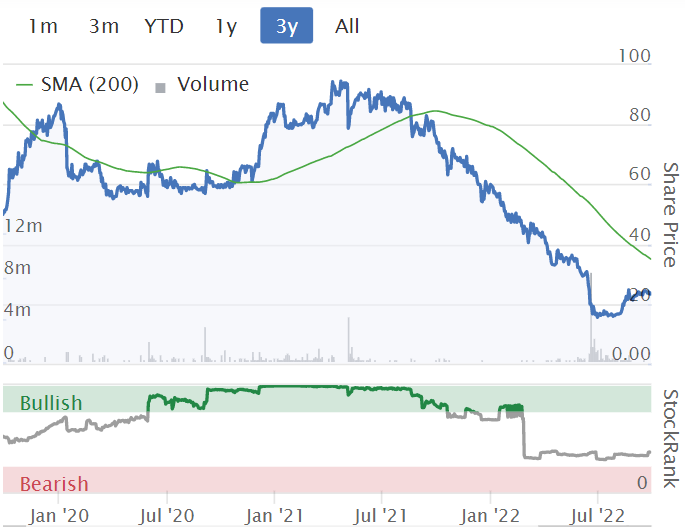
These numbers reinforce my view that MADE is probably only weeks away from insolvency, and 0p share price.
It made a £(35.3)m loss before tax, on £178.2m revenues in H1 (6m to June 2022). Worse still, the cash pile crashed from £107.2m at end Dec 2021, to just £32.1m by June 2022. Hence it seems obvious that the remaining cash is likely to have been burned before end 2022, especially as Q3 trading is said to have worsened.
As we’ve covered here before, the only hope for MADE is that somebody wants to buy it as a going concern, and the company recently launched a formal sale process.
Management says in the going concern note, that they believe a sale will happen, to a buyer with sufficient cash to inject into the business, hence why accounts are prepared on a going concern basis. However, they then admit that the formal sale process has only just started, and there’s “limited evidence from the process so far” that a sale will happen! So this has to be one of the flimsiest going concern notes I can recall ever seeing, based purely on hope.
My opinion - this share remains uninvestable, and I think insolvency is looking very likely in the short term. Who would be interested in taking on this can of worms, when the assets could be bought for a song from an administrator, minus all the liabilities? Miracles can happen though, so we can't be 100% sure about anything.
Management is slashing expenditure to try to survive for a bit longer, but as the going concern note admits, it may not have enough cash to survive until a deal concludes, even if anyone is interested in doing a deal.
Purely for gamblers now, but there’s a very real, imminent risk of a 100% loss, so why take the risk?
It's staggering that this was floated in mid-2021 at a value of £800m, and is now on the brink of going bust.
.
Tpximpact Holdings (LON:TPX)
60p (down 43% at 08:31)
Market cap £55m
Trading Update & Board Changes
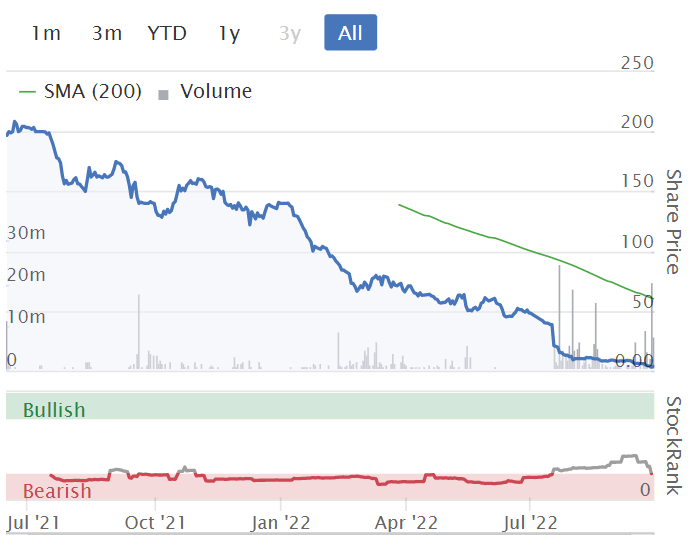
This is the top 2 faller today, so let’s see what’s gone wrong. I didn’t recognise the name, but then remembered it used to the called Panoply - an acquisitive software group. I recall listening to a webinar where management seemed quite switched-on. The story was that the group was buying up small IT companies, targeting work for the public sector, and providing fast & flexible projects using cloud-based software, rather than cumbersome & time-consuming bespoke software. I was initially sceptical, and had concerns about its balance sheet (e.g. deferred consideration). However, things seemed to have improved by 2021, with a strong order book and improved balance sheet. My report here in Sept 2021 says that the business was doing well, but shares looked expensive at 270p.
It’s now down to just 60p, so something serious must have gone wrong, although the overall market de-rating for small caps could easily have halved the price, even if performance was good.
Today’s trading update is for H1 (it has a 31 March 2023 year end).
Oh dear -
Trading for the first half of the year has been below our expectations, which will impact the Group's full year results.
What’s gone wrong? They’ve tried to centralise the various separate, acquired businesses, and it’s gone wrong, in a nutshell. Hence lower order intake in Q1, leading to reduced revenues in Q2 (it says this was disclosed previously, in July).
Management are ploughing on with the centralising strategy, and are spending more on finance, HR teams.
As a result of this botched strategy -
These investments have resulted in a significant increase in the Group's operating cost base which has impacted profit in H1, and will continue to do so on an ongoing basis.
In addition, there has been a short-term impact on productivity and efficiency of client-facing staff which has impacted gross margins in the first half.
That’s dreadful really, isn’t it? Investors have to work out if these are just growing pains, or whether the whole thing is a complete mess. Or somewhere in between.
Outlook - some signs of improvement here -
During Q2, the order book has shown marked improvement, generating new business in excess of £26m, reflecting the benefit of repositioning the sales, growth and bid management team in that quarter. This new business provides a solid foundation for H2 revenue expectations.
Given the above, the Board is now expecting full year revenues of around £90m, broadly split 45%/55% between H1/H2…
… approximately 75% of the H2 revenues needed to achieve its revenue expectations are represented by committed client spend as at today's date. The remainder represents a realistic assessment of pipeline opportunities that are currently (or will shortly be) in flight…
… Gross margin is now forecast to be around 30% for the full year (31% last year), although H1 gross margins will be below this average, before being expected to recover in H2.
On that basis, the Group now expects full year Adjusted EBITDA to be in the range of £7.0-7.5m, reflecting the investment in talent and operating costs outlined above. H1 Adjusted EBITDA is expected to be around £1.0-1.5m, reflecting the pressures on H1 performance as outlined above.
That sounds OK - reasonably good visibility. The above EBITDA translates into £5.7m adj PBT, according to research from Dowgate (many thanks).
Although I’m not keen on the heavy H2 weighting, combined with a poor H1. Quite often this type of outlook turns out to be too optimistic, and another profit warning might follow.
To be fair though, they do provide some justification for H2 optimism -
Given the momentum in new business evident from orders won during the course of the summer, the level of committed spend within the reforecast and a healthy pipeline of new projects, the Board is confident that H2 will show the anticipated recovery in performance.
Outlook for next year - sounds like they’re expecting things to get back on track -
The Board continues to believe the digital transformation market in the UK - in both the public and private sectors - remains vibrant and attractive, with plenty of potential for continued growth. The Group expects to return to more normal market trends in growth in the next financial year. Given an expected like-for-like growth rate of around 10% in H2 this year, the Board expects to achieve like-for-like top-line growth of around 10-15% next year and an adjusted EBITDA margin of around 12%.
Board changes - this is a bit of a bombshell - both the CEO & CFO (founders) are stepping down immediately (tomorrow), but remaining with the business in lesser roles. So this sounds amicable-ish, and the RNS says “different skill sets” are now required. A new CEO is joining tomorrow, Bjorn Conway, who sounds a big hitter - previously head of Ernst & Young’s public sector division from 2011-16, which sounds highly relevant.
An existing interim deputy CFO, Steve Winters, takes over the main CFO role.
The Chairman’s comments on this are interesting, and very unusual, if we can take this at face value -
"Neal and Olly have done a remarkable job in founding and then growing the Company to more than 900 people, including associates, in such a short period of time. Following the important strategic decision to unify all businesses, the Group is now well placed to become a multi-hundred million pound revenue business in the coming years. Having begun discussing their futures with the Board some months ago, Neal and Olly have demonstrated exceptional self-awareness in recognising their strengths and weaknesses and understanding that a different type of leadership is required if the Company is to achieve its full potential.
"Bjorn Conway has an excellent track record in the UK Public Sector and has the relevant skills needed to take the business forward. I am excited to welcome him to TPXimpact. Steve Winters has impressed since he joined in April and, through his time at WPP, is used to working with large, complex and multi-faceted reporting structures. As a Board we are confident that the combination of Bjorn and Steve alongside our Senior Leadership Team will be ideally placed to achieve our growth ambitions."
Sometimes people do recognise that a growing business has grown beyond their experience & skill set. Although it’s more usual for them to cling on, and have to be forced out. Maybe it’s a bit of both, I don’t know? The outgoing CEO & CFO are still significant shareholders, with about 14% combined.
I see the outgoing CEO & CFO banked £6m combined with share sales in Oct 2021 at 230p - since when the share price fallen by almost three-quarters. Multi-million share sales by Directors in small caps really are a very good bear signal - I think in future I’ll sell immediately when I see Directors banking large profits. There are numerous cases where this is a precursor to everything going downhill.
Last year’s accounts - for FY 3/2022. I’ve had a quick look at these, and it performed well, making adj EBITDA of £12.2m, which becomes £10.9m in adj PBT, and £4.9m in statutory PBT. Are the adjustments reasonable? The biggest item is £5.3m amortisation relating to acquisitions, which is fine to adjust out. The £2.8m restructuring costs are more dubious though.
Balance sheet is a bit weak, with NTAV negative at £(16.3)m, with the main culprit being an £18m loan which I would prefer not to exist. So further work would be needed on the terms of the bank debt, and its covenants. Although there was cash of £7.9m at year end, so the net debt position was about £10m, which looks manageable.
Cashflow was quite good. Note that TPX doesn’t capitalise internal developments costs onto the balance sheet, so EBITDA is actually a meaningful number, that isn’t a million miles away from genuine cash generation (before tax & interest payments, obviously).
Forecasts - many thanks to Dowgate for crunching the numbers, with revised forecasts out in a note today. This shows 4.9p EPS this year, rising to 8.8p next year. If that is achieved, then I imagine the share price could recover from 60p now, to maybe 100-150p?
This is quite an attractive sector to operate in, I think. We’ve seen how Kainos (LON:KNOS) has done very well long-term from lucrative public sector IT work.
My opinion - clearly a disappointing H1, so expect ropey numbers when they report H1.
However, the problems don’t seem disastrous, and there seems good visibility for H2.
The management changes seem unusual, but in a way quite encouraging - founders stepping aside for a more experienced sector specialist. That could be a catalyst for a re-rating maybe?
Overall then, I think this share looks potentially interesting.
.
Xeros Technology (LON:XSG)
6.15p (down 66% at 14:36)
Market cap £1.4m
I hope nobody in our community here is holding this jam tomorrow share. We warned here in the SCVR in March, and June 2022 that another placing looked necessary. Obviously, current market conditions are now dire for any company that needs to raise fresh equity from a position of weakness.
Hence the deal announced today is brutal - fresh equity is being raised at just 5p, which is a 73% discount to last night’s close. That’s horrendous.
Dilution - this is the scary thing about jam tomorrow companies running out of cash repeatedly. When XSG floated, there were just 1m shares in issue. That has reached 23.8m currently. Look what happens with this latest, discounted fundraising -
Placing: 120m new shares at 5p, raising £6m
Open Offer: 6 new for 7 existing shares, up to 20.4m new shares at 5p, raising up to £1.0m (but I wouldn’t bank on a high take-up of this)
Warrants: 140.4m with an exercise price of 5p
Total share count (excl. warrants) and assuming 50% take up of OO - 23.8m+120m+10.2m = 154m - which is a 6.5x increased number of shares in issue.
If all the warrants are eventually exercised, then the share count could rise to 294m.
The good thing about warrants, for the people investing in this fundraising, is that it gives double the upside, if things subsequently go well, with no risk. So warrants are free, but if the share price rose to say 10p, then you would exercise your warrants, which helps the company as you give them fresh money at 5p per share, then you sell in the market for 10p, probably. The effect of this is that it usually caps the share price, because warrant holders are tempted to bank their free money, if the share price goes significantly above the 5p fundraising price. So there's a big overhang of sellers. Hence it will now probably be very difficult for XSG shares to make much meaningful progress, unless the company starts performing amazingly well.
A capital reorganisation is necessary to lower the nominal value of each share, which is a straightforward matter requiring a GM vote. This is achieved by splitting ordinary shares into new ordinary shares, and deferred shares. The deferred shares are worthless. Lots of companies do this, so it’s nothing to worry about. We just ignore the deferred shares in future, because they are just a legal device to lower the nominal value of ordinary shares.
My opinion - we’ve never thought much of XSG here at the SCVR, although there was a spike up on some interesting contract news which briefly excited me, although I managed to quickly dispel the excitement by looking at the balance sheet and cash burn again.
The story is that XSG reckons it might be able to reach breakeven in 2024. Good luck to them, but it’s not something I would want to punt on, given the track record of 8 years of failure as a listed company. This looks very much the last spin of the wheel.
.
Disclaimer
This is not financial advice. Our content is intended to be used and must be used for information and education purposes only. Please read our disclaimer and terms and conditions to understand our obligations.

47 comments
Hi Paul, thanks again for your excellent weekly small cap summary podcast. Always adds value post-event reflecting on themes emerging.
I happen to have been approached by TPX to sell business in the early days. The original listing was based on 4 or 5 companies with no coherent strategy purchased for no cash but 8 EBITDA in shares. These shares could not be sold for 2 years and you got topped up if you business did well in the group. Interestingly the CEO only owned part of one of the businesses and the CFO had no interest in them at all.
I did not let them buy my business but did buy stock which I sold with the heady post-covid tech bubble . I did think they had managed to get the strategy on track with the public sector focus but the management team always troubled me. It always seemed a good deal for them but not for the founders. It is quite unbelievable that they have decided to leave like this.
It does look cheap now (if they do get someone in that knows how to run it) BUT you have a lot of founders of small businesses wrapped in a group with a leadership that ran away, these guys are holding some very heavy bags. Will they dig in and get themselves out of this or write it off and start afresh?
Thanks mainlydown. I hope you see this reply. Your comment is really, really useful for me because I spent much of yesterday researching Tpximpact Holdings (LON:TPX) and you have confirmed my conclusion that this is a cobbled-together bundle of good but small businesses run by talented people, and the cobbling-together has been done exceptionally badly. I did my research hoping to convince myself to buy. The price now is either ridiculously low or the business is running a risk of failure when the lock-in agreements expire and the talented people are free to leave, start up on their own again, and probably take their customers with them (depending on how effective the non-compete clauses are). I hoped it would be the former. It might have been except that your comment 'if they do get someone in that knows how to run it' is absolutely key. A simple online dig into the background of the new CEO, Bjorn Conway, leaves me wondering why the board thought he could sort the mess out. Obviously they will know more about him than I can find on the internet but what I have found makes me wonder what made them think he is the right person for the job.
Yes this is the issue, they only changed the name recently in an attempt to line the businesses up. I think as independent entities they are all good businesses . It would be a tough job for anyone to solve this, you can only hope those with shares will decide their least worst option is to carry on and try salvage the share price. There have been plenty of these types of groups in our market (see Be Heard and The Marketing Group) all of them have seen a similar fate....
Thanks to Dicktrade for responding to my post early this morning re £BT.A
I now understand clearly that in 2025 Landlines will switch to Digital from Analogue.
Pension disclosure : following story re Serco (LON:SRP) I have quickly read the note in the accounts. Of a 1.5bn scheme - 100m surplus - LDI assets of 400m held on balance sheet at NAV. Different disclose to BT re NAV. Fairly limited info to go on but I’d be more sensitive to mis-selling I think.
Just thinking forward, based on what I've learnt. Many pension funds started investing in equities, to juice returns, as bond yields were tiny. LDIs were used because of this.
Now that bond yields are going back to healthy levels. Isn't the incentive now for UK pension funds to sell all their equities, buy gilts? They are now able to lock in a decent interest rate to match their long term liabilities.
Does this mean further downward pressure on share prices over the next few months? As pension funds all but exit the equities market?
Just thinking forward, based on what I've learnt. Many pension funds started investing in equities, to juice returns, as bond yields were tiny. LDIs were used because of this.
The issue is that the quest for zero risk investment has led defined benefit pension funds to invest ever higher percentages of funds in gilts. LDIs are supposed to manage the risk associated with movements in gilt prices and do so partially by using derivatives, some of which are probably equity based.
The problem with derivative models is that they blow up when the historical precedents are broken - which happens much more frequently than any of the standard models predict. In this case the rapid blowout in bond prices triggered by the reaction to the unfunded spending promises in the mini-budget forced margin calls on the pension funds - causing them to sell gilts to meet the calls, further underming the gilt market (and increasing the UK government's cost of borrowing to boot).
What actually needs to happen is that we need some sensible regulation that allows properly risk adjusted investment, which will include a decent allocation of equities and takes account of the inevitable added volatility this will cause. To put this in perspective - in 2000 pension funds had less than 20% of their value invested in bonds, while today it's over 70%.
But the general point is correct - pension funds will hold a proportion of their investments in equities alongside bonds, interest rate swaps, LDIs etc. As the return on the risk free asset (usually the 10 year government bond yield to maturity) increases then funds will sell equities and buy bonds that match their liabilities.
We're seeing this happen already - the vertiginous fall in some of the warehousing REITs is probably caused by this, as they needed to derate in order for their yields to match bonds returns, adjusted for the equity premium.
This is effectively why increases in interest rates lead to falls in share prices - it's via the medium of government bonds, which funds swap into from equities when the yield is high enough to match their liabilities. If interest rates continue to rise - probable but by no means certain - then we should expect stockmarkets to stagnate at best.
But all cycles turn and lots of UK equities are looking cheap right now, especially if you have dollars to spend.
timarr
Hi
JLEN Environmental Assets (LON:JLEN) and Foresight Solar Fund (LON:FSFL) have added to their respective portfolios.
BRIEF-JLEN Environmental Assets Group Buys 50% Equity Stake In Gigabox No 4
News7:41 amSept 30 - JLEN Environmental Assets Group Ltd JLEN.L :
* JLEN ENVIRONMENTAL ASSETS GROUP LTD - ACQUISITION OF A 50% EQUITY STAKE IN GIGABOX NO 4 LIMITED
* JLEN ENVIRONMENTAL ASSETS GROUP - INVESTMENT HAS BEEN MADE ALONGSIDE FORESIGHT SOLAR FUND LIMITED AND ACQUISITION WILL SEE JLEN INVEST UP TO £16.4M
NextEnergy Solar Fund (LON:NESF) .. has increased the commitments available under its Revolving Credit Facility ("RCF") with AIB Group (UK) p.l.c. ("AIB") & NatWest from £75m to £135m. The additional commitments have been agreed on attractive terms with a margin of 120bps over SONIA ("Sterling Overnight Index Average"), available until June 2024.
JLEN Environmental Assets (LON:JLEN) has provided a detailed report about its performance, effects of the recent mini budget implications (this explains why the big share price falls occurred in recent days, thus why they seem to be reversing nicely), details of its activities along with comparisons against others in the renewables sector.
This is link to the RNS, followed by link to the detailed report.
If the sector interests you it is useful research material as it touches on solar, wind, battery, hydro, Anaerobic digestion and (even) Aquaculture.
https://www.investegate.co.uk/...
The detailed report is here ...
https://quoteddata.com/researc...
I hold £JLEN £FSFL £NESF
Regards
Howard
During periods like this you really have to adopt a long term mindset and try to ignore short term price movements. For each of the companies I hold I focus on the level of earnings I expect them to be generating in 3-5 years time - these are all high quality, financially strong companies and as long as they deliver as I expect then the share price will take care of itself at some point.
Also, instead of looking at the value of your portfolio, think in terms of owning x per cent of a range of different businesses - no matter what the market does I still own x per cent of these businesses, so there has been no loss of value. I've been following this mindset for a few years now and as a consequence am pretty relaxed during these episodes - unlike many I didn't panic and sell everything during Covid and no intention of doing so now (why would I want to sell these quality businesses to someone else at half of what they're worth and let them enjoy the futures profits?)
Very much my approach too. Also did nothing during covid, bar a little topping up as dividends came in.
Business owner not trader. I could probably sell out quite well but I know I'd be terrible at buying back in. Not saying there's anything wrong with trading, or timing, just that it's not for me.
Mine too. I also like to think in times like this of how great entrepreneurs like Dyson behave. Even though his business is unlisted its theoretical selling ‘price’ on any given day presumably also fluctuates with the state of the economy, cost of financing, animal spirits, prevailing tax rate, etc, etc. And yet he isn’t tempted to sell. Because his focus is on building Long Term intrinsic value. Now granted his non-business assets presumably nominally dwarf those of the average punter. And indeed I know, for example, he’s big on farmland. All that said from a portfolio perspective he breaks all the usual rules that advisors love: he is super concentrated from a company perspective, sector perspective, in the main Dyson industrial business. But that is the way great fortunes are made. Through decades of compounding. The caveat of course is that this strategy only works when being invested in the small per cent of truly quality / good companies. And I know we have very diverse opinions on here as to what ‘good’ represents. But if you have good companies, long only, unlevered, you can afford to sleep soundly, even in times like this
Capricorn CNE( I hold ) new deal to merge with Israel NEW MED looks good any opinion
Science in Sport (LON:SIS) placing is one to be avoided, throwing good money after bad. You know it’s a bad one when the CEO is hardly putting any of his own money into it (barely a couple months wages for him).
The market this year reminds me of one of my favourite poems, "If you can make one heap of all your winnings, And risk it on one turn of pitch and toss, And lose, and start again at your beginnings And never breathe a word about your loss;"
One more for the stock market:
‘If you can meet with triumph and disaster and treat those two imposters just the same’
Any chance of a gander at Numis (LON:NUM): chaps given the weak pound and strong dollar and talk of UK companies being snapped up would they stand to benefit under such a scenario given they get involved in mergers and take overs ?
Regards Andy
everyone should read STOCKS FOR THE LONG RUN by jeremy j siegel it will steady your nerves
Yes now is a good time to read to remind you of why we invest in the first place. I've just got the one you recommend here and will enjoy reading it over the weekend...
RD Howarth, Tsco with over £15bn of debt with rapidly rising rates,those are the type of companies i want to avoid.
Fair enough - most of it is leases though - devils in the detail.
Good point on the debt. But do consumers go back to Tesco once they’ve switched to the German discounters? The latter’s store opening program is it big threat.
Hi BnB,
I know within Covid Years several of the friends were Furloughed or made Redundant so were looking at how they could trim the household costs. We are a smallish town, so finally have a German Discounter, whereas previously you had to drive at least 14km to get to one. So for me time + petrol costs meant I felt that I would not get my monies worth unless doing a massive shop.
The basic findings, as people with younger families were, yes it is reasonable quality, yes it is a good price, and sometimes absolute bargains, but to get everything you then had to go to Tesco to get what you could not get in the Discounter!
So I guess now we have one you shop there, then walk across the road to Tesco and get what you didn't find.
Obviously now folks are back in work they are on a one shop per week, I do not have time to go to more than one place, and interesting several have switched to Sainsburys as basically they could get a parking space and it is a lot quieter!
That is my sample of a few folks.
I am on the delivery saver for Tesco, so hardly ever face going into the store. I pretty much get everything I want delivered to the doorstep twice a week (now split shop to get fresher fruit and veg rather than one big shop). Tesco have been removing stuff from their stocks left right and centre, so product choice down. They have also been ramping prices rapidly across the board.
Cheers
Tommy
ps. I do not hold Tesco (LON:TSCO)
Commenting on the post by RDHowarth about £BT. I understand Landlines in the UK will be discontinued in 2025.
Will this have a major detrimental effect on BT?
landlines will NOT be discontinued but will become digital instead of analogue.
I have no idea of the effect this will have on £BT.A
They will need an internet connection. So wont work if no internet or in a power cut. Think many will get rid of landline phones.
Rusty2Yesterday 9:37 pmIn reply to Dicktrade
They will need an internet connection. So wont work if no internet or in a power cut. Think many will get rid of landline phones.
Yes, but many still live in places with poor or non existant mobile signal, and I can see that lasting for some time. For them a working landline - conventional or digital only can be essential. And of course, those most likely no have a mobile signal are also often the same people who live on places power lines can be blown down or damaged by snow or storm.
Actually this is a bit more complicated. The move to digital will mean using 'voice over IP', which means the phone will be connected to your router which needs external power (unlike current phones). So if your power goes off, no router & no phone. Now OFFCOM has said vulnerable people must be able contact emergency services on their land line during a power cut but that means battery backup. Power cuts in the country can last for hours so although this is a necessary move to more modern technology I'm not sure the role out will be smooth or cheap for a lot of people.
New growth figures suggest UK not in recession
"Economic output rose by 0.2% between April and June, revised up from a previous reading of -0.1%"
It is not whole story - we are still below pre pandemic levels the only member of G7 economies. But it is good to see gilts and gbp/usd recovering and lets hope it continues after BOE intervention expires in a few days.
What a week ! Perma bulls on twitter now highlighting negative charts and not cups and saucers and other nonsense. This is positive. In financial markets we feel everything first and that means we are first out. Losses have been brutal and I’m certainly not calling an end to them but I can say with every fall we get closer. I stumbled over Tesco (LON:TSCO) which I haven’t done much work on but 10x and 200p doesn’t sound like the worst investment you will ever make.
Liquidity driven selling is part of the process. In case you didn’t see I checked out the BT (LON:BT.A) pension disclosure. It doesn’t look like leverage to me but that may just be the reporting - if net exposure is reported for instance then I’m wrong. It’s identified as liability matching and just half the scheme assets in gilts and corporate bonds. The deficit was £1bn on £50bn scheme. I wouldn’t rule out a positive move in this.
Stay positive everyone.
What a week ! Perma bulls on twitter now highlighting negative charts and not cups and saucers and other nonsense. This is positive. In financial markets we feel everything first and that means we are first out. Losses have been brutal and I’m certainly not calling an end to them but I can say with every fall we get closer.
My morning scan of the global economic headlines was an absolute horror show. I can’t divine whether this is a contrarian bull indicator or a sign of worse to come. Fully invested on principle, it wouldn’t affect my investing behaviour anyway, barring a little hedging (<10%] on the side. But I do take comfort in the quality of the businesses I own a small stake in. Hopefully we all can. Remember we own all the future cash flows as well as this and next year’s compromised performance. All things pass.
Although I'm an old geezer, I'm quite new to investing (2 years+). I am, of course, feeling rather jittery about this economic situation, so a big thank you to the many people who have provided sound, encouraging advice this morning (especially Paul Scott whose balanced and knowledgeable opinions I always value).
I've no sage advice of my own, I'm afraid. I, like Socrates, am the wisest man in Athens because I know how little I know!