Small Cap Value Report (Fri 30 Aug 2024) - FTC, NANO, PPH

Good morning from Graham & Paul.
Explanatory notes -
A quick reminder that we don’t recommend any shares. We aim to review trading updates & results of the day and offer our opinions on them as possible candidates for further research if they interest you. Our opinions will sometimes turn out to be right, and sometimes wrong, because it's anybody's guess what direction market sentiment will take & nobody can predict the future with certainty. We are analysing the company fundamentals, not trying to predict market sentiment.
We stick to companies that have issued news on the day, with market caps (usually) between £10m and £1bn. We usually avoid the smallest, and most speculative companies, and also avoid a few specialist sectors (e.g. natural resources, pharma/biotech, investment cos). Although if something is newsworthy and interesting, we'll try to comment on it. Please bear in mind the "list of companies reporting" is precisely that - it's not a to do list. We typically cover c.5 companies per day, with a particular emphasis on under/over expectations updates, and we follow the "most viewed" list of readers, so if you're collectively interested in a company, we'll try to cover it. Obviously with the resources available, we can't cover everything! Add you own comments if you see something interesting, and feel free to discuss anything shares-related in the comments.
A key assumption is that readers DYOR (do your own research), and make your own investment decisions. Reader comments are welcomed - please be civil, rational, and include the company name/ticker, otherwise people won't necessarily know what company you are referring to, if they are using unthreaded viewing of comments.
What does our colour-coding mean? Will it guarantee instant, easy riches? Sadly not! Share prices move up or down for many reasons, and can often detach from the company fundamentals. So we're not making any predictions about what share prices will do.
Green (thumbs up) - means in our opinion, a company is well-financed (so low risk of dilution/insolvency), is trading well, and has a reasonably good outlook, with the shares reasonably priced. And/or it's such deep value that we see a good chance of a turnaround, and think that the share price might have overshot on the downside.
Amber - means we don't have a strong view either way, and can see some positives, and some negatives. Often companies like this are good, but expensive.
Red (thumbs down) - means we see significant, or serious problems, so anyone looking at the share needs to be aware of the high risk. Sometimes risky shares can produce high returns, if they survive/recover. So again, we're not saying the share price will necessarily under-perform, we're just flagging the high risk.
Others: PINK = takeover approach, BLACK = profit warning, GREY = possible de-listing.
Links:
Paul & Graham's 2024 share ideas - live price-tracking spreadsheet (2 separate tabs at bottom), Video update of results so far, June 2024.
** New SCVR summary spreadsheet for calendar 2024 ** This is the live one! (updated 26/8/2024)
Archive - SCVR summary spreadsheet for calendar 2023.
Paul's podcasts (weekly summary of SCVRs & macro views) - or search on any podcast provider for "Paul Scott small caps" - eg Apple, Spotify.
Phil Hanson's data analysis measuring performance of our colour-coding system in the SCVRs, from July 2023- Mar 2024 (with live prices). My video explaining/reviewing it.
My other video (June 2024) - How to screen for broker upgrades on Stockopedia.
Companies Reporting
Summaries
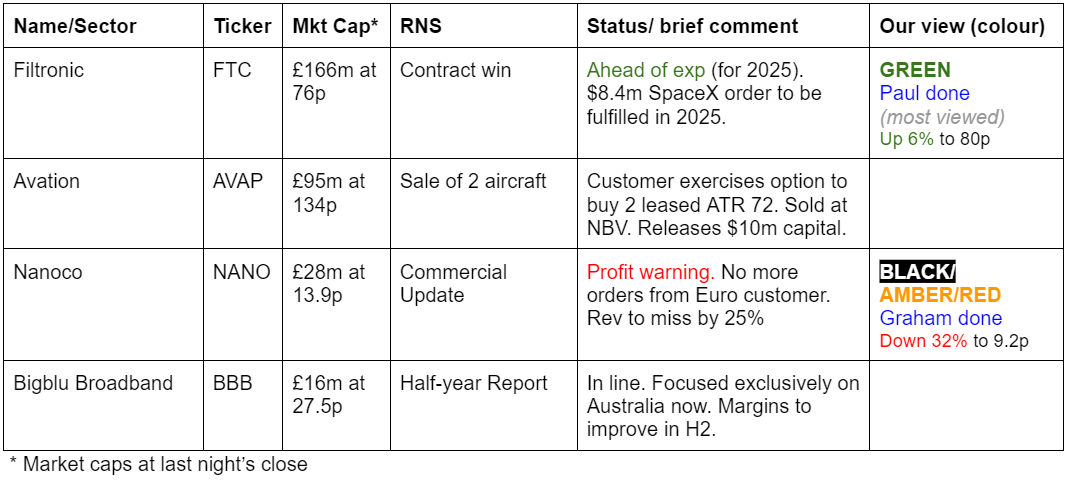
Filtronic (LON:FTC) - up 6% to 80p [08:21] £176m - Contract Win - Paul - GREEN
More good news with another order from SpaceX. Cavendish raises FY 12/2025 profit forecast by 20%. Shares still look reasonably priced, and it looks as if there's further upside. We've been very slow on this one, and I belatedly move us up from amber to GREEN. Well done to bulls, this looks an excellent situation, with more fuel in the tank for further rises, it seems. Although the bull case was already based on more orders being expected.
Nanoco (LON:NANO) - down 32% to 9.4p (£19m) - Commercial Update - Graham - AMBER/RED
I’m downgrading to AMBER/RED here as this is not one where I’d have any interest to invest, even if the current cash balance is slightly above the market cap. The company’s stated strategy to invest in its current commercial activities will see the cash balance decline and I don’t have faith that it will see profitability in the foreseeable future.
PPHE Hotel (LON:PPH) - £13.43 (£567m) - Graham - GREEN - see below for my notes from the company's IMC webinar and my Q&A with the company's CFO yesterday.
Paul’s Section:
Filtronic (LON:FTC)
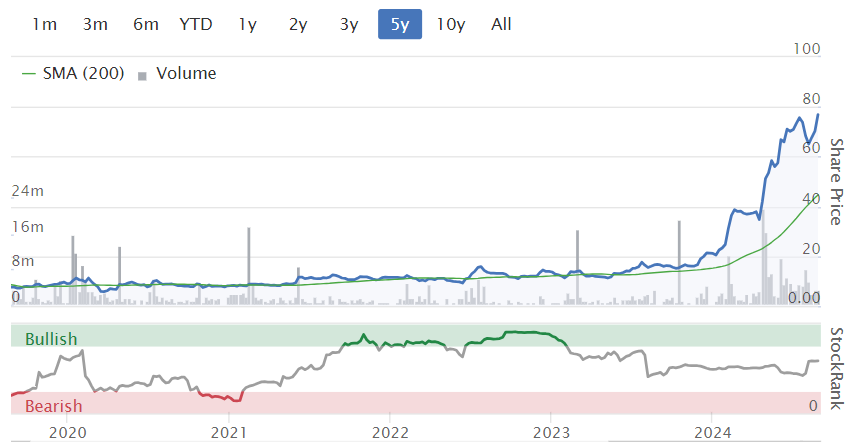
Up 6% to 80p [08:21] £176m - Contract Win - Paul - GREEN
Filtronic plc (AIM: FTC), the designer and manufacturer of products for the aerospace, defence, space and telecoms infrastructure markets…
More good news for the bulls today! -
“...is pleased to announce the receipt of a further follow-on production order from our partner SpaceX.
The order is irrevocable, valued at $8.4m (£6.4m), and represents a continuation of demand for the E-band solid state power amplifier ("SSPA") modules to support the ongoing deployment of SpaceX's Starlink constellation which provides high-speed, low-latency internet to users all around the world. It is anticipated the order will be fulfilled in calendar year 2025. Consequently, we now expect to trade ahead of current market expectation for FY2025.”
Broker update - Cavendish helps by quantifying the increase - raising its FY 12/2025 adj PBT forecast by a considerable +20% (old: £6.4m adj PBT, new: £7.7m).
In diluted EPS terms this is new: 3.2p, old: 2.7p. The 2025 PER is now 23.4x, which doesn’t sound a lot for a company that’s clearly hit the jackpot with a blockbuster product, and has the kudos of being involved with Elon Musk’s SpaceX (which has also been granted up to 21.7m warrants in FTC, vesting in tranches [10.86m vested to date] , potentially convertible into 10% of FTC’s equity, once it has bought $60m-worth of products). Full details in RNS dated 24/4/2024.
Paul’s view - this continues to look an exciting share. Speculation is rife that SpaceX might bid for it.
I don’t know why we’ve only been amber before, we should clearly be GREEN - very late to the party, but some subscribers here were ahead of the curve, with this share being discussed positively some time ago - well done to those of you who spotted the opportunity.
Graham’s Section:
Nanoco (LON:NANO)
Down 32% to 9.4p (£19m) - Commercial Update - Graham - AMBER/RED
Nanoco is “a world leader in the development and manufacture of cadmium-free quantum dots and other specific nanomaterials emanating from our technology platform.”
Here’s a Wikipedia article that might help shed some light on what these “quantum dots” are.
Paul covered Nanoco in March, explaining that after litigation with Samsung, it now had a large cash pile supporting its market cap.
But today we have bad news from the company: a large European customer (STMicroelectronics perhaps?) is walking away both from any further orders and from joint development projects with Nanoco.
The European customer has said “it’s not you, it’s us”:
Nanoco had achieved all of the required development milestones to date and had received positive feedback on the performance of the new material. Nanoco understands that the European customer's decision has been based on its own strategic priorities and not as a result of concerns with the performance of Nanoco's materials.
With this customer walking away, Nanoco will seek the “direct pursuit of already identified small scale market opportunities”, arising from the development work done to date.
Outlook
Revenue for FY July 2025 will be approx. 25% below consensus, that consensus being £9.5m. Development work with an Asian customer continues.
Chairman comment
"This is obviously disappointing news and reflects the nature of high technology supply chains for consumer electronics… Smaller scale opportunities are available for this technology in the short to medium term and we aim to address those niche markets directly and in partnership with other companies.
We also continue to work with our Asian customer in developing our second generation sensing materials, with commercial potential over the medium term. The Group's strong balance sheet provides us with the financial stability to continue this development work and our new business development activities."
Net cash balance
At the interim results (March 2024), the company said that after payments to shareholders and lenders, it would have a cash balance of £23m and was “fully funded through to cash breakeven, expected during CY25”.
At the year-end trading update (July 2024), the company said that it expected to have cash reserves of c. £20m at the end of that month. It admitted that the cash break even target for 2025 was now doubtful.
Today we have helpful new estimates from Cavendish: they reduce their net cash forecast for July 2025 from £15.8m to £12.9m.
Graham’s view
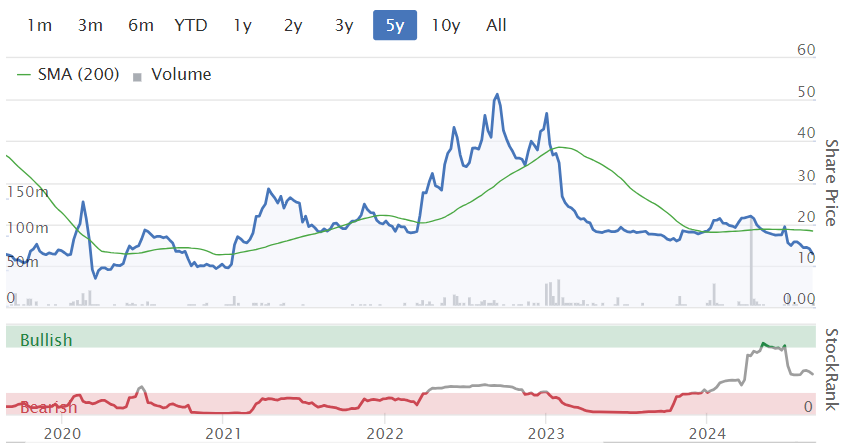
This is a cash-burning situation where personally I would not have much faith in the company making it through to profitability. That might be unfair, but I haven’t seen many advanced materials micro-caps achieve success, and Nanoco’s own track record doesn’t inspire confidence:
Therefore, even if the current cash balance is around £20m, above the current market cap, this is still one that I’d want to avoid. So I’m going AMBER/RED on this one.
PPHE Hotel (LON:PPH)
£13.43 (£567m) - Graham - GREEN
Yesterday was a great day for me when it came to studying PPHE. It started off with reading the company’s interim results (covered here), then attending their InvestorMeetCompany webinar with top management, and then finally having a 15 minute call with the CFO.
Many thanks to Andrew in the comments section here who submitted an excellent list of questions for me - as I only had 15 minutes, I didn’t get to cover them all, but I’ll keep them as ammo for the future! Many thanks Andrew.
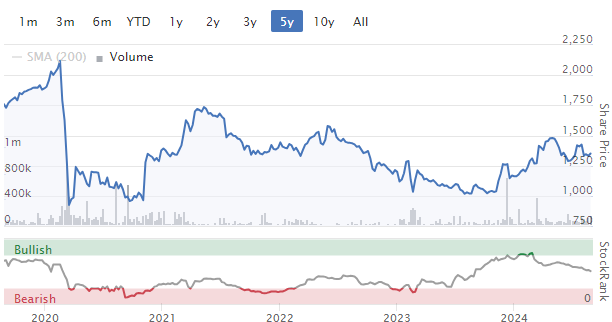
Context: I am positive on PPHE due to the steep discount its shares trade at, compared to its net asset value.
According to its balance sheet, NAV is £300m (the two major items are £1.4 billion of PPE, minus £900m of bank borrowings, plus various other items).
However, if you put the hotels at their most recently appraised fair values, under various different methodologies, the balance sheet gets an uplift of £800m for a “fair value” NAV of £1.1 billion. And yet the market cap is only about half of this.
Without further ado, here are the notes I took yesterday, both from the IMC webinar and from my own Q&A.
Typical debt profile: net debt for the group is about 30% of value currently. New debt taken on for new build hotels is about 60% loan-to-cost, but when a hotel matures its value is higher than cost and LTV should fall below 50%.
With interest rates currently at higher levels, PPHE is unlikely to borrow more or significantly increase its debt profile.
An important feature of the loans is that they are amortising (i.e. repaid gradually). 15-30% of the principal gets paid off over 5-10 years.
Debt is all fixed rate. Zero variable rate risk, zero interest rate risk until refinancings.
New York Project: a site was bought in 2018, then Covid hit. Building costs are up substantially now. Union legislation has changed, and the project is paused. PPHE is not currently looking to build a hotel on this site and would be happy just to recoup its value.
Discount to NAV (net asset value) (more on this later): it’s “weird”. PPHE has a strong pipeline with results coming. But it’s a complex company to understand. Refinancing of loans will help to prove the value of hotels. The share price discount was substantially less pre-Covid.
The value given to new hotels does reflect the risk of opening delays but it’s not the biggest factor. Their asset value does grow over the stabilisation phase (i.e. as the hotels mature), as profitable cash flows get nearer.
2nd £4m buyback: the company acknowledges that this doesn’t substantially move the needle. But they need to take liquidity into account. Shareholders should view the buyback as part of their total return, including dividends.
Hotel opening delays in Rome/London: the delivery of furniture and fixed goods from Europe was delayed. Additionally, Rome has been a complex market to develop in. Litigation around permits, licences and the demolition process. They do have good advisors but it’s a learning process. Rome to open in Q4.
Paris plans: it’s a target market and they’ve been looking at it for many years. But it’s incredibly expensive to penetrate. PPHE are disciplined investors, and more cautious than some. They want a high incremental return on investments, and so they have a high threshold to invest in Paris.
London: it’s becoming more challenging to develop in London. The planning process is particularly protracted now. PPHE has recently won a planning appeal after a development was voted down at committee level for invalid reasons. They are now second guessing new plans in London due to planning problems. It is easier to develop in Eastern Europe.
Maximising Revenue (RevPar, revenue per available room): the company tries to get the right balance between higher prices (average room rate) and filling more rooms (occupancy rate). A higher room rate is more valuable because the additional revenue goes straight through to profitability, whereas higher occupancy doesn’t boost profitability so much, as there are additional costs of serving more customers. PPHE could fill 100% of its rooms every night but it is not trying to. 2024 was more difficult than 2023, and the company had to work harder to fill rooms. But it still has another four percentage points to go, to get back to the occupancy rate of 2019.
US Dollar/Macro: the leisure months were rainy in London, leading to a decline in the average room rate as leisure travel tends to pay the highest rates. Leisure also has short visibility (2-4 weeks). Big currency movements can impact demand if they are substantial (e.g. 10-15% move in GBP). PPHE does enjoy a diverse geographical exposure which helps. Finally, a US Presidential Election does tend to cause a slowdown in travellers, a short-term reduction in demand, but it rebounds quickly afterwards.
My questions to the CFO:
1. PPHE seems complex to prospective investors. For example, the company publishes NRV (net reinstatement value), NTA (net tangible assets) and NDV (net disposal value). Which one of these should investors focus on and why does it give a meaningful description of the company’s value?
A. Yes, the company is misunderstood. And it is put into the “fear basket” of hotels and hospitality. There are many different business models in this industry: there are big players like Intercontinental Hotels (LON:IHG). There are those that own brands. There are those that lease hotels and pay rent. There are real estate investors that buy hotel real estate and don’t operate it, but instead pay a fee of 10% of revenues and get meaningful income that way.
PPHE does everything: it builds hotels, owns land, operates and rents. They do not pay fees out to someone else to operate. The value for PPHE is in the real estate itself. When it comes to valuations, PPHE can provide comparable transactions for similar properties using cap rates of 5-6% (i.e. an earnings multiple of 20x). But some people instead put PPHE in the purely “operating” basket where it would only get an EBITDA multiple of 10-12x.
There is complexity. PPHE has a level of debt and is involved in construction. £3 per share of value is tied up in new hotels in London/Rome. These construction projects don’t help P/E ratios, but their cost goes away after openings and they will have normal trading.
On the valuations provided, PPHE is obliged to publish all of the “EPRA” KPIs. NRV is an external value based on operating value. NDV is the value if sold. The share price discount is substantial and we don’t understand it. We were able to sell 49% of an asset (i.e. a non-controlling interest) to get through Covid. And our loans are refinanced by banks based on the banks’ own valuations.
When it comes to reported profits, the depreciation charge is based on the historical cost. The buildings are thought to be depreciating. But we think that 4% of revenues is sufficient to maintain buildings, and that’s the “real” depreciation. The buildings will not need to be rebuilt! So our adjusted earnings add back depreciation, then deduct 4% of revenues.
2. How are PPHE’s distribution costs evolving, especially with booking.com? Is there anything investors need to be aware of in relation to this?
A. We have a love/hate relationship with booking.com. We love their service, but we hate their bills! However, before booking.com, you would be trying to fill a hotel with cheaper “key business”, and only a minute element was the leisure business who would walk in or call you (and pay higher rates). After the arrival of booking.com, the cheap business has been displaced, the leisure market has expanded and this boosts revenues substantially. Not £1 of revenue is free, no matter where it comes from. But PPHE enjoys a strategic relationship with Radisson, part of JinJiang, one of the largest travel companies in the world. This means that PPHE can negotiate competitively for distribution. 13% is the average cost of acquisition.
3. PPHE has just published a negative PBT, but positive normalised PBT after adjustments. Will we see cleaner accounts next year?
A. PPHE is always transparent with its adjustments and investors are free to treat the adjustments as they wish, e.g. something like the fair value of derivative movements. PPHE adjusts it out, but investors can add it back in if they wish. PPHE takes out pre-opening costs, such as the cost of hiring staff before a hotel has opened, because they don’t think it’s a fair reflection of their profitability. In general, hotels need about 3 years before they deliver. The current pipeline should deliver an additional £25m of annual EBITDA when the new hotels stabilise.
Graham’s view: it’s a great privilege to be able to speak with top management at companies such as this - many thanks to Daniel Kos, CFO of PPHE for answering my questions! My view is that the company does need to follow through with cleaner and more profitable accounts next year, but I believe that it will do this and I think it does deserve to trade much closer to its fair-value NAV.
Disclaimer
This is not financial advice. Our content is intended to be used and must be used for information and education purposes only. Please read our disclaimer and terms and conditions to understand our obligations.

63 comments
PPHE Hotel (LON:PPH) I would like to add a further question for the management: They mention in their H1 report Continued diversification of the business mix, from predominantly leisure demand in 2023 to greater growth in 2024 from groups, meetings & events and corporate business travel." Q – Is this a long term change or just to fill a gap whilst new builds are made ready for bedroom occupancy, or the leisure market lifts?
Mello launched two networking events for the Autumn this afternoon and the links and info are on the Mello website. It is the tenth anniversary of the investor conferences in November
For those who want a loyalty ticket which is by far the cheapest then do book early as there are just 100 available and 17 have gone this afternoon. This is the link to the two day Anniversary show
Mello 10th Anniversary tickets – Mello Events
This is the one day London show...
Mello @ LIS tickets – Mello Events
Have a great weekend
David
NANO I got sucked into the hype on this a number of years ago. I lost money, naturally. It contributed to me swearing off story-stock for good.
Just buy solid dividend-paying stocks.
I've been watching a few vids on "ergodicity" lately. I might create a post of it. Luca's video has a good explanation without melting your brain.
Investing is a "non-ergodic" process. He explains this via a coin flip that has a positive expected outcome. You would think that you would get a positive outcome over time, but it turns out that you lose all your money. It's a non-ergodic process, meaning that the "ensemble average" does not equal the "time average". Don't let that put you off watching his video, as he does a good job of simplifying it.
Non-ergodicity was something that I intuited myself when my old firm had a night out where their was a casino where you got some free chips. There was no money involved, it was just a night of fun.
Monopoly seems to be a a non-ergodic game, too.
To finish first, you must first finish.
I think my investing style is being shaped along those lines.
There was an interesting comment I heard about a particular fund manager. The fund (whose name escapes me) always appeared in either the second or third quartile, but never the first or the fourth. It turns out that this led them to being one of the top-performing funds.
I could go on about this making my own observations, but I'll probably leave it at that right now and expand on it elsewhere.
Thanks for your post. John Lee was reputedly the first ISA millionaire using the dividend paying company approach.
Mark. Agree with your comments about story stocks. Disaster area for many small investors (have a quick check of ADVFN on shares like Nanoco (LON:NANO) . The more rubbish posts on those over there the more rubbish that share usually is).
I still go for the odd fun punt like S4 Capital (LON:SFOR) just in case Martin Sorrrell pulls something out of his hat and Plexus Holdings (LON:POS) with the buy based on Paul’s sort of optimism and where one day surely they will issue an update. But otherwise our portfolios are now full of quality big dividend paying shares and Investment Trusts and other quality shares and if those are small companies selected from the “green” rusted ones here, and that tactic works. I’ll post the 1 year performance of the big dividend payers over the weekend but on a separate thread as it’s off topic for this one.
Ken, of course depends on tax rate you pay, if outside an ISA. In that case if your a higher rate tax payer a total return might be better given the Div tax free amount is £500, Capital gains is £3000- and currently the CGT rates are lower than dividend. I expect the 8.75% basic dividend rate to increase though at the budget.
...you're a higher...
Hi Charles
Two points in reply. The obvious way to avoid capital gains and dividend tax is to have as much as possible in tax free Investment ISAs. A couple can add £40,000 every year which is a very useful amount. All our share and Investment Trusts are held in ISAs, and I no longer add additional funds as the dividends provide enough income for new investments.
Don’t hopeless buybacks like the Nanoco (LON:NANO) example in my post this morning make capital gains issues irrelevant?
Sticking to the Ergodicity theme, the Apollo Space Program was cancelled, officially running out of funding but it just wasn't all this, was it? Today, there is a conondrum going on at the Space Station exacerbated by a problem at the Musk floating landing platform. I agree with you Mark that investing must be non-ergodic, doing my weekly checks I noticed I have missed the bus in that Softcat (LON:SCT) has slipped beyond my selling point yet surely another bus will come along to enable me to take a larger profit. This among a host of holdings to which the Rule of 80/20 has to apply.
Quiet Friday idea - not quite blue sky
Franchise Brands (LON:FRAN) an international, multi-brand franchisor focused on B2B van-based service with 7 franchise brands and a presence in 10 countries across the UK, North America and Europe. The Group is focused on building market-leading businesses primarily via a franchise model and has a combined network of over 625 franchisees.
The Company owns several market-leading brands with long trading histories, including Pirtek in Europe, Filta, Metro Rod and Metro Plumb, all of which benefit from the Group's central support services, particularly technology, marketing, and finance. At the heart of Franchise Brands' business-building strategy is helping its franchisees grow their businesses: "if they grow, we grow".
The 2023 FY results caused the SP to drop 25% and saw the CFO depart. This fall was mostly in reaction to the profits dropping 50% due to acquisition borrowing costs for Pirtek and the fall in the price for used oil in the US at Filta.
They have committed to paying down the debt and in their recent AGM statement commented
As indicated in the recent 2023 final results announcement, Filta International's income from the sales of used cooking oil in the first half of 2024 was impacted by a 28% fall in the average price, which was only partially compensated for by a 15% increase in volume in the period. As part of the "FiltaMax" strategic growth initiatives, the range of services offered to our commercial kitchen customer base is being expanded with the addition of new bulk virgin oil sales and an eco-friendly kitchen cleaning service, which will reduce the impact of used oil sales in the future.
Looking at the growth of SAF for sustainable of flight, this could help underpin used oil prices in the future https://www.pressreader.com/ma...
The SP has recovered over the last two months and looks ready to head higher.
I like the mixture of business and geographic spread. Stocko marks it down on value, but I suspect that most franchises suffer the same fate - yes, just checked Mortgage Advice Bureau (Holdings) (LON:MAB1) and Keystone Law (LON:KEYS) [all holdings]
Like Sigmaroc (LON:SRC) [I hold] recent years have seen significant growth through acquisition with accompanying growth in debt and share issuance.
Provided the company focus on bedding in the acquisitions and paying down debt, profit and ROCE should return to growth
Negatives: debt, negative NTAV
Due to manifesto dishonesty, my impression is that UK investors are currently experiencing the start of a doom-loop....at least until 30 October. Labour appear to be talking everything down, blaming it on the Conservatives and scaring everyone daily... who have assets or any lifestyle choice that isn't compatible with theirs. The reality of the budget in 2 months time is likely to be less severe than the scare stories, but the harm done by the daily speculation about which tax is going to hurt the most is not going to help things at all. It has been caused by Labour not being honest.
What about all manifesto's having a costed budget in the back as a requirement before the election, not 2 months after? I reviewed all the manifesto's at the election and none had this. It would hold them to account.
The reality is that tax relief on pensions is the easiest and most reliable source of income. However, it will most impact Keir Starmer and his colleagues, so will be taken badly by highly paid non-risk takers. Capital gains tax, however, doesn't impact such people as they don't generally take as many entrepeneurial risks. It will scupper a generation of entrepeneurs though. The obvious solution is higher rate tax relief capped at 30% and CGT at a flat rate of 30% for higher rate taxpayers (i.e. nearly everyone soon)....keeps the incentive, but raises a lot of cash. That's my central view, for what it's worth.
Anyway, back to small-cap stocks. Chelverton UK Dividend Trust (LON:SDV) results are out today. Yields about 9% and David Horner at Chelverton has good small-cap stock picking skills, if you want high dividend payers. The downside is its too small and so ongoing costs are relatively high. I've found it a good leveraged vehicle to buy in a market sell-off (purchased in GFC and Covid sell-off) and always worth watching what he's adding and selling...if you are a dividend investor!
Interesting Topvest- though in Total return terms over 5 and 10 years Law Debenture (LON:LWDB) and Merchants Trust (LON:MRCH) (and others) have done better-plus larger and therefore easier to deal in. See the AIC UK Equity Income table. https://www.theaic.co.uk/aic/f...
Your identified 'optimum' tax (increase) regime is also reasonably fair. The very rich got hammered over the last 10 years in terms of relative tax burden whilst 'middle incomes' did proportionately well. The Conservatives, had they won, would either had to borrow enormous amounts or (finally) destroy the viability of numerous public services by death cuts. Labours aim at reducing the long term impact of Chronic obstructive pulmonary disease (COPD) which drains NHS capacity along with Type 2 diabetes, is an attempt to put a floor on the 'bottomless pit' of NHS spending. I was surprised when the new Home Sec rushed to write in the The Telegraph, but it now seems they all read it every day!
Nanoco (LON:NANO) today provides yet another example of the nonsense so many commentators and Companies spout about buybacks and how they supposedly “reward shareholders.” For every example where they do as is the case with Next (LON:NXT) there are so many more examples like this one from Nanoco (LON:NANO) today where they are a shambolic waste of money. If these Companies really want to “reward their shareholders” they should do so with real cash via dividends and specials or tender offers at a premium and not waste it on buybacks with no real cash and too often a “shareholder punishment” via a lower share price.
Nanoco (LON:NANO) returned £30 million to their shareholders from the payout they got from Samsung via a tender offer at 24p.
They also announced a further return to shareholders via a £3 million buyback.
“ As set out in the Circular, the Company will pursue an ongoing on-market share buyback programme of up to a total value of £3.0 million to provide a continuing value-accretive return of capital to Shareholders.”
Those who took up the 24p tender offer got real cash compared with just 9.3p today. Investors who continued to hold or decided to reinvest the tender proceeds to enjoy that “accretive return of capital” have suffered a 65% loss. How on earth have those buybacks rewarded shareholders? The shares bought back were cancelled.
Those buybacks were started at 21p and there was even a buyback of 189,000 shares yesterday at 14p!! The share price has fallen steadily ever since that first buyback in April, and has crashed on the bad news today by a further 32%.
Great example of how not to use on market share buybacks. The Samsung payment was an exceptional item and should have been returned entirely as a special dividend or B share. On market buybacks only work when a Board can be confident that the intrinsic value of the company is rising, eg RELX or Next. It’s wholly inappropriate for a loss making nascent company such as NANO.
Sorry but I disagree. I think the tender offer was a very good solution for the situation Nanoco found itself in in early 2024. Following the settlement with Samsung, shareholder sentiment was split between those who had been in the stock for the perceived litigation upside and those who believed in the technology. One story (the litigation) had ended (not for as high a figure as many had hoped). The tender offer provided an opportunity for those not enamoured by the technology story to sell and for those who were to hold on to their position.
If a special dividend had been paid - all shareholders would have seen a c50% reduction in position for everyone and then for one group (those who were not enamoured by the technology) to sell the balance and for another group (those who wanted to stay invested) to buy. This solution would no doubt have created higher costs (mostly trading costs) for shareholders.
Indeed, for any shareholder who wanted to mirror the effect of being paid a special dividend, they could have effectively elected this option by electing for a pro-rata tender.
Obviously, today’s news that STM is not continuing with the technology is unfortunately a body blow for Nanoco - and gives a negative signal for other companies planning on using CFQDs for SWIR/NIR technology. But that is the risk shareholders take on investing in small start-up businesses.
[I hold Nanoco (LON:NANO) - but a small position.]
Sorry, my comment was more about the ongoing share buyback. The tender offer was a sensible return of capital which was available to all shareholders who tendered. It was a shareholder judgement call. However ongoing share buybacks only make sense if the board believe that the value of the ongoing business is likely to increase. It is a judgement call by the Board and consequently very difficult for a company at a nascent stage of development, so really should not be contemplated.
Buybacks have turned into a mantra. People need to think rather than quoting lore.
I'll quote Prof Aswath Damadora: shareholder value is increased when the return on capital exceeds the cost of capital. Its value-destructive otherwise. That principle applies to share buybacks as it does to other investment options.
I recently criticised NVDA for making a share buyback of $50b when its shares traded on a PE of 70. Meanwhile, directors had been selling. For my troubles I was told that I had no idea what I was talking about. Of course the management carefully weighed up the buyback. Um, OK.
Yesterday I saw that Dollar General (NYQ:DG) fell nearly 30%. Someone commented "Dollar General management doing buybacks when the stock was at the tops.. now they don't".
The problem with buybacks is that they are often "pro-cyclical" rather than "counter-cyclical". That means that there is a big temptation to buy back shares when profits (and share prices) are riding high and they've got a lot of money ("pro-cyclical").
When business conditions deteriorate, so does the share price, but the company is cash-strapped. So they buy at a time they should be selling, and sell at a time they should be buying. I think housebuilders ran into this problem a number of years ago. They actually needed to raise cash at a time where the market was fearful and therefore raising equity was expensive.
DG is a US company, and the comments by the CEO is quite illuminating on what the economic headwinds might be:
our overall sales comes predominatnly from households earning less than $35k annually. Inflation has continued to negatively impact these households with than 60% claiming that hey have to sacrifice on purchasing basic necessities due to the higher cost of those items, in addition to paying more for expenses such as rent, ulitiies, and health care. More of our customers report that they are now resorting to using credit cards for basic household needs, and approximately 30% have at least 1 credit card that has reached its limit. And in our latest survery, 25% of our customers surveyed noted they anticipated messing a bill payment in the next 6 months.
At the risk of getting overly political, if the Democrats win the next election, don't expect economic hardship to get more benign.
You should probably expect Labour to have trouble containing inflation, too.
A question for any subscribers who have a SIPP with A J Bell that is in drawdown.
I am drawing income from my SIPP through monthly Uncrystallised Funds Pension Lump Sums (UFPLS). I have only recently checked A J Bell's calculation of my remaining Lump Sum Allowance (LSA) and Lump Sum Death Benefit Allowance (LSDBA), following the change from LifeTime Allowance (LTA) to LSA and LSDBA on April 6th. By my calculation A J Bell have got this wildly wrong. I have asked them for details of their calculation but have yet to receive any reply.
Has any other subscriber experienced any problems with the changes from LTA to LSA/LDBSA?
Thanks for any help
Martyn
I think the distinguishing fact may be that you were already crystallising benefits when applying for the certificate?
The advice I received from Hargreaves (which don't offer UFPLS) was to get my interim tax-free certificate before commencing crystallising transferring into a draw-down account. They also offered to speak to me if their calculation was going to result in a lower figure because once issued they can't be amended, apparently. My circumstances weren't straight forward as I'd made sigificant transfers into a QROP in the past, but by a quirk of the recent legislation still got the maximum tax-free lump sum.
On a general point unless you need cash free cash to, say, repay a mortgage then taking funds out of a tax and currently IHT-free wrapper doesn't make sense. It's more tax efficient to take UFPLSs as you need them, albeit that the tax free amount is frozen and therefore falling in real terms.
Many are anxious about the prospect of Reeves making unhelpful changes to pension pots in the budget. The only real defence is to crystallise now by putting the SIPP into draw-down and taking tax-free amount if that suits you. My view is these changes are unlikely now: reducing the tax-free allowance would be politically damaging, its already capped in real-terms and Starmer personal suggested otherwise during the election; and re-introducing the LTA or similar would take at least a year to do but they would do it if they could.
The real tax opportunity for Reeves would instead be to replace all pension contribution tax relief with a flat rate of probably 25% which would mean "ordinary working people" would be better off but high earners wouldn't and a massive boost for the Treasury (>£10Bn). However that creates massive problems for highly paid GPs, NHS doctors etc and it becomes difficult to carve them out and impose the cut in relief on all others.
Lets see.
Hargreaves does offer UFPLS - I've taken nine annual payments from them.
I've had the opposite experience, though my UFPLS payments were from another (non-AJ Bell) SIPP.
I just took the rest of my lump sum (including protection) from my AJ Bell Sipp and their calculation agreed with mine.
Mike
CGT. Increase question 2 parts -
Have a question for the clever ones on here .
1/ Pretty sure I know the snswer but want to ask the audience .
- if CGT shoots up in budget to say 45% i n October
- if I sold a chunk of shares with CGT gains in September but obviously complete my tax return in April
Is the CGT payable on the rate at day of transaction or at date of filing tax return ? Logic implies date of tax return
2/. CGT rollover relief.
Due to rollover relief if you made a large Capital gain (by the forced gain eg takeover) you can then simply reinvest in qualifying asset so the CGT doesnt get paid across but rolls forward as a re-investment
Sorry logic is transaction date not rax return date
Best we can hope for is the theory that just talking about raising CGT makes people brings in a lot of revenue as people bring forward sales. Otherwise it's hold your winners until the next Tory government takes it back to 20%
The critical date is the date of the budget. It's bad practice to make taxes retrospective, so they normally come into force either at midnight of budget day (or maybe a day or two later) or, much more commonly, as from the next tax year.
Agreed virtually cannot make it retrospective but during the budged speech the Chancellor can say "from today" or identify another date in the near future the following change will become effective.
Holdover and gift reliefs are complex.
Gains from the sale of listed securities can't be rolled into another holding of listed securities. However, there are more tax benefits available for AIM-listed shares which qualify for Business Property Relief.
These are explained in the following guide >>>>>> https://docs.londonstockexchan...
Essentially, a holding in AIM can be gifted to a family member with the gain "Held-over" and payable by them when they eventually sell. The IHT benefits of AIM shares, once established after 2 years of continuous ownership, then pass to any subsequent qualifying holding without the 2 year clock being re-set.
chargeable gains made on the sale of any listed security can be "rolled-over" into an investment in EIS shares which will also qualify for 30% income tax relief. These are risky including no liquidity, although secondary placings by some qualifying AIM-listed companies can benefit from this and there is then liquidity although you can sell for 3 years.
Dialight (LON:DIA) Anyone know what is pushing the price up with Dialight?
CEO bought shares RNS
Filtronic (LON:FTC) it was Donald Pond (take a bow Don) who alerted us all to Filtronic with a brilliant post about nine months ago. I've done very well out of it, as have lots of us suspect!!
I'm intrigued though Paul that you are GREEN on it now. I think before you felt the valuation was hard to justify? Today's announcement doesn't necessarily alter that does it? Space-X was already deeply entrenched....
I think Richard Staveley and Rockwood were one of the first to flag it and openly discussing the technology its applications and its at the time customer who couldnt be named .
That was when SP was circa 15p .
Worth watching and listening to that man due to the very detailed understanding he has of the companies they take a hold in.
In an interview in July 24 Richard Staveley said that he thought that Filtronic sales could go up by 5x.
I see that independent market research is suggesting some 60,000 LEO satellites by 2030. Google tells me there are just under 10,000 circulating in June this year, (of which 6,646 belong to SpaceX). So 5 a fold LEO satellite increase would make Richard's sales prediction credible.
Filtronic (LON:FTC) is operationally geared so assuming sales increase in line with the market, its future earnings/share could make the current projected earnings look meagre!
Hi iwright7 & planetx
Reference Filtronic (LON:FTC) below is a Vox Markets (Paul Hill) interview with Richard Staveley from 3rd Jul 2024. The Filtronic (LON:FTC) segment starts at 10:22 mins.
I don't hold yet.
I looked at Filtronic (LON:FTC) quite a while ago but will look again with this new order from Space X (as I follow Elon closely).
Coincidentally, just yesterday I researched whether a Starlink internet connection would be better for my needs.
Regards
Howard
I bought some Filtronic (LON:FTC) today. I can't believe I'm so late to the party, I follow all things SpaceX and my largest holding is Tesla (NSQ:TSLA) No idea why I didn't jump on this Months ago.
Oh well, still looks a good opportunity at this point in its story.
Sorry Paul, announcing my trades, but I think it's relevant as I'm interested if others are buying at this price.
Filtronic (LON:FTC)
'research is suggesting some 60,000 LEO satellites by 2030'
Maybe. Though its far from clear how many of these constellations are needed? Or how many will get funded and built? Normally a fraction of those being proposed? Not all the constellation designs will need the extremely high frequencies and power levels at which Filtronic (LON:FTC) excel?
My understanding is that the SSPA's supplied by Filtronic (LON:FTC) are for the network gateway or 'backhaul' Earth Stations - not the spacecraft.
Space-X tends to keep the space hardware in-house and its the E-Band uplink (@86GHz) from the gateway earth stations to the constellation which needs the highest power now available.
Right now that's Filtronic (LON:FTC) whose 'special sauce' has always been combining power output efficiently at crazy high frequencies.
How many 'back haul' earth stations are required? Normally a lot lower number than the number of spacecraft in the constellation. That would depend upon the network design.Well done to those who bought Filtronic (LON:FTC.). it was on my watchlist but I've managed not to buy it on more than one occasion - to my annoyance. So I'm still watching from the sidelines at the moment. I wish them well - it's great to see high-tech UK companies succeeding - we need a lot more of them?
cheers
Mark
60,000 LEO satellites ? Quite seriously is there a company working on helping these things avoid crashing into each other...?
I do vaguely remember there being such a company in the portfolio of Seraphim Space Investment Trust (LON:SSIT). I think capable of viewing 2cm objects from 1,000 miles or thereabouts. Seriously!
60,000 sounds a lot, but if there were only 60,000 cars on the surface of The Earth you'd not see one very often.
Hi doctor dave,
Remember with our colour-coding we're reflecting the latest news, not trying to be psychic or tip things.
As I highlighted in the article above, with the 20% broker upgrade today, FTC now has a 2025 PER of about 24x, which given the strong growth (and prospects for more) now looks quite attractive to me. Hence moving up from amber to green.
Back in Jan 2024 the 2025 broker consensus was only 0.58p - we have to go on the facts, figures & forecasts at the time of each report.
Today, the 2025 forecast is now 3.2p, about 5.5 times what it was in Jan. Hence despite the shares going up nearly 4 times, the earnings forecast has gone up more, hence why I think valuation is actually now more attractive.
Obviously the clever bit is to do your own, much more detailed research, and find the companies where forecasts are far too low, in advance!
With hindsight, we should have moved up to amber/green some time ago, but never mind. Amber is still good, and the latest data from Phil Hanson's spreadsheet shows that green, amber/green, and amber all do really well - far better than the lower ones -
So I'm happy that we didn't actually say anything negative about FTC's fundamentals, just pointed out that the shares looked expensive on the old forecasts (which they did). Doing your own research would enable you to disregard that point, and make up your own mind.
Regards, Paul.
Thanks Paul. Not criticising just intrigued to understand. Thanks for the explanation. I had thought broker estimates were already at 3p but probably mistaken.
Just for the lack of doubt and not wishing simply to blow smoke etc (what a strange expression, who would like that???) your analyses are terrific and I always take note of them. dd
What's really pleasing about this how the ratings go down monotonically, suggesting that you guys have a refined sense of judgement.
Valuation is still a problem in my eyes due to huge single customer risk. It's even worse in FTC's case as it's all the same product! Unless you know where in the product lifecycle the SpaceX LEO gear is, then I don't know how you can value FTC. It's been great for AIM & those who got in early, but buying today feels high risk to me.
Avation (LON:AVAP) announces sale of two aircraft and price goes...oh....down. Weird. Admittedly only sold at book value but £10m in the bank.
A previous sale was at well above book value and Avation rose on the assumption that the fleet as a whole might be undervalued. This sale tends to take the wind out of the sails of this assumption so some of those that bought in may have decided to cut their losses.
That might make sense, if it were not for the fact that Avation (LON:AVAP) is trading at a 50% discount to book value - so selling aircraft at book value looks a pretty good deal.
Agreed it helps confirm book value but the previous sale was more bullish if I remember rightly. I hold, am reassured and will continue to hold but am still down slightly on my purchase price. Unfortunately, I suspect Avation will always trade at a chunky discount to NAV.
I believe Avation (LON:AVAP) used to trade at a much tighter discount pre pandemic, but agree unlikely for the discount to close meaningfully any time soon. The best hope is probably a takeover - indeed this was previously a target but fell through around the time of the pandemic if memory serves me correctly.
I have a small position - my main rationale is that they provide a very geared exposure to a further recovery in the aircraft market. Given their high level of debt, interest (and depreciation) currently wipe out most of their revenues, but it would only take a small rise in leasing revenue to see substantial rise in cashflow. Same applies to the balance sheet - NAV is currently the small difference between the aircraft and the debt, so even a modest rise in aircraft values should see a decent rise in the NAV.Avation (LON:AVAP)
The previous sale was a new ATR they had received - not a second hand aircraft that had been on lease where the lessor had an option to buy the aircraft.
The new ATR price effectively highlights the value of the 32 options they have over new ATRs - this hasn’t gone down.
The 2nd hand resale values show that prices are stable/upward trajectory
Note: the broker references the TNAV as 250p (per previous accounts). The ATR valuations means it’s more like 275-300p but of course this hasn’t been announced yet.
Hi doctor dave.
My thought was that, as the AVAP disposal was a customer exercising an option to buy an existing leased aircraft, then I assume the contract would probably have contained a clause with a pre-determined price, or mechanism for calculating the price.
Hence the disposal price vs book value may not necessarily be anything to do with open market value. That's a guess, but I'd be interested in hearing from anyone who knows how aircraft leases are set up re options to buy.
Regards, Paul.
Good point Paul, well made. You have obviously read the RNS and drawn the right conclusion methinks.
Avation (LON:AVAP) not known for their lengthy or fully explanatory press releases
I hold
Paul, I was just about to offer my congratulations on reaching 10,000 posts but it seems stockopedia's maximum is 9,999. A gentle request to upgrade to the tech guys to upgrade the software and we can get the bunting up next week.
For those who are following the fortunes of Zotefoams (LON:ZTF) (I hold) there was an interesting article a couple of week ago in packaging world (https://www.packworld.com/seco...). Looking back through discussion history on Stockopedia I couldn’t find mention of it so thought I would flag here, as it indicates a deal has been made with another company (Censo) to reduce lead times and increase production of the equipment needed for clients to use ReZorce. The article also sets out a timeframe for this work to commence.
Smurfit WestRock (LON:SWR) don’t know how likely they are to actually get paid but if it happens ought to be good for the SP! (I am a long term holder)
“Global paper producer Smurfit Westrock SWR.L has been awarded a $469 million arbitration ruling against Venezuela by the World Bank's International Centre for Settlement of Investment Disputes (ICSID), the company and the tribunal said.
The decision grants the Dublin-based company compensation for the 2018 seizure of its assets in Venezuela in excess of $468.7 million, legal costs of $4.5 million and interest until the date of payment, Smurfit said in a release on Thursday.”
Great news, I hold, and appreciate that Ireland always seem to have better luck than the UK in any kind of arbitration.
Morning Paul - I've been meaning to say I really like the macro commentary at the start of the podcasts. Really helpful. I personally prefer it at the start as I don't always get to/listen to the stock recaps if I am short of time.
Speaking of macro points, has anyone looked at whether the possible changes to capital gains tax being trailed in the press in advance of the Budget might have implications for REITs/property companies? My assumption has been that the government would close possible CGT loopholes, or bring more into scope of CGT, rather than necessarily increase the rate - although I appreciate in recent days the press has speculated about whether CGT could be brought into line with income tax levels.
I don't think REITs are exempt from CGT are they?
I own Supermarket Income REIT (LON:SUPR), Palace Capital (LON:PCA) & Tritax EuroBox (LON:EBOX) although I am not sure how the latter is affected by CGT given their properties are in Europe. A lot of the REIT values are still quite bombed out generally due to worries interest rates will remain higher for longer so it's an attractive sector although the risk with many is they are facing materially higher finance costs if they need to renegotiate bank loans soon.
Could Reeves hit the UK with the most punishing capital gains tax in Europe?
https://x.com/CityAM/status/18...
How can anyone ever trust a "manifesto" or what politicians say.
I don't think REITs are exempt from CGT are they?
https://www.gov.uk/hmrc-intern... seems to imply that they are? At least in most cases if I have understood this correctly?
" Gains made on assets that are used in the property rental business are not chargeable gains (CTA2010/S535)
Gains not chargeable are those arising on disposal of assets that have been used wholly and exclusively for the purposes of the property rental business throughout their period of ownership (CTA2010/S535(2)). There are extensions to this rule to deal with assets that have been used partly or wholly for residual business purposes (see IFM25010), including a de minimis rule for assets where residual use has been insignificant. "
I have plenty losses on SUPR and EBOX ETC will not need to worry about CGT
Nice for a company Filtronic (LON:FTC) to announce a new order that allows it to say "expect to trade ahead of current market expectation for FY2025." Often new order announcements don't seem to have an impact.
My morning smallcap tweet: Blue sky in the morning, investor's warning
Nanoco (LON:NANO) Zenova (LON:ZED) ReNeuron (LON:RENE) Filtronic (LON:FTC), Bigblu Broadband (LON:BBB)
◄Nanoco (NANO)► Warns FY-July25 rev 25% below consensus forecast of £9.5m. Following a customer says it won't order any more first generation sensing products, the customer has served notice on the two year Joint Development Agreement for second generation sensing materials. Customer cites own strategic priorities, not performance of the materials. Continues to work with an Asian customer second generation sensing materials. [SP=13.9 Cap=28m]
◄Zenova (ZED)► a wet-blanket RNS from the fire safety tinpot as it warns H1-May rev only £51k (£108k) and post-tax loss £478k (£709k). Blames "delays in advanced product certification awards required to enter key market segments and weather-related delays at a major customer". Should have warned before now! Co believes it has sufficient working capital. Outlook - "Closing recently on additional major sales and distribution agreements further enhances my confidence in the ability of Zenova to scale up and deliver on the increased international interest". [SP=1.1 Cap=2m]
◄ReNeuron (RENE)► hopes it can can exit Administration on a going concern basis. Little interest shown in a fundraise, proposes de-listing. [SP=3.28 Cap=2m]
◄Filtronic (FTC)► wins $8.4m contract from SpaceX for delivery in calenday 2025. [SP=75 Cap=164m]
In line: BBB
Please don't ever stop those parables at the beginning.
Trading updates at night, investors take fright.