Small Cap Value Report (Fri 8 Feb 2019) - DWF, MYSL, EUSP, HDD, EPO

Good morning!
I'm back for one day only, to give Paul a break. A few stories popping up on my radar today:
- Confirmation of intention to float by DWF
- MySale (LON:MYSL) trading update
- EU Supply (LON:EUSP) trading update
- Hardide (LON:HDD) fundraising
- Earthport (LON:EPO) improved offer
Graham
DWF - Intention to float
Confirmation of intention to float
It continues to amaze me that firms which traditionally would have stayed private, are now selling their shares to the general public.
Another example of this today with DWF, the international law firm headquartered in Manchester.
Law firms are perfectly good LLPs, and they've always been LLPs. Why is now the right time to take on the PLC model? And can they really function as publicly-listed PLCs? I suppose we will find out.
The simplest explanation for me is that there's still quite a lot of complacency out there, and that this has manifested itself in the flotation of companies which would never ordinarily float (not only because investors wouldn't bite, but also because the companies themselves would want to stay private, for the sake of their long-term futures).
Another example of this complacency in my opinion is the property portal On the Market (LON:OTMP), which Paul discussed on Wednesday. This was a mutual organisation which demutualised, and yet its strategy now is to continue acting as if it were a mutual (i.e. to act for the benefit of its customers, rather than its shareholders). In other words, it wants to have its cake and eat it, too.
I used to work for a mutual organisation, so I have seen how they work from the inside. There is nothing wrong with being a mutual, but I would never want to own shares in one. The whole point of the thing is to serve its customers, not shareholders! So shares in a mutual which don't come with the privileges of being a customer are unlikely to generate a good long-term return, in my view - they are a structurally bad investment (disclosure: I own shares in Rightmove (LON:RMV) ).
Similarly, law firms are a structurally bad investment. Why work for a law firm which has to pay out a percentage of profits to external shareholders, when you could work for one which pays out everything to staff? In the end, the external shareholders will be nothing more than a drag on the company's competitiveness. Combine that drag with an acquisition strategy, and you have a recipe for disaster.
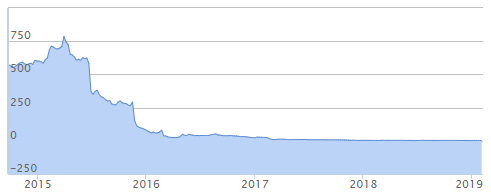
Back around 2015, I made a quick profit shorting the Australian law firm Slater & Gordon (SGH), whose shares are now almost worthless versus their previous value:
UK listed law firms so far include Gateley Holdings (LON:GTLY), Knights Group (LON:KGH), Keystone Law (LON:KEYS) and Gordon Dadds (LON:GOR). I tend not to do any shorting these days but I might keep an eye on these as potential candidates, along with DWF. DWF's potential market cap should allow for much better liquidity than the others, but beware that the opening free float will only be 25% of the company's shares.
MySale (LON:MYSL)
- Share price: 20.95p (-8%)
- No. of shares: 154 million
- Market cap: £32 million
MySale Group plc (AIM: MYSL) (''the group''), the leading international online retailer, today provides a trading update for the six months to 31 December 2018.
Paul commented on Mysale's profit warning in December. The Australia-focused online retailer announced then that it would make an EBITDA loss in H1, and guided for "a small underlying EBITDA profit" for the full year.
The company reiterates this guidance today, with cost savings and improved margins set to generate a "significantly improved performance" in H2.
We also get more detail on what happened in H1. The gross margin weakness is pretty bad: down from 30% to 23%. Especially since i thought that it's strategy was to grow its gross margin by holding its own inventory - so how could margins fall?
Active customers also fell, by 7%. I'm not aware of any disposals that might have triggered that reduction. So it shrank on an underlying basis.
The cash position improved, and this seems to be the only bright spot. Net cash of A$2.7 million. With sales down 17% and a lower working capital requirement, it makes sense that the company could convert some of its inventory back to cash.
CEO comment:
"The group has a strong balance sheet and the anticipated improvements in working capital are being achieved and cash balances increased. We believe the reconfigured business will be stronger, more efficient and continue to provide a compelling consumer offer and deliver unique solutions to our brand partners.''
Brokers are leaving their forecasts unchanged, so the EBIT forecast for FY 2020 is A$5.5 million (about £3 million).
I can see how a short-term recovery to profitability could happen through cost savings, rationalising operations and disposing non-core businesses. I'm less clear on why we should expect sustained organic growth and strong returns in the core business. It's a collection of clearinghouses for cheap clothes - nothing wrong with that, but I don't know what the competitive advantage is. So I'm happy to leave this for others to dabble in.
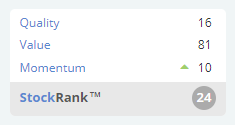
The StockRanks continue to view it as a Value Trap, and it passes a short-selling screen.
EU Supply (LON:EUSP)
- Share price: 10.5p (-2%)
- No. of shares: 72 million
- Market cap: £7.5 million
This is a small, growing software company. It provides something called Complete Tender Management (CTM), which is "a comprehensive tool that allows tenders to be created, distributed and evaluated without the need to create and manage paper documents". So it's a modern way of doing the tender process.
Key points for FY 2018:
- Revenue +10% to £5.1 million, slightly below market expectations. Most revenue is recurring.
- Maiden PBT of £0.4 million, materially above market expectations. The company discloses that this includes a £0.3 million boost from capitalising development costs.
- Development of a "micro procurement solution" is proceeding according to plan.
My view
This could be worth researching in more detail - it's great when a small company crosses over into profitability, and can fund its own growth from a stronger base.
The StockRanks no longer view it as a Sucker Stock, instead describing it as "Style Neutral".
I'm open to the idea that this could be a winner. It has perhaps failed to catch the market's attention yet, or get rewarded for today's earnings beat, because its top-line is still very small, and 10% sales growth in 2018 isn't exactly mindblowing.
That said, it has been making steady progress. And if the revenue is truly recurring, that gives it a nice tailwind for the future.

Hardide (LON:HDD)
- Share price: 1.6p (-9%(
- No. of shares: 1700 million (pre-Placing)
- Market cap: £27 million (pre-Placing)
Fundraising & Share Consolidation
I've been getting up to speed on this maker of patented coatings for metal parts.
Checking the archives (always very useful), Paul has previously flagged up the concentration risk with Hardide's customer base. The 2017 annual report confirms that the top 3 customers accounted for almost 60% of the company's revenue - way too much for comfort.
At the 2018 preliminaries, the company said it was making progress diversifying, but also that this diversification was taking longer than it would like.
It has been well-supported by investors despite mostly losing money, with £11 million of losses having accumulated on the balance sheet as of September 2018.
Today's proposed fundraising for £3.6 million, at a proposed price of 1.5 pence, will enable it to replace its UK facility (it is also active in the US). It has identified a new, modern building with double the floor space, and wants to invest in additional machinery.
The positives:
- strong revenue growth in 2018 (though at lower margins)
- oil and gas sector is currently strong, and O&G customers predict that conditions will remain favourable
- discussions with Airbus and its partners ongoing
- currently developing parts for other aerospace manufacturers
My view
Another one that could be worth a look, it has well-defined intellectual property in the form of patents and appears to be highly valued by its customers.
There is no point in looking at a P/E multiple at this stage. If we look at the forward price/sales multiple instead, it seems rather adventurous to me at about 5x. For a business with lumpy sales and exposure to cyclical industries, I would want bargain pricing. So I am inclined to agree with the Value Rank of 10 attached by Stockopedia.
Earthport (LON:EPO)
- Share price: 44.2p (+14%)
- No. of shares: 623.5 million
- Market cap: £275 million
Vsa - Increased Recommended Offer
Mastercard is Considering its options
What a dream for shareholders! Not only does Visa increase its bid to 37p (its second bid for the company, after Mastercard offered 33p). but Mastercard is still lingering and "considering its options".
Well done to anyone who owns shares in this company, which makes cross-border payments faster for its customers. It made huge losses for many years, but built a product which the big boys clearly want.
The current share price of 44p says that Mastercard is likely to come in with an improved offer. It would be understandable for some shareholders to take risk off the table at this point, unless they have huge conviction in the value of the business.
I think I'll leave it there for today. Paul will be with you next week!
Cheers
Graham
Disclaimer
This is not financial advice. Our content is intended to be used and must be used for information and education purposes only. Please read our disclaimer and terms and conditions to understand our obligations.

30 comments
Just a quick comment on MySale (LON:MYSL) trading update.
I bought some shares in this online flash sale retailer in July 2018, after an upbeat trading update.
It seemed very strange to me that, within a few days, the shares continued their downward spiral, despite this very upbeat update.
I gave the company the benefit of the doubt, and bought more. It continued going down. Then a bombshell profit warning in Dec 2018, which explained why the share price had been so weak - all sorts of problems had emerged, including a hike in VAT for online transactions in Australia.
After licking my wounds for a little while and wanting to give the company the benefit of the doubt I've since decided that I don't trust the company any more, so have ditched my long position for an unwelcome loss.
Lessons learned? This experience reinforces my aversion to overseas companies trading on AIM. The trouble is, as a UK shareholder, how can I possibly know the ins & outs of Australian tax law for online retailers?
A few bears on this stock thought that it was going to run out of cash, which looked wrong. The company had simply spent cash on increasing inventories, and making acquisitions. I don't remember any bear suggesting that VAT changes were about to clobber MySale. So bears got lucky on this one, rather than doing any correct analysis.
The market cap now is peanuts, and the Directors do seem to be making some progress on turning it around. But the bottom line is that, for me, anyway, the trust is broken, and I won't be revisiting this share again, at any price. Some you win.... (and plenty you lose too!)
Regards, Paul.
"Sports Direct International plc ("the Company" or "the Group") confirms that it has made an offer to acquire the business comprising the trade and assets of Patisserie Holdings plc and its group companies out of administration."
One more reason to shop on-line.
Wow
Graham, I disagree with your argument about legal services firms. Your argument is "why work for a law firm which has to pay out a percentage of profits to external shareholders, when you could work for one which pays out everything to staff?" If this argument was valid then the same argument would apply to other services firms e.g. IT services.
Look at Accenture. It emerged when Arthur Andersen split in two. The audit side continued as a partnership and the consulting side listed on the NYSE. Accenture has gone from strength to strength and the audit side went bust.
Or look at smaller exampes e.g. Scisys (LON:SSY). Why would anyone want to work for Scisys when they could work in a partnership structure?
Maybe you think that all such companies are doomed. If so, you should say so and not restrict your argument to legal services. If not, you should say why legal services are a special case.
I'm not saying these are great companies, I'm just examining the logic of your argument. Keep up the good work, I always read when I can.
cmpeckham, to answer your question directly, I have a track record of caution with regard to investing in all types of professional services firms. Architects, accountants, legal, consultancy, etc. I am aware that Accenture ($ACN) stands out as an exception, a consultancy which has also been a fine investment.
I also have a track record of caution with respect to generic "managed services" IT companies.
I also disagree with the negative comments about law firms.
The fact is that most partners in law firms set up as LLPs or conventional partnerships will only ever be able to build up capital equal to their share in the net assets of the business. When they leave they will be paid their capital but nothing for goodwill. With an IPO they will be able to receive their capital plus a goodwill payment because the flotation price will normally be above net asset value.
In most cases they will take some of their capital as shares in the new PLC. Although their base salary will probably reduce compared with their previous profit share, they will also receive dividends from their shareholding and will be able to participate in the future goodwill of the business as it expands and the share price increases. The value of their equity in the business should increase at a greater rate than if they had remained as a partner in the LLP.
Yes, they could leave and start up again but why do that when they could probably earn more remaining with the PLC and receiving a salary plus dividends and help to increase the profitability of the business and thus the value of their shareholding.
I think understanding the remuneration is key to understanding why a flotation in good quality law firms won't necessarily be a bad investment, and goes some way to answering one of Paul's points.
Usually, in most commercial law firms, partners will get a (sort of salary) each month, and then get a share of the profit pool at certain points in the year when the business is relatively sure of what it is going to get in. These are the partners' drawings, but, in effect, it's the same as receiving a dividend. So not much has changed here, except that some dividends will now be paid out to third party shareholders. However, for a long time, like everyone else, law firms have relied on banks for funding, so if an equity raise could remove any debt, you would remove interest payments.
To me, what DWF is proposing doesn't change the current remuneration structure so much that it does anything to reduce the partners' incentive to bring in good quality fee paying work, as Paul queries. They still want to bring in good clients, with profitable work, to fund the dividend pool.
What sets apart the best firms, of whatever size (like most businesses), is the ability and enthusiasm to collect in the cash from clients. Some solicitors (like other professionals) are totally useless at this, as it was traditionally deemed unseemly to talk directly about cash with clients. So as Paul says, you want to watch the cash collection and debtor days/amounts metrics particularly closely.
Finally, I would say it's essential to understand the type of work the specific law firm does, and they absolutely cannot all be lumped together. Some types of work lend themselves to prolonged payment periods, such as contingent medical negligence litigation. It can result in decent payments, but a long way down the track. The "best" type of work to look out for would be a continuous and well mixed stream of commercial work (not too reliant on property) such as M&A, property, commercial contract, intellectual property, construction work etc., mixed with a strong commercial litigation practice (as opposed to personal injury/medical negligence/consumer claims), which can smooth out the business cycle somewhat.
Like any industry, some will be good investments and some will be Slater & Gordon.
The other point on this is that younger lawyers who have ambitions to become partners are being attracted to the PLC law firms because of the ability to build up equity through share ownership. This means that not only can they participate in the growth of the firm, but they can also cash in part of their investment at any time if they need extra cash. This compares with the LLP structure where it is very difficult to release capital without affecting the firm's cash flow.
If PLCs can attract the best young talent in this way, then that bodes well for the success of the business going forward.
has anybody got any clue why keywords studio has fallen 10 pc today
Post 2366 on advfn suggests a few - sector in downtrend, Keywords Studios (LON:KWS) cross-selling strategy not working out, clients beginning to diversify their suppliers. No idea how true this all is but the poster sounds to have industry knowledge
has anybody got any clue why keywords studio has fallen 10 pc today
No obvious news today for this drop that I can see, the points mentioned on ADVFN post seem reasonable.
For me, the chart says everything, sp halved in less than six months. The stocko rank of 'fallen star' could well be on the money here. This is still a great business but like a lot of techs on high ratings has got spanked. I have no position but is going on my watch list but fear we are in falling knife mode at the moment.
D.
On Keywords Studios (LON:KWS), I suspect the fall relates to what some of the others have posted.
It's worth having a look at the corresponding share prices of the large publishers - Activision, TakeTwo, EA etc. All of them have struggled of late, some are down more than 50%; other smaller studios have been closed. One of the main reasons blamed is the "Fortnite" effect; in other words, popular free to play games cannibalizing the market and meaning gamers are opting for these "free" games and not stumping up the $50-60 for a full priced game. I'm not an expert, but the perception I've read is that 2018 was a one-off and this year is expected to be more "normal".
EA posted some pretty bad results last week, which resulted in a sell-off in the sector. I think Activision has results this Tuesday. All of these companies are big clients of Keywords Studios (LON:KWS) so I think any troubles they have, or them pushing back/delaying AAA titles will result in a read across for KWS.
I have a smallish holding in KWS (2%) and intend to keep holding it as it is a key growth sector despite the above headwinds. Gaming has over taken the video and music industries, and I think it is accelerating. BBC reported earlier in the year that the "gaming industry is worth more than video and music combined". Good luck and all the best, Will.
Ps - I'm not a fan generally of proactive investors - it can be a bit rampy - but this video from earlier in the week with Andrew Day is worth watching (it explains some of the issues I mentioned above):
https://www.proactiveinvestors.co.uk/companies/stocktube/12090/keywords-studios-sees-big-opportunities-in-2019-for-cloud-based-gaming-12090.html
If gaming is worth more than music plus video, isn't it going to hit capacity constraints? All this is chasing finite demand for entertainment... Or we need Elon to terraform some new planets with fast reproducing gamers double quick.
Hardide (LON:HDD) will hopefully benefit from sunset dates being set by EU regulatory authorities for several “Substances of Special Environmental Concern”. Some, such as hard chrome, are used on components subject to heavy loads and wear in environments where servicing/replacement is difficult and/or dangerous, and down-time is inordinately expensive. (Think nuclear, o&g, aviation.) The big problem is proving to manufacturers that the Hardide process is the answer. It seems to me the company is getting there, albeit slowly. I have a small holding.
Some further thoughts on MySale (LON:MYSL) as it's something I've followed and briefly invested in in the past:
In a nutshell: I would avoid.
Coming back to you re OnTheMarket (OTMP). To emphasise a point that some readers don't seem to have understood. The company is not issuing shares like confetti to estate agents. What it is actually doing is this (which was the planned strategy at IPO);
First year free - this strategy is designed to quickly increase the number of estate agents using the OnTheMarket platform. This has been very successful, with the company rapidly gaining on Rightmove & Zoopla in terms of number of properties listed. See this RNS earlier this week, with some impressive stats.
Conversion to long-term paying contracts - this is the absolute crux of the matter. If OTMP can convert free trial agents into paying contracts (it charges about a quarter of what Rightmove charges), in enough numbers, then there is a chance that its business model could really take off. Then we would have a 5-10 bagger (more, if it supplants Rightmove) on our hands. That's why this share is interesting - but it's very much binary in terms of outcome!
The key to converting free trial estate agents onto long-term, paying contracts, is the inducement of free shares (with a lock in). The idea being that estate agents then benefit from OTMP doing well, and it incentivises them to promote OTM portal to their clients & everyone who they talk to.
Zeus Capital note - there is a very interesting, indeed innovative, note from Zeus Capital out this week. It's available on Research Tree. It has testimonials from 39 clients of OTMP, and makes fascinating reading. Obviously these will be the best testimonials, and many are from single office, or small chains of estate agents.
A recurring theme in these testimonials is just how fed up estate agents are with Rightmove's excessive charges, repeated price rises, and huge profit margin. Rightmove shareholders need to sit up & listen to this - any business with is obviously profiteering, and upsetting its captive customers, is probably going to run into trouble eventually.
Several small agents complain that Rightmove charges are higher than their office rental! A few have found that OTMP provides enough high quality leads for them to drop Rightmove altogether.
Lock-Ins - given that the original estate agent backers bought shares in the company, then lock-ins were included. Details on this are on p.44/45 of the Admission Document. The good news is that 80% of the original shares are locked in for 5 years, which is 9 Feb 2023.
The bad news is that 10% of the original (36.2m) shares are permissable for sale, with a lock-in expiring tomorrow. Then a further 10% expire on 9/2/2020.
So next week will determine whether the house brokers have done a good job in lining up buyers for any shares which agents decide to sell in the market. I would be surprised, and disappointed, if Zeus are not able to arrange buyers for a maximum of 3.6m shares which could potentially come on the market (see what I did there?!) next week. Zeus should have lined up Institutional buyers in advance.
In practice, I imagine that the number being sold next week is likely to be a fraction of this - because it's fragmented over many estate agents, and some will probably want to keep their shares for the long-term. Also, how many estate agents will have dealing accounts set up with a stockbroker?
Given the first lock-in expiry next week, I think it's probably safest to watch from the sidelines. I want to buy more shares in this, but feel it's best to wait until the first lock-in period has safely passed, hopefully with no disruption to the share price.
Regards, Paul.
A different take on regulation of legal services and competition.
Until recently, law firms have not been allowed to list publicly. Traditional law firms used to regulate themselves (i.e. their own industry body rather than an independent regulator) and only allowed use of the partnership model. The market was/is extremely fragmented (ouside of corporate law) and almost laughably inefficient and uncompetitive, with little to no investment in technology and lawyers relying on a lack of transparency to pretty much charge what they want.
They have only been allowed to use ‘Alternative Business Structures’, to raise public finance finance and employ non-legal directors as a result of the Legal Services Act 2007. This allows legal businesses to consolidate, invest in technology, hire business people and compete more effectively, particularly in more commoditised elements of law (e.g. probate and conveyancing) people would tend to go to high street lawyers for in the past. This won’t affect the magic circle and corporate law much, though I would expect the more commoditised areas of law to be disrupted over time. In the long run traditional law firms will be at a structural disadvantage in a more competitive environment from lesser access to finance needed to invest in technology (which will become a much more key component in delivering services efficiently). However, this will take a long time. Decent investment opportunities seem rather limited so far...
Hi Graham,
I agree with you about legal firms listing on the stock market - I'm not keen on this development, and tend to avoid them. As others have correctly pointed out, once the partners (i.e. the big fee generators) cash in their chips, there's less incentive for them to make an effort to bring in more business. That's because the spoils will have to be shared with passive, outside investors.
Any shares to do with legal claims, compensation, etc, tends to have a high risk of going wrong. Lots of this type of shares have gone disastrously wrong - Quindell being the biggest such case, but there have been lots of smaller disasters.
We all learn from our mistakes. My fingers were badly burned about 10 years ago by a company called Accident Exchange. Its business model was to muscle its way into situations where people had car accidents, and offer an (expensive) hire car free of charge to no fault drivers. Then the invoice would be sent to the other party's insurance company for payment. The trouble was, that the insurers (perhaps deliberately?) strung out payment, causing a working capital crunch at Accident Exchange, which was eventually taken private. Stock market investors like me lost almost everything we had invested.
In a similar vein, Redde (LON:REDD) almost went bust c.2011, but refinanced, and seemed to re-work this model of providing hire cars after accidents, but seems to have done it by co-operating with insurance companies. That's worked amazingly well, and the share has been a lucrative payer of divis since. How long this business model will continue to be successful, who knows?
Another mistake of mine in the legal services space, was a company called Fairpoint. It's gone bust now. The company originally did consumer debt management, charging a fee, which was immoral really, as there are free services which do this. Management was a bunch of very credible-sounding accountants (I remember a conference call with them). There was a very large debtor book, supported by bank debt. Anyway, it didn't work, I think the debtors proved to be a lot worse quality than planned, and didn't pay up. Plus Fairpoint tried to diversify into other areas, such as buying firms of solicitors, hence its relevance to Graham's comments in the main article here.
In summary, my view on legal services type of companies, is to watch out for these warning signs in particular;
Regards, Paul.
Wise words on law firms going public Graham.I wonder if this is mainly in the interests of founder partners, inasmuch as they get to bail out at some point without the other partners having to put their hands in their pocket. Individuals being what they are, risk averse, this will tend not to drive high valuation multiples. So having a decent starting multiple of say 10 x PE may be a much better option. In which case when/if we subscribe to the
IPO perhaps we are the mugs?
Hi Graham
Would you be able to comment on the recent announcement by Duke Royalty (LON:DUKE) of its acquisition of Capital Step? One of your concerns was concentration risk of DUKE's investments. This acquisition effectively doubles their investment portfolio very quickly but there will be an element of paying a premium. I made very rough estimates that the acquisition would result in £5m of goodwill.
https://www.investegate.co.uk/duke-royalty-limited--duke-/rns/acquisition-of-uk-royalty-finance-provider/201902040700059090O/
I would appreciate any views you had on this.
Thanks
Hi reacher, thanks for the message but please see my comment above. I am neutral on the acquisition at present, because I'm a bit cautious about the riskiness of the underlying deals. I will be conducting and publishing an interview with company management next week. Cheers!
Hi Reacher,
RE: Duke Royalty (LON:DUKE) This is a "Doubling" of the spread of the portfolio rather than the size of it, sure diversification is a good thing but the size of the underlying new deals are only 25/30% of the size of the previous "Duke" deals.
Numbers look good on the face of things but I would like to think that management will not be getting bogged down in these smaller deals and take their eyes of the ball.
I have been in two minds since the announcement on Monday but having gone back and reread it this morning I am feeling a little more positive and I look forward to Graham sharing his thoughts following his meeting with management next week.
As an aside this has totally buggered up my tracking spreadsheet which had previously contained some rather large numbers ... I will attempt to rewrite it when I have a better understanding of the new beast.
Thank you Graham and Paul for all your hard work ... it is much appreciated.
Hold Duke Royalty (LON:DUKE)
I too am struggling with this one. On the face of it, diversification and much higher yields with some further equity upside.
However, it seems that the target was more aggressive in taking risk and used leverage, which might explain the smaller principal investment.
I understand that these have follow on opportunities which will align them with transaction size more typical of Duke Royalty (LON:DUKE)
Look forward to Graham's interview as well. In addition to the risk, I would be interested in cultural fit since Duke seems to be quite a conservative business, and that was the impression I got from the earlier podcast Graham did on Cube.
Happy Friday all
Hi Graham, if time permits I would love to know your view on the recent Duke Royalty (LON:DUKE) acquisition. I expect you are pleased there is no dilution which I know you like to avoid!
Hi thejh, I have a few queries about the acquisition which I will be raising with management next week. At the moment, I'm neutral on it. It's good in terms of diversification, but I want to know more about the riskiness of the acquired deals and what the transaction means for Duke's future strategy.
Any chance of a circle back over Numis (LON:NUM) Graham trading statement alluded to a 25% drop in institutional revenue but outlook said good pipeline moving forward still looks cheap on Stocko forecasts and has zero debt obviously brexit isn't helping matters but wondered if you saw any value at current price or if best avoided.
Thanks
Hey clarea, I haven't got a strong view on Numis (LON:NUM), sorry.
No worries Graham thanks
My morning smallcap tweet: Card game over Earthport hots up
Earthport (LON:EPO), Smart Metering Systems (LON:SMS), EU Supply (LON:EUSP), Hardide (LON:HDD), GLI Finance (LON:GLIF)
Earthport (EPO) Visa comes back with a 37p offer, 4p more than Mastercard.
Smart Metering Systems (SMS) becomes the preferred supplier for Co-operative Energy to install smart meters in some areas, which have 326k homes total.
EU Supply (EUSP) guides FY rev up £5.1m, being slightly below market expectations but pretax £0.4m, materially above market expectations.
Hardide (HDD) placing at 1.5p, a 14% discount, a 13% dilution. Cash will be used to move to new site and build more reactors to meeting increased demand. Trading 'positive', in line I guess.
GLI Finance Limited (GLIF) FY trading. Guides core business, Sancus BMS Group rev up 28% but will close its supply chain finance offering Sancus Finance. Also expects to suffer further material write downs in its Fintech Ventures portfolio because several of the platforms are finding it harder to raise further capital at the valuation levels previously expected