Small Cap Value Report (Mon 11 July 2022) - JOUL, QTX, MPAC, MORE, GLE

Good morning, we have Paul & Graham here today. I hope you're coping alright in this heatwave. Today's report is finished.
Mello Monday tonight - last one before the Mello team down tools for the summer! Details here.
Agenda -
Paul's Section:
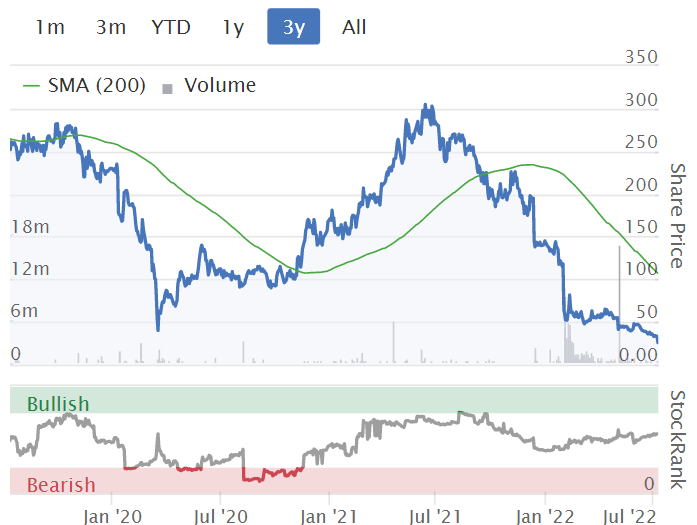
Joules (LON:JOUL) (I hold) - a Sunday Times article reveals that KPMG debt advisory has been called in. An RNS from the company this morning confirms it. Clearly not good news, and this share is now a lot more high risk, unfortunately.
Hostmore (LON:MORE) (I hold) - another one of mine, which has crapped out due to the consumer downturn. Today's update is reassuring though - forecasts have been considerably lowered, and it's trading in line - that's the way to do it. I challenge the EBITDA numbers though, which translate into very little real profits this year!
MJ GLEESON (LON:GLE) - not a company I know well, but I'm very impressed on a review of today's positive trading update. This share looks really attractively priced right now, and with an average selling price of only £167k, its niche of affordable homes should be relatively insulated against macro headwinds. Uncertainty over cladding remediation costs looks the only negative.
Graham's Section:
Quartix Technologies (LON:QTX) (£161m) - A good trading update from Quartix, guiding full-year results in line with market expectations. Growth is according to plan, and H2 should show further improvement compared to H1. I remain impressed with this company’s transparency and see many attractions as a potential investment. Unfortunately, the valuation of six times annualised recurring revenues is very aggressive, especially when you consider that total revenues are only growing at a single-digit rate and the company continues to battle against underlying price erosion.
MPAC (LON:MPAC) (£54m) - A nasty profit warning and Mpac gets its earnings estimates slashed. A partial recovery is seen next year, with an almost full recovery in 2024. My concern is that recovery appears to be reliant on supply chain, economic and inflationary problems being fixed, which I’m not sure I’d be willing to bet on. Of course, many companies are in the same boat and also need these problems to be resolved. Mpac does at least have a decent net cash position, which should help to support the valuation.
Podcast - episode 2 of Paul's small caps podcast went up on Saturday - it's here. Sorry about the glitches with the phonetic alphabet, I seem to go blank once recording starts, so will practice this week. We'll get them onto a proper podcast platform at some stage. One step at a time.
The idea behind my podcasts, is to provide an easy to digest summary of the key companies covered in the week's written SCVRs. Also it's a chance for me to have a think & a ramble about market conditions/macro, etc. I jot down points on paper during the week, then run through them on the podcasts. Also, if they're shared widely by you, then hopefully it might drum up some new subscribers for here - as sadly some people do drift away in despondency - at exactly the time that the bargains are emerging.
As I keep saying, it's the hard work done now, researching the market for the bargains, that lays the ground for our multi-baggers of the future (timing unknown). Hence for anyone with cash, this is a tremendously exciting time. For everyone else - decent shares recover, in the long run, they always do. Note the emphasis on the word "decent"! That's key. StockRanks can be a great help there, which combined with my balance sheet analysis of practically every company I cover, gives you some good tools to deploy. Plus of course, the absolutely vital process of doing your own research.
Explanatory notes -
A quick reminder that we don’t recommend any stocks. We aim to review trading updates & results of the day and offer our opinions on them as possible candidates for further research if they interest you. Our opinions will sometimes turn out to be right, and sometimes wrong, because it's anybody's guess what direction market sentiment will take & nobody can predict the future with certainty. We are analysing the company fundamentals, not trying to predict market sentiment.
We stick to companies that have issued news on the day, with market caps up to about £700m. We avoid the smallest, and most speculative companies, and also avoid a few specialist sectors (e.g. natural resources, pharma/biotech).
A key assumption is that readers DYOR (do your own research), and make your own investment decisions. Reader comments are welcomed - please be civil, rational, and include the company name/ticker, otherwise people won't necessarily know what company you are referring to.
Paul’s Section:
Joules (LON:JOUL) (I hold)
33p (before market opens) - update at 09:44 - 26.5p (down 20%)
Market cap £37m - update at 09:44 - £30m
The Sunday Times is at it again! Last week it undermined AO World (LON:AO.) by reporting that a trade credit insurer had reduced cover. As it turned out, AO was in the final stages of organising a placing. I imagine (but don’t know for sure) the placing price probably had to be reduced, as a result of the S.Times article clobbering the share price.
Still, we can’t really shoot the messenger. This situation once again reinforces the madness of the UK system, where shares continue to trade, despite hundreds of people knowing that a discounted placing is going on in the background. This clearly creates a false market, and has to be stopped. It’s top of my (long) list of things that are wrong with the UK system. Shares should be suspended, and a fast fundraising process done online, with minimal fees. We’ve had the tech to do this for over 20 years. We need to lobby Govt over this - they want ways to make London more attractive for listings, surely rapid & cheap fundraising would be ideal? That’s one of the key reasons markets exist - to raise capital, as well as provide a market for secondhand shares.
Anyway, my Sunday roast at the Englefield (my favourite London haunt when I’m up here) was ruined after I spotted a small article on the front page of the business section, about Joules (LON:JOUL) (I hold), saying it had engaged accountants KPMG (debt advisory practice) “to help shore up its cash position”.
We already knew Joules was having trouble, after a series of profit warnings, supply chain problems, and resignation of its CEO. Also, previous broker notes indicated that the business was now being run for cash (it has excess inventories which are being wound down, so is constantly offering discounts online). I wouldn’t normally get involved with anything that needs extra cash, but took a risk here, because JOUL owns the substantial freehold to its new head office, the idea being this could be sale & leased back, thus easing the pressure on bank debt that’s not excessive to start with.
Although, as we know, once companies become loss-making, as JOUL will certainly be currently, then bank covenants are usually breached, and banks get jittery, and may withdraw facilities.
JOUL has responded promptly this morning, this is what it says -
Joules, the premium British lifestyle group, provides a statement in response to an article published in The Sunday Times.
My summary -
Confirms KPMG debt advisory have been appointed.
Provides the (now outdated, 7 weeks ago) year end liquidity position -
As at 29 May, the Group had net debt of £21.4m, giving £11.3m headroom within its banking facilities, in line with the Board's expectations.
This is reassuring, providing the bank facilities remain available -
Whilst the Group continues to manage its cash resources carefully over its seasonal borrowing peak, it expects to have sufficient liquidity to manage its working capital requirements over this time.
Strategy - this confirms what it has already said before -
The Group is making good progress against previously announced key initiatives aimed at simplifying the business and optimising the cost base to improve long-term profitability. This includes implementing significant changes to its wholesale operations to focus on fewer, profitable wholesale accounts and improving and simplifying the Group's end-to-end product process to reduce costs and shorten lead times.
My opinion - it feels as if JOUL seems a bit rudderless at the moment.
There’s tremendous upside potential, if it can be decisively turned around - look at previous profits when trading well. In my view that requires a drastic cull of the bloated central overheads - which are similar to Superdry (LON:SDRY) in terms of headcount, but JOUL is half the size in terms of revenues. That doesn’t make any sense to me.
Also, I don’t think the central overhead is doing a very good job - they seem to mess up supply chain at regular intervals, and the product is currently uninspiring & over-priced. Hence why I get daily emails offering big discounts.
We talk a lot here about pricing power, and if a brand is constantly discounting, then it hasn’t got pricing power, and the product isn’t good enough. Once customers get used to paying 50% less, it becomes addictive, and they just wait for the products they like to be reduced in price. All that set against rising costs, is an unhappy mix.
My other worry is that reporting accountants are often brought in at the behest of the bank - I have personal experience of this brutal process - and the report from the accountants is then used by the bank as cover to withdraw facilities, prompting an existential crisis.
It’s a bit different for listed companies though, as they have access to fresh capital from the market.
Hence I think a dilutive placing now looks highly likely, and that’s bad news for existing holders like me. It should be able to get a placing away, given that the founder holds a big stake, and has deep pockets from a previous large sale.
There has to be a risk that a pre-pack administration could be used to grab the business on the cheap, so that’s an increased worry now, as this wipes out all other shareholders - as we saw at Studio Retail recently.
On the upside, KPMG might be able to help arrange a sale & leaseback on the big freehold property, although I think about £9m of the existing bank debt is secured on that already.
This situation should be fixable, because it’s not actually that much debt, at £21m, and the bank has security on a freehold property in the books at about the same cost.
So a say £10-15m placing, and a sale & leaseback, would be more than enough to wipe out all bank debt. It’s doable, but that depends on current trading, which is not mentioned in this update.
Overall then, this has to be seen as higher risk, after the news of KPMG getting involved.
Apologies for getting this one wrong - I didn’t expect trading to deteriorate anywhere near as much as it has done. Fundamentally, the current crisis has been caused by poor management.
.
.
Hostmore (LON:MORE) (I hold)
34.5p (unchanged at 08:45)
Market cap £43m
Hostmore plc (the "Company" and, together with its subsidiaries, being the "Group"), the hospitality business focused on American-themed casual dining brand, 'Fridays', the cocktail-led bar and restaurant brand, '63rd+1st', and the fast casual dining brand 'Fridays and Go', announces an update on trading for the 26 weeks ended 3 July 2022.
It’s a calendar year end, which I’ll call FY 12/2022, but due to weekly accounting which retail/hospitality often use internally, period ends are typically a day or two either side of the month end date.
PR headlines look good -
Trading in line with expectations
Growth opportunities remain, despite consumer caution
This seems encouraging -
Guidance for the full year remains unchanged, with LFL revenues for the period since 23 May 2022 in line with the expectations set out in the trading update issued on 26 May 2022.
This is what the company said in that last update on 26 May (my summary) -
LFL revenues down 6% on pre-pandemic 2019 (for 20 weeks to 22 May 2022)
Guidance - LFL dine-in volumes expected to be down 8% for the rest of this year FY 12/2022. I take that to mean the volume of meals/drinks served, not the revenues generated.
That’s an important but confusing distinction.
Price rises to mitigate half the volume decline - which implies that LFL revenues (vs 2019) would only be down 4%. I've lodged a query with the company on this point, so will update this article once my query is responded to.
EBITDA margin (pre-IFRS 16) in low double digits for FY 12/2022 - which is actually quite good, given tough macro conditions for discretionary consumer spending (although I query the calculations below).
The market seemed to largely ignore this update in May, which struck me as a lot better than might have been the case, in current conditions.
Roll things forward to today, which I summarise -
- Full year guidance unchanged.
- Roll-out of new 63rd+1st restaurant/cocktail bar format is continuing, with 4 sites now operating. (Have any readers visited them? I’d love to hear a mystery dining report!)
- Bank facility increased from £25m to £30m, and extended by a year to Oct 2024.
Valuation - this is tricky. The only current research I can find is from Finncap - it has pencilled in these key numbers for FY 12/2022 -
Revenues £214m, Adj EBITDA £40.1m, Adj EBIT £17.0m, Adj PBT £3.5m, Adj EPS 2.3p.
Note how the massive EBITDA number has almost disappeared by the time we get to PBT!
At first I thought this might be a typo, but the c.£13.5m drop from EBIT (operating profit) to PBT, is consistent with other years in the forecasts table. It must therefore relate to a finance charge of £13.5m, which is far too big to be just bank interest, it must relate to the notional interest cost re leases, under IFRS 16.
I’ve worked it out now, from looking back to the FY 12/2021 accounts. Note 5 shows that of the £13.6m finance charges, £10.2m is “interest on lease liabilities”. Therefore any numbers above this line are meaningless!
Even the pre-IFRS 16 EBITDA number looks unrealistic, because it doesn’t seem to be adjusted for the finance charges related to leases.
For these reasons, I don’t think the EBITDA or free cashflow numbers quoted by the company look realistic.
The bottom line for me is that it’s only expected to make £3.5m PBT this year, just above breakeven.
Forecast EPS is 2.3p this year (PER 15 - in a tough year, so not excessive).
Forecasts for 2023 & 2024 are a big rise in EPS to 7.2p, and 11.2p. If it can achieve anywhere near those forecasts, then shareholders could be on to a future multibagger. It might be more prudent to assume a slower recovery in earnings perhaps?
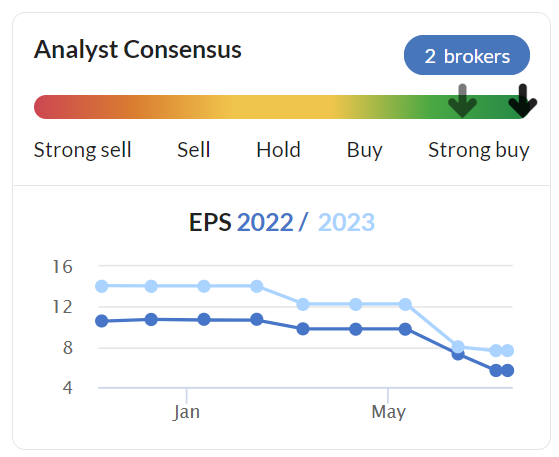
Note from the broker consensus graph from the StockReport below, forecasts have come down a lot - which is exactly what we want to see! More realistic, lowered forecasts, then an in line update. Other companies & brokers, please take note! Get the forecasts down to a realistic level, then we can invest!
.
My opinion - given where we are in the economic cycle, I am not at all keen on companies increasing borrowing facilities. However, it does mean the bank is happy, and will see the management accounts that we don’t get to see. Hence it is reassuring in a way.
My worry is that, the more debt that cyclical companies take on, then the less safety margin there is for investors if trading subsequently really hits a brick wall.
A bit more digging into the numbers has made me distrustful of EBITDA here. The curse of IFRS 16. I’m happier working on adj PBT, which is only £3.5m for this year. There’s a hefty depreciation charge of physical assets though, so it does mean decent cashflows being generated, to fund the roll-out of new sites, in 3 different formats.
Management are ambitious, and strike me as competent.
The valuation has collapsed mainly due to macro factors, not to company-specific problems.
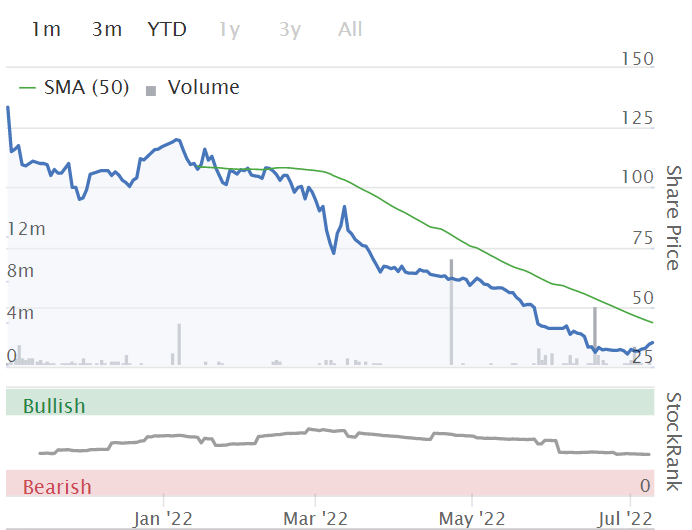
I think long-term, this share should do well from this bombed out level. It's starting to find a level where people seem to be buying.
MJ GLEESON (LON:GLE)
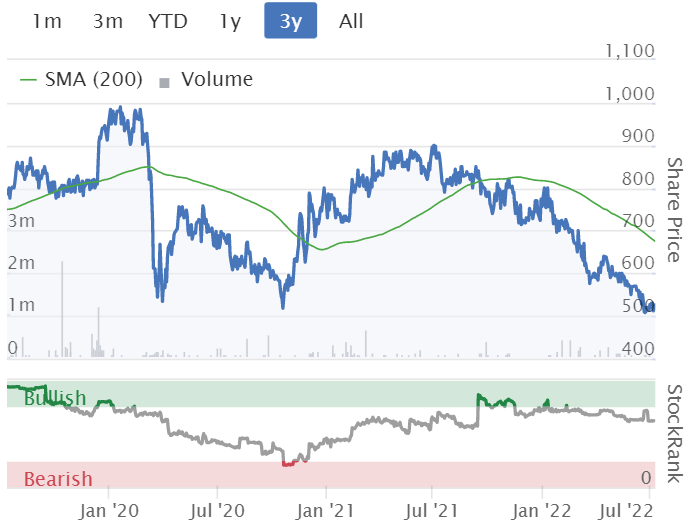
526p (up 2% at 13:00)
Market cap £306m
I’m not familiar with this housebuilder, but thankfully Roland wrote an excellent summary in May last year, here. Comparing the figures that Roland mentioned then with now, in particular a Price to Tangible Assets ratio of 2.19 being a bit high, it’s now dropped to only 1.15 - very much more appealing to value investors.
So what’s the news today?
MJ Gleeson plc (GLE.L), the low-cost housebuilder and land promoter, today provides an update for the year ended 30 June 2022 ("FY2022").
This sounds good -
Full year results expected to be significantly ahead of expectations
Here are my notes -
2,000 house completions - hit target of doubling over 5 years.
Completions up 10.4% against tough LY comparisons.
Strong selling prices offset higher building costs - very good.
Key point - avg selling price really low, at £167k - highly affordable.
Availability of materials and labour has improved.
Reservations shortened to 34 days from release (LY: 49 days), showing strong demand.
Recent activity - reservations up 16% on LY, in last 8 weeks - (so no sign of a slowdown, or loss of confidence then).
Planning congestion a nuisance but not a disaster (my words!)
Land - available at “sensible prices” still, has pipeline of >8 years sales, owned or purchased subject to planning permission.
Cash of £33.8m, and no debt (flat vs LY).
Key point - Cladding - possible costs - this sounds a bit vague, as if they don’t really know, so this is a key point to clarify.
Overall trading significantly ahead.
Balance sheet - I exclaimed “bloody hell!” when I saw the last reported balance sheet as at Dec 2021. It’s incredibly good!
Total tangible assets of £308m, less total liabilities of only £65m, gives NTAV (no intangibles) of £260m. The market cap is £306m. But remember that everything is on the balance sheet at cost. So inventories in particular of £245m are likely to be worth considerably more than original cost.
Hence you could argue that this share might be trading at a real world values discount to NTAV. That’s quite exciting.
My opinion - this looks really interesting, and gets an SCVR thumbs up, for readers to do some more research for yourselves.
What I like most, is that this builder is making houses that are being sold for only £167k, and making good profits at that level. As the commentary says, this is so affordable that a couple earning just Living Wage could buy one, and it would be cheaper than renting. That strikes me as an excellent market position in current uncertain times.
The only negative I can see is the uncertainty over cladding remediation costs, which needs more clarity.
Of course, if you think house prices are likely to crash, then the whole sector is best avoided.
.
Graham’s Section:
Quartix Technologies (LON:QTX)
- Share price: 335p (+2%)
- Market cap: £161m
During my sabbatical, this company adjusted its self-description.
It used to call itself: a leading supplier of vehicle telematics services to the fleet and insurance sectors.
It now calls itself: a leading supplier of subscription-based vehicle tracking systems.
The reason for this isn’t too hard to understand: revenues from the insurance sector have been intentionally allowed to shrink for some time, as it focuses instead on the “fleet” business.
Let’s bring you up to date with today’s trading update for H1 (ending June 2022):
- New unit subscriptions +26% versus H1 in 2021.
- Revenue, adjusted EBITDA and free cash flow for the full year are expected to be in line with consensus market forecasts.
There’s an important point about Quartix which stands separately to its underlying business: it is a model for how small companies should communicate to shareholders.
I’d give Quartix a higher valuation than it might otherwise deserve, purely as a result of this factor. It is transparent, it publishes clean numbers, and it gives better information than most other companies do.
Looking ahead, the company expects H1 revenues of £13.3m, and then full-year revenues of £27.4m. That implies 6% sequential growth from H1 to H2 – not bad.
Similarly when it comes to adj. EBITDA and free cash flow, Quartix is expecting H2 to be a little better than H1.
I am reminded by previous SCVRs that Quartix doesn’t capitalise development spending. That being the case, the use of adj. EBITDA by Quartix is less objectionable than it normally is.
(When a company capitalises development spending, the cost of that spending isn’t counted until it is amortised – the “A” in EBITDA. If that company asks you to focus on EBITDA, it is asking you to pretend that development costs don’t exist. This is common practice.)
Continuing:
- Vehicle subscription base +9.4% to 221,800 vehicles.
- Annualised subscription base value +6.6% to £26m.
These percentage growth figures look quite disappointing compared to the 26% growth figure mentioned earlier.
But you have to remember that 26% was the growth in new subscriptions. It doesn’t reflect the growth in overall subscriptions or total revenue, and it’s not adjusted for any loss of customers. It’s a second derivative!
Quartix does focus quite a lot on this second derivative. Here are new unit subscriptions by region:

The USA is set to benefit from “new strategic initiatives in the region”.
Price erosion
This has been a theme at Quartix for a while. I’m always looking for quasi-monopolistic companies with a great deal of pricing power, so price erosion is definitely not something that I like to see. Quartix says:
Price erosion over 12 months calculated at constant currency rates continues to improve and was 5.6% compared to 6.5% in the same period in 2021.
It’s comforting that there’s an improvement in this regard, but the fact that price erosion is still occurring would certainly trouble me, if I was a shareholder. With prices falling over time, is it not natural to conclude that Quartix’s technology is being imitated or even improved upon by competitors?
Annualised revenues are growing at a slower pace than the growth in subscribers. I’d really like to see price erosion come to a halt, to boost my confidence in the uniqueness of what Quartix is offering.
Quartix has launched a new product for electric vehicles, and is about to launch a new product to assist with vehicle checks. Maybe these will help to reverse the price erosion trend?
My view
I can accept that subscription-based businesses with predictable recurring revenues and strong margins are worth a multiple of sales. Quartix does have predictable recurring revenues and its margins are even better than you get from the headline figures, because it expenses many of its costs upfront.
I also believe that Quartix deserves a valuation uplift for the quality of its shareholder communication, its historic cash generation and its willingness to pay cash out to shareholders. Dividends have been paid every year since 2015, albeit with a few cuts in the tough times:

My difficulty is with the valuation multiple of six times annualised recurring revenues. Given the underlying price erosion and the single-digit growth in sales (in a highly inflationary environment), I worry that investors might be getting carried away with the impressive second derivative figures which the company publishes.
At two or three times recurring revenues, I might be able to argue that this was a bargain. At six times, I have to admit that I’m sceptical.
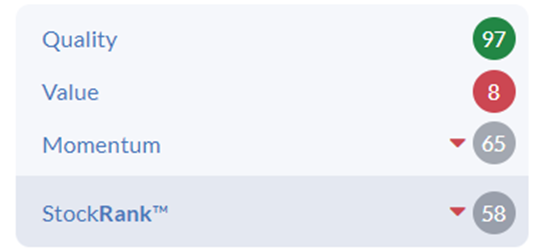
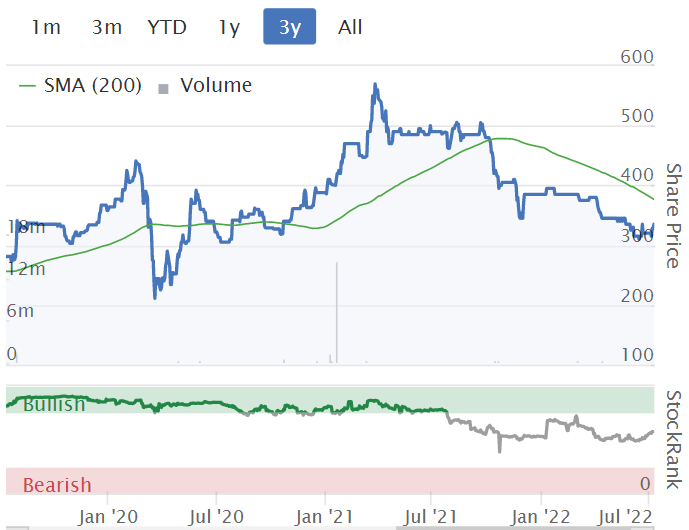
The computers at Stockopedia agree with me, and see very little value on offer here. Although Quality is excellent, as expected, and momentum is ok:
.
.
MPAC (LON:MPAC)
- Share price: 267p (-30%)
- Market cap: £54m
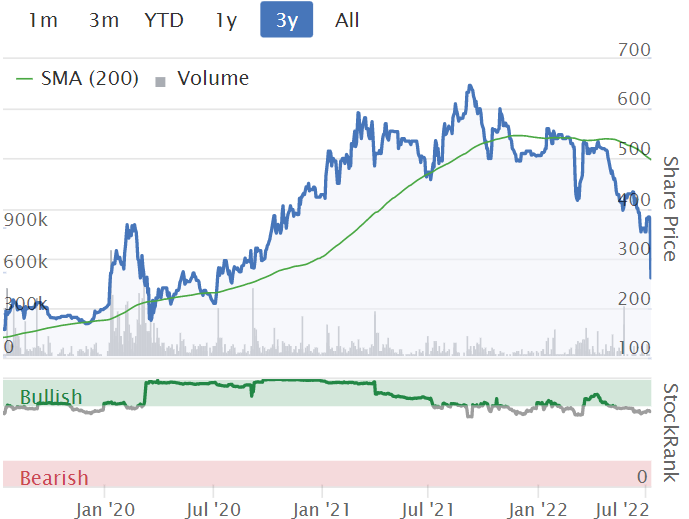
An almighty share price drop for this packaging/automation company, on a nasty profit warning.
In May, the company warned of “supply chain uncertainties and operational challenges amplified by transportation delays at global ports and increased macro-economic uncertainty”.
Mpac maintained that “prospects remain positive”, and the share price survived intact on that day, though it did drift lower in the weeks that followed.
Today’s announcement is much worse. The supply chain and economic problems “have become more acute in recent months resulting in extended lead times and cost inflationary pressures which are impacting the Group’s operational efficiencies and margins”.
As a consequence, FY 2022 profits will be “significantly below current market expectations”.
Mpac follows the usual pattern of not saying what current market expectations are, and also not saying what the new market expectations should be.
But the company’s broker previously had an adj. EPS forecast of 34.5p. It has today reduced that forecast to 13.7p, or by 60%.
The forecast for next year is reduced by 26%, to 27.4p.
As Paul has said, it is unfortunate when forecasts aren’t gradually revised lower, and instead we get these awful share price collapses when the estimates get slashed.
The company itself thinks that the big-picture problems it faces will ease in 2023, but on what basis?
Supply chain and operational challenges are likely to continue for the remainder of 2022, before easing in 2023.
I hate to rain on anybody’s parade, but I’m not convinced that inflation is set to ease in 2023. Granted that some of today’s supply chain problems might be fixed, and that price pressures for certain components and certain products may ease, but I would be very cautious before betting on a “return to normal”.
If we put a positive spin on it, Mpac’s adjusted PE ratio for 2023 is now less than 10x, and is lower again if we see a full recovery happening in 2024.
And this does not adjust for the net cash position (£14.5m at the end of 2021).
With that cash, Mpac does enjoy some flexibility in how it responds to its challenges. Hopefully, this will put a floor on how bad things can get for the company and its shareholders.
Disclaimer
This is not financial advice. Our content is intended to be used and must be used for information and education purposes only. Please read our disclaimer and terms and conditions to understand our obligations.

66 comments
Hi Graham,
Many thanks for your write-up on our company (Quartix Technologies (LON:QTX)) and for the kind words about our reporting.
You are quite right in stating that the growth in new installations is part of a second derivative function, whereas the growth in unit base and ARR are first derivatives. I think that we have caused a little confusion at the half-year point by stating these last two without making it clear that they are 6-month figures:
“Continuing:
So these are growth figures from Jan 1 2022 to June 30 2022. I will see if we can publish the 12 month growth (i.e. from July 1 2021 to June 30 2022) instead of, or as well as, those figures in our Interim Report at the end of this month.
I hope that helps,
Andy Walters, (Founder/ Non-Exec, Quartix Technologies (LON:QTX))
Joules (JOUL) is rapidly turning into the case study of how to destroy shareholder value of our times.
I keep banging away on here how little emphasis is put on management capability when making investment decisions in small cap companies . Where are the measures and checks and balances on the people at the top who make the big decisions ?
Just a brief review of Linked In shows that the Joules chairman knows a bit about selling sofas . No clothing retail knowledge of any kind. No experience of dealing with clothing suppliers in the far east. But its ok - he's taken on the chairmanship of a vehicle retailer
The CEO, ex Asda maketeer, decided to outsource not only all the logistics, but also all the internal logistics expertise. Fine when all is well but suicidal when that knowledge becomes fundamental to survival. He then decides to invest in a £20m head office vanity project packed with twice as many people that they should need, even though most won't even be spending their time there. He then decides that it would be a good idea to throw money at a garden products business absolutely saturated with competitors, at the top of the market, when it has nothing to do with the core product. He then resigns, but get this : he's still there !! Incredible !
A relatively recently appointed Fd who has no experience whatsoever of retail, clothing, supply chain, working capital management, stock control, overseas sourcing and margin and cost control in a retail environment . Yes. Seriously.
You just couldn't make this stuff up !
And yet this kind of thing is happening across plc uk time and time again
Even this week, with the demerger of GSK. How can it be possible that an ex Oreal executive can be placed in charge of a sophisticated pharmaceutical company when she has absolutely no knowledge or experience of products, science, customers, technology, medicine, the health sector, competitors, the market place etc etc
Aaargh !!!
'How can it be possible that an ex Oreal executive can be placed in charge of a sophisticated pharmaceutical company when she has absolutely no knowledge or experience of products, science, customers, technology, medicine, the health sector, competitors, the market place etc etc...'
But Rutland Ram surely you jest? I'll give you one guess.
Oh alright then. It's simple. She went to the right school, the right university (MA in classics) and had the right parents.........and in 2020 was appointed 'Dame Commander of the Order of the British Empire'.......for services to the pharmaceutical industry. Yes really. That's 7 years running (or making a) Horlicks and 3 years as CEO of GSK. Yes really. But what do you expect? It seems to stack up well against the qualifications required to run the country?
cheers
Mark
MJ GLEESON (LON:GLE) (I hold)
Last night I was coincidentally looking at MJ GLEESON (LON:GLE) 's trading update from just 10 days, where details were oddly vague, but with a little bit of work one could see that the company was very likely going to beat revenue and profit forecasts for FY22.
Bizarrely I then saw that the share price had barely moved since then. Market sentiment is clearly not good for house builders right now.
Nonetheless I would say that MJ GLEESON (LON:GLE) is my favourite listed housebuilder, especially given their low selling prices. If key workers - their main customer base - can afford their homes, then the company should always do well.
Management said this back in 2020:
"At the heart of what we do is build homes that are genuinely affordable and provide our customers with the opportunity for wealth creation through home ownership. It is substantially cheaper to buy a Gleeson home than rent with a typical three-bed Gleeson home costing as little as £76 per week with a Help to Buy mortgage compared to renting a three-bed home which costs around £138 per week in the private rental market.
A working couple on the Minimum Wage can buy a home on any Gleeson Homes development site."
I have hope that this will prove to be a long term winner and plan to keep holding in the "do nothing" section of my portfolio.
Cheers
A
Interesting market response to MJ GLEESON (LON:GLE) which as Paul Scott
says makes all the right noises and ticks all the right boxes. Clearly it is not strong in the south east and perhaps regardless of average house price, affordability etc it is only affordable if people - two people in their case - have a job. Most impressive is that ownership is cheaper than renting - again with the same employment caveats.
Yet the market was unimpressed. Less than 1% uplift. No accounting for taste. Doesnt augur well for the expectations of the building market.
Not sure that I feel the same was Paul about the possible negative cladding implications since they have after all been through a significant first stage of assessment.
If any of you would like a last minute free ticket for tonight's Mello show we have 20 to give away as it is so hot out there and we want you to come inside and cool down in front of a fan and watch the show. So when you register here https://www.tickettailor.com/events/melloeventslimited/719317# just enter the code 1107FREE where it requests a promo code and it will be complimentary just for this one.
Podcast - the phonetic alphabet was great. I also enjoyed the struggle to turn off the recording in the last podcast. I think there's also some stuff about shares too, which is bonus content...
Fantastic podcast and a great way to start the week! Lots of interesting thoughts and info.
The phonetic alphabet made it all the more enjoyable, particularly "sierra, armadillo, golf, abattoir" Saga (LON:SAGA) :)
Looking forward to the next one.
I use to used the Weather and Cars for my phonetic alphabet but I found many years ago that I have a greater range with Chocolate and Snacks:
Aero
Bounty
Caramel
Dime Bar
Eclair
Fudge
Galaxy
Hula Hoops
Ice Cubes
Jelly Babies
Kit Kat
Lollypop / Licorice
Maltesers
Nougat
Opal Fruits
Polos
Quality Street / Quavers
Rolo
Smarties / Spangles
Twix / Treacle
Ultra Strong Mints
Victory V's
Wispa
Xtra Strong Mints
Yorkie
Zunes
.
David.
Record (LON:REC)
hi Graham
In your recent write up you were quite positive and said in your summary;
'I’ve allowed myself to get excited about this change in Record’s strategy. Now I’m going to have to go and reflect on all the reasons why it might not work!'
Over the weekend I read the FY '22 Annual Report and one particular aspect, Directors' Remuneration, took my eye.
The CEO, Leslie Hill, received total remuneration of £2.395m (£724k fixed plus £1.671m variable) whilst the CEO, Steve Cullen, received £258k (£153k fixed plus £105k variable). This amounts to a total remuneration multiple CEO:CFO of 9.3. This multiple seems staggeringly high to me, even though Leslie Hill does appear to be doing a good job (to date) in the company turnaround.
However, I wonder what possible effect this might have on the ongoing working relationship between CEO and CFO?
In the company's defence the Chair of the Remuneration Committee states;
'The Group is in a three-year transitional phase wherethe current senior managers prepare to hand over to the next generation under our succession plans.'
and
'To deliver the Group's three-year strategy, the Boardbelieves that it is imperative that our current CEO, Leslie Hill, continues to drive this strategy. Our new RemunerationPolicy for our CEO has therefore been designed to ensure that she is motivated and incentivised to deliver this three‑year strategy'
I'd very much appreciate your views.
I hold
Thank you very much for looking into this re: Record (LON:REC) ! I'd need to look into the structure of her bonus to comment further as to how she will be incentivised over the next three years but that's something I should try to do next time I'm covering this. That total comp. is certainly eye-catching against a £140m market cap. Thanks again! Graham
Paul, many thanks for your podcast, which is excellent. Totally agree on 'London buzzing', and 'what recession?' We were trying to book a table for supper last Thursday, everywhere was fully booked, in the end we got into our fourth choice! Perhaps MPAC (LON:MPAC) is one of those broker downgrades you suggest. Hopefully they won't all be of that magnitude. Agree with GavSmith below re the phonetic alphabet, although hilarious!
Results season is starting again, and we have four webinars and Q&As that might be of interest over the next couple of weeks.
Sosandar (LON:SOS) on Tuesday 12 July, 11.30am. Register here.
Sosandar have had continual upgrades for FY22. Here, we'll get insight to the start of FY23 with the additional distribution through Next Platform Plus and The Very Group. They are suffering from negative consumer sentiment although retail sales clothing data looks strong. We will find out all tomorrow. (Note time has moved earlier than previously publicised).
DSW Capital (LON:DSW) on 14 July, 1pm. Register here.
DSW IPOd in December, they are an IFA advising on corporate finance and due diligence to tax and corporate recovery. They are bsed in Manchester, Leeds, London and Aberdeen. This is the opportunity to learn more about this newcomer, and the broader macro picture.
Tpximpact Holdings (LON:TPX) on Tuesday 19th July, 12 noon. Register here.
TPX had a storming year in 2021. In March 2022, they said revenue was at the top end of market expectations (£78.8m), which is 54% up on 2021, and in FY23 they'll hit £100m revenue. The share price has sold off 38% over the last 6 months, in line with the tech sell off. We will learn more next Tuesday.
Creightons (LON:CRL) on Wednesday 20 July, 11am. Register here.
As normal, no news from Creightons since interim results. We'll find out how they are navigating supply chain and inflation issues, together with the additional trading from the new acquisitions Broadie & Stone and Emma Hardie. They tend to duck and dive to deal with whatever the markets throws at them so it will be interesting to hear how the last 6 months have been.
Note, the registration links take you to the PIWORLD events page. Scroll down to the webinar you are looking for.
So, MPAC (LON:MPAC) warn on profits due to supply driven inflation and drop 30%. They join a long list of others in the same situation. As I've said before, the problem with these results announcements and "forecasts" is that the reality is they are all very backwards looking, reflecting at best what has been happening in the last month. It's been obvious from the macro situation for a long time now that there would be lots of profit warnings, but it takes time for them to come through. Meanwhile, the macro situation is changing.
The reality is that the supply chain situation is improving now. These figures are from the June global PMI data:
General supply chain issues are still a concern and sadly they have been overtaken by specific issues driven by the Ukraine war and labour shortages, but the original supply chain issues are improving and that will help in some ways e.g. in fighting inflation.
Unfortunately, at the same time this will throw up other issues. From the same macro data, it looks as though there is generally a lot of inventory sitting around. While supply chains were malfunctioning, companies built up precautionary inventory. Now they are likely to let that unwind. As a result, other companies will see a hit to new orders. Profit warnings like that from Supreme (LON:SUP) are likely to become more common.
I agree. The focus is now on inventories more than on supply chains. But this could switch back again. Suppose you are a Chinese factory making LED lightbulbs which Supreme (LON:SUP) buys by the containerload and distributes direct to retailers without ever handling them. The retailers experience slower sales and find they have excess inventory, so they stop ordering for a while. This hits the distributor but it also hits the factory, which might well reduce production and make some workers redundant, not replace equipment, etc. In the next phase even if demand doesn't recover and stays at a depressed level the retailers eventually do have to re-stock. The question is, will the supply be there?
What I am trying to say is that a disruption as massive as the Covid reaction (not the disease, the reaction to it) can lead to waves of later disruption. Investment is always like playing chess but it's even more important to look 3 moves ahead at the moment. In fact I have given up investment for the time being. All I am doing is short-term trades, holding usually less than a week, never more than a month.
Hi cmpeckham,
Excellent post, I completely agree with everything you've written.
We've seen quite a few small caps say that demand was pulled forward by the pandemic, and mgt now seem surprised that customers are reducing orders - Luceco (LON:LUCE) and Supreme (LON:SUP) (as you mentioned) spring to mind, and there are bound to be many more in the pipeline.
My macro notes that I haven't published yet focus on the same thing, here we are - Telegraph article says solution for inflation already in place - falling commodity prices (higher prices is what triggered higher inflation in the first place), shipping starting to loosen up, de-stocking by many companies as supply chains recover, reduced consumer demand for things as spending on experiences recovers.
On the other side of the equation, there's still massive food & energy price inflation to feed through this autumn. A farmer told me a couple of months ago that he's having to pay insane prices for fertiliser, so the autumn's crop will have to be much more expensive if farmers are going to survive.
Subject to unknown factors (esp. Ukraine), it does seem as if the current soaring inflation is probably likely to be temporary, maybe peaking in 2023? Who knows, but as you say, there are very sensible, data-driven reasons to expect inflation to come down again.
In the meantime, a winter of discontent re wages/strikes, and horrendous conditions for low income people, as food & energy make up such a high proportion of their household budgets.
All interesting to discuss, so thanks for an excellent post, with some data/graphs, which is so much better than the unsubstantiated opinions that we sometimes read.
Best wishes, Paul.
Paul I have the greatest respect for you and have made money by reading carefully what you write. But on a macro point I don't think this is right: 'higher prices is what triggered higher inflation in the first place'. All the evidence I see points to Milton Friedman being right, the cause of inflation is excess money supply and the result of inflation is higher prices. In February the BoE announced that they have chopped down Sunak's magic money tree: 'The Committee agrees at this meeting that the Bank of England should cease to reinvest any future maturities falling due from its stock of UK government bond purchases. This reflects the MPC’s intention to reduce its holdings of government bonds in a gradual and predictable manner.'
But I agree with your conclusion because I think this is going to have a huge negative impact on the UK until they lose their nerve and start expanding their balance sheet again.
I think Paul is referring to cost-push inflation
"Cost-push inflation is a purported type of inflation caused by increases in the cost of important goods or services where no suitable alternative is available. As businesses face higher prices for underlying inputs, they are forced to increase prices of their outputs."
Like gas/oil/food suddenly costing more.
I am not an economist but have a slightly different view...
In my opinion, the problem is not the excess money, or inflation, it is what people do with their money.
We (globally, collectively) wrote 100s of billions in fourlough / stimme / bounce-back cheques over the last few years, to ourselves - some people kept the lights on, some bought food, some bought online training and some bought NFTs / houses / risky Stocks.
The problem (IMO) is when people collectively use too much money on buying non-productive assets.
This can happen in two main cases
"excess money supply" - I suddenly have some money - and dont know what to do with it
"high inflation" - I do not know what the relative prices of things will be in the medium term - and so dont know what to pay for them.
Boiled down to 1 sentence
In uncertain times, people tend to mis-allocate capital - this is bad.
This isn't the place to debate that in any depth, I'll just say that there's a lot of evidence to say that's wrong, if you're talking about money supply as controlled by the BoE via QE. Look at 20 years evidence on QE; look at Japan; look at Switzerland; look at where this bout of inflation first appeared, etc. etc.. The evidence is clear. Also, since Milton Friedman's time, we've seen the hard evidence that increases in money supply are dominated by reductions in money velocity, which cancel each other out. That evidence wasn't available in his day. As the Fed explain on their website, if increased money supply led to inflation as you suggest, then "inflation in the U.S. should have been about 31 percent per year between 2008 and 2013". So, why was it barely above 0%?
The things that really drive inflation are supply shocks, fiscal deficits, short term interest rates, weak currencies and socio political factors such as the strength of collective bargaining in the labour market. The impact of QE (increasing base money supply) doesn't even come close to those. Central banks know that, which is why they've only used QE when base rates were effectively at zero and they had no other way of nudging up aggregate demand.
Plenty of newspaper and internet commentators have been wrong about QE and inflation since 2008. They are now determined to claim they were right all along: all we had to do was wait 14 years! But the evidence tells a different story. The inflation we've seen in 2021/22 is fully explained by supply shocks. According to the BoE, 80% of the UK inflation we've seen so far is imported (mostly via energy and food shortages) and 20% is due to domestic factors (mostly labour shortages). I would be interested to see an evidence based challenge to the data from those that disagree, rather than more faith based arguments about hard money, but I don't think that will happen.
cmpeckham
Excellent summary . Thank you.
Richard
Fed Chair Powell is on record as saying recently that current higher inflation is caused by the "collision" of two factors -
1. Supply shocks, essentially due to the pandemic & its aftermath, and more recently Ukraine, and
2. Excess demand for "stuff", when people couldn't spend their money on experiences, like travel/leisure/hospitality, and it was diverted into buying goods.
It seems to me that point 2 above was due to, with hindsight, too much money printing & stimulus in the pandemic.
The quantity of physical goods imported, hitting ports in the US went up 20% in the pandemic, so no wonder ports & supply chains couldn't cope.
All the above factors are linked, surely. It's not one or the other.
P.
Perfectly summed up
The details of the US and UK experiences are slightly different. For the sake of brevity I focused on the UK experience where all of the inflation can be attributed to supply shocks. In the US, demand was kept higher than in the UK. But even in the US, although demand for some categories of goods (stay at home goods) was higher, aggregate demand was not and neither was total consumer demand (services fell off a cliff). All that monetary policy can change is aggregate demand, not which goods or services people decide to spend it on. If you can remember at the time, the talk was of a "V" shaped recovery and the authorities job was to keep demand intact so that the V shaped recovery could take place. The big picture was that they did that well, but the supply side of the economy did not recover as quickly as expected, hence inflation became more than the "transitory" type that had always been expected.
As for how they maintained that demand, it was not to do with money printing, it was down to massive fiscal deficits. QE does very little to demand because it hardly impacts the consumer. It is confined to asset markets, with some tiny trickle down effects. Fiscal deficits have a big impact on demand, particularly one-off stimulus like that used in the US, because they put money directly in to consumers pockets. They are independent of QE, they could have happened exactly the same without QE. In that situation, demand would have been only slightly lower than it was with QE.
Is it not the case though that in 08/09 the banks held on to all the QE issuedand invested it into bonds and stocks so we got asset price inflation, where as in 2020 money was given directly to the public to spend so this time it went into the mainstream.
I don't disagree with the energy crunch argument you present but I'm finding it difficult to square that the trillions printed globally during the pandemic haven't had an impact on where we are now.
QE is the process of the central bank creating new money and using it to buy bonds and similar assets from banks. That's all it is. QE does not involve giving money to the public (or indeed giving money to anyone). As far as the world outside of the central bank is concerned, the only difference is that a zero duration government note called "cash" has been substituted for a long duration government note called a "bond" at the prevailing market price of exchange. All of the transactions take place in asset portfolios and the effects are largely confined to pushing up the price of assets. The channels connecting these events to consumer demand are weak.
To put money in the public's hands requires a fiscal deficit. These really can increase demand and so inflation, but a fiscal deficit is a different thing to QE.
I think there is a lot of confusion about QE, how it works, and the way that it impacts on economic activity. The term 'quantitative easing' is itself gnomic in the extreme and only adds to the confusion. I'm an economist by background (though not a macro or monetary specialist) but find this stuff pretty tough to understand. Can't be easy then for the majority who don't have an education in the miserable science.
Anyway, thank you for your very clear explanation and argument. I find this very helpful.
Of course they do give money to the public.
They drive the rates down , hence the mortgage rates go down. , loan rates go down etc etc etc.
Paul
One further macro issue. Covid-19 isn't over and seems likely to get worse again in the Autumn because respiratory infection rates always do. Even if no new variants emerge, that could reduce consumer willingness to go anywhere crowded. At the same time, we may have a flu epidemic that is moderately severe, judging by the reported experience in Australia. I wouldn't rule out the need for another lockdown by Christmas, and my opinion is that the incoming PM would not invoke it, which would lead to further serious problems for the NHS.
I welcome other subscribers' views.
We were talking about this on Sat. 4 anecdotes:
1 My $employer has re-introduced social distancing and masks in larger offices
2 My sister was off with CV19 for 10 days, there are a _lot_ of cases at the school she works in
3 My local doctors texted me (it was a group text), over 50% of the receptioninsts are off with CV19 and dont expect anyone to answer the phone
4 My partner broke her ankle on hols. I took her to the local hospital 2 weeks ago today. Very few masks worn.
From this I take it that
yes, there is a lot of 'it' about, Happily, very few are getting seriously ill (hospitalised)
we (collectively) dont want to know, we just want to get on with life.
....and Tandem (LON:TND) and.....and.....
Horrendous (and muddled) update from MPAC (LON:MPAC) which I will almost certainly follow the Stockopedia profit warnings guide and sell today (in part or in full) (I need to free up some cash to continue away from a purely small cap portfolio and this gives me an excuse to raise some cash).
Only in May (just over two months ago) they released:
"Trading in line with the Board's expectations
The Company is pleased to report that trading in the current financial year has been in line with the Board's expectations. In addition, the prospects pipeline remains strong, and the current orderbook is significantly above the previous year, providing extensive coverage over forecast revenue."
"Our management team has responded well to the supply chain disruption and has been able to largely mitigate the impact on Mpac and our customers"
It strikes me that there was some wishful thinking in May or denial. Or possibly some economy with the truth, which there data must have been flagging up(?)
I don't expect management to be soothsayers or know the future with 20/20 vision but how they can write the above one month, then two months later write a conflicting RNS with the phrases in it:
"The Group expects to report revenue that is ahead of last year and in line with its expectations in respect of the six months ended 30 June 2022"
AND
"However, these challenges have become more acute in recent months resulting in extended lead times and cost inflationary pressures which are impacting the Group's operational efficiencies and margins. Consequently, the Group now expects that profit in respect of FY22 will be significantly below current market expectations."
Is beyond me.
Either this business is too vulnerable to the vicissitudes of macro events, management don't have a real handle on the business or I don't have the smarts (very likely) to understand the business or analyse it.
Any comments fromGraham or Paul would be welcome.
Couldn't agree more MichealFBS. My current rules are that I am allowed to hold/buy more stock if the trading update is good, otherwise sell. So I held on to MPAC (LON:MPAC) post the May update. For that I get clobbered 30%. Why should i believe things are going to improve next year, management are just guessing....
MPAC (LON:MPAC) - just an observation as I don't hold buts its been on my watchlist for a good while.
As I understand they are a supplier of advanced and automated production equipment to manufacturers. Probably one of the first to see signs of trouble when manufacturers respond to macro expectations of a recession by putting production capex on hold?
They seem to have navigated the supply disruption and consequent price rises well - but like many companies have responded by increasing component inventory, particularly with the scarcity and price rises of semiconductors . Which increases working capital and decreases margins. Hard to escape.
Apparently they've also committed to work in progress to maintain delivery times. Which is always risky.
I expect much of their kit is quite specific to individual customers - as are some of the components - so hard to switch around once components are bought and work started.
Looks like their actions to navigate the supply disruptions may have just run straight into their customers actions to navigate the much talked about recession approaching?
The good news is that MPAC looks to be a very well run company and their kit will remain in demand - but it may take a while to untangle and with who knows what consequences for the share price?
Does indeed look like more difficult times ahead - not just for MPAC but also for many other companies as decisions made at the top of the food chain take time to work their way down the supply chains?
cheers
Mark
Re MPAC (LON:MPAC) comments earlier.
I used to run a software engineering company. During recessions, I learnt the hard way that our market was other businesses investing in their own future and that when the future is uncertain or they get short of cash, they stop investing - often quickly and brutally.
That seems likely to apply to many B2B businesses that depend on individual contracts or contract extensions or individual license sales.
"Once customers get used to paying 50% less, it becomes addictive, and they just wait for the products they like to be reduced in price."
So true Paul, I always do this. I usually buy clothes from Lyle & Scott. They have 60% off most items during the Xmas and summer sales, so why would I buy anything during any other time of the year?
Please keep the impromptu phonetic alphabet going Paul.. love it, slightly disappointed when you get it right ;-)
Woodbois (LON:WBI) I wouldn't normally look at something like this for exactly the reasons Paul gave a year ago but the update today, if truthful, suggests the basic timber business may be doing better than ever before, and (in the footnote) suggests the possibility of carbon whatsits for their 470,000 acres of forestry concessions. Stocko rates it highly on everything except value. The book value is nearly double the share price (admittedly down 75% in 5 years from 39p in 2017). I am asking because my charting system raised a flag for a short term opportunity here. Does anyone here trade this?
Thanks FREng! I discussed podcasts with Stocko HQ, and their view (which I agree with) is it's best to trial it, and see if I can do these every (or at least most) weekends. We didn't want to launch in a blaze of publicity (!) then fizzle out again, like last time. But I think, so far so good, but it's only been a fortnight.
Thanks for the feedback from everyone, it's really helpful.
Best wishes, Paul.
The update from Sylvania Platinum (LON:SLP) today is reassuring:
Production Update
The Group is pleased to report a strong finish to its financial year and has achieved the mid-range of its target production of 66,000 to 68,000 ounces for FY2022.
The Board is aware of sector wide headwinds impacting the wider market and carefully monitors macro-level trends to ensure that they can be carefully navigated. Domestically, it also notes the challenges created by loadshedding implemented by the National Power Utility, however the Group's performance in the full year highlights that it has not impacted production across the Sylvania Dump Operations.
Grasvally Sale Update
The Company is pleased to report that all of the conditions precedent for the sale of 100% of the shares in, and claims against Grasvally Chrome Mine (Pty) Ltd to Forward Africa Mining (Pty) Ltd ("FAM") have been fulfilled and the sale became unconditional as of 8 July 2022.
I hold
Thanks for that FREng re Sylvania Platinum (LON:SLP) where I saw the RNS early morning referring to announcements dates but I didnt see this one. Came out later/separately?
The Sylvania Platinum (LON:SLP) RNS was a single one - entitled Notice of Results AND Production Update.
Great podcast, listened Sunday afternoon with a cool glass (or two ) of wine .
Cheers
Paul, on a separate note I would just like to say how much I enjoyed your first podcast, which I listened to over the weekend. A really great job. I look forward to listening to episode 2 later today.
All the best
Tough times for the portfolio! One good MJ GLEESON (LON:GLE) and one bad MPAC (LON:MPAC) I hold both. I suspect the share of the price of the latter will fall the obligatory 30% and the former may gain 10%. Such is life.
I need to assess the damage and decide what to do regarding MPAC (LON:MPAC) I like the area it operates in, particularly the potential of the relationship with Freyr, the Norwegian battery manufacturer, which has recently announced the construction of an inaugural giga factory, 'Giga Artic'.
MPAC (LON:MPAC) is currently developing automated packaging technology for Fryer's battery production facilities and this in particular appears to have great potential.
Question do I look through the current difficulties, which will end at some point, or sell out, albeit I suspect it is too late to do so.
Any thoughts on either company Paul/Graham?
MPAC (LON:MPAC) Remains profitable and appears to be a sound, longterm, investment. As a holder I will be considering whether this is a buying opportunity.
I am inclined to agree Chris. It may well be a buying opportunity but will let the dust settle first.
Its a matter of how many times it will be punished for the same news, as tends to happen of late.
Its a matter of how many times it will be punished for the same news, as tends to happen of late.
RE: MPAC (LON:MPAC)
I don't really think that's what's happening. MPAC has been trading on a PER of around 14 for the last couple of years but before that it usually traded at under 10. That PER increase was associated with an improvement in the operating margin. If the operating margin is normalising then the current reset valuation is probably about right.
We're seeing this with a lot of companies at the moment - first they fall as they revert to more traditional PER levels, and then they get hit with a profit warning. The point, I think, is that the market isn't pricing in profit warnings, even though there are clearly a lot on the way. The falls to date are simply about repricing the value of equities as interest rates rise.
In terms of buying MPAC - well, I tend to revert to the Stockopedia profit warning guide which tells us to get out at the first sign of trouble, as it usually means worse is on the way. In nearly all cases where I've ignored the research in favour of my instincts the research has won. There are always exceptions to this, of course, but at the moment it's impossible to know which companies will deal well with the economic conditions and which won't. Given that I'd rather sit on the sidelines until it becomes clear which camp MPAC belongs to.
timarr
Thanks Timarr, that makes sense on the PER normalise, and one to look out for.
I read somewhere profit warnings often come in three's.
Uniform
Heatwave? Love how in the UK everything above about 25 degrees get classed as an heatwave with articles on the BEEB about being safe in the hot weather etc.
Whilst I understand its all relative I don't think I've seen a day below 30 here in Madrid for the past month or two and the mercury is hitting 40 at the moment. I laugh at my family back in the UK complaining about hot nights ..
Hi Paul,
Love the podcast. The alternative phonetic alphabet could catch on! LOL.
Sierra Armadillo Golf Abbatoir was my favourite.
Honestly I wouldn't bother with the phonetic alphabet, funny as it is hearing you struggle. We can all hear the tickers clearly enough anyway, and can look them up easily if not.
loving the podcasts- bags of info and personality
Also really liked the podcast.
I’m no longer holding SAGA, as one of the key attractions was that unlike other cruise Companies they also had a successful insurance business to help mitigate against covid cruise losses. But now with their cruise business doing well again (for now and hoping covid doesn’t put a spanner in the works) could a concern be their 3 year fixed rate policies?
As a customer I’m pleased that there’s no price increase on the policies for 3 years. But if inflation stays high or goes even higher surely SAGA’s profit margins are going to take a hit?
The podcasts are excellent Papa Alpha Umbrella Lima :) Thanks
Umbrella?
Re Michael C, I gave him the benefit of the doubt and thought that perhaps he chose Umbrella deliberately because of the way some small caps especially are being punished eg today Joules (LON:JOUL) and one of the stars - until today - £MPAC! It never rains but it pours!
Isn't it Unicorn?!!! ;-)
Uniform (17.5 years at argos some on the voice headsets)
Quite a grim update from MPAC (LON:MPAC) who manage to simultaneously report revenue that is ahead of last year and in line with its expectations in respect of the six months ended 30 June 2022 and profit in respect of FY22 will be significantly below current market expectations.
https://www.londonstockexchang...
This seems to be due to supply chain issues and inflationary cost pressures neither of which should be a surprise, I suppose. Obviously they expect these challenges to be short-term - but will they be? We were being told nine months ago to expect supply chain issues to ease and that inflation was transient, so it's hard to have much confidence that the environment will change .
Difficult though it is, trying to avoid companies with extended and complex supply chains seems like the safest course of action for now. Given that it's hard to know when conditions will normalise - or even what "normal" is - it's down to individual companies to show they can cope with changed circumstances. You have to imagine we're going to see a lot of profit warnings in the next six months.
timarr
Edit. My mistake. My post was nonsense.
kudos for a brilliant edit, Blissgull! ;-)