Small Cap Value Report (Mon 16 Dec 2019) - FUL, K3C, VANL, STU

Hi, it's Paul here.
Estimated timings - I awoke today feeling uncharacteristically perky (not being a morning person). Therefore I'm hoping to have this report finished before 1pm.
Update at 12:59 - sorry, I got so bogged down in FUL that am running a couple of hours behind schedule. Revised finish time of 3pm - it has to be done by then, as I have to walk into town to get an Xmas present for my nephew, and have a beard trim.
Update at 14:33 - today's report is now finished.
Remit of the SCVRs here
I thought it might be helpful for new subscribers here, if I explain our remit.
Graham and I review typically the 4 or 5 most interesting trading updates & interim/final results statements, announced on the day, from small caps [which we define here as c.£10-400m mkt caps]. Sometimes we stray outside of that size range if we see something interesting (e.g. being an ex-CFO for a ladieswear retailer, I like to look at my 2 favourite retail sector picks, Boohoo (LON:BOO) and Next (LON:NXT) results statements).
We cover about 500 companies in total, excluding these sectors: natural resources, pharmaceutical/biotechs, insurance, anything wildly speculative/blue sky, and anything else we don't like the look of. Also, I don't tend to cover financials but Graham does. I might start covering financials in 2020, to eliminate that anomaly.
Since we cover so many shares, please understand that we're just reviewing the figures & commentary. The idea is that readers might then like to do your own more detailed research on anything that catches your eye. The idea is very much that readers DYOR (Do Your Own Research).
We are NOT share tipping! Hence you will never find buying advice, or buy/sell instructions here. Graham and I are both professional investors, sharing our research & views with you. We disclose if we have a position in a share.
We're independent! We never accept money from companies to give a more positive view on them.
Like all other investors, we make plenty of investing mistakes - missing opportunities, and sometimes buying shares that do really badly (that's been my personal speciality in the last 18 months!).
I think our main achievement here over the last 6 years, has been to steer our readers away from frauds & semi-frauds. Notable successes have included these;
- A blanket negative view on all Chinese AIM floats (sure enough, they nearly all turned out to be frauds).
- Nearly 30 extremely bearish articles on Globo over several years (which turned out to be a fraud).
- Similarly with Quindell - although Tom Winnifrith deserves a hat tip for his detailed investigative work on it.
- Plus numerous other junk stocks that we've been bearish on here, which turned out to be disasters (the most recent one, that we've been extremely bearish on for 5 years, being Koovs, which went bust recently).
There have been plenty of successes here too (readers have collectively made multiple millions from BOO), but I'm most proud of saving people money by pointing out dodgy companies with dodgy accounts.
Also, we focus on trying to explain accounting concepts to non-accountants, hence enabling readers to more confidently do your own research.
Last but not least, we have a super community here, where together we help answer each others' queries, and put our heads together to share information & views, in a friendly environment.
Fulham Shore (LON:FUL)
Share price: 11.25p (price unchanged at 08:40)
No. shares: 573.6m
Market cap: £64.5m
(for the avoidance of doubt, I do not currently have any position in this share)
The Directors of The Fulham Shore PLC ("Fulham Shore" or the "Group") are pleased to announce unaudited interim results for the six months ended 29 September 2019.
This is a chain of casual dining restaurants, concentrated mainly in London, with 2 formats;
Franco Manca - 51 restaurants offering everyday good value (i.e. no discounting) sourdough pizzas. Limited number of menu options, non-branded drinks (e.g. excellent "No Logo" bottled beer for £3.50), and focus on ingredients with good or interesting provenance.
The Real Greek - 18 restaurants - nicely presented Greek-style food.
I've mystery shopped both brands, and they're very good - worth trying if you haven't done so yet.
Sector - the restaurant sector has well-known problems at the moment, so this share has to be viewed in this context;
Over-capacity - far too many new restaurant sites were created in the last 10-15 years - I recall hearing a figure of +40% sector capacity increase since 2006. Whilst many restaurants are going bust now, sector experts Langton Capital (subscribe for their outstanding, free, daily email here - highly recommended) made a very important point recently, which hadn't occurred to me. Namely that excess capacity is not disappearing fast. What's happening instead, is that when a restaurant operator goes bust, the landlord is likely to simply re-let the restaurant to another, probably inferior operator, at a lower rent possibly. Who may operate the site for say a year, and then they too go bust. The fixtures & fittings possibly cost £0.5 -1.0m originally, most of which is left behind by the tenant that goes bust, as it has little resale value secondhand. Therefore, the landlord can offer all the existing F&F to a new tenant as a major inducement. In other words, as Langton points out, a restaurant site that goes bust is most likely to re-open as another restaurant. Thus capacity is likely to take a long time to finally leave this sector.
Discounting - struggling competitors are resorting to almost permanent discounting, in order to just get bums on seats. I prefer FUL's every day good value pricing model, but if a competitor nearby is offering permanent 50% off (e.g. Wildwood operated by Tasty (LON:TAST) does that) then it's bound to take some business away from FUL.
Staffing costs - again, a well-known factor that is hurting labour-intensive businesses, particularly in the retailing & hospitality sectors. Minimum wage is rising above inflation, plus pension contributions, and the apprenticeship levy are putting additional pressure on this sector.
Business rates - seems to have particularly hurt London properties, which is mainly where Fulham Shore operates.
EU migration - I hate to raise this topic, as it risks lighting the blue touch paper on an unwanted political argument here - please resist the temptation to post a scathing remainy reply (that means you, purpleski! ;-) ) please remember we're only talking about markets & economics here, not politics - you have Twitter for that!
Anyway, Franco Manca in particular employs a lot of Italian staff. You can tell that by how noisy it is, mainly staff shouting at each other in good-natured banter. I sometimes feel that I've crashed a rather boisterous Italian house party, when having a pizza in Franco Manca. Therefore, investors in FUL should be asking the question about whether it can retain those staff?
To my mind, the bottom line is that it doesn't particularly matter if the staff are Italian, Polish, Romanian, Croatian, or even British. Does it really matter? Not to me, and probably most people, I imagine. Although it does give a bit more authenticity to the whole Italian experience if the staff are Italian. So maybe it does matter, actually, thinking about it!
Anyway, when I mystery shop, I always ask the staff about the business. Franco Manca staff (and I accept the sample size is small) that I've met look & sound happy, and always answer positively when I ask them about how they are treated, and if they like working at FM. Are they all rushing off back home to Italy, since the referendum, etc? In a word, no.
Anecdotal evidence is often rubbish. So what do the statistics say? Net immigration from the EU is still positive, although numbers have fallen considerably. So talk of a mass exodus is, so far, simply untrue. More people are coming in from the EU, than are leaving.
[Source: ONS]
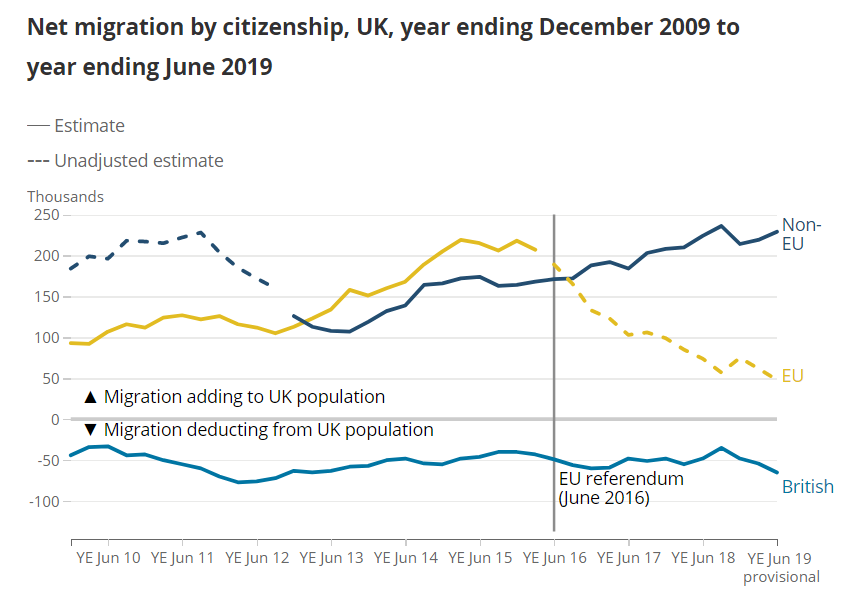
We don't yet know how things might change in the future. Everyone seems to be inventing their own scenario of the outcome they envisage might happen, and then labelling it as a "fact". Hint: adding "(fact)" after stating your opinion, does not necessarily make it a fact! In fact (haha!) seeing as it's a prediction of what might happen in future, then it definitely is not a fact.
Probably the key statistics to look at now, are the number of EU citizens applying for settled, or pre-settled status in the UK. I've heard stories of EU citizens who have lived in the UK for decades, being mightily angry and upset at having to apply to stay here. And I very much sympathise with them. If I reverse things, and imagine myself in that situation, then I would feel angry and upset too.
Getting back to facts though, doing a bit of googling reveals that the application process for EU citizens to apply to remain in the UK, looks simple, online, and free.
This article says that 2 million EU citizens have already applied to remain in the UK after Brexit, despite the deadline being some time away;
The deadline for applying will be 30 June 2021, or 31 December 2020 if the UK leaves the EU without a deal.
[source: gov.uk website]
Therefore, it looks to me as if a mass exodus of EU workers, from the UK, looks unlikely. A smaller scale exodus is still possible though, which might push up wages further for companies like FUL. So for investors, this is an area of possible concern, which needs monitoring, in my view.
Just to reiterate, whatever your political views, please don't post them here. I'm only interested in the economics of how this issue might affect companies which employ a lot of EU labour. Grazie mille!
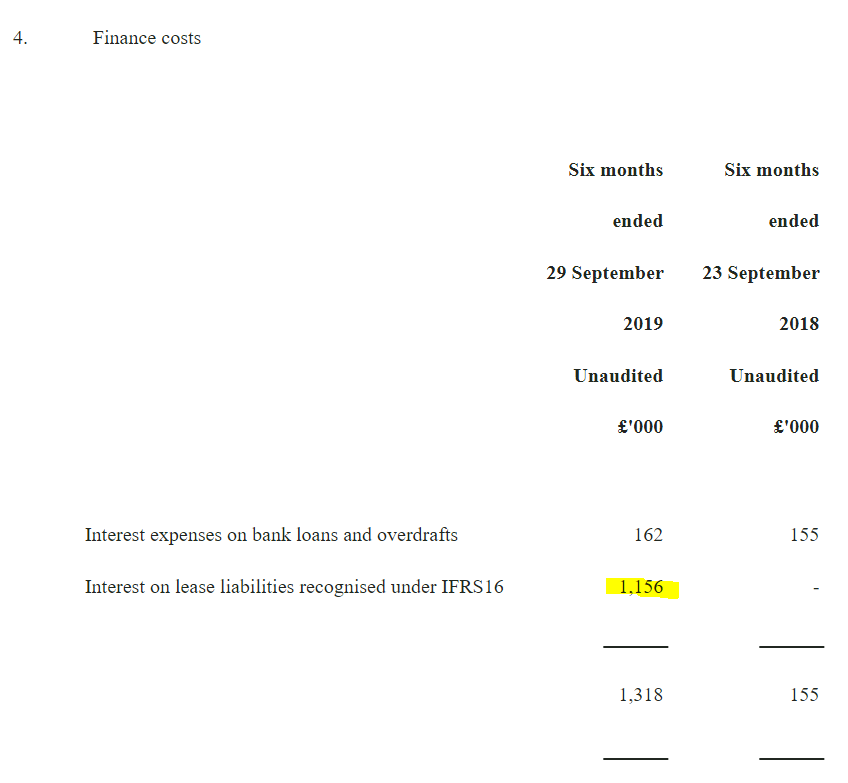
Interim results - looking at the numbers, they are really messed up by IFRS 16, because the prior year comparatives have not been restated, so are not really comparable. This particularly applies to EBITDA.
At first glance, it looks as if profit has gone up on H1 LY. However, note 4 shows that the IFRS 16 nonsense has created a large distortion to finance charges on the P&L, for an invented, unreal finance cost;
The other complication, in addition to IFRS 16, it that the company has its own definition of adjusted profit, which it calls headline operating profit. This adjusts out pre-opening costs for new sites, brand amortisation, etc. But it's stated before the newly increased (due to IFRS 16) finance charges. Therefore I don't think the year-on-year comparison at that level is meaningful.
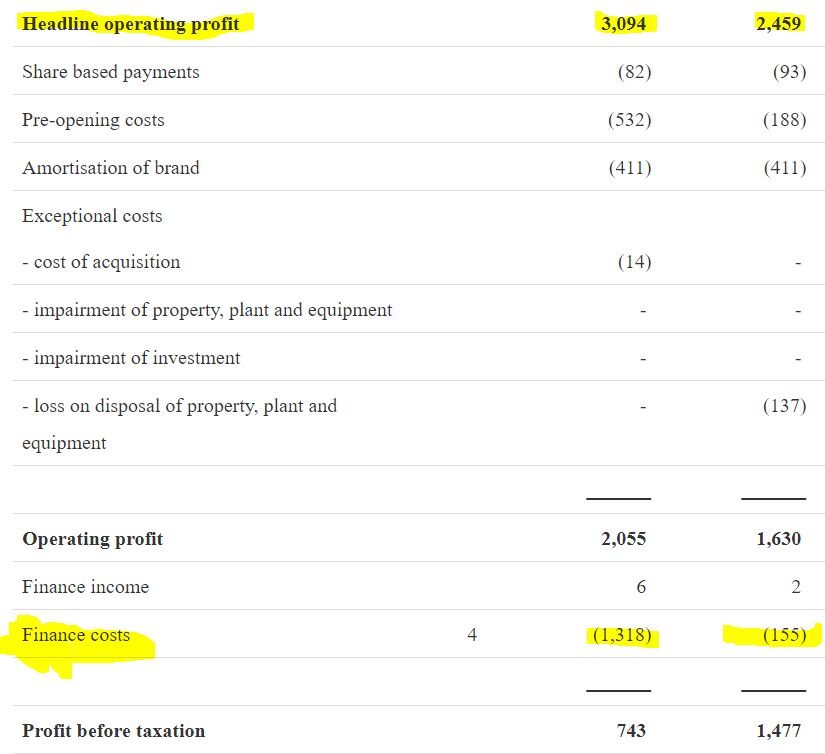
If I'm reading the numbers correctly, then I would want to take the £3,094k and £2,304k headline operating profit numbers above at the top of the table, and deduct finance charges. Doing that arrives at my adjusted profit before tax of £1,776k vs £2,304k LY H1 - i.e. on a comparable basis, it looks like profit has actually fallen 23%, not risen, as the company claims in the narrative. What do readers think? Does my logic make sense to you?
Like-for-like sales - an investor friend pointed out to me recently that FUL doesn't disclose its LFL sales. This is a key number, which investors need to know. As Graham pointed out recently, retail/hospitality companies generally need to be increasing LFL sales by say 2-3% p.a., to offset rising costs.
Note that its smaller chain, The Real Greek struggled a bit in the period;
As previously reported, trading at The Real Greek proved difficult during summer 2019. A number of terraces were not consistently useable during this period and this softer trading was compounded by particularly strong revenue comparatives against the glorious summer of 2018. The Real Greek opened one new restaurant in the Strand, London at the end of the Half Year, which is trading well. Since the Summer, we have seen improving trends across our Real Greek restaurants.
Property leases - if leases expire, then some tenants will be getting the benefit from re-negotiating falling rents, but that depends on the timing of lease expiry, which are often not disclosed. As a theoretical example, a company might have an average lease expiry of say 3 years, which sounds fairly harmless. But that could hide a reality that a company has say 3 or 4 massively loss-making sites with leases that don't expire for 10 years, but the more numerous sites trading profitably or at breakeven might have leases that expire on average in 2 years (and in some cases might even see rent increases). Therefore current disclosures leave investors largely in the dark as to whether lease liabilities are a problem, or not. I'm very unhappy about the new IFRS 16 system, as you might have gathered.
Even if you had access to data of what all the sites rents are (which e.g. a chartered surveyor would have access to), you still don't know whether a site is trading profitably or not. Hence the rent data per site, on its own, is pretty useless.
Balance sheet - is also groaning with IFRS 16 entries, which don't help me at all. So I just cross them out.
NAV is £40.7m. Eliminating intangible assets, arrives at NTAV of £15.3m.
Net debt of £8.8m looks OK to me, given the cash generative nature of the business.
Overall, I would describe the balance sheet as just about OK, but not strong by my standards.
The roll-out (i.e. opening new sites) has resumed, after a pause last year. Hence capex is rising again, considerably. This must be a great time to be opening new sites, as I imagine landlords must be offering a quality operator like this stunningly good deals on new sites.
Cashflow statement - this also seems to have been messed up by IFRS 16 (grrrrr, I need a lie down in a darkened room, with a wet flannel over my head, after spending all morning on this). Rather than wasting more time trying to untangle that, it's easier to just draw the broadbrush conclusion that net cash is about the same as it was a year earlier, after absorbing the cost of opening a decent number of new sites. Therefore the key takeaway is that this is a self-funding roll-out. Hence patient shareholders are likely to own shares in a much bigger business, if they sit back and wait 5 years. Hence the shares might look expensive now, but when you factor in the roll-out, they may not be expensive after all. Possibly.
Outlook comments - the key bit says this;
Current trading remains satisfactory but the sector's outlook is not helped by poor consumer confidence.
I'll be keeping a close eye on consumer confidence figures, as I think the recent, decisive election outcome, and promises of considerable increases in Govt spending, could turn the tide somewhat, although I've no idea how much.
It removes one of the two major uncertainties anyway.
My opinion - I had no intention of spending so long on this!
Bull case - this business has 2 successful restaurant formats, which generate decent cashflows to fund expansion without diluting shareholders. So it's a self-funding roll-out, which tend to attract premium valuations as investors price-in future growth.
Bear case - it looks like underlying profit is going down, so the new sites might be obscuring profit declines at older sites maybe? The company doesn't give us any information about LFL sales, so we don't know. Arguably if LFL sales were strong, then the company would tell us! Or, the new sites might take time to reach strong profitability, therefore the new sites could be diluting good performance from older, maturing sites? We don't have enough information on this.
Overall, I like the business, and think it has potential for a national roll out across the UK. Therefore, long term, this could be maybe 5-10 times its current size, perhaps? That is possible.
Personally, I held a small long position here for some time, but got rid of it earlier this year, on a general portfolio tidy up (given political uncertainty, I decided to have a cull of my small positions that wouldn't move the dial if they went up a lot).
At some point in the next few years, I might go back into this share.
Its current market cap is just under £1m per restaurant. That strikes me as a bit over-valued for the existing sites, but it's pricing in the self-funding roll-out. Therefore, in that context, I'd say the share price looks about right, to me, based on current information.
K3 Capital (LON:K3C)
Share price: 212p (up 21% today, at 12:13)
No. shares: 42.2m
Market cap: £89.5m
K3 Capital Group plc, a leading business and company sales specialist in the UK, is pleased to announce a trading update ahead of its interim results for the six-month period ended 30 November 2019 (the "Period") (the "Interim Results"), which will be announced on 4 February 2020.
I wouldn't normally look at this type of company, but the 21% share price rise has intrigued me.
The other thing is that conventional brokers are saying that business (for IPOs, fundraisings, and company sales) is tough. Yet this company (which seems to specialise in company sales) is doing well. It looks a more specialised business model than traditional brokers - and things are going well - so it sounds like K3 could be on to something.
The key bit of today's announcement says;
... the Company is pleased with the growth that has been achieved during H1 and can confirm that it remains confident in achieving market expectations.
Which I presume means full year market expectations. What else would it mean, yes of course that's what it means.
John Rigby, CEO of K3, commented:
"We are pleased to report another very solid H1 performance with more transactions completed during the first half than ever before, a particularly encouraging performance in the context of the difficult market backdrop of political and economic uncertainty.
This growth is further backed up by a record number of deals in the pipeline that underpins our confidence of continued growth in the second half of FY20 and beyond."
It's probably the strong outlook comments, more than being in line with expectations, that triggered the excitement in the share price today.
Plus a lowly valuation - here are the Stockopedia stats from last night (so before today's big rise in share price, which will obviously change the valuation stats considerably);
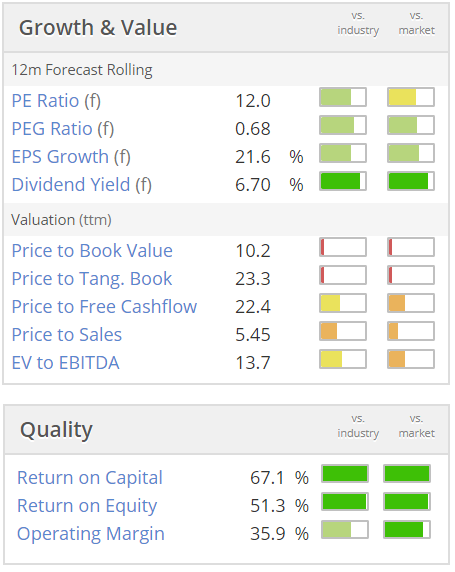
Dividend yield - looks excellent. Although that may not necessarily be sustainable, if the deal pipeline were to dry up in future. I'm having a quick look through its results for FY 05/2019, and note that PBT fell by 33%, and the dividend was also reduced by 33%. So it looks like the company has a policy to pay out a fixed percentage of profits, which is likely to make divis volatile.
Shareholdings - management seem to own a big chunk of the equity, which is good for a business that relies on "rainmakers" to get deals done. Also note the quality institutions on board, so management clearly are credible in the City.
My opinion - this is my first ever, and rather brief, look at this company. It floated in April 2017, on AIM. I think it looks potentially interesting, and would like to find out more about it.
It seems to have carved out a niche in broking & managing the sale of smallish businesses. So if you're thinking about selling your business, this looks like the company to approach.
Fees seem to be lumpy, as dependent on deal volume & size. It seems to be doing well, when competitors are struggling - so they're either better than the competition, or got lucky with some big deals. It looks like revenues & hence profits come from one-off deals, rather than recurring revenue, which is a potential downside.
It's a capital light business model, being a people business. Hence cash generated is paid out in divis. Management have decent shareholdings, so hopefully should stick around.
Overall, I'll add this one to my watch list, as potentially interesting, and will report on it again in future. If time permits, I'll have a look through its AIM Admission Document, which is here. The purpose of the float on AIM was to allow the founder, Tony Ford & wife, to sell some of their stake, for health reasons. It's unusual to see that specifically mentioned in a float.
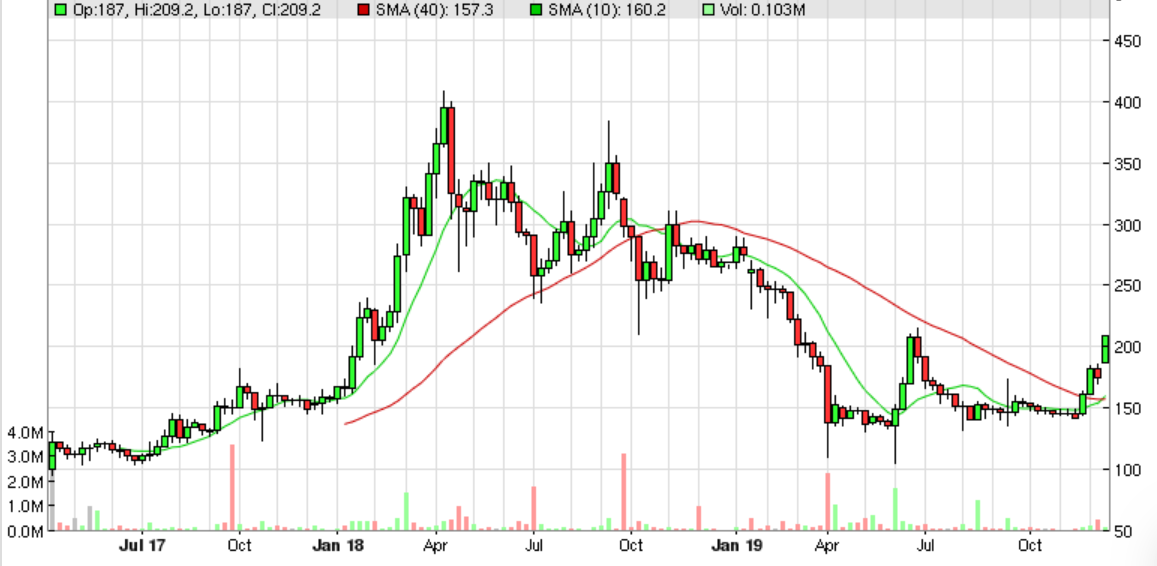
It floated at 95p, then spiked up to c.400p within a year of joining AIM. So the selling Directors must have been kicking themselves at selling too cheaply. It's since fallen back, but looks to be regaining its poise after today's bullish update.
Here's the chart since it floated at 95p - very volatile, but an undeniably successful float, being over double the IPO price now;
Van Elle Holdings (LON:VANL)
Share price: 41.5p (up 5% today, at 13:06)
No. shares: 80.0m
Market cap: £33.2m
Van Elle, the UK's largest ground engineering contractor, is issuing the following trading update ahead of the announcement of its results for the six months to 31 October 2019 ("H12020").
(sorry, I couldn't get rid of the bolding in the original)
A poor H1 performance, well down on H1 LY, as expected;
... As a result, the Group expects, subject to completion of the interim audit review, to report first half revenues of circa £48m (H12019; £42.9m) and adjusted PBT of circa £1.0m (H12019; £2.8m), reflecting both work mix and the adverse impact of the quiet first quarter.
I say as expected, but given that the share price is up 5%, it must be not quite as bad as expected.
Outlook comments sound reassuring;
Notwithstanding continued short term uncertainty in several of the Group's markets, including the commercial building sector and subdued activity levels in year one of Network Rail's Control Period 6, the Board anticipates modest market improvement during the second half and believes the diversity of the Group's operations and continued delivery of its transition plan initiatives will allow it to maintain the current momentum.
Consequently, the Board believes that the Group is on-track to deliver a result for the current year within the range of market expectations.
Bear in mind that earnings expectations have more than halved in the last year;
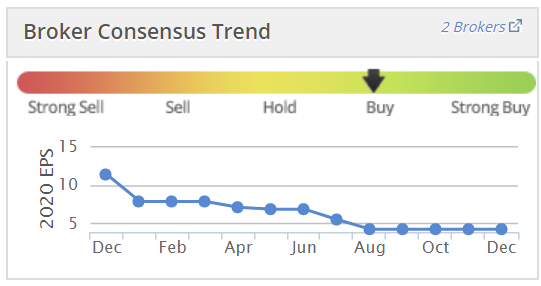
That puts this share on a PER of about 10 for the current year. Why would you want to pay more, for a contracting business, that has disappointed considerably since its float in Oct 2016?
This reminds me of a conversation I had recently, with a friend who does deals for a City broker, including floating things on AIM. I was good-naturedly haranguing him on various matters. The conversation went something like this: "Me, can I give you my wishlist for 2020? No.1 on the list, is will you please stop floating crap companies! Please just float some decent companies!". His reply gave me pause for thought: "If you own a decent private company, why would you want to float it?".
He's got a point, hasn't he? Why take on all the hassle of a stock market listing? Good reasons might include major shareholders/founders wanting to retire, and cash out. Or a private equity owner just wanting an exit, to recycle funds. Or funds for expansion. So there are good reasons to float, but I think we need to look more sceptically, and ask tougher questions about why companies are listing their shares, and maybe not just meekly accept generalised answers?
My opinion - I'm not interested in owning shares in any contracting companies.
Having said that, the surge in Govt infrastructure spending that is now expected (see today's papers) could mean a decent macro backdrop for this sector. So although I wouldn't want to own this share, or others like it, long-term, there could possibly be a decent shorter-term, speculative trade to be had, maybe?
Studio Retail (LON:STU) (formerly Findel)
I've had a quick look through these interim figures, and decided not to dig any deeper, as there are too many complicating factors - e.g. disposal post period end, lots of debt, pension deficit, IFRS 16, PPI claims. So it would take hours to unpick it all, and I'm too tired. Plus this share has never really interested me.
Although just to flag up that its current trading comments today sound good, so it might be worth readers taking a closer look at it, possibly?
We saw more customers waiting for Black Friday and Christmas than in previous years but when they arrived, post period-end they did so in record numbers. Record levels of online sessions in a single day (781k on Black Friday), daily dispatches exceeding 100k parcels for the first time ever, and product sales in the last 11 weeks up 10% on prior year underlines Studio's digital growth trajectory.
Time's up for today, so I'll leave it there.
Regards, Paul.
Disclaimer
This is not financial advice. Our content is intended to be used and must be used for information and education purposes only. Please read our disclaimer and terms and conditions to understand our obligations.

43 comments
NMC Health (LON:NMC) still falling.
Can't see why they have not even put out a holding RNS like Burford did. If there isn't one tomorrow you'd probably think the falls might continue.
Can you buy shares in Muddy Waters? Seems a licence to print money if you were them.
Thanks for the shout out Paul!
It was just a bit of fun! ;-)
I know!
I was chuffed that you have even noticed me. I used to be on twitter/watch the news/read the ft/read the Guardian/listen to Today and it screwed with my head (don’t think I am alone). Was off all of those for about 8 weeks and have only dipped my toe back in the Ocean (or should that be mire) that is Twitter but have muted B and J words amongst others and still enjoy the Fintwit community there.
I have you to thank for Globo (out with small profit just in time) and Boohoo (LON:BOO) still in four years on with my first purchase up 7 fold and the profits on Boohoo (LON:BOO) representing 24% of all portfolio gains.
Hoorah! Well done :-)
Paul, I own a company being "sold" by K3 Capital, 2-3m window. They have been excellent from the off with a steady stream of investors and a number going to DD and offers. They also offer to manage the legal side of the deal via Gateley. Happy to discuss more.
Laney, do you own £K3C too?
I've met mgt a couple of times and I think they are good...and hungry to so more/better.
No, but only because I keep my holdings 8-12 and they remain on my monitor list. I run a double filter, one Buffet like (must pass) and one O'Shaughnessy like qvm (90% rulz pass). K3 albeit a good forecast return, not sure if EPS growth or ROE are sustainable, would need a lot more small/meds deals but they are the go to, so 5 years of conserve gov will see a lot more deals IMO. My flags are F-score only 4, also last couple of years OPsCFps lower than EPS (not big gap). Seeing them in action is very useful (qual) insight but they still need to pass my (quant) rules to deploy funds.
Genuine questions:
1) Why is there an assumption that money will flood back into the UK after the recent election? Isn't there still much uncertainty over the next 12-18 months?
2) Why does the UK market appear to be cheap to some? I personally don't find it easy to find a "cheap" + quality stock, or at least UK companies weren't coming up more frequently on my various Stockopedia screens (hence my recent upgrade to European Stocks).
Could it just be that US stocks are expensive, therefore making everything else look cheap? Or perhaps my criteria are just too stringent?
Thanks in advance
A
1) Why is there an assumption that money will flood back into the UK after the recent election? Isn't there still much uncertainty over the next 12-18 months?
The assumption is international funds will buy UK stocks based on yields and lower PER ratios, given they are cheaper than USA markets, effectively repricing out the discount for political uncertainty. But, your second point is correct, the details of the final deal with the EU will unfold between now and July and markets will move on news flow. So the repricing upwards we have seen is a receding of political risk, not a full removal. Also, any impact will vary by industry and whether earnings are generated domestically in the UK or overseas, so a few moving parts. For example, Rio Tinto's revenues are derived outside of UK-EU in USD but it's stock price quoted in Pounds will vary based on the £ fx rate. In contrast the revenues of Lloyds Bank are tied to the UK economy not the £ fx rate.
Why does the UK market appear to be cheap to some?
High yield, both on a dividend and earnings basis.
Could it just be that US stocks are expensive, therefore making everything else look cheap?
Yes. But tricky part of the equation is growth. Much of the UK FTSE100 is high dividend, ex-growth, mining, financials, consumer stocks, cyclicals. Whereas in the USA you have companies with growth. So you would pay a higher multiple for a stock you expect to grow.
Of course, the likes of Warren Buffett advise to buy good growth stocks, but at a reasonable price, so you have a margin of error. The challenge is to find them.... :)
Personally, I have taken profits on small UK stocks I held on a value basis as they don't look so cheap now, but kept the small-cap growth stocks and also large caps, on the basis funds flows will goto large caps first and also any growth should pay.
I have bought US stocks, as I think Trump needs to win the election in Nov and the Fed has quietly restarted QE injected funds into the REPO market. More liquidity needs a home.
As it's a bit slow news wise I will drop this in on the immigration debate.
Brixton market in London..Mexican restaurant. Bit of Dad talk to the pretty waitress.
'So which part of Mexico are you from' (said Dad having been there on business/pleasure a few times)
'Oh I'm not from Mexico I'm from Colombia/Venezuela/Ecuador.'...can't remember which
' that's interesting how did you manage to get over a job over here.?'
'It's easy enough to get to the UK..everyone has relatives in Spain ...if you know what to do when you go to Spain you can get a Spanish passport in around two years. Once you have that then you can live anywhere in the EU'
good luck to her ..but it's the true life version of immigration which you never really see reported in the media.
Hi Paul & Graham,
Don't usually comment here but enjoy the SCVR a lot.
Before you get inundated with 'Best Wishes for Christmas & the New Year'. I would like to add mine and thank you both for all your hard work over the past year and look forward to a successful 2020 to you both,
Happy Christmas and a Peaceful New Year.
Paul, either your profile picture is out of date or you would be wasting money paying for a beard trim.
K3 Capital
£K3C
(Got prob getting the symbol to work!)
Despite the pop today and overall 40% rise from lows about a month ago K3C is still pretty cheap if you believe it has a sustainable niche and model. At 150p the price implied more than mere brexit and/or cycle woes and that something more fundamental is wrong.
At 210-220p its probably still pricing too much Brexit/cycle risk perhaps something like 50p worth.
The operating margin of the business is 40%. As its capital light it pays out a high proportion of that the profits are highly tangible to shareholders...I'd actually prefer they reduced the payout and had an ongoing share buyback but that isn't simple due to extent of inside ownership.
Growth in the business last 18 mths has been highly impressive but hidden by some quirks of the financial model whereby big corporate deals bring windfall type profits to the business. FY18 results brought this bonanza but FY19 saw a precipitous drop off in large deals. Underneath the business has steadily grown both the number and average deal size of small and mid sized transactions (roughly deals worth £500k to £20m). In their words moving effectively from sell chip shops for retiring owners to more small industrial and service business.
At 400p in April 2018 the stock was erroneously pricing ongoing high volumes of large corporate deals (ie £20-200m ish). At 215p approx right now its saying the large deals are dead to them. Large deals involve bigger business and private equity as buyers. This is the Brexit uncertainty hit. There may even be a little bit of counter cyclicality (or very early cyclicality that looks counter cycle) to this blockage unwinding. Notch a couple of bonanza years in a row (not forecasting it!) and expect the valuation to get toppy again.
IMO its probable that K3C have a category killer model and a decent amount of market share to go after. To be simplistic their great realisation/advantage is that they realise that their bread and butter business is not really looking for or comfortable with high end corporate finance stuff nor well served by accountancy firms doing it on the side. They start with relationship/sales guys meeting and handholding and showing people a fairly simple and systematic route to realising a sale. A lot of process is systematic and increasingly being automated
Its probable that their model is much better aligned to needs of user than others and that competitors cannot easily copy it without upheaval. Its hard to know what the scope for growth in market share is. They claim to be something like 2% of market share so maybe the path to say 20% is all sensible scaling...but its hard to know whether that also includes moving the model to serving greater scale businesses. Not essential knowledge for the next couple of years but one to put to mgt next time I see them.
1 Thanks Paul, for another fine and detailed article, full of insight.
2 With certain other colourful characters, I think it makes sense to learn from the good work they do. Then for anything more dubious, well there is no obligation to act upon the advice. Certain readers prefer to get stressed out when they could take the easy option and move on.
3 I would think automation in other sectors should free up enough labour for the restaurant sector.
Look automated payment in McDonald's.
Automated tills could be rolled out much further in supermarkets and have features added to reduce supervision needs (e.g. fingerprint age verification).
Train drivers should be replaced by software.
Bank staff will mostly be eliminated, whether we like it of not. A process well under way.
Hi Paul,
Your unpick of the numbers for Fulham Shore (LON:FUL) - their Operating profits do seem to be down and from your calcs they do look to be down by more than the company implies. They claim pre IFRS op profit of £1.5m vs £1.6m - I haven't got the will of the time at the moment to track down the discrepancy.
The reason for the decline I think is that LFLs (undisclosed) look to me to be down or certainly not up by enough to offset cost inflation.
The company again uses a misleading (imho) description of their revenue growth
The bit that I have bolded seems to imply a growth in LFLs, but I do not believe that is the case (and if it was, why would they not just say so clearly.
Tracking their number of restaurants it looks to me that the average in the 6 months was 63.5 (averaging the start and end numbers) compared with 58 in H1 the prior year. That an increase of 9.5%. So superficially it looks like revenue per venue is actually down slightly, so all of the growth comes from increasing restaurant.
That would also lead me to surmise that perhaps all of the "increased customer numbers in or restaurants" is also driven by having more venues.
If that's the case then their statement looks borderline dishonest to me.
I could be wrong of course, but if their narrative was clearer there would not leave room for doubt.
In my view unclear narrative tends to be down to either lack of competence of deliberate obfuscation; neither possibility would encourage me to invest here.
(No position)
Aren't we civilised here! Even our bickering is polite!! So much better than Twitter. I will not be reapplying to activate my old Twitter account :-D
It does help that most of us have been making a few quid the past couple of days. The new site might need to introduce a swear filter before the next correction!
Yes, the bounce has been most pleasant.
Several people here said they hold a lot of cash, and I have just sold an IL Gilt that was approaching expiry so I hold a lot of cash too.
I'd be interested to know what others are doing about feeding cash back into the market and where they see significant upside on current valuations.
Personally i had about 30% cash and have already used it mostly to top up existing holdings (what i know best). It's not just our cash that's finding its way back into the market though. i suspect a lot of international cash will too (you can already see that with strength of GBP). I expect this to continue for a while as value hunters become growth/momentum hunters. It's incredible how much catching up we have to do still.
Does that mean there will not be multiple tweets from you when you've had a few too many drinks?
Paul,
Therefore, it looks to me as if a mass exodus of EU workers, from the UK, looks unlikely. A smaller scale exodus is still possible though, which might push up wages further for companies like FUL. So for investors, this is an area of possible concern, which needs monitoring, in my view.
It's worth noting also that retaining EU workers will be aided by any increases in the Living Wage and the strengthening of the pound against the Euro. I assume many workers send money home and so this is an upside for them staying.
All the best, Si
Hi simoan,
It's worth noting also that retaining EU workers will be aided by any increases in the Living Wage and the strengthening of the pound against the Euro. I assume many workers send money home and so this is an upside for them staying.
Excellent points. I think the considerable weakening of the pound was the real reason that net migration from the EU slowed (and not Brexit fears). Now that the pound has strengthened a lot in the last 2 months, it will be interesting to see if the net migration figures swing back again, upwards. As you say, migrant workers everywhere tend to convert their wages abroad with the purchasing power back home.
Best wishes, Paul.
Since the EU migration topic is being discussed, my own feeling is that the improvement in the East European economies, Poland especially, has already been reducing the flow of people from there looking for jobs in this country, and that this is going to continue, quite regardless of political changes to the rules, if any. I suspect restaurants in this country are going to go on finding it is no longer as easy to recruit. Those who treat their staff well will probably do best.
Indeed. Since they joined the EU the Polish average wage has risen something like 2 1/2 times, so a low-wage job in an expensive place like London is far less attractive than it used to be.
I hope so. They need it. I think we western European countries still don't understand the journey many East European countries still need to go on to get up to Western European standards. A young chap I know recently left a major Polish City after a period of secondment moving to the German Capital. He said it was like coming from a life lived in black and white into a world of colour.
Dare I say it, but those years of Soviet oppression following the war left a pretty grim legacy.
I go touring to Eastern Europe frequently and small villages in Bulgaria have depopulated and are left with just old people and fewer doctors to care for them as they've gone West. People here are always on about we rely on EU people for our hospitals and caring etc. but don't seem to realise to the detriment of others.
That's a good point and something rarely pointed out by those on the left of the political spectrum.. Poor country trains up medical staff/doctors/nurse who then leave for a richer part of the world. Is this a good thing or a bad thing.?
Looks like the NHS is now a sacred cow and therefore not subject to reform..it is in fact hugely inefficient/bureaucratic. In my experience it greatly favours huge US multi-nationals ..initially because they bribed doctors/consultants/purchasing staff by offering freebies (overseas conference in Thailand anyone....all on expenses). Since that got chopped the big fear for hospital buyers is change. Buy some cheaper British made forceps from a small UK producer and something goes wrong in the op.then the lawyers will be all over it. Why bother...just stick with the big established US supplier.
What irony...again never really understood by the Islington lefty types.
The Govt set out a policy of encouraging small companies to get involved in Govt contracts, and may be there has been some improvement, but when it comes to it, big understands big, and small companies find the weight of compliance and other guff somewhat overwhelming, as Govt and indeed most large institutions apply tick box regulation, because Politicians and regulators create a punitive environment to show they have done something.
Most big entities can cope with it, because they can afford their own compliance and technical resources.
Indeed (re the movement of young people from the East to the West), this one of the big issues I always had with freedom of movement of labour across such an economically diverse continent.
I remember seeing one of the Sunday morning politics shows a good few years ago where Jack Straw (I think it was) and a conservative (predecessor or ante-cessor can't recall which) agreeing that the increase in immigration was a good-thing because it had helped to redresss the imbalance between working age people contributing to the state pension pool vs older people drawing down from it.
But as you observe, it has exactly the opposite effect on the 'donor' countries. It is a source of puzzlement to me that it seems to be the 'poorer' countries that are most in favour of freedom of movement of labour (within 'the club') when it is actually against the interests of their economies.
On a related note, and pointing back to the discussion on the potential shortage of cheap low skill labour, it seems clear to me that the influx of low cost labour over recent years is a major factor behind the much vaunted "productivity gap" here in the UK. Also I would argue it is part of the reason for over-capacity in sectors such as casual dining and also is the reason that home delivery has become so cheap as to decimate the high street.
I honestly do not know how profound Brexit will actually be on immigration and movement of labour, but I do think it could cause significant short term damage to some sectors, but over the medium term encourage innovation and rationalisation in the domestic economy.
Hopefully I managed to just about squeeze this into the investment remit of these discussions.
;-)
Historically poorer countries are generally happy to encourage emigration on three grounds. First, emigrant remittances provide a very valuable source of revenue (in the 1890s they provided over 20% of funds spent in Ireland). Secondly, the the decline in population frees up domestic resources for those remaining, be it land or government services. Thirdly, migration offers a safety valve for politically unstable regimes, drawing of the discontented and disappointed.
As a side effect emigration also drains away the industrious, the dynamic and the motivated.
Simoan
I agree - a sudden exodus is unlikely (as a slow-motion one is already unfolding).
One issue will be the extra bureaucracy involved for EU people who wish to come to the UK post the transition period - that's the current uncertainty. My brother-in-law employs Bulgarians and is particularly concerned about this.
Presumably the bureaucracy already applies to non-EU people - note that net inward migration is now 3x as large for non-EU as EU. The difference is that many EU people work here and then go back to their home countries after a few years. Non-EU people tend to stay.
Sorry Paul, I'm not having a go at you, i just dont want readers to fall foul of his otherwise poor recommendations. Please excuse the tone of my comment.
Sorry Paul, I'm not having a go at you, i just dont want readers to fall foul of his otherwise poor recommendations. Please excuse the tone of my comment.
Thanks for your follow-up comment, much appreciated.
Most of us have been around long enough to have the measure of Mr Winnifrith. To be fair though, for all his faults, he does some good investigative work, and has shone a light on a lot of dodgy companies & Directors. That is to be commended. There aren't enough people doing that kind of work.
So my view is, a thumbs up for his investigative work. And a thumbs down for everything else!!
TSI two shields have 2 announcements today and I think this stock could do well next year, interesting investors and products - I am long
I don't think it wise to mention steering away from frauds and at the same time talking up Tom Winnifrith.
I did not talk up Tom Winnifrith. If you knew me a bit better, then you would realise what a laughable suggestion that is!
However, the fact is that he did detailed, and excellent work, uncovering a major fraud, Quindell.
Personally I've learnt to avoid companies that TW rubbishes, he's generally spot on in this area, imo why take the risk anyway ?
On the buck side I've also learnt to avoid companies that he tips up haha
Paul, that's a very valid point about spotting the losers. Simply reducing the universe of companies that can be considered for investing is an incredibly useful exercise. A short glance at social media reveals large numbers of private investors who appear completely focused on the upside and the next "Multibagger" with little regard to the downside. Taking a conscious effort to remove the frauds and losers will almost certainly increase the odds of success.
It's also worth noting that the lack of sanctions and punishments for fraud on London's stock market is now a serious issue. Especially when it comes to the "Untouchables". Some people and institutions will not be held to account. In developing countries, it's referred to as corruption. Over here, it's barely acknowledged.
At the end of the day, it's up to the individual investor to thoroughly vet companies. And that means discarding the dross.
Very good point - my limited experience has taught me that if you eliminate the potential losers as much as possible, the winners tend to look after themselves,
Video. Panoply Holdings (LON:TPX) resport H1 20 last week. Here, Neal Gandhi, CEO, gives an overview of the business, runs through H1 20, and outlines the investment case.
Panoply Holdings (LON:TPX) should benefit from the election result. They help government and companies smoothly transition into tech. TPX have many IT areas of expertise, Eg. implementing RPA, partnering with Blue Prism.
My morning smallcap tweet:
Be Heard (LON:BHRD) Yu (LON:YU.) Gresham House Energy Storage Fund (LON:GRID) ValiRx (LON:VAL) Live (LON:LVCG), £K3C
Be Heard (BHRD) guides FY in line. "digital and insight businesses continue to perform well, offsetting the disappointing decline that the Group has experienced in its more traditional and creative businesses, which is in line with recent announcements from several of the Group's competitors."
Yu Group PLC (YU.) will buy hedged-price energy from SmartestEnergy. This will release up to £13m or working cap and allow it to expand faster. Claims the prices will be market competitive and transparent prices, but sounds like a free lunch to me.
Gresham House Energy (GRID) buys two operational battery storage facilities totalling 50MW for £29.2m. This is a quarter of National Grid's 2016 Enhanced Frequency Response (EFR) capacity.
ValiRx (VAL) Phase I/II trial update on VAL201, ValiRx's lead Phase I/II therapeutic compound, for the treatment of prostate cancer and other indications of hormone-induced unregulated growth, including endometriosis. "The results appear, in advance of full analysis, to indicate that the VAL201 compound has a clear impact on patients with prostate cancer."
Live Company Group (LVCG) extends maturity date of a loan facility, £0.7m outstanding. £2m placing at 30p, a7% premium. "Under an equity sharing agreement also entered into by the Company with the Investors (the "ESA"), an amount equal to the gross proceeds of the Subscription following its completion, will then be returned by the Company to the Investors (the "ESA Payment"), with the Company to receive back the ESA Payment, subject to certain pricing adjustments (as detailed below), on a pro rata monthly basis over the next 12 months pursuant to the ESA." What?
In line: £K3C