Small Cap Value Report (Mon 17 June 2019) - STAF, KIE, PTGS

Good morning, it's Paul here!
7-8am comments
Staffline (LON:STAF)
An update is given today.
Key points;
- Results for FY 12/2018 due out on 27 June 2019 - cutting it fine for the 6 month deadline - due to detailed investigation into compliance with minimum wage regulations
- Increasing related provision from £7.9m to £15.1m (a cash cost in 2019) - another example of how the initial assessment of accounting problems is usually the tip of the iceberg
- Total exceptional costs for 2018 now £32.6m
- Possible breach of bank leverage covenant - will require a waiver
- Operating within bank facility limit & expected to continue so
- Placing to raise £30m + £7m open offer
- No final dividend, which shouldn't come as a surprise to anyone
- On the positive side - underlying performance for 2018 in line with expectations, and same for 2019 - EBIT in range of £23-28m, and y/e net debt also expected to be in line (previously guided up sharply)
My view - Placings are normally done on the sly, and the first private investors know about it, is when the deal is announced. It's a terrible system, because information often leaks out, thus creating a false market in the shares.
What should happen is that shares should be suspended when a fundraising of any kind is taking place.
Pre-announcing a placing, as in this case, is an open invitation for traders to short the share. Emergency fundraisings like this can be done (if at all) at a deep discount, as new funders demand their pound of flesh. It all depends on the strength of the broker & its contacts, plus how convincing management are in the meetings that take place with possible funders. So this is a very uncertain situation until the deal is done. In an ideal world, existing institutional shareholders step up and support a fundraising, in order to defend the value of their existing shares.
For me, it's uninvestable until the placing & open offer complete. After that's done, I think it could be worth taking a fresh look at the refinanced company.
It's perfectly reasonable for the bank to require an equity raise, of a similar size to the exceptional costs.
I think shareholders will need to prepare for another potentially ugly day today. Let's hope the broker can get the placing done & dusted quickly - as the price could be potentially very low.
This situation has been incredibly badly handled. It's another example of how an acquisitive group borrowed too much from the bank, hollowed out its balance sheet with goodwill, and then did not have adequate financial strength to deal with an unexpected problem.
The previous CEO timed his exit & shares disposal almost to perfection. That happens quite a lot, doesn't it? Hence why for me, a major/total disposal by Directors, is probably the biggest sell signal you can get.
After 8's
Continuing the theme of financial distress;
Kier (LON:KIE)
Share price: 118.7p (down c.9% today, at 10:03)
No. shares: 162.1m
Market cap: £192.4m
Strategic review & indebtedness update
Kier is a sprawling, acquisitive group, covering infrastructure, building, and services. To learn more about the group (which I've not covered before, as it's not been a small cap until now), I've perused a useful presentation slide pack here, covering the interim results to 31 Dec 2018. Major infrastructure projects the group undertakes seem to be mainly public sector contracts, and utilities companies, e.g. constructing a lot of roads projects (e.g. so-called smart motorways).
I find complex groups like this very difficult to analyse, as there are so many moving parts. That's why generally I stick to smaller companies, whose accounts are easier to understand.
The other weekend, whilst stuck indoors during non-stop rain, I spent some time looking at Kier. I came to the conclusion that the shares looked dirt cheap, on a forward PER of 2.5, and that the net debt seemed relatively modest. The shares were 155p at the time, and I even put a "Buy Kier" note onto my calendar for the following Monday.
Thankfully, two things made me hold back from buying;
1) Sector - this infrastructure building/services sector has been a graveyard for investors. So many groups have gone wrong, often involving a collapse, a recent example being Carillion.
2) A horrible cashflow graphic in the presentation pack linked to above. This reminded me that I'm increasingly coming round to the view that I should treat the balance sheet & cashflow statements as the most important. The P&L is really the least important statement, as it's the easiest to massage to present a favourable picture. Therefore, maybe as investors, we're getting it all wrong by concentrating on earnings-based valuation measures such as PER?
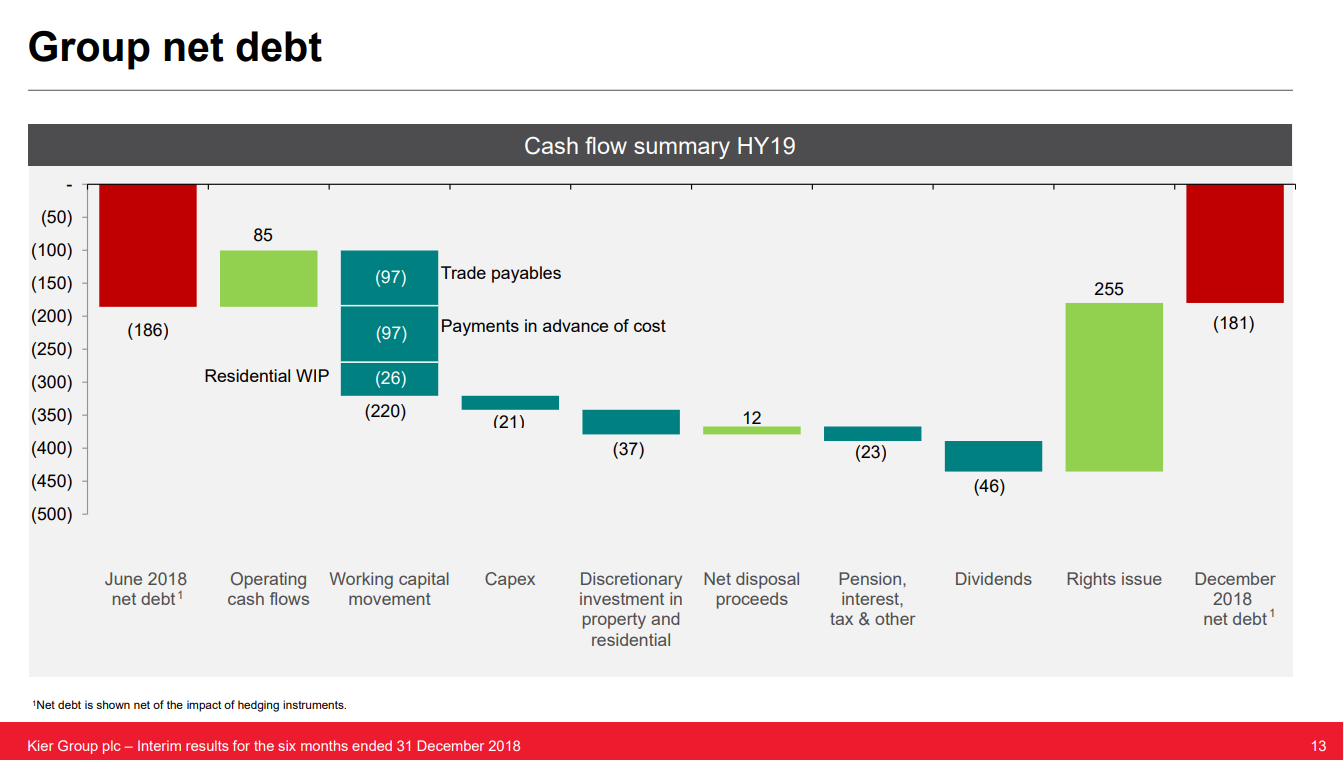
The above graphic shows us that the proceeds of the £250m (net of fees) Rights Issue in Dec 2018 was entirely consumed within just 6 months, by adverse working capital movements of £220m, and paying divis of £46m.
Trade credit insurance - very recent press reports suggest that trade credit insurers have been withdrawing cover for Kier's suppliers. This is an often-overlooked, but crucially important point. Trade credit insurers such as Euler, guarantee that suppliers get paid, even if their customer goes bust. This enables suppliers to extend credit to their customers (such as Kier), without having to worry that the customer might go bust, leaving them with a bad debt. It also satisfies banks that the supplier may be borrowing from, that it also won't go bust from suffering a bad debt.
I've had a lot of dealings with trade credit insurers, and they can be trigger-happy (understandably, as they're taking large risks) in withdrawing cover, when any doubts arise about the solvency of a company. Such withdrawal of insurance cover can tip a struggling company over the edge, and lead to it going bust - since without insurance cover, many suppliers refuse to send in fresh deliveries, thus causing the struggling company's business to grind to a halt.
... Kier is in regular dialogue with its largest customers who continue to be supportive during this period of volatility.
Kier understands that certain suppliers have experienced a reduction in the level of trade credit insurance available to them; Kier is working with those suppliers to mitigate the impact of this...
Update today - where do I start with this? There's so much information to process.
Here are what strike me as the key points;
1) Improve cash generation & reduce debt;
... insufficient focus on cash generation and that the Group today has debt levels that are too high...
Well done to Kier for being straightforward about the problems. The net debt looks fine, but it's the gross debt that's too big. A reminder that balance sheets are often window-dressed to present an artificially favourable picture on one day.
Hence why reform is needed of accounting standards, to focus on average net debt throughout the year, not a snapshot on the year end date. Kier does give average monthly net debt, but I wonder if that is calculated on month end dates, or a daily average? If any readers know, perhaps you could post a comment accordingly. This excerpt today is very good;
... Going forward, Kier will focus on managing its retained businesses to deliver long-term profits and a sustained reduction in the Group's underlying debt levels rather than targeting lower debt positions at reporting dates.
2) Simplify the group through disposals
3) Cost cutting - staffing is in the process of being reduced by 1,200 people, saving £55m p.a.
Borrowing facilities - not repayable for a while, but bank facilities could become repayable on demand, if bank covenants were to be breached;
The Group has committed debt facilities of £920m, with its bank debt not maturing until June 2022 and the majority of its private placement debt maturing between 2021 and 2024.
While some of the recent external commentary has had an adverse effect on confidence, with a consequential impact on the Group's working capital position, the Group's liquidity headroom is able to absorb the volatility that this has caused.
However, it will result in reported net debt at 30 June 2019 being higher than current market expectations and an increase in FY2019 average month-end net debt to £420m-£450m.
It looks as if I've answered my own question there, in that average net debt seems to be the month end figure - i.e. not necessarily typical of the net debt at other times during each month.
On the upside, the above strategy is going to reduce net debt, therefore I imagine the banks would remain supportive as this process is implemented;
The Board considers that the revised strategy outlined above, together with the related actions which are now underway, will result in a significant reduction in the Group's net debt during FY2020.
Dividends - the yield was ridiculously high, at about 20%, which already indicated that the forecast divis are not going to happen!
This is confirmed today;
The Board is suspending dividend payments for FY2019 and FY2020. The Board will continue to review dividend policy for future financial periods.
Balance sheet - last reported as at 31 Dec 2018 (interim period end).
NAV: £713.6m. Deducting intangibles (goodwill) of £829.9m, gives;
NTAV: Negative, at £-116.3m - I try not to invest in anything with a negative NTAV, unless it's super-cash generative. Kier seems to be super cash-absorptive, as noted above.
JV investments are on the balance sheet at £238.3m - I don't know how realistic this is, and how much off balance sheet debt might be included within that?
Pension deficits - there's a pension asset of £33.4m, and a pension deficit of £49.9m. I tend to ignore the balance sheet entries, and look at the actual cashflows. In this case, Kier paid £11.9m deficit contributions into its pension schemes, in H1, so almost £24m annualised (assuming H1 & H2 are the same). That's clearly a big issue.
My opinion - I had a close shave with this share - almost buying a few days ago, as it looked remarkably cheap on a PER basis, and the net debt didn't look too bad.
Lessons learned;
- A very low PER means the market thinks there are deeper problems, yet to emerge. The market was right.
- Net debt can conceal a much worse gross debt figure, through window-dressing to get debt down for reporting dates.
My over-arching feeling from trying to dissect the last accounts, is that it's way too complicated for my pay grade. There must be plenty of analysts covering the company, who will understand it better than me. The trouble is that city analysts are not independent, and are almost always under pressure to show things in a positive light. Therefore, all research needs to be seen through sceptical glasses, were there to be such a thing.
I can only conclude that this is way too complicated for me.
It's also high risk, as there's an admitted issue with bank funding, and trade credit insurance.
I think on balance, this situation looks salvageable. If you compare Kier's negative NTAV of £-116m, it's vastly better than (slightly larger in revenues terms) Carillion's negative NTAV of £-1,956m at 29 Sept 2017 - accounts here. Carillion was hopelessly insolvent, as pointed out here in our SCVRs, long before it went bust. Whereas Kier is not in anything like that degree of financial distress.
I think, if it's well-handled, that Kier could get through these problems. That needs continued support from the banks (usually forthcoming, if they trust management & the accounts). It probably also means another rights issue is likely to be needed, once the ship has been steadied.
Would I want to gamble on the equity at the moment? In a word, no. This is for high risk special situations investors, who've done their homework properly, or for complete punters. I think Kier is not a basket case, but that doesn't necessarily mean the equity makes a good investment.
Overall then, too high risk for me.
Premier Technical Services (LON:PTSG)
Share price: 98p (up c.3% today, at 13:41)
No. shares: 126.3m
Market cap: £123.8m
AGM statement (trading update)
...the niche specialist services provider...
Updates us on its progress to date, for FY 12/2019.
"I am pleased to report that the Group has seen continued sales growth and strong levels of orders in the year to date. In addition, working capital utilisation, margin and profit levels are in line with the Board's expectations.
The recent acquisitions of Guardian and Trinity are performing ahead of management expectations. This underscores our confidence in achieving a successful full year result in 2019.
I wonder what "working capital utilisation" means? Nice and vague. Cash is king.
The big question mark over this group's accounts, is excessive receivables (debtors). This can often be a sign of underlying problems, and for me it's a major red flag here. Directors talk about the group being highly efficient, and managed very tightly, yet they take nearly 90 days to collect in receivables. I don't buy it. There are some adjusting factors, but even after the best possible light is shone on the numbers, the trade receivables number is still way too high.
There are several other red flags with this share, in my view - e.g. completely inappropriate benchmark (EBITDA), and excessive management rewards for hitting that target - i.e. providing a multi-million pound incentive to adopt aggressive accounting techniques.
Numerous acquisitions can also increase risk - as it's more difficult to understand, compare with prior years, or otherwise rely on, the accounts.
I don't accept the explanation given about booking a large, one-off profit for consultancy fees, for a company that was shortly afterwards acquired. The commercial substance of that accounting entry seems to me, to have one purpose only - to boost reported profits.
Bear raid - an interesting shorting dossier was published early this year. It contained some interesting points, but like all such dossiers, was intended to rattle investors, inducing them to sell, so that the short seller(s) could close their positions at a profit. Therefore all such dossiers have to be viewed in such a light - i.e. as hatchet job, not fair & balanced commentary.
My opinion - if I don't trust the numbers (and therefore management), I don't invest.
This last paragraph today is interesting;
The Board is currently involved in a review of the Group's internal and corporate governance structures. This review follows the substantial growth in the size and scale of the Group's activities since IPO in 2015. The Board will update shareholders on progress in due course."
This begs the question that, if I don't trust management, why would I want them to conduct or even oversee a review?
This one's definitely not for me. I'm happy to be proven wrong on it, but experience has taught me that if the numbers just don't look right to me, then keeping clear is usually the right decision, in the long run.
Thanks for dropping by! I'll leave it there for today. There are updates from a couple of tiddlers, but they're too small for me to cover here.
See you tomorrow.
Best wishes, Paul.
Disclaimer
This is not financial advice. Our content is intended to be used and must be used for information and education purposes only. Please read our disclaimer and terms and conditions to understand our obligations.

30 comments
Mojomogoz, looked at cynically, with the right information it's probably a lot easier to pick a stock that's likely to tank rather than a stock that's likely to soar. The problems are very much in the here and now. The potential upside is largely unknown. I suspect that few serious shorters act without some form of inside knowledge – such as a tip-off from a management consultant. And I would suggest that many simply work backwards from the information they have obtained. Having been given the inside track on a company with serious problems, they build a shorting thesis around it. Add some plausibility (Expensive offices, secrecy, PhDs, MBAs, etc.) and there you have it.
Soft network stuff is important particularly if you're, say, Kynikos and running a 30 stock fundamental stock picking short. In the UK, someone like the well known Odey is towards this sort of approach (bit more macro and technicals going on too). But the 5 on Kier I reckon are fairly short-ish term and data driven in their shorts generally (I know TT, Marshall Wace and Blackrock well historically) with a perspective that it's as much about permitting some leverage into long ideas too.
Having tried short selling myself on a personal (non professional) level I disagree with the statement that its easier to find a stock that tanks rather than soars. I can take a lot of volatility and be patient but there is no escaping the fact that volatility in shorts is particularly trying plus the world inc management are working against you. With shorts its much easier to cut in and out with the price and narrative momentum in a trader sort of way.
The most public short seller in an ongoing accessible way is Marc Cohodes (ex Rocker Partners and CopperRiver) - @AlderLaneeggs. I knew David Rocker but not Marc at Rocker but I got to know him well (professionally) at Copper River his own shop. It blew up in the 2008 crisis - a bit of a fishy one and Cohodes says its as GS pulled his borrow on him and squeezed him out of business (probably true IMO but unverified). He does the full network and forensic investigation thing. Its truly amazing stuff...but its painful and hard work...not normal to TBH. Real short selling IMO and what I would pay for.
Kier (LON:KIE)
Graham
That's a very stark admission by Kier that it made net debt look good at reporting dates.
I would guess that's par for the course with many listed plc's - not really something they can deny if factually correct - basically it says plenty about the morals of the bods in charge - ie they don't have any. I remember years ago is was common that listed housebuilders would simply withold part of payments due to subcontractors in the last month of the reporting period and then add the payment onto the next month, basically this probably enabled them to make debt/cashflow whatever they wanted it to be. Its the most ridiculous form of playing with the numbers as you then have really strong comparatives at the next reporting period end which cause the same problem next time and then some.
looking at the last annual report for Kier they comment
(a) Trade receivables and trade payables
Given the varied activities of the Group it is not practicable to identify a common operating cycle. The Group has therefore allocated receivables and payables due within 12 months of the balance sheet date to current with the remainder included in non-current.
Does that read that they are saying its not practicable to age their trade payables? - - pretty staggering as i have to presume all their suppliers must have had agreed payments terms that are presumably mostly much less than 12 months ignoring retentions. I guess they have the choice of choosing what is practicable and what is not.
Ok so where does this all end up ? - as ever it seems that the number that generally takes a hammering from such shenanigans is the trade and other payables. Looking at the current trade and other payables the balance per the last annual report is £1.5 Billion - one can see why the credit insurers are getting a little twitchy in this regard as the bods owed the £1.5 billion will deffo be at the bottom of the foodchain - especially when they don't have enough assets to cover their liabilities (negative NTAV as confirmed by Paul)
It may be a bargain but i see zero downside protection if things don't go as "hoped for" - so deffo in the basket case bucket im afraid - as we should probably expect with the price being down over 90% from its peak - ie the smarter money looks like it has left the building some time ago.
That's a very stark admission by Kier that it made net debt look good at reporting dates.
When it comes to shorters, it's very telling if they appear as a group. In the case of Kier (LON:KIE), some five funds are shorting the stock as of today. So five separate funds are reaching the same conclusion. Whether this is statistically accurate in predicting the direction of the stock, I am unsure. But it certainly is something that I am very wary of. The breadth of the shorters is, in my view, just as important as the depth.
There are plenty of UK stocks with more than 5 institutions shorting.
There may be trouble ahead.
On short sellers....
I love fundamental short sellers and think they are often the best business and financial analysts out there (having met, interviewed and analysed loads of them including the famed ones)
However, most shorting today is a sort of mirror world to factor and momentum (inc narrative) investing. With Kier (LON:KIE) I think all 5 are rather factor and momentum based (note that Kuvari is a TT spin out): Blackrock, Kuvari, TT, Marshall Wave, Squarepoint.
Hard to be too sure with Blackrock as so big and so many independent teams. But all (probably including Blackrock) are basically running and trading portfolio against a long portfolio. There is an absence of highly committed fundamental short sellers picking on Kier.
Screen stocks on high debt, cash vs reported earnings, earnings downgrade and negative price momentum and you have the universe of high short interest stock
I have no view on Kier fwiw. My point is simply short interest isn't what it once was as a signal (back in the 80s it was a great predictor)
Some of the five large shorters of Kier stock today might be shorting Kier because they know that Woodford's funds are likely to be forced sellers (in order to raise money for large redemptions by the holders of Woodford's funds). That might also be the case with other stocks that are held by Woodford's funds.
Hi Longvalue,
How do you determine who is short a stock?
Hi Sanj,
I download the Notification and disclosure of net short positions excel spreadsheet on this website https://www.fca.org.uk/markets/short-selling/notification-and-disclosure-net-short-positions for UK shares.
Neil
Thank you Neil.
Thanks for that Sanj
With Kier (LON:KIE) there are also substantial short positions and that is something that always stops me buying. Of course they get it wrong sometimes but I work on the basis that they know more than I do!
Thank you Paul Your point on Balance Sheet and Cashflow prompts me to dig out t and go back over the notes from Graham’s excellent day on this topic........clearly worth more than every penny BUT how do we treat PER? Ignore even when it is in the 20 to 40 range??
Woodford's funds own 15.9% of Kier, according to this article:
https://www.thisismoney.co.uk/money/markets/article-7143061/Bitter-blow-Woodford-Kier-crashes-again.html
As Woodford's funds have to sell stocks they own in order to raise money for redemptions by their holders, this might put further downward pressure on Kier's share price.
Good point, thanks pka.
I knew that Woodford holds Kier, but forgot to mention it in the main article, so thank you for reminding us!
A forced seller can bring a much more attractive price for buyers.
Best wishes, Paul.
Good analysis of Kier.
Shareholders put in £255m in a rights issue and get about a fifth of that back in dividends which are then taxed? Insane.
Only when the dividends end up in the hands of individuals or trusts.
Paul,
A very perceptive Keir comment of yours:
....This reminded me that I'm increasingly coming round to the view that I should treat the balance sheet & cashflow statements as the most important. The P&L is really the least important statement, as it's the easiest to massage to present a favourable picture. Therefore, maybe as investors, we're getting it all wrong by concentrating on earnings-based valuation measures such as PER?
If I look at my own portfolio it generally the strong balance sheet and cash generating companies that have done best for me. Often these type of Quality/Growth companies have very high PERs, which would put many off. A metric best ignored! Ian
Kier (LON:KIE) includes a useful chart of (an amazingly) smooth graph of the level of net debt across FY17 and FY18, in its 2018 annual report p54. This indeed shows that net debt is at its lowest at the end of the reporting periods (June and Dec). For example in around March 2018 net debt seemed to peak at just over £600m, versus £186m reported as of June2018.
In addition, p53 of the same report says that the debt of the JVs is generally non-recourse to the parent - although seemingly there might have been around £38m of guarantees given by the parent on this JV debt, still outstanding as of start 2019. Link to the annual below:
https://www.kier.co.uk/media/2408/kier-annual-report-2018.pdf
Anyone know what is happening at Filta? Down nearly 16% today on no news. In their last update they said that sales would be weighted towards H2 but this seems an excessive and delayed reaction?
Hi Investornot1
RE Filta Group (LON:FLTA)
I don't know what is happening but I suspect that people read into the second half weighting that there is more risk now that they don't achieve their expectations and so are moving on...
I had made a mental note on friday to sell today if they fell any further after the weekend and they have so I got out at 1.75 loosing 23% overall so disappointed but afraid of it going further than this...
To me they should have good prospects after buying over Watbio and with all the recurring revenue and year on year growth but I want to preserve my capital at the same time so for now I am out and will probably never return in case it becomes an attempt at revenge that doesn't work out!!
Thanks InvestorJohn
I'm in some ways in the opposite situation to you on Filta Group (LON:FLTA). I don't currently hold but profit warning looks like a soft one and Filta Group (LON:FLTA) have previously had a H2 weighting so I will monitor and may be tempted to buy once the dust settles.
Be careful not to catch a falling knife... I would much prefer a share that is pushing new highs
The key phrase though was : "and profits will be skewed slightly more than is usual towards the second half" I vented my scepticism here .
It is though a bit surprising to see a further stark fall three trading days later, I would if a "tip" was updated or rescinded over the weekend. (Was it perhaps a Small Company Share Watch publication weekend?)
c. £90k worth of trades on the day - slightly less than on the date of the statement, but significantly more than an average day - Not very liquid then given the c. £55m market cap.
Hi Paul,
I'm a big fan of 'After 8's'.
Happy Monday.
Chris
IG Design (LON:IGR) FY19 results presentation given last week, by CEO&CFO
https://www.piworld.co.uk/2019/06/17/ig-design-group-igr-fy19-results-presentation-june-2019/
Always an impressive presentation.
Future KPI's incl EBITDA +10%; cash conversion 75% ROCE +24%
MrC, Staffline provisions increased from 7.9m to 15.1m
My morning smallcap tweet: STAF's serial stumbles, Kier cash crisis.
Staffline (LON:STAF), Audioboom (LON:BOOM), Kier (LON:KIE), Keywords Studios (LON:KWS)
Staffline (STAF) another stumble as it delays results to 27 June, increases provisions to £7.9m and plans placement of £30m to deal with likely covenant breach. I hold.
Audioboom (BOOM) SPV set up to gtee minimum rev payments to some content providers. BOOM to pay 8% of net advertising revenue plus 2.5m warrants for every US$1m of gtee. SPV owned equally by the Chairman, and Candy Ventures, BOOM's largest shareholder. It's a bit whiffy.
Kier Group (KIE) fire sale including property division to cut debt. No divs for 2 years. Going to focus on cash generation (and not crash generation).
Keywords Studios (KWS) CFO to leave. He is thanked.
Staffline please, looks complicated!