Small Cap Value Report (Mon 19 Aug 2019) - IXI, GNK, RBG, BVC, MTI

Good morning, it's Paul here. I'll be looking after you this week.
HQ tell me that subscribers like it when I give a rough idea in advance of anticipated timings for each report. My plan for Monday is to write mainly in the afternoon, with anticipated completion time for this report of c.6 pm.
Tue, Wed & Thurs reports this week should be finished by late morning, because I have meetings lined up in London for the afternoons.
There's hardly anything to report on today.
IXICO (LON:IXI)
Share price: 41.8p (up 23% today, at 15:48)
No. shares: 46.8m
Market cap: £19.6m
IXICO plc (AIM: IXI), the data analytics company delivering insights in neuroscience...
The company description means this share is well outside my comfort zone!
As the +23% share price suggests, today's update is very good;
Given the performance in the period to date, the Board anticipates that the results for the full year ending 30 September 2019 will be materially ahead of current market expectations.
I usually assume that "materially ahead" means about 10% ahead.
- Strong revenue growth in H2
- New & expanded contracts coming on line
- Increasing demand
- Newly developed algorithms
- Faster turnaround times
That all sounds encouraging.
Interim results - 6m to 31 Mar 2019 - these figures were published on 22 May 2019. Improved profitability, of £215k after tax (on £3.4m revenues in H1).
I focus on the after tax figure for any company that has a negative tax charge due to R&D tax credits (which I'm assuming is the case here). Since tax credits are a bona fide contribution to profitability (assuming the tax rules remain the same).
Balance sheet is notably strong, with almost £7.5m in cash, and no debt. That followed a placing, which seems to have raised more money than the company needs. Still, a balance sheet stuffed full of cash is very nice for investors, as it de-risks things considerably.
My opinion - this looks worthy of a closer look. I have no idea how to value it, as this is not a sector I have any knowledge at all on.
The very strong balance sheet, and good current trading, plus a strong order book, all look attractive.
Stockopedia is not impressed yet, with a low StockRank.
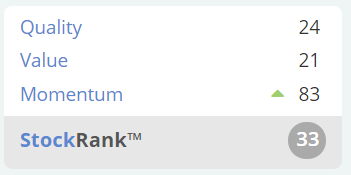
On the downside, it's a small & illiquid share.
The crux here, is whether the company can deliver faster growth. If it can, with strong operational gearing (66% gross margin in H1), then profit could rise fast.
BREAKING NEWS!
Greene King (LON:GNK)
Share price: 846p (up 50% today, at 16:21)
No. shares: 310.0m
Market cap: £2,623m
Recommended cash offer - for this pub/brewer group.
850p per share, a thumping 51% premium to Friday's closing price.
This is very interesting, as it follows on from the recent bid for another large pubs group, EI (LON:EIG)
Googling the parent company of the bidco, CK Asset Holdings Ltd, it seems to be a Hong Kong based property investor.
Yet another foreign takeover bid for a UK company. Something is going on here - no doubt helped by weak sterling, foreign investors seem to be untroubled by Brexit risk, and are snapping up UK listed companies at a remarkable pace.
Which pubco will be next then? I remain of the view that late night bars operator Revolution Bars (LON:RBG) (in which I have a long position) looks ludicrously under-priced, on an EV multiple of only about 2.5 times site EBITDA basis (NB. site EBITDA ignores H.O. costs). That's a sitting duck for a takeover bid (again) in my view, but it might be too small to attract much interest. Time will tell!
Batm Advanced Communications (LON:BVC)
This share has been around seemingly forever - I remember it being one of the leading tech story stocks in the 1998-2000 technology boom/bust.
It's an Israeli-based medical & data communication products group.
I tend to steer clear of overseas small caps that list in the UK. There's usually something wrong with them below the surface.
H1 results today show a move from a small loss ($0.6m) last time, into a small adjusted profit this time of $1.6m.
Good growth expected in H2, in line with expectations.
It's not something I would ever buy, so can't motivate myself to look any deeper.
£MTI
Similar to the above, this is another Israeli tech company listed in the UK.
This share looks quite good value, based on the StockReport here. Note in particular the high dividend yield.
H1 figures today look quite good - increased profits, and a decent balance sheet.
Again, not something I would ever invest in, as I avoid overseas stocks listed in London wherever possible.
All very boring really, apart from the Greene King takeover bid - well done to any subscribers here who hold that one.
See you tomorrow.
Regards, Paul.
Disclaimer
This is not financial advice. Our content is intended to be used and must be used for information and education purposes only. Please read our disclaimer and terms and conditions to understand our obligations.

42 comments
Revolution Bars (LON:RBG)
Branch closure in Swansea for any holders out there:
https://www.walesonline.co.uk/whats-on/whats-on-news/two-bars-swanseas-wind-street-16857149
Ive been a holder/buyer of Marston's (LON:MARS) for some time now. Just as a solid high yield stock with a low PE and a strong brewing business. Underpinning are the high % of freeholds that they have (although they have quite a debt pile).
Been content to let the divis roll in whilst the brewing business grows.
The outer was, in my mind, a separation of the brewing business or the property angle.
Also held Greene King (LON:GNK) but not in such large quantity sadly.
As far as the general UK market goes, it is hugely under-owned by institutions on a historical basis and all the interest is in the international UK names not domestic. That sort of scenario always gets my contrarian nose twitching.
Apologies, for being Off-Topic, but I just wanted to say 'wow' and hello. djpreston - another ex 'TMFer', great to see you here (it looks like you have been here a lot longer than me, but I just hadn't noticed.
Without wanting to 'gush' too much, I think the quality of the clientele is a great testament to Stockopedia.
Hi Gromley
I wasn't sure if it was you but yes, Ive been here essentially from the start but more as a lurker for the past couple of years. Lots of familiar names.
Best regards
Hi Paul regards to builders,and Persimmon is in your report today. I have the great misfortune to live next to the new devon town of Cranbrook. I do mean next door ,this past year they have started in the fields next to my country lane way in. The relevance of my comment is to explain that they,and their close partner TW continue to build unabated,and only yesterday were suggesting upping the original 3000 dwelling idea to 18000 long term.I would further add,since they 'moved' in over the lane they have been working 6 SIX days a week,and sats are 7.30am to 4.30pm. So there is DEFINITELY no sign of any slowdown here. Tony
Paul
I feel Revolution Bars (LON:RBG) is more the "ugly duckling" in the sector at the moment.
The only Corporate consolidator in the sector is Stonegate and after their approach for Revolution Bars (LON:RBG) was previously rejected (which I thought was a reasonable offer), they went on to buy Be at One (a far better business imho) instead and now have their hands full with integrating EI (LON:EIG). Revolution Bars (LON:RBG) is now far too small to move the needle on their returns so will probably be left on the shelf unless it gets into difficulties and they can pick it up out of administration.
So who's left to buy £RBG?
Private equity could be an option but any business reliant on discretionary spending with the current macro risks are out of favour. The PE pipeline of casual diners and multi-site retail roll-outs has well and truly been turned off. As one mid-market consumer focused PE house mentioned; they can't invest in the space as how will they manage to get a successful exit ?
I hope that something comes out of the blue but I feel you could be waiting a bit longer yet to get your Revolution Bars (LON:RBG) payday.
N
I hold Mitchells & Butlers (LON:MAB) which are well up in recent days, and up 6% today - they are another rumoured takeover target in the pub & restaurant sector.
"Let's take back control".
That was the war cry of the Brexiteers.
So we will leave the EU (or maybe we won't). But meanwhile we are busy selling off our businesses to foreign organisations. We are now seeing Greene King go to Hong Kong and BRITISH Steel has also just gone to Turkey. The only British owned car company is Aston Martin and there is the potential for the car industry to be wiped out.
The irony.
Hi Ken
I hope you are well.
I’m with you on UK focused companies - some (including those you mention) are looking exceptional value. Selectively, my current focus is to buy more of these, especially where the dividend outlook is strong. At some point, money will flow back into UK assets and high yielding shares in a low interest rate environment will be a compelling proposition.
Cheers
Simon
Folks, this article really does bear repeating. If I have read it correctly it affects all of us.
Published by Reuters
The final five minutes of trading have become the busiest time of day for stock market traders in Europe.
Aside from an initial burst of activity after the open in the morning followed by a brief flurry when Wall Street opens, a growing portion of the daily equity volumes is now concentrated into the five-minute closing auctions at the end of the day.
The growing popularity of passive and index-tracking funds and tougher regulations are driving the shift, which is draining liquidity in the $11.1 trillion market and raising concerns about big price swings and possible disruption to price discovery.
The trend is also fracturing the industry as rivals look to take a slice of the action by launching their own post-close trading products. If sustained, it will likely stir the debate about whether there is even a need in the long term for an elongated trading day.
Products like exchange-traded funds (ETFs) and hedge funds typically use end-of-day prices set during the closing auctions for their daily pricing.
Equity ETFs in Europe have ballooned in recent years and are now worth about 500 billion euro. That's up more than 8% in the first half of the year and a whopping 38% from January 2017, according to Morningstar data.
With their rise, the five-minute window between 1530 and 1535 GMT each day is capturing a bigger portion of daily volume, which averaged about 70 billion euros in June.
Closing auctions across Europe's major bourses have on average accounted for 20% of daily average volumes in the first half of this year, and hit their highest on record of 23% in June, according to Rosenblatt Securities which tracks volumes.
That's up from just 13% three years ago. There is a similar trend in the United States, where activity is also clustering in the auctions.
Activity typically spikes in the final month of each quarter, as funds scramble to participate in the auctions that set the value of their investments for the quarter.
This year though, there has been a pronounced and steady rise each month as banks, brokers and asset managers find the auctions provide the deepest pool of liquidity.
"The rest of the day is meaningless and you can't see flow," said Andrea Vismara, chief executive office at Italian boutique investment bank Equita.
The jump has been particularly noticeable this year as overall trading volumes have slowed amid tighter regulation and rising costs and as investors have in general shunned equities even as prices have soared.
Onerous paperwork imposed by the EU Markets in Financial Instruments Directive (MiFID II), which came into force early last year, has also helped drive the shift. The reporting process for regulatory purposes is simpler if trading is executed at the closing auction.
The trend has drawn the scrutiny of the French market regulator Autorite des Marches Financiers (AMF), which warned last month that lower liquidity may distort price-setting mechanisms and increase price swings.
Closing auctions on Euronext's Paris blue-chip CAC 40 stock index <.FCHI> account for as much as 40% of volume, it found.
"The associated risks are a deterioration in price formation and liquidity during trading sessions, not to mention the operational vulnerabilities at the end of the day given the volumes concentrated in the closing auction," the watchdog said in its report.
Liquidity begets liquidity
While it's not clear if it has yet disrupted price formation, interviews with a dozen traders and senior executives at international banks, brokerages, wealth managers and exchanges show that the trend is upending how they do business.
For a start, liquidity begets liquidity - as more traffic goes through the closing auction, it has a self-amplifying effect.
"In many cases, volumes in the closing auctions are so significant they cannot be ignored," said Derek McCole, head of equity dealing for EMEA at Aberdeen Standard Investments.
He has adjusted to the new norm. He tends to place a percentage of an order at the settlement price in the closing auction and then opportunistically trade the rest of the order if a certain price is hit.
But some executives say it is getting more difficult to do big block trades during the day, forcing many to save large transactions until the end of the day. That leads to even lower liquidity during the remaining 8-1/2 hours.
"The market opens, nothing happens and then the U.S. come in. It's busy for the first hour and then it quietens down," said a senior executive at a global bank.
"People are struggling to get orders done. If people are looking for blocks, they wait until the closing auction."
Rare source of revenue for exchange operators like Deutsche Boerse and the London Stock Exchange , the rise of closing auctions provides a rare and much-needed source of revenue.
The exchanges often charge higher fees to transact in the closing auction compared with intraday levels. Each bourse has a different fee structure so it's hard to pinpoint an exact premium.
But signs have emerged that the financial industry is divided over the trend, with CBOE Europe and Aquis Exchange launching rival platforms to break the exchanges monopoly.
CBOE says it will not charge customers until the end of the year to use its 3C product, while Aquis charges a fixed 10,000 pound subscription.
Aquis Chief Executive Alasdair Haynes said he wants his company's Market at Close product to provide competition to the exchanges. He estimates the fees for closing auctions are costing the industry an extra 75-100 million pounds each year.
The product got UK regulatory approval a few years ago, but it has only seen volume pick up in recent weeks, a spokeswoman said.
That rise in interest has come as banks aim to slash costs due to razor-thin margins, which have been eroded by the burden of extra regulation and lower volumes.
"There is no doubt there is a correlation with banks trying to save money and the interest in our product where there's a serious cost reduction for the banks," Haynes said.
But the Aquis and CBOE foray has, in turn, stirred worries about drawing liquidity away from the main exchanges.
"There's a perception that the exchanges exploit their monopoly position for the closing auctions, so the lower fees offered by alternative products may be attractive for brokers," said Rosenblatt Securities' market structure analyst for Europe, Anish Puarr.
But "there may be a danger in fragmenting" liquidity in the auctions, which provide a vitally important official closing price, he said.
Investors like Equita and Aberdeen are also worried that alternatives could attract volumes away from closing auctions, distorting price creation.
"As these different ways of trading the close appear, that could potentially weaken the existing closing structure if liquidity gravitates away from the primary market onto these other mechanisms," said McCole.
(Reporting by Josephine Mason; additional reporting by Simon Jessop in LONDON and Inti Landauro in PARIS; Editing by Hugh Lawson)
Copyright (2019) Thomson Reuters. This article was written by Josephine Mason from Reuters and was legally licensed through the NewsCred publisher network. Please direct all licensing questions to legal@newscred.com.
Share via emailShare on FacebookShare on TwitterShare on Linkedin
Interesting article from Reuters but of course the move to more auction trading mainly applies to large/mid caps stocks. It is worth noting that it does not apply to many (most?) of the shares considered by the SCVRs.
Key points about markets so far not covered in comments today:-
1. US market. Some shares (especially big tech shares) ARE on exceptionally high PE ratios and that's making US markets look very overvalued.
e.g Facebook PE 70
Netflix 109
Uber.... will it ever make a profit?...... off the scale overvalued imo
YET cash rich Apple a more sensible PE 17.
US market has looked overvalued for many years, and I’ve avoided for years too, yet with hindsight the US has often been THE best place to invest. But risk is that soon reality will hit, and those highly rated shares could be very vulnerable.
2., UK market.
It's FAR better to look at UK sectors to see where and what is oversold or overbought rather than this blanket heading of MARKETS.
And right now a lot of UK focus shares look extraordinarily good value and at bargain basement levels not seen for many years, with PE ratios in single figures and sometimes huge dividends. BREXIT no deal fears are one reason why they have fallen so far. A chaotic no deal outcome, if it happens, might not be fully priced in but surely at these levels, not far off being priced in. And while waiting there are those big dividends to help compensate for any further falls.
Usually 8% and more dividends are a warning sign. Yet some now paying 8% and more are confident of increasing their dividends!
imo anyone buying high quality dividend paying shares now, the more so where those Companies are confident of continuing to increase their already huge dividends, will not go far wrong, even if those shares go even lower short term. Shares often overshoot both on the downside and up.
My own portfolio is now full of these bargain basement shares.
e.g currently 33 FTSE100 shares are paying dividends of 5% and more. That's extraordinary with inflation and rates on savings accounts so low.
Here are just a few examples, both FTSE100 and smaller Companies.
AVIVA. 363p. PE 6. Dividend 8% AND progressive dividend policy too. Currently at year low and lower than in last December's rout.
LEGAL AND GENERAL. 227p. PE 7 and dividend 8% with increases every year and likely to continue. The only time the shares has been lower than now in recent years was the crazy overdone drop to 170p immediately after the Brexit vote.
(Worth a reminder! I was on holiday in France that day but read Paul Scott's report before going out, where he covered shares that had fallen to crazy prices that day. Some (e.g housebuilders) were down nearly 50%. Thanks Paul as I bought several following that advice.. It soon proved a great time to top up. And current big falls for similar shares for similar reasons surely likely also to prove a great buy opportunity).
ITV. 104p. PE 8 Dividend 7.5% though unlike AV. and LGEN with a cut a possibility. But also chance of a bid.
IGG. 555p. PE 14. Dividend 8% and they say will be held until market conditions improve. PLUS results recently were well received and share has gone up a lot. IG a better quality Company (e.g more Professional clients where ESMA regulations irrelevant) and if PLUS over the worst then maybe next update from IGG will say the same.
GALLIFORD. 550p, PE JUST 4. Dividend if held 12%
Their construction business (like others in the sector on wafer thin margins so vulnerable to even modest cost overruns) seems over the worst and increasing focus to be on much more successful housing business.
NEW RIVER REIT. 154p. PE 7 and dividend if held 14%. A modest cut seems likely though.
Retail and pubs are arguably the wrong sectors to be in at present. Against that the share price fall, perhaps made worse by big Woodford stake, has been relentless. So yet again a lot of bad news now priced in,.
BT. 168p PE 6. Dividend 9%.
VOD cut their divdend to a still reasonable 6.5% at share price when news of that cut. It meant more to invest in the business and market reaction has been a quick 20% share price gain. So if BT cut theirs the same could happen. Share has been falling non stop since at £5 in 2015 and is now down nearly 70%.
New CE a plus and others raising their prices decreases price pressure on BT. Telecoms sector has been a terrible performer for ages and big investment needed for 5G .. but in time that could also bring big profits.
CENKOS. 40p PE 9 and DIVIDEND 14%. BUT these might change for the worse with next update. Yet as Graham Neary pointed out Cenkos has never made a loss and cash more than covers the current share price.
Hope my thinking is not too way out as I hold all these shares.
There are many more where similar case about them currently being great value can be made.
Ken - Your thinking mirrors my own. Just re-introduced AV. and GFRD to the income portfolio last week. Valuations were just crazy to my eyes, come Brexit or anything else for that matter. Already hold several of the others that you mention. Didn't see the GNK bid coming though.
Sold my CNKS at 50p taking a very large loss. I think the dividend is in for a sever haircut this time around. Value at below cash means that it is still on the watch list - looking for signs of new life under big Jim.
Lord Gnome.
I also didn’t see the GNK bid coming. Maybe some hope now that Revolution Bars which I’ve held at a loss for ages will also get bid for?
I’m heavily down on Cenkos too, and should have cut the loss, but at current price any hint of new life (as you put it) could see a decent bounce. And Crystal Amber’s Richard Bernstein is pushing for something but not sure what. Also sector ripe for mergers?
Simon. Good to hear from you. Encouraged that you and Lord Gnome (and maybe many others?] also think that there are so many shares on crazy too low valuations.
Where did you get the £FB p/e of 70 from?
Oops! I meant Amazon and not Facebook. Facebook PE is in the 20s.
Ahh, no worries. I was worried my own data was off!
Nice reading your message but I think there is one thing you are forgetting. The stock market cares not for the past or what was but what will be. It discounts future cashflows not past cashflows. If a stock trades on a low PE then there is a reason for that. It is trading at a price that the market thinks is 'fair'. This is especially true of big caps which are better researched and have liquidity. Because a company has a high yield and low PE does not make them good value. In fact, often times, a basket of low PE stocks perform worse than high PE stocks.
In times of panic you can get value. What I mean by that is you can get temporarily very low prices that don't reflect the true intrinsic market value because everyone is panic selling. But hardly think nows that time. You could say that was the case in 2008 or after the Brexit vote.
What I mean is - take say Aviva which you mentioned. It has a low PE and high yield. But how can you say it's good value? How can you say the market (loads of institutions, intelligent investors etc) are all wrong? Do you know something they don't? What is fair value? I think the market (with all the news it knows) takes a dim view of future prospects hence the PE is low. Until Aviva can demonstrate earnings surprises to the upside, that dim view and low PE will remain.
I would just say to everyone - careful of using historic prices to predict the future because that's something the market does not do!
I don’t understand your reasoning. Bombed out shares with successful business do recover when sentiment changes. If they didn’t once down they would stay down. Buy low and searching out good value shares is a proven way to succeed if buying quality.
Note too the takeovers like Greene King yesterday. Intelligent investors (as you call them)are seeing great value Companies here in the U.K. A shame though that some bombed out great British Companies are sometimes falling to foreign bids. Rewarding for their shareholders, but otherwise sad. These bidders see value where perhaps you don’t?
Hi Ken, please don't think that I am in any way criticising you and your methods. Its just a different opinion.
My point was that in normal times (as opposed to panic selling), the market forms the view that these are fair prices. If the price is low its normally becuase prospects are bad. It could be because its a cyclical and demand is forecast down. It could be downgraded forecasts. I don't know much about these shares but just a cursory glance tells me with Aviva, BT and Galliord forecasts are down. Legal and General forecasts are up so don't know why thats down but theres probably some reason.
If you are buying true quality (sustainable and high OM's, ROCE/ROE), with bright prospects then these are mostly not on sale. I have a list of these that I want to buy. If there is panic selling, I might get my chance. For example, Experian, Hargreaves Lansdown, Burberry, LSE, Rightmove, Fevertree, Craneware, GB Group.
Like I said, no criticism intended at all. I enjoyed your post. Wish you all the best.
For foreign investors UK companies may well look cheap as the £ has fallen considerably since Brexit, also compared to many US companies they may look cheap, I can see many more takeovers and not just bombed out companies. For UK investors value may not be so obvious. Yes it is sad I agree but unless the UK can sort Brexit out then things won't improve for a while.
Paul says that the bidder for Greene King (LON:GNK) is a property investor.
The RNS says: The Cash Consideration under the terms of the Acquisition values the entire issued and to be issued share capital of Greene King at approximately £2.7 billion on a fully diluted basis and implies an enterprise value of approximately £4.6 billion.
The most recent a/cs show freehold land and buildings are valued at £3bn. and I would suggest that is what attracted this bidder. So if you are looking for 'Who is next?' check freeholds!
Perhaps the intention is to separate the business from the freeholds - something an activist fund is trying t persuade Whitbread (LON:WTB) to do.
The Hong Kong base caught my eye as well. If I had the Peoples Liberation Army gathering on the border I'd be looking for somewhere safe to park my money too. It does put our Brexit worries in some perspective. And perhaps helps explain the report I saw today of the first uptick for a while in London housing prices.
Well for me it's gold, silver and more gold ! Gold and silver miners in particular. Oh and cash.
To many negatives around for my liking.
Some of you gold bugs may be interested in Kinesis Money, assuming one is not already aware of this; It goes live the end of this month. -
https://kinesis.money/en/#/
I think Woodford is right about the UK, though it might take a year or two post-Brexit to see it. More attractive than Europe full stop and looks better on price than the US.
Doesn't mean I'm convinced by his share selections.
And delays and uncertainty just detract from the potential value.
I still see risk in the UK market, yes Brexit priced in generally, but not in full, in FX the USD-GBP rate was trading 150-160 in the years pre-referendum, now 121 with discussion of 1:1 if hard Brexit occurs. Oh dear.
Myself, my largest holding is silver, which has provided a hedge.
However, some UK domestic shares have really been taken out back of the woodshed.
Some of this looks overdone. In particular, property shares are selling at recession level NAV discounts, especially if they hold the twin bogies - UK property and retail exposure. At some point they are too cheap, and a hard Brexit might provide an opportunity to buy, if there is further capitulation selling. Have to pick through the rubble though.
Neil Woodford - who was one of the most famous fund managers has come undone in recent years, in part because he thought British companies were priced very cheaply and that once Brexit had past, their true valuation will be reflected.
Question remains for the future - did he call it wrong or did he call it right, but timed it completely wrong?
It's very hard to value a business if we don't know major macro events that will affect the businesses we're trying to value in 6 months, let alone 5 years away. Tariffs? Supply Chain Issues? Sterling collapse?
Difficult, yet fascinating few months ahead of us.
Interesting rns out by £bids the story is certainly developing there. Not sure if it would be of interest to you Paul, still a bit blue sky however it’s signed an agreement with appnexus and epic games. This in theory should allow them to increase revenues at scale.
There has been a nosedive in £CSSG in the past few days with no news. Does anyone have a view? (no position)
RE Croma Security Solutions (LON:CSSG) I had a quick look and it doesn't look that bad with lowly valuation and what looks like ok Free cash flow and no Debt. Looks like the CEO holds around 24% from the Directors dealings
However my concerns would be
5.64% Margin is pretty low and also I cant see them having any sustainable competitive advantage despite their aim to become THE British Security brand
Revenue looks pretty Flat
No position here either
I've kept a beady eye on Croma Security Solutions (LON:CSSG) as I've been expecting a fall since their results last year suggested that this year wouldn't be as good. That's what I wrote in my personal notes back then anyway, there were a number of one off contracts. Maybe the market knows as much, could be ok but I'm waiting at the very least
No interesting RNSs, so let's discuss macro.
It feels uncannily calm, with Brexit just 10 weeks away. Can it really be that the short and medium term damage has been fully discounted in the markets - even in small cap companies that will benefit less than the large caps from a further fall in Sterling?
We seem set to have major political turmoil this Autums, as parliament tries to force Government to avoid a disorderly Brexit.
The dispute between the USA and China seems likely to continue and get worse before it is resolved. "America First" is likely to contine at least through the 2020 US election, so any trade deals there won't be on good terms for anyone else. The US market is at an extraordinary valuation by all historic comparisons and theirs an inverted yield curve.
What have I overlooked?
Do you feel calm? If not, what are you doing to protect yourself?
I think everyone’s sold up and left old chap, it’s just us here.
There could be some bargains later for those with cash to spend. Meantime gold is popular.
I am holding off with a lot of stuff, mainly prepping my potential portfolio for a pre-brexit (or post) panic in the markets concentrating on identifying companies which may perform well post-Brexit with a good dividend and cash flow record.
If things get bad I am ready for a punt on SUK2 for a bit.
Old Manfit, you won't be the only one who is sitting on a healthy proportion of cash...it's another bullish indicator as far as I'm concerned.
The majority, historically, have called the market wrong. If institutions and private investors are currently sat on healthy amounts of cash in anticipation of the "turmoil" ahead, it's very likely that the market is going to motor on up. And those with cash will end up chasing it, adding fuel to the fire.
The time to worry is when everyone is fully invested...ain't no extra cash sitting around to keep pushing it up.
"Can it really be that the short and medium term damage has been fully discounted in the markets"
I would say it has. The market must have discounted a broad range of probability-weighted risks expected from Brexit/trade wars etc by now. Given expectations of a "no deal" have soared recently, and project fear details were leaked over the weekend we must be near peak probability-weighted pessimism!
Same argument goes for trade and tariffs. A tariff-related global slowdown will have been heavily priced in by now. I can't see Trump allowing the trade wars to drag on, so close to the election. He needs to be seen to "win". Interest rates are on their way down and there will be both monetary and fiscal expansion.
The only thing I can see causing major market issues, is a black swan event. eg. significant slowdown on mainland Europe (aforementioned reasons Brexit/tarfiffs etc.) leading to a collapse of one of the Italian banks or Deutsche Bank etc.
I feel calm!
Markets cannot correctly price binary events. Brexit will happen or it won’t. If the market has priced in an 80% probability then they are out by either 20% or 80%.
It takes more faith in the wisdom of the crowd than I possess to think that the markets can price in the Brexit impact with accuracy even if the timing and terms of exit become fixed.
"The US market is at an extraordinary valuation by all historic comparisons"
Not true. The valuation against US Treasuries, corporate bonds and cash is not extraordinary. Yes, the valuation is high against it's own history, but until someone invents a time machine to go back to the 1980s, we can only choose between contemporaneous assets.
That is not to say that the US market will not fall. That is a different question.
By my own (fallible) judgement:
- US, EU and Japan market risks appropriately discounted
- EM risks overly discounted
- UK risk of disorderly brexit leading to a Corbyn or McDonnell govt not sufficiently discounted
but it is only at times of the most extreme fear or optimism that you can say the market is wrong with any reliability. We are not there now.
There are other major risks out there (e.g. mishandling of HK protests, Italy, Kashmir, Argentina contagion ...) but if everyone felt calm, that would be a reason to sell, not buy.
"The US market is at an extraordinary valuation by all historic comparisons"
Problem is all historic comparisons are bogus. The composition of the S&P500 (SPX) has changed enormously over time, which makes a comparison over time akin to 'apples & oranges'.
The 1950's SPX consisted of just Industrial stocks, Utilities & Railroad companies.
Financial companies were added in the 1970's.
It wasn't until the late 1980's that Technology companies were added.
This recent article by Ben Carslon provides an interesting historical insight : https://awealthofcommonsense.com/2019/08/the-impact-of-interest-rates-inflation-on-stock-market-valuations/
Paul
I think HQ is right. It's good to know your timings.
Thanks
Steve
My morning smallcap tweet: Quiet day
IXICO (LON:IXI), PHSC (LON:PHSC), Dev Clever Holdings (LON:DEV)
IXICO (IXI) guides FY materially ahead of market expectations.
PHSC (PHSC) moves to FY EPS breakeven from loss on rev down 25%. Outlook - Brexit concerns.
Dev Clever (DEV) 3-year commercial agreement with Toshiba Global Commerce Solutions (UK) to offer gamification platform to Toshiba's retail customers. No numbers.
IXICO - bullish update.Was slightly lossmaking,but Stocko's -Z - score of -16 seems too harsh consideriing the 7 million in cash and low burn rate ?