Small Cap Value Report (Mon 19 Feb 2018) - MCLS, GLE, CLIG, SAL

Good morning!
Stocks crossing my radar today are:
- McColl's Retail (LON:MCLS) - final results
- MJ Gleeson (LON:GLE) - half-year report
- City of London Investment (LON:CLIG) - interim results
- Spaceandpeople (LON:SAL) - contract renewal
(Edit: the Photo-Me International (LON:PHTM) announcement wasn't interesting enough, so I've left it out.)
McColl's Retail (LON:MCLS)
- Share price: 237.5p (-5%)
- No. of shares: 115 million
- Market cap: £274 million
I've just been reviewing the arguments for and against this convenience retailer. We last discussed it here in December at the full-year trading update, just after the fall of Palmer & Harvey, one of its major suppliers.
Thanks to the trading update, we already knew that LFL sales were +0.1% for the year ending November 2017 (improved from minus 1.9% the prior year).
Now we get these figures:
Adjusted EBITDA up 20.0% to £44.0m (2016: £36.7m)
Net debt increased to £142.2m (2016: £37.0m), in line with management expectations
Profit before tax increased to £18.4m (2016: £17.7m)
Basic earnings per share slightly reduced to 12.3p (2016: 12.8p)
Sales exceeded £1.1 billion so the pre-tax margin comes in at 1.6%.
Looking back at my previous writings on this stock, my criticisms have been less to do with the specifics of the company and more to do with the sector. I've suggested that it's too competitive to be attractive, while others have suggested that good locations and scale provide some form of a moat against competition.
There is no denying of course that margins are very thin, and that the chosen strategy of debt-fuelled expansion elevates the risk.
P&H: I also warned that the replacement suppliers for P&H (in administration) might be less generous on pricing, which would impact margins at 700 stores.
Today we learn that there have been "some availability issues" and then "further disruption" in the new financial year, following on from this issue.
We have put in place contingency arrangements, entering into a new short-term supply contract with Nisa on 4 December 2017 for the affected stores. We also began our new supply partnership with Morrisons (agreed in August 2017) earlier than previously scheduled to supply these same stores with tobacco.
Whilst these contingency agreements have largely ensured continuity of supply, we continue to closely manage distribution to these stores and the disruption has impacted our sales performance. Total LFL sales for the 11 week period ended 11 February 2018 were down 2.2%, held back by sales in our stores formerly supplied by P&H where LFL sales were down 3.6%.
Those LFLs are a significant deterioration, and I think they imply that the non-P&H stores have not performed well either (since the -2.2% total LFL sales figure should be mostly driven by the c. 900 stores not supplied by P&H).
My opinion
The news isn't all bad. Gross margins improve slightly, as expected, as the company sells more food and fewer newspapers.
If you can look past the frictional costs associated with the Co-Op store acquisition (£5 million) and costs of closing underperforming stores (£3 million), then pre-tax profit was £26.4 million rather than the reported £18.4 million.
I would argue that there might regularly be costs associated with closing underperforming stores, so would not add back that £3 million. There is a stronger argument for adding back at least some of the £5 million acquisition costs, I think.
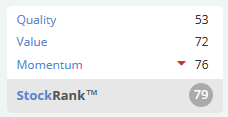
It continues to show an above-average StockRank. The dividend yield is not bad, either.
Ultimately, I can't get away from the company's weak LFLs, low-margins, low returns on capital (the balance sheet has ballooned to nearly half a billion pounds), and its exposure to macro forces (wage costs, inflation) which are beyond the control of any company. I also suspect that we haven't heard the last of the problems associated with its supply chain.
Hopefully I'll be proven wrong and can turn into a bull on this stock in due course!
MJ Gleeson (LON:GLE)
- Share price: 720p (+4%)
- No. of shares: 54.6 million
- Market cap: £393 million
This is a house builder and land trader. I've not studied it before, but I should, since I happen to own a few shares in rival brownfield developer, Inland Homes (LON:INL). (Gleeson builds for low-income families in the North of England, while Inland is based in the South of England).
These are nice results:
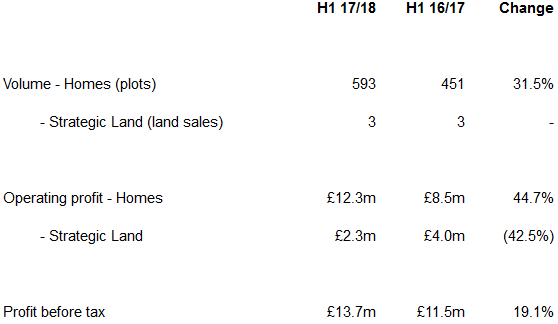
The company reports ROCE (return on capital employed) at a whopping 26%. More companies should voluntarily highlight this metric!
Checking the operational highlights, the biggest driver has been the sheer number of homes sold, up 31.5% (as shown above). Average selling price also improved a little (2.5%), with a small improvement in gross margin too (i.e. costs rose at a slower pace than the average selling price).
The Strategic Land division did a little worse than last year, due to smaller sites.
The full-year outlook is in line with expectations.
There has also been more progress with the pipeline. Gleeson now has 12,000 plots (as of Dec 2017), versus 11,600 in June 2017 and 10,500 in Dec 2016. The number of sites and outlook for sites is very good too:
At 31 December 2017, we were selling from 59 sites, an increase of seven sites on the corresponding period last year. We expect to open a significant number of sites during the coming months and anticipate the number of active selling sites to be approaching 70 by June 2018.
I think I can see another big reason why the share price might be up today - investors happy with a new, more generous dividend policy. The company only requires dividend cover of 1.75x - 2.75x from now on (versus 2x - 3x before).
My opinion
Really impressive results, and I think this is reflected in the valuation. Net assets are £174 million, with very low leverage (total assets £210 million).
This gives a price to book value of 2.2.5x at the current share price, which doesn't allow for any uplift in property values which might not yet be recorded on the balance sheet.
Nevertheless, it's a much more adventurous valuation than my own holding, Inland Homes (LON:INL), which is only at 1x book value. Personally, I focus on book value first and foremost for this type of company.
On the other hand, if Gleeson continues to perform well for long enough, it will certainly grow into this share price and generate attractive dividends for shareholders while it does so.
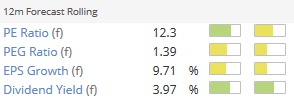
So if you're willing to put the book value to one side, and focus only on earnings and dividends, it does look attractive:
City of London Investment (LON:CLIG)
- Share price: 430.5p (+3%)
- No. of shares: 27 million
- Market cap: £116 million
This is a fund management company, primarily serving US clients.
Its primary strategy is to invest in emerging market closed-end funds (i.e. investment trusts and similar), using quantitative strategies to exploit discounts to NAV and other pricing anomalies in these funds.
According to the Chairman, the size-weighted average discount to NAV for its investments was 15%, before the "hiccup" in markets earlier this month. So there was "compelling value", even before the sell-off.
However, performance over the past year was behind the emerging market sector as a whole. CLIG's strategy earned 6.1%, versus 7.4% - 7.5% for emerging market indexes.
An underweight exposure to technology was partially blamed. Since I'm bearish on the NASDAQ and tech prices in general, I wouldn't have a problem with CLIG underperforming because of an under-exposure to the sector.
Funds under Management (FuM) grew well, total FuM now $5.8 billion as of January 2018. FuM was just $4.1 billion at December 2016. There has been big growth in developed market strategies and other products ("Global Tactical Asset Allocation" and "Frontier"), broadening CLIG away from its emerging market strategy.
The company has a policy of paying dividends with "rolling 5 year cover of 1.2x". That's a clever idea - shareholders get heavy dividends versus earnings, but the company gets to use growing earnings for its own purposes for a couple of years first. The dividend yield is in the region of 6.5%.
CEO succession - an internal candidate has been found to act as Deputy CEO, in advance of succeeding the current founder-CEO in December 2019. It sounds like a very orderly transition has been planned for several years already. No worries on this front.
Outlook from the Chairman sounds good:
Notwithstanding the major gains witnessed in 2017 across global equity markets, the exceptional value we find in emerging market closed-end funds and holding companies gives us confidence that we continue to be well placed to deliver strong relative returns. This, combined with the traction now achieved with our diversification products, justifies my confidence in anticipating a successful outcome for the full year.
(Side note: fund management companies are a great source of commentary on the financial markets in general, even if you don't want to invest in them - they are at the coalface, and have a great view of macro conditions.)
As noted in the discussion thread below in an excellent comment, CLIG benefits from doing its own research, and therefore is not affected by MiFID 2 restrictions on fund managers paying for research through their trading commissions.
My opinion
I'm warm on this share, and will add it to my watchlist as a potential buy.
Brokers warn about the lack of client inflows, and it is true that net flows have been lukewarm.
In the previous financial year, net flows were negative by over $300 million. In the six months to December 2017, they were only marginally positive.
However, the CEO argues that this is due to clients re-balancing after returns were too strong, forcing institutional clients to reduce their exposure to emerging markets back into an acceptable range.
The FTSE Emerging Index is up over 50% in the past two years, so this is quite understandable.
If you are an institution which wanted 15-20% portfolio exposure to EM, you will probably be forced to sell some of your EM holdings if it approaches 30% of your portfolio after strong returns.
In the CEO's words:
Our clients "weight us within their portfolios, and as markets appreciate, and based upon their prearranged asset allocation, if their exposure goes outside of a "range", they will rebalance.
If this helps to describe to shareholders both the cause and effect of client actions during this bull market it should also, as long as we outperform, help them value our shares during the next bear market.
I've warned many times before that fund management companies often benefit from positive investment returns and clients inflows simultaneously, while at other times they suffer from negative returns and client outflows simultaneously. This particularly applies to retail investors and "faddish" investment sectors.
CLIG argues that its client base is a bit more sophisticated than that, and is able to allocate funds in a more disciplined way, based on portfolio weightings. So when there is a bear market in EM, hopefully there will be a return to net inflows.
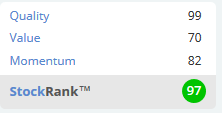
If this is true, it makes the shares look very interesting at a PE ratio of 10x:
Spaceandpeople (LON:SAL)
- Share price: 35p (3%)
- No. of shares: 19.5 million
- Market cap: £7 million
Contract Renewal and Expansion
This one is below our £10 million cut-off, but remains well-followed by readers of this report. It produces "experiential marketing" and promotions in areas of high footfall.
The share price has approximately doubled over the past year, so those who were brave enough to buy in when the market cap was just a few million pounds have been rewarded.
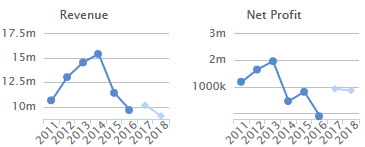
The full-year results are due on 26 March. We can expect a debt-free balance sheet with net cash of £1.9 million (adjusted for an expected working capital outflow) and pre-tax profit of £1.2 million.
As I remarked at the full-year trading update, this is priced as a super-cheap micro-stock. The official bid-ask spread is over 10% of the share price, so you have to be prepared for illiquidity, and the potential for things to go wrong as they have done before.
This graphical history tells the story:
Today's announcement sounds promising:
Landsec owns and operates 15 shopping centres and 33 retail and leisure parks in the UK and is one of SpaceandPeople's largest clients. The new agreement is a five-year contract to provide revenues from experiential activity, pop up retail and mobile promotion kiosks ("New Agreement").
The New Agreement extends across their portfolio of shopping centres including, for the first time, Southside Wandsworth and the newly relaunched Westgate Oxford. In addition, the New Agreement includes Landsec's retail and leisure parks, their three recently acquired outlet centres as well as their Central London business estate.
No numbers are given. However, the announcement was classified as "inside information" prior to publication, so the company must have considered it to be material for investors.
So we can afford to have a little bit more optimism.
The spread puts me off investing in this. If my timeframe was long enough, so that I could forget about the liquidity problem, I might consider it.
I'll leave it there for today. Thanks for dropping by!
Graham
Disclaimer
This is not financial advice. Our content is intended to be used and must be used for information and education purposes only. Please read our disclaimer and terms and conditions to understand our obligations.

34 comments
re post 32
You might like to read
http://www.eureferendum.com/blogview.aspx?blogno=86656
http://www.eureferendum.com/blogview.aspx?blogno=86655
to give you an idea of the complexity of the legislation covering flying - a real dog's dinner!
Concludes
"......................... If we were to rely strictly on evidence – bankable evidence in the public domain – that the government had a grip on this issue (airline legislation), then we would have to conclude that there was room for considerable alarm. And, where we do rely on evidence in the public domain, we must also conclude that it is extremely unlikely that UK Airlines can keep flying overseas in the immediate aftermath of Brexit.
And, if that is the case, we really do have to ask why those lying bastards are lying to us."
A question for someone in the Stockopedia community. Has anyone been to the USA to attend the Minervini 3 day seminar he holds in October? I am considering it for this year and some feedback would be very useful. If you don't want to go public with the feedback I could contact you separately. I will be extremely grateful for any feedback. Regards, Charles
ridavies, have responded to your comments here:https://www.stockopedia.com/content/avation-plc-lonavap-aircraft-leasing-327223
The comments from CLIG regarding MIFID were interesting today: Firstly the chairman said 'Barry also discusses in his statement the impact on our business of MIFID 2. Currently the Group's income accrues at a weighted average rate of approximately 82 basis points of FuM, net of third party commissions. We have been operating in a very competitive environment with constant downward pressure on fees. Looking ahead, the cost of third party commissions will continue to reduce but arguably, even more importantly, there will be reduced competitor pressure on fees with MIFID 2 resulting in substantially increased costs for most of our competitors. With almost all our research having been carried out in-house we will not be suffering the same cost increases. Most competing fund managers now have to pay themselves for research previously paid for by their clients through bloated broker commissions; they are, therefore, unlikely to want to see or afford a further erosion in the level of fees.'
and the CEO was positive about MIFID 2 overall 'Shareholders might not be aware of the significant impact of MIFID 2 on our industry in terms of the cost, provision and potential outcome of the provision of research to Fund Managers.
In our case we are in good shape as we source NAV's internally and conduct the vast majority of our visits and undertake our research independently of brokers and other third party providers.
In this respect we are to all intents and purposes independent from, in my opinion, the correct influence of MIFID 2, which in effect discourages Fund Managers from double dipping as they received fees from their clients, and then effectively charged clients again via the commissions paid to brokers for research. The effect of MIFID 2 on our P&L will not therefore be discernible.
Other Fund Managers will not be as immune and in some cases they are likely to have significant bills. Having said that, these significant bills will probably be reduced as companies take on research staff from brokers who will inevitably suffer further commission erosion.
This potential for Style Drift will not be lost on US Consultants, Foundations, Endowments and Pension Funds as they continue to review their Managers for changing personnel and components of attribution.
As implied earlier, our payments to third parties are minuscule and are only really relevant in terms of our Macro team, where we have historically paid for relevant research via our P&L.
Mrs Thatcher, Cecil Parkinson (Big Bang in 1986) and Paul Myners (Myners Report 2001) should be congratulated regarding the far sighted effect that they had in making London such a successful financial centre by removing both restraints on trade and conflicts of interest. In my opinion MIFID 2 completes the job that they started.'
Am a holder and topped up this morning. Dividend increased and is 6% going forward with excellent Stockrank ratings
Got a pretty good idea that DTG is sound but fully valued.Would appreciate your opinion.though.
A good contract renewal and extension from the company Spaceandpeople (LON:SAL) this morning.
The CEO has been working hard to turn this company around and it seems that things are now definitely moving in the right direction. Anyone have any thoughts on £SAL
(The stockopedia quality ranking is 99, which i really don't understand because their individual quality metrics do not seem that good....)
Spaceandpeople (LON:SAL) - I bought in after the 15th of January trading update, so pleased to see the update today.
With a market cap of around £6.5M a cash pile of £1.9M is pretty significant downside protection. Profit before tax of £1.2M is not to be sniffed at and a divi of 1.5p is handy to have. I'm also a big fan of companies with a Piotroski F-Score of 9.
As far as I can see they've had a few issues over the last couple of years, but management have navigated them without significantly diluting shareholders and are coming out the other side in much better shape.
Torn between sticking with what I have and tucking a few more away. Don't want to buy too many as it might be difficult to sell them all if I needed the money for any reason. But there still seems to be good value at the current price.
I used to be a Spaceandpeople (LON:SAL) holder.
This is great news, and I agree as well that I see it as being very lowly valued, but the spread, illiquidity, and size is what holds me back from investing, especially in these turbulent times.
Also the still open question about their German operations.
I do see them as being a good M&A candidate for a larger ad inventory player in the market, as they have a clean niche, some interesting real estate under contract, and marketing and advertising spending is still increasing in the UK. Would make a nice bolt-on for a highly rated advertising group (on PE 10-12) and earnings accretive for whoever takes over.
I like the valuation of Spaceandpeople (LON:SAL) - but as you state liquidity is dire. As for Germany, the company said in September that the continuation of its 2 German divisions depended on the successful renegotiation of its German contracts, which were due to end in January 2018. Since then no news -and today would have seemed a good opportunity to update the market. (So I presume this is negative.) SAL also said in September that German “closure costs would be limited and would not have a material impact on the Group profitability going forward.” So perhaps they can use this “non-materiality” excuse for not updating the market.
Graham, the mis-titled Avation (LON:AVAP) RNS today was just announcing the H1 results date - 26 February 2018. So nothing to review!
For a yawn you can always read my thoughts about it all here: https://www.stockopedia.com/content/avation-plc-lonavap-aircraft-leasing-327223/
re: Avation (LON:AVAP). Thanks for spotting that, and the link. D'oh! G
Re your comments on Avation (LON:AVAP), than you very much for a very thorough analysis. The only comment I would make is that with a very slim team, the principal guy there Jeff Chatfield, is key. If he decides that he wants out, then I guess that a change of ownership is a distinct possibility.
Richard Wolanski seems to put himself about a lot in the UK - he is back at Mello Derby in April I notice - but I dont see any significant institutional shareholders (ie over 3%) on the company's website. I assume this must be a disappointment. Institutional support would presumably help on the credit rating and interest rate front?
As I say, thanks anyway and I will take the oppor5tunity to put some questions when I go to Mello Derby this year.
Your comment on the lack of institutional interest in Avation (LON:AVAP) is one that I would certainly hope to see aired with the company at Mello. Last time around at Mello Richard Wolanski was asked about this, and at the time the market cap was below £100million which he said was the minimum capitalisation limit for many institutions. Market cap is now £142million so it would be good to know whether the company is seeing more interest from larger investors.
Thanks for you in depth review of AVAP and your sentiments are part of the reason I have held AVAP now for the last three years. Its continued to see steady progress in that time and management are very heavy holders of the stock which gives me comfort they are also in this for the longer term.
Hi Graham,
Do you look at software companies at all? I think those which rely on SAAS are worth considering as their recurring revenues avoid the lottery of the old final quarter software sales. If you are interested it might be worth looking at Statpro in the light of positive outlook within the Fidessa results, just announced. Its a cheaper alternative (everything is relative!!) which in my opinion has more operational gearing to the continuing data evolution of the financial services industry, fund management in their case. I have been a shareholder for a very long time.
Best,
Peter
Hi Peter,
re: StatPro (LON:SOG)
Yes, I do study software companies and I like the SaaS model. I'm not investing in them at the moment simply because I think that valuations are in a very optimistic mood!
I did take a look at StatPro (LON:SOG) last year and felt that it must be doing something right to have maintained its independence for so long, in the face of industry trends toward consolidation. Revenue was very flat for a long time, however, so I wasn't not sure about its ability to generate organic growth. I should update my view on it when I get a chance.
Thanks for bringing this up in the context of Fidessa (LON:FDSA). Always happy to read insights about either company. G
In the context of Fidessa (LON:FDSA) they've announced a possible bid by Temenos:
https://www.stockopedia.com/sh...
I really wouldn't want to be tendering my shares at any price really, but there you go.
timarr
Hi Graham
Your thoughts on City of London Investment (LON:CLIG) would be appreciated. Produced their interims today, which on the face of it look pretty appealing.
Phil
Hi Edward, re: City of London Investment (LON:CLIG). Thanks for the suggestion. Am reviewing it now. G
Hi Graham
Thanks for the analysis on City of London Investment (LON:CLIG) - as always, most illuminating.
Phil
I believe there are a couple of things to be aware of when investing in asset management companies. Firstly, MIFID II; whilst some firms may not be impacted by the cost of buying research because it is done in-house, I believe that may not be the case for many. Some firms will pay for research in order to have the leg work completed and then use that to develop ideas. Nevertheless, this will be a relatively minor cost in the scheme of things especially for a listed asset manager.
Secondly, and more importantly, whilst market performance will have an impact on profits, outflows due to "clients rebalancing" may offset some of those gains. More importantly, many institutional clients are placing significant pressure on active fund managers to lower fees. This is a significant issue in the industry especially for institutional asset managers. I consider the average fee rate of 82 bps in the case of City of London Investment (LON:CLIG) to be exceptional. As noted at Baillie Gifford, institutional clients were switching from active funds to passive funds (due to the fee rate being in the region of 15 bps). A number of institutional clients use consultants to find fund managers; if a consultant represents 5 pension funds with one asset manager and has negotiated lower fees for one, then more than likely it will push to replicate that fee across the other 4. There is very little the asset manager can do; either accept or loose a significant amount of AUM.
I wonder if CLIG has an economic moat or whether their fee rates will also succumb to the pressure the industry is facing.
I'd recommend reading the following:
https://www.ft.com/content/10f49fd2-067f-11e8-9650-9c0ad2d7c5b5
Hi gajri
Many thanks for those two insights.
Phil
Morning Graham
Thoughts on M J Gleeson MJ Gleeson (LON:GLE), if time permits please.
Jonno
Morning Graham (and all).
Cannot seem to create a new discussion this morning so for now will just post here.
McColl’s Retail ( McColl's Retail (LON:MCLS) ) – 249p – £286.8m – PER 11.6
Preliminary Results For The 12 Months To 26 November 2017 And A Trading Update For The 11 Weeks Since Then – Revenue up 19.1% to £1.13bn (2016: £950.4m) following successful integration of 298 convenience stores (completed in mid-July 2017), LFL Revenue up 0.1%, Gross margin up 60 basis points to 25.7% (2016: 25.1%), PBT of £18.4m (2016: £17.7m). EPS of 18.3p (2016: 16.0p) and the Final Dividend is up just 0.1p to 6.9p. Supply issues (with Palmer & Harvey) are being addressed, 11 week LFL Revenue down 2.2% but total Revenue is up a healthy 26.7%.
The Net Debt (£142.2m now) of 50% of Mkt Cap and sub industry average Operating Margin is enough to put me off now.
Batm Advanced Communications ( Batm Advanced Communications (LON:BVC) ) – 24.5p – £98.8m – PER 340.3
Trading Update For The 12 Months To End December 2017 – Expected to be ahead of market expectations. Revenue of $106m (up 17%), EBITDA of $7m (benefit of $5.6m from property sale) versus $2.8m last time.
I am just not interested here for a number of reasons including location (Israel), no real profit update and the reliance it seems on property sales for profits!
Not sure if either are worth SCVR coverage though to be honest.
My morning smallcap tweet:
Batm Advanced Communications (LON:BVC), Kin (LON:KIN), Quadrise Fuels International (LON:QFI)
BATM Advanced Communications (BVC) FY tradng - rev significantly ahead of market expectations at $106m. EBITDA $7.0m (2016: $2.8m) inc. profits on disposal of a wholly-owned building of approximately $5.6m (2016 EBITDA of $2.8m included profits on disposal of another building of approximately $3.1m).
KIN Group (KIN) fails to make am acquisition in time so this cash shell will be suspended on 1 Mar.
Quadrise Fuels (QFI) approval delay to combustion boiler project in Saudi.
MJ Gleeson (LON:GLE) H1 please - A strong start to the year and confident in outlook for the full year and beyond.
Looks to be beating broker expectations in H1.
Cheers for that re: MJ Gleeson (LON:GLE), it's on the list. G
Seems pretty quiet for trading updates today. Possibly worth a quick look at Dart (LON:DTG) which has been covered in the past on SCVR but is now above the market cap limit. Trading update this morning “materially ahead” for 2017 results due in March and “in line” for 2018 (although tricky to give forward guidance early in the year). Not much in the way of substantive figures.
https://www.stockopedia.com/share-prices/dart-LON:DTG/news/dart-group-plc-trading-update-urn:newsml:reuters.com:20180219:nRSS1852Fa/
Gus.
Hi gus, thanks for mentioning Dart (LON:DTG). I am inclined to leave it out of this report now, given the size. Cheers, G
Fair enough - Dart (LON:DTG) is now about 16% bigger after this morning’s update!
Gus.
I personally don't understand the huge rise in share price of Dart (LON:DTG) after the update today. 17%?!? Agreed, the current results are stated to be "materially above expectations" (whatever those expectations might be, and whatever materially means, because as usual we are supplied with no figures at all)... BUT they then go on to say "the Board currently expects the Group's trading performance for the year ending 31 March 2019 to be broadly in line with the current financial year", so this already looks like a profit warning for the year after in that trading is going to be practically flat.
As ever, Fowler Welch remains the ball and chain that seems to as ever be the drag to the performance of the travel-related operations.
Thanks for that on Dart (LON:DTG). I read the RNS exactly as you have and have stayed on the sidelines, though regretting missing out on a big rise today. I have held and done very well with the shares in the past but am holding off for now waiting on some clarity on the risks that may threaten the business
My thoughts on Dart (LON:DTG) are:
* strengths - a very well company that seems to be able to outperform its competitors to provide consistent profitable growth
* risks:
- for how long will the cost of opening two new hubs still be a drain on profits
- how will Brexit (whatever form it takes) impact the business:
* will Dart (LON:DTG) be allowed to continue operating all of its European routes?
* will the £ fall again (maybe after a harder Brexit)? DTG’s income is mainly in £’s while a large chunk of costs are in €’s (hotel costs, overseas airport fees) and $’s aviation fuel. If they don’t get their hedging right or find ways to pass on these costs to customers a fall in the £ could hit profits hard
Am I missing something here or am I right to wait for some clarity on these issues? Any thoughts?
I think that pretty much all of those are valid concerns on Dart (LON:DTG) - I'd be surprised if they were "not allowed to continue operating all of their European routes", although who knows if there would be extra elements of Euro-government taxation or other charges incurred on each flight/hub.
The other concern I have is if they will ever manage to get Fowler Welch to produce a decent return...
Willie Walsh at International Consolidated Airlines SA (LON:IAG) says Brexit will be fine, nothing to worry about. Michael O'Leary completely disagrees and says he may have to force his UK Ryanair Holdings (LON:RYA) shareholders to sell up so he can be majority EU owned and keep operating.
easyJet (LON:EZJ) may be able to qualify as a European owned business as Stelios has joint UK/Cyprus citizenship for his stake.
For Dart (LON:DTG) I see that Philip Meeson holds 37.8%. If he is still a UK citizen then it's hard to see how they could qualify as majority EU owned. But they don't as far as I can see fly any routes that would be intra-EU post Brexit - their holidays are from UK to Europe, so perhaps they will not be impacted?