Small Cap Value Report (Mon 20 June 2022) - STEM, CBOX, RNK, SYS, FTC, PIER, NWT

Good morning, it's Paul & Graham on duty this morning.
Agenda -
Paul's Section:
SThree (LON:STEM) - an impressive update. Profit guidance is raised, with trading at least 5% ahead of market expectations for FY 11/2022. This share looks excellent value now, and I think 319p looks an attractive entry point, providing your macro view is not too gloomy.
Cake Box Holdings (LON:CBOX) - updates on timing for FY 3/2022 results, and reiterates they're in line with expectations. A minor technical issue re distributable reserves has arisen during the audit, but it doesn't look to be a worry. Previous accounting/audit problems have left a lingering question mark over this share though, and major holders nearly all seem to be selling, which could leave a prolonged overhang in the shares maybe? Stays on my watchlist though, as I do like the underlying business model.
Filtronic (LON:FTC) - a positive, ahead of market expectations update. Although updated broker forecasts show a drop in profits next year. I'm not keen on the business model, and erratic historic performance, so not of interest to me. It's difficult to justify the current valuation, when the market is throwing many bargains at us.
Graham's Section:
Rank (LON:RNK) - this casino and bingo hall operator issues a nasty profit warning. The main problem appears to be lower-than-expected overseas visitors to the UK. But there are other niggles too, and inflationary cost pressures are also hitting the company. The last-seen balance sheet (December 2021) showed net cash and the company is still forecasting a respectable underlying profit for the current financial year, given the reduced market cap. An interesting but risky value opportunity.
SysGroup (LON:SYS) - this managed IT services company reports lower revenues but succeeds in maintaining profitability. Looking to grow through acquisitions and achieve success through increased scale. But for now the share appears to have few attractions. The cash balance has been spent on its two most recent deals.
Brighton Pier (LON:PIER) (no section below) - (£30m). This is a Luke Johnson company (Mr Johnson is Chairman and owns 27% of the shares). PIER owns Brighton Palace Pier, along with some bars, mini-golf sites, and a theme park. Revenue and adjusted EBITDA for the current financial year are tracking in line with expectations – a nice result for a domestic hospitality business! These expectations had already been raised in March thanks to a very nice update at the interims.
PIER is changing its accounting date from June to December. While the rationale for the change makes perfect sense, it would have also made sense in any prior year. So it is natural to ask: why wait until 2022 to change the accounting date?
Newmark Security (LON:NWT) (no section below) – Value investors love family businesses, but not all family businesses love them back. The daughter of Newmark Security’s Chairman was appointed CEO of the company back in April 2013. In all of the years since then, the company has paid out c. £1.5 million in total dividends, with the last one being paid in 2016. Meanwhile, the directors have been paid to the tune of £650k annually (2021 Annual Report).
Today’s RNS announces the grant of options representing 4.57% of company’s current share capital, so that total options now represent 10.68% of shares (most of these held by the CEO).
In my view, this pointless listing is a hazard for investors.
Explanatory notes -
A quick reminder that we don’t recommend any stocks. We aim to review trading updates & results of the day and offer our opinions on them as possible candidates for further research if they interest you. Our opinions will sometimes turn out to be right, and sometimes wrong, because it's anybody's guess what direction market sentiment will take & nobody can predict the future with certainty. We are analysing the company fundamentals, not trying to predict market sentiment.
We stick to companies that have issued news on the day, with market caps up to about £700m. We avoid the smallest, and most speculative companies, and also avoid a few specialist sectors (e.g. natural resources, pharma/biotech).
A key assumption is that readers DYOR (do your own research), and make your own investment decisions. Reader comments are welcomed - please be civil, rational, and include the company name/ticker, otherwise people won't necessarily know what company you are referring to.
Paul’s Section:
SThree (LON:STEM)
319p (before market open)
Market cap £426m
SThree plc ("SThree" or the "Group"), the only global pure-play specialist staffing business focused on roles in Science, Technology, Engineering and Mathematics (‘STEM’), is pleased to issue a trading update for the half year ended 31 May 2022.
This looks good! PR headlines -
Double-digit net fee growth across all regions and sectors
Trading ahead of market expectations
There’s lots of detail in this update, so I’ll just note the key points -
H1 net fee income up 25% on last year.
Within that, Q2 (Mar, Apr, May) is up 23% on last year - the company says this is the first non-covid comparison, but I’d question that, as there were still some covid restrictions during that period last year.
Net cash £48m (flat vs LY)
Raised guidance - profit before tax (PBT) for FY 11/2022 expected to be at least 5% ahead of market expectations - helpful footnote -
(3) Current consensus PBT expectation is £66.2m for FY22. Source: SThree compiled consensus
Upgraded forecasts - many thanks to Liberum for publishing an update this morning. It raises FY 11/2022 EPS estimate from 32.5p to 35.4p. That’s a PER of 9.0 - really attractive for an impressive company, with a good international mix of operations, in a niche that’s likely to do reasonably well, even in a recession, due to key skills shortages.
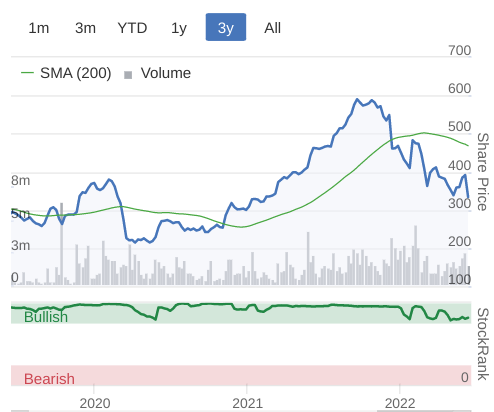
My opinion - both Jack and I (Paul) think this is a good business. I reviewed its FY 11/2021 accounts here, and was impressed when the price was 467p. Today’s price is only 319p, yet the company confirms today it is trading ahead of expectations. This is obviously because the stock market is pricing in a recession now, which may or may not happen. If we do get a recession, then we don’t know if it’s likely to just be a blip, before Govts stimulate economies again, or something more prolonged. Hence as we know, lots of uncertainty, especially around inflation.
With my value investing hat on, this is the time we’re offered some cracking bargains by the market, as people fixated on their own personal P&L, sell at irrationally low prices, driven by emotions, primarily fear of further paper losses, and sheer despair.
Yet with STEM, I see a decent business, now being offered at a very attractive price.
For long-term investors, I think 319p looks an attractive entry point, if you can cope with market volatility, and recession risk. Shares are likely to bounce today, so it could be a good one to buy on the opening bell, I reckon.
Obviously if you think a deep, prolonged recession is coming, then you probably wouldn’t see this as an attractive entry point. That's your call, as none of us know what the future holds.
.
.
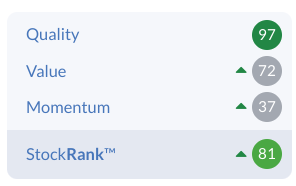
High StockRank too -
.
Cake Box Holdings (LON:CBOX)
173p (flat, at 08:42)
Market cap £69m
Diary date - 27 June, for FY 3/2022 results.
Confirms results in line with market expectations (but no footnote to say what this is).
Conference call on results day seems to be open to investors as well as analysts, which is good to see (details on how to join the call are in the RNS).
A problem has emerged in the audit, over distributable reserves re previous dividends paid. This sounds inconsequential, and is being fixed with a resolution at the next AGM, so it doesn’t seem to be a concern. That’s how the market has taken it too, with no change in share price.
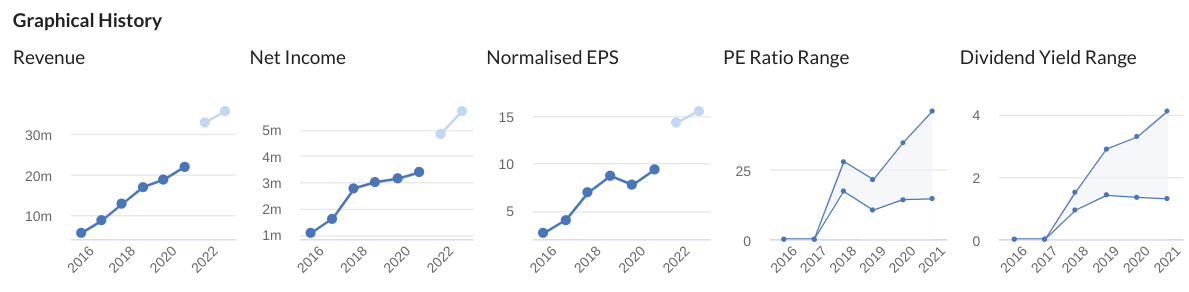
My opinion - as you can see from the graphs below, CBOX has a lovely track record as a growth company. I like the business model - rapid expansion of niche cake shops via franchisees.
.
.
The downside points are -
Accounting problems, and mgt castigated by former auditor (as flagged in an excellent report from Maynard Paton in Jan 2022).
Former CFO sold a lot of shares just before the accounting problems were revealed, hence there’s a lingering bad smell from that - it takes time to rebuild market trust.
Consumer downturn, so shares have moved down with other retailers.
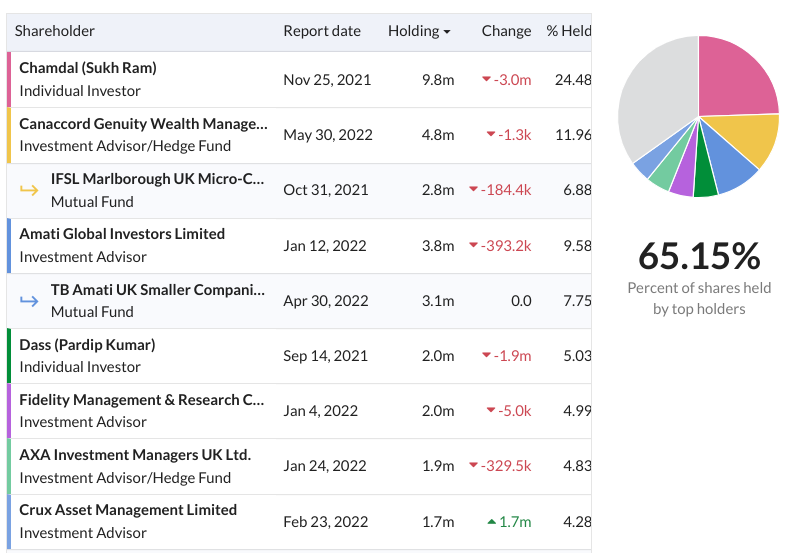
Major shareholders almost all seem to have been selling - risk of a prolonged overhang of sellers in the market? That could depress the share price for a long time.
To be fair, CBOX did replace the CFO, and seems to be getting its house in order. The problems could be seen as growing pains, hopefully not something more ominous. Although personally, I rarely go near any share where accounting problems, and lack of financial control becomes evident, just in case more problems come out of the woodwork.
It might need more time to rebuild investor trust in CBOX, but it’s an interesting business I think, so am keeping it on my watchlist.
Lots of red (selling) in the major shareholder list, "Change" column below -
.
Filtronic (LON:FTC)
10.0p (up 11% at 09:31)
Market cap £21m
Filtronic plc (AIM: FTC), the designer and manufacturer of products for the aerospace, defence, telecoms infrastructure and critical communications markets, is pleased to provide the following trading update for the financial year ended 31 May 2022 ("FY2022").
PR headline -
Positive Trading Momentum maintained as improved second-half lifts earnings and net cash at year-end
Key points -
We are pleased to report top line growth and that adjusted EBITDA is set to exceed market expectations despite the challenges of the global semiconductor shortage…
… a strong sales mix and tight control of overhead costs resulted in adjusted EBITDA being materially ahead of forecasts.
The Board therefore expects, subject to audit, to report FY2022 revenue of approximately £17.1m (FY2021: £15.6m) and adjusted EBITDA of not less than £2.7m (FY2021: £1.8m).
It wastes time for us when companies just report EBITDA, because we then have to look up what real profits are. In this case, Finncap has helped by crunching the numbers, and £2.7m adj EBITDA turns into £1.4m adj profit before tax (PBT), clearly a big difference.
In adj EPS terms, that’s 0.5p, so the PER is 20.0 - seems high, in current bearish markets.
Especially as the latest forecast is for PBT to drop next year from £1.4m to £0.8m.
Outlook - sounds reasonably positive to me -
"The delivery of key semiconductor components will remain an industry-wide challenge for the foreseeable future, but we believe we have the resources to manage the disruption to our business and we start the new financial year with a strong order book and optimism to deliver further growth next year".
My opinion - I’ve followed FTC for years, and it has very patchy performance, with the occasional bonanza, then wilting. I seem to recall this is due to innovative products having fairly short life cycles, so it’s continuously having to invent new products.
I suppose investors must be hoping that at some point it might hit the jackpot with a blockbuster product.
As things stand though, I struggle to find any reason to want to own this share.
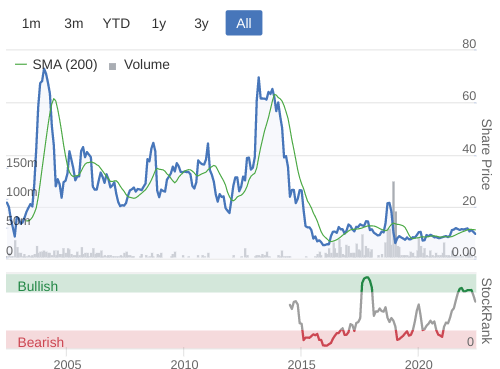
It's been listed a long time, and has been a long-term disappointment -
.
Graham's Section:
Rank (LON:RNK)
Market cap: £384m (-17%)
Good morning, everyone!
I’m intrigued to see this share languishing back in the double digits. I had some involvement with it, maybe about a decade ago, when I started focusing on FTSE-250 shares.
It operates Grosvenor Casinos, Mecca bingo clubs, a Spanish casino brand called Enracha, and a variety of gambling websites.
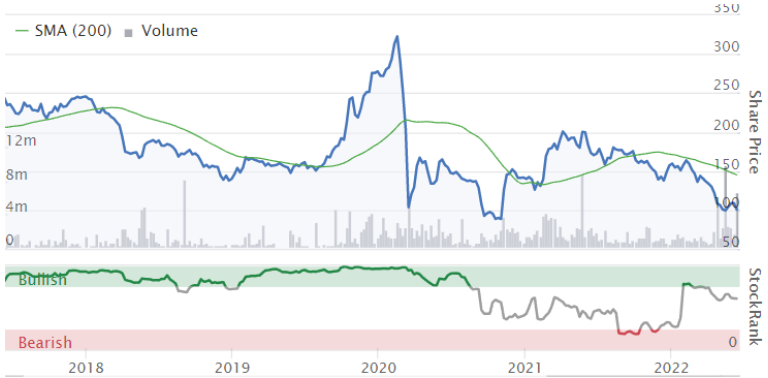
It was hit hard by the Covid crisis and despite temporarily recovering, the share price is back around those Covid lows again:
I last covered the stock in 2018, when I thought the company’s £77 million in “adjusted operating profit” was mostly real, not a figment of the adjustments. Statutory operating profit was running at £50 million for the year.
Today’s trading update – this is a profit warning, blamed in part on a variety of factors affecting Grosvenor Casinos (the bolding is mine):
We have seen some improvement in Grosvenor's performance post April, but it has been considerably weaker than expected, principally due to a slower than expected return of higher spending overseas customers to our London casinos, continued softness in visitor numbers across the UK and a lower-than-average casino win margin in the quarter to date.
I can speak to this myself: the only times I’ve entered a Grosvenor Casino have been when travelling! Once on a business trip, and the other time at the tail end of a holiday. But I’ve not been back in recent times.
Casinos don’t make all that much money from their weekly regulars, who are often sober and only there to make money, not to have fun! Instead, they thrive on tourists and business travellers, which is where they will find the high rollers.
Perhaps trends have improved in recent months, but I noticed this February forecast by VisitBritain, where they predicted inbound visitor numbers to the UK in 2022 would only reach 52% of 2019 levels, and that spending would reach 59% of 2019 levels.
The same organisation also predicted that it would take “a few years” before there is a full recovery to 2019 levels.
I doubt that the forecasts for 2022 have improved too much in recent months, given what Rank Group is telling us.
Win margin – this measures the “edge” enjoyed by the House, or the profit margin on bets placed in the Casino. Rank says there was a lower-than-average casino win margin at Grosvenor.
I suspect this could be another consequence of fewer overseas visitors. The locals, or regulars, may be in the habit of playing games where they don’t lose too much, compared to the games played by tourists. So that could be an easy explanation for why the casino win margin is running lower.
Alternatively, Rank’s long-run win margin might just be declining – they were complaining about the lower win margin back in 2018, too!
Profit warning – Rank’s update ends as follows:
As a result of the recent performance in Grosvenor venues and continued inflationary cost pressures across the Group, subject to normal casino win margins between now and the year end, we expect like-for-like underlying operating profit to be approximately £40m for the year ending 30 June 2022, lower than the previously guided range of £47m - £55m.
My view
It’s a nasty profit warning on many levels.
Firstly, of course, you have the more than 20% reduction in underlying operating profit compared to the previous central estimate.
Secondly, you have the fact that this new estimate is far from guaranteed: it relies on casino win margins improving back to “normal” levels, which I would have very little confidence in.
Thirdly, the 20% reduction in annual operating profit has been caused by only two months of poor trading. It shows how vulnerable the results are to very short periods of poor performance.
And finally, if you are nervous about continued inflation like I am, this profit warning confirms that Rank is not immune to cost pressures. There may be little relief from this problem in the short-term, perhaps not for quite some time!
However, despite all of the above problems, I still retain a fondness for this company. I’d like to see it recover.
As of December 2021, it had net cash (pre-IFRS 16) of £55 million.
And depending on the level of adjustments in the results, it can still grind out a profit for this financial year (FY June 2022). The net income forecast was £33 million, prior to today’s profit warning.
So I do think there is potential value to be had with this one.
Here’s what the StockRanks say:
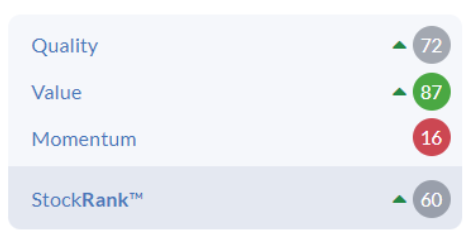
If you’re willing to hold your nose and ignore the terrible momentum (no doubt made worse by today’s events), then the Quality and Value scores are really quite good. Although of course these scores may be affected by lower profitability!
I would guess that more pain is due for Rank in the months ahead. But holding these shares in the bottom drawer for a few years could lead to pleasant surprise, somewhere down the line, in better economic times.
SysGroup (LON:SYS)
Market cap: £13m (unchanged)
Managed IT services provide very important facilities for businesses who need to outsource their IT function. But that doesn’t make them good investments!
When I’m studying a company, the first thing I want is a competitive advantage. That means an element of differentiation that creates an “unfair” advantage against its rivals.
If I don’t find any competitive advantage, then I need the company to at least have some assets that can generate a return. The return might not be spectacular, but at least the company can do something for its shareholders.
Where does a managed IT services company fit into this picture?
Unfortunately, I find it hard to come up with an investment rationale in this industry.
I see it as a labour-intensive, people-based type of business, with few ways to create a sustainable competitive advantage.
External shareholders aren’t needed, and are therefore unlikely to be rewarded.
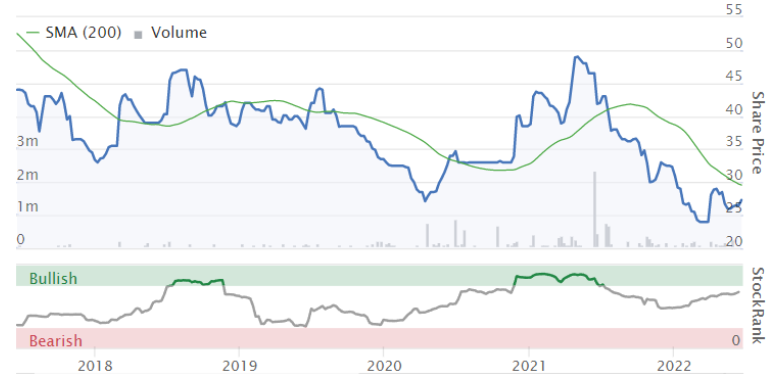
This share has been knocking around for years, and has done little for external shareholders so far:
Results – revenues are down 19%, but profitability is steady. High-margin services increased as percentage of total revenues, and low-margin reselling activity declined.
Cash – finished the year ahead of management expectations at £3 million, but this money is gone now thanks to acquisitions. The two recent deals (after the accounting period ended) cost £5.8m in aggregate, plus an earnout of £3.075 million.
Here’s a snippet to help you understand the overall strategy:
The expansion of the business enables SysGroup to offer customers an enhanced suite of IT solutions, providing a competitive edge over competitors and better positioning the Company to take
advantage of the market opportunities in the near future. We continue to engage with potential targets and assess businesses that could enable the continued growth of the Group and ensure that our customers continue to receive the best possible service available.
Outlook – optimistic words from the CEO, who finishes with the conclusion: “I am confident that we will see improvements to both revenue and EBITDA performance in this new financial year.”
My view
I agree with the company’s assessment that increased scale does bring competitive advantages. It’s working on creating this scale through acquisitions. Perhaps, like £CCC , it will surprise me and achieve great things for investors! But personally this is not a bet that I would be interested in making.
Disclaimer
This is not financial advice. Our content is intended to be used and must be used for information and education purposes only. Please read our disclaimer and terms and conditions to understand our obligations.

28 comments
Cake Box Holdings (LON:CBOX) - It looks to me as though the selling by major shareholders has normalised. I tracked this through the spring and came to the conclusion that the appointment of a new FD, an experienced troubleshooter, had settled the nerves. Shares have actually outperformed since. I also wrote at length why I believed the problems to be non-fraudulent, but I’m on a very slow Internet connection in Bohemia right now and can’t find my comment without tearing my hair out.
Cake Box Holdings (LON:CBOX) (I hold). I agree with your thoughts. Also, I pass by my local outlet (Tolworth, West London) from time to time and occasionally look in. There seems to be a steady trade and the creamy cakes are doing nothing of any good to my waistline!
On Friday, I posted a list of the new large shareholders in Tern (LON:TERN) and asked if anyone here knew what is going on. One answer was "Pretty sure it's to do with the takeover of Pires Investments (LON:PIRI)".
Today, and RNS was published saying that one of the new investors, jonathan mark swann, who owns 2% of TERN, disclosed a short holding of about the same size on 13 June. Can anyone here offer a possible reason why someone would acquire 2% of a company and short it around the same time? Is it possible that he acquired the shareholding to cover his short position and that the other new shareholders were also covering short positions? I see that TERN is up over 10% today.
I have emailed Ian Ritchie, TERN's chairman, to ask if he can cast any light on what's happening.
It was me on Friday. If the fellow is who I think it is, he trades Tern up and down on a daily basis.
Perhaps the oddest thing about Filtronic (LON:FTC) is that a couple of private families own huge amounts of it and have been increasing their stakes: the Dixons and the Newlands have 9% and 25% (can't remember who has which). and they have been consistently increasing their position for a few years. I've heard of averaging down, but that takes it to a new level. More seriously, anyone holding that amount of a relatively illiquid AIM listed company has no exit other than through a takeover. The fact they hold so much suggests to me that there must be a takeover at some point. So I think it is worth holding on to. There's new management and they seem to be more clued in than the previous.
Donald that seems a very tenuous reason to hold a share.
Graham, you observations on Newmark Security (LON:NWT) are so astute and could fit quite a number of AIM outfits. I hold some of those myself but not this one. I'm learning all the time from Stocko's SCVR on a broad front impossible to do by myself. Best Regards.
Silver
I appreciate the feedback, Silver. Thanks! G
An interesting podcast of an interview of Mark Slater ( Slater Investments) by Johnathan Davies, done in late May 2022, probably worth 30 odd minutes of your time.
Is the bear market over? – Master Investors – UK Podcasts (uk-podcasts.co.uk)
Kudos to Mr Contrarian for pointing out Brighton Pier (LON:PIER) are changing their year end accounting period.
This is one of my personal red flag alerts. Such a measure whilst it can be done for a fair reason, it can be used by management to rebase their results overview e.g. extending the year end makes revenues look stronger as a comparative superficially, or a reduction in the accounting year conveniently cuts off a period of under performance which will be merely aggregated into the next accounting year, conveniently kicking the can down the road to a period when they hope to have a stronger trading period.
Brighton Pier (LON:PIER)
For entertainment business that will be busier may-july than december january i think changing to december year end makes perfect sense - seems nonsensical for year end to have been somewhere near the middle of the peak summer season. So whilst red flags may exists for some this seems no brainer sensible decision - the only caveat i would have is that temporarily i would be more wary about newsflow and the potential for stuff being swept under short term if any vaccum of concrete numbers exists. Note the company have confirmed they are doing 12 months figures to 30/6/2022 and 12 months figures to 31/12/2022 - so seems like you are getting more rather than less here reporting wise !!
Thanks for market backdrop comments on Friday Paul. I tend to agree that its too late to sell ... especially the most bombed out areas.
A while back I looked at past bear markets ... 2007 2000 and 1929. I don't think we are back in 1929..... but the initial fall in the S&P 500 was 36% followed by an 18% rally. In 2001 the initial fall was 11% ...followed by a 12% rally... and in 2007 the initial falls was 18% followed by a 12% rally.
At the moment the FTSE 100 is only down 7% ... the 250 -20.4% so the UK has been more resilient in this first phase. The Nasdaq is down 30% and S&P 24%. The US must be close to a level it can rally. Whatever happens though by Autumn the debate will be all about the length and depth of recession... it could be mild, not happen, or be severe. We don't know, its pretty complicated at the moment....but at the moment the economy has been a little hot...and the Fed behind the curve. I think we follow this with Fed no longer behind and/or Fed has gone too far. So we worry about the slow down.
Clearly the inflation limits the Fed response in a slow down...so its likely to come late as inflation is a lagging indicator. We will see.... its worth noting that even in big bear markets, say 2001, the market rose 70% but this was offset by 5 periods of weakness..... you tended to get a fall of nearly 30% followed by a rally of about half the loss.... it was similar in 2007, but you only had four different phases. Things do seem to speed up. This sort of supports the idea that we can rally here ... and likely about half the fall.
Obviously a recession brings earnings downgrades... and these will likely reset in the Autumn. Some sectors like retail already seem to be discounting a lot. Others sectors still do not. When value starts to do better than growth this normally last several years. I would wait for a rally of approximately half the losses to restructure. Some of the areas like resources might not held up so well in the next phase if we worry about the recession but a lot depends on china and what type of policy they implement.
For now I think we have seen most of the losses in the first phase and a rally will inevitably come... and then you can kick some stocks out if you have changed your mind.
regards
Hi RDHOWARTH
I suspect you have already seen this chart or others might be interested.
Regards
Howard
Interesting that the "time from peak to trough" has such a diverse range of values.
I wonder, how many of those previous times, did the 20% decline happen while GDP is still growing, and unemployment is still at a record low?
What do readers use to track their portfolio, diversity, performance etc? I'm currently using Sharesight which is using given the range of reports available but it's relatively pricey so just seeing if people use Stock, Excel, their broker portals or something else to track.
Google sheets. I have it set up to show prices (obviously), but also other things I find useful to see at a glance; % on average volume, MA levels etc, a little 6 month chart. I also have a watchlist page and an ex-holdings page.
Adding and removing cash and getting a true yearly return figure takes a bit more work with another excel sheet, but I rarely add to my portfolio now and it gives me a ballpark figure even if I do.
I have used Sharesight in the past, but didn't think they really offered much more than Stocko portfolios to justify the extra cost of a subscription.
Do you rate Sharesight's portfolio tools much better than Stockos? In which case I might go back and give it a try again...
I have 4 Folios at Hargeaves Lansdown with the Missus and I input the shares and costs into an HL Watchlist so that in order to see the current ups and downs (mainly downs recently!) and the accumulates gains/losses I only have to look in one place. I also run an Excel spreadsheet which contains the history of our Folios and then check that the two sources agree each evening. Sharepad and Stockopedia will allow you to set up Folios where you can input directly your trading actions, hence no need for Excel but I had already set up my Excel system before I subscribed to those two and it was too time consuming to have to re-enter all the trades. Hope that helps.
I use Excel, with a combination of feeds from various sources so I can mix & match my pricing source for each individual security. Whilst I do use quite a bit of code/VBA, I'm not sure I'd need to if starting from scratch now as you can achieve a huge amount with Excel's StockHistory function (if you subscribe to Office365), together with PowerPivot. Much of what I used to use SQL for a decade ago can now be done with a bit of DAC and PowerQuery.
When I left the City I thought I would miss my Bloomberg terminal, but I've managed to replace much of the equity functionality without paying $20k a year. Yes, I do still miss the clean corporate action history and the reliable total return analysis. Fixed income is a different matter entirely - it is very difficult to replicate the professional tools as the data is much harder to come by.
Sharesight is a much better tool for tracking a portfolio than Stockopedia as it can do total return and it is vastly superior when it comes to handling dividends. I had a thorough look and liked the product, but I have more portfolios than their private investor pricing framework permits. They are Australia/NZ in origin, and I'm not sure they fully apprciate how many SIPPs, ISAs and Junior ISAs a UK family can accumulate.
Stocko is better for analysing companies, taking a quick glance at the historical accounts and comparing various ratios.
I don't really consider Sharesight & Stockpedia to be comparable offerings. I've not looked hard at Sharescope - I'm not a trader so technical charts and Level 2 pricing are of limited value to me.
Just re-reading Paul's last analysis on BEG and he called it spot on - hope he invested in it!
The re-rating of the Begbies Traynor (LON:BEG) shares over the past week has been very dramatic, and also interesting, based on almost no news/developments.
Gov stats on non-voluntary insolvencies haven't increased yet by much, albeit it is predicted to grow as 2022 progresses. However, compulsory liquidations is 4x higher in May 22 than May21, so clearly there's more work YoY in the industry.
I remember FRP released something recently, predicting that summer will still be a lull, before a surge in Autumn.
So it does look like momentum is building to an outstanding second half of the year for Begbies, and next year too. But the numbers aren't showing it yet.
(I hold in The Boon Fund)
Interesting reading from AJ Bell for last week.
FTSE 100 - ending the week 4.1% lower.
The FTSE 250 - closing 3.8% lower for the week.
The AIM All-Share - shedding 5.3% for the week.
Bombed out small caps as a whole are still getting hammered which was a surprise to me, as I have been feeling they had seen the worst.
Good to have some numbers.
Hi Paul.S
Market falls only really matter if you're planning on selling though. I'm not, so it doesn't really matter that much to me what the current prices are. I've decided to stop looking at them!
Regards, Paul.
Agree.
I guess for me Paul its information to help when to buy in again. Operating a 15% stop loss (for better or worse) makes my perception verses reality important to understand.
I would have put money on AIM being the least affected.
A clear indication of how actual company performance is not being reflected in share price performance . Sthree £stem ( I hold ) issued a trading statement this morning with that wonderful expression "trading ahead of expectations " - there is a bit of symmetry about the share price (down 26.9% in the last 6 months ) and group net fees up 25% YOY - bizarre!!!
This will be one of the companies that will benefit from the anticipated inflation in salaries and wages over the next 2 years as fees are usually related to salaries plus they are specialists in Science,Technology, Engineering and Mathematics where there is high demand world wide . Will the share price reflect this - not at the moment it won't but it will over time .
I’d suggest you cover SThree (LON:STEM) TU this morning but I can sum them up thus: They are every bit as good as I expected and have regularly predicted on here.
Shares are fantastic value but could stay that way in a market that completely ignores the company’s two major advantages over other, more cyclical, listed recruiters:
i) Exclusive focus on IT, Technical and Life Sciences
ii) Large and increasing (now 77%) concentration on contract (higher fees per placement, stickier, better earnings visibility)
One of the key metrics delivered today is a growth in the contract fee forward load of 35%. If earnings are only being upgraded by 5%, then this suggests a substantial increase in the duration of bookings which provides huge downside protection to near and medium term earnings.
Hi BnB,
I agree, SThree (LON:STEM) looks terrific value right now. Section is up in the main report, as I spotted it was ahead of expectations, so prioritised it. Looks a highly attractive entry point for an excellent business, that should, as you suggest, do OK even in a recession, due to its specialist focus on sectors where there's a skills shortage.
Regards, Paul.
[edit] ◄Actual Experience (ACT)► on Friday night: gets £1m 3yr contract terminated because of "changing requirements within the customer".
"The decision to terminate the contract was not based on the performance of Actual Experience's offering."