Small Cap Value Report (Mon 21 Feb 2022) - MNZS, SLP, CLG, WIL, SNG

Good morning, I'm back (Paul) after a few days break. Many thanks to Roland for covering.
It's certainly a very tough time in the markets at the moment, especially small caps. I always remind myself at time like this, that bearish market conditions are laying the foundations for the next bull run. So providing we hold sensible companies, reasonably priced, they'll usually go back up again.
Mello Monday starts at 6pm (online) this evening. Details here. I do think it's important to keep engaged, rather than withdrawing into despondency when markets are difficult.
Agenda -
Paul's Section:
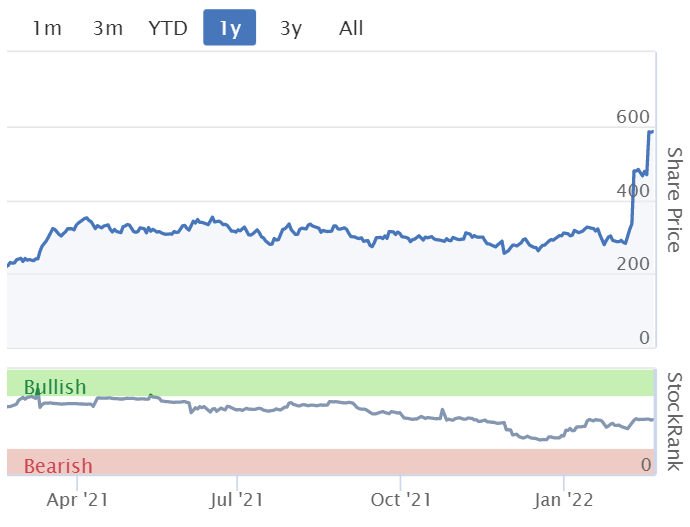
John Menzies (LON:MNZS) - looks like a cash bid at an increased 608p is now enough to win over management to back the takeover bid from Kuwait's "Agility" infrastructure group. Are bearish stock market conditions creating opportunities for more investor windfalls from takeover bids?
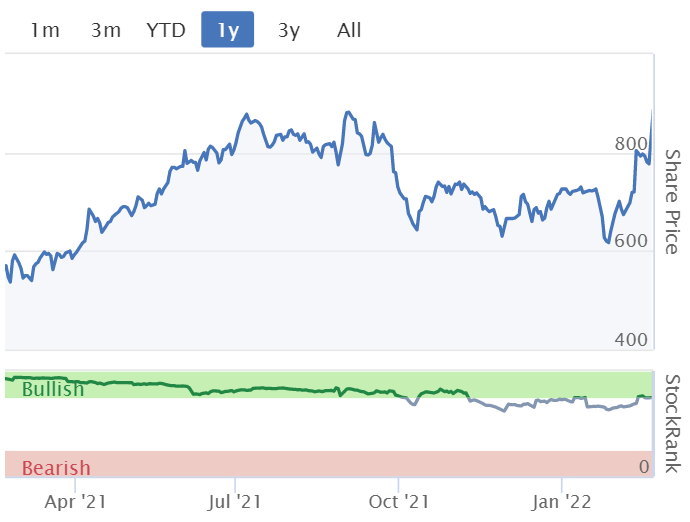
Clipper Logistics (LON:CLG) - continuing the takeover theme, management has agreed a bid from US-listed GXO, 75% in cash (690p) and the balance in GXO shares, which UK investors may not want to hold. It looks a fair price to me.
Synairgen (LON:SNG) - a speculative drug treatment company delivers the news investors dread - that its product failed the main targets in testing. Although crumbs of comfort come from secondary results. It's difficult to see much of a bull case now.
Jack's Section:
Sylvania Platinum (LON:SLP) - I hold - production down due to flagged technical difficulties and cash costs are up. The stock remains cheap in my view, but that depends on the outlook for the group’s PGM basket price. Management continues to return cash to shareholders via dividends, special dividends, and share buybacks. Even accounting for the operational challenges, the company remains highly cash generative at these levels.
Wilmington (LON:WIL) - good H1 results, as previously flagged. AMT has been sold for a useful premium, which goes some way to mending a balance sheet that could still do with a little work. The group’s two segments are both growing organically, and the return of face-to-face events could lead to further upgrades. I think it’s one to watch.
Explanatory notes -
A quick reminder that we don’t recommend any stocks. We aim to review trading updates & results of the day and offer our opinions on them as possible candidates for further research if they interest you. Our opinions will sometimes turn out to be right, and sometimes wrong, because it's anybody's guess what direction market sentiment will take & nobody can predict the future with certainty. We are analysing the company fundamentals, not trying to predict market sentiment.
We stick to companies that have issued news on the day, with market caps up to about £700m. We avoid the smallest, and most speculative companies, and also avoid a few specialist sectors (e.g. natural resources, pharma/biotech).
A key assumption is that readers DYOR (do your own research), and make your own investment decisions. Reader comments are welcomed - please be civil, rational, and include the company name/ticker, otherwise people won't necessarily know what company you are referring to.
Paul’s section:
John Menzies (LON:MNZS)
Agreed takeover bid at 608p
The Board of Menzies (the "Board") announces that it has received a further revised proposal from NAS, a subsidiary of Agility, regarding a possible all cash offer for Menzies of 608 pence per share (the "Final Proposal") . The Final Proposal is conditional on, amongst other things, confirmatory due diligence and the recommendation of the Board of Menzies (such conditions being capable of waiver by NAS).
The Final Proposal follows earlier approaches from NAS to the Board regarding possible all cash offers for Menzies at 460 pence, 510 pence and 605 pence per Menzies share.
My opinion - this is fantastic news for MNZS shareholders, and management seem to have handled the takeover bids very well - squeezing a higher price out of the Kuwaiti bidders several times.
Going back through the archive here, I can’t see anything obvious in the numbers to suggest that MNZS was a bargain, or likely to attract a bid. Although the broker forecasts were increased several times, and a decent turnaround seemed to be underway. So maybe it’s time to run a stock screen for companies where broker forecasts are being raised? A very weak balance sheet, heavily dependent on bank debt, ruled it out for me personally.
With such bearish stock market conditions currently existing, I wonder if we might see a rash of takeover bids?
An interesting point with MNZS, is that when the initial bid was announced (and rejected by management), the share price did rise, but remained a long way below the rejected bid price on the first day. I remember looking at that as a potential buying opportunity, but unfortunately didn't have any spare cash, so missed the opportunity.
.
.
Clipper Logistics (LON:CLG)
884p (up 14% at 08:18) - mkt cap £907m
Statement re. possible offer for Clipper Logistics plc
Continuing the theme of takeover bids, it looks as if Clipper is the next one to be taken over.
The Boards of Clipper Logistics plc ("Clipper") and GXO Logistics, Inc. ("GXO") are pleased to announce that they have reached agreement on the key terms of a possible cash and share offer for Clipper by GXO (the "Possible Offer").
The terms are:
- 690p cash, plus
- C.230p equivalent in GXO shares
GXO is a logistics group listed on the NYSE. If you have a US subscription for Stockopedia, then the StockReport for GXO is here.
GXO looks expensive, for a low margin logistics group, on a forward PER of 29.5 - so personally I wouldn’t want to own any GXO shares.
The market cap of GXO is £6.9bn, so it’s a credible bidder, and it should be liquid enough for CLG shareholders to sell their unwanted GXO shares in the market. Although I think that all cash bids are always preferable to bids which contain some element of shares as payment.
My opinion - it seems that CLG management is backing this bid approach, although the 23.3% irrevocable undertakings to accept are not high enough to make it a done deal yet.
The overall price looks fair to me, although the mix of cash & GXO shares is not ideal. There’s always the option of selling in the market now for 885p, giving up c.35p, in return for a certain, immediate, and all-cash pay out.
Or there’s the possibility of holding out for improved terms - which does carry some risk that the bid might fall apart.
Quite often I sell half immediately, when takeover bids occur, depending on how credible the bidder seems. That locks in some profit, and makes me more relaxed about the outcome for my remaining shares. Although I know other investors who always hold, because bids usually succeed and you get the full takeover price (as opposed to a discount for selling early in the market). Also that way you capture the upside from a higher competing bid, which sometimes happens. In this case, it sounds as if CLG management have committed to backing the GXO bid, so maybe not so much upside from any higher bids?
We like CLG here at the SCVR - because it has a good track record of growth in EPS.
Another good logistics share to consider is Wincanton (LON:WIN) - although the low PER is due to heavy cash payments into its pension scheme (a non- P&L item).
I know a lot of investors are nervous about the situation in Ukraine, and worries over interest rates & inflation. All valid concerns. However, sitting on the sidelines in cash, does mean that you miss out on takeover bids. Takeover bids happening is also an indicator that the UK market is probably now quite cheap.
.
.
Synairgen (LON:SNG)
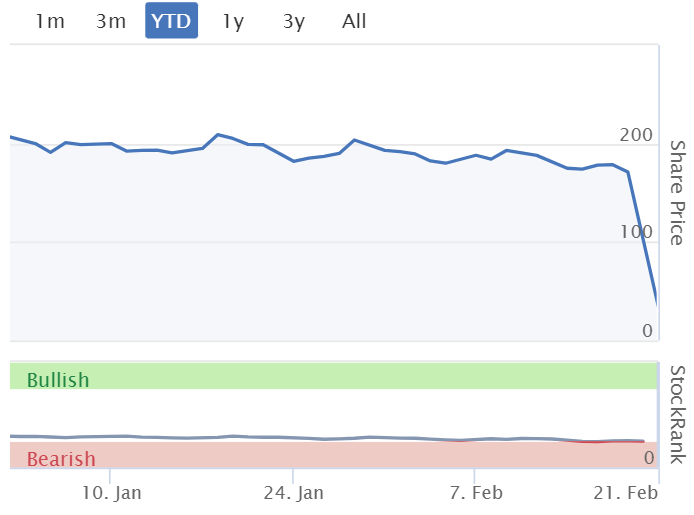
35p (down 79% at 10:02) - mkt cap £70m
Topline results from phase 3 trial
This share bottomed at under 20p first thing this morning, down from 171p at Friday’s close.
We don’t normally cover speculative drug companies here, or indeed anything blue sky with zero revenues (other than to warn people off!), because they’re impossible to value rationally. So investors are left to guess and speculate on what the future might hold.
The failure rate on such speculative shares in extremely high, so it continues to amaze me how many such shares are chased up to high valuations, especially in bull markets, when investors seem to confidently assume that the bull case is a near-certainty, despite evidence all around us that the bull cases nearly always fail, fully, or in part.
Synairgen’s bombshell announcement this morning is that its inhalable treatment for covid doesn’t seem to work in its “primary endpoints”.
Although there do seem to be benefits from the number of patients who received SNG’s treatment (compared with a placebo) in reducing the number of patients having severe disease or death.
The sample sizes look small though, so larger trials are needed. Meanwhile other treatments, and the severity of covid, are reducing. So whether SNG has missed the boat on this, is open to question?
SNG says it has over £25m cash remaining, so there doesn’t seem to be an immediate solvency risk.
It all depends on what the cash burn is likely to be though, for larger trials to take place? £25m doesn’t sound enough for major trials.
My opinion - it’s difficult to see how a market cap of £70m (at 35p per share) is justified now that SNG’s key product has failed its main aims. Also, with omicron now a milder strain, and herd immunity having been achieved in many countries, is it worth investing in anything that is developing covid treatments? That moment seemed to have passed once vaccines came out, so this feels a very stale story.
Small investors have a great advantage, in that you can sell, whereas the institutions are stuck with it.
This share looks a busted flush to me. So if I held, I’d chalk it down to experience, as a punt that didn’t work, and move on, rather than expending more mental energy worrying about it.
Clinging on, in denial about the changed facts, or just hoping that something good might happen against the odds, doesn’t usually work in these binary type of situations. You've either got a blockbuster, highly lucrative drug, or you've got nothing. That's why averaging down usually just makes a mistake a bigger mistake, unless you're lucky in catching a short term trading bounce.
I don't touch anything like this, as I've got no informational or knowledge edge. So once I've heard about a bandwagon, chances are the smart money is already selling!
.
Jack’s section
Sylvania Platinum (LON:SLP)
Share price: 96.5p (-4.46%)
Shares in issue: 272,985,435
Market cap: £263.4m
(I hold)
Half year report to 31 December 2021
With the caveat that pretty much all Metals & Mining stocks are to one extent or another geared plays on different commodities, Sylvania is a sensible operation with experienced management focused on optimising what is within its sphere of control.
The shares have come down from highs of c140p last year to 101p as of the time of writing but, with a recovering basket price (that remains well above historical norms), there’s still a solid argument that the stock is cheap. Net cash is up year-on-year from $67.1m to $110.1m (and up c$4m since the start of the period), meaning the cash-adjusted forecast FY22 PER is just 3.1x.
A 2.25p is declared, to be paid in April 2022, while a 4p dividend was paid in December 2021 in addition to a total of 1,873,430 shares bought back. The group continues its good track record of returning cash to shareholders.
In terms of other highlights, we have:
- Sylvania Dump Operations (SDO) production of 32,376 4E PGM ounces (down from,
- Group cash cost per ounce is up 23% to $815/oz,
- Net revenue of $69.1m (HY1 FY2021: $84.9m),
- Average gross PGM (platinum group metals) basket price of $2,966/oz (HY1 FY2021: $3,184/oz),
- Group EBITDA of $36.2m (HY1 FY2021: $58m),
- Diluted earnings per share of c6.38p.
The market should have been expecting less good year-on-year results due to the change in commodity prices.
There has also been progress made on the Grasvally chrome mine, one of SLP’s exploration assets that has been up for sale for some time. An amended agreement sees the agreed upon sale move from 74% of the company to 100% for $6.7m.
Operational challenges include lower than planned Run of Mine (ROM) and PGM feed grades at Western operations and the temporary suspension of operations at Lesedi in Q1, which has commissioned a new water supply and tailings dam facility. Progress here is proving a little trickier than expected, however.
Regarding feed grades:
During the period, the SDO continued to engage with the host mines in order to address the lower PGM grades in ROM and current arising sources, as well as optimisation of blending activities from surface sources. Various sampling campaigns and investigations have been performed together with the host mine to evaluate potential alternative feed sources. It is anticipated that ROM feed grades should improve during HY2 FY2022.
Power supply to operations remains a focus area, as vandalism and cable theft at substations continue, often resulting in unplanned delays to the operations.
Opportunities - the group’s ‘MF2’ projects remain on track. Lesedi MF2 will be commissioned in March and Tweefontein should be later in the calendar year. These should add further production capacity, between 4.5-6k oz.
CEO Jan Prinsloo comments:
The SDO has achieved 32,376 ounces of PGM production in the period, with a solid performance from most operations, especially Tweefontein, which achieved new record quarterly and six-monthly production performances which helped mitigate the lower production from Mooinooi and Lesedi during the period. However, the lower PGM feed grade of Mooinooi ROM material received, the impact of the temporary production stoppage at Lesedi and subsequent water shortages, as well as some water supply issues which are being addressed, have affected production from our Western operations. As a result, we have made a modest adjustment to our annual PGM production estimate, with a range of 66,000 to 68,000 ounces now targeted by the Company.
Capex - a notable increase in maintenance capex here.
Capital spend increased during the current period compared to the prior year corresponding period from $2.5 million to $7.4 million, comprising $6.1 million optimisation and stay in business capital that includes the abovementioned projects, as well as $1.3 million spend on exploration projects. All capital projects are fully funded from current cash reserves.
Liberum notes ‘approved near term growth adding 6.2- 8.3koz PGM p.a. for $6.7m. Over next three years, possibly two new plants adding 25-35koz p.a. for $40-$50m.’
Conclusion
Cash costs are up some 23%, but still well below basket price levels. The major drivers here are higher electricity costs, higher mining costs as a result of trying to secure higher feed grades, and higher levels of oxidised materials.
Management is actively addressing this though, and my base case view is that the current operational challenges are temporary, although there is always scope for more complications to arise.
Assuming this is correct though, then the shares continue to look cheap at the current levels. But then there’s that second, more fundamental assumption: that today’s basket price is more reflective of the future than the pre-2019 levels.
I think the outlook is fairly positive here, given that Rhodium figures more heavily in SLP’s basket than it does for other PGM producers (around 2-3x the exposure), is used in catalytic converters for cars to reduce nitro emissions, and with automotive production set to recover at some point in the short term. Rhodium is a tight market, which makes the price volatile.
The medium term outlook is solid, with the switch to EVs not an immediate threat, although that volatility does need to be considered. In order to meet Rhodium demand, experts are forecasting record levels of recycling. If that fails to transpire, then there would be upside pressure on the commodity price. Here’s what management (which is generally cautious on giving commodity price guidance) says:
While the average 4E PGM basket price for HY1 FY2022 was approximately 30% lower than HY2 FY2021, we remain cautiously optimistic in terms of the PGM price outlook. Based on market forecasts for Palladium and Rhodium to remain in deficit and demand forecast to increase with vehicle sales as the global chip shortage is resolved, we are expecting PGM prices to remain healthy with potential modest upside from current levels as the year progresses. While electric vehicle sales have increased sharply during the past year, especially as internal combustion engine ("ICE") vehicles sales were impacted by the global chip shortages, PGM consumption in ICE vehicles is expected to remain robust for the short to medium term based on the balance of market fundamentals.
It’s not my area of expertise - something I might do more detailed work on this week though - but for now I think the valuation, cash balance & generation, and the way in which management returns that cash to shareholders, makes SLP one of the more attractive Metals & Mining stocks out there.
The stock has to come with that commodity price caveat, and sentiment has weakened recently. The shares are down this morning but I’m more relaxed about these results. I think it’s a competent management team here, focused on the controllables and returning cash to shareholders when prudent to do so - which is perhaps more than you can say for some others in this neck of the woods.
Wilmington (LON:WIL)
Share price: 248p
Shares in issue: 87,593,017
Market cap: £217.2m
Half year results to 31 December 2021
Increasingly strong outlook… If the major face-to-face events happen in March as expected, we anticipate our profitability to improve still further.
Highlights:
- Revenue +7% to £58.9m,
- Adjusted profit before tax +35% to £9.5m
- Adjusted basic earnings per share +34% to 8.6p,
- Statutory EPS up from 5.05p to 26.14p, helped by sale of AMT,
- Interim dividend +14% to 2.4p,
- Net cash of £11m (up from net debt of £17.2m a year ago).
Organic revenue is up 12%, driven by the acceleration of its digitalisation programme and the return of face-to-face events. Information & Data is up 10% and Training & Education is up 15%. It’s worth noting that the company’s performance is ahead of pre-pandemic levels.
Adjusted pre-tax profit margins have improved from 13% to 16% despite cost pressures resulting from staff, venue hire, and some increased travel.
Strategic sale of AMT for £23.4m in December leaves Wilmington free to focus on its strategy of establishing single technology platforms for its remaining two divisions in order to enable a more ‘digital-first’ approach, which could lead to higher margins in due course. This will likely entail acquisitions in GRC, funded by the group’s net cash and £65m bank facility.
Information & Data - the group breaks down its operating segments into sub-segments. Here, we see Healthfcare revenue is up 14% to £15.9m, Financial Services & Other is up 1% to £10.5m, and Identity & Charities is up 3% to £2.4m. Discontinued operations declined by 78% to £0.3m. The result is £29.1m of total divisional revenue, up 5%, with an improved 19% operating margin leading to a 28% increase in operating profit to £5.6m. The group is targeting an H2 operating margin of 20%.
Training & Education - Global +2% to £11.4m, UK & Ireland +17% to £11.7m, North America +74% to £2.6m. Discontinued operations are down 11% to a still material £4.1m. Total revenue is therefore £29.8m, up 10%, and an improved operating margin of 24% means operating profit is up 20% to £7.1m.
In North America, results were helped by the return to face-to-face events.
Current trading
We continue to derive considerable benefits from our diversified portfolio as well as the investment we have made in product development and digitalisation over the past two years. In addition to driving organic growth, we have continued to improve margins. Provided we can continue to run events face-to-face, we expect an additional boost to profitability in H2 FY22. If not, we still expect profits and revenues to be higher than last year despite the sale of AMT.
Conclusion
An attractive feature of Wilmington’s is its focus on GRC and regulatory compliance markets - demand for its products is strong because customers need them in order to operate successfully.
I think it’s one to watch, although that is reflected in the improving share price. It’s doing about as well as it ever has done, so now it comes down to growth prospects.

The group has restructured, revenues are rising, the return of face-to-face events could further bolster momentum, and margin-enhancing acquisitions might be in store.
Meanwhile, the valuation does not look too demanding based on a forecast rolling PER of about 14.6x and a dividend yield of around 3%. And the group itself is pointing to the potential for further upgrades. Whether or not those upgrades arrive will likely be the key driver of the share price over the next year or so.
Note the improving StockRank.

The balance sheet looks a little weak though. Goodwill and intangible assets make up around 54% of total assets, leaving a negative net tangible asset value of -£16.1m. The current ratio is just 0.93x, although this is actually a marked improvement on the 0.58x from a year ago. The group is quite cash generative, but I’d still like to see more of a buffer here.
Total debt has come down as a result of the AMT sale though, which looks to have been sold for a healthy premium, and the F-Score points to improving financial health.

Disclaimer
This is not financial advice. Our content is intended to be used and must be used for information and education purposes only. Please read our disclaimer and terms and conditions to understand our obligations.

71 comments
Synectics (LON:SNX) 21.6% up today. Results tomorrow. Looks like a leak.
Inflation.... while I was having lunch, I had a bit of a thought which is making me re-assess my portfolio for those companies depending on discretionary consumer spending in the UK.
If we take the general population, and assume 75% of income is spent on essentials/must-haves. And 25% on discretionary items.
In the worst case scenario, assume they get zero pay rise. And essentials/must-haves go up by inflation, lets assume 8% this year.
That means the ratios change; now 81% of their income goes to essentials, and only 19% left on discretionary. That's a 25% decrease in their discretionary income.
So if we look at the discretionary industries and imagine they will see a 25% drop in demand, and also facing cost/input inflation headwinds, as well as fixed cost headwinds (ie wage increases, energy, etc). Then it is clear that unless a company has at least double digit net margins (I'm thinking 15%+ net margins are required to withstand), the going over the next 12-24 months is going to get very very tough. Unprofitable and cashflow negative tough.
---------
Obviously very simplistic calculations above, and you can input your own variables like wage growth to temper it down. But from a macro-view, I don't think we're out of the woods yet...
Thoughts?
I think against this you need to factor in that consumers have built up a lot of excess savings over past couple of years, which should cushion the blow. Furthermore, unemployment is low with lots of demand for labour - under these circumstances I would expect most workers to get fairly healthy pay rises (perhaps not matching RPI, but not too far off).
I think you need to go one level down and split consumers. Roughly the top two-thirds (i have seen various estimate) of wage owners have built up savings, as have those on good pension schemes (the retired rich). The bottom third (poor pensioners, the working poor and young adults) have not. This bottom third will now face a disproportionate impact from the cost of living crisis as non-discretionary food, energy etc are a much bigger part of income plus National Insurance rises.
From an investing point of view therefore, Saga (LON:SAGA) premium cruises and older owner-occupier insurance are in a very different place than say £Boo, a budget discretionary clothing company. I hold both but see why one has tanked.
My thoughts are that you've just pulled a load of numbers out of the air. I get the general idea that inflation goes up, discretionary spend goes down, that much is obvious, but where did you get numbers like 75% of spending is essentials on average?
And I think you're starting from a flawed premise - if inflation is 8% that doesn't necessarily mean bills go up to 81% as that 8% won't carry through to fixed costs. Most mortgages are fixed rate. Most car loans and other borrowings are fixed. Additionally essentials are essentials, but there's a lot of discretionary choice even in staples like food. People will swap brands for supermarket labelled goods, down scale to the budget stores. It's more likely the 8% inflation only really hits the discretionary spend rather than core spending.
And why are you stating that pay rises are zero in a high inflation era, the lesson from history is usually the opposite to such an extent that pay rises can become the cause, not the response to, ongoing high levels of inflation.
As I said at the top, I think your general premise is correct, discretionary spend will be down, but I don't anticipate the absolute bloodbath you predict.
I think the essence of what you are saying is valid. The BoE agree. This is one dynamic that they are factoring in to models and relying on to bring inflation down. One thing that's worth pointing out is what economists call the "permanent income hypothesis" which basically says that consumers smooth consumption patterns so the kind of effect you are discussing is much lessened. It's also worth saying that the evidence on this is mixed but there is a picture that says the wealthy behave as if they have a permanent income while the less well-off don't (unsurprisingly). Ignoring other factors you could then say that the likes of Burberry (LON:BRBY) or perhaps £SAGA might be unaffected, while discretionary spending at Scs (LON:SCS) might fall. But you could also predict that revenues and profits might rise at the likes of B&m European Value Retail Sa (LON:BME) , so perhaps margins aren't the metric that will determine who does well and who badly.
Inflation on essentials is going up far more than 8%. My gas and electric are going up around 100%, that's from January to April, then again in October probably. Petrol/diesel has gone up around 15%. Food also is going up. So essentials are going up way more than inflation.
I am thinking that big items, sofas, white goods etc could well struggle a bit, any spare cash could well go on holidays if borders open up fully, I am also not watching companies with very low or unstable margins. But TBH I think buying into any more companies ATM seems like folly, as todays fair price just gets smashed down through tomorrow. Keep what I have and sit back in cash till the dust settles, which i think could be a few months yet.
A general question, please: Do you consider the liquidity of a share when deciding on the maximum size of your investment in it? If you do, do you use a multiple of EMS and, if so, what multiple?
I use something different. I take the average daily trade size (minus outliers) in the last 3 months and my max position is a quarter of that. I admit I haven't used any statistical or scientific rigour but logically it makes sense. It should be easy to get rid of my holding in one day as I'll only make up to a quarter of usual daily volumes. And in practice I've found that at those sizes I'm able to get a decent price within the bid-ask.
The problem of course is that we should be estimating liquidity during a crisis, as that's when you might need liquidity the most. But how to do that? I'm stumped for an answer. Is liquidity in a crisis usually half, or 30%, of normal traded volumes? Answers on a postcard please! :)
It should be easy to get rid of my holding in one day
It’s taken me a month to sell down Ixico (LON:IXI) . But if I had stuck to your rule, then the position size would have been negligible. This rather supports a view to avoid micro caps altogether and was the reason I sold out. Certainly nothing to do with the company itself which has a fair value rather higher than today’s depressed level IMO
Sometimes the issue isn’t just liquidity, there’s market maker whims to consider. In the case of Ixico my bank’s MM (“a law unto themselves “ apparently) only traded a max of 5000 shares per day in 2021 - except on rare occasions like today when I got shot of the last 12500.
Share tip: shares normally surge when I sell out so watch Ixico for signs of vitality ;-)
Yes I consider liquidity. You should be able to trade at least up to £x. Where x = share price in £ multiplied by EMS ( which is to be found near the top of the stock report.) You may also wish to consider the spread as a percentage of the share price because this may also be taken as a measure of liquidity. For this a high spread indicates low liquidity.
I consider liquidity but I don't think that EMS or anything else that is based on normal market conditions is really any use. For me, if you invest in anything whose cap is less than £1bn then you have to accept that liquidity wont be there when you might want it most. If things turn ugly, either on a stock specific basis or in the market generally, then liquidity wont be there. I think that's part of the deal with microcaps, it's one reason that they are higher risk. If you want the higher returns that they offer, you have to accept the risks. I would say that people should consider what liquidity they want in the middle of a market collapse and to put that in large caps (in the UK, the FTSE 350) or collectives such as ETFs. Micro caps are only for scaling in to and out of slowly.
Thanks for all the answers on liquidity. I like dahokolamoki's suggestion of the daily average shares traded (available in the 'full quote' panel in the stock report) but as he says, in difficult times liquidity can disappear. It seems EMS is of little use to investors in small cap shares unless one keeps one's position sizes very small - which implies a very large number of different shares unless one has a rather small total investment.
But I'd like to hold a maximum of 50 (ideally 20) different shares , so that my stock picking has a material affect on my portfolio performance, otherwise I may as well buy an index tracker or three.
It was easy to be tactical rather than strategic when the market was rising. Now I need to think harder about my strategy.
Always difficult to remain focussed on the longer-term when conditions are so challenging. Comments such as "...that bearish market conditions are laying the foundations for the next bull " are good reminders not to panic!
Morses Club (LON:MCL) - down 66% this morning based on a news that "The cost base of the HCC division has been impacted in recent days by a rapid increase in claim volumes submitted via claims management companies leading adjusted profit before tax for FY22 to be between 20% and 30% below current (£7.5Mn) consensus" and the CEO has quit and sold out.
In a separate note that "The Company was notified on 18 February 2022 of the disposal of 464,119 shares by Paul Smith, former CEO, on 17 February 2022, having received no prior notification of the former CEO's intention to deal."
Wow! This is likely to lead to my second biggest loss (after Non-standard Finance (LON:NSF) !!). So much to digest here.
The CEO sold out at 46.2p and the price is now 14p. (I hope he is now unemployable and in hiding for this)
Regulatory/Legal risk was always the biggest threat at £MCL but I cannot believe it has been triggered by a surge in claims with no change in the legal framework that I am aware of being published. For instance the failure to put into a new U money group signalled that they wanted to keep the Home Collect separate from the Digital business which is why the price had fallen and the yield was so high. A bad outcome was possible.
But perhaps I missed something or perhaps the CEO went to a meeting on Friday and heard something but this level of action suggests that Home Collect Credit as a legal, publicly funded business is over and the Claims companies have won not the battle but the war - but killed the goose to mix my metaphors.
(For consumers, this means with Provident having gone as well, hundreds of thousands will now now have access to regulated credit and go to loanshark operators or unregulated buy now pay later companies or digital lending which suffers from huge write offs from scammers. People disliked the Home Credit business model but personally I thought it a lesser evil. The high cost lending will not stop.).
Trying to put emotions (running VERY hot today!) to one side, there is a choice to be made. Either I should junk all my shares in the next few hours and get out with whatever I can. Or do I hold my nerve or buy with buckets of blood on the street. Or is the market right, the company remains viable just worth a lot less.
Wisdom is to sell but the business was already pivoting to its digital lending arm and the majority of its customer base even in Home Credit will pay up. The consumer base had been getting smaller and progressively higher quality in recent years. I simply cannot believe that the claims are all legitimate else they would have skyrocketed before. The recent Woolard review gave no clue that massive change was needed and Morses were following all guidance as far as it was possible to tell.
If this is simply attack by ambulance chasing claims companies that is going to take down a whole industry, we are going down a dreadful route
Morses Club (LON:MCL) - FWIW I didn't like the look of the CEO after seeing a couple of investor presentations - came across as a pushy insurance salesman and one of the reasons I got out (the main reason I sold was because of obvious problems in the digital division that clearly weren't getting resolved). Sometimes good to go with your intuition.
Re Morses
Historically this has been a troubled sector, you could have added Cattles to the list of investor disappointments.
For me - a sector to avoid at all costs.
In reply to my email:
"Thank you for your email. We have noted the concerns you have raised in respect of Morses Club Plc (the Company).
This matter has been received by the Market Integrity Unit in the Market Oversight Directorate (MO) of the FCA. MO is responsible, among other things, for monitoring issuers’ compliance with the UK Market Abuse Regulation. Your concerns have also being referred to our Market Abuse Team for their review.
We note that the Company is admitted to trading on AIM so we are copying AIM Regulation in our response.
We are reviewing the issues that you have brought to our attention with a view to determining whether it is appropriate for us to exercise any of our statutory powers. As part of such reviews we may use the information gathering powers available to us to seek further information from the subjects of the enquiry and reach out to other agencies as appropriate.
etc"
Quilleron - Well done for emailing. Who did you email, and at what address? Maybe some others here want to encourage investigation of the sales by the CEO of Morses Club (LON:MCL) ...
I hate to be the one asking the stupid question here re Morses Club (LON:MCL) but what exactly are these claims and what is the wrongdoing that they claim Morses to have done
It's not a stupid question at all. There is a real lack of information in the £mcl RNS. That together with the CEO leaving suggests something is badly wrong here. I hold a small amount thankfully but will stay out for now.
When the likes of Wonga and Amigo got hit hard by regulation I thought the writing was on the wall for Morses and their equally dubious business model. I’m bullish on the pawnbrokers as pretty soon they’ll have most of the sub prime short term credit market to themselves.
MIUMailbox@fca.org.uk
I also just wrote to Sharesoc about this, hoping to start a ball rolling
I also reported them and got the same response. Unfortunately, I've received so many of those responses over the years, that I am not hopeful that anything will happen. The UK markets are amongst the weakest regulated in the developed world. It's extremely rare that the FCA takes action. Oh well, there's another investment down the tube.
Reading about this in the FT just now, it reports that Paul Smith is a member of the FCA Smaller Business Practitioner’s Panel!
https://www.fca-sbpp.org.uk/fc...
https://www.ft.com/content/05c...
Morses Club (LON:MCL)
Why did is take so long for the risk of claims management companies to be reported to members?The CEO has gone see this morning annoucenment.
Yeah - just days after flogging a load of shares.....highly dodgy.
I should have noticed that another director also sold their entire holding a few weeks ago. In my experience, seeing a director sell their entire holding is a red flag. Double red flag today, but the CEO was cunning enough to do a runner straight after selling and we only heard about his selling after the profit warning! Another possibility is that the company sacked him after hearing of his sale, but that's just conjecture. Either way, it stinks.
Hi Paul,
So maybe it’s time to run a stock screen for companies where broker forecasts are being raised?
The "Change in consensus" screen filter does not work. I asked about this many months ago and was told that the reason is to do with the Stockopedia subscription to data feeds and therefore is not easily fixed. If you can find a way to get the Change in Consensus filter working I would appreciate it (or is there a workaround).
At present I simply have a consensus filter and check to see if any stocks have risen in my screen.
You can screen for change to consensus forecasts FY1 or FY2 in either the last 1 or 3 months
Hi Epsilo,
Thanks for the tip on EPS Upgrade.
I was using the Change in Consensus filter which does not work. I was unaware of the EPS Estimate upgrade filter.
Thanks again.
Today's agreed bids for Menzies and Clipper at premiums of c.50%, prior to the approaches, highlights how fundamentally cheap the London market is, with current/forecast interest rates. Cash is on a PE of 50-100x.
A question for holders of Ienergizer (LON:IBPO) : is there anything that persuades you the 83% owner will not simply de-list the company? If he does there would be a rush for the exits. You could hang on and theoretically you would still be entitled to dividends, but there would be nothing to stop him switching to a PE type structure i.e. loaning the company money and charging interest on whatever basis he chooses while eliminating dividends, effectively leaving you with nothing.
Is there any reason for this share to remain listed? Why bother with the inconvenience of an AIM listing? I could understand if the free float had gradually been growing but the reverse has happened. I can't see the point of the listing as it stands. It seems to me that either the free float has to increase dramatically, which has implications for the supply and demand of the shares, or it is de-listed. What am I missing?
You have missed the 49p Special Dividend paid on 5th Feb 2021 for one.That is because Stockopedia's data provider ignores dividends of this size.Check it yourself and ask Stockopedia?
I didn't mention historical dividends, I was discussing future ones. Why would the owner not move to a structure where he takes 100% of future payouts instead of 83%, while eliminating the burden of a public listing?
Check out the 20-21 Annual Report, pg 14 and 15 for details . The 83% owner has signed an agreement with Ienergizer (LON:IBPO) to "regulate the arrangements between them". Not sure this alleviates certain risks, but the NOMAD is attempting to ensure good corporate governance prevails.
That's a good answer, thank you. But for me personally, it's not sufficient to address the concerns. At the end of the day it's an agreement he's signed with himself and he is free to change his mind at any time.
So the offer for Clipper Logistics (LON:CLG) was actually made on the 28th of January, but the company have decided it was in the best interest of shareholders not to tell us for several weeks? Look at the price movement since the 28th, pretty obvious that insiders already knew and were trading on this information. Having sold my shares within the last two weeks at £8, I must say I find it absolutely scandalous that disclosure rules appear to be so brazenly ignored. Not the first time something like this has happened either, seems to be almost standard practice now to let your mates cash in before announcing. Trading should be suspended on the day of the offer.
There must be an MP to write to over this?
Get Lord Lee pointing in the right direction first. (Not difficult, I imagine he has already exploded his corn flakes over this).
Lord Lee has been proactive over this issue - of companies delaying telling the market when they have received a bid. He raised it as a question in the House of Lords a while ago and I'm sure, has had a number of private conversations about it. He also wrote about it in the Financial Times, and it's been covered in the Investors Chronicle. But as ever, the House of Commons has its own agenda and I've not heard of anyone in Government taking any action over it.
The Lords, the FCA, the FOS. I though mining was bad and so watched it carefully. I will do so with any UK institutions as well as would I Latin America.
It was in The Sunday Times so I assume that's forced them to tell the market
It's certainly a very tough time in the markets at the moment, especially small caps. I always remind myself at time like this, that bearish market conditions are laying the foundations for the next bull run. So providing we hold sensible companies, reasonably priced, they'll usually go back up again.
I think the challenge I have and probably many others is that when I go through my portfolio (with a couple of risky ones I am aware of) they all have very strong reasons to go back up in my personal opinion. What I struggle to do though is look at the things that can go wrong sometimes and then I'm suprised that my bull case is actually totally misplaces. I guess thats reality and not every stock we have will do well from here on.
Keeping calm I guess is important and I have started adding a little on the index's as they are coming down.
Hi Brookeda,
You make a very good point here -
I think the challenge I have and probably many others is that when I go through my portfolio (with a couple of risky ones I am aware of) they all have very strong reasons to go back up in my personal opinion. What I struggle to do though is look at the things that can go wrong sometimes and then I'm suprised that my bull case is actually totally misplaces. I guess thats reality and not every stock we have will do well from here on.
The way I look at things, is that over the long term, about 60-75% of my investments do well, and the rest do badly. That's completely normal, and shouldn't come as a surprise.
Layered onto that, is that market conditions in the shorter term can be adverse for almost everything (as we're seeing at the moment), which is often unrelated to the performance of the companies concerned. That's because of market sentiment - people sell for irrational reasons sometimes, when they're fearful. Which is what provides selected buying opportunities.
I also look at specifically what has gone wrong, with shares that perform badly in my portfolio, in order to decide whether to continue holding, or to sell.
A common theme at the moment is supply chain disruption, which has hit many companies' profits badly. However, that's an external factor, which is already starting to ease. So that profit headwind for 2021 is likely to become a profit tailwind in H2 2022 (when the CEO of Maersk recently said that he expects container shipping rates to "normalise").
In the long run, sensible portfolios containing decent companies tend to do alright. But we have to live with volatility, that's normal.
Regards, Paul.
Hi Paul, Great response to Brookeda and market mindset that not everything is a winner
I am reminded of Seth Klarman a very deep thinking introverted fund manager (Baupost Group). He was one who made real money in 2008 by thinking clearly and going with his convictions Perhaps not a coincidence that his racehorse was named "Read the Footnotes"
Finsbury Food (LON:FIF) (I don't hold) is an example of a number of companies lately that have been giving outlook commentary during the year that gives the impression they are managing inflationary pressures OK only on the actual results day to reveal otherwise. Today they note that revenue has gone up 9% in the half year but profit before tax is down 23% 'reflecting the impact of inflationary pressures'.
Yet in their pre-close trading statement in Jan for example they said 'The Group delivered a robust H1 performance, notwithstanding the external challenges being faced by the Company' and 'Throughout H1 the Group has faced persistent pressure from input cost inflation, staff shortages and other supply chain disruptions. It has been able to successfully mitigate the impact of these pressures to date through commercial negotiations, operational improvements and other supply chain initiatives. It will continue in the same vein given further inflationary cost pressures are expected in H2. In addition, the impact of Omicron on foodservice consumer demand and production disruption due to staff members required to self-isolate remains unpredictable, but the Company has a successful track record of navigating challenging market conditions, and will continue to use its experience as it works through the second half.'
Similarly in their AGM statement in November they said 'Like many others in the manufacturing, distribution and retail sectors, we continue to manage challenges around inflation, skilled labour, driver shortages and other supply chain disruptions. We have responded quickly to mitigate much of the impact of these challenges through commercial negotiation and other initiatives. Whilst there is uncertainty around how long they will persist, Finsbury has a track record of successfully navigating challenging market conditions, as proven throughout the Covid-19 pandemic.'
While they didn't speak of 'fully' mitigating inflationary pressures I think their pre-close trading statement is misleading because a 9% revenue rise translating to a 23% profit fall is not 'successful' by my measure and there was no mention that profit would fall so much, although I appreciate they may have worked incredibly hard to avoid it being worse.
They say today they expect to deliver results in line with market expectations for the full year. That seems highly unlikely because full year EPS expectations according to Stockopedia are 10.3p and in the second half they typically have lower EPS than the first half (which is 3.4p on an adjusted diluted basis today). Either Stockopedia's computers are way out or Finsbury Food (LON:FIF) have been eating something but full year EPS is probably going to be closer to 5-6p not10.3p.
They also announce 'its wholly owned subsidiary Lightbody Holdings Limited has today entered into an agreement to acquire a further 35% of the issued share capital of Lightbody-Stretz Limited.' In the accounts this is registered I believe as a non-controlling interest which they currently pay more in dividends to than they receive in income from. I've not fully dug into it before (so do correct me if I have mischaracterised this relationship) but I'd be interested to know the extent to which this announcement benefits Finsbury Food (LON:FIF)
I've been monitoring Finsbury Food (LON:FIF) for a while as a possible value play but happy to have been too wary of their inflationary commentary previously.
My take, was that they are only now putting up prices in the shops which will boost the H2 profits. Interestingly, you can now assume they expect H2 eps to be around 7p and if the price rises stick into next year then we can expect eps of 14p. Hence I'm still a happy holder.
Finsbury Food (LON:FIF), Prices have certainly gone up on some items such as cakes, I used to buy some in Morrisons for 99p, now 129p, so now I buy cakes in Aldi.
So prices may stick but customers may not.
I'm not a holder.
BOD @ John Menzies (LON:MNZS) caves in at 608p cash offer after all the bluster previously about serious undervaluation!
Hi eParo,
BOD @ John Menzies (LON:MNZS) caves in at 608p cash offer after all the bluster previously about serious undervaluation!
Caves in? Sounds more like good negotiation to me! :-)
Regards, Paul.
There's a limit to how far the BoD can push things when institutional investors are willing to sell up at 605p. I haven't given up all hope of a counter bid yet.
Morning all,
Short but sweet update from Ienergizer (LON:IBPO) this morning.
"Growth across all verticals, coupled with organic growth, meaning another record year significantly above last years numbers".
On a forward pe of around 12, plus a divi yield of around 6%.
I hold.
Re Ienergizer (LON:IBPO)
Has this been covered by Jack or Paul recently? I can’t find any recent threads. Looks a tremendous GARP share on fundamentals but the website is truly crappy with appalling syntax that betrays a machine translation of the original text. For a business that purports to manage and improve its clients’ communication with stakeholders, this is a notable red flag. Non-execs meanwhile are, hmmm, how shall I put this, unimpressive.
If not already covered recently, would you like to take a look guys (or someone put me out of my misery and provide a link to recent coverage) please.
There is a note from Arden back in Nov of last year on Research Tree.
Unfortunately i don't seem to be able to link to it.
Ah. I knew I’d seen something somewhere. That must be it. Thanks, I’ll check it out. Comparing the business to French giant Teleperformance there is a material undervaluation but this looks to carry elevated governance risk as an investment.
Ienergizer (LON:IBPO) and corporate governance:
Here is a link to an RNS from the 7th July 2015. When such a large
percentage of a company is owned by a dominant shareholder, private
investors are not able to prevent this sort of thing. A 49% discounted
placing exclusively to the CEO (NED at the time)/dominant
shareholder of c. 9% of the company prevented me from wanting to become
involved here. ...And then this happened: LINK
The Placing Price represents a discount of approximately 78.72 per cent. to the closing price of 23.5 pence per share on 14 August 2015, (being the last practical date prior to the announcement of the Placing).
The Placing Shares will, when issued, rank equally in all respects with the existing ordinary shares and will represent approximately 11.57 per cent. of the entire issued share capital of the Company immediately following Admission.
Thanks. And to cmpeckham too. Extremely helpful. I hope to return the favour some day.
CEO holds 82% of the shares here - very small free float
CEO holds 82% of the shares here - very small free float
How does that affect things? Is it intrinsically good/bad, or does it depend?
London Security (LON:LSC) has come up on my screens and 99% is owned by two corporations. Wasn’t sure what to make of that.
It is bad for governance - see the comments above from @laurie which explain it nicely
dark clouds over at Morses Club (LON:MCL) mixed messages and a CEO who scarpers
£Morses Club(LON:MCL) Massive loser for me now. Where do they go from here?
Did I read correctly that the CEO sold his shares late last week before departing?
Welcome back Paul!
Horrific sounding update at Morses Club (LON:MCL) - profit warning and CEO leaving (after dumping load of shares). Something didn't feel right here so not entirely surprised at latest developments.
bloodbath here and scandalous that the CEO offloaded all those shares before heading out.
Looking at the chart the market sold off on Morses Club (LON:MCL) on Friday for no "apparent" reason. Given the CEO sold his shares at 46p that has to be have been done on Friday ahead of the RNS stating he is leaving and a 20-30% profit warning. I'm struggling to understand how that is not inside trading. Surely he must have known about the conditions and he wouldn't have been able to sell that many at the open today. I am not aware of any non discretionary share sale scheme he had in place either. That sale needs to be scrutinised.
As for the shares, well they might be starting to looking interesting here. With the profit warning they should make £5.5m to £6m so at a £20m market cap its on a PE of just 3 to 4 now. The main thing I'd want clarity on is any forward impact of the increased claims and why they are occurring. It may be opportunistic. ie a claims management firm will often target a demographic and bombard them with adverts urging claims and then go after the company with a view to settle. Its almost like a pre-emptive ambulance chaser! That doesn't mean the company has necessarily done anything whereby they need to compensate, but it does mean they need to process the claims diligently and properly. I'd like more clarity on this from the company before buying but on the face of it the falls look overdone to me.
I wonder how many Clipper Logistics (LON:CLG) shareholders are happy this morning?
The offer seems to seriously downplay the future prospects of Clipper and I think they’re being cute with the announcement stating it’s “implied” value is £9.20 per share but actually you’re only going to get £9.01 if the deal completed today.
In these situations I always wonder what extra inducements have been made to management on top of what’s being paid for their shares - I don’t understand why they’re so desperate to sell to this offering company such that they would forfeit the possibility of a higher offer from someone else.
All academic to me in this case anyway, I don’t hold Clipper anymore.