Small Cap Value Report (Mon 27 Jan 2020) - Coronavirus, BEG, SFE, HAT, TPG, AMGO

It's Paul here with Monday's SCVR.
Estimated timings: should mostly be finished by 1pm, but I'll carry on writing into the afternoon because I got bogged down in thinking about the possible implications of coronavirus, which I suspect could become quite serious. Fully done by 3pm.
Edit at 15:12 - today's report is now finished.
Red Flag Report
Issued this morning. Click on the heading above (everything in blue is a link, for anyone not aware) to read the latest quarterly report from Begbies Traynor (LON:BEG) - an insolvency practitioner and property services group.
...the number of businesses in significant1 financial distress has risen to 494,000 - the highest number recorded by this research, with the real estate and property, support services, construction and retail the sectors particularly badly affected.
Other points of note;
- Q4 was worse than Q3
- Not clear if this is due to short term confidence (affected by political situation) or more fundamental issues
- Online retail - not immune from sector malaise, with 8% increase in companies suffering financial distress vs last year
- Environmental credentials are becoming more important, to attract customers. BEG suggests that fast fashion such as "BooHoo and Primark models could fall from favour in 2020" - that strikes me as far-fetched. I think it's more likely that they continue taking market share from other retailers.
- Plus some general waffle about the political situation, which doesn't really add any value.
PMI Data
Released late last week, which comes from IHS Markit. This is a widely followed survey of business confidence, because it's a forward-looking indicator - useful for gauging what share prices might do.
The Jan 2020 report is well worth reading, and only 3 pages long. UK PMI rose to a 16-month high, of 52.4 (anything over 50 is net positive). This confirms what the very bullish Deloittes CFO survey said a couple of weeks ago - that business confidence shot up after the decisive general election result.
The big question is whether this is a relief rally, or whether it has legs?
Fundsmith letter to investors
Of all the reading I did last week (thanks to Graham for holding the fort here!), Terry Smith's 10th annual letter to his investors was the best. I strongly urge readers to click on the link above and have a read. It's only 12 pages long, and written in an engaging style.
He makes a brilliant case for the Buffett-style, long term investment approach. Namely buying great quality companies at fair (or even expensive) prices, then holding forever. The results achieved by Fundsmith certainly bear out the wisdom of this approach - up 364% in just over 9 years since inception - impressive stuff.
Although I think it should be noted that expansion of PERs in an environment of ultra-low interest rates have provided something of a one-off boost.
CoronaVirus - China
I was watching the TV coverage over the weekend about this new virus which has struck Wuhan in China, and seems to be spreading.
Then I cast my mind back to Bird Flu, and the SARs virus. I can remember discussing these with investors at various meetings, and plenty of people were very nervous about them. But the crises passed, and now they're barely a blip on the chart.
If I recall correctly, SARS was said to have formed in sewers, and was sucked into Chinese apartments through the drains, caused by extractor fans. Whereas in the past, Chinese cleaned their bathrooms with lots of water, they were now using chemicals and extractor fans. Once that was realised, it could be stopped, and the spread of the virus was contained.
Bird flu, and ebola, were also successfully contained, and the impact on the economy and hence shares was very limited.
Therefore, history shows us that these things tend not to do any lasting damage. Although the short term impact on the economy can be significant, it's only temporary. One article I read over the weekend said that SARS hit the Chinese economy by 5%, but it was quickly recouped as things rebounded.
Having said that, the scale of the problem this time around looks much larger than previous sickness outbreaks, still seems to be in the early stages, and is spreading fast. For that reason, I'm viewing this with some trepidation. I've decided to open some Index shorts, to hedge my illiquid small caps portfolio, in case the situation worsens into an epidemic. Let's hope for everybody's sake that the problem is contained.
Another thing to consider is that SARS happened right at the bottom of a bear market, in 2002-3. As I recall, it was just one factor of many that made people bearish at the time. An article I read this weekend said that airline shares fell by about 30% at the time, although I haven't verified that.
My worry is that the market has had such a boom in recent months especially, that it might be looking for some reason to sell off. If people become more worried about the coronavirus, then it could trigger profit-taking. Sometimes it's an external, unforeseen factor, that triggers the end of a bull market. Also traders start opening short positions, which helps push things down.
I know it sounds grubby to be talking about money when there are human beings suffering, but that's unavoidable I'm afraid. We can't ignore the investment risks when anything bad happens.
On to today's company news;
Safestyle UK (LON:SFE)
Share price: 59p (down 14% today, at 09:19)
No. shares: 82.8m
Market cap: £48.9m
Trading update (profit warning)
Safestyle UK plc (AIM: SFE), the leading retailer and manufacturer of PVCu replacement windows and doors to the UK homeowner market, today issues a trading update in advance of its preliminary results announcement for the year ended 31 December 2019 ("FY19") on 19 March 2020.
This is a turnaround situation. H2 beat prior year comparative;
Turnover for FY19 is expected to be c.£126 million, with the second half of 2019 delivering c.10.7% higher revenue than for the same period in the prior year.
That's great, but I'm more interested in profitability than revenues.
As a result of this investment the Board now expects an underlying loss before tax for FY19 of up to £1.5m.
This looks like a slightly worse outcome than broker consensus - Stockopedia is showing £129.5m revenues (actual is nearly 3% below this). Profit has also undershot forecast.
Outlook - the closing order book is up 24% vs end Dec 2018 - good, but no £ figure given.
Intention to spend £3m more in 2020 on marketing, which won't help profits in the short term.
Broker forecasts - have been slashed today, in one case by 68% from 7.7p EPS to only 2.4p EPS for FY 12/2020.
My opinion - why would anyone want to own shares in a double-glazing company? It's a competitive sector, and the big profits made in 2013-17 could possibly now be a thing of the past? Profits collapsed when some top salespeople jumped ship to a competitor, then had to be enticed back - no doubt on more favourable terms for the employees, hence worse terms for shareholders.
Broker forecasts today have been deeply slashed. As such, I think the muted share price reaction of only down 13% is a selling opportunity. The price should have fallen a lot more, as this is a serious profit warning for FY 12/2020, dressed up in positive-sounding narrative. When that sinks in, I wouldn't be surprised to see this share fall further.
There's been an indiscriminate rise in many shares in recent months, and I think some of these are not justified, as in this case. Hence they could fall back down to more realistic valuations perhaps.

H & T (LON:HAT)
Share price: 390p (up 7% today, at 11:34)
No. shares: 39.7m
Market cap: £154.8m
H&T Group plc ("H&T" or "the Group") the UK's leading pawnbroker, today announces a trading update for the financial year ended 31 December 2019. H&T expects to report its results for the year ended 31 December 2019 on 10 March 2020.
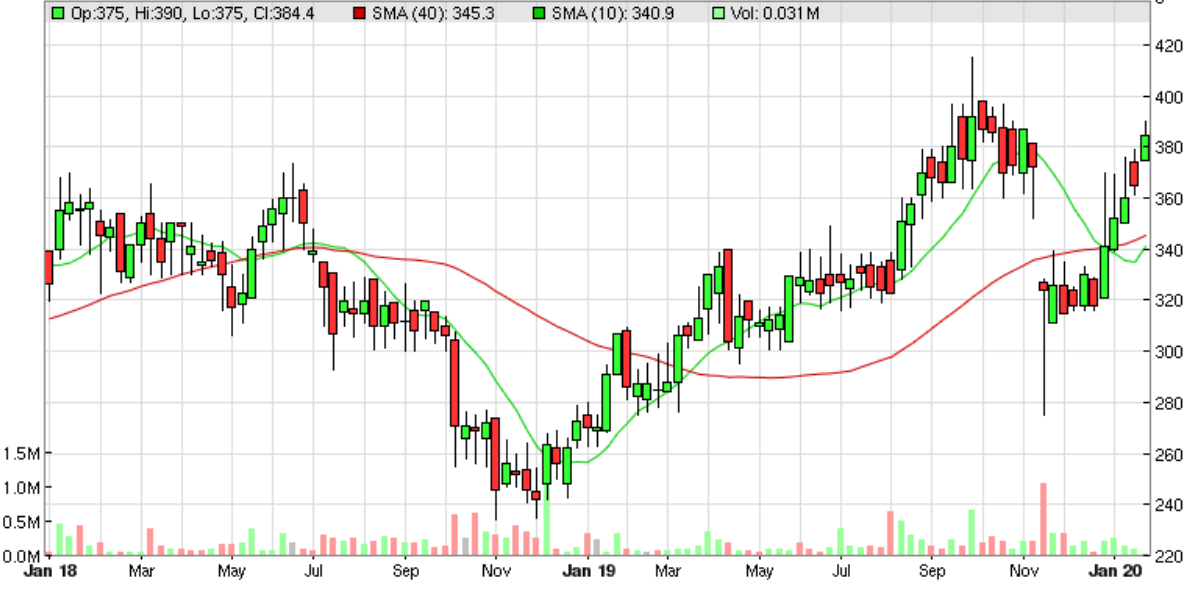
This is an interesting one. The share has now recovered fully from its setback in Nov 2019 (FCA investigation & changes to lending practices). Graham wrote about that here, correctly concluding that only a small part of HAT's business was affected, therefore it wasn't too serious. Good call Graham! Anyone who bought on that spike down to 280p is looking very smart now! Sometimes it can pay to catch a falling knife, just not that often.
Trading for 2019 ended up being good;
Following strong second half-year trading and a positive performance of the recently acquired Money Shop and Speedloan business assets, H&T expects the full-year profit before tax to be at the top end of current market expectations.
The narrative reads well, I won't repeat it here.
FCA - no new information, it's "working closely" to review high cost, short term credit.
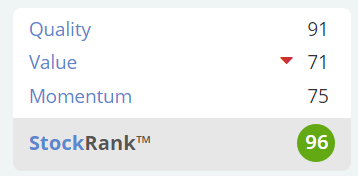
My opinion - the valuation metrics still look great value, even after the recent recovery in share price. StockRank of 96 too - worth a fresh look maybe?
TP (LON:TPG)
Share price: 8.05p (unchanged today, at 12:53)
No. shares: 779.2m
Market cap: £62.7m
2 separate links above to each RNS.
TP Group (AIM: TPG), the providers of mission-critical solutions for a more secure world, announces the following trading update for the year ended 31 December 2019.
What a ridiculous self-description. It's an engineering company, focused on energy & defence sectors.
Trading update - this following bit makes more sense, thankfully!
The Board is pleased to announce another year of substantial growth in both revenue, and adjusted operating profit, with a significant strengthening of the Group's order book.
The Group therefore reports that trading for the year ended 31 December 2019 has delivered revenue and adjusted operating profit in line with market expectations*. This strong performance has been driven by both organic growth and acquired business activities.
*Analyst research is available on the Company website.
Unfortunately, I cannot find the analyst research on TP's website. If any of you have spotted it, please can you post a link in the comments below. I was getting excited when I saw the asterisk, but the moment has now passed.
Cenkos (in which I have a long position) come to the rescue, via Research Tree, with an update note today. Their forecasts are for 0.6p adj EPS in 2019 and 2020, giving a PER of about 13 - which looks about right for this type of business.
Note that the adjusted profit figures that the broker uses are a good bit higher than those used by Stockopedia (which are usually the most conservative). This seems to be because TP is very fond of exceptional costs, which are over £1m for 2017-2020 actuals & forecast. That would need checking out if considering a purchase here.
The group has made a series of acquisitions in recent years, so potential investors would also need to check out those, and to what extent growth is coming by acquisition rather than organic?
Balance sheet - I've had a quick look at the most recent one, dated 30 June 2019, and it looks satisfactory. NTAV is fairly low, but still positive, at £7.7m.
My opinion - this type of sector doesn't really interest me, so I'm neutral on it. To value an engineering company sensibly, investors would need to see all the details of contracts, longevity & margins, etc. Without that information, trying to value the share, and assess its future prospects is really just guesswork.
Amigo Holdings (LON:AMGO) - a quick comment to round off. It's a sub-prime lender. Shares are down 28% today to 49p, due to an announcement that the company is putting itself up for sale. One strategic option being considered is de-listing the shares.
It has not received any approaches so far. It mentions a "challenging operating environment", including from the Financial Ombudsman.
Richmond Group, holding 60.66% is said by Amigo to be a willing seller.
This looks a mess.
That's it from me today. I've been very distracted by the Coronavirus issue, so apologies if individual company reports were not up to scratch, although there wasn't much to report on today.
See you tomorrow morning!
Best wishes, Paul.
Disclaimer
This is not financial advice. Our content is intended to be used and must be used for information and education purposes only. Please read our disclaimer and terms and conditions to understand our obligations.

68 comments
"diversification is protection against ignorance" - Warren Buffett
Buffett is a clever bloke who researched firms in huge depth. He used to call up their suppliers and customers to figure out what you can't see from annual reports. All amounts of scuttlebutt and information edge. He always went for firms he knew a lot about and this gave him the confidence to back the truck up or buy firms outright.
But if we don't know a firm and industry to this level of detail, we are more playing to probabilities and then diversification does work.
Yet he has about 100 different holdings and has some really large mistakes fairly recently, Tesco is one and there are a few other that he had very large holdings in. I’m very surprised he even bought Tesco’s.
"Yet he has about 100 different holdings and has some really large mistakes fairly recently, Tesco is one and there are a few other that he had very large holdings in. I’m very surprised he even bought Tesco’s."
Yes, that's true.
His returns in the last few years have been poor, relative to the SPX. I suspect that is a function of size, his AUM is too large now and he sits on a lot of cash. Recently he said if his fund was smaller he could find great opportunities 'again'.
When I was reading about his early days, his returns were good and he appeared more concentrated, I recall one year he loaded 40% into one stock.
His investment pond is too small and too expensive for him to find hidden value now. So he just has to wait for the next market meltdown to deploy billions.
market sentiment scores over the past few weeks have been stupidly exuberant: irrespective of the narrative, mean reversion is a powerful equalizer. Even the FOMO catch-up crew got filled. Despite an over 50% increase in the VIX today it still remains at just 17 so protection is still cheap.
Healthy pullbacks always create opportunities and we are long overdue one
"Despite an over 50% increase in the VIX today it still remains at just 17 so protection is still cheap"
Cheap or not cheap dscollard, history would definitely not favour buying VIX given it's elevated momentum.
As the chart below shows, spot VIX closed yesterday with a14-day RSI above 75:
When VIX did so in the past, its forward returns leaned HEAVILY bearish:
Meanwhile, forward Equity returns (SPX) leaned bullish on all time frames:
Hope this helps.
Data courtesy of SentimenTrader
Hiya,
Where can I find the sentiment dashboard?
Thanks in anticipation.
Jim
So, Amigo Holdings (LON:AMGO) (no position), IPO'd only recently in June 2018 at a market cap of approx £1.3bn, during which the selling owner (Richmond Group) and the directors cashed out approx £350m between them. Less than 2 years later and the market cap is now less than the amount they cashed out, having eradicated the best part of £1bn of shareholder "value", and now the same IPOers are publically mulling a delisting?
Maybe the sub-prime environment has changed in an unforseen (in 2018) manner and caught them by surprise, but my cynical guess is they saw it coming back then, and got out with as much as they could when they could.
Yes, ive got my cynical hat on too. How this is legal I will never know
Hi,
I too am puzzled by the reaction to Equals (LON:EQLS) is is now down 15%. The trading update reads very positively, maybe it's less than was expected but the whole thing reads very well. I have held for a while and it is quite volatile, maybe there's just very little volume, even so its down a lot on seemingly good news.
Edit: So looks like Cenkos forecast £13m earnings & this is saying £10m earnings, so a broker miss. Still growing at 30% & very positive update but should the company have made it clear they have missed broker forecasts, hence market forecasts, need to do some analysis here as 30%+ is still excellent.
I have no position but am a private client of the company's prepaid cards and thus interested. FY revenues look like 31.3 (all figs £mn) +20% suggesting H2 revenues +18.5%. i.e. a slight (if understandable) slowdown in growth rate despite acquisitions. The update is all about EBITDA but they had a pretty large issue last summer and one suspects eps won't be brilliant nor will returns on capital though these are usually pretty low for financial firms I believe. I would have liked to see some comment at least on operating profit and net profit . There are 179mn shares issued now following 155mn at December 2018. Plus of course the market is lousy today which doesn't help. Crystal Amber will not, I suppose, be popping champagne corks today.
> history shows us that these things tend not to do any lasting damage
History shows us that these cause enormous damage occasionally.
The 1928 Influenza Pandemic / Spanish flu infected 500 million people and killed somewhere between 50 and 100 million people. If it killed a similar proportion of todays population, that would be 200 to 400 million people dead.
Most viruses won't cause anywhere near the same amount of damage but the possibility is always there that one will.
Spanish Flu was in 1918-1920, and killed more people than WWI.
what was unusual about the Spanish Flu was that it caused a cytokine storm in the infected and this was particularly dangerous for young people because they had more responsive immune systems.You could be showing symptons in the morning and be dead by evening.
The CoronaVirus seems so far as we know seems to be acting more like a new flu strain, killing those whose immune systems are compromised, either by chronic diseases or old age.
I have some recollection that the American Army played a key part in its spread by bivouaking soldiers getting ready to Europe for the 1st World War, increasing the infection rate significantly.
Paul writes:
"Another thing to consider is that SARS happened right at the bottom of a bear market, in 2002-3. As I recall, it was just one factor of many that made people bearish at the time. An article I read this weekend said that airline shares fell by about 30% at the time, although I haven't verified that".
I think a greater factor at the time was the Gulf War. The index continued down with fears that Saddam Hussein would unleash all those supposed weapons of mass destruction in the build-up. The invasion of Iraq on March 19th 2003 more or less coincided with the bottom point on the chart. SARS on the other hand, although starting in November 2002, was not reported by the Chinese Government until February 2003 with the WHO declaring an alert on 12th March and then declaring it contained on 9th July.
The BAY share price bottomed below 90p in February 2003. On 19th March it was above 100p and on 9th July it was 180p.
Corona Virus
Sad news for the persons afflicted and their families.
Situation gaining in media attention, latest revelation is the incubation period is up to 14 days and person is contagious during this time. Also social media is showing some fairly dramatic pictures in China.
Bloomberg produced a chart of Corona Virus cases versus previous SARS outbreak by day and the shape is tracking roughly.
What has sold off fairly heavily is the China A50 index, Emerging markets, specifically the SET due to Thailand's reliance on tourism as well as oil because airline travel is seizing up with China banning overseas group tours and with it XLE and XOP. Also resource stocks like RIO which mainly sell to China.
Peak bad news not here yet, but the above are getting cheap. Let's see how the US session goes but there will be a chance to buy some good indexes at lower prices i think.
My UK small caps seem to have held up ok.
But what is not being reported is that although very many people could be affected, it is not believed to be a serious illness for those that are fit and healthy.
Any chance looking at rolala Rotala (LON:ROL) boring bus company transformed by latest aquation?!
Hi davidallen77,
I tend to ignore Rotala (LON:ROL) because there was something funny about the ownership structure, from memory. If that has changed, and it's a normal company now, then I'd be happy to give it the once over. Maybe readers could give me more to go on?
Regards, Paul.
To bring together 2 strands discussed above; Terry Smith and cognitive biases. Smith points to half a dozen owners / investors and says: "The latter all seem to have become extraordinarily rich by concentrating their investment in a single high quality business and not trading regardless of valuation. So much for it not doing any harm to diversify across strategies."
I'm sorry, Terry Simth is a wonderful investor but this part of his letter is complete nonsense. It's a classic example of survivorship bias and availability bias. If you only look at lottery winners, you will conclude that lotteries are fantastic investments.
Terry Smith's approach has worked brilliantly for his Flagship fund, but his developing markets fund has not performed well, although based on similar principles.
He has a smaller companies fund which is being run by two new fund managers, but I am not sure how that one is performing.
Its a cliche, but I am afraid its horse for courses.
smithson is doing well so far (up 3o% since inception I think)
I have a small position in his emerging markets trust Fundsmith Emerging Equities Trust (LON:FEET) which has basically gone nowhere shareprice-wise since I bought it about 2.5 years ago, so your comment motivated me to look into it a little.
Although the shareprice has been trading sideways and latterly downwards over the last couple of years, this reflects a widening discount, and the NAV is close to its ATH at the moment. NAV is up about 30% over 5 years since launch, which given the bull market conditions in that time is not exactly shooting the lights out, but it's certainly been better than cash in the bank (or a Woodford fund!).
I ran a search for all the top 10 holdings on Morningstar (I only have UK & US stocko). All of them appear to be growing steadily. The issue appears to be valuation - typical trailing P/Es range from about 35 to 70. That is quite a steep valuation. Given the growth (both in the companies and the demographics of the countries invested in) I think this will probably do OK over the very long run, but I'll be looking for a bit more of a discount before adding having looked at those valuations.
Spot on. Terry Smith has had some great results, I agree. But the letter is full of self serving bullshit.
I'm not sure being undiversified is rubbish considering that if you are a business owner with a good business, you will certainly make more money than someone who buys a 'diversified' index.
For several reasons indexes are terrible and that was previously discussed here but I'll just say this; Warren Buffet/Bill Gates/Jeff Bezos/Elon Musk/Bloomberg/Phil Knight/Jack Ma etc etc - and their are many many more - didn't diversify their 'portfolio' or buy gold or large cap divi stocks or the other silly things which are banded around as investment gospel for huge returns these days........
Thornabian - Just starting with Warren Buffet - that's exactly what he did do. Lots of diversification - Coca Cola, Kraft Heinz, IBM, Wells Fargo, American Express and numerous other holdings.
Now he has because he has too much AUM to not be but in the beginning he was very undiversified.
He bought companies whole like Geico. If you read his book Snowball he actually says that's where Ben Graham got it wrong and his buy and sell after 50% gain was also wrong.
Mary Buffet also wrote a book on the same thing.
You certainly will if you have the genius to pick the right market niche and perhaps a little bit of luck to avoid any totally unpredictable black swans.
We each have to play to understand our strengths and weaknesses and play to them, so it always annoys me when someone presents their view as the only way.
I don't actually know much about Terry Smith, but I would just note that if this is the 10th Fundsmith annual report, then it was founded in early 2009? Not a bad time to have started investing in the market really!
Possibly though, not such a great period to let your successes convince you that you are a genius, who is always right,.
Whilst there is actually imho a lot of wisdom in the report, there is an equal measure of self congratulatory hubris. Mr Smith uses the quote "To a man with a hammer, everything looks like a nail".
Hmm given that the last 10 years have fortuitously presented mostly nails to his investment style - I wonder it a it of self-reflection might be appropriate?
He made that quote to question his own investment strategy and went on to explain the reasoning for why he won't change it.
It is the same strategy of Charlie Munger over the last 40 years so I wouldn't get too caught up on 2009.....
Try reading the article again.
For several reasons indexes are terrible and that was previously discussed here but I'll just say this; Warren Buffet/Bill Gates/Jeff Bezos/Elon Musk/Bloomberg/Phil Knight/Jack Ma etc etc - and their are many many more - didn't diversify their 'portfolio'
Well, yes. But how many of those people are there? Is that handful of examples the shining evidence of a proper approach to investment or the last gasp of survivorship bias?
I'm not an investment genius or a smooth talking entrepreneur but I know if I can manage 10% to 12% portfolio growth while saving 10% of my earnings over 30 to 40 years I'll have a very comfortable retirement and my children will get a nice windfall when I finally drink my last dram.
Diversification is the closest thing to a free lunch that the markets have to offer, I think it's a real shame that it's given a bad name by a few great investors. Sadly, they're great because they either don't need to diversify or they got lucky. I don't know which, but I know I'm not in the former group and I don't want to trust that I'm in the latter.
timarr
If you diversify and buy 100 stocks, the likelihood is 40% will be either badly run or in a bad industry at that time. However, you may even get some really cheap and at a 10% discount.
Now, if you take one brilliant business which is a market leader and controls logistics with a great brand and owners who are committed but pay 10% more.
In the first case, that 40% may not make anything or lose money but you might get some a little undervalued and the other 60% may make some ok returns. However, this is now averaged out with rubbish which is providing negative or flat returns year on year.
In the second case, the one business generates 20% return on equity year after year.
Which strategy will generate you greater compounded returns in 20 or 50 years?
The mathematical basis for diversification (for those who fancy doing further reading) works like this:
Suppose you have a single stock with mean annual return μ and annual volatility σ which I will write as (μ,σ). The Sharpe Ratio is μ/σ (or (μ-r)/σ if you include a risk free rate r). The Sharpe Ratio is proportional to the probability of a return > 0 in the next year.
Now if you can find N stocks all with distributions (μ,σ) an equal-weighted portfolio of those stocks is (μ,σ/√N) giving a Sharpe Ratio of μ√N/σ provided that the covariance between the stocks is zero. You can see from this simplified case that a law of diminishing benefit applies as the number of stocks in the portfolio increases. The improvement goes with √N so you have to add more stocks than before to get the same amount of benefit each time.
If the covariance is zero then the stocks are completely independent and you have a fully diversified portfolio. In practice this never happens and a more complicated formula is required.
The full formula is the rather daunting (π'μ,√π'Σπ) with Sharpe Ratio π'μ/√π'Σπ where π is the vector of proportions of each stock in the portfolio, μ is the vector of annual returns and Σ is the covariance matrix for the stocks.
You can program a computer to maximise this expression across all stocks in a given market (with the constraint π'1 = 1) to find the highest Sharpe Ratio portfolio - which will maximise return and diversification (hence maximise probability that returns will be greater than zero). This is called mean-variance optimization (MVO) and it takes a computer a few seconds to search through 2000 stocks and find the solution.
However, to be honest, there are so many uncertainties that you will get similar results by choosing the one or two stocks with the highest Sharpe Ratio from each sector (thus forcing low covariance fairly crudely) which even a lowly human can do in a few seconds using a Stocko screen. But the trade-off rule-of-thumb still applies. The benefit to adding more stocks rises with √N and also the the difficulty of finding additional uncorrelated stocks as the portfolio grows.
That just gives you the best return of the average, there are many ways to make an average.
That doesn't mean it will outperform.
It goes back to my prior point but this is the common investment ideology now as can be seen from the number of likes for people just following the crowd logic of buying everything in sight. Or in other words, throw mud at the wall and hope something sticks.
I'm always conscious of the risk of living in an echo chamber, but I do not think that is the case here and I think you are wrong to identify the balance of "likes" as crowd behaviour.
I think rather you are in danger of creating an army of straw men.
Diversification absolutely does not mean "buying everything in sight".
Early on you made this comparison :
You need a time machine to be sure that your "brilliant business" continues to be brilliant in perpetuity. On the other side,you again appear to be assuming the 100 stocks (that's even to diverse for me) is the product of monkey's throwing darts at a copy of the FT.Picking business with positive investment profiles is not mutually exclusive to diversification.
There have been several times in my investment journey when I have been thoroughly convinced that I have found brilliant investment opportunities. I have not always been right!
In the early days there was an element of arrogantly dismissing the negative possibilities (because I followed the well worn path of starting my serious investing career with a couple of big wins and then developing a god complex).
I am more discerning now (I think & hope) but I still call some wrong, perhaps because of things I could not have predicted.
I am right sufficiently often to make a return and if I had concentrated my investments over the last couple of years into my very best returns - then I would be in San Tropez right now, but there is an equal chance that I would have concentrated into my very worst performers in which case I might be sleeping in a shop doorway.
Extremely concentrated investment is absolutely the way to go if you are a genius grade investor and also lucky.
I don't think I qualify on either front, so I'll stick with selective diversification.
I'm not saying only buy one company but also why diversify just for the sake of it?
I agree with all the stuff written about risk perception, and small numbers so far affected by coronavirus itself.
However, the number of people affected by travel restrictions is huge and growing rapidly. The Chinese appear to have been in denial until the horse has already bolted. The impact on world trade might be significant, even if the worldwide number of deaths isn't. Hospitals already overrun and most hospitals worldwide have limited spare capacity, so potential knock-on effects are also high.
My underlying point is that up to a certain, unknown level the economic impact of the virus will be too small to measure. But beyond that point the size of the impact is likely to rise exponentially.
Since I see the market as high not low the risks are all in one direction.
News about coronavirus is likely to get worse before it gets better. Although common flu is a routine and unremarked upon killer, it doesn't lead to the shut-down of cities the size of London, emergency evacuations, cancellation of flights and construction of field hospitals for thousands of victims. This is because most healthy people have some form of immunity against the more serious consequences of contracting flu. That isn't the case for such a new virus. Consequently, the economic consequences and the perception of the prospects for the share price of many companies as a result of government reaction (or over-reaction) to the threat may be out of all proportion to the numbers of fatalities. Or not.
There seemed to be a good deal of underlying confidence in the prospects for the share prices of UK small companies in 2020 (less so for the underlying earnings performance). Some perceived 'quality' companies' forward multiples have been pushed ever higher. Coronavirus may be a trigger for a re-evaluation of the prospects for the share prices of some of these. Some, such as Fevertree Drinks (LON:FEVR) , were already responding to a re-evaluation of their growth prospects.
We can be sure that, in the background, some of the best minds in pharmaceutical companies are already working on a vaccine and that our public health services are developing a plan on how to contain the virus's spread. So, while the news of its spread may get more alarming, the flow of news of the eventual solution will also increase. The question is whether news of the former drowns out news of the latter.
As Nassim Taleb has continually stated, the markets generally under-price the risk of a 'black swan' event. I don't have a view on whether this could be such an event. But I am surprised at the scale of the measures being taken and talked about by governments around the world.
It would not surprise me to see other people locking in profits that have accrued since 13th December as I have just done. I imagine that we will have a better idea of the likely scale of the impact from this scare within the next couple of weeks. For the moment, I think the risk / reward has increased and am happy to forego some further return until prospects are clearer. It will be interesting to see how a much more over-valued market in the US reacts.
"As Nassim Taleb has continually stated, the markets generally under-price the risk of a 'black swan' event. I don't have a view on whether this could be such an event."
I do have a view: the coronavirus is not a black swan. To borrow Donald Rumsfeld's terminology, which Taleb endorses, this is a "known unknown" rather than an "unknown unknown" and so is not a black swan. Various models exist to predict the spread and impact of just such an outbreak, which will be updated by feeding in the variables of how contagious etc it appears based on the initial data.
That is not to down play the seriousness of it, which you are right to highlight. It MIGHT be a global pandemic. That is horrendous and I hope the only impact anyone reading this personally suffers is on their investments. But the risks will be understood as the situation develops, so it is not a black swan.
A contact says the streets of Shanghai are empty as people are largely staying indoors to avoid catching any potential virus.
Bus transportation to other Cities has been cancelled to limit infection spread, but the Underground system is still working, I think.
The effect on service industries will be huge, as Chinese New Year is a big celebration, though Chinese are food lovers, and will quickly repopulate restaurants if the Red Alert subsides.
A nurse on social media has said 90,000 rather than the official Govt figure have been infected in Wuhan. That would probably mean 2,000 deaths are likely from the infection in the Province (around 2% is the death rate). That depends whether she is right, or its social media hype.
Certainly common sense precautions will hopefully limit its spread, but pity the poor Doctors and nurses. When I go to Chinese Public hospitals the doctors look the most tired, as they are not well paid (the Govt restrict their wages) and work long hours with unceasing demand. So God Knows how they are coping with this event.
Remember that the news footage we see is regulated by the Chinese government. There has been footage put on social media by Chinese doctors showing a distressing situation and demanding action. Extreme overcrowding, lack of safety equipment, patients being turned away are what they describe. These posts are of course, swiftly taken down. I don't think there's any way to predict how rapidly this is going to spread. However very drastic steps are now being taken by the Chinese authorities which is part of what is required.
I have concerns that the market is waiting for a catalyst to signal the end of the bull market. News out of China does not look good. Am sure it is nothing, but I have been taking a lot of risk off the table (and put on a S&P500 short at market open last night). Am also concerned by some of my small cap holdings ...
Hi Paul..Thanks for bringing Red Flag report to our attention..What you write about Fundsmith Letter To Investors is interesting(Note I have a holding here)...I know many people have a view on Terry Smith and i was reading yesterday incidentally, Stockopedia stuff from 2015, when subscribers were asking if he and Fundsmith could continue to deliver returns of 18% per year ..we all know the answer if you read the letters now!!!!! but what is really more interesting is that everyone should read all the letters he has written, since 2010.
Smith is somewhat unique and his no nonsense style of writing will educate anyone with an interest in markets, though of course, many will not agree with his philosophy of get rich slow.
His narrow list of holdings is not for everyone and I know of many friends who bailed out towards the end of August last year as the prices of Fundsmith began to fall...they are now buying back in now albeit at higher prices.
If the world is going to take a breather in stock markets, I know where i want my money to be invested..I love Terry Smith
Re: Fundsmith and horse racing.
Thanks for your post Tonysaparito. I have also been a fan of Terry Smith since shortly after I realised that his approach to investing was so successful and (equally importantly) I could understand why it was successful. I believe that Nick Train and Keith Ashworth-Lord are from a fundamentally similar mould, but perhaps with somewhat more subjective strategies. I am attempting to apply some of the principles expounded by Terry Smith to sports betting (as well as smaller company investing) and have had good success in football betting over the past couple of seasons, although with only a couple of hundred bets. Horse racing is more difficult as there is more insider information. Do your horse racing betting activities align with your investing principles and, if so, have you found this to be a successful approach?
Hello Peterthegreat....I agree with you on Terry Smith but he is not for everyone..interestingly, I followed Fundsmith Equity for several years before actually putting money with him...I was too focused on other areas of investment at the time..which in hindsight was an error on my part.
Terry Smith has a very focused approach as you know , in that he is only invested in about 25 or so fabulous companies and whilst I am in no way comparing myself to Terry Smith , I have made my biggest profits in racing by betting on no more than 20 to 25 gold standard horse racing bets in any one year ...I do have bronze and silver bets and they are more numerous but my stakes on the bronze/silver bets are significantly reduced .
Fundamentally, I take no interest in “ inside information” as it’s the road to ruin...Newmarket is the HQ of racing in the UK and there are more betting shops in Newmarket than any other town...and so many of the punters with inside information are riding bicycles..and will continue to do so.
Inside information is from those most closely involved in the sport but the ‘noise of Newmarket” will lead you astray.
I spend thousands of hours per year, daily sifting through every horse in every race every day....I am looking for horses that meet my criteria , which is based on just 4 factors...Form, Class, Weight and Time..,,only a minute percentage on the horses I look at meet the stringent criteria I set for gold standard bets....When a horse meets the criteria I bet on it.
I know several full time professional punters and they have over 30 years experience like me and they rarely have more than 30 gold standard bets per year.
Terry Smith became attractive to me in that he is happy with what he does, even if many others disagree with him .The fiercely independent Terry Smith has proven over many years of investing , even before he established Fundsmith , “ he knows the time of day’ and his principles of success have made him fabulously prosperous ...and those currently invested in Fundsmith Equity .
Personally, I do not care what anyone else thinks about Terry Smith as his motto of “ Get Rich Slowly” is the motto me and my friends have used for 30 years in our approach to betting.
Most racing punters cannot sit on their hands to wait for 20 plus gold standard bets per year ..but those that do have been loyal clients of mine for 30 years and have made a level of racing success most regular punters only dream of.
I have invested my racing profits outside of racing and have a very nice residual income..
Terry Smith with Fundsmith Equity have averaged annual returns at circa 18%....however, if they halved I would still be happy with Terry Smith
Re Coronavirus
There are a number of common biases in risk perception - a lot of good experiments have been conducted and you can see certain biases that come up again & again :
1. we tend to exaggerate spectacular and RARE risks and downplay common risks. e.g. flying versus driving.
2. The UNKNOWN is perceived to be riskier than the FAMILIAR. One example would be people fear kidnapping by strangers when the data supports kidnapping by relatives as much more common.
3. Thirdly, people underestimate risks in situations they do CONTROL and overestimate them in situations they DON'T CONTROL. So once you take up skydiving or smoking you downplay the risks. If a risk is thrust upon you, terrorism is a good example, you'll overplay it because you don't feel like it's in your control.
4. Finally, the concept of BASE RATE NEGLECT - when presented with specific information (information pertaining only to a certain case) & with related base rate information (i.e. general overall statistics), the mind tends to ignore the latter and focus instead on the former.
A never-before-seen virus detected in the Chinese city of Wuhan has claimed 81 lives since it was first reported to the World Health Organization on Dec. 31, 2019.
By contrast, influenza claims 4,700 lives every month on average (an annual average of 56,000 lives). In part, the media can be blamed for the panic - the media by definition report on stuff that rarely happens.
brilliant comment Howard Marx.
My thoughts exactly, Howard Marx. But expressed far more articulately than I could have done.
Yes, but influenza has not resulted in the Chinese government shutting down businesses for an extra week, thereby reducing GDP output.
Many retail businesses in China will go into administration, as the Chinese New Period is akin to the run-up to Christmas in the Western world. Imagine if this happened in the two weeks up until Christmas - half the high street retailers would be in financial difficulty come Jan.
This could snowball effect further into the Chinese economy, and then the global economy. It could be the event that precipitates the next recession / financial shock. Obviously this is the ultra-bearish case.
Hi Howard Marx,
Those are all great points. However, I don't think we should ignore the potentially serious economic damage that this coronavirus could do. A BBC report yesterday was what really spooked me, saying that China could be reporting 200k people infected within days. That could shut down a lot of the country's economic activity. It seems to be rapidly transmitting from human to human, which could cripple airlines & tourism, if/when it spreads to other countries (which hopefully might be able to contain it better maybe?)
I don't like the look of this one bit, it feels a lot worse than my recollection of SARS, bird flu, and ebola. Normally I don't react at all to things like this, but in this case it literally gave me sleepless nights over the weekend.
I'm not disagreeing with your excellent post by the way, but I think it would be potentially dangerous to be complacent about this, from an investment point of view. After all, markets are expensive, so I can see why some investors/traders might want to take money off the table, to wait & see what happens.
Regards, Paul.
"A BBC report yesterday was what really spooked me, saying that China could be reporting 200K people infected within days. That could shut down a lot of the country's economic activity."
Three points, Paul
1. In their effort to grab your attention, the media will often seek out the most extreme information often from unqualified sources. I tend to place minimal weight on headlines involving probability words likecould . After all, an infinite number of things could happen, most of then don't, though.
2. We should try to avoid 'denominator blindness'. 200,000 is a lot of people, but for China with a population of 1.44 billion, this is 0.014% of the population. But the media will never release the headline '99.986% of the population unlikely to be affected by Coronavirus in the next week' .
3. A report on the deaths so far in the New York Times last week suggested 'Coronavirus deaths are so far mostly older men, with previous health issues'. So a similar age cohort to those who fall vulnerable to influenza, which as has already been mentioned, on average claims the lives of 4,700 every month.
The key factor to watch for here is not the infection rate or mortality rate but the impact on company profitability arising from the reaction by governments and consumers. Of most importance is the reaction by the Chinese government and the consequent reaction of Chinese consumers. It is reassuring that this is occurring in a country that has the financial resources (and undemocratic government) to be able to make decisions like quarantining a city of 10 million people. But the panic among Chinese consumers and resulting economic impact is where the investment risk lies and far less (hopefully) in the numbers of people infected.
Very good points. I read something similar supporting your point 3. There has been very little reporting of the fact that it is believed to a very low risk of serious illness to healthy people.
The biggest problem is this is an airborne disease (unlike Ebola) that is killing, mostly the elderly and less well. But it’s the wide spreading potential and lack of antibodies in the world population that is going to make this more impactful than Ebola for example. An infected person might have picked it up despite never seeing a sick looking person. It really could become a big problem in the well traveled and highly populated parts of the world. Who knows? Tyvec, Avon rubber possibly and medical suppliers will do well off the back of it if we’re being brutal.
Has anyone watched the footage of all the diggers building the new hospital?
It looked like a sham to me. . I mean there were so many diggers, they were getting in each others way!
I reckon this is China trying to spook the US in a 'look at how important we are' kinda way.
'This is what we can do to the markets!' (With a bit of centrally controlled spin).
The mayor of Wuhan reports that 5m people have left the city both for the new year and in advance of the lockdown. An infected person on average infects 2.5 other people. What will the authorities do when the virus takes hold in Shanghai and Beijing?
Equals (LON:EQLS) Full year trading update today. Down 11% today at the moment. The announcement sounds very confident about the future and bigs up the figures of yoy revenue increase of 23% and adjusted EBITDA increase of 30%.
It gives no details of what forecasts for the year were but I see from other bulletin boards that this may have been a miss on Cenkos forecasts (which I don't have).
Does anyone follow this stock and have a better understanding of the company. I see Graham reviewed interim results in September and thought it a tricky one as whilst the company was working to grow hard the competitive advantage wasn;t clear. (then 90p, now 69p) Probably not the time to be holding an fx business.
I do hold this one, partly because I like they way they have invested in function and integration to provide a sound growth platform. The forecast EPS growth for 2019 is fairly spectacular but will be less as they have clearly missed the revenue figure by a modest amount. It's very silly not to state it as it is one of the first numbers people will look for, and on not seeing it they become immediately frustrated. Similarly the effect of additional overheads on the pretax result (& thus EPS) should be stated and not leave the investor to assume the worst. Given the underlying growth and margin in the business these could be easily explained and justified. The update read like the management was 'Frit'. Nevertheless I will wait for the dust to settle and then consider adding to my holding.
Hi Paul, et al
Bit off-topic, I note the other week you offered some sound advice to the readership regarding large payment bank transfers.
I equally received some advice today in a similar vein.
It has been brought to our attention that when dating an important document using an abbreviated date such as 27/01/20 is vulnerable to forgery, whereby the year can be changed to any variant from the last two decades.
Please remember to always use the full date when signing contracts and important documents.
All the best.
CID
Morning cidunn,
What a brilliant point about dates being liable to forgery if abbreviated.
Many thanks for posting, I will always use the full date from now on.
Incidentally, I always write out the Month, as otherwise the date can be ambiguous to Americans. E.g. 5/10/2020 could be 5th Oct 2020 to Brits, but Americans would read that as 10th May 2020. Hence I would write 5 Oct 2020 instead, to make it 100% clear.
Regards, Paul.
Surprised to see Begbies Traynor (LON:BEG) down almost 10% on the news its business is likely to increase dramatically.
Gresham House (LON:GHE) trading update released today, with this video giving an overview of 2019, by CEO, Tony Dalwood.
https://www.piworld.co.uk/2020/01/27/gresham-house-ghe-review-of-2019/
Hi, can someone explain to me why Begbies Traynor (LON:BEG) has gone down so much? With the report saying how many businesses are struggling i would have thought that was beneficial to them.
FTSE is down 2% today as I write. The market is taking the opportunity to use the bad news from China to mark prices down and test supply at lower levels - force out weak holders. Aim is to accumulate and sell when price rises again - ie when market calms down. Seems to be demand at the lower price levels, so the tactic doesn't look like it's fully worked so far.
Re: Begbies Traynor (LON:BEG) it's pure speculation on my part but I wonder if the reason is that algorithms can sometimes be stupid. There are clearly automated trades based on scanning RNS. When these bots read the BEG RNS today and saw lots of phrases like "significant distress" maybe that kicked off some automated trades. Other bots then responded to those sales with more sales (on the principle of act first, ask later). New bots go live all the time. Perhaps this is the first time some have seen a red flag report? Algorithms have a learning process too.
The title of the RNS was ambiguous and I suspect that many thought it referred to the company itself!
"Begbies Traynor Group PLC Latest Red Flag Alert Report for Q4 2019"
sounds like the latest in a list of profit warnings!
The obvious explanation: coronavirus. The news last week seemed hopeful, but now seems much worse and its spread might go on much longer.
Yep my two biggest fallers this morning are Carnival (LON:CCL) and Easyjet (LON:EZJ) so seems pretty good explanation to me. I am not totally unhappy with that as i could be tempted to pick up some more Carnival (LON:CCL) - pe of 10 and dividend yield of 4.5% . Deffo wait and see policy here though it could get very messy short term particularly if coronavirus made its way onto a cruise ship. I kinda remember (but may be wrong ) Easyjet shareprice took a long term to recover after the Iceland Volcano thing. Perhaps the sensible bods were the ones who sold out of these stocks friday? and will be able to pick em back up cheaper.
Begbies Traynor Group PLC Latest Red Flag Alert Report for Q4 2019.
Makes an interesting read.
Morning.
FTSE seems set to open down 130 points and looks to be a very poor day. The obvious explanation: coronavirus. The news last week seemed hopeful, but now seems much worse and its spread might go on much longer.
I was not trading around the time of the SARS outbreak, but can anyone recall how much the market dipped and how quickly it bounced back?
My morning smallcap tweet:
Nektan (LON:NKTN) Safestyle UK (LON:SFE) accesso Technology (LON:ACSO) H & T (LON:HAT) Shield Therapeutics (LON:STX) AFC Energy (LON:AFC), Gresham House (LON:GHE), TP (LON:TPG)
Nektan (NKTN) delayed accounts published and trading resumes following restructuring. Also H1 trading: B2B rev up 153%.
Safestyle UK (SFE) guides FY rev £126m up 8%. F/C is £129.5m. Order book up 24% due to sales push but extra cost of this hikes adj pretax loss to up to £1.5m. Co will spend ~£3m in 2020 on ads and improving training and systems.
Accesso Technology (ACSO) gives returning CEO 582k nil cost options LTIP with a 2 year KPI period. When did 2 years become long term?
H&T Group (HAT) guides FY pretax at the top end of market expectations.
Shield Therapeutics (STX) see FY rev £2.9m =£2.3m from milestones received from Norgine and EWO and £0.6m sales-related revenues from Norgine. F/C rev is £3.4m.
AFC Energy (AFC) invests £100k (in shares) in blue sky methane-to-hydrogen startup. Trumpets possible greener hydrogen production. If the plasma-based process looked like a winner why does it need a tinpot like AFC to fund it? Suspect will generate more headlines than hydrogen.
In line: Gresham House (LON:GHE) TP (LON:TPG)