Small Cap Value Report (Mon 30 Dec 2019) - DISH

Good morning, it's Paul here.
Given that markets are quiet, I'll be approaching things in a leisurely fashion today, so estimated time of completion is 17:00. Sorry, that didn't work out as planned. Let's try again.
I see that the retired head of Next, Sir David Jones, has died. It's not for me to cast judgement on his career, other than to say that his autobiography is a fascinating read, very highly recommended. It details not only the turnaround of Next, when it had came close to going bust. More memorably, the book explains his battle to continue his business career, whilst suffering from Parkinson's Disease, it's quite astonishing the adversity that he overcame.
BigDish (LON:DISH)
Share price: 1.23p
No. shares: 349.0m
Market cap: £4.3m
(at the time of writing, I hold a long position in this share)
We can't go into a new decade with a backlog of things for me to write about, so I'll get this section finished (am writing this on new year's eve, evening).
BigDish Plc (LON: DISH), a food technology company that operates a yield management platform for restaurants, is pleased to announce its half-yearly report for the period ended 30 September 2019.
Background - I came across this company in early 2019. It floated, with a full listing (i.e. not AIM listing) in Aug 2018, at 5p per share, then steadily drifted down. The concept is that it's a dining app, which enables restaurants to offer highly targeted discounts, at times of day when they would normally be empty or almost empty. Restaurants have to offer 50% and 25% off discounts on all food, but require customers to pay full price for drinks. Unlike almost other dining discount schemes, BigDish is free for customers, and enables restaurants to precisely control, in real time, what offers, and how many covers can claim the offers. When they're gone, they're gone.
I thought to myself, this sounds an interesting concept, I'll read the admission document on lazy Sunday afternoon. The app was operating in Bournemouth, and coincidentally I had moved to Bournemouth in 2017, so decided to download the all, and try it out.
I found the app absolutely brilliant. There were about 50 decent quality restaurants set up on the site, and using the app achieved superb discounts, on good food. I liked it so much, that I ended up dining out 2 or 3 times a week, at low cost. Everywhere I visited, I chatted to the staff about the app, and most of them really liked it.
Even though the published financial figures were rubbish, I decided to take a stake in the company at an average price of about 2p.
Much to my surprise, the share price then roughly doubled, and then slipped back down. Then a much bigger surge happened in May 2019, as you can see below - by June 2019 I was feeling pretty happy about life, with a nice £6-figure profit on my holding.
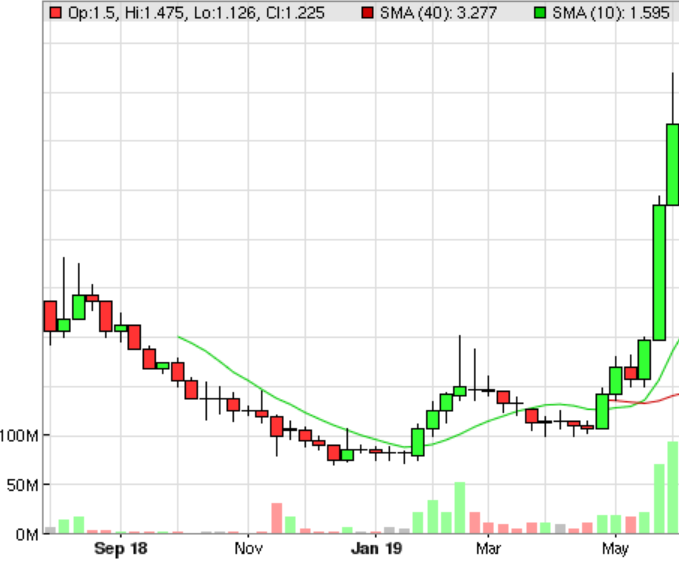
The low point in Jan 2019 is about 1.5p, the high point in May 2019 is about 9.5p.
I remember thinking at the time, that the price was getting a bit toppy for a blue sky stock, but somehow convinced myself that it could continue rising to about 12-15p, at which point I would be happy to sell some or all. What a mistake that was. In fact, I would say that my failing to sell into the huge price spike in DISH was my biggest investing mistake of 2019.
I'd had concerns about how rampy the newsflow from the company was, with OTT gushing trading updates, saying how exciting the future was. Plus it kept putting out rampy short videos & commissioned research. All of which made me nervous.
I met the Chairman, who comes across well, but again a bit over-excitable. At one meeting I recall him saying something like, "Forget things like revenue, and profit. This is all about the opportunity for data...". Later in the meeting he asked me what I thought private investors would want to hear, and I replied, "Pretty much the opposite of everything you just said!" Or maybe I just thought that, and replied with something more diplomatic, I can't recall exactly.
On 6 June 2019 the company announced a placing raising £2.1m, at an excellent price of 7.2p. I thought that should put a floor under the share price at around that level. It didn't.
Results for FY 03/2019 were published, via a link to the company's own website. That's a strange way of doing it, I thought. Reading the results, I could see why the company didn't want to make it easy to read them. The revenue was minimal, not a huge surprise, as the company was only just launching a nationwide roll-out.
Of major concern, was that the cash position at 03/2019 was not comfortable, as the company had told investors. In fact, they had been almost out of cash at the balance sheet date. Sure, the placing since had fixed that, but it left a bad taste, and I think a lot of people must have decided to bail out, as this is what happened to the share price next. All the way back down, and to new lows, recently touching 1.0p
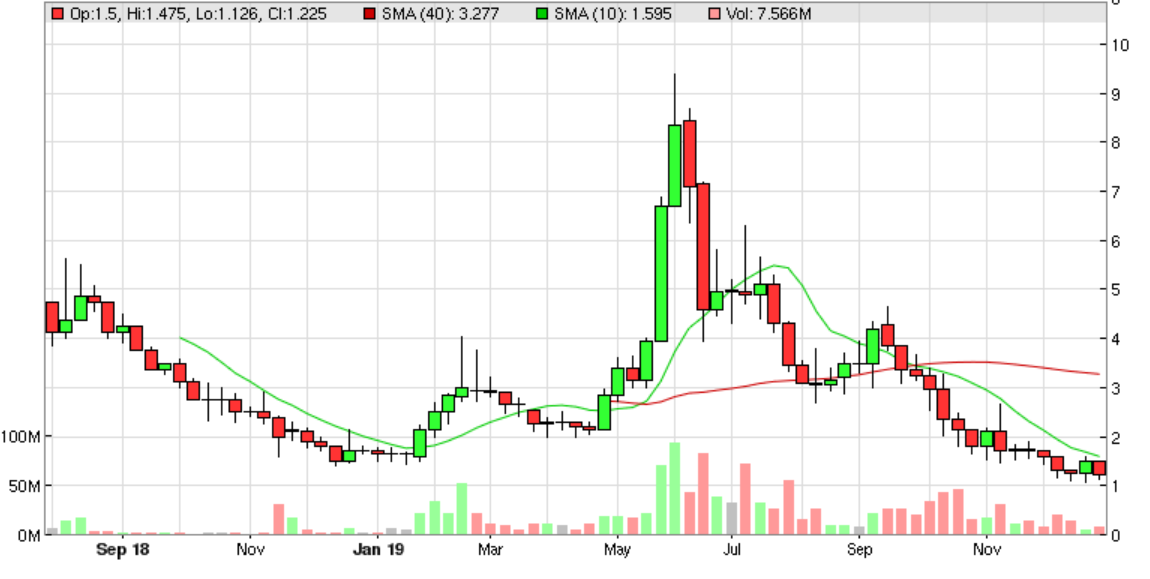
I can understand why most investors probably wouldn't want to touch this share. Although personally, I feel that it overshot on the upside in May 2019, and may have now overshot on the downside. Hence recently I've been buying more.
The main reason for optimism, is that the business model has recently been improved. It began a nationwide roll-out, by recruiting 10 territory managers. Only 2 of them delivered decent levels of restaurant recruitment (Brighton is one which has grown rapidly). Swift action has been taken to restructure, with the 8 unsuccessful territory managers having been let go recently.
Instead the company has shifted to a telesales model. This has recently begun, and should start to kick in nicely in Jan 2020 - prime time for restaurants to be seeking methods of getting bums on seats in the quiet post-Xmas period.
This is the most important recent RNS regarding the new CEO, with highly relevant telesales experience. Telesales is a much cheaper, and more effective way of recruiting restaurants. I think it's likely that this should achieve much better results than "boots on the ground". Hence we could be in for a series of positive updates in the spring of 2020, showing much faster restaurant recruitment. I think that could be the driver for at least a partial recovery in share price. Hence why I've been buying more shares at recent lows.
Another interesting angle on this, is that growth company investors are valuing this type of company at much higher valuations that the stock market. Look at how a US family office were happy to fund it at 7.2p.
Interim results - are absolutely terrible. Revenue was only £11k! Pathetic really.
Cash was £1.3m, and cash burn means that it's likely to run out of cash in Q3 2020, as stated in the interim results statement.
Therefore, buying/holding this share at the moment, is a gamble that it can refinance again later in 2020. So I see this share as binary - it's either going to run out of cash & go bust, or it'll refinance later this year on the back of decent growth in restaurant numbers (my money is on the latter).
My opinion - I see this as potentially a multi-bagger. Although it could also be a complete wipe out, if it is not able to refinance later in 2020.
I keep coming back to how good the app is - it works very well, and saves customers lots of money, whilst delivering what restaurants want - customers at tables, instead of an empty restaurant. I've watched how restaurants put the BigDish customers in the window seats, so that people passing by, notice that there are already people in there, eating. I've watched how passers by do a double take, then walk back and look at the menu. The best way of attracting other full price customers, is to have people already in the restaurant, making it look busy at the start of the evening.
Therefore this stock is my favourite highly speculative share for 2020. Definitely not for widows or orphans though.
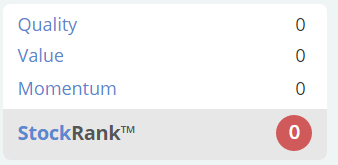
Stockopedia has no time for shares like this, and it scores a big fat zero on the StockRanks!
I like it when StockRanks warn us like this - highly speculative shares like DISH are usually disastrous investments. However, the odd one delivers great results.
There was no other interesting news out on 30 Dec 2019.
Sorry this report was late, but I got there in the end. It's just like that occasionally.
Best wishes, Paul.
Disclaimer
This is not financial advice. Our content is intended to be used and must be used for information and education purposes only. Please read our disclaimer and terms and conditions to understand our obligations.

30 comments
With all respect, you don’t seem to have learnt from previous errors. There’s a popular saying ‘*its like trying to catch a falling knife’ ,well this ones more like ‘trying to catch an exploding HAND GRENADE,
Sorry i\t’s my first ever post!
If the article appeared I could comment on it but where is it ?
Does anyone know including Paul himself under this new format how I can find Beam me Up Scotty as I can't see it anymore. My tip for the year is Asimilar which I am very long of time will tell
https://www.stockopedia.com/fantasy-funds/beam-me-up-scotty-4990/
I think he's in the pub!!
Nothing to do with today's SCVR, but could we please have an easy to spot link from the home page to the share picking competition? TIA.
Hussman Funds' end of rear update is a useful reality check:
January 2020
Blue Chip Performance: 1973-1974
Du Pont -58.4%
Eastman Kodak -62.1%
Exxon -46.9%
Ford Motor -64.8%
General Electric -60.5%
General Motors -71.2%
Goodyear -63.0%
IBM -58.8%
McDonalds -72.4%
Mobil -59.8%
Motorola -54.3%
PepsiCo -67.0%
Philip Morris -50.3%
Polaroid -90.2%
Sears -66.2%
Sony -80.9%
Westinghouse -83.1%
We forget. The same collapse happened in 2000 - 2002 and in 2007/8 ...
End of rear? (but I do know what you mean).
Could I wish all of you , especially Paul and Graham the best seasons greetings and a Happy, Prosperous New Year..
Paul - another general request as it is a quiet day - would you like to tell us what weighting, if any, you put on brokers' target prices.
What prompts this is the rather miserly premium placed on Nasstar (LON:NASA) as mentioned above. finnCap advised the directors that 12.88p was fair and reasonable even if their TP was 15p.
The other prompt is that in my end of year musing I have done a simple screen for % price change 1 year greater than or equal to 100. It produces 78 companies including my 'one that got away' - SDI (LON:SDI) Several times this year I almost bought but didn't because it looked fully valued and this view was helped by finnCap's TP being around the actual price. The TP has been moved up but even today it is 75p with actual 78p (I could - and in retrospect should - have bought at 35p at the beginning of the year).
Paul - another general request as it is a quiet day - would you like to tell us what weighting, if any, you put on brokers' target prices.
I can't speak for Paul but broker target prices are worse than useless. Don't take my word for it though, studies by people far cleverer than me have shown them to be so inaccurate that they are totally worthless. The reason I say they are worse than useless is that any kind of target price engenders anchoring which is very possibly the most dangerous behavioural bias for an investor. I wish Stockopedia would remove it from the StockReport.
All the best, Si
upgrades/downgrades are worth looking at in my opinion just to gauge sentiment.
There is some speculation that brokers downgrade or upgrade shares to move the price in the direction they want, I have bought shares which fell around 8%, just because of a broker downgrade then shot up the next day. I think most of them are pretty useless apart from giving opportunities to buy and sell.
upgrades/downgrades are worth looking at in my opinion just to gauge sentiment.
I think you'll find that in reality any broker forecast is no better than tossing a coin. Again, studies have been performed that prove this to be the case. There's a good section in the James Montier "Little Book..." on this very topic.
All the best, Si
“I wish Stockopedia would remove it from the StockReport.”
Could not agree more.
I've personally seen how broker targets are gauged at probably the market leader and the usual approach is if a share is put on a focus list then the price target will be based on a really detailed analysis including discounted cashflows and economic value adjustments across all FS.
If a company isn't on the focus list, this isn't done and it is generally a bit of a finger in the air exercise. I will caveat this by saying some brokers have specialisation so it isn't a criticism of them but rather a reality that they cannot cover everything.
I have no expectation of BigDish whatsoever Mr Contrarian and Andrea. That is what makes a market!!
Ah - thanks both. That answerrs that question (silly me for not noticing).
I wonder what happens to them when Google decides this is an easy space for them to fill (discount notifications sent to your phone as you're walking past the restauant or park your car/get off the bus in the locality)?
As you can probably tell, I'm not a holder.
Paul,
If you are struggling for inspiration on a slow news day, I will donate £50 to a charity of your choice, if you wish to do a write up on something you probably understand very well. Your portfolio, or parts of it.
You state you are not having a very good year, so I would be particularly interested in your worse performers and why you are still hanging onto them. This will obviously lead to an army of people on here going bottom fishing (urgghhh) and the price then goes up, so win - win for both of us :-)
Hope you had a good christmas and a Happy New Year.
ps. If you are ever in the Gloucester/Cheltenham area, and fancy more money for your charity, plus curry and beer let me know.
BigDish (LON:DISH) - I admit that I'm not brilliant at reading company accounts especially the nuances of Balance Sheets so I could have got this all wrong.
I appreciate that this is a "new" company but some of these figures look scary to me. It's so small and the income is minute so obviously they are in the early stages of building a business but:
Their income went up almost 500% which is great but it's still only £11,766!!
They made a LOSS of just over £1 million
They had staff costs of £252,000 (excluding director's fees)
They had £1.2 million in the bank
The income is so small that even if they increase it by another 500% they are on course for another thumping loss for the current half year and, as far as I can see, there is a real probability of them running out of money in the next 12 months.
But what I don't understand is that the auditor confirms that the accounts have been prepared on a going concern basis appropriate for the 12 months period from the date of approval of the financial statements. But the financial statements were approved on July 31 which is 2 months before the period end. How is that possible? How can directors approve statements before the figures are available?
Is it possible that, had the financial statements not been approved until a more normal period following the period end then the auditor might not have been able to give such an assurance?
Hopefully the more financially literate can enlighten me. Always happy to learn
Laughton
you are looking at the half yearly accounts. These are not audited; but they include a note referencing back to the audit opinion given in the previous annual accounts.
Hi Laughton, the financial statements covered the year ended 31 March 2019 and were approved on 31 July 2019. Going concern assumption is based on information provided by management on the company’s forecasts for the year ending 31 March 2020. The interim accounts aren’t formally audited. Therefore, what the directors are saying is that there going concern assumption is still appropriate.
The auditors would still look at the plans of the company for the forthcoming year in order to determine whether going concern basis is appropriate regardless of when the accounts are approved. However, the later there are signed should provide greater clarity on going concern.
Laughton, you comment "..so obviously they are in the early stages of building a business..", but it could also be a fraud, or if not, a deception! Look back at what the company issued as news in the past and compare with what has happened subsequently. Did the directors lie in a statement? Make your own mind up, but for me they are uninvestable.
Remember two things about about auditors: 1) They are appointed and potentially dismissed by the directors, not the shareholders. Their duty is to directors - a clear systemic conflict of interest. If there is a horrendous stench associated with a company they will probably give some adverse comment to save skin if things really go pear shaped, but just a bit of a pong - nah, risk/reward is in favour of them overlooking it, or accepting any semi-plausible excuse from the management. 2) The going concern statement simply means that there is a reasonable prospect that they will have enough cash to pay the bills for the near future; it says nothing about where that cash will come from. If the directors say to auditors "Our stockbrokers are putting together a plan for a new share issue and they are indicating to us that there is a lot of interest, and it should do well", the auditors will be happy to give the statement. Of course, a more truthful statement might have been "we have been ramping the shares and our stockbrokers think that they have enough mug-punters showing interest to be sure of getting the placing away", but the auditors may have had a bit of a problem with that. Most, I suspect would simply have said "Hmmm! I don;t think I quite heard that correctly. I suggest you rephrase it a bit more positively - then we can sign if off!"
Hello cic,
Re. auditors you said:
Presumably you meant to the shareholders - the members of the company? The auditors address their audit report to them. The auditors are chosen in practice by the directors although the appointment is confirmed by the members at the next AGM. I agree with you, this is a systemic conflict that has not yet been fully addressed. This is very much a live topic in government circles and in March a new regulator was announced to address this and other concerns.
It's pretty much Pre-revenue Laughton, so can't really value it like a traditional business.
IMO if they can scale and execute the technology it could do really well.
Slightly out of date, but does anyone have any views on the proposed sale of Nasstar (LON:NASA) to a trade buyer. I.e. the unquoted company is buying up the quoted company. This is not exactly a tiddler - 70 million odd market cap - but the directors' reasoning for accepting the bid may be worth thinking about.
". . . The Nasstar Directors also view the limited trading liquidity in Nasstar Shares as an important factor in considering their recommendation and believe that the Acquisition presents an opportunity for all Nasstar Shareholders to realise their investment in Nasstar at a premium to the prevailing share price which may not otherwise be achievable in the near-term future due to Nasstar’s limited trading liquidity.
The Nasstar Directors also believe that to exploit fully the available market opportunity, through organic growth strategies and adding additional technical expertise, will require additional investment and an increased focus on growth on a longer-term basis than is typical in a public company environment, particularly when set against a background of a declining pool of readily available capital and increased difficulty in fundraising for small cap companies such as Nasstar. . ."
The point of having a quote is to get a higher price for your shares than you would unquoted, to be able to use your highly rated paper to buy out unquoted companies, to be able to raise capital more easily, etc., etc. All made possible because investors will pay a higher price for quoted paper than for unquoted paper. At the moment we are regularly seeing quoted companies being taken off the AIM market into private ownership. I.e. either the stock market isn't working as it should do, or there are just too many small cap stocks out there, or we have gone through a temporary period of low prices, and low investment of capital into the market, which will at some time reverse. Which is it?
And, incidentally, why do the directors think that shareholders in a public company will not support "an increased focus on growth on a longer-term basis"? There are plenty of investors who spend a lot of time trying to identify investments doing just that.
fwiiw, I have a small holding in Nasstar (LON:NASA), and am being taken out at a modest profit, probably having overpaid in the first instance.
A problem with small quoted stocks is that investors - institutional as well as private - don't have the information needed to value them; and they don't know whether the 'information' they do have is trustworthy. So the biggest factors impacting price are spin and inertia and Greed and Fear are both supercharged.
In the absence of greed and a spinner these stocks will be lowly rated and possibly no higher than a private company. A private buyer who knows the actual value might well pay more.
Sometimes they are stuck with maintaining a quote because shareholders want the security of a public quoted price.
if I had my cynical hat on it would strike me that for £NASA " will not support "an increased focus on growth on a longer-term basis" is code for making (possibly increasing) losses in the short term.
If so then the stock ranks are a v good example of systems which militate against funding these types of businesses. All of the current stock market wisdom is around quality so these early stage companies don't get a look in.
My morning smallcap tweet:
BigDish (LON:DISH)
Bigdish (DISH) H1 loss £1.1m (£0.4m). Cash £1.3m, sufficient to Q3 2020. New CEO says "It is my expectation that 2020 will be a turnaround story for BigDish and our shareholders."
It is my expectation that Bigdish (LON:DISH) will continue to disappoint :-/ (No position)