Small Cap Value Report (Mon 7 Oct 2019) - DUKE, RFX, BOOM, ANG, GHH

Good morning!
Well done to everybody reading this - you've survived a tricky couple of weeks in the markets.
The FTSE has stabilised around 7150, which from my perspective seems to price in lots of bad news, especially with the pound also rather weak.
The papers suggest that this is a critical seven days for Brexit negotiations. I'm sure we're all completely fatigued when it comes to that subject, however, so let's not dwell on it!
Personal trading update
I like to be as transparent as possible when it comes to my personal portfolio, so please note that I have today closed both my short position in Tesla and my long positions in the FTSE Index. That's why this morning's report has got off to a slow start - I've needed to tidy up a few personal matters.
To be clear, this has not been driven by any change in my view of the merits of these trades. I still view them both as extremely attractive. The reason is that I am in the middle of a house-buying process, and need to use the collateral for the deposit and fees. The potential returns from a trading account must be swapped out for the certainty of home equity.
On that subject, I wonder if readers here have any views on the home equity vs. stock market equity question? Do you carry a large mortgage while also building a stock portfolio? Or would you prioritise building home equity first, before venturing into the financial markets? I've always found this an intriguing question, and now I have to answer it.
Today's news
This is what I plan to discuss today:
- Duke Royalty (LON:DUKE) - primary bid fundraising, announced on Friday
- Ramsdens Holdings (LON:RFX) - trading update
- Audioboom (LON:BOOM) - Q3 trading update
- Angling Direct (LON:ANG) - interim results
- Gooch & Housego (LON:GHH) - trading update
Duke Royalty (LON:DUKE)
- Share price: 45.5p (-4.4%)
- No. of shares: 197 million (pre-fundraising)
- Market cap: £90 million
Fundraising of up to £20 million
Retail offer via PrimaryBid.com
This was announced on Friday, after the market closed.
It is no surprise that Duke wants to raise more capital. But I was a little surprised to see it using PrimaryBid, which I associate with very small deals.
As it turns out, the amount raised on PrimaryBid was just £461k. So while it was a nice gesture to use the PB platform, the amount raised there is hardly going to move the needle.
A further £3.45 million is available to existing shareholders via an open offer, on top of a £16.1 million placing. So we get a £20 million increase in total.
What the money will be used for
The money raised in this fundraising, plus new borrowed funds, will be used as follows:
- £8 million for a new royalty partner in Ireland, to support a management buyout. The company "supplies teams of expererienced managers to its clients (mainly governments and government agencies)". Initial yield 13.2%.
- £16.4 million in follow-on investments to existing partners. £8 million of this is for an Irish recruitment company, to fund an acquisition.
My view
As noted previously, I sold out of Duke several weeks ago. While I still think it has some attractions, it is no longer safe enough versus my risk tolerance.
For example, I don't personally invest in the recruitment sector. Duke has announced today that it is financing an MBO and an acquisition for two recruiters. Debt-funded MBOs and acquisitions in a competitive sector like recruitment strike me as rather risky.
And then we have to consider that Duke itself is using a rather large debt facility. Duke is borrowing at LIBOR plus 7.25% (let's call it 9%, using 1-year LIBOR), in order to make investments yielding 13%+.
Is that something you'd do with your own funds - borrow at 9%, to invest at 13%? This is what Duke is doing, while also paying large dividends.
It could (and probably will) work out fine for shareholders. There is an equity cushion, so I wouldn't expect a handful of defaults to topple the company. But I value my sleep, so it's much more comfortable watching this from the sidelines.
Ramsdens Holdings (LON:RFX)
- Share price: 196.8p (+2%)
- No. of shares: 31 million
- Market cap: £61 million
Trading at Ramsdens is in line with expectations in H1.
There's an interesting snippet in relation to inventories:
...during the first half, Ramsdens' management took the decision to scrap some of the Group's slower-moving jewellery stock to take advantage of a relatively high gold price. As a result, the Group will report an additional, non-recurring gross profit of approximately £600,000 in its first half results.
H & T (LON:HAT) (in which I have a long position) recently reported lower gross margins, after it took the decision to dump some slow-moving inventory such as watches.
From the sounds of the RFX update, there won't be any hit to margins from this particular inventory dump. It sounds more like an opportunistic move, to take advantage of the high margin on offer.
As someone who is bullish on the long-term prospects for gold, it wouldn't bother me if RFX assumed that the positive momentum in gold was set to continue, and managed their inventory accordingly. But clearly they prefer to grab the cash while it's available now!
And there's some positive news on Money Shop, along with a reference to Albemarle & Bond:
The stores acquired from The Money Shop have performed well and the Board continues to appraise acquisition opportunities in this highly fragmented market. The widely publicised recent collapse of one of the Group's largest competitors has again highlighted the importance of our outstanding and highly-trusted customer proposition.
It's good news for Ramsdens and I think it has to be encouraging for H&T, who are also integrating stores from Money Shop. I'm very pleased to continue holding the latter, while keeping a watchful eye on the former.
Audioboom (LON:BOOM)
- Share price: 168.9p (-6%)
- No. of shares: 14 million
- Market cap: £24 million
This company lost its CEO recently.
At the time of departure, he said:
The business is now entering a more mature phase and I believe that the time is now right for me to pursue more entrepreneurial opportunities.
While I wish him well, I find this rationale difficult to take seriously.
Audioboom has never made any money, and is set to remain loss-making for the foreseeable future.
As the driving force behind the company for many years, it strikes me as odd that he prefers to leave at this moment, rather than see the company through to financial success - that is, unless financial success is not on the cards.
Audioboom is not a mature company, and whether or not it survives to maturity is an open question.
Q3 update
Today's trading update reflects the fact that the company is trying to be a mini-Netflix, funding content creation.
The Netflix/Audioboom business model is really quite old-fashioned: buying content, and hoping to profit later through the sale of advertising spaces.
By contrast, I own shares in Alphabet ($GOOGL) and this is partly because YouTube is a place where content creators want to be. Content creators get a share of advertising revenue at YouTube, but YouTube doesn't have to devote resources to funding any content itself. Creators go to YouTube and upload their stuff there automatically.
Today's update from Audioboom is in line with expectations, showing revenue growth of 86%, but the shares are still down by 6%. This might be due to the cash balance declining by nearly $1 million during the quarter, leaving the company with $2.5 million left.
Audioboom has a track record of equity issuance/dilution, and I would assume that more dilution is on the cards. Will the interim CEO have the same fundraising skills as his predecessor?
Angling Direct (LON:ANG)
- Share price: 61p (+4%)
- No. of shares: 64.6 million
- Market cap: £39 million
These interims are again in line with expectations.
This expanding group of fishing stores is one that I've been moderately impressed by - the financials look "ok", even if profitability hasn't exactly taken off yet.
Today's results show more progress: in-store like-for-like sales up 13.3%, online sales up 26.7%, from June to August inclusive.
The Board remains "highly optimistic for the future growth and success of the business".
Own websites - I like this strategy shift. The company manages and sells from its own websites, rather than 3rd party. Sales via eBay are now immaterial. Although the company's own fishing brand, Advanta, is still very small.
Outlook
H2 has started "very positively", with like-for-like store sales up by 11.8%. The company is on track to meet market expectations for FY January 2020 (a small after-tax loss).
My view
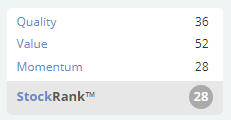
This company's updates continue to suggest that it has the potential to generate nice profits, a couple of years from down the line. As such, it might be worth researching in greater detail. It does have quite a lot to do, to justify the almost-£40 million in market capitalisation.
The StockRanks are rightly cautious:
Gooch & Housego (LON:GHH)
- Share price: 1196.25p (+2%)
- No. of shares: 25 million
- Market cap: £299 million
This one is also in line with expectations.
G&H is a "specialist manufacturer of optical compenents and systems" (lasers, to you and me).
It reiterates that the macro trends it faces are somewhat mixed:
G&H has long been aware of the risks associated with cyclical downturn in microelectronic and semi conductor manufacturing and more recently the impact of the US/ China trade dispute. G&H believes that technological innovation in end market applications, such as 5G and the introduction of new manufacturing techniques, combined with our market leading position will ultimately drive improved demand for our industrial laser products.
My view - no strong opinion on this one, but its long-term financial track record is solid and it could be one to watch.
Out of time for now. Thanks for all your comments on the home equity vs. stock market equity question. Lots for me to chew on over the next few days and weeks (and years!). Finding the right balance between highest expected return and minimum stress will be my objective.
Have a great evening,
Cheers,
Graham
Disclaimer
This is not financial advice. Our content is intended to be used and must be used for information and education purposes only. Please read our disclaimer and terms and conditions to understand our obligations.

47 comments
Two factors do not appear to have been clearly pointed out so far:
First: Real Estate prices are cyclical, moving from Buyers to Sellers' markets over periods of about 25 years. There are cycles within cycles, moving from the developed world to individual countries to individual regions. So one has to judge where one is in the cycle for where one wants to buy. In North America prices have surpassed the peak of 2006-7 but in South America there are some great opportunities.
Unfortunately few of us have the time to shop, invest or settle in those areas.
Second: Property with a mortgage is a leveraged investment just like one in the stock market and if you buy at the right time the underlying asset is fairly stable. The fact one can live in the asset if it drops in value helps.
So then it comes down to a question of cash flow. How much mortgage debt can you service? If you have tenants you can service more.
You could take the house out of the equation and ask would you be prepared to borrow, say, £100,000 at a low rate of interest to invest in shares. Younger people may find this hard to believe but at one time you could get tax relief on interest borrowed for any purpose. At the time tax rates went up to almost 100% when the investment income surcharge was taken into account and it was often the case that persons on high earnings would borrow money, get tax relief on the interest at their top rate of tax and hope to secure a capital gain which was entirely free of tax at the time. It is not something I would do at the present time as the £100,000 borrowed could become £60,000 in short time but, of course, if it came off it would be a good idea.
I've always thought of any houses I've owned as investments. There are massive regional variations but where I live in Norfolk renting seems cheap to me compared to buying. We sold our house last year as prices had got 'silly' (they may yet get 'sillier'). This has freed up lots of cash for investing. We're now renting a very nice house on a long term secure lease and I reckon the landlord is grossing about 2 to 2.5% pa. Happy to take the other side of that trade.
We sold our house last year as prices had got 'silly' (they may yet get 'sillier'). This has freed up lots of cash for investing. We're now renting a very nice house on a long term secure lease and I reckon the landlord is grossing about 2 to 2.5% pa. Happy to take the other side of that trade.
If that's the case, what if the landlord comes to the same conclusion as you tomorrow, doesn't want to be on their side of the trade any longer, and decides to sell the property? This idea of a long term secure lease does not exist in reality and is a bit naive... and therein lies the rub - the vast majority of people in the UK want their own home with the peace of mind and security that brings, not just a house to live in as an investment.
I guess if you are a full-time investor like Graham and need to reduce equity exposure to fund a property acquisition you may naturally take a different view, however as someone who has paid a mortgage off entirely from the income gained through full-time employment, I don't see any need to conflate the equity in my home with my quite separate equity investments. Investing is difficult enough without that added complication IMHO.
All the best, Si
Hello simoan, we are renting an Ecclesiastical property so it is genuinely a long term lease, several of our neighbours have been here 20 years or more. None of the houses (100+) have ever been sold they're all rented. We can stay as long as we like as long as we behave!
I suppose they might have a change of heart and decide to sell up but I think that's unlikely after all this time.
Obviously, I'm glad you feel secure in your new environment but I hope you take my point that it is just a feeling, not a 100% guarantee that you get from owning your own property outright. I'm not sure how you put a value on the peace of mind offered by the latter? All I know is that it's worth a considerable amount to me given all the other things there are to worry about on a daily basis, particularly as you get older.
All the best, Si
Obviously, I'm glad you feel secure in your new environment but I hope you take my point that it is just a feeling, not a 100% guarantee that you get from owning your own property outright.
To be fair, if you wanted a landlord that was pretty much guaranteed to give you peace of mind it would be Ecclesiastical. This was their response when Aviva tried to steal preference shareholders rights away:
https://www.investegate.co.uk/...
Their annual report is well worth a read: https://www.investegate.co.uk/...
Of course, I've held hold a boatload of Ecclesiastical Insurance Office (LON:ELLA) prefs since the GFC, so I'm probably biased ...
timarr
Ah I probably expressed that ambiguously, when I said Ecclesiastical I meant church owned property - nothing to do with the Insurance office.
Ah I probably expressed that ambiguously, when I said Ecclesiastical I meant church owned property - nothing to do with the Insurance office.
Ah. It was the capital E that baboozled me :)
timarr
I don't believe the feeling is any different to the one you may have owning your own property.
For example what if your neighbours decide to let their house to rowdy students, or a new four lane bypass is built that comes very close to your home, or a homeless/drug addict shelter is built on the other side of the road to your front door?
All these are real life examples I've come across where people who had a feeling of security with home ownership suddenly found that this wasn't the case. With an illiquid asset like property that can leave you stuck.
Not to mention what might happen regarding home ownership if we get a Marxist government!
I don't believe the feeling is any different to the one you may have owning your own property.
For the majority of people that is simply not true in my experience. Most people in the UK want to own their own home not live in rental property and pay someone else's mortgage for them. Especially if they view their property as an investment! :)
I think we'll just have to beg to differ. All I know is, with low interest rates it makes sense to buy a house if you can afford it and need somewhere to live because the returns on holding cash are pitiful and being eaten away by inflation. Of course, that may change, but if I were to rent my current house it would cost 15-20x the final monthly mortgage payments before the interest was cleared. Why on earth would I sell it and rent?
All the best, Si
Or the Hell's Angels buy the house next door to use as their club house. Another true tale.
At age 70 I had to payout my previous mortgage on my home but found I was able to remortgage at a fixed rate for 5 years at just over 2%. This seemed a no- brainer to me rather than taking the money out of the market. Effectively the mortgage money is now in a Fundsmith ISA earning 17% plus so far, so will pay it off when the 5 year fixed term is up.
On buying a home versus investing, I think that this country's obsession with bricks and mortar has been damaging to the UK economy. On top of which we have continual government meddling. Help to Buy etc.
Hi Graham, Your question about Home Equity v Stock Market Equity has generated a huge response, and rightly so. I've faced a similar decision recently, as I was in a position to pay a significant part of my mortgage early. I had 10 years to run and faced the decision: do I pay it off, or do I keep investing?
One source that I found really useful when thinking about this was a series of articles by "Big ERN" on his blog https://earlyretirementnow.com. He's done a lot of research into the "sequence of returns risk", and how the sequence of returns affects your actual return over time. His worked examples are extremely detailed. He also discusses the merits of paying off the mortgage early.
As a quick example, say you choose to pay off the mortgage early, so pump as much free cash as you can into that goal. You're mortgage free, maybe 10 years earlier than planned. Is that a better scenario, than pumping all your free cash into the stock market and running the mortgage out for the full term? If you go with option 1 then you've potentially lost 15 years savings, PLUS all the compounded returns. You also start investing 15 years later, and although you may now be in a position to invest more cash, you have less time left to benefit from the compounding effect. The risk due to the sequence of those returns is also greater because you have less time left to invest.
Inflation also plays a serious part here. Although the interest rate may fluctuate, the amount you owe will not be affected by inflation. In fact that amount will become less significant over time. By investing alongside the mortgage, inflation works in your favour, as your returns should benefit from inflation, whilst your mortgage amount remains unaffected.
If you fancy a podcast that provides and good summary of this subject then he appears on the Choose FI podcast - this one discusses sequence of returns risk https://www.choosefi.com/035-sequence-return-risk-early-retirement-now/ .
Bluecurve wrote:
"As a quick example, say you choose to pay off the mortgage early, so pump as much free cash as you can into that goal. You're mortgage free, maybe 10 years earlier than planned. Is that a better scenario, than pumping all your free cash into the stock market and running the mortgage out for the full term?"
If you have an offset or flexible mortgage, you don't have to make that decision until the mortgage reaches its full term. You are free to put any free cash into offsetting the mortgage (and thereby reducing your mortgage interest payments) or into the stock market as and when you choose.
"Do you carry a large mortgage while also building a stock portfolio? Or would you prioritise building home equity first, before venturing into the financial markets?" Graham, I think the answer to this comes down to your appetite to risk. Considering you can borrow money for next to nothing at the moment, this lends itself to carrying a large mortgage. It doesn't look like interest rates will be moving north anytime soon. If interest rate rises worry you, for peace of mind you could always take advantage of a 10 year fixed product. I notice you can get fixed rates at 2.3% on a LTV of 75%. Considering you are still a young man it seems sensible to have the capital work for you in the markets rather than have it tied up in property. Its really a question of opportunity cost. Personally, I think you'd be crazy not to take full advantage of the low interest rate environment and use it to your advantage.
I purchased my first property in 1995, having deliberately decided they looked too expensive in 1990.
I liquidated my Investment Trust holdings to have a 26% deposit.
The mortgage was about 2x income and I put together an Excel spreadsheet & adjusted the numbers until it showed the mortgage being paid off in 5 years. Which is exactly what I did.
I then went back to stock market investing from 2000, having had no exposure during the life of the mortgage.
With hindsight:
1 The property purchase was well timed.
2 I was much too conservative in paying off the mortgage, when I should have being doing a combination of paying off the mortgage and utilising PEP allowances. With the way I did it, I missed PEP allowances and missed the 1995~2000 stock market returns.
I did just fine from 2000 onwards, avoiding tech stocks and investing in breweries etc.
The situation now is slightly more complex, a a couple have 2x £20k ISA allowances, plus the opportunity to avoid a lot of 40% tax with a SIPP (£40k per annum ?). So it would need a good 6-figure income to live, fully exhaust these tax allowances and still have some left over to pay down the mortgage.
Hi Graham,
I would strongly recommend an offset or flexible mortgage to buy your property, rather than a traditional repayment mortgage. An offset or flexible mortgage can save you a fortune in mortgage interest payments over the years. It might also make it easier for you to combine stock market investment with the purchase of a property.
Interesting question posed by Graham about whether it is best to pay off the mortgage or used the money for investing. I think the comments accurately reflect the fact that this is best considered on a case by case basis and the answer is different for different people, depending on their circumstances. I would suggest that a key consideration is whether you are confident that you can outperform the markets through investing in shares over the long term.
Graham, the best advice I can give regarding property and equity is to make sure you can go to sleep at night without worrying about the roof over your head. The security of each of our incomes, and the people we need to support with that income is different for each of us, so it's very much a personal decision.
I've never been one for taking massive financial risks, and have always split my money evenly between the stock market, the family home and any investment properties.
At the moment, I'm thinking we could well be due a significant property correction and a stock market correction, due to years of low interest rates and various national and international risks, so having a large pot of cash at the moment suits me fine, offset against my mortgage, while I wait for the black clouds to either clear or play out.. Yes there is an opportunity cost, but I gain flexibility to take advantage if there are any significant falls.
On the house v stock I used to live in a pretty nice house and rent out an apartment both on LTV averaging about 45%. In the last year we sold the house and remortgaged the apartment to 90% which we not live in.
I am using the excess capital to put into the market in quarterly intervals over 6 years (1 of which has elapsed so far) to ensure I avoid timing issues (in theory.)
I have gone minimalist in my thinking and imagine spending my later years traveling full time without any property living off bond/dividend income.
I regularly had to report to my wife on how I was paying down the mortgage. So that influenced my take, and it was generally my natural inclination to do that versus playing the market, on which I had a patchy record.
Arguably the lower interests rather justifying deferring pay down for market opportunities should encourage an appropriate amount of spare earnings to be allocated to mortgage pay down, whilst the opportunity exists.
However, I was on a definitive salary, with certain occasional material variations in my own business, so if your business is 100% making investments on your personal account, then it would be harder calculation to make perhaps as to where you place allocations of capital.
With respect to home equity vs stock market equity - my story comes from a rather different time. I had a total of three endowment policies linked to my mortgage, and when the first two of them matured I used them to pay off a chunk of the mortgage without thinking about it too much. The third, for £20,000 or so, matured in the spring of 2009 just as the credit crunch bear market was reaching its bottom. I was pretty certain that the bottom had been reached and so instead of paying off my mortgage entirely I invested the £20,000 in equities. This decision was well justified, and within three years I was close to doubling my investment.
Who can say where the FTSE will go from here? I agree that under most potential scenarios it should rise appreciably, but if a Corbyn government is elected then I hate to think what will happen.
In terms of home equity vs. stock market, I paid off my mortgage in 2007 and just at the right time as it happens. Being debt free is fantastic and takes the pressure off investing. I am 25% cash right now and intend to stay that way or even up to 30% until the US market enters a bear phase. I think lots of people are being fooled by the UK stock market being cheap. It's irrelevant in my view, as in a global bear market it will go down as with everything else. In my view, its not a time to be geared on shares.
Graham, the starting question is: is your home really an investment and how would you measure the return?
Robert Kiyosaki (Rich Dad Poor Dad) has made a career of thinking of a home as part of your investment thinking but I think he is wrong unless it really has to be part of your income planning.
For many people (well, including me!) a home is not a tradeable investment, it is quite a different part of my life. I do not intend to move if the value goes up or down, any “sell” signal being largely unrelated to value. I do not (cannot!) live better if the value goes up unless I take on debt, which I have no intention of doing while in healthy retirement, and if the value goes down - so what, if you can afford the debt.
The “return” , if you can call it that, is the immense enjoyment of a home that is mine ( after many years of sharing it with the mortgagor !).
For many people (well, including me!) a home is not a tradeable investment, it is quite a different part of my life. I do not intend to move if the value goes up or down, any “sell” signal being largely unrelated to value. I do not (cannot!) live better if the value goes up unless I take on debt, which I have no intention of doing while in healthy retirement, and if the value goes down - so what, if you can afford the debt.
I couldn't agree more. I have never really understood why your main residence should be considered an investment, and it's not something I take into account at all with regard to my equity investments. I guess the reason most people do so is that historically property prices have only ever increased and the equity in the property increases over time. I guess if you end up with negative equity (as many have done in the past) your view will change. I guess it's a natural human bias. I always find it funny that very few people consider their other major purchases that decrease in value e.g. large screen TV's, family cars as investments...
All the best, Si
I would say few people consider other major purchases such as cars as investments because they know they are certain to eventually be worth nothing (unless it is classic car). Although I am aware that people can finish up at least temporarily with negative equity I believe that over a lengthy period your house can only be an appreciating asset. For one thing building costs increase. There must be many people whose houses like mine are worth 10 times what they paid. The investment return is that I do not have to pay rent. So if we say that my house which cost me £60,000 would now cost me £18,000 to rent that would be a pretty good return. Also it is an investment in that the ultimate value on my death is relevant to me in that one objective is to pass on as larger an amount as possible. As regards paying off a mortgage or investing the money I think it depends on age and whether the amount of the mortgage is something you are comfortable with. I went with paying off the mortgage.
Hi Graham, on the equity v bricks debate I am terribly risk averse. My own personal story is that I bought my house in 1999 with a mortgage. Modest income and modest mortgage. I was very financially aggressive in paying down my mortgage (then @ 6.3% interest rate) and paid off the mortgage in just over 8 years. Whilst over that time I invested a small amount in funds and an ISA my primary focus was becoming debt free.
I'm reaping the benefits now. In 2009 I met who has become my wife. She is not earning and now I have to support 3 of us. Thankfully by personally being mortgage free I have a little more flexibility as some months have seen unexpected expenses mean monthly income < monthly outgoings (beyond my control which is a frustration because I'm very prudent with my own personal expenses when needed). My wife had and still has an apartment on a mortgage which she lets out. Over the years this has been a constant surprise of unexpected costs and rent free periods (since my wife doesn't have a job (health issues) I cover these, sometimes significant costs). I've pleaded with my wife to sell the apartment since it is a net loss generator but since it is in negative equity (even after 10+ years) she won't do this.
If I remember correctly didn't it say in the book "Rich Dad, Poor Dad" that property is not really an asset because it has ongoing maintenance and costs, whereas a true asset generates value without taking value away from you?
Since I cleared my mortgage I've been able to focus on my ISA and generated some notable % returns in recent years. Being mortgage free helps me since when I have surplus cash I can fund investments, when I don't have surplus cash I have less outgoings to help me make ends meet.
I was interested in the £DUKE PrimaryBid offer. However on attempting to make a payment two different debit cards were rejected as 'not being debit cards'. I called PrimaryBid's support line and was told their systems did not correctly recognise Lloyds Bank debit cards (nor my Starling debit card).
I wonder if the low retail take up of the £DUKE offer via Primary Bid is at least partly explained by their poor IT systems?
Henry, I had a very similar experience with the Duke Royalty (LON:DUKE) PrimaryBid offer. In my case I had two Lloyds debit cars rejected because of errors in the expiry date (both in 2022). PrimaryBid has yet to respond to the message I left. PrimaryBid seems unusable for me.
Richard
Hi Graham, home equity v stock market is an interesting question. Putting money into buying a home means you are pegged to the property market which isn’t as volatile as the stock market. This has its benefits.
I’ve also built up a small portfolio of buy to let flats. When I initially purchased property the gross yield on offer was 7% and this would drop to a net yield of around 1-2%. However, as time as gone on, the gross yield has increased to 15%. In addition there has been capital appreciation. I’m sure there are shares which have done particularly well over the past 15 years. But a lot more diligence is required to be undertaken and when things do go wrong, the impact can be significant.
Overall though, I believe a balanced investment approach is required rather than 100% in property or stocks.
I agree, and with interests rates so low at the moment, its very attractive. I certainly wouldn't pay off a mortgage with money I could otherwise have invested (or wating in cash to be invested, come to that).
A bit of a dumb question but is there a place I can purchase a FTSE option for a specified strike price?
I am wanting to hedge my exposures, but I do not want to place a short.
£AGFX (FX service provider) trading update today. Revenues up 45% yoy. Recent IPO, founders own lots of stock, IPO proceeds used to support growth, couple of interesting small-cap investors involved (Amundi / Gresham House). Profitable every year since formation (2011 I think), and good rates of growth. Very competitive sector but plenty of short-term tailwinds. Interesting comparator to Alpha FX / Record.
A trading update from Franchise Brands (LON:FRAN) today indicating an encouraging start to the second half of the financial year. They have also acquired WPL Group Holdings Ltd (Willow Pumps), a pumps and drainage company, in a cash/shares deal. It strikes me as a slight change in direction but it seems to have been well received by the market.
Hi Graham
Ramsdens Holdings (LON:RFX) / H & T (LON:HAT)
If you have time today I'd be grateful if you could give your take on recent events in this area.
Ramsdens have issued an in-line TU today and note:-
"The stores acquired from The Money Shop have performed well and the Board continues to appraise acquisition opportunities in this highly fragmented market. The widely publicised recent collapse of one of the Group's largest competitors has again highlighted the importance of our outstanding and highly-trusted customer proposition."
H&T acquired the pledge books of A&B (probably at a discount but this wasn't disclosed) and took over a big chunk of The Money Shop.
Do you have any insights into why these two appear to be doing well when the sector in general seems to be having problems.
Phil
Hold both (didn't expect them to be on the acquisition trail but pleasantly surprised)
Interesting announcement from Air Partner (LON:AIR) ahead of tomorrow's interims. Air Partner (LON:AIR) to partner with NGS an international emergency response company as preferred emergency air charter supplier. Although emergency air charter is not new to Air Partner (LON:AIR) it is nonetheless a positive development as the company seeks to diversify the range of services provided.
A good update from Ramsdens Holdings (LON:RFX) with £0.6m added to cash balances. Slightly more nuanced that H & T (LON:HAT) but still very positive. "Compare and contrast" to borrow a phrase from school exam papers. Any thoughts you have Graham to add to your previous commentary would be appreciated.
Good morning!
There's a solid update out today for H1 (6m to 30 Sept 2019) from £IGP (in which I hold a long position).
It's a turnaround situation, under new-ish management, who stripped out costs & moved it into positive cashflow. Important because it should not now need to raise any more funding.
I met management earlier this year, and think they're very backable - CEO has a good track record of developing small software companies. His main reason for joining IGP (and also my main reason for buying shares in it), is the astonishing quality of its clients - US Govt Depts, major global companies & banks. A lot of revenues are recurring, so if it has a breakthrough in winning more orders, then the operational gearing could be exciting. As always though, there are no guarantees this will work out, and the company has had false dawns in the past, under old management.
This morning's trading update is in line with expectations, saying;
The stand-out number there is cash, which has risen £2m in just 6 months. I reckon this probably means one or more big contracts might have been won near the end of H1, hence cash up-front, and and likely to feed through into H2 revenues, possibly?
Note that it has £4.7m in convertible loan notes, costing 8% p.a., so paying down some or all of this debt from the £5.2m cash pile would make sense, saving up to £380k p.a. in interest costs. That would also remove potential future dilution, if the shares really do take off (conversion price is 68.8p, well above current 34p share price)
I've put a call in to the company, to query the high cash balance, and some other questions.
A lot of its earnings are recurring, and in US dollars. So nice protection from Brexit & forex issues.
There seems to be an H2 trading bias. No outlook statement is given today, so I presume they're in line.
All in all, a nice potential turnaround situation I think. DYOR as usual.
Regards, Paul.
P.S. Azalia Trust recently increased its stake to 29.7% - always nice when a major shareholder increases to almost the maximum allowed without triggering a takeover bid (30%)
Re Intercede (LON:IGP) (which I hold)
Thanks Paul. I thought 5% growth was rather disappointing but the cash improvement is certainly encouraging. Finncap reiterate 80p target today.
cheers
Francis
The major shareholder being a trust of which NED Jacques Tredoux is a beneficiary … interesting times
£IGP announced a $4.3m order from the US Govt on March 29th with $2.0m of that to be recognised in this FY.
They also sold a property in April for £400k.
A small company with lumpy revenues is not ideal - unless the NED interest indicates some good news in the pipeline?
Thanks for the Intercede update Paul and looking forward to any follow up if your questions to them provide anything interesting.
So many U.K. Companies are falling to bids while £ is so weak so that near 30% stake looks interesting.
I’ve held for a while.
I would think the US Govt would have a veto over any acquirer on security grounds which does limit the field.
But we do sometimes see property sales and the like as tidying up the books.
Intercede update is out this morning. Not too much detail, but things seem to be progressing ok.
My morning smallcap tweet: Construction destruction at SIG
Totally (LON:TLY), SIG (LON:SHI), Local Shopping REIT (LON:LSR), Deltex Medical (LON:DEMG), Time Out (LON:TMO)
Totally (TLY) wins two contract extensions. £10.6m to Sep 2020 and £6m from April 2020 to March 2022. F/C FY20 rev is £120m.
SIG (SHI) construction mkt weakened further in UK & Germany. Warns significantly lower profit than its prev. expectations. Also selling Air Handling and Business Solutions divs for £230m tot. Will return majority of cash not used to cut debt ie up to ~£60m.
Local Shopping REIT (LSR) Duncan Soukup coup takes effect following cash return. He becomes Chair and an independedt NED appointed. 3 directors leave.
Deltex Medical Group (DEMG) FD left on Friday. He is thanked.
Time Out (TMO) placing of up to £17m at 127p, a nil discount. Cash for continued investment in roll-out of Time Out Market and to reduce debt.