Small Cap Value Report (Thu 12 Oct 2017) - EHG, NXR, RNO, RBG

Good morning! It's Paul here.
I read an astonishing article in the weekend press. It stated that the cost of tax relief for private pension contributions has now risen to a staggering £53bn p.a. - enough to wipe out the entire Govt spending deficit. Bear in mind that this is mostly going to the affluent, and I don't see how the present arrangements can possibly be justified, or continued. So I think we'll see another raid on private pensions by the Government fairly soon.
I have an ancient SIPP, however it's a system which makes me very nervous. The money is tied up for years, and in the meantime who knows what awful policies successive Governments might implement to raid my savings? ISAs seem much more attractive - at least you could grab that money & wire it abroad, if a hostile Government were to be elected.
Elegant Hotels (LON:EHG)
Share price: 84.8p (up 5.7% today)
No. shares: 88.8m
Market cap: £75.3m
(at the time of writing, I hold a long position in this share)
Trading update - for the year ended 30 Sep 2017.
This company owns & operates 7 freehold "upscale" hotels, plus a restaurant, in Barbados. Note that renowned entrepreneur Luke Johnson is a NED, and owns 12.5% of the company.
Rather surprisingly, things seem to be going well;
Trading since the interim results in June has remained in line with market expectations. Whilst the Group is only 12 days into its new financial year, it is pleased to report that bookings are currently tracking ahead of the same period last year.
I say surprisingly, because this company is heavily reliant on tourists from the UK - who make up something like 70% of its revenues. So my main worry was that the post-Brexit plunge in sterling might trigger a reduction in British tourists visiting. Apparently not!
Also, the refubishment of one of its hotels is going to plan, with re-opening scheduled for the start of the peak tourist season.
Valuation - this share looks strikingly cheap, which makes me worry that there might be something wrong?
Zeus are forecasting 8.1p EPS for the year just finished, 09/2017. That's a PER of 10.5 .
For y/e 09/2018, they are forecasting 10.4p EPS, for a PER of 8.2 .
Dividends are forecast at 7.0p for each year, giving a divi yield of 8.3% - usually that's too high to be sustainable, so a question mark hovers over such a high payout, which is only just covered by earnings. Personally I think the company is over-paying, and should probably halve the divis, and redirect the saved money into refurbs to keep the properties in tip-top condition. Reviews on TripAdvisor seem to indicate that inadequate maintenance is a problem.
Asset-backing - what I like about this company is that it owns the freeholds for these prestigious properties. So the balance sheet looks solid, with $118.3m NTAV - that's $1.33 per share, or a whisker over 100p per share. So at 84.8p, the shares are trading 15% below NTAV.
Two brokers today state that the discount to NAV is much larger. I've checked their figures, and the discrepancies seem to be that they're using an outdated exchange rate of £1 = $1.25 (whereas I have used the current exchange rate of £1 = £1.32). Also the brokers seem to have uplifted the value of the freeholds by $20m over book value, in their calculations.
Given how cash generative the hotels are, I can't see any reason to question book value, which seems reasonable. There is $173m in property assets, and $61.5m in net debt, shown in the most recent accounts. That looks a perfectly reasonable position, so there are no worries about excessive debt.
My opinion - this seems a very reasonably-priced share. I like the low PER, the monster divi yield, and the asset-backing. That Luke Johnson has given it his seal of approval, by buying about £10m-worth of shares, and joining the board, is nice confirmation.
I wouldn't normally buy shares in any overseas companies on AIM, but this (and Somero Enterprises Inc (LON:SOM) ) are rare exceptions. I see upside to maybe 100-120p per share, with patience. Along the way we get huge divis to keep us interested. Plus there is expansion (contracts to manage other hotels) in the pipeline. Overall then, I like it.
Norcros (LON:NXR)
Share price: 175.5p (up 4.4% today)
No. shares: 61.7m
Market cap: £108.3m
Trading update - for the 6 months to 30 Sep 2017.
This group sells bathroom fixtures & fittings, including Triton showers, and Johnson Tiles, plus other more recently acquired companies such as Vado and Croydex.
Today's update sounds quite good.
Group revenue and underlying operating profit1in the first half is expected to be in line with the Board's expectations.
Group revenue for the first half is expected to be approximately 144.9m (2016: 128.8m), 12.5% higher than the prior year and 7.1% higher on a constant currency basis.
The growth reflects a robust performance in our UK business and continued growth in our South African business
Net debt has reduced from £27.5m a year ago, to £21.0m now - this looks a modest level of bank debt. However, the elephant in the room is the massive pension scheme - no mention is made today about how that is looking.
Outlook comments - again, reassuring;
Against the backdrop of challenging market conditions, our performance demonstrates the strength of our market positions and the resilience of our diversified business portfolio delivering revenue growth in all UK sectors, strong growth in exports and sustained progress in South Africa. The Board remains confident that the Group will continue to make progress in line with its expectations for the year to 31 March 2018.
Valuation - strikingly cheap on a PER basis, and with a decent dividend yield too. The reason for this lowly valuation seems to mainly be due to investor concerns over the pension scheme;
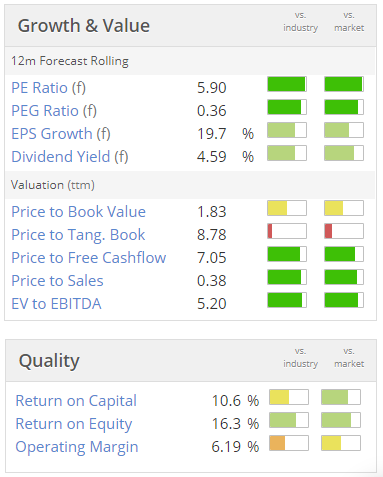
My opinion - the valuation strikes me as excessively pessimistic. Sure, the pension scheme is a big issue, but it's been managed perfectly well in recent years. The trouble is that the deficit is highly volatile, and being a very large scheme relative to the size of the company, it's an ongoing thorn in the side.
Another problem is that this share seems to forever trade sideways. So shareholders buy, hold for a while, get bored, then sell up & move on to something with more perceived upside. There has been quite good earnings growth in recent years, and a series of seemingly good, sensibly-priced acquisitions, with good synergies.
I'm tempted to buy a few shares in this, but have been disappointed & frustrated by the lack of progress in share price before.
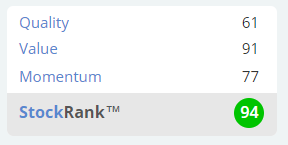
Note that the Stockopedia computers love it - classifying it as a "super stock", and with a very high StockRank;
Renold (LON:RNO)
Share price: 46.1p (down 10.4% today)
No. shares: 225.4m
Market cap: £103.9m
Trading update (mild profit warning) - relating to the 6 months ended 30 Sep 2017.
This group makes industrial chains & other power transmission products.
The share price put on a nice spurt earlier this year, but has come most of the way back down again now. That pattern has occurred with lots of small cap shares this year - a sign that investors perhaps got rather over-excited in the strong bull market of this spring/summer.
I like the no-nonsense wording used in this announcement;
Trading in the period has been mixed. The Torque Transmission division performed in-line with expectations. The Chain division delivered organic growth, but profitability was affected by machine break-downs at our Einbeck facility and by sustained increases in raw material costs.
Consequently, the Board now expects adjusted operating profit1 for the Group for the year to 31 March 2018 to be slightly below the lower end of the current range of analyst forecasts.
That's obviously a bit disappointing, but hardly a disaster.
A lot more detail is given in the RNS, which I won't go into here - you can read the announcement yourself, if interested. The gist seems to be that problems have been, or are being resolved, and the order books sound healthy. So if you like the company, this could perhaps be an interesting buying point?
My opinion - the balance sheet is the deal-breaker for me. There's a gigantic pension deficit of £102.0m shown in the most recent accounts. As we know, the actuarial deficit can often be a lot worse than the amount shown on the balance sheet. So this is a huge issue - more so even than with Norcros above.
Renold hasn't paid divis for years either, so there's nothing to enjoy whilst waiting for a potential capital gain. Overall then, this share has no appeal whatsoever to me.
Revolution Bars (LON:RBG)
Stonegate update - with Deltic now out of the frame, Stonegate has taken the opportunity to try to scare RBG shareholders into accepting their 203p cash offer - pointing out that market conditions are challenging, etc.
Also Stonegate emphasises that its 203p offer is final - and won't be increased (unless someone else comes along and offers a higher price).
What to do? Personally I think the Stonegate offer could yet be increased, as they're getting RBG on the cheap. So the issue now is how RBG shareholders will vote in the imminent shareholder meeting? Will investors vote against the 203p offer, in the hope that Stonegate will increase it? Or will shareholders prefer a clean cash exit and vote for the deal? It's a tricky one. Given that the share is illiquid, the institutional holders might decide they prefer a cash exit.
Personally, I'm sitting tight for the time being. I think there's still a chance that the offer could be improved, or a late suitor might crash the party.
I have to leave it there for today, as I'll be on a train visiting relatives this afternoon.
Regards, Paul.
Disclaimer
This is not financial advice. Our content is intended to be used and must be used for information and education purposes only. Please read our disclaimer and terms and conditions to understand our obligations.

94 comments
Can't make any useful comment but notice that previously you have mentioned shorting shares. Could I ask how this is done? There doesn't seem to be an obvious UK options market to buy puts. Do you short via spread betting?
Sorry to be a nuisance
Joseph12
Hi paul,
Couple of points regarding elegant hotels. The refurb at treasure beach highly unlikely to be ready for the new season, secondly property prices have almost halved here since 2008 . However they paid top dollar for waves hotel last year without including the renovation .
The coming season will not be affected because most people already booked, it is next season I worry about.
The government has placed a 10% tax levy on everything increasing prices that are already expensive especially with the poor exchange rate.
All that being said they are a well run hotel group with good management .
Re pensions have a feeling the only people not subject to the million pound lifetime allowance cap are mp's and judges who wouldn't pass the act unless they were exempt also.
The other issue is final salary schemes are 20 x income for lifetime allowance purposes where as a money purchase pot with current annuity rates would need closer to 35 x income to generate same income level completely unfair.
I simply don't understand why the lifetime allowance isn't based on benefit for DB schemes and contributions for DC schemes. Your total "pot" being the sum of your DB benefits + your DC contributions. Surely that would be simpler, easier to understand and fairer than the current system.
Essentially if you have both it already is ie you have a defined benefit pension built up so far of say £10k , this times 20 is £200k of your allowance gone, if you then have dc pot of 300k the two added together is 500k of the mil.
As I mentioned before the big issue is using the above example to get the 10k income under dc scheme you would need nearer 350k on current annuity rates so someone could have a 50k income under defined benefit scheme using 20 to 1 and be up against the mil lifetime allowance but a mil dc pot would buy nowhere near that income prob nearer 30-35k so essentially if income is the main driver anyone in db scheme is way better off.
Probably already last week's news, but a couple of novelty RNS from Stonegate today on Revolution Bars (LON:RBG) The first, presumably either prompted by the Takeover Panel or Deltic, required them to retract some of the slightly more racy claims about the merits of the Stonegate offer compared to the alternatives. The second is a retraction of a comment attributed to the Stonegate Chairman about Revolution Bars (LON:RBG) 's prospects if the bid does not go through. Sounds like a foot in mouth moment after a liquid lunch ...
For what it's worth, the wife and I have just posted our votes to reject the offer. Fed up with Stonegate's arrogance. Short term, it might cost me a few bob, but a rejection will cost Stonegate a fair bit more.
Gus.
-----------
immediate release
13 October 2017
Stonegate Pub Company Limited ("Stonegate"): Retraction Statement
The Chairman of Stonegate, Ian Payne, was today quoted on Twitter by Dominic Walsh of The Times as saying "The alternative is not palatable. If it doesn't go through they'll have a broken company" when referring to the Scheme vote for Stonegate's offer for Revolution Bars Group plc.
Mr. Payne requests that this statement is disregarded as there is no basis for it.
Thank you very much to everyone for the helpful replies to my question on SIPP providers, very much appreciated!
Renold, think there may be more bad news to come. It seemed that way looking at the share price last year. Think it may be worthwhile waiting till nov.
Very helpful discussion regarding SIPPs, so thanks to all. Since we're on the topic, may I cheekily ask which providers people are using for their SIPP and any positive/negative experiences? I've been doing a fair bit of reading, trying to weigh up the various fees and +/- of each platform, and it seems, for my circumstances, AJ Bell or IG are good options. I plan to use a different provider from my core ISA provider so that rules out CS Direct. Many thanks in advance for any thoughts people could share. Will.
I’d give an unreserved vote for AJ Bell, they do most things well but if they have an issue they fix it fast, the mindset is customer first
I would have given an unreserved vote for AJ Bell, but their sudden imposition of a shares custody charge when previously they had none rather coloured my view of them, and resulted in using IG for non-SIPP money from then on. It was more of an issue in the ISA and dealing account where there were previously no charges other then dealing charges and fund custody charges than the SIPP, where it replaced the existing expected SIPP custody charge.
I use AJ Bell for my SIPP and have no problems. I also use IG for an ISA and have no problems. I don't think that currently you can buy funds on IG, only listed investment trusts, that might colour your decision if you want funds.
One thing that hasn't been mentioned on this thread is the option of salary sacrifice. I am a standard rate tax payer, but by using salary sacrifice on my SIPP my relief is on a par with that of a higher rate tax payer, since I save the 12% employees NI (standard for salary sacrifice), and also get most of the saved 13.8% employers NI (need to negotiate with your employer, can range from none of it to all of it, mine give me most of it but keep a little for administration). The mechanics of it are simply that AJ Bell take a direct debit from my employers bank account each month, and my employer subracts a lesser amount (to account for the saved employers NI) from my salary as salary sacrifice (their payroll software has a "salary sacrifice" option apparently).
I suspect that that arrangement will be in the cross-hairs of some government at some point, I don't really expect it to last indefinitely.
Willhampson asked "which providers people are using for their SIPP and any positive/negative experiences?"
I use Alliance Trust Savings for my SIPP and am happy with them, although I find their web site a bit clunky to use. They charge a fixed fee each year, regardless of the total value of the investments in the SIPP, so they are cost effective for reasonably large SIPPs but might not be for small ones. My wife started her SIPP with Hargreaves Lansdowne, because they charge an annual fee that's a percentage of the total value of the SIPP, but once it grew to a certain size it seemed to be more cost effective to use Alliance Trust Savings so I persuaded her to transfer her SIPP to them. Hargreaves Lansdowne's reputation for providing good customer service seems to be better than that of Alliance Trust Savings, although I have no complaints about the latter.
What a fascinating day's reading. A short preamble by PS on the merits of ISAs as against SIPP provision has given rise to some excellent high quality posts. I have learned quite alot from some excellent feedback. Very intrigued by post 57 as it appears illogical to shift from one tax free wrapper to another but ISAs seem to offer benefits over a SIPP once you have a decent pot. The few with £1m plus ISA pots are in a nice position eg Lord Lee. I suspect all these pots are highly concentrated portfolios in 'winners' and most of all impeccable timing eg putting plenty in during 2009.
As the subject of pensions is being dicussed will someone who knows be kind enough to offer me their opinion. I am retired and have no earned income. I have a reasonably large SIPP and an ISA which I self invest. I can no longer fund my ISA and I am starting to take small sums from both my ISA and my SIPP but I am able to do so from profit thus preserving my capital. I am thinking it would make sense to annually fund my ISA to the full allowance by drawing from my SIPP. This would seem to me to be tax efficient. Does anyone have an educated view on this. Naturally I am not asking for financial advice just a view. Thanks in hopeful advance.
Charles
I currently work on the software side of the pensions industry and know enough to know that your question sounds easy but is actually v.v. complicated.
To get a proper answer you would need to have a long talk to a qualified IFA (they are not all shysters) about your attitude to risk (equities/housing/gilts etc) /politics (future tax rates) / how long you expect to live (when did your grandparents die) and many other things.
It also depends on whether you have taken your tax free cash sum
it also depends if you are seriously rich (millions)
and many other things.
I will say that I have (and I bet many here do) a SIPP.
My plan (simple and unoriginal):-
While I pay higher rate tax I will put money in a SIPP first.
When I have stopped doing enough paid work to hit higher rate tax (I do not expect to come to a full stop for a v.v. long time) I may start drawing on the SIPP up to just below the threshold (as 25% of it is tax free and the rest is basic rate) and anything left will go in the ISA.
Thanks for taking the time to respond and help. All useful information. Not in the Millionaire bracket I'm afraid but managing to produce good returns in both the ISA and the SIPP. Just moved the ISA from Barclays, who have totally ruined their stockbroking platform, to AJ Bell. Thanks, Charles
This is just a view on pensions:
I thought you would be allowed to take out a 25% tax free sum from the pension. As far as I can see, it must be attractive to take that & feed some of it into the ISA each year. Considering the ISA income is tax free & if you wanted to emigrate with the money, it's possible.
Thanks for responding, all useful information. Charles
On the topic of withdrawing from a SIPP to fund an ISA, in addition to the points already raised don't forget to consider..
i) IHT tax breaks, if this is important to you (an advantage for SIPPs)
ii) Lifetime allowance limits and the penalties if you exceed them, which is especially a problem if your investments do well (an advantage to ISAs).
Thank you for taking the time to help, useful advice. Charles
"I am thinking it would make sense to annually fund my ISA to the full allowance by drawing from my SIPP. This would seem to me to be tax efficient."
I'm not sure why you think that. Both ISAs and SIPPs are tax efficient 'wrappers' for investments, in the sense that investments within them are not liable to any capital gains tax on capital growth within them or income tax on dividends. Both ISAs and SIPPs can hold a wide range of investments, such as equities, gilts, property funds, commodity funds, and absolute return funds. SIPPs are slightly more flexible in the investments that can be held within them, because it is possible for someone running a business to put the property from which that business is run into a SIPP.
The main difference between ISAs and SIPPs is when money is taken out of them. Any money taken out of an ISA is free of all tax, but money taken out of a SIPP is subject to income tax at one's marginal rate apart from that designated as the SIPP's 25% tax free lump sum. But the income tax on money taken out of a SIPP is to compensate for the income tax relief that was obtained at one's marginal rate at the times when contributions into the SIPP were made.
Recent changes to the laws on SIPPs mean they have some Inheritance Tax benefits, which ISAs don't have. However, there is a lifetime allowance on the maximum amount that one can have invested in a SIPP before punitively high tax rates apply above that amount. The lifetime allowance is currently a million pounds, but other pensions one might have may contribute to that.
Other issues are that if you take too much money out of a SIPP in a particular year that might put you in a higher tax band, so your marginal income tax rate would go up. So if you want to take a large amount of money out in one particular year, it might be better to take most of it out of the ISA, unless you are able to designate the money taken out of the SIPP as the 25% tax-free lump sum.
Another issue is that one has to guess what the rules and laws on the tax treatment of ISAs and SIPPs in the future are likely to be. From that point of view, ISAs have the advantage that money can be extracted from them more readily than from SIPPs without punitive tax penalties if a government in the future looks likely to remove their tax benefits.
I agree with other posters who have said that the issues to do with the best course of action in one's particularly circumstances are not necessarily obvious. It might be worth taking advice from a good Independent Financial Advisor, if you can find one who you trust, preferably one with a Chartered Financial Planner qualification. Even though that advice might be expensive, it might lead you to make better decisions and thereby save you more money that the cost of that advice.
Further to my previous post, when I wrote that "investments within them are not liable to any capital gains tax on capital growth within them or income tax on dividends", I meant that any dividends that are retained within the ISA or SIPP are not subject to income tax.
Of course, if you take the dividends out, then they are free of income tax when taken out of an ISA, but are subject to income tax when taken out of a SIPP. But to repeat what I wrote previously, the income tax on money taken out of a SIPP is to compensate for the income tax relief that was obtained at one's marginal rate at the times when contributions into the SIPP were made.
Further to my previous posts, until a few years ago SIPPs were much less flexible than ISAs because of the old requirement to buy an annuity when you wanted to take money out of a SIPP. But George Osborne got rid of that requirement (although it is still an option) and allowed 'flexible drawdown' from SIPPs, and also introduced Inheritance Tax advantages for SIPPs, so in my opinion SIPPs are now much more attractive than they used to be.
Thank you for taking the time to respond. Very helpful advice. My thoughts are the growth I hope to continue to produce will be better in the ISA as 100% is tax free whereas only 25% is tax free in the SIPP. I take your point on ensuring my transfer doesn't put me in a higher tax bracket but as I have no earned income I should be able to manage the amount. Great help, thanks. Charles
Hi Cashcaf69, you wrote: "My thoughts are the growth I hope to continue to produce will be better in the ISA as 100% is tax free whereas only 25% is tax free in the SIPP. I take your point on ensuring my transfer doesn't put me in a higher tax bracket but as I have no earned income I should be able to manage the amount."
When I first read this, I thought your plan is based on a fallacy, because your investments will grow within your SIPP tax free just as they will in your ISA. Once you've taken out the 25% tax-free lump sum from your SIPP, any further money you take out now from your SIPP would be liable to, say, 20% tax, so you would have 20% less to put in yout ISA, and whatever that grows to you would have 20% less than if that money had stayed in your SIPP, but when you eventually take that money out of the SIPP that would be subject to 20% tax, so it all evens out.
However, on further reflection, I now think your plan does have some merit, if you're not concerned about losing the IHT benefits of having more money in your SIPP, because if you do get good capital growth of your investments, if that money stayed in your SIPP you might be pushed into a higher tax band and therefore have to pay, say, 40% on some of that money when you eventually take it out of your SIPP, whereas if you gradually transfer modest amounts of money each year from your SIPP to your ISA (being careful to stay in the lower tax band) then that issue would not arise.
I recently discovered the Brewin Dolphin podcast. Some of the interviewees are very interesting. They recently interviewed Neil Woodford. The most recent podcast was with Simon Brazier a fund manager with Investec. Reckitt, DS Smith, Booker and Next amongst the companies discussed. He had some comments I thought were insightful.
https://feeds.feedburner.com/BrewinDolphinPodcast (RSS feed, otherwise use your favourite search platform)
I recently listened to this and second the recommendation.
A couple of others:
http://www.goldmansachs.com/our-thinking/podcasts/ (The Paul Russo one I was impressed with)
http://adventuresinfinance.realvision.libsynpro.com/website (Recently, Jim Grant!)
I notice a lot of references to 'gold plated' public sector pensions. Seems to be another example of the greedy envy of something that other people are perceived to have that is so common now; whipped up in the media with large doses of lack of knowledge.
But public pensions are not all the same. Some are funded, though many aren't. The vast majority require substantial payments in by the workers.
You can't get cash transfers or choose to take money as you want; they are enforced annuities. They are completely controlled by the government of the day.
The switch from RPI to CPI was an imposed decision; in the private sector it has frequently had to be negotiated and some are still on RPI. Across the poorer countries of the EU public pensions have had substantial reductions imposed and there is nothing to stop the same happening here. Pensioners from the public sector can't contemplate just moving it abroad as a lump sum, they are always at the mercy of the government.
Before Gordon Brown they were worse than private sector pensions for most people. That changed as governments allowed (encouraged?) company pensions to wither away.
I've seen it from all sides; I've worked in the private sector, public sector, been self-employed and had my own companies. As with most things, there are disadvantages as well as advantages. For the moment I feel that SIPPs are probably the option with the most to offer and fewest risks, although that can change in an instant.
PS I am in no way condoning MPs pension arrangements or focus on feathering and protecting their own nests. And I suspect that the higher ranks in the Civil Service never lose out either.
Accrol, which was widely discussed on here has stated that the fine for health and safety breach will be in the range of £550K to £2.9M (seems a pretty big range!) subject to a one-third deduction for their admission of liability. The lower figure seems immaterial and I cannot think that this issue had any real bearing at all on the profit warning.
Pensions....I got my former employment pension just a few weeks ago. Very pleased to get final salary based (local government) ; that is not longer available to almost anyone and it makes a massive difference. Our kids can look forward to what? I think there will be a lot of company pension issues in the UK over the next few years as we saw with BHS. Too much blatant robbery; even the government is at it with pushing up state retirement age. I think any company with a large pension scheme is a big red flag with current politics in mind.
The private pension system is designed as a deferred tax system, incentivising people to save for retirement so that they do not become dependent on the state when they are older. It has a side benefit of increasing the national savings rate (much needed in the UK) and increasing investment monies available for UK companies (and government). In generational terms it increases governmental costs for current tax payers and reduces costs for future tax payers.
Winners from the system include people who pay in at a higher rate than they take out, and the few non-earners who can pay in £2880 (net) a year. Losers include most people who pay higher rates on their pension (the vast majority will have made some contribution at standard rates). The system also benefits people whose earnings fluctuate dramatically.
Ironically, given that the system was established to help the working man (mostly men then) provide for his family's future, the system has been under sustained attack from the left. Firstly with Gordon Brown disabling the company pension side and more recently by reducing the lifetime and annual allowance and widescale publicity arguing that it is a system that only benefits the wealthy.
George Osborne introduced a large number of changes; only half thought-through, as was typical of him. The original justification was to avoid the problem of pensioners being forced to take annuities at a time of very low interest rates (largely caused by quantitative easing). They included freedom to withdraw large amounts (increasing the current tax take) and taking residual amounts out of IHT.
Most of the changes I have seen recommended are likely to have adverse consequences down the line. Only allowing relief at standard rates, means that there is a disincentive to higher rate payers to save in a pension (although, of course, the government could make pensions compulsory). A 33% rate has the same disadvantage, but smaller, and is an expensive giveaway to standard rate payers. Many of the proposals have the impact of reducing future tax take but increasing it now.
Certainly the system as it stands has more potential benefits for the wealthier (eg IHT is mostly an issue for wealthy people and middle classes in London and the South East). The 25% tax free is the main incentive and helps smooth the transition from a working income to a pension, but there is no obvious reason why it could not be capped without losing that benefit for the majority of people.
My guess is that if there is a significant pensions raid then there will also be a raid on ISAs soon or at the same time to stop the better off just switching. Could reduce the annual allowance, or, more sneakily, switch the 0% tax rate to a preferential rate, that could easily be increased in future budgets.
The country does need an effective pension system, and the old company system seems permanently broken for most people. SIPPs are OK, but too complex for the average worker. NEST equivalents seem the only option we have at the moment and can apply to the self-employed as well as the employed.
I'm not sure much will happen in this budget, though I will be reducing my risks; Hammond seems to in with the City and too politically incompetent to try anything big. Nevertheless, I do intend to reduce my exposure to risks.
At the moment as a "retiree" from a large American computer company 15 years ago I'm getting by on my final salary pension BUT it was based on my basic salary which was low enough to encourage me to work all the hours to support customers who always needed help out of normal hours. The next BUT is that after 4 takeovers I effectively worked for one company for 25 years and the last company after taking on a fully funded pension scheme, have put in the bare minimum and refuse to make any increases to pre 1997 pension because like so many, particularly US companies, they have no legal requirement to do so. Bloody annoying when government with their gold plated pension can't make a slight change to the law to say to these companies "if you're making profits and paying dividends, then do the right thing for your pensioners", and treat pre 1997 entitlements the same as post 1997. A campaign is starting soon, I wonder what Theresa will do. Answers on a £20 note please.
I held Elegant Hotels (LON:EHG) until the last trading update when a few figures spooked me enough to warrant a sell. Here are some of my notes for those who are interested:
EHG has substantial assets and Barbados will always be a popular destination but to me the figures are irrelevant compared to the fact that Luke Johnson has invested £10M during the past year.. That is the sort of thing I look for with, for example, Communisis being one of my largest holdings for little other reason than the £20M+ investment of Richard Griffiths. I then look for such investors selling down and keep my eye on the charts. It worked well when Bob Morton took a large shareholding in Vislink and I got out the few minutes after he sold a chunk of shares at their peak prior to the company going into a downward spiral.
Re Norcros (LON:NXR),
personally, I think like Paul the pension issue is manageable especially if nothing dramatic happens soon since they are close to peak payout and the scheme is mature plus finally there are signs interest rates may rise
Personally, my biggest fear is South Africa (now roughly 1/3 of the business) which faces a critical election in another year. If that goes badly (economic idiots or crony capitalists win power) then the currency may tank and capital controls may be put in place. This may also be deterring the investment in new capacity there, partly driving the profitable current full utilisation!
Nevertheless I personally think the risk is in the price and happily hold
What Norcros (LON:NXR) really lacks is a reason to re-rate and break free from the range it has traded in for some time. Since they have acquired well recently, perhaps this is one of those occasions where a substantial acquisition or merger could unlock a lot of value. For instance, NXR does tile retail in SA well and had just mothballed a kiln in UK; Topps tiles is bigger and drifting down all the time. Do their ranges overlap, does it make sense to merge. Would a snitary wear producer make more sense. Frankly, no idea but it is something like this that is needed to move Norcros (LON:NXR) from boring shower maker with imported bathroom bits to dynamic growth story.
In the meantime I will collect the dividends!
personally, I think like Paul the pension issue is manageable especially if nothing dramatic happens soon since they are close to peak payout and the scheme is mature plus finally there are signs interest rates may rise
Yes, this is why I hold Norcros (LON:NXR). It's a play on UK interest rates rising and the pension deficit slowly ebbing away. It's also a nice hedge to other holdings that will be adversely effected. In the meantime you have a company that is trading well and paying a well covered 4.5% dividend. One of my holdings that I don't lose any sleep over :)
All the best, Si
Historically (as a holder for a number of years here) the share price has done well when there has been interest rate rise speculation. The recent comments from the BoE don't seem to have done much this time but perhaps the actual expected rate rise will. Norcros (LON:NXR) seems to be trading very well right now, despite the various turmoil in South Africa, and seems like a good play on interest rates.
The talk on pensions always reminds me what happened in Cyprus. The government got away with it and it opened the door to a similar incursion on a larger economy such as UK. And pensions are prime candidate.
Hello,
Regarding Elegant Hotels.
It seems rather timely to ask if anyone knows whether it qualifies for BPR (Business Property Relief) and is therefore an Inheritance tax efficient investment?
Regards
Paul
Paul - Hawkipa
I would also like to know and also Somero. Although can not always be 100vsure a calculated judgement would be OK.
Ken.
Hi Ken, Somero definitely qualifies as I confirmed it with their IR dept. They always caveat that can't ensure it will always be so, but that's to be expected.
Regards
Paul
Hello Paul
Thanks for that info. Every little helps. On the odd occasion I have contacted companies ref. BPR they have usually been very non committal.
Personally trying to build a AIM IHT portfolio with stocks that I can buy and forget. Questor in Daily Telegraph has just started one (yesterday) and tipped Youngs Brewery . I am considering Wynnstay Group whose price has been subject to negative momentum recently.
Ken
Hi Ken,
Likewise, thanks for those two names and the info about The Daily Telegraph Questor IHT.
I am in the process of scouting for names that qualify for my father to buy.
I have spoken to APH and they have confirmed they currently qualify for BPR.
I may start a separate thread to see if we can get a forum going for sharing names, as I would certainly find it useful to share names. I'm not sure how many people care, but I guess we'll see.
Regards
Paul
Hello Paul
Thanks for that.
It would be great if you could get a thread going for any of us who are interested. There must be quite a number for the Daily Telegraph to start a IHT AIM portfolio.
However I don't understand the process for setting up a thread !!! If need be I am willing to state my mobile number .
Ken.
I used to take the same view of defined contribution pensions - you were basically giving the money to the government and hoping they'd let you have some of it back some day in the dim and distant future. At any point they could change taxation within the pension, taxation on money taken out, your retirement age or annuity rates (remember that annuity providers are forced to buy government gilts at any price so are subsidising government borrowing).
However, there have been two massive changes: 1) Pensions freedoms, including the sometimes overlooked inheritance changes, and 2) I am now less than 10 years to projected SIPP retirement so money is tied up for less time and giving less time for adverse changes.
Right now I'm putting 100% of my taxable earnings into my pension and withdrawing money from ISAs to live on (although they are growing quicker). That I consider myself well-paid and am struggling to use all my allowance and expiring carry-forward suggests to me that the allowances are still too high as others have said, thus some urgency in using them. I also think the ISA allowances are too high, especially given the (relatively) new tax-free savings allowance.
Clearly an income tax rise would be bad news for pension holders and this is a real possibility as part of a merger with employees NI to level the playing field with self-employment. Therefore I'm not building up my pension bigger than required to support perpetual annual payments in the nil-rate band - the ISAs will cover the rest.
Rather agree with you, leoleo, except that our ISA strategy of putting in everything spare into a self-select stocks and shares ISA is why I'm now in early retirement, not withdrawing anything for years and compounding that way. I have felt the investment flexibility of recent ISA regimes to be so liberating (no CGT or income or even SA reporting concerns), that I expected, on retiring, to eat down my SIPP first. However, George Osborne, completely unprovoked, I believe, made a parting gift of allowing SIPPs to be passed on to children. So suddenly DCPs and SIPPs gained a dimension, given that, like most lucky bs of my generation, I see no pensions swelling for my children. So pensions and ISAs are in balance again for me, although it then means you're working for your children.
But it's certainly too complicated for most, and I agree, allowances, for both Pensions and ISAs, are higher than strictly necessary. I would expect Labour also to put a capital limit on ISAs, as for pensions, but I'm hoping no-one will dare make this retrospective.
Moral for all, use all allowances you can for both forms while you can. I can't see the pension higher-rate allowance or £20k ISA lasting more than a couple of years.
Due to the inheritance tax advantages of SIPPs introduced by George Osborne, my current plan for when I retire is to take income from my ISA and leave my SIPP untouched for as long as possible. Of course I might modify that plan if the rules for ISAs and SIPPs should change in the future.
JTG,
"But it's certainly too complicated for most, and I agree, allowances, for both Pensions and ISAs, are higher than strictly necessary. I would expect Labour also to put a capital limit on ISAs, as for pensions, but I'm hoping no-one will dare make this retrospective. "
I have thought about this but as I mentioned earlier, there are lifetime full and complete records of all contributions to pensions but ISAs are checked at time of contribution but after that there really are no records. I opened a paper based PEP with Lloyds in 1986, they passed it on to Bradford and Bingley (that might have been single co PEP) and I am not sure if that is the one I hold with iDealing or part of the one I hold with Share. So I cannot see how any future govt can limit what you put in, other than the annual contribution limit, now 20,000 .
Interesting discussion about the relative tax treatments of ISAs versus SIPPs. I prefer the flexibility of an ISA and the ability to access the cash earlier if needed (I'm 31 so won't see my pension for another 25 years). However, if you're lucky enough to have a decent workplace pension (mine pays 10% contributions which is pretty generous by today's standards) then you don't have an option than to put it into a pension plan and wait for retirement.
Reference RBG: Please can anyone advise me how to vote on the Stonegate offer. The notification I received via iWeb gives no indication, nor can I find anything on RBG's website. Is the only way to vote by going to the meeting?
Hi,
You need to select the corporate actions page in iWeb and then read the information pertaining to the action required. It should ask you to vote "yes" or "No". You do not need to go to the meeting.
A
Thanks for the advice, Apadappa. Unfortunately, the corporate action notification didn't have any vote buttons, (see the full text below), although I accept I might have missed something. I couldn't find anything about voting on RBG's website either. However, thanks again for your reply all the same.
REVOLUTION BARS GROUP - Important Information
Acquisition by Stonegate Pub Company Limited.
GBP2.03 for each Revolution Bars Group PLC Ordinary share held.
On 24th August 2017, Revolution Bars Group (Revolution) and Stonegate Pub Company (Stonegate) announced that they had reached an agreement on the terms of a recommended cash acquisition of the entire issued, and to be issued, Ordinary share capital of Revolution by Stonegate. The Acquisition will be affected by means of a Scheme of Arrangement (Scheme) under Part 26 of the Companies Act.
The Scheme Price represents a premium of approximately 62.4 percent to the Closing Price of GBP1.25 per Revolution share on 28th July 2017, this being the last Business Day prior to the commencement of the Offer period.
The Board of Revolution, having been so advised by Numis, considers the terms of the Acquisition to be fair and reasonable.
The Scheme is subject to shareholder approval at a General Meeting and Court approval at a Court Meeting both to be held 17th October 2017. The Scheme will then be subject to Court sanctioning at a Court Hearing to be held 20th October 2017.
Subject to acquiring the necessary approval, the Scheme is expected to become effective on 23rd October 2017.
Prior to the Scheme becoming effective, an application will be made to the London Stock Exchange for the cancellation of listing of the shares on the Main Market of the London Stock Exchange. Subsequently, the cancellation of admission to trading is expected to become effective on 24th October 2017 with the last day in dealings expected to be 20th October 2017.
The Scheme Proceeds are expected to be credited to your account within two weeks of the Effective Date i.e. before or shortly after 6th November 2017. Should you retain your holding of Revolution shares, we will notify you when the cash has been credited to your account.
Before making any decision please take into consideration all relevant factors of the event including the current share price and any possible tax implications. If you require any further information in making your decision please contact an appropriate professional advisor.
Should you wish to find more information about the Scheme, please visit the Revolution website, www.revolutionbarsgroup.com/.
Hi CliveBorg,
Very strange!? I would contact iWeb either by phone or Livechat and inform them that you wish to vote. I purchased my shares in £RGB through another broker but I have had many corporate actions in iWeb and each time I have been given the opportunity to Vote. Hope they sort it out.
To vote on this matter with iWeb refer to 12.1 of their T&Cs:
http://www.iweb-sharedealing.co.uk/PDFs/terms-and-conditions.pdf
The initiative is on you to contact them to tell them how you want your shares voted, Check if there is a charge. 15 months ago I attended an AGM and they sent me a letter of authorisation free of charge - many brokers will ask you for £25 for that. (as JonBirdy in the post above has found out!)
Hi Sharw, thanks very much for this.
Regards,
Clive
Hi sharw,JonBirdy and Apadappa,
I contacted iweb via their live chat facility and they registered my vote, no charge incurred. Thanks again for your helpful replies.
"Personally I think the Stonegate offer could yet be increased, as they're getting RBG on the cheap."
Stonegate have declared their offer "final". They can only offer more "in the event of a firm offer announcement to acquire Revolution under Rule 2.7 of the Code by another party which includes the payment of cash to Revolution shareholders." In the absence of another offer with a cash component, Stonegate can not, under Panel rules, increase their offer. They've made a rod for their own back by declaring the offer "final". Given that no other offeror has emerged (other than Deltic who won't be making an offer) it's probably now down to shareholders to decide yes or no on the vote.
32.2(b)
http://www.thetakeoverpanel.or...
As a small shareholder in RBG, how/where can I vote?
Thanks
It looks like you have to go to the meeting on 17th October. Below is an extract from the RGB announcement in September:
'The Scheme is subject to shareholder approval at a General Meeting and Court approval at a Court Meeting both to be held 17th October 2017. The Scheme will then be subject to Court sanctioning at a Court Hearing to be held 20th October 2017.'
On the Revolution Bars (LON:RBG) takeover, I think your ability to vote will depend on how you hold your shares. If you hold them directly (i.e. you're on the company share register) you should have already received by post a hard copy of the Stonegate Offer document together with a blue form for voting at the Court Meeting (by post or in person at the meeting) and a yellow form for voting at the EGM. I am in this position.
On some fund platforms or where the shares are held in an ISA or a SIPP, it can be the case that you aren't on the register in person and will not have have received these documents. If this is the case, you may still be able to vote but I suggest you contact your broker or platform provider to find out what the position and if applicable, procedure is.
In terms of the vote itself, I am inclined to vote to reject the offer, albeit I have a relatively small position. I think Stonegate are taking the p**s with the offer price and would prefer to hold the shares even if in the short term the price falls if the offer is rejected. My main reservation is that the incumbent Revolution Bars (LON:RBG) management have been pretty unimpressive of late to the extent they seem to have already given up and I fear the business may be coming off the rails at a critical time given the recent distractions. Still to make my mind up. Have a few days to do so.
Gus.
As a small shareholder in RBG, how/where can I vote?
To be honest, Matt. In my experience of these situations it doesn't really matter how small shareholders vote. I realise I will get flamed by ShareSoc now but the reality is it's the men from Artemis, Man and Merrill Lynch who will determine the outcome. So I wouldn't worry about it too much. I can't imagine they've built up their recent stakes to now flush it down the toilet by not accepting the Stonegate cash offer. I expect to receive 203p (not a penny more) for the rest of my holding.
All the best, Si
The Scheme vote has two conditions both of which must be satisfied - 75% of the number of shares voted and 50% of the number of shareholders voting. Obviously, Artemis has you beat on the first condition. The second condition is more interesting. The Artemis (for example) shareholding may only be a single line item on the register. You and your holding potentially count as much toward the second condition as Artemis. If you have a holding across multiple accounts (ISA/non-ISA/SIPP) or across multiple platforms, you would probably get multiple "votes" for the second condition. I've heard of particularly angry shareholders who dematerialised their shares (converted to a share certificate) and got the registrar to issue multiple certificates for that one holding to Mr. A. Jones, Mr. Andrew Jones, Mr. Andy Jones, Mr. Andrew Jones Esq. etc. at multiple connected addresses. A concerted effort of small shareholders could potentially block an unpopular scheme.
I just contacted my broker who hold my ISA to vote on Revolution Bars (LON:RBG). For £24 they'll vote for me. I declined their offer ;)
Re Elegant Hotels (LON:EHG) I think that their projections on occupancy rates are a bit on the optimistic side.
I visited their location recently and saw first hand progress on the hotel refurbishment and would agree that it should be finished for November but there is a slight drawback that the adjacent hotel is also being refurbished and has a long way to go so guests in the new hotel might not be too happy to find themselves staying next door to a building site.
On the point made above about hurricane risk, it is not a serious concern, Barbados has not suffered from hurricane damage for over 50 years so the risk is small.
Ayi
Revolution Bars (LON:RBG) Good thought sharw. I am holding on but what about others? I think Paul was 20/80. Totally unscientific but vote me down if you are selling and up if holding in the hope of a better offer: I will try to vote myself up! Seadoc
For all the skinny on pensions the link below is a good start.
As you would expect from the "weekend press" the £50 billion cost is the most alarmist figure they could find and as has been mentioned above there is tax on this number that brings it back to about £40 billion, still huge but with 10 million pensioners already and contributions from the working population it is far from being lavish on a per person basis.
Also of interest is Table 30 in the below link to Pension Facts which shows that the cost of tax relief is primarily (36%) to those in the £20k to £45k income bands with a the second group (34%) going to the £45 to £75k band so although governments are keen to hit the "fat cats" the actual costs go not to the fat cats or even the plump ones but more the normal to well rounded groups!
http://www.pensionspolicyinstitute.org.uk/pension-facts/pension-facts-tables
"if you remove the relief now you couldn't tax it later"
No reason why not - if that's what Jeremy decides he wants to do, should he get the chance.
Agreed - an inherently fair principle, but that is scant protection from political whim and ideological zeal.
A Corbyn led government would be fairly radical, you'd imagine, so it's hard to know what would be regarded as off-limits if investment in the NHS and nationalisation of utility and rail companies was a priority. But the low hanging fruit is cutting tax reliefs rather than increasing taxation - so CGT relief, high rate pension relief, AIM IHT relief and ISA allowances would be obvious targets.
Of course, if we don't like this we can always use our freedom of movement rights under the Treaty of Rome to move to some other more favourable regime in Europe. Oh, hang on ...
timarr
Agreed re your 'low-hanging' fruit & I'm sure Corbyn would (will?!) avail himself of these and significant tax-rises.
Yes I would agree with you but Cornyn would have to get his policies through parliament, which is not a given. But nothing would be off limits. Remember Cyprus taking 10% off the top of all banks accounts not so long ago.
And remember that for €250,000 investment (I think in property but I will be investigating other investments qualify) Greece will give your family Greek passports so one could move to another EU regime. Of course the most attractive (Jersey and Monaco) are not in the EU and you need a few more millions than most of us have to get residencey!!
Paul - regarding Revolution Bars (LON:RBG) you say "...the institutional holders might decide they prefer a cash exit".
Don't forget this is proposed as a Scheme of Arrangement - one of the few times that small shareholders come into their own as the Court requires a vote of 75% by shares and 50% by shareholders regardless of the number of shares they hold.
As an aside to the pensions discussion and approaching retirement age, I recently got round to collecting up all the various scraps of pensions - mostly one-off payments and was pleasantly surprised to find that two of them had guarenteed annuity rates of 9.1% and 9.8%. As my advisor said 'you don't see figures like that very often these days - I think we' ll leave those where they are'!
Hi Paul,
The public sector people effectively get 100% relief on the contributions to their gold plated final salary pensions.
As far as I can see, they also are not affected by the cap on the size of the fund & can take pensions well in excess of what we can get within the cap.
Last time I looked, I believe MPs built up full final salary pension in about 20 years.
So how can they justify further penalising the private sector, whilst the public sector have much more favourable pension arrangements ?
I do agree ISAs have a huge advantage for flexibility & would only pay money into a pension if I get higher rate tax relief on that money & expect to pay tax at basic rate in retirement.
Also, no way will I continue working and paying 40% tax to fund other people's larger state sector pensions before contributing to my own lesser pension. It's robbing the poor to pay the rich, certainly in terms of pension income. Which is the only way to measure it.
J
Nearly all Public Sector workers have been moved to a career average scheme.....apart from MPs and the army if memory serves.
The latter I have no issues with, but the former....
There does seem to be some real issues with ordinary public sector workers who don't get the pensions that Nick Clegg alleged. He'll be getting a decent pension I'm sure.
The more senior civil servants and management elsewhere are often allowed to retire and are employed somewhere else 'earning'a sizeable sum and drawing a pension at the same time - this isn't the case for the majority.
Regards,
DS.
The deficit has cowed the Tories into towing a socialistic line. The tenets of self-help have evaporated from political life, and it is now the duty of Governments, it seems to re-distribute money via as many taxes as they can. They do not seem to notice that they are playing the socialist tune, and eroding their own core aims.
All we can do is adapt as best we can, because there is absolutely no bottom to the needs of others, and Govt, of seize on political clichés that play well to a restricted gallery.Most 'well off' people, and companies have been hit by higher rates of NI, Income Tax, dividend tax and in effect have lost benefits of pension contribution allowance, and companies over a certain threshold pay an apprentice tax, and minimum wage, and VAT. Homeowners pay enhanced stamp duty. It feels relentless, and yet inevitably Govt cannot balance the books because the demands on it are never ending, and it cannot resist the political pressure arising for enhancing the massive amount of subsidies it gives.
It can only be a matter of time before desperate chancellors think of more feathers to pluck from the tax payer goose.
My own risk-averse view on EHG is that their hotel offering is both small and very geographically localised in an area potentially susceptible to significant disruption from hurricanes and tropical storms; on that basis perhaps, at the least, it deserves its low rating...?
Re. NXR, I bought quite a few years ago and I hold purely for the yield, which is 4% at the price I bought them
Barbados is less affected by hurricanes than other Caribbean islands - the latest devastating ones did little damage. In fact, this is a plus for Elegant as other resorts in the Caribbean has suffered damage and maybe closing down after being destroyed, and neighbouring country infrastructure has been wiped out.
So those considering holidays in other Caribbean islands might now have less choice and so demand for Barbados holidays could increase.
On the downside, the Barbados tourism board themselves have complained that customers overseas don't know Caribbean geography and might now (wrongly) avoid Barbados because they think it has been devastated by the hurricanes.
Good evening Paul,
"...and in the meantime who knows what awful policies successive Governments might implement to raid my savings?"
Well it is evening in NZ!. I was very lucky, in the 6 years before I retired I put every single penny that would have been charged at 40% into the SIPP. Got all the tax back and 25% of withdrawals will be tax free. Now on my final salary pension of just over £23k and take out just enough from SIPP to touch the higher rate. You are right about changes. I am sure the master plan of Gordon was to throw his hands up at the income from pensions and say that it is iniquitous that a pensioner can draw more than average wage so anything from a SIPP above average wage is at higher rate and heaven forbid you get to higher rate because there is a new super rate. I am taking out as fast as I can, subject to remaining at basic rate, should last a few y6ears, indeed I have deferred my state pension and gain 10.6% upgrade each year I so do.
One comment about the advantage of the ISA: They know exactly what I paid into my SIPP and what it is now worth, there are absolutely no records about the ISAs. From the start of PEP I have paid in whatever I was allowed each year, changed providers, usually at behest of provider and I now have an extra (tax free) income of £40k. I agree with you, ISA first and review situation as you near retirement.
Regards,
Seadoc
Sensible chap!
Phil Oakley also did a useful article on Elegant Hotels recently. I've attached the link below for info.
https://www.sharescope.co.uk/philoakley_article173.jsp
Best
Richard
Isn't Pension Relief simply Tax Deferral? The Govt gets their cut when you take the income after you retire, if you remove the relief now you couldn't tax it later.
Either way seems fine of course but then Private Pensions should be binned as ISAs would be better then.
You would also need to consider public sector final salary schemes.
Ajay, I can't follow your logic on pension taxation. A pension plan is simply a form of savings account. Every other savings account except ISAs and pensions is taxed on any income generated and on capital appreciation above a certain level. There is no logical (as opposed to policy) reason why pensions (or ISAs for that matter) should be treated any differently from all other savings.
ISAs & Pensions are Government attempts to encourage savings.
Pensions are given Tax relief on their contributions but taxed on their income when they come into force.
ISAs are given no tax relief on the money you place in them but are free of Tax on any profits.
Both are valid forms of government incentive to encourage people to save, something that seems to be a huge problem amongst younger folk, the people reading this blog and others are clearly the exception in our society in that we all clearly do save, the vast vast majority do not.
Personally I agree with Paul that the Government should not give Tax relief to higher rate tax payers on their pensions as those people will save anyway and therefore it seems an unfair tax break. However I would be worried about removing the incentive for middle and lower income earners to save as they are also far less likely to use ISAs.
This is an issue the Government needs to look at but as usual with longer term issues politicians prefer to ignore the problem.
Isn't Pension Relief simply Tax Deferral?
Pretty much.
But...
a) there is a timing issue
You do not pay 20/40/45% tax on contributions, but in N years time pay tax at your marginal rate on the withdrawals
(this is the opposite to an ISA where you have paid tax at today's rate on the contribution, but no tax on the withdrawal)
b) there is also a complex set of rules and small print applies so ymmv
you also get ~25% of the fund as a tax free lump sum.
but generally speaking cannot access the money until 55.
--
For me one of the key deciders between Pension and SIPP etc is
will your marginal rate of tax be higher as a pensioner in N years time or as a taxpayer now?
I have no clue either
-all things being equal I will not be paying higher rates of tax as a pensioner
-BUT that supposes tax rates stay constant for the next 40 years or so.
Ajay - Note that upfront tax relief is a huge boon to the long-term investor since returns compound at a faster rate and produce a larger [post-tax] capital sum in the end (even allowing for the larger tax charge as a consequence of greater capital appreciation): taxing 20% (or 40%) upfront is not equivalent to taxing 20% (or 40%) on pension income.
Regards,
Ed
Paul,
Elegant Hotels (LON:EHG) bought Treasure Beach in May for $10M+ inc refurb costs but was valued in June at $22M. This figure won't yet be in the audited figures but will be included for the year to Sept17 and so perhaps explains the additional $20M of assets.
From the interim statement-
"Net Debt and Net Asset Value
The Group's property, excluding Waves, was valued at $235 million by CBRE as at 15 April 2015 and Waves Hotel & Spa was valued by Terra Caribbean at $22 million as at 3 June 2016."
Dave
Thanks very much for that Dave. It sounds like the acquisition of Treasure Beach probably is the reconciling difference on property valuation. So my NAV figure will be too low - which is encouraging!
Useful info, so thanks for posting it here.
Regards, Paul.
Dave are we talking US Dollars or Barbadian Dollars? Sometimes leads to confusion.
Tony,
The company reports in US dollars as per the fuller extract from the interim accounts below. Never seen any reference to Barbadian dollars in any releases.
"Net Debt and Net Asset Value
The Group's property, excluding Waves, was valued at $235 million by CBRE as at 15 April 2015 and Waves Hotel & Spa was valued by Terra Caribbean at $22 million as at 3 June 2016.
Using these valuations, the Group's properties excluding Treasure Beach, would be valued at $257 million. Based on net debt of $62 million as at 31 March 2017, this would equate to an implied net asset value (NAV) of approximately $195 million (219 cents per share or 175 pence share, based on an exchange rate of 1 : $1.25).
The Group has third party debt with the Bank of Nova Scotia in the form of a loan facility of $62 million. In addition, the Group has an overdraft facility of $10 million, of which $1 million was drawn down at 31 March 2017, and an undrawn revolving credit facility of $5 million. The Group also has a vendor loan in relation to the Waves acquisition of $2 million. "
Dave
Dave
Thank you for your helpful reply.
Tony
On tax relief John Lee raised this as a potential issue in his FT column last weekend, mainly around AIM IHT relief but more generally in terms of potential raids on capital such as through reducing CGT or ISA allowances.
My point on the former is that many Aim holdings in portfolios like mine are standing at their current historically high levels, in part because of existing taxation relief. Any change or withdrawal could result in very sharp share price corrections.
https://www.ft.com/content/213...
timarr
Many thanks for flagging Elegant Hotels (LON:EHG), Paul. I've seen it come-up a few times and it sounds potentially a good shout for a small starting investment. Will read some more and may well buy some later today. FWIW, those that I know who regularly holiday in the Caribbean are not at all being dissuaded by Brexit and the fall in Sterling against USD. They all seem to be continuing as normal, which I guess is not that surprising given the affluence required for such trips in the first place!