Small Cap Value Report (Thu 15 Sept 2022) - GLE, THG, AVAP, DFS, HFG

Good morning from Paul & Graham!
Today's report is now finished.
Agenda -
Paul's Section:
MJ GLEESON (LON:GLE) - excellent results for FY 6/2022, beating (previously raised) forecast. Bulletproof balance sheet, and the market cap is currently at par with NTAV, so you're really getting it at a discount, because the large land bank is probably worth well above book cost. Positive-sounding outlook. If I had to buy one housebuilder, this would be it. The average selling price is only £167k, all houses (not apartments), so this should be defensive, in any housing market downturn. This share looks exceptional value, in my opinion.
DFS Furniture (LON:DFS) - sorry it took me so long to crunch these numbers. I'm horrified at DFS drawing down most of its overdraft, to fund divis and buybacks. This seems incredibly reckless, given the rapidly deteriorating macro picture. The balance sheet remains horrible. I consider it uninvestable right now, much too high risk.
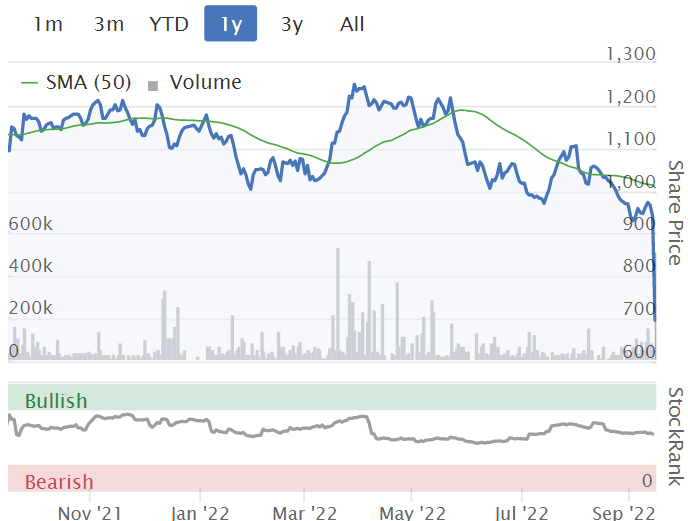
Hilton Food (LON:HFG) - is down 27% today, on a profit warning. The house broker lowers FY 12/2022 forecast by 23%, so this price reaction looks justified. Acquisitions have been fuelled by debt, which looks a bit too high to me. It's trying to expand, fund a lot of capex, and pay divis at the same time, which looks too ambitious. Overall, it doesn't interest me - the margins are too low, and inflation/costs/consumer retrenchment are all significant headwinds.
Graham's Section:
THG (LON:THG) (555m) - this e-commerce business issues a profit warning with its interim results. Rising whey prices have hurt margins at its myprotein business, and its beauty brands and websites are also suffering from the difficult consumer environment. THG has elected to “protect” and “shield” its customers from rising prices, in order to gain market share and improve customer retention. This has resulted in a large (£89m) loss in the six-month period, and a significant increase in borrowing far beyond that which would have been caused by normal seasonal outflows. This company had a much higher valuation at IPO, far higher than our market cap threshold. However, even at its current much reduced asking price, I am struggling to find any value or quality here. After today’s share price fall, the adjusted EBITDA multiple is still 6x-8x.
Avation (LON:AVAP) (£58m) (+4%) [no section below] - this aircraft leasing company provides an update for FY June 2022. The results will be published in full on September 29th, but for now it lets us know that it expects to have made a net profit, on revenues of c. $115m. This signals a recovery from the disastrous year that was FY June 2021 (see coverage by Jack here). As a footnote to the Virgin Australia collapse, Avation announces that it will receive 5.4 cents on the dollar from its AUD $101.4m claim against that company, with the possibility of additional payouts.
The fallout from Covid undid the financial gains made by this company over several years, but if that event can be considered extremely rare and unlikely to happen ever again, then these shares might be worth exploring - it has a long-term record of attractive returns on equity. Net assets per share were £1.64 as of December 2021 and although much will have happened in the intervening six months, the value on offer here could be substantial. Deserves further study. [no section below]
Explanatory notes -
A quick reminder that we don’t recommend any stocks. We aim to review trading updates & results of the day and offer our opinions on them as possible candidates for further research if they interest you. Our opinions will sometimes turn out to be right, and sometimes wrong, because it's anybody's guess what direction market sentiment will take & nobody can predict the future with certainty. We are analysing the company fundamentals, not trying to predict market sentiment.
We stick to companies that have issued news on the day, with market caps up to about £700m. We avoid the smallest, and most speculative companies, and also avoid a few specialist sectors (e.g. natural resources, pharma/biotech).
A key assumption is that readers DYOR (do your own research), and make your own investment decisions. Reader comments are welcomed - please be civil, rational, and include the company name/ticker, otherwise people won't necessarily know what company you are referring to.
Paul’s Section:
MJ GLEESON (LON:GLE)
464p (pre market open)
Market cap £271m
I’m a recent convert to the delights of this value share, and covered its “significantly ahead” trading update for FY 6/2022 here on 11 July 2022. Re-reading my notes, this low cost land developer & housebuilder (for first time buyers mainly) looked great value at 526p per share. The only uncertainty needing more research, being cladding costs.
There are some useful short videos here on the company's website, explaining what it does.
The good news is that results out today look great, the outlook seems fine, and the share price is now even lower, so should we be rubbing our hands with glee, son?! (Geddit?!)
As you can see, the financial highlights look really good -
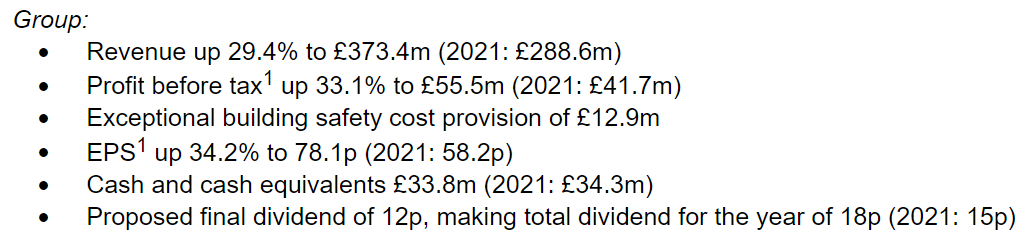
EPS looks like a beat, actual being 78.1p, vs broker consensus on the StockReport of 71.6p.
Dividend yield is nearly 4%, and the 18p total divis are more than 4 times covered, so the dividend paying capacity is much larger than the actual payout.
Balance sheet - is stupendously good, as a lot of housebuilders are. In previous downturns, the leveraged balance sheets resulted in housebuilders almost going bust, I recall. This time around, they’ve generally got superb, ungeared balance sheets. So the cyclical risk is probably lower than in past economic downturns.
NAV is £272m (NTAV is the same, as there are no intangible assets). That’s within a whisker of the market cap, at £271m. That strikes me as a terrific asset-backed bargain. Bear in mind there would be upside value on the land bank, in the books at cost. So you’re really getting this share at a discount to its net tangible asset value, which doesn’t make any sense to me.
Current assets are £353m, whereas ALL creditors total £95m! That’s astonishingly good.
I’d say this share looks a sitting duck for a takeover bid, on the basis that it’s priced well below its fundamental value, and is trading well, making good margins.
The best bit, is that its low price new homes are in strong demand, and the energy crisis is helping - because well insulated new homes will cost a lot less to heat than draughty old rental properties.
Average selling price is only £167k - which again makes this share so attractive, as new homes that affordable are not likely to see much, if any downturn in price, especially when incomes are rising strongly.
Outlook - pretty upbeat, considering the macro environment -
This is another excellent performance which reflects not only the strong operational capability of our business but also the continuing structural under-supply of affordable homes for first time buyers on low incomes.
As well as being affordable, our high-quality homes are also very energy efficient, costing significantly less to run than most houses in the UK, particularly in the rented sector. As a result, our homes are much sought after, and demand remains resilient.
Gleeson Land's market remained robust throughout the year and the business delivered a strong result. Demand in the South of England for quality sites with sustainable and implementable residential planning permission remains strong and the division is well-placed to drive further sustainable growth.
The Board has reviewed a range of macroeconomic forecasts and, notwithstanding the current outlook for the broader economy, remains confident that the Group, with its defensive qualities and unique position within the wider house building sector, is well-positioned to deliver further profitable growth in the current financial year…
Employment levels remain high and mortgage availability, supported by the recent relaxation of lending rules, is robust. Whilst the withdrawal of the Help to Buy scheme, which closes for new applications in October 2022, means no government support for homebuyers for the first time in over 20 years, it is not expected to impact the affordability of, or demand for, a Gleeson home.
The average selling price of a new build home in our geographic regions is £266,000, 59% higher than the average selling price of a Gleeson home at £167,300. Gleeson Homes is therefore uniquely positioned to serve customers who might previously have been considering a more expensive property but who, in the current environment, will look at more affordable price points. We are already seeing interest from these value-driven customers.
Cladding & fire remediation - more clarity & detail here -
In signing the Department for Levelling Up, Housing and Communities' ("DLUHC") pledge in April 2022, the Group gave its commitment to investigate and remediate any life-critical fire-safety issues on buildings over 11 metres in which the Group had some involvement in developing over the last 30 years. Following a detailed assessment of the buildings covered by the pledge, an exceptional provision of £12.9m has been recorded this year. This estimate of the life-critical fire-safety remediation costs for these buildings is based on reviews and surveys completed to date. We are in the process of undertaking a programme of intrusive inspections and fire risk assessments, where permitted by the building owners.
Like all housebuilders, we have also been subject to the additional 4% residential property developers tax ("RPDT") from April 2022, which was designed to raise at least £2bn over a 10-year period towards the government's cost of dealing with defective cladding. This comes on top of the planned rise in corporation tax from April 2023 from 19% to 25%.
(I thought the Govt was reversing the rise in corporation tax, or maybe I imagined that? Maybe it hasn’t yet been formally announced?)
My opinion - there’s so much to like her, I only wish I had some spare cash to buy some. Not for a trade, but for a long-term position. It looks exceptional value right now, in my opinion. As always, please DYOR, because I might have missed something that explains why it's so cheap - do post your comments if you think I'm wrong, we want to hear contrarian views!
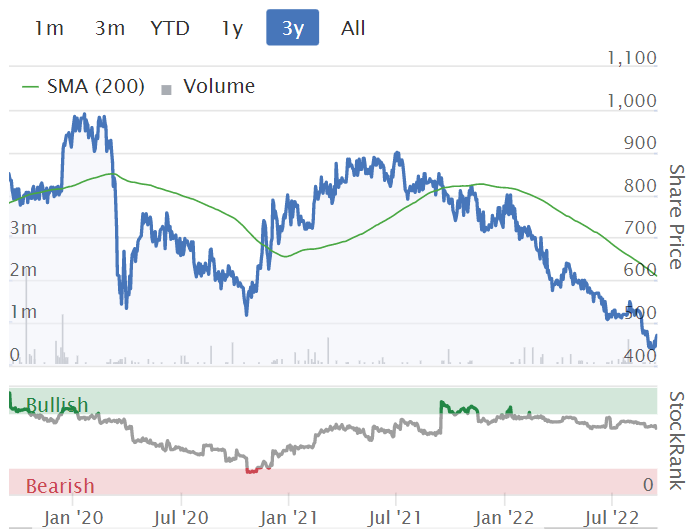
Note the share price is now well below the pandemic lows. The share count has only risen from 56m to 58m over that time.
A friend points out that other housebuilders also look cheap at the moment, Redrow (LON:RDW) in particular, but it's the defensive nature of GLE that I like, building really cheap starter homes for first time buyers. There's so much demand at that bottom end of the market.
.
.
DFS Furniture (LON:DFS)
117p (down 14% at 08:40)
Market cap £284m
The 14% drop this morning has wiped £47m off the market cap.
As regulars here will know, we like the business of DFS in itself, but detest its horribly stretched balance sheet. To make matters worse, reckless share buybacks are underway, with management seemingly unconcerned about the economy going into a recession.
This is despite the fact that they had to do an emergency fundraising when the pandemic began, so I just cannot understand why they’re being reckless again with the balance sheet, so soon into the next downturn.
Shares in the whole sector have been under pressure, with SCS (LON:SCS) dropping heavily, along with DFS, and of course the supposed disruptive challenger, Made.Com (LON:MADE) has been the biggest disaster, and looks to be heading to zero, in my view, due to the massive losses it’s now generating.
Note also that DFS, which had been doing well with online sales, has seen that fall back sharply from 34% of sales last year, to 22% this year - so (hardly a surprise) it seems that customers do mostly prefer to see, and touch furniture before they buy.
Anyway, let’s look at today’s update.
DFS Furniture plc (the "Group"), the market leading retailer of living room and upholstered furniture in the United Kingdom, today announces its preliminary results for the 52 weeks ended 26 June 2022 (prior year comparative period is the 52 weeks ended 27 June 2021, non Covid-19 disrupted comparative period is the unaudited pro-forma 52 weeks to 30 June 20191).
I don’t think the company headline adds much value -
OVERCOMING SIGNIFICANT COVID-RELATED CHALLENGES WHILST SECURING MARKET SHARE GROWTH AND REMAINING FOCUSED ON LONG-TERM VALUE CREATION
DFS gives very clear guidance, and on 5 July 2022 it sounded upbeat, saying FY 6/2022 adj PBT would be at the top end of its guidance for £57-62m. The actual figure today is £60.3m, so that’s just about as expected.
That’s a long way down on last year’s £109.2m PBT, which was boosted by people revamping their homes during the pandemic, and Govt support measures.
Pre-pandemic the adj PBT was £52.6m, so it looks as if the business has returned to making £50-60m profit p.a., which is similar to what it achieved in 2016 & 2017. So not really a particular growth story, at least in profitability terms.
The big drop in profit from LY, is due to the gross margin dropping from 56.3% to 52.7%, but mainly due to a huge increase in selling & distribution costs, up from £298m in FY 6/2021, to £368m in FY 6/2022. A lot of that is probably the unwinding of Govt support measures, such as business rates relief, plus wages & utilities rising.
In EPS terms, FY 6/2022 saw 17.5p achieved, so at 117p, the PER is 6.7 - low, but low for several good reasons, I would say.
Outlook - this is probably more important than the historic numbers now.
As I’m sure we would all expect, demand is now softening, this shouldn’t be a surprise to anyone -
In the fourth quarter of FY22 and first quarter of FY23, order volumes for the Group softened markedly relative to pre-pandemic levels, reflecting a trend seen widely across the furniture industry. The macroeconomic environment remains challenging, given the potential effects of the current high-inflationary environment on consumer behaviour. We therefore present three alternative scenarios for performance in the financial year:
As always, the guidance DFS gives is superlative. If only all companies (and broker research) would do this low/medium/high range of scenarios -

.
Note that, as we’ve seen this year with online competitor Made.Com (LON:MADE) there’s no guarantee that companies will necessarily achieve results within the guided range. MADE blasted through the downside scenario with a series of profit warnings earlier this year.
Plus remember that, by using order intake in the above table, that does provide something of a buffer to profits, since some of the downturn would be deferred, due to the time lag between placing an order, and recognising the revenue & profit.
If we take a gloomy view, then I reckon this could see EPS drop into single digits this new year, FY 6/2023. If you’re more optimistic about the macro picture, then profitability might be more robust, who knows!?
Going Concern note - tells us that everything will be fine, even in a severe but plausible downside scenario. However, what this assumes is that the banking consortium remains supportive. Previous recessions have taught me that you cannot rely on banks to be supportive, when things get difficult. They hate risk, and sometimes force listed companies to raise money from shareholders, at the worst time & price.
Note how the RCF is already mostly drawn down as of 12 Sept 2022, without much headroom -
The Group has a £215.0m revolving credit facility which has been extended to mature in December 2024, with an option to extend the facility for a further year, subject to mutual agreement with the consortium of lending banks. At 12 September 2022, £37.0m of the revolving credit facility remained undrawn, in addition to cash in hand, at bank of £5.5m.
Covenants applicable to the revolving credit facility are: 3.0x net Debt/EBITDA and 1.5x Fixed Charge Cover, and are assessed on a six-monthly basis at June and December.
The Directors have prepared cash flow forecasts for the Group covering a period of at least twelve months from the date of approval of these financial statements, which indicate that the Group will be in compliance with these covenants.
Bank financing carries risk, and DFS management seem dangerously complacent about this.
The facility has been extended by another year but only to Dec 2024, so it’s not secure, long-term funding. Yet the whole business is dependent on that bank facility.
Where are the customers’ cash? It’s been spent! On divis and buybacks, which DFS calls “surplus capital”, when it actually has a yawning deficit in capital, with heavily negative NTAV.
I think this is a horrendous situation actually, just an accident waiting to happen. Management strike me as absolutely delusional.
Balance sheet - very much the elephant in the room.
Furniture retailers have a negative working capital model - i.e. they get paid by customers, before they have to pay suppliers for making the product (usually made to order).
So there should be a big pile of surplus cash sitting on DFS’s balance sheet, as there is with smaller rival SCS (LON:SCS) , but there isn't any (significant) cash, it's gone!
Net bank debt has shot up from £17.1m a year ago, to £88.5m at 6/2022. Judging from the going concern note above, this seems to have further increased to £172.5m as at 12 Sept 2022, with only £35m headroom left on the bank facility.
Overall, the balance sheet is horrible. NAV is £268.9m, but that includes worthless intangible assets of £533.8m. That leaves a nasty NTAV deficit, of £(264.9)m. Remember that management think they have surplus capital, when they quite obviously don’t.
IFRS 16 entries are £338m RoUA, less lease liabilities of £445m, so a deficit of £107m. That suggests there must be some loss-making, onerous leases within the store estate.
If we eliminate all the IFRS 16 entries, that shrinks the NTAV deficit from £(264.9)m to £(157.9)m - still pretty awful.
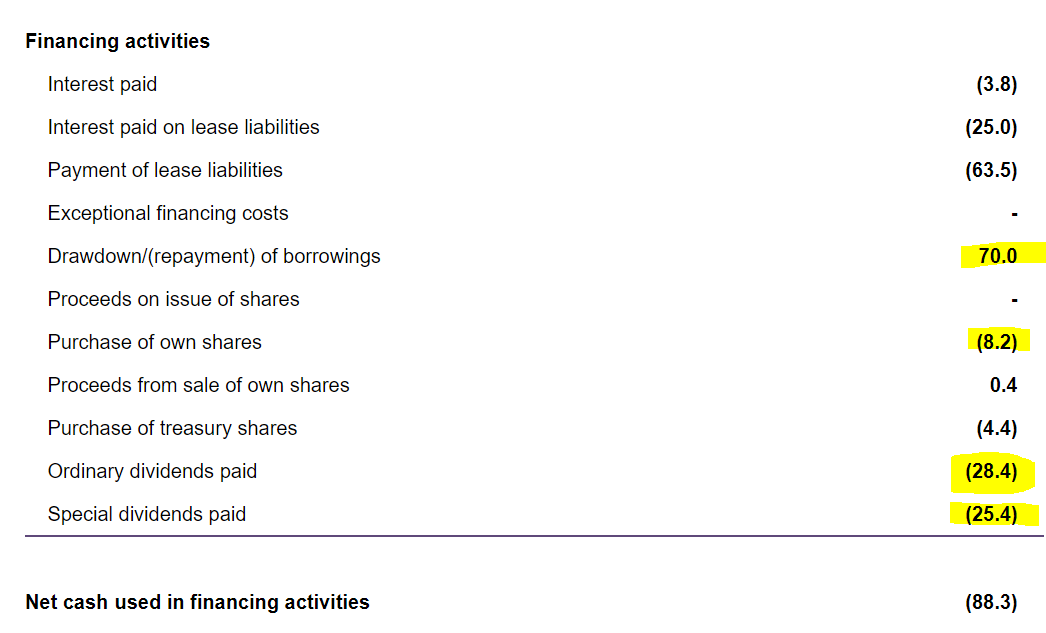
Divis/buybacks - with such a ropey balance sheet, and going into a recession, DFS has borrowed to give £75m to shareholders - this is madness -
This 3.7p final ordinary dividend taken together with the 3.7p interim ordinary dividend and 10.0p special dividend paid in May and also the £35m of share buybacks will mean the Group will have returned over £75m of capital to shareholders during calendar year 2022.
Cashflow statement - is complicated. The way I look at it, there wasn’t any free cashflow, since adverse (normalising?) working capital consumed cash, and what was left was spent on capex.
The financing section is the most revealing, which shows that all the shareholder returns were financed from bank borrowings -
.
My opinion - if the good times were still rolling, then I could maybe overlook the horrible financing structure, which reminds me of how private equity strip out cash & load companies up with debt.
However, it seems to me that, given very tough macro conditions, DFS management seem to be doing a Titanic - and speeding up as they approach the icebergs.
Special divis, and share buybacks, are things that should only be done when there’s surplus cash sitting around. To finance them from a big increase in bank borrowings, at a time when customer demand is softening, just seems an unimaginable thing to do. It’s asking for trouble.
If the economy really turns sour, then people curtail big ticket spending. Surely DFS know that? Hence they should be hoarding cash, not maxing out the overdraft.
Given all the above, I’m putting DFS on my uninvestable list, because it’s too high risk. It might be a false alarm, but the last thing I want to be invested in, going into a probable recession, is a big ticket consumer-facing company, that’s loaded up with debt. It’s not just the bank debt either, remember that trade creditors often rely on trade credit insurance, which can be withdrawn in the blink of an eye.
Hence a thumbs down from me, mainly due to the wobbly funding structure, but also deteriorating forward outlook.
.
Hilton Food (LON:HFG)
697p (down 26% at 13:09)
Market cap £623m
Mr Market has just thrown HFG back into our small caps space, and it’s currently lying on the floor, groaning!
It’s given up the previous 5 years’ upward share price momentum in the last 5 months, including today’s move.
I last looked at this 6 years ago, so my previous notes here are outdated. Especially as the business seems to have tripled in size since then.
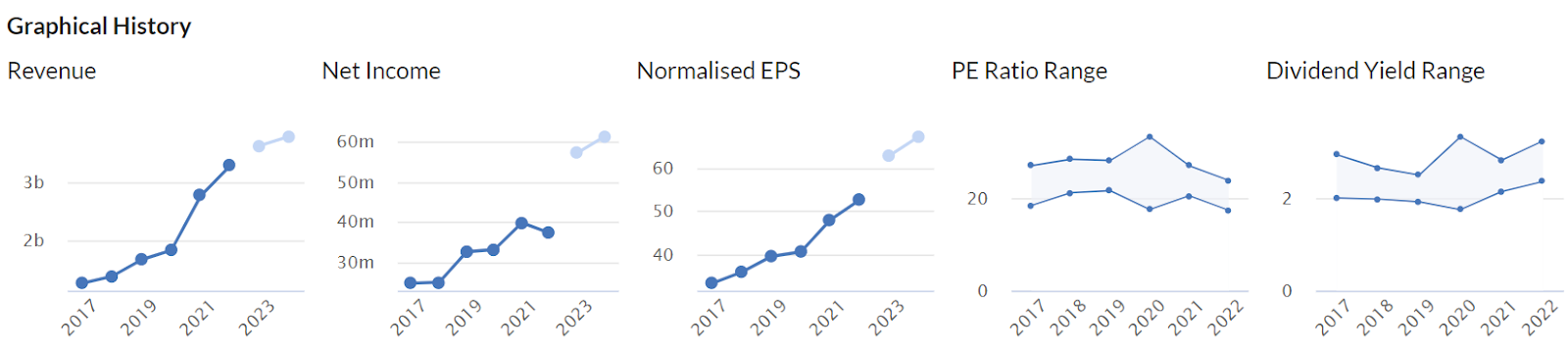
As you can see, there’s been a fairly good progression in profits & EPS too - although today’s market move suggests the forecast (lighter coloured blobs below) might be coming down somewhat -
Is it a bargain? Let’s find out.
Hilton Food Group plc, a leading international protein producer, is pleased to announce its interim results for the 28 weeks to 17 July 2022.
Key points from interim results -
Big H1 revenues of £2.04bn (up 19%, or 20% at constant currency)
Wafer thin margins though, with operating profit only £30.8m (up slightly)
Finance costs & tax both look quite high, so statutory PAT is only £14.5m (down 15%)
Adj basic EPS for H1 is down 12% to 28.0p
Small cut in the interim divi to 7.1p (H1 LY: 8.2p)
Adjusted numbers look a bit more respectable, removing goodwill amortisation, and making adjustments for IFRS 16 it seems (see note 16): adj EBITDA £66.6m, and adj PBT £34.4m.
Balance sheet - it’s a capital intensive business, and notice it also seems to rely on a lot of leased properties, with big IFRS 16 entries.
Net bank debt is high, after acquisitions, at £221m. That looks a little too much for comfort, in an economic downturn.
Going concern note is reassuring, well within banking facilities, which are committed until 2027.
Outlook - is a profit warning, but not quantified -
While we benefit from the strength of our diversified business model and continue to grow volumes internationally, Hilton has not been immune from the impact of macroeconomic headwinds. Across our markets, we have seen volumes come under pressure with the cost of living increasing and consumers becoming ever more cost-conscious. In our Seafood business these trends have been exacerbated with world events leading to unprecedented raw material price increases.
Given these factors, and combined with the impact of start-up costs and rising interest rates, the Board now anticipates that profitability for the year will be below expectations. However despite these short-term challenges Hilton's well-invested business, the recent acquisitions of Foppen, Dalco and Fairfax Meadow and our investments in Agito, Foods Connected and Hilton Food Solutions provide a strong platform for medium-term growth. We continue to explore opportunities for both geographic expansion and growth in our existing markets across the five pillars of our proposition.
Forecasts - many thanks to Shore Capital for letting us see its revised forecasts, up on Research Tree. This lowers FY 12/2022 EPS forecast by 23%, to 50.8p (a PER of 13.7). This is a drop of 16% against FY 12/2021 actuals.
I suppose it’s to be expected that a meat producer or distributor would come under pressure from consumers reining in household budgets, combined with inflationary cost increases.
I wonder why the company didn’t get brokers to gently guide down forecasts earlier, when these cost pressures & consumer hesitancy first started? It doesn’t look terribly well handled.
My opinion - it looks an OK business, but the trouble with low margin companies, is that it doesn’t take a lot to knock the profit numbers heavily. Profit is the small difference between 2 very large numbers (revenues, and costs).
Given the heavy debt, and a balance sheet that’s only really adequate, I don’t think I’d want to pay more than a single digit PER for this share at the moment. So it’s not of interest to me fundamentally, nor on valuation (which isn’t particularly cheap, even after today’s fall).
StockRank is only middling -
.
Graham’s Section:
THG (LON:THG)
Share price: 39.8p (-19%)
Market cap: £555m
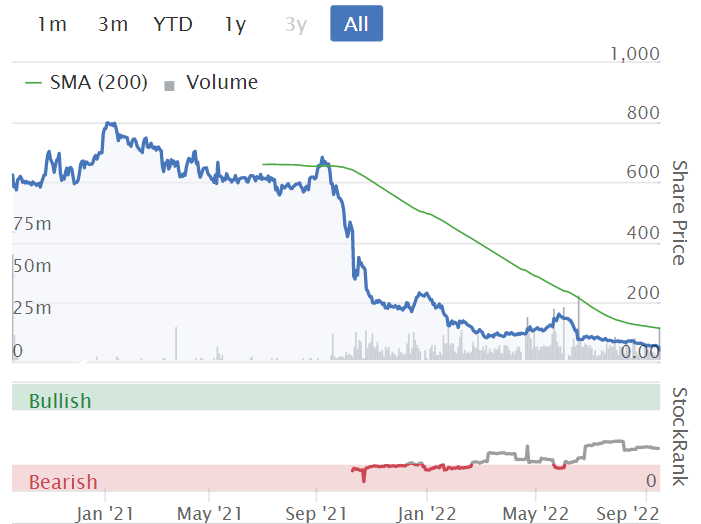
This one has dipped below our market cap threshold, after a 94% share price decline from the peak that it reached early last year.
It’s a stunning loss of value from a company whose IPO valuation was £5.4 billion - it was the biggest UK IPO since Royal Mail. And that was less than two years ago.
But the IPO valuation is in the past. Those who went ahead and bought shares from the private equity sharks at KKR must surely regret their decision, but it can’t be changed. Let’s see what today’s interim results have to say about the future of the business.
What it does - THG says that it has built an “ecosystem”. If you want a quick rule of thumb to avoid overpriced puffery, then run (don’t walk) from any company that claims to have made an “ecosystem”. An ecosystem is a rainforest or a lake - not a business.
More seriously, this is what THG does:
Since 2004, we have grown from a British start-up to a globally renowned end-to-end tech platform specialising in taking brands direct to consumers worldwide, powered by our propriety (sic) technology platform, THG Ingenuity
The group includes a collection of beauty brands and beauty websites, the nutrition brand “Myprotein”, the e-commerce platform Ingenuity, and a collection of smaller, related businesses.
Results highlights for H1 2022
- Revenue +12% to £1.1 billion
- Adj. EBITDA minus 60% to £32m
- Operating loss £89m (last year: operating loss £17m)
The financial loss is said to reflect “consumer price protection investment strategy” (yuk!).
Gross margin declined because of the company’s strategy “to partially shield consumers from adverse macro-economic conditions and a period of unusually high raw material costs (principally whey).”
This is nonsense, isn’t it? Since when does a company selling lipstick and protein powder decide to lose money, out of a desire to protect and shield its customers?
THG argues that the “investment” is helping to drive consumer retention, but so what? Losing money isn’t sustainable, so THG is only going to have to raise prices sooner or later, anyway.
Balance sheet
There is little tangible balance sheet value here. The company has equity of £1.7 billion but that includes nearly £1.6 billion of intangibles. Strip them out and tangible equity is about zero.
Also, while the working capital position looks comfortable (£1 billion of current assets vs. £600m of current liabilities), the company has had to take out £500m of long-term borrowings. Net debt is £226m.
The company says there are seasonal effects here, but the company had a large net cash position a year ago. It’s the non-seasonal investment decisions that have mainly driven the plunge into debt.
At least the banks are happy to lend and THG has headroom of £170m in undrawn facilities, plus a new £156m facility. But where is all of this going to lead for shareholders? I like to invest in businesses which generate lots of cash, and have surplus cash to send to shareholders - no sign of that here.
Outlook
The company cuts its adjusted EBITDA forecast for the year (previously, it expected to achieve around £160m).
Noting the impact of rising interest rates and energy prices on consumers, it says (emphasis added):
Despite this outlook, the Group anticipates a strong H2, with another period of double-digit growth. This performance is expected to be supported by increasing growth rates in both Nutrition and Ingenuity, comparatives easing, stable AOV's, new customer acquisition and repeat rates.
Pricing power across THG's own brands allows inflation to be partially mitigated through increased prices, albeit the Group remains committed to raise slower and lower than inflation to protect consumers and drive market share gains.
Whilst inflation is easing in core areas such as commodities, the majority of margin benefits will be realised in the fourth quarter due to forward buying plans. Therefore the Group now expects FY 2022 adjusted EBITDA between a range of £100m to £130m…
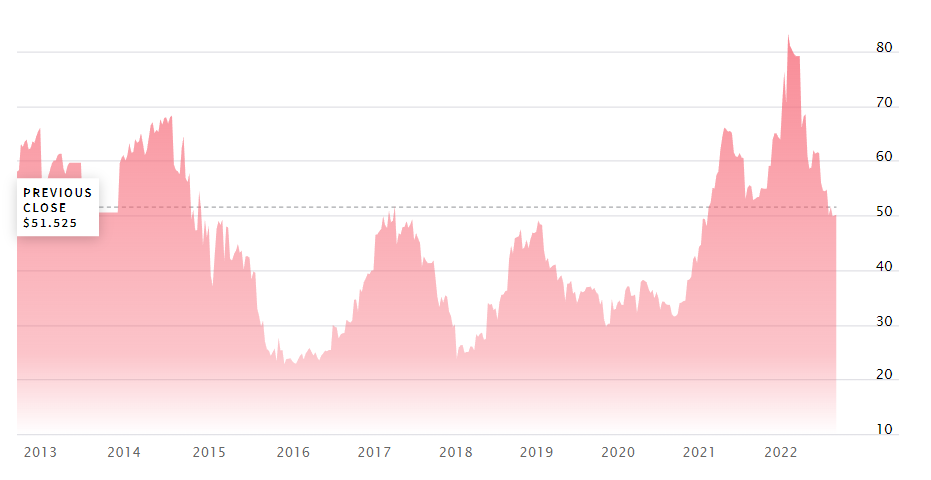
Looking out beyond the current year, THG expects its EBITDA margin to recover. It thinks that lower whey prices will help to normalise its margins.
Courtesy of nasdaq.com, I’ve found a long-term chart of the whey price:
My view
Despite its hard work in selling its story, I’m not sure if there is any high-quality business among THG’s large assortment of enterprises.
In theory, myprotein should be a valuable brand. But it’s being run as if whey prices hadn’t increased, on a theory that commodity prices will come back down to their 2019-2020 averages. If they don’t come back down, what then? The company - and by extension its shareholders - will be saddled with hundreds of millions of pounds of bank debt.
It already owes the banks £500m, and judging by its eagerness to open a new credit facility, this number may be set to increase.
Therefore, even at a price/sales multiple of only 0.5x, I’d be wary about getting involved. Add on the bank debt to get the enterprise value, and you’ll find that enterprise value/sales is closer to 1x.
Another metric we could use is enterprise value divided by adjusted EBITDA. For THG this year at the latest market cap, I think this is in the range of 6x-8x. That could make sense for a high-quality, profitable enterprise. It does not make sense for THG.
This is a falling knife that I would not be interested in catching.
Disclaimer
This is not financial advice. Our content is intended to be used and must be used for information and education purposes only. Please read our disclaimer and terms and conditions to understand our obligations.

60 comments
Ecosystems are worth investing in, if they truly turn out to be that. £GOOG and £AAPL are the best known example. Hence why all sorts of companies' IR and PR departments have tried to claim their businesses are also ecosystems in the making.
Thanks for the analysis of THG which I thought was one of the best explanations I have read on its recent decline.
I did wonder however if it was fair to completely discount the Intangibles given the nature of the underlying business. The brands are after all what allows it to generate such substantial revenue and growth, and surely have material value.
Also, as a vertically integrated business operating at scale, it does have pricing power (especially in beauty) and operational efficiency that smaller competitors will not.
Having read the half year pack this morning, the explanation that admin expenses are temporarily high and will fall as new businesses are integrated does make sense. Add this to the fact (probability?) that with falling input costs, future price rises and lower operating costs, there is a clear path to profitability.
Also interesting was that 20% of sales are in the US. No small achievement for a UK business.
Re £THG "Since when does a company selling lipstick and protein powder decide to lose money"
The big problem here is that I take this for code to mean "we have no pricing power." So down the plughole we go.
This seems to be a little like Premier Foods (LON:PFD) when it started out. They wanted to "build a portfolio of brands". So they bought some brands that other companies were happy enough to jettison, went on an acquisition spree at undoubtedly inflated prices, racking up debt in the process. Earnings growth was great (at the start) and the share price went up.
Then the whole thing collapsed. Amazingly, Premier Foods (LON:PFD) managed to keep going, and in fact seems to be clawing its way slowly back from the abyss.Let us not forget that no brand is forever. Maintaining a brand costs money, and consumer tastes can change.
There's a few lessons here. 1. Acquisitions, although sometimes good, probably aren't. There's often too much hubris on behalf of the acquirer. 2. Too much debt will kill you. 3. Folk overplay EPS growth, and underplay ROCE.
Premier Foods (LON:PFD) was a classic example of this. The EPS goes up nicely, so does the share price, almost always accompanied by a higher PE, too. But the increasing debt and decreasing ROCE are signs that the company is destroying, rather than creating, value. Then something bad happens, and the whole thing comes tumbling down.
Anyway, this is the first I've heard of THG (LON:THG), so I don't know how similar the situation is.
And to think there were some mooted 150p-200p bids for £THG just a few months ago! And the share price is now 40p at the end of today...
Sorry, the conspiracy theorist in me needs to escape:
Is it conceivable that management could blow up a listed company to force it into some kind of administration or dilution whereby they get to buy it back for peanuts?
£MPAC *** FREYR 3-year supply agreement (new note from Equity Development) ***
Mpac Group has announced that it has signed a framework agreement with FREYR Battery, for an initial three-year period, for the exclusive supply of casting and unit cell assembly equipment to FREYR’s battery cell production line at FREYR’s Giga Arctic plant in Mo I Rana, Norway. This is an important step towards the commercialisation at scale of Mpac’s technology at the start of FREYR Battery’s major investment in next-generation clean energy provision, and a clear validation of Mpac’s commitment to this new market vertical.
As indicated by the 3-year agreement announced today, Mpac will seek long-term partnerships in this rapidly-growing segment of the clean energy sector, using its expertise to add production (and battery-size) scale, and with this achieve cost reductions for its clients.
At this stage our outlook to FY24 remains unchanged, but we are sensitive to updates in this rapidly-developing addition to Mpacs core markets. Our fair value for Mpac is 485p/share, indicative of a FY24 EV/EBITDA multiple of 6.7x.
Link to full report: https://www.equitydevelopment.co.uk/research/freyr-3-year-supply-agreement
A rare bit of green and upward arrows on the screen for one of our small cap friends. MPAC (LON:MPAC) Up 17% today on this news.
Hi Paul
Re M J Gleeson
I work for one of the top 4 builders on sales and your comments are spot on. My next development will be selling houses outer London . Apartments will struggle in the south due to end of help to buy and rising interest rates which will have a big impact on affordability especially for first time buyers.
Thanks for your comments on Mj Gleeson and agree they would make a great takeover candidate.
regards
jeff
Thanks jeff, that's good to hear.
I was watching the short videos on Gleeson's website here, and it looks very different to the other housebuilders. The houses (no apartments) look lovely - small, but incredibly cheap. Also, two thirds of buyers are key workers, so it would probably be a nice place to live. They don't sell to investors, only to owner-occupiers, and often build on brownfield regeneration sites.
Set against that, as prompted by a reader here, I've also been looking at the TrustPilot scores & customer comments, which are split evenly between excellent, and awful (often the case with Trustpilot, as only the extremes are motivated to leave a review).
But the detailed complaints from many customers do give the impression that the builders are slapdash, and leave behind lots of snagging lists.
Mind you, my parents bought a new house in the late 1970s, and I remember many things being sloppy, incomplete, and getting them to remedy faults was slow, and painful.
So maybe the lesson is to only buy properties that are nearly new, and let the original buyer go through all the pain of sorting out the snagging list!
It always amazes me how low UK building standards are too. Floors & stairs seem so flimsy & move about when you walk. The walls are paper thin, and you can hear everything going on in the rooms underneath and adjacent. Tiny garages that don't fit a modern car (or you have to climb out of the sunroof!)
Maybe it's time for the Govt to revamp building standards, so that we gradually get better quality housing? After all, the housebuilders make insane profits, for throwing up shoddy houses. I'd be interested to know how this compares internationally? I recall visits to peoples' houses in Germany, France, and Belgium (a long time ago, mind) and being amazed at how much better built, and more spacious, ordinary houses there were, compared with what I was used to in the UK.
Plus of course the obligatory visitors from the USA and Australia, coming into your home, and saying "Oh my God, everything is so small!" And complaining about the lack of water pressure in the bath/shower.
Regards, Paul.
For comparison I checked Trustpilot reviews for Barratts and Bellway (much more expensive homes around 300k, and both 5 star builders) - these both scored 4.3, versus 3 for Gleeson. Not sure how much should be read into this, but perhaps suggests that you get what you pay for.
House builders do generally look cheap. Dependable dividends from them over the years. Which ones, considering Barratt or Vistry.
I have only just got in front of a computer but finally some good news. MPAC (LON:MPAC) has announced
"Mpac signs framework agreement with FREYR for the supply of automated cell assembly equipment"
https://www.research-tree.com/...
Short and sweet but emough to give a filet to the stock price. Up 23% as write. I held through this sell off as I like this company despite the hideous pension fund (this could become less onerous under high bond rates and interest rates, though above my pay grade to know the effect of inflation on pension deficits).
Another long term holding of mine, Anglo Asian Mining (LON:AAZ), is also up today on H1 update. Up 6% as type. This is also 54% (MPAC 58%) from 12 month high but again I have held.
https://www.research-tree.com/...
Regards
Michael
Good afternoon, I've just been looking briefly at Hilton Food (LON:HFG) following its interim results today. SP has dropped 26% so far but results don't look that bad apart from inflationary costs as a result of macro. Now looks to be lowest SP for about 5 years. Looks interesting but would appreciate others views as always!
Many thanks for looking at Hilton Food (LON:HFG) so quickly Paul, it's very much appreciated, and it's great to hear your thoughts. I think I'll pass on any purchasing today. All the best!
Hi Bristolian,
I've just published a section on Hilton Food (LON:HFG) - it's a profit warning, with broker forecast for FY 12/2022 lowered by 23%, to well below 2021 actuals. So unfortunately, the price drop today does look justified.
Regards, Paul.
Thanks Paul, super analysis and most useful. Like Bristolian I might pass on purchasing today!
Director share purchases continue at £VNET (I hold)
On 14th September James Dickson Chairman and interim CEO bought 20,000 shares at 48.5p and Stella Panu (recently appointed NED) bought 45,000 shares at 47.8p
Previously on 4th August the Interim CEO bought 30,000 shares at 61.8p
and on the 1nd August Stella Panu bought 30,000 shares, her first purchase, at 67p
The James Dickson now owns 17.7% and Stella Panu 0.26% of the issued shares.
Not huge purchases by some standards. But large, I think, in the context of the interim CEO's remuneration 209k and the usual NED payment at VNET of a lowly 32k?
Vianets share price has fallen sharply in the last month - most likely in response to the perceived closure of large swathes of pubs. I suspect the fear is overdone because just enough help will arrive to prevent mass closures though vulnerable independents may have no choice. And because Vianet's connections are almost entirely to pubco's and brewery owned chains - rather than independents - and less likely to close in the short term. I suspect that the directors agree with me - and with their smartzones division adding connections strongly and more profitable than the pub division at the last results it looks undervalued to me. Though not to everyone's taste and none of us know what the next few months will bring so definitely not for the faint-hearted.
cheers
Mark
Hi Paul
I hold 2 housebuilders, one of which is MJ GLEESON (LON:GLE) . I agree with all your points, particularly their low cost proposition.
The chart below is a couple of years old now, but it shows how cheap the MJ GLEESON (LON:GLE) homes are vs other listed competitors.
My belief is that whatever happens elsewhere, their prices are so low that they will never not be able to sell their homes.
Even if they increase their prices, they'll probably still be the cheapest homes on the market.
---
And here are some long term stats for any interested.
(ASP = average selling price; OP = Operating Profit)
Do you know how they are able to sell homes so cheaply yet still make a healthy profit? Is it just because land is cheaper in the regions where they develop, or is it because they build smaller, no thrills homes (perhaps a combination of both?)
There is surely the question of the quality of the construction as well ? It might well be profitable to sell shoddy substandard homes in a market where people are desperate to get onto the housing ladder (maybe this is what you meant by no thrills). I just had a quick look at Trustpilot... !
MJ GLEESON (LON:GLE)
Hi Bouden54
Their gross margins (c30%) seem pretty comparable with Persimmon (LON:PSN) (the other house builder I own) so I don't think there is anything untoward happening.
The MJ GLEESON (LON:GLE) homes are generally much smaller as well - 2 bed houses without garages:
https://gleesonhomes.co.uk/hou...
Compare this with Persimmon (LON:PSN) homes, which generally sell >3 bedrooms and many with a garage:
https://www.persimmonhomes.com...
MJ GLEESON (LON:GLE) have been listed for a long time and I've never seen anything strange in the accounts.
For reference I was rummaging though old MJ GLEESON (LON:GLE) Annual Reports this morning and I recall one of them saying that individual land plots generally cost £9k. I can't remember which year that was for though I'm afraid - maybe 2019?
Making £26k on a £167k sale doesn't seem unreasonable to me.
I'm afraid that I can't offer any more insight, but from the numbers alone, I remain a content holder.
Cheers
Abs
MJ GLEESON (LON:GLE)
I've just finished watching the results video from today and can confirm that they generally target brownfield sites that none of the other developers want to build on.
Their price per plot is closer to £12k vs the £50k-£100k paid by developers in more prime locations (this is their words towards the end of the Q&A.)
A
In July we highlighted how net FUM inflows in FY22 (+£785m), were a sign of strategic strength, and emphasised the impressiveness of Q3 and Q4 flows (+£179m and +£280m) during a period of sharp market falls, which often correlates with weakening flows for investment managers. Today, with more peer data available, we re-emphasise this, and highlight that Brooks Macdonald (LON:BRK) has been one of the strongest performers in attracting and retaining client funds.
Also, with the release of FY22 results, BM has demonstrated that it can translate this strategic strength into financial success, with revenue, profit, profit margins, and dividends all up, despite top-line FUM being pegged back by market falls (FY21: £16.5bn; FY22: £15.7bn).
These factors, coupled with an upwards mark-to-market FUM adjustment (PIMFA Private Investor Balanced Index +2.4% quarter-to-date) lead us to increase our medium-term growth forecasts and consequently our fundamental value to 3,100p (from 2,900p), 41% above the current share price. We also highlight that BM’s PER of 14.8 is well below a peer group median of 18.6.
Full note here: https://www.equitydevelopment....
And presentation Tuesday 20th at 12pm https://www.equitydevelopment....
M J GLEESON
Does the High Earnings Manipulation Risk bother you
Well spotted. Out of interest Barratt Developments (LON:BDEV) also has a high earnings manipulation risk.
Well, that's the trick - there's some complicated accounting in house building, what with upfront deposits, recognition of revenue in relation to progress of the build, etc. I don't know too much about the sector, but do know that in good times, complex accounting is not an issue. It is in troubling times, that the outgoing tide shows who wasn't wearing any swimwear.
The biggest example in recent history, of course, is Evergrande and the swathe of housing scandals now emerging from China, all related to accounting, financing etc.
Interim results from Checkit (LON:CKT) out today (I hold as a rump from a very successful investment in Elektron Technology).
I am getting impatient regarding breakeven but they say "Management is accelerating its plan to achieve profitability and believes that monthly cash burn peaked in the period".
Edison forecasts LPS 7.1p this year 4.9p next. https://www.edisongroup.com/wp...
I hold Checkit (LON:CKT) too. Edison suggest a 50p target sp for FY2023 but the market clearly worries about the need for another raise before it starts turning a profit. Looks to me like a binary bet from here - it's revenues grow and costs are managed so its doesn't need to raise at all (Edison suggests it has 2-3 years of runway cash left) or it fails to grow sufficiently fast and needs more capital. I halved my position (in the mid 40p range) and will add when that binary bet becomes clearer.
Cheers
Francis
Paul are you planning to take apart DFS Furniture (LON:DFS) balance sheet? results out
Morning davidallen77,
Yes, I'm working on DFS Furniture (LON:DFS) right now! Should be up in about half an hour.
You can probably guess what I'll be saying about its balance sheet, and returning capital to shareholders with special divis & buybacks, fuelled by debt! ;-)
Regards, Paul.
Re DFS Furniture (LON:DFS) presumably there is a carry across to SCS (LON:SCS) too.
They do mention somewhere thaqt Sept was a bit better than July and August, but don't know whether this is a meaningful shift?
There arn't too many companies that can make the statement outlined below in this mornings TS but Eneraqua Technologies (Lon : ETP ) have done that this morning ( I hold ) . The forecast for the half year is at least £24million with Half 2 expected to be more because of the way contracts are awarded
"As highlighted in the Group's AGM Update on 29 July and further evidenced by the contract wins detailed above, the Company has a strong pipeline of opportunities for the current year and beyond with an Order Book1 providing full revenue cover for its FYJan23 revenue target and 79% for FYJan24."
I realise that they are in a group of companies that you are highly sceptical of (IPO 2019) but they are operating in the sweet spot of heat pump technology and energy saving schemes for Local Authorities which means thet the metrics since their IPO are good with sales , profitability and would you believe it dividends all going in the right direction . Sales were £7.61 m in 2019 and they are forecasting sales of over £60 million in 2022 and over £70 million in 2023- according to the TS indicating that the current order book just about covers those forecasts. Other metrics are also good with a PE of 10 .5, ROC of 26.6% and ROE of 43.5 %.
Might be something that could cheer us up !!!!
I'm trying to work out the bear case for this one as it passes all my tests after doing some digging.
It seems too good to be true, and the valuation looks very moderate - making me think either I'm missing something, or everyone else has been missing this!
Potential bear case points?
Anyone who's closer to this please do prove me wrong!
Stockopedia is showing (LON:GLE) as having a High Earnings Manipulation risk? Anyone think this could be a concern?
Eneraqua Technologies (LON:ETP)
You might find this PIWorld presentation of interest
https://www.piworld.co.uk/comp...
With regard to one of your bear points, they are focused on replacing existing heating systems with ground source heat pumps rather than in the new build sector. This will include local authority housing. Also their water flow control products look very interesting in particular for the hotel industry. (I hold a small position).
I agree that ETP has great financial metrics and operates in a hot sector. My key concern is that they are relying on a relatively small number of high value, multi year contracts with a handful of clients (page 36 submission document).
First is the risk that these contracts are not delivered on time or in budget (as with any big contract) but also what happens after these contracts are completed. For ETP to continue to grow I think it needs to be regularly winning large contracts and I've not seen much evidence of that over past 9 or 10 months I've been watching/investing in ETP.
In the annual accounts and submission document they also refer to the risk of being able to deliver due to supply chain or resource limits. This led them to buy a drilling company to have better control over critical machinery.
Post Covid many local authorities are struggling for cash and so future demand maybe dependent on central Government policies/grants. On the other hand the private sector construction activity is starting to cool.
Definitely one to watch though.
Thanks Paul for highlighting MJ GLEESON (LON:GLE) definitely need to look into this. Looks very cheap and strong balance sheet, although worth noting this is the case for pretty much all housebuilders, with the likes of Vistry (LON:VTY) and Barratt Developments (LON:BDEV) trading close to or below NAV and with PEs around 6. Must admit I tend to prefer the bigger housebuilders as I think scale is important in this sector. Would also like to understand how Gleeson are able to build such cheap homes and still make a profit?
I like Barratt Developments (LON:BDEV) , for the reasons mentioned here, plus massive cash levels (£1B) for buying land if there is a downturn, 9.6% dividend in the meantime, well covered.
Hi Bouden54, I think you are right about the importance of scale in the sector. I hold Redrow (LON:RDW), and interestingly in yesterday's final results there was a comment under the "Strategy and Meeting the Climate Challenge" section (fairly well into the results themselves) that describes the problems that the UK domestic housing industry faces going forward from an "overly bureaucratic planning system" that they think will drive many smaller and medium sized house builders out of the market. They also highlight other issues that would seem to play well to the larger housebuilders.
One property play that is trading at a big discount to NAV is £HWG. More than 30% discount, the last time I checked. They're one step up the chain from housebuilding; they buy land, remediate or transform it, get planning permission, and then sell it on to housebuilders or other developers.
They also own a bunch of commercial and industrial properties (so you have that complexity when trying to value). They also play in the value space; up "North" where the land and housing is cheap.
I have to say that there is a lot that I cannot say with regards to Harworth (LON:HWG) due to my previous work role.
They have a lot of ex-coal and rail sites in the north, they also have bought a lot of land along the M1, M42 and M6 corridors from memory, I know the eastern rather than western side of the country better.
They know what they are doing, and do it well, they are also in for the long haul and are prepared to wait. An example would be Gateway 45 at Leeds and the wider site, just announced an Energy to Waste facility on the previous site of Stourton Power station. Current company working on that.
The other company to consider is £BOOT
I currently do not hold.
Tommy
MJ GLEESON (LON:GLE) Thank you for the commentary, Paul, with which I agree. I hold so that is no surprise. It is rare for MJ GLEESON (LON:GLE) to trade at NAV. In more normal markets it trades closer to twice NAV.
Christopher Mills bought 500,000 at £5.15 for North Atlantic Smaller Companies Investment Trust (LON:NAS) where he is CEO. My purchase price is not dissimilar. Nobody gets it right all the time, but Chris Mills has a pretty good record. 'Follow the money' to borrow a line for 'All the Presidents Men'. Time will tell.
All the best
Portmeirion (LON:PMP) Interims (I hold)
Very positive. Record revenue up 5% to £45.5m. Excluding impact of £1m exception restructuring charge - Headline profit before tax up 30% to £2m Headline eps 12p up 31% (statutory profit before tax £1m and eps 5.7p down 14%.) Operating profit margin improved from 4 to 4.3% - though note that longterm energy contracts in place until 2024.
I say very positive rather than excellent due to that exceptional restructuring charge and because FY results are heavily skewed to the all important H2 season - which in 2021 produced 72% of annual profits.
H1 positive results have been achieved despite revenue falls in the US, their largest market, due to de-stocking and in the UK (second largest market) due to poor consumer confidence. Sales rose significantly in Canada, South Korea (third largest market) and also in China and the Far East, albeit from a low base.
Growth in direct on-line sales in the UK and US stalled against tough lockdown comparatives in 2021, growth is expected to resume. Launch of their newly built websites are expected to drive improved sales.
Moved from a net cash position to net debt - as inventory grew strongly caused by increase in US inventory, shipping charges, continued capital investment in productivity and digital sales and that restructuring charge that they don't talk about much - but is perhaps related to the turnaround of wax lyrical? The recent Aromaworks acquisition is quite possibly key to this. (Edit - I note the US$/£ impact on inventory as well - which will provide a profitable tailwind as it unwinds in H2).
Interim dividend restored at 3.5p - very welcome.
Outlook is suitably vague. But the market won't like it much. July and August US orders apparently good which bodes well. They expect revenue at least in line and profits to increase on 2021
Good progress on what could be a very profitable longterm journey. Looks signficantly undervalued to me - the comparison with Churchill China (LON:CHH) is striking although the read across is limited due to the totally different geographic, retail versus hospitality and product markets.
cheers
Mark
Re Portmeirion (LON:PMP) - I think illiswilgig's summary captures it better than the RNS as "Good progress on what could be a very profitable longterm journey."
Despite sales drops in H1 in US/UK (esp in UK down -13%) profit is held up reflecting payback from self help measures and strategy over the last couple of years. These included a big pick up in S Korea (grey imports fixed & NPD), integration of Canadian JV bought last year, strengthening of higher margin online (now 55% of US/UK sales in a mostly post-Covid year although its own site sales falling was a bit of a disappointment) and factory cost reductions through automation coming through.
Energy is hedged through Q1'24 - so time for events to unwrap and off-setting measures to be found . Unfussy self help measures & improvement plans continue across the business from warehousing in the US, to online systems in the UK and a strong focus on NPD on both favourites and newer 'contemporary ranges'.
Always a big 2nd half sales weighting, but looks to have a good chance of delivering this as this would have been the time to dampen expectations. Translation of dollar sales into weaker pounds will help short term.
However, best for me was reiteration of the 13% op margin target 'within 5 years' by the CEO who I rate and who is steadily but significantly improving the underlying business IMHO .
Price is now below the COVID crisis placing price which seems wrong. So I am a buyer and there for the journey. (I hold)
Portmeirion (LON:PMP)
"They expect revenue at least in line and profits to increase on 2021"
I was pondering a purchase early this morning but noticed that Singers last note had adj PBT going up from £7.2m to £10m which didn't sit well against a vague "profits to increase on 2021".
Subsequently they published their note on the interim accounts (on Researchtree) and they've reduced their forecasts by 20% for 2022 and 2023 and 13% for 2024.
I still think this is interesting, but I think I'll wait a bit longer.
Phil
(No position)
Thanks for flagging the Singers note which may explain the fall. What were the EPS predictions?
2022 44.5p
2023 52.0p
2024 62.1p
Phil
So it looks pretty good value considering!
Wouldn't disagree. Just waiting for things to settle down a bit - then I'll have a detailed look.
Hi
Foresight Solar Fund (LON:FSFL) a solar farm Investment Trust's interims today (I hold). Here is a portion of the RNS .....
Highlights
●
NAV increased to £754.9m (31 December 2021: £660.0m), driven by further upward revisions in power price forecasts and updates to short-term inflation assumptions; NAV per share rose 14.4% to 123.8 pence (31 December 2021: 108.2 pence).
●
Electricity generated by the global portfolio was 2.8% above base case for H1 2022, resulting from high irradiation for the UK portfolio and good operational performance.
●
Consolidated revenues and EBITDA were 18% and 26% ahead of budget for the period, respectively, driven by strong power prices.
●
The Company's Spanish portfolio has begun to move into operations with the 99MW Lorca Portfolio successfully energising in the period and subsequently reaching full operation.
●
Second investment into standalone battery storage systems with the 50% acquisition of the 50MW Clayfords project in Aberdeenshire, UK (post-period close).
●
The Company's global portfolio generated enough clean energy to power 189,600 homes in the period (H1 2021: 169,650 homes), avoiding 424,477 tonnes of carbon emissions.
●
Total dividend of 3.56 pence per share related to the period; the Company remains on track to deliver its 2022 target dividend of 7.12 pence.
●
Dividend cover of at least 1.5x forecast for full year 2022 and strong projected cover is expected in the near term; based on current forecasts and prevailing market conditions, the dividend for FY 2023 is expected to be covered by contracted revenues alone.
Full RNS here ....
https://www.investegate.co.uk/...
I like these solar IT as they are not that volatile, in an evolving sector which has climate & geopolitical tailwinds, continuously improving efficiencies from innovations, and very attractive dividends. Also most revenues are index linked to inflation, thus they are inflation proofing themselves.
In short, a long(ish) term growth, innovation and dividend play I feel.
Regards
Howard
I also hold Foresight Solar Fund (LON:FSFL) for the reasons you state and the great, reliable, dividend.
I did note that the EU are proposing a windfall tax on solar/wind operators so that could impact the Spanish operations.
They are starting to move into grid scale batteries which will also generate strong revenue / profit in the future.
Hi Nick
Thanks for your comment I had not spotted that.
I like the extensions Foresight Solar Fund (LON:FSFL) and others are doing by co-locating batteries with solar farms as well as going into stand alone battery farms. I also hold Gresham House Energy Storage Fund (LON:GRID) and NextEnergy Solar Fund (LON:NESF) . As well as Greencoat UK Wind (LON:UKW) for the wind play.
If you have have not already done so you might want to take a look at JLEN Environmental Assets (LON:JLEN) .... a similar play but a broader portfolio of alternative energy production. I also hold that.
Regards
Howard
Or perhaps an even better option is to invest in the fund managers who manage these funds - Foresight group (LON:FSG) and Gresham House (LON:GHE) with the latter reporting today. That gives you geared to exposure to these in favour sectors.
Hi Bouden54
Yes I have looked at Foresight group (LON:FSG) but was not so keen on the spread of 428bsp. But what I have seen from my broader research is that Foresight group (LON:FSG) does seem to be an incubator of talent as well as running interesting funds. I'll take another look.
I have looked at Gresham House (LON:GHE) in the past but will take another look at their results.
Thanks for the heads up.
Regards
Howard
A superb update from Croma Security Solutions (LON:CSSG) this morning announcing £6.1m of new annual revenue contract wins. This amounts to 17% of Group revenue and almost all of it is recurring income.
A strong validation of its Vigilant brand and the first fruits of the iLOQ joint venture. It would inevitably lead to large broker upgrades, but the stupid buggers don't publish any broker forecasts.
I still consider this business to be extremely undervalued.
https://www.stockopedia.com/co...
Read Paul's previous comments on this company Effortless Cool, did a bit of DYOR and joined you at 8.00am, had to pay 69p for a small holding which we'll now follow closely, thank you for the comment.
Thanks Effortless for the £CSSG heads up. When it comes to making an on the bell decision I too look at Paul’s previous comments, (which were largely +ve.) and any other info I can scan.
Croma is a share that has had poor price momentum (only 16M), which would normally put me right off, but I also like to look into the F Score for its recent financial health trend. In this case Croma scores a credible 7/9 F Score.
But if you delve into the F Score scoring the 2 it fails on, it almost passes. This gives Croma an “almost passes” @ F Score 8/9 or near 9/9, which with the new contract wins places it in much better light. Have brought an opening position at 74p.
F Score Fails.....
Ability to pay long term debt: Current Ratio ttm 1.67 vs. previous year 1.8. = Very Close!
Is it more productive: Asset Turnover ttm 1.8 vs previous year 1.8. = Identical!
Hi iwright7,
Croma Security Solutions (LON:CSSG) has indeed had very poor share price momentum, and I've been on the wrong end of that for a few years now.
I think that there are two main things that have held them back.
Firstly, an inability to grow revenues, which have gone nowhere since 2018. Admittedly, they operate in an sector that was severely impacted by COVID but, nonetheless his has been hugely disappointing. That is the reason why the step change in revenues signaled by this update is so exciting. Lots of operational gearing benefits and, hopefully, some meaningful growth momentum going forward.
Secondly, the lack of broker forecasts. Croma is the sort of small cap that should appeal to sophisticated private investors; a decent-sized and growing dividend, a rock-solid balance sheet with 35%+ of its market cap in cash, etc. Unfortunately, with no forecasts, it does not show up in any screens and they do nothing to get investors' attention otherwise. I will be lobbying them to change this.
Anyway, welcome to the share register, along with JASVFS.