Small Cap Value Report (Thu 2 April 2020) - G4M, BAKK, SAA

Good morning, it's Paul here with the SCVR for Thursday.
Estimated timings - as you might have gathered, I'm still struggling with fatigue, so can only do roughly 2 hour stints of writing, in between resting. It's currently 13:24, so I'll do another 2 hour stint, should be finished by 15:30. Today's report is now finished - sorry for unreliable timings this week.
Press reports say that a staggering 1 million people in the UK have applied for Universal Credit. I think that's likely to be the tip of the iceberg, as the policy of economic shutdown starts to bite. We're therefore heading for a severe recession. Investors have to decide whether we think this is likely to a V-shaped recession - i.e. short & sharp with a rapid recovery, or something more serious & extended. At this stage, I haven't made up my mind what is more likely. That is one of several factors which makes it so difficult to assess individual shares at the moment. I'm still leaning towards caution, and am generally holding back from buying most things on my watch list, until we have some more clarity.
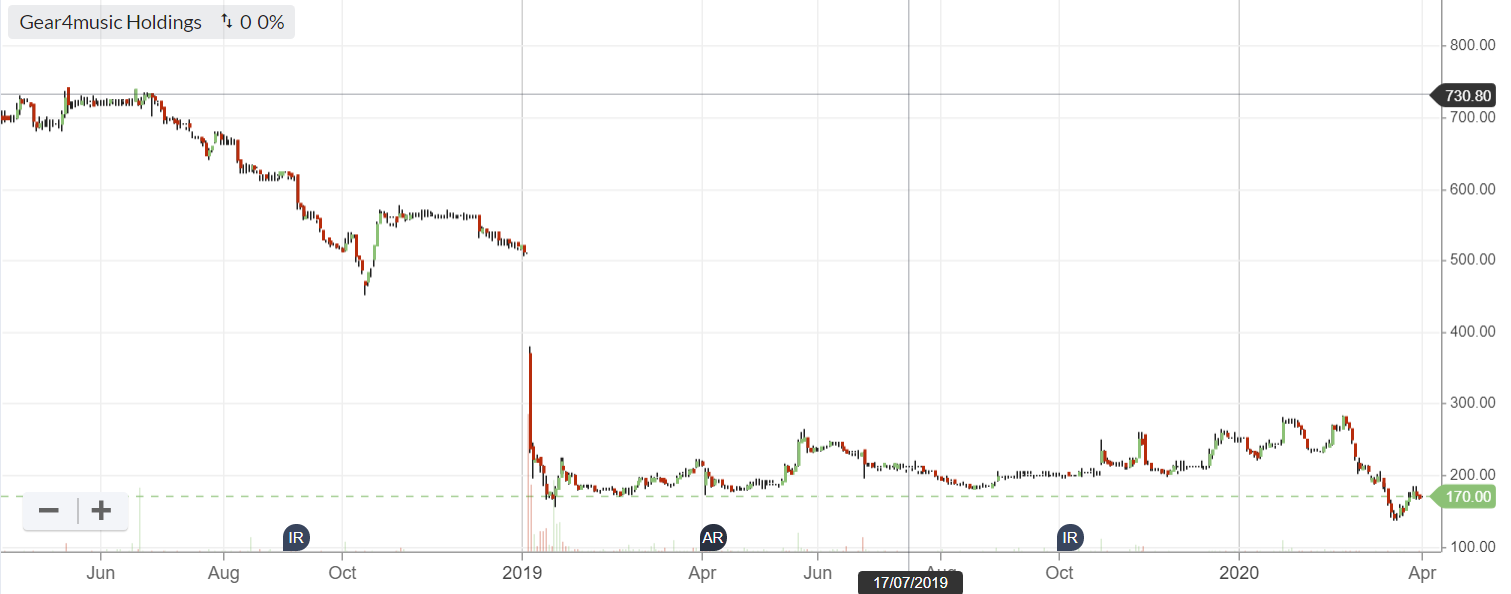
Gear4Music (LON:G4M)
Share price: 170p (pre market open)
No. shares: 20.9m
Market cap: £35.5m
(at the time of writing, I hold a long position in this share)
Gear4music (Holdings) plc ("Gear4music" or "the Group"), the largest UK based online retailer of musical instruments and music equipment, announces the following trading update for the financial year ended 31 March 2020, following the announcements made on 23 January 2020 and 18 March 2020.
This company is a rare beacon of light in current grim circumstances;
As a result of the commercial and operational progress we have made during the last 12 months, we now expect profits for the financial year ended 31 March 2020 to be ahead of previous expectations.
It is pleasing to see that the company has adapted, in order to continue trading normally by the sounds of it;
Following the necessary Government restrictions put in place to tackle the spread of COVID-19, we are pleased to say we have been able to quickly reconfigure our operations to ensure that we are keeping our teams safe. This has been due to the huge effort our incredible staff have made during this very challenging time.
The health and safety of our employees and customers has been our absolute priority, and we have implemented fundamental changes across our business to ensure a safe environment in line with current Government guidance. Our call centre and administrative teams are successfully working from home, and we have implemented a wide range of social distancing measures and safety protocols designed to protect employees working in our distribution centres in the UK and Europe.
That's really good to hear. I was shocked that Next (LON:NXT) shut down its online operations, and that badly dented my previous hope that online businesses could ride out the COVID-19 crisis. Another great disappointment was that Sosandar (LON:SOS) issued a profit warning, saying that online business had gone downhill. I was probably naive in thinking that fashion sales would shift online. After all, why would people on lockdown at home buy new frocks? People usually buy new clothing for specific social events, not for sitting around at home accumulating biscuit crumbs and coffee stains (or is that just me? - I always seem to end up wearing part of every meal, splattered down my shirt).
I suppose musical equipment might be more appealing to people on lockdown, as a leisure activity. I'm sure parents trapped at home with young children would love the idea of entertaining their kids with lots of squeaking recorders, and drums! Some might, anyway. This is alluded to in the CEO comments today;
"Whilst it is impossible to predict what further operational actions may become necessary during the coming weeks and months, we remain committed to operating safely and serving our valued customers for as long as Government guidance allows. In addition to the economic benefits of uninterrupted trading, we are driven by the knowledge that learning a new instrument or improving musical skills can bring enormous mental wellbeing benefits to people of all ages, particularly in challenging times like these."
My opinion - it's vague on details, but sounds like G4M is navigating its way through the crisis, unscathed so far.
After chasing growth at any price in previous years, the company revised its strategy to concentrate more on earning higher (but still low!) gross margins. That seems to be working, although current forecasts show it only marginally profitable for FY 03/2020.
I dipped my toe back in with a small purchase earlier this year, and this update today reassures me. The main risk is that the company might be forced to halt its operations in future. At this stage though, that doesn't sound likely. Clearly by continuing to work, G4M's staff are made of sterner stuff than those at Next, who decided they didn't want to continue working.
I should mention that professional musicians are having a terrible time at the moment. Family members tell me that literally everything in their diaries (gigs, teaching projects, etc) has been cancelled. Although, as with many other sectors, they are adapting, e.g. teaching remotely via Skype, and even doing morale-boosting socials online. I think we're already seeing remarkable changes in working patterns. Bosses of some major businesses have been interviewed on CNBC, saying how they are managing to operate their businesses almost normally, with most of their staff working from home. Which makes me wonder whether long cloud computing, short commercial property, might be an interesting theme?
Today's positive update might be good to boost the share price back up to c.200p, at a guess (writing this before the market opens)
.
Bakkavor (LON:BAKK)
Share price: 91p (down 8% at 08:10)
No. shares: 579.4m
Market cap: £527.3m
I've been meaning to look at this convenience, ready meal food company for a while. I've probably eaten lots of its product without knowing it! BAKK floated in Nov 2017. I vaguely recall there was something funny about the float - maybe it was deferred or pulled at some point, before going ahead later? Something like that anyway.
Its update today strikes me as rather disappointing. Supermarkets are trading strongly at the moment, partly due to some initial panic buying by selfish idiots. But also for the simple reason that with restaurants & cafes mostly shut, we have no alternative than to buy more food from supermarkets. To my mind, that should have put the wind in the sails for suppliers like BAKK, but apparently not.
Its biggest market is the UK;
In the UK, which represents around 90% of Group Adjusted EBITDA, the impact of COVID-19 has resulted in a reduction in orders across all of our categories, most notably in our salads and food-to-go products
USA and China are also down.
Guidance -
Guidance and mitigating actions
Given that market conditions are likely to remain highly uncertain for the foreseeable future, Bakkavor is withdrawing its guidance for 2020, issued on 27 February 2020, and committing to a number of important actions to preserve liquidity:
· A tight control on costs will be maintained, and all non-essential capital investment and discretionary expenditure has been placed on hold.
· We are reviewing capacity across our facilities to better match the current levels of demand and, wherever possible, we will be supporting any impacted colleagues by making use of the Job Retention Scheme (Furlough) introduced by the Government in the UK.
· In addition to the pro-active steps we are taking around cash and investment, the Board has decided to suspend the proposed final dividend. We will review our dividend policy in due course.
· Members of the Board and Management Board have also agreed voluntary reductions in remuneration for the coming three months: the Chairman and Non-executive Directors' have agreed to a 50% reduction in base salaries and fees, while the Group's founders (CEO, Agust Gudmundsson and Non-executive Director, Lydur Gudmundsson) have volunteered not to take a salary in the period. The wider Management Board have also agreed to a voluntary 20% reduction in base salaries.
Bravo for the voluntary pay cuts. We're seeing that increasingly at various companies, and I think it's an absolutely excellent idea. Sharing the pain, and leading from the front, is what leadership should be all about. Banks are particularly receptive to Directors taking pay cuts too, in my experience.
My burning question with BAKK remains, why is it struggling at the moment, when demand should be buoyant? Maybe it supplies cafes & restaurants as well as supermarkets, I probably should have checked that. Do any readers know?
Debt - this looks to be the big issue. These strike me as worryingly high figures;
Together with a number of bilateral facilities, the Group currently has facilities in place of £562m. As at December 2019, the Group had operational net debt of £355m and leverage of 2.3 times against a covenant of 3.0 times.
With a downturn in business underway, that covenant could come under pressure in future, perhaps?
Balance sheet - looking back to the last reported balance sheet, it's got way too much debt on it, in my view. Deducting large intangible assets, results in NTAV of negative -£80.4m. I rarely invest in any business with negative NTAV.
This brings me on to the issue that many companies have used cheap debt to over-gear their balance sheets in recent years. It's a good way for management to boost EPS and hence trigger lucrative share options, etc. Yet this has left many companies extremely vulnerable now that we've had a totally unexpected crisis emerge.
The coronavirus crisis has also demonstrated that many business models, across lots of sectors, were all wrong. Risk had been badly under-estimated. I'm thinking here of travel, retail & hospitality sectors in particular. It's always been a given that business would flow continuously. Even something like a volcano erupting only delayed flights for a few weeks. But now we have a new world, where large parts of the economy need to be shut down, in order to contain a virus outbreak. This changes everything, in many sectors. What companies will need to do in future, is operate with much stronger balance sheets - more financial reserves, and restructure their costs to ensure that fixed costs are not fixed any more - e.g. maybe new forms of property leases are needed, which allow for rents being waived if closure is forced? Maybe travel companies should be forced to put aside customer deposits into segregated, untouchable accounts? Maybe we need tighter rules on payment of divis?
There's also the question that many companies have turned out to have some form of taxpayer support. Shouldn't companies be charged for that? (a bit like the bank levy?). Why should shareholders receive lucrative dividends in the good times, but then demand taxpayer bail outs when something goes wrong? I feel that companies receiving taxpayer support should have to give up some equity to the taxpayer, with the option to buy it back at a later date.
My opinion - for these reasons and others, I'm not touching any companies with highly indebted balance sheets right now. Banks may (and hopefully will) remain supportive for now, but they're likely to want to reduce risk in future - making a wave of equity fundraisings likely, once the dust has settled. Dividends are being widely scrapped too, so shareholders face a double whammy of lost income, and possibility of dilution from equity fundraisings to repair balance sheets.
Overall then, I don't see any attraction to BAKK shares.
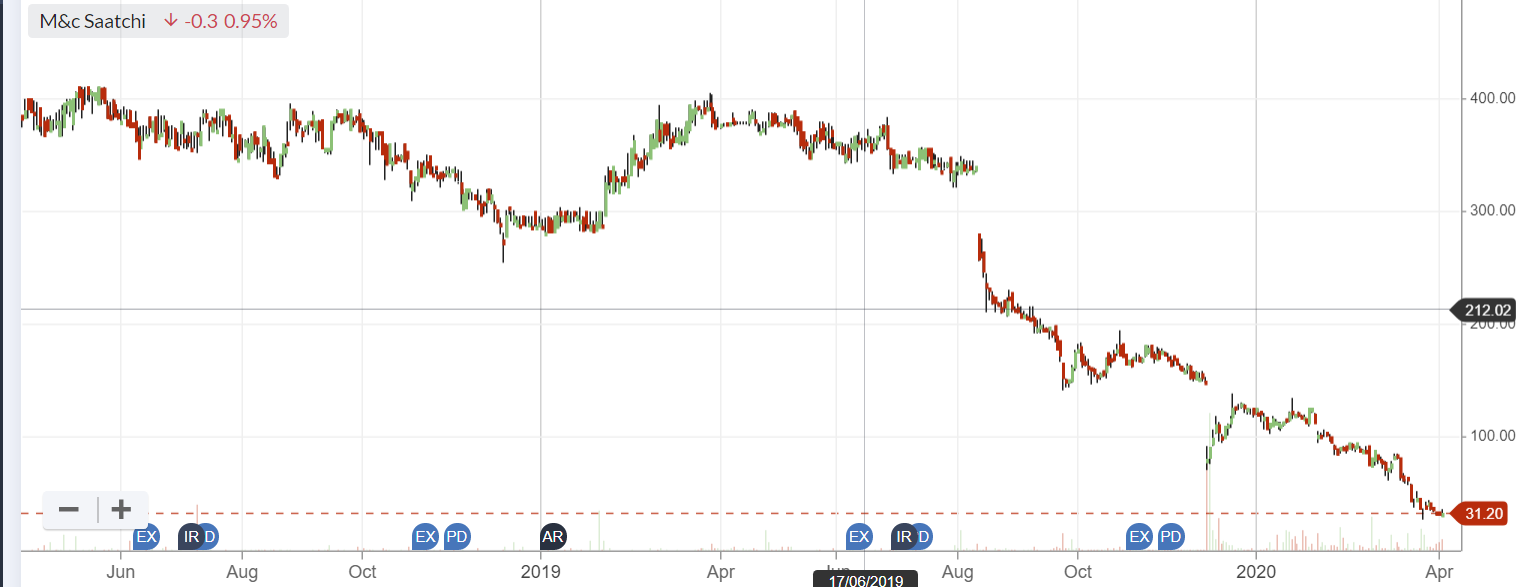
M&c Saatchi (LON:SAA)
Share price: 31.3p (down 0.5% today, at 13:25)
No. shares: 96.2m
Market cap: £30.1m
This is the famous advertising & marketing group. Obviously in a recession, this type of company gets whacked, because customers often rein in non-essential spending. Hence the sick-looking share price. Could it be a recovery share, and will it survive, are the 2 questions that I'm interested in. It might be worth looking back to 2008-9, to see what happened then. From the data I can find, it seems to have remained decently profitable throughout the 2008-9 financial crisis/recession, which is quite surprising.
.
.
Covid-19 impact - this is what it says today -
Trading in the first two months of 2020 was in line with the Board's expectations. We began to feel the impact of COVD-19 in March, with a reduction in activity in several of our markets following government restrictions on movement and the consequent reduction in economic activity.
No surprises there. This next bit sounds encouraging, although no figures are given;
The Board has been undertaking strenuous stress-testing of the financial models under different scenarios (and will continue to do so) and remains confident about the liquidity status of the Group for the foreseeable future.
The good thing about people businesses, is that the cost base is flexible. If they have to, they can let people go, and close or sub-let offices.
Other points;
- Remote working policy for staff, so can continue operating
- Sharp drop in demand, but some areas still have steady demand (e.g. talent & influencer businesses)
- Performance in March substantially weaker, and not possible to predict scale or duration of downturn - hence no guidance currently
- Preparing for further worsening, taking actions to protect liquidity
- Cost-cutting, and tight focus on improving cashflow - all sounds sensible
- Seeking Govt support where available
- Reducing salaries for higher paid staff, including 20% reduction for Directors & senior staff - good
- Divis suspended, as is becoming the norm
Cash & debt - it's clearly dependent on bank facilities, but it sounds as if the covenants should be OK;
The Group had approximately £45m of cash worldwide as at 23rd March 2020. This includes a fully drawn revolving credit facility (RCF) with NatWest of £36m, leaving a net cash position of £9m. Although the Group is in a net cash position, the RCF and cash is typically required for working capital purposes. The £36m RCF and £5m overdraft facility (which is undrawn), was recently extended through to 31 July 2021, and has a 2.5x Gross Borrowings / Adjusted EBITDA covenant and a 5x Adjusted PBIT / borrowing costs (interest cover) covenant. Despite the increased pressure on cash, the company forecasts it has sufficient liquidity and expects to be able to continue to operate within these covenant levels for the foreseeable future.
That last sentence which I've bolded, is key, and does reassure.
Like many other companies, SAA has fully drawn down its available RCF facility, which looks sensible. Better to have the cash on hand, than to worry about whether the bank might not allow them to draw down on the facility at a later date. If I were the CFO, I'd make sure the cash balance was moved to a different bank, if allowed.
Balance sheet - not great, and there are lots of strange items on it. So I'm not entirely comfortable with this, and would need to look more closely at this, if I were inclined to buy some shares.
My opinion - it's lost over 90% of share price value, yet doesn't appear to be in any imminent danger of going bust, thanks to bank facilities being utilised.
For that reason, I would certainly put this on my watch list as something speculative, which could rebound strongly once the economy starts to recover. Potentially interesting at this lowly valuation.
All done for today.
Best wishes, Paul.
Disclaimer
This is not financial advice. Our content is intended to be used and must be used for information and education purposes only. Please read our disclaimer and terms and conditions to understand our obligations.

93 comments
Hi timarr
That was helpful too. I’ve just checked more recent Argentina hyperinflation effect on property and it confirms your opinion. So good to find that out.
I hope you’re right about little chance of hyper inflation; lack of comment generally suggests it’s not yet being seen as a threat.
One good thing is that afaiaa it doesn’t come out of the blue.
The right equities (easier written than done) seem obvious route. Index linked savings accounts too but doubt those would be available. Don’t know about Indy linked gilts.
Maybe best to save serious discussion on this for if it looks like becoming a reality.
Brilliant reply timarr. Thanks. I agree with most of it, but perhaps add property (e.g Investment Trust Reits) if hyper inflation?
Hi ken
Thanks. I agree with most of it, but perhaps add property (e.g Investment Trust Reits) if hyper inflation?
The evidence from Weimar is that property prices collapsed - people were paying over 95% of their earnings on food, rent was insignificant. Basically rent tends to be set occasionally, food prices change frequently and under hyperinflation you see massive daily changes in currency valuations.
I struggle to see any realistic hyperinflation scenario, though. Apart from on healthcare government spending is replacing corporate earnings. As long as the taps are turned off when the economy reboots it's very unlikely to cause runaway inflation.
Gold is probably the best protection. As it happens it's my single biggest holding - although only at 5% of the portfolio. Generally I don't hold it as I regard it as an unproductive asset whose value is based entirely on sentiment. However, when cash is yielding zero and we have rampant uncertainty it's a useful hedge.
timarr
Thanks for the interesting reply Gromley. I hope you are right and think you probably will be if lockdowns end within the next 3 weeks or so. The hyper inflation fear is if many Companies and their suppliers go bust if these lockdowns last longer. . Then there will be big supply problems ahead.
e.g in the clothes retailing sector. It’s great that Stocko subscribers will have the benefit of Paul Scott’s retail experience and knowledge for informed comment on this. But already there are fears that many of the cheap labour suppliers in Countries like Bangladesh will go bust just on the cancellation of mass orders from the likes of Primark and many others already. Those sources of exceptionally cheap clothes could be gone for a good while.
The effect on the prices we pay could be big as retailers struggle to find supplies.....and that assumes that many of the remaining High Street retailers don’t also go bust. (Online like BOO could thrive and be able to charge a lot more). Add a few similar examples and the need for much higher wages to compensate and clear recipe for serious inflation.
Tackle that via higher interest rates and a generation now thinking near zero rates are the norm will be in for a big shock with their mortgage increases. Add to that huge Government and other debt in so many Countries and it might have to be inflated away. And also need to be part funded with tax increases.....adding further inflationary pressure.
Hope the above thinking IS way out!
Hi ken
I know it's a horrible time but over 250 years markets have a 100% record of recovering from crises and going on to prosper.
On the specific concern of hyperinflation - it occurs, as you know, when too much money chases too few goods. Personally I doubt that's anything more than a very short-term issue - most people have no savings and the government bailouts are barely covering their expenses. However, should hyperinflation actually happen then the only safe places are gold and equities - we saw this in the Weimar Republic: cash and fixed interest get destroyed.
Of course, a recession is certain. On inflation, again, well chosen stocks are our best protection. In the short-term with interest rates at near zero shares will soar when dividends return. A depression is the only scenario in which shares don't do well and governments are doing the exactly opposite of what happen in the 1930's - it's very unlikely.
On retail. Retail stocks as well as those in leisure, travel, car dealers etc will struggle. It's worth noting that government is covering a lot of their non-discretionary costs but even so the weak will go to the wall. You have to be brave and knowledgeable to seek value in these sectors when basically everything else is either doing OK or will recover on a 2 to 3 year basis. Why even contemplate dabbling there?
I note that Keith Ashworth-Lord, lamenting the recent performance of the Buffettology fund, has this to say:
“I fear that both Revolution Bars (Revolution Bars (LON:RBG)) and Restaurant Group (Restaurant (LON:RTN)) need a large equity raise and bank forbearance to survive. What remains of the holding of the former represents only 0.11% of the portfolio. The older I get, the less enamoured with consumer-facing businesses I become.”
Why bother?
On the very specific point of Boohoo (LON:BOO) there's an article in the Guardian today about the issues in social distancing in their Sheffield warehouse. Quite why their orders for throwaway tat have gone up by a factor of three is beyond my understanding, especially when the staff could be redeployed to help the NHS. But there's obviously a risk they'll be forced to close for safety reasons.
However, if this ends up causing the collapse of fast fashion via sweatshops in Bangladesh and other countries then I think that's a good thing in the long run: people buying cheap clothes, wearing them once and throwing them away is criminal. We need to develop shorter supply lines, source more from closer to home and find ways of helping developing countries improve their own economies without creating more suffering.
The world will look different after this - but probably not as different as we think. And as for lockdowns - the science is leading, we will find a way out of this. Technology is being developed across the planet to ensure we can track and trace infections - that's the first step. Then we have research into existing drugs to alleviate the symptoms, there will be something. And eventually there'll be a vaccine.
I find it amazing that we have developed to the point that we can decide across the planet, across cultures, races and religions, to wage war on a virus. We didn't even know the damn things existed until 1892, now we're about try and do something never done before.
Remember, unmitigated Covid-19 was expected to kill 510,000 people in the UK - at the moment we might hold it at 20,000. Anything close to that is astonishing and will be achieved by an act of collective will across the nation. It's an extraordinary thing to even imagine let alone seeing it put into action.
And at the end of this there may be some good in terms of a general appreciation of the role of science in our society, who knows - even the climate science may start to be taken on board? Although given that we have imbeciles burning down 5G masts because they believe Twitter posts I'm not entirely hopeful of that.
timarr
It is an interesting thought Ken, but I don't personally think it likely to happen to any great extent.
Certainly some businesses will go bust if they haven't got the access to cash to tide them over. However, by and large if demand for their products and services still remains - then their creditors will lose out, but someone will buy their business out of administration and continue to fulfil the demand, but with an improved balance sheet and possibly a streamlined operation.
I suppose if it becomes uneconomic to 'relight' a mothballed factory (or other venture) to supply at the former prices, then this could be inflationary, but I would expect that to be quite limited.
Perhaps there might be some short term supply shortages as facilities come back on line, that might be inflationary in the short term, but I wouldn't really expect that to be a particularly lasting effect.
We might well also expect to see some areas where there is over supply, rationalise especially if there are any behavioural changes. Coffee shops / cafes would be an example imho. I have felt (just from local observation) for some time that there is significant oversupply - I noted a couple of years ago that almost every shop that closed down on my high street, seemed to come back as a cafe. I thought it was a recipe for disaster and indeed some of the new ones and some of the previously well established ones have gone already. If we become a little less keen on mixing, then I suspect some of them won't come back from this crisis.
Several replies as late as 3.53am Paul. Hope it’s just not being able to sleep and nothing more worrying. Or maybe your continuing coronavirus upsetting normal sleep patterns. Anyway it will be good to hear when you are at last feeling back to normal. You’ve done a great job here, providing so much interesting reading material for us in addition to the Investment angle, and managing to do it while so unwell too.
You’re the only commentator I’ve come across who has made that so obvious point that since there has never been total lockdown before there’s no point with comparing it marketwise with totally different events.
Is another fear that as a result of the shutdown, there will be widespread shortages in all sorts of areas, thanks to whole sectors of the economy at risk of going bust? Could that lead to hyper inflation? Demand way exceeding supply = much higher prices. That would solve the debt problem, but otherwise scary. As are so many of the potential consequences if total shutdown does not end within the next 2 to 3 weeks. Decisions are being made on the hoof, not only in this Country, without much if any thought of the long term economic consequences.
Interesting late RNS from Shoe Zone (LON:SHOE):
"The Group has a strong relationship with its lending bank and is in advanced discussions with it with respect to the provision of a new 4 year £10.0 million term loan (the "Term Loan"), to provide it with additional liquidity through the current disruption caused by COVID-19. However, should the Term Loan not be provided, or the proposed quantum of the Term Loan be materially reduced, the Group would need to seek to take further cost saving measures and/or raise additional capital by early May 2020, assuming that the 2019 Final Dividend is cancelled and not paid to Shareholders."
I've often thought that Shoe Zone (LON:SHOE) could be a really good buy. And could be one for the bounce back. But every time I think that, I find I can't quite understand how they make their money. And that puts me off again.
Re SHOE - you said;
But every time I think that, I find I can't quite understand how they make their money
High gross margins on cheap, China-made shoes. Low overheads from cheap rents & short, flexible leases. Cheap shop-fits. Entrepreneurial management running a tight ship.
Proof of the pudding is prodigious divis in the past.
Regards, Paul.
Hello Paul,
I congratulate you on your diligence but personally I think the effort and detail your are undertaking on each of these companies you cover is marvellous....however, I would prefer to learn more about your insights into the events of each day, rather than the companies....because most of the companies you are covering are going to struggle to survive in there current format , if the CV does what I thinks it’s going do, so many previously successful businesses ....will struggle come the New Dawn , they will adapt and do what they can but if they run out of cash...we all know the consequences....
I would prefer you share your thoughts of the market and news and brief bullet point summaries of the companies.
You are the rock star here and reading that you are exhausted tells us all, after what you are going through and have endured with a John and his wonderful mum ...you must take it and make it easier on yourself ...we need you to get our day going Paul.best wishes
Hi Tony,
Thanks for your thoughtful message.
To be fair, in times of market turmoil, I do give my general market overview, but am mindful that such comments are really not a particular area of personal expertise. There are many commentators & market participants whose knowledge & experience far exceeds mine.
Hence, I like to generally stick to musing on smaller caps, whilst keeping an eye on the bigger picture.
Having said that, it's fair to say that I was flagging up the potential risk of CV19 here in fairly rigorous terms, in early to mid February, well before most other commentators. It somehow felt a lot more risky & different. Hence why I hedged my own portfolio with some shorts.
Regards, Paul.
One thing that just cropped up on the BBC new channel that adds context to the 1m applications for UC. It hadn't occurred to me but apparently those on the furlough and self employed scheme may be entitled to Universal Credit to tide them-over until the payments come in (at which point they will have to true up). So the 1m figure may over-estimate longer-term figure - although of course it is 1 million so far.
''The race for the White House, which was one source of uncertainty, seems likely to be between Trump and Biden, which could mean business as usual for the drug companies.''
quote from RNS today from International Biotechnology Trust - Update research from QuotedData
I’m still bemused as to why the market is only down 30% or so?! The newsflow is awful. Discounts on investment trusts only really opened up on the day the markets dropped 10% (march 18th) and then closed back in to single figure %.
V Shaped, U Shaped L Shaped?
The US jobless data today where 6.6 million lost their jobs in a week added to the 3.3 million from the previous week so 10 million jobs thus far.
https://www.bloomberg.com/news/articles/2020-04-02/u-s-jobless-claims-doubled-to-record-6-65-million-last-week
Given the huge hits to businesses, supply chains, jobs and households a V shaped recovery seems highly unlikely : at best U shaped and increasingly likely to be L shaped. Additionally , too many dislocations and global misalignments on timings and responses to see this bounce back quickly as extended supply chains will remain impacted over those time horizons.
Reckon on the "new normal" being very different than the previous one so almost by definition a V shape is the wrong shape if only on the asymmetrical nature of those two states. That said there are always opportunities, the transformative nature of digital technology being one where many have had damascene conversions
My understanding is that Banks are well capitalized (rolling in cash) and there has been a lot or central "advice to pause dividends and executive pay". (The Telegraph)
I recall that Drucker commenting on escalating executive pay said that executive pay should not exceed 12 times mean non executive pay. I was trying to validate the quotation and came across a list of Drucker quotes (www.azquotes.com/author/4147-Peter Drucker) which are well worth reading.
I will continue to search for the exact quotation.
Just by way of comment re trying to make money in the markets....
Royal Dutch Shell (LON:RDSB).....could have readily bought below £10 during a two/three day window around March 18th and cashed in today not far short of £15. Extraordinary times.
Yes and BP (LON:BP.) is very similar, from a low of 223p to 363p today.
Talk of 6 month lockdowns is totally off the mark. 6 weeks, possibly 2 months. The problem the Government has is how to ONLY lockdown/cocoon the vulnerable, until a vaccine can be found for them. More widespread testing will show that the virus has spread and "infected" many, many more people than have been found and registered as positive so far, and that the numbers of those who have "recovered" is huge. Present research says re-infection isn't happening, (or likely to). A high percentage of herd immunity, which will arrive sooner than later, and the increasing availability of treatments, if not "cures", will dictate that the continuing economic cost of total lockdown is unjustified.
The last piece of the Research jigsaw that hasn't been calculated yet, but which soon will be because of the number of infected healthcare workers, who, having recovered, will be returning to work, is "How much time has to elapse before a "recovered" person [disinfected] can be allowed come into contact with an uninfected one"? The answer will probably allow a policy of "at risk" and "everyone else" be formed to protect "at risk" but allow "everyone else" resume full economic activity and daily life.
Wuhan is resuming activity. But 100% of it's citizens weren't infected.
It's interesting that you mention recovery rates. The UK's published recovery figures are tiny - 135 total last time I looked. It seems that we are not recording it properly. I presume that you mean worldwide not UK?
Surely it's reasonable to say that if c.1000 people have died in on a given day 97-99000 have recovered within their cohort.
Thanks for your estimates of the likely duration of lockdowns Brianm, I would tend to agree that 2 months seems a reasonable guess. However, I would suggest that there is one extra piece of the "research jigsaw" which you mention and that is the time taken to produce drugs and vaccines against the virus. Having observed the biotech/pharmaceutical sector for over 40 years, I think I can say with confidence that a drug to effectively treat and probably reduce the chance of Covid-19 infection is likely to become available within 6 months but a vaccine is a much more challenging task and I reckon an effective vaccine could easily take a year to 18 months or even longer. Although a completely different situation, it is interesting to note that very effective drugs against another recently emerged virus, HIV, have been developed but even after 40 years of intensive work, there is still no effective vaccine against HIV. Hepatitis C virus is another virus which can be effectively treated with drugs, but has no effective vaccine, despite huge research efforts.
Covid-19 is an enveloped virus. This is why it's relatively easy to kill with disinfectant or alcohol. (break the envelope) I would think that an approach that removes the Capsid & DNA, and possibly Matrix from the centre of the virus, but leaves the rest of the envelope and envelope protein, should easily work. Train the immune system to attack the envelope protein with a vaccine that poses no infection risk (because the virus shell can't replicate without it's capsid and DNA) It's been done before, and imho, could be fast-tracked to be available in 6 to 8 months. If a biotech in China produces a vaccine as quick as Moderna has, I can't see the Chinese version of the FDA waiting 12 - 15 months to look for possible side effects if patients, or "volunteers", are producing T-cell / anti-viral immuno-responsiveness. Such a vaccine would be on the market in 6 or 8 months. On the cure front - a Chinese Biotech is already producing a bio-similar to Remdesivir (which was used against SARS, MERS and Ebola, but hasn't, because of the multi-million $ costs involved in a full FDA Stage 3, been officially fully approved) because they (the Chinese Biotech) think that Remdesivir is a cure
Hi Brian
A genuine question from a lay person if I may - isn't HIV also an enveloped virus?
As far as I know there is no vaccine for HIV.
Do you know if there is any reason why a vaccine for Covid-19 might be possible when one has not been made for HIV?
Thanks in advance
A
Covid-19 is a positive-sense single-stranded RNA virus. As a BetaCoronavirus it has a multi-spike 'crown' of envelope protein. It is unique among known betacoronaviruses in its incorporation of a polybasic cleavage site. It sheds it's DNA load instantly upon successful attaching, so replication is rapid
The HIVs (1 &2) are also a positive-sense single-stranded RNA viruses, but from a different family - the Lentivirus subset of Retroviruses - which have slightly different envelope protein structure, (less spikes), shape, and, especially for HIV2 a different cell target and replication/cell dormant/latent period in/during which, unlike Covid, it can remain dormant in the human body for up to ten years after primary infection; - during this period the virus does not cause symptoms.
Having more envelope protein spikes makes Covid-19, in my book, a better candidate for "removal of DNA" type vaccine approach as described earlier, with a greater remaining amount of envelope protein to target by the immune system. But I could very easily be totally wrong. As I alluded to in the last post, BrightGene in China are making a 'remdesivir', which may shortly prove to be a cure, or treatment at least.
Hi Paul
Just a note that M&c Saatchi (LON:SAA) are still subject to an FCA investigation, announced in January. I only know this because I am unlucky enough to hold:
https://www.investegate.co.uk/m--38-c-saatchi-plc--saa-/rns/fca-investigation/202001310706145496B/
It is interesting that the price here fell on opening to 28, recovered and rose to 35, but now seems to have settled more or less back at last night's close of 31. The volume is comparatively high at nearly 300k. This market has become a trader's paradise.
Hi Beginner,
A very good point, thanks for flagging. I forgot to mention the FCA investigation in my update on SAA recently - in fact the tab of that RNS is still open on my computer, in the WIP section that was meant to be included in the report earlier this week.
Apologies for my oversight & thanks for flagging it up - great point.
Best wishes, Paul.
HI Paul, any chance of a look at Adept Technology Adept Technology (LON:ADT)? Thanks and regards.
I know people worry about the balance sheet as a consequence of the roll up strategy but I felt it was quite a positive update this morning with the services they provide being in very high demand in their key sectors of NHS and education.
Amino Technologies (LON:AMO) (LON:AMO) This announcement from Amino made me smile
“The Adjourned AGM of the Company will be held on Thursday 16th April at 9.30am in the car park of Mid Sussex District Council, Oaklands Road, Haywards Heath RH16 1SS..“
"Investors have to decide whether we think this is likely to a V-shaped recession - i.e. short & sharp with a rapid recovery, or something more serious & extended. At this stage, I haven't made up my mind what is more likely"
Value or Growth. The backdrop to the recent chaos was an already slowing global economy and an overvalued stock market driven by an abundance of capital chasing limited growth.
This capital is at least temporarily in very short supply. The chaos that has ensued and lack of visibility will leave many casualties.
The stock picker can concentrate on value and financial strength. With a sufficiently cheap stock with a strong balance sheet ( little or no debt, and able to finance WC) you will make a good return. So if you make conservative assumptions and still see a path to an 8% return or higher from your investment, Im sure you will do just fine. In recessions, of which we are in, strong high quality businesses do better, predictable lower growth companies do better, cheaper stocks do better. Its actually a much easier stock picking environment than trying to second guess what will be the next momentum fashion.
All around investors seem only interested in picking a bottom, I think they remain attached to the cycle that just ended. Tomorrows winners and losers will emerge in time... for now, safe and steady will win the day, whether we bottom in the next few weeks or not. The good news is, lots of these stocks have been hit much harder than normal in the sell off, due to passive selling I assume. Happy hunting everyone.
How much does reduced demand in one sector ripple out across all sectors? Our household income is currently reduced by 61% (we are living off 39% of our pre-virus income). My best guess is it will take a year to recover after the lockdown is lifted but we won't recover fully, I think our income may be permanently reduced by about 40%, and of course that's the top slice, disposable income. That's a noticeable chunk of demand that's evaporated and of course it's not just us. When a bit of demand comes out of an economy in normal times it's like a bit of water slopping out of a bucket, the level goes down but not by much and it eventually fills back up again. But this is like having a socking great hole in the bottom of the bucket which the government is desperately trying (and failing) to top back up with a tap that isn't anywhere near big enough. The way I see it if this goes on for 6 months the only businesses which will survive will be those getting income directly from government (or from people who are paid by the government) because consumer disposable income will be destroyed. Or am I being too extreme here?
Hi Michael.
I understand your concerns and hear what you are saying but I do think you are being too extreme...we will all have to adjust to lower levels of income, hence lower demand but the multiplier affect of the handouts receiving government money ,one way or another will be huge and eventually , once current measures are reduced or lifted , normal life will not return but a different type of normal life will return.
I wager with the reduction you have experienced in your disposable income , your family will never waste a penny in the future on ‘rubbish’...such as clothes, restaurant meals on a whim, unnecessary car journeys etc etc ..so that you may appreciate more than ever the beauty of a cup of tea and coffee and a simple cheese and tomato sandwich .
I wish you and your family well
"I think our income may be permanently reduced by about 40%"
I can tell you with absolute confidence that wont happen. The only question is how quickly it will recover and then exceed previous levels. Just as incomes rose even after the Black Death, so they will rise again in future. (In fact, personal incomes rose dramatically after the Black Death but that's a different story). In the medium term, the only things that matter to national incomes are the size of the working population and the level of productivity. In the UK, both of those will continue to rise.
Unlike after a war, the supply side of our economy will remain largely intact. The vast majority of workers, technology, plant and equipment etc. will still be there. The only issues will be financial capital and demand. But those are relatively easy issues to fix provided that governments don't make a mess of it. I'm sure they'll make some mistakes but the broad direction will probably be ok.
A lot of company equity and personal wealth will be wiped out, and it will take a bit of time to reorganise and get back on our feet, but there's no reason that the economy as a whole should suffer in the medium term. In the medium term, the strength of the economy is determined by the supply side. Parts of that will be "under new management" but it will still be largely intact and capable of resuming growth.
I think Michael was referring to his own personal circumstance (of which I'm sorry to here) rather than suggesting that as a society we'll see a 40% reduction in income.
Whilst some a being hit very hard economically by this (witness the 1m Universal Credit applications Paul refers to) but it is far from an even picture.
I haven't seen any numbers at this stage but a significant proportion of people have not had their income impacted, they are either still working or have the same pension or benefits still coming in.
More yet are at least receiving 80% of their pay (more post tax) whilst furloughed.
At the same time people have possibly as much as 30% of there regular spending curtailed, creating pent up demand for when restrictions start to lift.
Key workers are in fact probably seeing their incomes increase as they put in many extra hours and their ability to spend is probably even more curtailed.
On the back of all of this, I'm really not so gloomy for the longer term as others.
I think Gromley has hit the nail on the head there.
All those working from home or being furloughed, whilst not maybe earning as much, will also not be spending as much either: no fuel costs, no trips to coffee houses, no expensive lunches from Greggs/cafes etc when a sandwich at home is suffice, no random trips to clothes shops, no impulsive purchases (yes I'm aware that some will as they will still use the internet), no trips out to restaurants/days out with the kids, leisure and tourism, holidays to name but a few.
Once restrictions are lifted, I think you'll see a big rise in spending as people will be either:
a) relieved it's all over and want to get back to normal, see family and friends, go places they haven't been able to etc.
or b) will be wary of a second wave of the virus and want to stock up on loads of things to eat/drink/do (DIY, gardening) etc, in case we have another lock-down/curfew.
Yes, some business may go bust if they cannot ride this out but if the demand is there, new businesses will emerge like a phoenix from the flames.
Thanks for the kind comments. Hope you don't mind a second long post.
Perhaps our circumstances are a bit unusual and certainly won't elicit sympathy, but I wasn't asking for sympathy, just asking what the ripple effects are likely to be.
I'm semi-retired now. Our old business is our tenant and was shut down by government order at the worst time of the year for cashflow, especially because of a big investment last autumn. It will run out of money completely some time in May and the bank has imposed unacceptable terms for a loan under the CBILS. Our residential tenants are currently 25% non-payers. A very long-standing investment is in a business established over 150 years ago which weathered all previous storms but not this one, it's shut and doesn't seem to qualify for much by way of assistance. If it is shut too long it won't re-open, it's the sort of business that doesn't reopen after a long closure. My SIPP was invested for dividends - you all know what's happened to those. Our large house and our boat are now liabiities, especially the latter eating its head off with berthing fees and insurance, nobody is allowed on to the pontoons to clean the seagull shit off it or run the engines up, and it's unsaleable. My NED fees have just been reduced by 50% (with which I agree). The amount of disposable income that has been wiped off the face of the UK economy in just our household alone is really quite remarkable. We had a refit in a boatyard not long back, kept two and a half men employed for several months - won't be happening again for a long time unless I can multi-bag the SIPP!
I'll say it again, I don't want sympathy. I'm just asking where the
demand will come from to keep open those businesses which are still
functioning or revive those which are mothballed if this goes on for 6
months.
@Tonysaprito - all the evidence I've seen is that with debt levels this high there isn't a multiplyer effect. As for tea and cheese/tomato sandwiches, yes indeed, that's how we started all those years ago, but who is going to eat all those pub lunches we used to enjoy?
@cmpeckham - I think you are right in the long term, but in the short term I really do wonder whether the demand will be there for all the things our society produces (or are produced for us in the Far East).
@Gromely - You mentioned pensions. What about all those pension funds which depend on dividends, commercial property, and bond yields to produce the income to pay pensions? At the very least they are going to have 6 months without significant dividend income.
Hello again Michael.
I recently wrote a reply last month about residential property and commercial property debt.
I worked in banking when interest rates went up to just under 17% in late 80’s early 90’s.
Initially, the bank I worked for were very aggressive, however, they soon realised they had simply no choice but to work with the property owners..
Whilst, I understand your worries, I am supremely confident that even if you cannot pay your mortgages, the problem will be your banks ...they will be inundated with similar situations to yours, and sooner or later they will realise its better to have a property heated and occupied , even if they are receiving no interest, than to try and repossess it.
The bank I worked for received no interest on some properties for 2 years, they stopped writing business for 2 years and their only concern was to preserve the value of the property, so that when the economy recovered , they would have an asset either to sell or a property that you could finance.
If the scale of the problem is as substantial as I believe it is likely to be , we are going to see the banks forced to do what they normally do not like doing ...simply write off the interest not paid , and start afresh, otherwise they will have bad debts on a scale no one ever imagined.
As for your boat, well Michael , I only offer one thought to you.....sink it in the ocean as soon as you can and walk away....life in its most basic form is to be healthy and my earlier comment when I talked about a cup of tea and a cheese sandwich, I was not suggesting you go to a bar or cafe for that because your kitchen and garden with your family and friends will be more than enough.
I wish you well
Sink the boat? Couldn't do it. It's a lovely boat. The boat will continue to float.
Hi Michael
I misunderstood your earlier post. Apologies for that and sorry to hear of your bad luck. Just for context, I am also losing on private investments and also on the listed investments that I didn't sell.
You say you agree with me in the long term. Well, I agree with you in the short term. Yes, demand will be hammered and in the short term, demand is all that matters in recessions. But history tells us that demand will recover, and in the medium term, supply is what determines success.
Many people will be less affected than you and me. They will delay new purchases until they can see their way out of the hole, but then they will start spending and releasing pent up demand. Prices will have fallen, making spending more affordable. Companies will swoop in with new investment to take advantage of the new opportunities. The same processes that always happen after recessions will start the chain reaction of higher demand. For governments and central banks, the lessons are there to know which actions will help or hinder. With lessons from the financial crisis fresh in their minds, I think they will get more right than wrong.
This recession may well be severe, but there is no reason to believe it's fundamentally different in nature to what has gone before, or that recovery will look dramatically different. The differences that do exist suggest recovery, when it comes, may actually be at a more rapid rate than usual.
Best wishes with everything. I really hope it works out well for you.
This recession may well be severe, but there is no reason to believe it's fundamentally different in nature to what has gone before, or that recovery will look dramatically different.
But look at depressions. This is likely to be a depression, according to one or other definition at least. The key is whether there will be a recovery or the whole thing will stumble on. There may be reasons for optimism but also for the reverse. Seems very likely that western governments will seek to purge the vulnerabilities that have become apparent. Increasing resilience will come at a cost in terms of governmental controls as well as efficiency and productivity. Globalism will be under threat which would disrupt the whole of the economic system that has built up over the last thirty years.
The thought fools paradise comes to mind
"some initial panic buying by selfish idiots"
Yes they were selfish, but not idiots. I took the conscious decision not to panic buy and ended up disadvantaged. I ran out of several basic goods and I am still out of many. In all honesty, presented with the same situation again I think I would "panic buy" or "rationally increase stock levels in expectation of a supply shock". I don't mean buy van loads of loo roll, I mean buying additional supplies, even though if everyone did the same this would lead to shortages. In many ways it's like the stock market: you have to think what everyone else will do and do it first.
This is in the same family of problems as "the tragedy of the commons", "the paradox of thrift" etc. where rational individual action runs counter to the overall good. The only way around such issues is if action is taken by some higher authority. We don't like being told what to do but sometimes that's the only way. Sometimes decisions need to be taken out of the hands of the individual simply for our own good. Sometimes free markets fail to deliver beneficial outcomes and this is one example of that.
One small tip. Check out the office suppliers for home delivery. Like Viking Direct. They supply all the office stationary needs but also lots of helpful stuff like tea, coffee, soft drinks, biscuits, chocolate, toilet rolls (plenty in stock), cleaning materials and so on. A lot of offices are closed so they now have plenty to sell to individual consumers. They do sell in larger minimum numbers...I have a family of five......but none of it will go out of date and little chance of getting some of this delivered by the supermarkets.
Or...I am maintaining prudent levels of food and loo rolls, you are overstocking, they are panic buying.
Panic buying or stocking up simply didn't occur to me. My view is/was that there's no reason to expect normal supplies of food & other household items to be seriously impacted overall. Hence over-buying by individuals just harms others, who then are not able to buy what they need.
How did reality compare with expectations, for me personally? The main problem was that I came down with CV19 in my London lodgings almost 3 weeks ago. So I had no control over food or other supplies when sick. Everyone in our household was ill, and food just became random & generally low quality. The nearest shop mainly sells booze, sweets, and frozen pizza. So when I was well enough to pop out, I bought junk food. Also, I shouldn't have been drinking any booze, but the pressure of everything that's been going on became too much at times, and we vented with beer & vodka about once per week over the last 3 weeks.
Also, being completely sedentary also results in other problems. Depression, constipation, muscle wasting (so that going up stairs is a struggle). This is all just in 3 weeks. You start to speak & feel a bit like a zombie, it's weird.
Regards, Paul.
P.S. - also loo roll - WTF?! Why would anyone consider this an urgent purchase? I've always thought it is most hygenic to have a quick shower after every pooh. Hence no need for toilet paper at all. After all, if your dog accidentally smears her dirty bottom on your forearm, you don't just wipe it off with a tissue, you properly wash it off with soap & water. People have got their priorities all wrong!
BAKK had it's original float pulled when it was revealed that (I think it was 2) of it's owners were also involved at Kaupthing the Icelandic bank that went bust. After the dust settled presumably it floated. Apart from salads it also makes pizza's and cream cakes for the supermarkets having bought smaller suppliers out.
Thanks David. Interesting colour.
I note Avacta have had a small fund raising and comment on outlook today. I like to put a note on this company when I see it because a) i think it is a really interesting company and b) i cannot help but think it is being overlooked. That last point is not the share price. A market cap of £35m is probably about right at this stage. It has 2 major projects on the go. One is the result of research by Tufts Uni. Avcts affimers (read alternative to antibody) can attach to an existing cancer drug (doxorubicin). By doing so they can specifically target the cancer cell. That allows them to get maybe 6 times the dose in. At the moment the toxicity of the drug at that level causes heart failure. The mkt is about £1bn so would increase to £6bn. Avct suggests if their work is successful and should know third quarter a deal in range of £50m short term payments plus longer term of £300m should be possible. They are also trialling affimers for work on humans having only worked on animals previously. If this works and no reason to think it won't according to company then the company will have not a drug but a platform on which these affimers are designed to meet each request. They are smaller than antibodies, faster to produce and more consistent. The risk is the company burns around £9m a year and has been raising cash via shares so number expanded. The raise today creates another 11m shares, guy behind boohoo (Mahmud Kumani) and wife of founder of Zeus Capital have provided £2m at 18p. The company also has other research contracts with Daewoo and LG. They have links to Glaxo and AstraZeneca. To me this is a building story. I cannot see them being allowed to run out of cash at this stage. Although the path to here has been long and costly!! They have some good institutional support. Of course the risk is the trials fail the key one being testing on humans. But if not and Tufts goes ahead, if they are valued with just £50m short term at 10 times that would make them a 10 bagger plus. Equally if they fail there is a small vet supplies business but it wouldn't justify the current £35m mkt cap. Please DYR just trying to identify an opportunity that might / might not exist.
I just wanted to add a short addendum to this note on Avacta. It seems to me totally unacceptable that they can issue 11m shares to 2 people like this. How does that represent existing shareholders well. I appreciate not a huge amount of shares but surely for 2 people to get a 10% discount in this manner??&^%£ I mention it only because I know Paul is with me on this one!!
"Business leaders have warned that British companies are running out of time to stay afloat amid the coronavirus outbreak, after a survey showed a majority of firms had just three months of cash or less in reserve". The big difference between this and previous recessions is debt. The amount of personal debt is staggering. Will the housing market just disintegrate? People have paid crazy money for property in places like London; mortgaged to the hilt. If prices fall sharply I just dont see how the economy can recover quickly with so many in debt.
China will step in and buy the companies and equity for a song.
Or our Government might step in and buy them. Could we see BAA floating again in 3 years time? They did it it with RBS in 2008.
Just published: Tremor International (LON:TRMR) FY19 results webcast video by Ofer Druker, CEO, following results released yesterday.
https://www.piworld.co.uk/2020/04/02/tremor-trmr-2019-full-year-results-presentation-april-2020/
Separately, a reminder to join piworld for the lunchtime webinar at 1pm today, where John Rosier discusses how he's playing the markets, based on his experience of bear markets. To pre-regsiter: https://attendee.gotowebinar.com/register/8065341507614979085
Perhaps best to be very wary of making investment decisions based on previous bear markets?
There has never been a situation like the current one with total lockdowns so widespread, so what happened in previous bear markets is irrelevant.
Future market moves are often guesswork and that certainly applies now because we don’t know whether the worst will be over with a return to some normality in a few weeks, or whether lockdowns will last for months with devastating effect on many businesses and risk of a worldwide depression. Add to that the risk of the virus returning before there is a vaccine for it and so another lockdown ahead. There are several possible outcomes. Hope the best one, soon be over for good, proves THE one.
BUT until we know, market comparisons with1929 crash, 1987 and 2008 banking crash arguably of little or no use?
There ARE Companies that will benefit. Problem is that often that news seems priced in, but there must be some where it isn’t?
Might add that charts based upon historical price movements are probably of little value in the current climate. As you point out, much depends on how this unfolds and what has gone before is of limited value.
I agree Ken. I don't see any value in comparing this downturn with previous bear markets driven by completely different circumstances. We've never had a total shutdown of large areas of economic activity.
This is totally different to what any of us have experienced. Hence I think great caution is needed.
Morning Paul, wondered if you have any thoughts on Saga's update this morning?
Coronavirus: A fifth of smaller UK firms 'will run out of cash'
https://www.bbc.com/news/busin...
Not that I am a big fan of BBC economic news, but at the moment I am almost addicted to all financial news channels as things are moving so fast, but I think a tsunami of bad news is coming.
That's according to research from a network of accountants which suggests between 800,000 and a million firms nationwide may soon have to close.
Kirsty McGregor, founder of the Corporate Finance Network, told the BBC: "Small and medium-sized businesses employing less than 250 people employ most of the workforce - 23 million people.
"We could lose up to a million of them in the next month or so. And it will be irreversible which will be catastrophic for the UK economy."
After analysing the government help on offer, those accountants say that 18% of their clients were unlikely to get access to the cash they will need to survive a four-week lockdown
Now I accept there many be some panic in statements from people in the thick of this, like Kirsty McGregor, but announcing £mega bucks of support and the reality of getting it to the bank a/c of those that need it are very different.
In the last 10 years I spent 4 years working for LLOYDS & RBS Treasury departments, the Treasury department of a Bank is responsible for managing the banks risk across all it's business lines & all its trading positions. After 2009 the banks & these two in particular, and as the largest banks in the UK this is critical, are very cautious and do not operate fast but the primary goal of Treasury is to manage risk & protect the bank, and they will not just open the door to immediate loans to all based on a government promise of cash. They will be working incredibly hard to achieve this but corporate finance must be 20-30,000 people and they are not geared up to handle dealing with an economy put into stasis & all that means, they will be extremely cautious at this moment, the scares of 2009 run deep in these banks.
It's quite likely that the news this will hit over the coming weeks, but this is going to be on a much bigger scale in the US. US news is still full of optimism, as is the S&P, I could be as wrong/as right however, the probability of extremely bad news in the next few weeks is not in favour of buying into this market at present.
If there is another lurch down, it's likely the companies reporting no impact will be hit, so low value/low price resting orders, are the order of the day for me. But keep a lot of cash, if this news hits, and the economy is not opened up straight away, all bets are off.
Stating the very obvious; the world is changing and on the level that we discuss here, businesses must change or die. The word now in use appears to be recalibration.
I do wish everyone good health.
Hi Paul
Whilst for some working from home may be ideal (many IT companies have already incorporated this flexibility) many more will begin to loathe working from home associated as it is with lockdown.
After two weeks the strains are showing, and I think the Govt will have to be showing something that will allow people to extend their range of activity and association.
"... two of its direct portfolio companies, The Native
Antigen Company Limited ("NAC") and Oxford Genetics Limited (trading as
"OXGENE") have formed a new strategic partnership to scale up COVID-19 antigen production. ... ...".
I bought a few, in case this triggers a bid for the companies.
Paul
Investors have to decide whether we think this is likely to a V-shaped recession
Looking at this mathimatically i think if we take the viwpoint we will not be in the same lockdown situation next year this must be a v shaped recession (is it 6 months needed to count?) the dropoff Aprr-Sep this year will probably be bigger than anything we have ever seen. Howvere the same time next year they will be running against comparatives of possibly 50% of normal.
I guess the real question is will this be a W or V\ type recession if any given bounce may not last once comparatives are fair trading v trading comparatives.
Rather strangely this doesn't feel like a "normal" recession type situation from my perspective after talking with a wide variety of small businesses. In the 2008 recession the economy toook a nosedive overnight with self employed running out of work or bing forced into lower rates and seeing no solution in sight not helped by financing drying up. Most small buisnesses i know currently still have tgheir work lined up they simply can't do it. Infact some are building up a nice weee order backlog that should give them a running start when hopefully lockdown will end. Obviously we need some end in sight with regard to the complete lockdown in the next 6 months for suspensions to avoid being cancellations. My guess would be that if we can get most busines sback up and running by July / August the normal lazy holdiay season not working and spending dosh on holiday abroad will be replaced by some good hard graft and an element of catching up on last time. we are lucky here that weather wise that time of year should be helpful in that regard too.
Ref the 1mill signing on for universal credit i am rtelling self employed bods to sign on in the full knowledge they will probably get little help, give up on the process or be on for only a short period of time.
It's rather annoying that the government has done so much right but been completely discrimatory and broken the taxpayers charter with regard to their abritrary calculations as to who they give funding too.
Some sole traders earnings 5k this year may get 7.5k grant if they had higher sole trader income back in 2016 and 2017 than they do now - payouts for sole traders being based on period 6/4/2016-5/4/2019.
Whereas someone who gave up work and started sole trader 6/4/2019 and may have earned 3k per month since april and have the bank statements to prove it but they get nothing based on current sole trader income and get no credit for earlier employed income.Lets be clear here the taxpayers charter 1.2 says.
1.1 Respect you and treat you as honest
We’ll treat you even-handedly, with courtesy and respect. We’ll listen to your concerns and answer your questions clearly. We’ll presume that you’re telling us the truth, unless we have good reason to think otherwise.
Here is what the chancellor says
To minimise fraud, only those who are already in self-employment and meet the above conditions will be eligible to apply. HMRC will identify eligible taxpayers and contact them directly with guidance on how to apply.and the chancellor then says
one of the above conditions is that self employment began before 6/4/2019.
Basically i read this as saying we will not give you the same help as your neighbours earning the same as you are a potential fraudster. Clearly unnaceptable language that should not have been allowed to be said.
similar applies for people who changed jobs in March and also limited company owners who with consent of hmrc take a high proportion of income as dividends.
When people need cash to live support and pay bills and the government have stopped them bneing able to work excluding that last 5-10% from hlep on an equal basis is a disgrace - and to what end? those bods will clog up the universal credit system and all claimaints and staff lives harder than it shoudl have been. They cost of doing some sort of independently veified backup plan for those with changing circumstances would have ben minimal. Going diurectly against the taxpayers charter at this time is reprehensible - hopefully it does though give is hope that the universal credit spike will not be as bad long term as the numbers look.I think the fact is most bods are not workshy as evidenced by the high % of people in work - i don't may of these poop bods signing on now will be signingon for a day longer than is necessary.
Ok rant over :)
Perhaps the negative impact on Bakkavor (LON:BAKK) is because so much converience food is sold in small outlets near rail and bus stations that have either closed or are being hit by travel restrictions.
...and much of the recent buying has been longer life product (hence M&S's comments in their last update where their largely fresh convenience range hadn't seen the uplift of Tesco/Morrisons).
Good point regarding Bakkavor (LON:BAKK) - it does not produce tinned goods or toilet rolls (although visiting Tesco yesterday there was better availability than the last month - the hoarders cupboards and freezers must be full).
As well as all the supermarkets Bakkavor (LON:BAKK) lists the likes of Pret a Manger (all closed) among its customers which could a/c for some drop although the latest report (to 12/18) states... "85% of UK revenues were generated from our four largest customers: Tesco, M&S, Sainsbury’s and Waitrose".
Bakkavor probably supply a number of ready meal products and salads that are used for lunchtime meals. With offices shut people can make their own meals at home and probably eat very differently there.
As a regular purchaser of Paella and similar ready meals from Tesco for a quick hot lunch I noticed that last week the stock was running out of date - so didn't buy. This morning the shelf life was better so have picked up a couple.
100% on "highly indebted balance sheets" at the moment Paul
Recently there was quiet but growing concern about Zombie Companies when interest rates rose.
Who would have predicted the issue would crystallise from a complete drying up of positive cashflow!
Most bear markets take quite some time to work through from peak to trough. I think the shortest in recent times was 1987 which took 4 months but we were not in a recession then. In my opinion (and I hope I'm wrong) we haven't seen the trough yet.
While many companies are reducing directors’ pay, Mirriad Advertising (LON:MIRI) has decided now is a good time to rebase the CEO’s option package.
not a small cap, but with wider relevancy-
from Langton Capital's excellent newsletter:
• Actions speak louder than words. JD Sports has stopped paying rent to its landlords.
Hi laurie,
That's interesting about Jd Sports Fashion (LON:JD.) not paying rents. I heard something similar about Primark.
In my view, given that both are highly profitable, successful businesses, there's absolutely no justification for them to withhold rents. I hope landlords throw the book at them, and send in bailiffs, because they're taking the piss.
Relief on rents should be offered to tenants who genuinely need it, not the biggest & most successful opportunists.
Regards, Paul.
Hollywood Bowl (LON:BOWL) announced that it paid its March rent in full.
Hollywood Bowl (LON:BOWL) announced that it paid its March rent in full.
And it is paying it's staff 100% of salary "for as long as is practicable". It's at times like this that you really find out whether a company is run by dishonest chancers (JD Sports, Primark) or moral, honest and competent managers who understand that when all this is over, business will be much smoother if you haven't burnt bridges and shafted others at the first opportunity when the going got tough.
BTW I haven't seen anyone post a link to Howard Marks latest memo "Which Way Now?" which is worth a read:
https://www.oaktreecapital.com/docs/default-source/memos/which-way-now.pdf
All the best, Si
Being the optimist that I am I think it will be a shortish recession. Having said that caution should be exercised when investing. I suggest we invest in what people need.
My morning smallcap tweet: Part 2/2
Saga (LON:SAGA) Benchmark Holdings (LON:BMK) Flowtech Fluidpower (LON:FLO) Manolete Partners (LON:MANO) GRC International (LON:GRC) Hollywood Bowl (LON:BOWL)
SAGA(SAGA) guides FY(Jan) pretax in line. Has drawn £50m revolving credit facility, cash at hand £92m. £23m cash to come from the sale of Bennetts. Passes div. Bank agrees looser gearing covenant to July 21.
Benchmark (BMK) expects lower FY earnings. 3 year cycle of salmon production means that demand for salmon eggs is less affected by current reduced demand for salmon. Shrimp, sea bass and bream hit. ~£64m cash at hand.
Flowtech Fluidpower(FLO) Q1 was in line but sales currently trending down by around 30%. Co would need a prolonged 35% drop in revenue run rates before the business becomes broadly break-even. Credit extended to end of June 2021. Bank supportive on covenants. Passes div. "Despite the short-term trading disruption, the business should generate positive cashflow through 2020 and 2021."
Manolete Partners(MANO) Activity levels in March 2020 were high. "While there have been some delays in the Courts, very few of our cases go to Court and we have been conducting mediations and other Alternative Dispute Resolution meetings using video conferencing." Guides FY(March) gross proceeds £10.1m (£9.3m) and a 131% increase in new cases.
GRC International (GRC) demand dropped slightly in mid March while clients focused on the transition to remote working. Some clients have de-prioritised security and compliance projects while others are doing the opposite. £3.5m was raised in Feb.
Hollywood Bowl (BOWL) £15.6m cash at hand. Lenders increased credit by £10m and amended covenants. Passes div.
Clearly its staff are made of sterner stuff than those at Next, who decided they didn't want to continue working.
The safety difference between working in a high volume clothing distribution centre and a low volume musical instrument one ought to be obvious to all, I'd have thought?
A few non-small cap straws in the wind apart from Gear4music Holdings (LON:G4M) - Moneysupermarket.com (LON:MONY) has maintained its dividend, although its travel, loan and mortgage businesses are being impacted. Lots of cash and liquidity there. Unsurprisingly online businesses providing essential services will trade through this, probably with reduced earnings.
Burford Capital (LON:BUR) has also indicated it expects to trade through unimpacted - in fact the litigation funders are a classic counter-cyclical opportunity, there'll be lots of post-crisis law suits as stressed borrowers renege on existing agreements. They are, however, scrapping the dividend as they see better uses for the capital.
And a very interesting update from Serco (LON:SRP), well worth reading to gauge the impact of Covid-19:
The Coronavirus epidemic is testing governments across the world in ways which have not been seen before; they are trying to develop policy based on information which is often contradictory and changes from day to day, and at the same time civil servants and politicians are having to adapt to ways of working and decision-making which are very different from those used in previous crises. It is hardly surprising then, that all governments are feeling their way, taking decisions on the data they have in front of them, and often having to change direction on a moment's notice. Just as we are.
Well worth a read given the intense criticism we've seen of government policies in recent days. This also is worth considering:
Indeed, we think that those companies that succeed in sustaining investment and organisational capability through the crisis will be faster to recover and be in a stronger competitive position. This approach is, realistically, time-limited; if the crisis lasts along time, we will have to take decisive action, and we will not shrinkfrom that. However, for as long as we can sustain investment and maintain our hard-won capability, we shall do so.
timarr
timarr,
Perhaps you would like to elaborate on your rather dismissive comment here?
The safety difference between working in a high volume clothing distribution centre and a low volume musical instrument one ought to be obvious to all, I'd have thought?
G4M's warehouses are not low volume, for a start. What safety difference do you mean? Both warehouses have people picking stock, and putting it in a plastic bag, for despatch. I'm struggling to see much difference.
Paul.
Unlike most people posting here, I have worked order picking in various warehouses. Products included clothing, electrical goods and medical devices. I can assure you they are all pretty much the same. Ignore the Amazon ads on TV. You work at a constant trot, are constantly clambering over the top of other workers, take little or no care in handling items, and quite quickly learn to swear in Slovakian.
I wonder why M&S, Currys, Argos and Amazon are all still running online operations, whilst Next have closed theirs. No doubt many employees are anxious at all of these companies. Are Next staff better organized to push back against management?
My guess would be that it has nothing to do with staff. Most, like me, were employed through agencies, they are not unionised, and are pretty much regarded as being expendable. Very probably Next (LON:NXT) made the decision on economic grounds. Once reopened, their shops would be swamped with three months of returns.
it may do with the fact not much demand for clothing from next whereas Gear4music Holdings (LON:G4M) and the rest you mention are likely to have huge demand.
£MANO 's update also seems to reinforce the view that litigation finance companies can continue to work with little disruption, with the possibility of COVID fuelled additional business . The sp has naturally soared this morning. It is on my list for a buying opportunity.
Manolete Partners (LON:MANO) (I hold)
My own notes from this morning for any interested:
"84 live cases at end of FY19
During FY20, 54 of these were completed & there were 141 new cases
Live cases at end of FY20 (should be) 171
Note that 84 live cases at end of FY19 have generated gross proceeds of £10.1m in FY20
In theory, gross proceeds should be materially higher by the end of FY21
Wait for final report to confirm cash actually being received"
The last point is based on suspicious cash flow from the H1 report, where nearly all the received cash appeared to be from cases many years earlier, and which I only discovered after a few back and forth emails with management.
On a similar note, I saw a similar issue with the recent Litigation Capital Management (LON:LIT) results recently, with AR relatively high and with management only responding to my concerns on aged debt with some rather vague and unconvincing responses.
"Manolete Partners (LON:MANO) 's update also seems to reinforce the view that litigation finance companies can continue to work with little disruption, with the possibility of COVID fuelled additional business"
This may well be the case, but what would concern me is that many of the companies against whom these very expensive cases are being pursued may end up insolvent, so that any settlement / judgment against them may not be worth the paper it's written on.
Up till now, the main criterion for choosing whether or not to finance a claim will have been the merits of the case, but in this new environment it's going to be far more important to assess the ability of the defendant company to pay.
I suspect that of the 84 live cases live at end of FY19 there will be a large number where judgment is obtained but no money will ever be seen. However, the lawyers will still want paying, and I can foresee substantial losses for anyone involved in litigation financing.
Hi Timarr and anyone else with any thoughts on Moneysupermarket.com (LON:MONY) (which I hold)
I was surprised by the dividend still being paid, which looks like it will cost c£45m.
As of 2 days ago the business had net cash of £30m.
Yes, there is a rather large credit facility (£100m) but with the stage set for a very dire Q2, this seems like quite a ballsy + confident move.
Was anyone else surprised by this?
I've been looking to top-up and the dividend situation seems like a good indicator to do so, yet I'm still in two minds for my next move.
Thoughts appreciated.
A
Hi abtan
Yes, slightly surprised that the dividend is maintained but obviously they have better visibility of cashflow than we do (and it's not paid yet!).
Their capex is minimal and their earnings aren't going anywhere near zero. So they've made a decision that if they pay the dividend and things get really bad they will still comfortably survive.
They're not the only business in this situation but many are cutting their dividends anyway so it's interesting. However, it doesn't tell us anything about their future earnings only that their management can see no circumstances where they can't manage the situation going forward.
I hold and am happy to do so but feel it's a bit too expensive to top up given the wider environment.
timarr
Paul - great to see you still delivering quality reports, a voice of sanity in a crazy time. Always appreciate your views, even if I don't always agree ! - that's the beauty of an investor community like this with a range of skills and experience to share.
In terms of recession / recovery I think this time we are in a different ball game, and there will be sector-based strong recoveries, alongside total wipeouts. Such a dramatic set of circumstances is going to change the way the world does business, we have already seen immense change in our lifetimes, and this for me will be a catalyst for accelerating those changes.
We have had the "ebbing tide lowers all boats" scenario but for me anyway it is now about trying to identify which sectors will rise, and which sink - and then which stocks within stand the best chance and are at the right price. For sure we will be many years before the highs are back, but still many gains to be made.
For the first time in my shares career I bailed out of large loss positions yesterday, in Lloyds Banking (LON:LLOY) and Jupiter Fund Management (LON:JUP), as I see no near to mid-term recovery in the financial sector (although they may well in 5-10 years) and I want more cash available for sectors I think will bounce & rise. Big tech for example, and am awaiting a price point on Polar Capital Technology Trust (LON:PCT) to complement my Nasdaq 100 ETF, and perhaps medical, industrial, construction will all tick up. I do think that after the mass global government interventions to stop the economy there will be a push to restart it in "get people into work" mode.
Any views on a macro level about sectors and recoveries ? Am intererested in yours, and others views - not seeking tips, just balancing views.
My increasing belief is a relaxation of lockdown after Easter - if only to "manage" the rebellion already gaining momentum, enabled by better testing, better data, and an acceptance that it is not practical to keep everything shut. So I am preparing for a(nother) rebalance of my portfolio - whilst crying into my beer at many of my leisure and hospitality company holdings, perhaps I can spend my way to their recovery !!
Banks: trade at significant discount to book in the expectation of a default cycle that will once again destroy capital. Yet they have more capital, and a government that is supporting those customers most likely to default. So you have historic low valuations and actually trade doesn't need to recover, you just need a better loss experience than the discounts suggest. So assuming we come out of this you could see a world where Banks sit a little better. Tech on the other hand has never been more over valued relative to the rest of the market and has escaped rather lightly in the recent sell off. This on the assumption that revenues have benefitted since you can still shop on amazon! However tech has traditionally been one of the most operationally geared sectors with virtually fixed costs base until R&D is cut, which they are often slow to do. Buying tech now ignores history and follows momentum. In 2001, all the top performing funds of 1999 came last, and the most widely held stocks were the worst.
Hear hear! It's very good to be part of a likeminded community of people trying to navigate our way through these unbelievably challenging times. Thank you everyone for your continued wisdom. And three cheers to the NHS and other sectors supporting us on the front line right now. I hope you and your families are safe and well.
It's very difficult to call sector recovery as I think it really depends on our behaviour - when the curfew is lifted (how it is lifted etc.), are we racing back to the pub, booking a flight somewhere sunny, or are we hunkering down at home with friends/family? Spend will also be dictated by cashflow which is not great for people right now..
So hard to call in a general sense. Also, the facts are changing daily. However, I'll share my own (no doubt misguided and daily shifting ) macro views to at least provide you with a bit of entertainment:
1) Local supply chains - I think there will be a focus on "local" and in particular trying to match local supply with local demand. I think this could be immensely positive for communities and also from a sustainability point of view. I think this could be a new renaissance for UK manufacturing (call me an optimist).
2) Regulations for fin. svcs. - I think there will be consequences for financial services (esp. private equity and venture capital) and on lending, cashflow will become king (adversely impacting venture) and the heady days of 7x EBITDA debt packages are gone for the forseeable (didn't this happen 11 years ago!?). I see credit tightening already despite best efforts.
3) Food/agriculture/environment/ESG - I see the next decade providing a new "Dig for Victory" moment which will help us re-connect with both communities and the environment. I think it could lead to some innovation in UK agriculture. I also think the ESG investment aspect is here to stay and will have market implications.
4) Security - I'm bearish on international travel as see us staying at home, I can also see greater health checks being introduced at border control which will make flying more of a pain (c.f. introduction of 9/11 checks which are still with us today). Therefore I could see UK based operators reaping the staycation benefit as they did in 2009.
5) Technology - network infrastructure, IT security and online education services would all seem to be well placed to benefit. As you say, events of late would seem likely to accelerate the extent of the wind that is already in those sails.
5) Small cap value - Small is beautiful. Security Analysis came out of an economic situation like the one we are entering into and I really think this could be a moment for small cash rich companies to prosper and grow.
I have positions (currently underwater) in Brand Architekts (LON:BAR), Character (LON:CCT), Colefax (LON:CFX), Portmeirion (LON:PMP), Stm (LON:STM), Walker Greenbank (LON:WGB), Zytronic (LON:ZYT) as I think that they have the balance sheets capable to weather the storm and I think they will prosper on the other side albeit end market demand could take a while to come back yet. I'm not trying to pick winners, just trying not to pick the losers (he says, with long positions in consumer cyclicals)!
I'm also wary of another significant leg down and continue to lick my wounds so don't want to average down just yet until we are a bit further out the woods (no doubt I'll kick myself in hindsight, I always do)...
My morning smallcap tweet: Part 1/2
Pets at Home (LON:PETS) £G4M ULS Technology (LON:ULS) WH Ireland (LON:WHI) Duke Royalty (LON:DUKE) Palace Capital (LON:PCA) KRM22 (LON:KRM) M&C Saatchi (LON:SAA) Shearwater (LON:SWG) AdEPT Technology (LON:ADT) Omega Diagnostics (LON:ODX)
Pets at Home(PETS) guides FY (Mar) U/L pretax slightly ahead of expectations due to recent exceptional levels of demand. Expects reduced demand of vet services. No FY21 guidance. I hold.
Gear4music (G4M) guides FY (march) profit ahead of previous expectations.
ULS Technology (ULS) guides FY(March) U/L pretax £4.7m despite recent lower conveyancing volume. Cash over £2m after fully drawing down credit. Expects a sharp fall in revenue and profitability.
W.H. Ireland (WHI) made a loss in February and March. Guides FY(March) op loss £2.2m. Covid impact on Corporate and Institutional activity has been notable. Financial strength not mentioned.
Duke Royalty (DUKE) guides FY(March) royalty in line. Withdraws FY21 guidance. Co is 'conservatively geared.
Palace Capital(PCA) guides FY(March) U/L earnings broadly in line with expectations. Valuation of assets at 31 March will include a statement from the valuers highlighting material uncertainty. Rental income would have to fall by over 40% on average ton breach covenants. Gearing 34% with £14.7m cash. Cancels div.. I hold.
KRM22(KRM) guides annual recurring revenue significantly lower than management expectations but still adj EBITDA positive. Sales cycles for contracts are extending due to high volatility in markets and trading volumes increasing workloads for customers and prospects. A few customers terminating or asking to defer payment. "Strengthening its balance sheet to meet its working capital needs over the next six weeks is critical, particularly in these turbulent and uncertain times. The Company will be talking to existing and potential new shareholders about a placing."
M&C Saatchi(SAA) sharp drop in demand in March. No guidance. Net cash £9m, £45m cash at hand. Co can operate within these covenant levels for the foreseeable future.
Shearwater Group(SWG) guides FY(March) U/L EBITDA over £3m. The software division has seen significantly higher levels of activity. Confident outlook.
AdEPT Technology (ADT) guides FY(March) rev and EBITDA in line with market expectations. Sales are 45% public sector. £12m cash at hand. Cancels div.
Omega Diagnostics (ODX) distribution of VISITECT CD4 350 test in Nigeria delayed. 50,000 test kits for each of 2 versions deferred into FY21. Guides FY EBITDA broadly in line with market expectations. CO is still stress-testing business forecasts.
Not small caps, but dividends cancelled at Centrica (LON:CNA) , John Wood (LON:WG.) , and Close Brothers (LON:CBG) . Similar actions at Hotel Chocolat (LON:HOTC) , Robert Walters (LON:RWA) , and Caribbean Investment Holdings (LON:CIHL) .